
Inside the binary adder Electromechanical relay A solid
Inside the binary adder
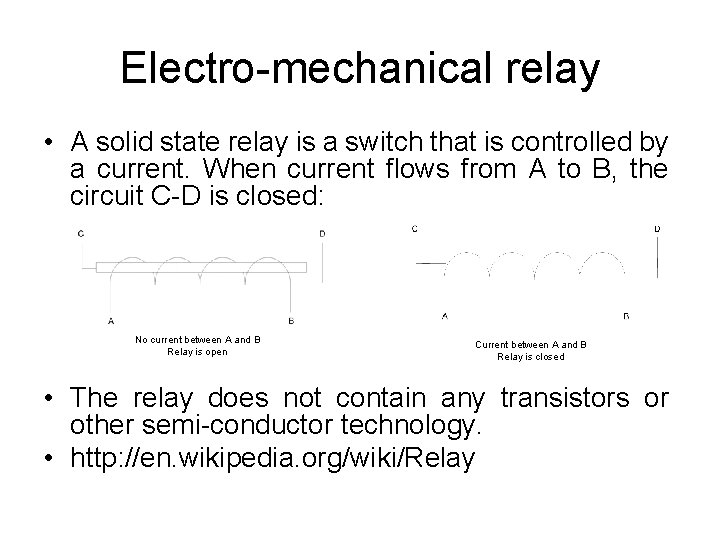
Electro-mechanical relay • A solid state relay is a switch that is controlled by a current. When current flows from A to B, the circuit C-D is closed: No current between A and B Relay is open Current between A and B Relay is closed • The relay does not contain any transistors or other semi-conductor technology. • http: //en. wikipedia. org/wiki/Relay
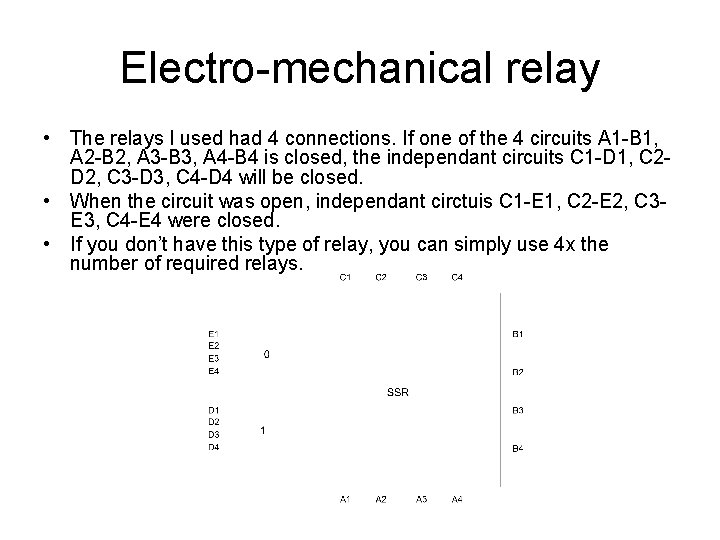
Electro-mechanical relay • The relays I used had 4 connections. If one of the 4 circuits A 1 -B 1, A 2 -B 2, A 3 -B 3, A 4 -B 4 is closed, the independant circuits C 1 -D 1, C 2 D 2, C 3 -D 3, C 4 -D 4 will be closed. • When the circuit was open, independant circtuis C 1 -E 1, C 2 -E 2, C 3 E 3, C 4 -E 4 were closed. • If you don’t have this type of relay, you can simply use 4 x the number of required relays.
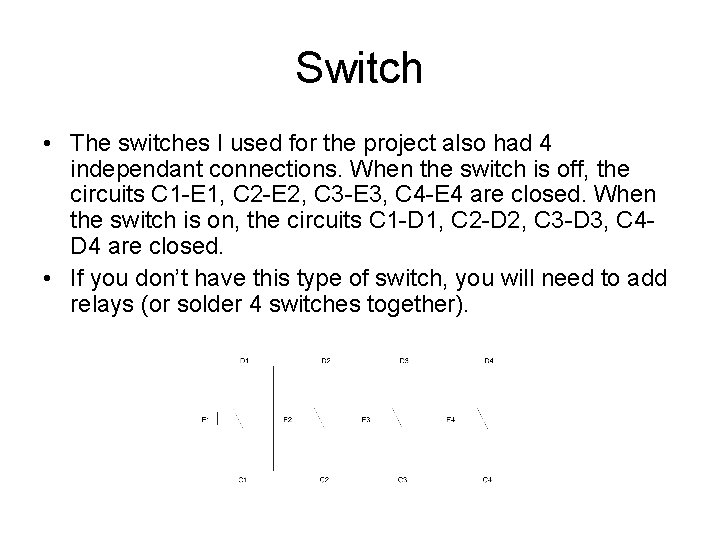
Switch • The switches I used for the project also had 4 independant connections. When the switch is off, the circuits C 1 -E 1, C 2 -E 2, C 3 -E 3, C 4 -E 4 are closed. When the switch is on, the circuits C 1 -D 1, C 2 -D 2, C 3 -D 3, C 4 D 4 are closed. • If you don’t have this type of switch, you will need to add relays (or solder 4 switches together).
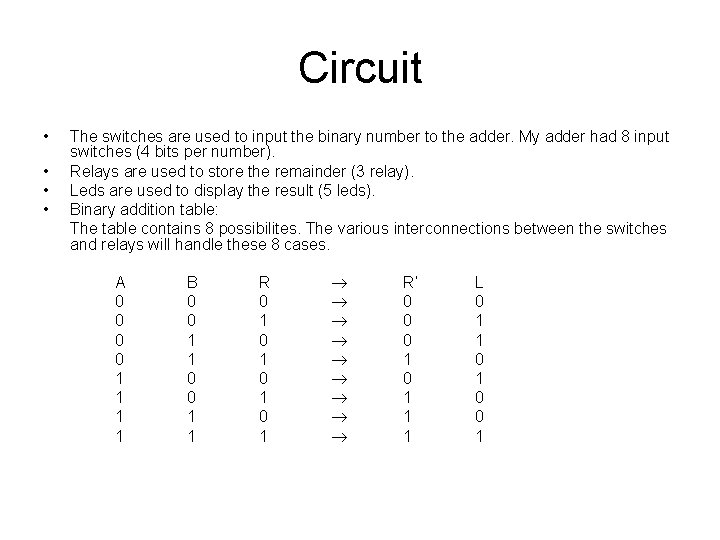
Circuit • • The switches are used to input the binary number to the adder. My adder had 8 input switches (4 bits per number). Relays are used to store the remainder (3 relay). Leds are used to display the result (5 leds). Binary addition table: The table contains 8 possibilites. The various interconnections between the switches and relays will handle these 8 cases. A 0 0 1 1 B 0 0 1 1 R 0 1 0 1 R’ 0 0 0 1 1 1 L 0 1 1 0 0 1
Circuit • The following circuit illustrates a basic A+B+R block. Such a block needs to be created for each bit (4 in my case). • Given my component choice and DC current supply, I only needed resistors for the LEDs. • The relay I used required quit some current. I used a transformer from an old appliance.
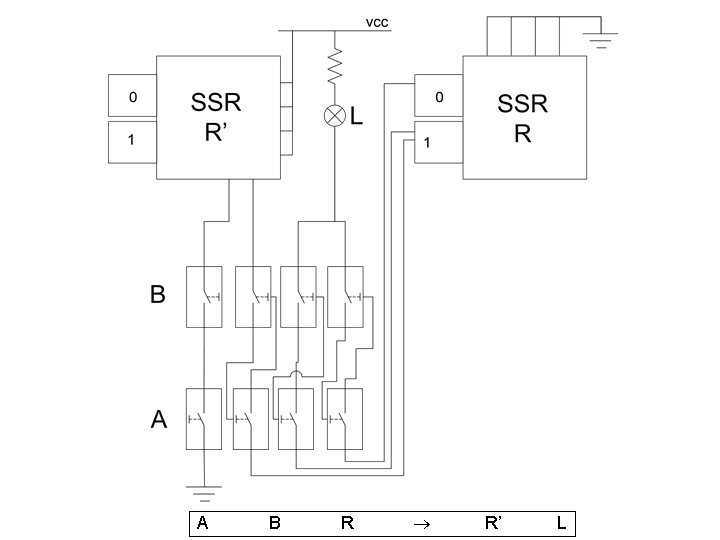
A B R R’ L
- Slides: 7