
Insert picture from First page of chapter Chapter
- Slides: 74
Insert picture from First page of chapter Chapter 24 Nonmetallic Elements and Their Compounds Copyright Mc. Graw-Hill 2009
24. 1 General Properties of Nonmetals • Properties of nonmetals - more varied than those of metals • Physical state – Gases: hydrogen, oxygen, nitrogen, fluorine, chlorine, and the noble gases – Liquid : bromine – Solids: All the remaining nonmetals • Poor conductors of heat and electricity • Exhibit either positive or negative oxidation numbers. Copyright Mc. Graw-Hill 2009 2
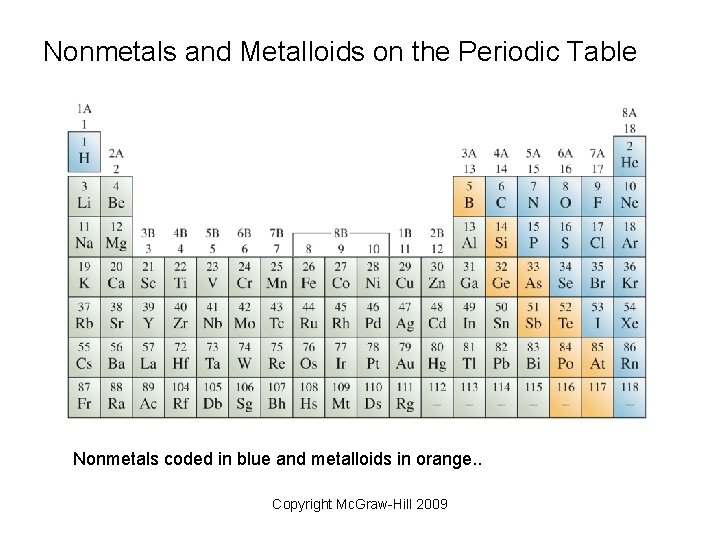
• Metalloids - small group of elements have properties characteristic of both metals and nonmetals. • More electronegative than metals • Electronegativity increases from left to right across any period and from bottom to top in any group in the periodic table • With the exception of hydrogen, the nonmetals are concentrated in the upper right-hand corner of the periodic table • Compounds formed by a combination of metals with nonmetals tend to be ionic, having a metallic cation and a nonmetallic anion. Copyright Mc. Graw-Hill 2009 3
Nonmetals and Metalloids on the Periodic Table Nonmetals coded in blue and metalloids in orange. . Copyright Mc. Graw-Hill 2009
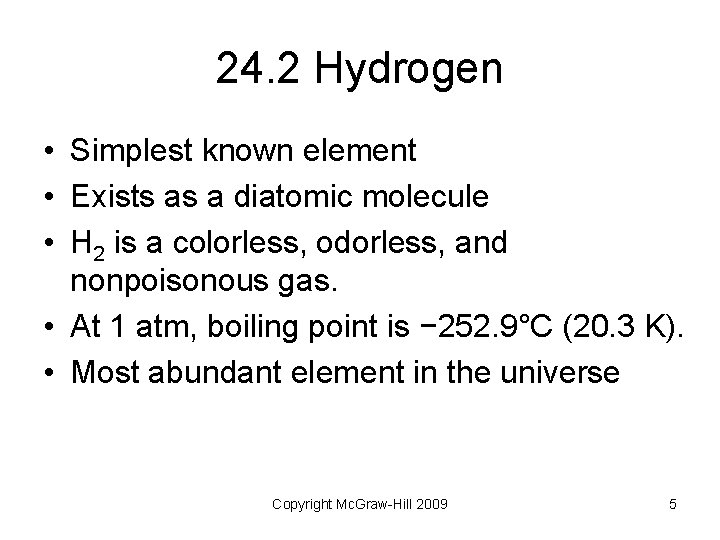
24. 2 Hydrogen • Simplest known element • Exists as a diatomic molecule • H 2 is a colorless, odorless, and nonpoisonous gas. • At 1 atm, boiling point is − 252. 9°C (20. 3 K). • Most abundant element in the universe Copyright Mc. Graw-Hill 2009 5
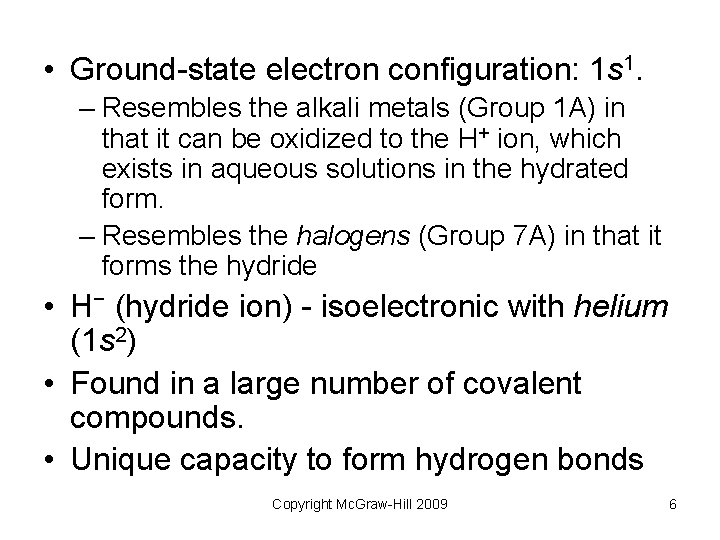
• Ground-state electron configuration: 1 s 1. – Resembles the alkali metals (Group 1 A) in that it can be oxidized to the H+ ion, which exists in aqueous solutions in the hydrated form. – Resembles the halogens (Group 7 A) in that it forms the hydride • H− (hydride ion) - isoelectronic with helium (1 s 2) • Found in a large number of covalent compounds. • Unique capacity to form hydrogen bonds Copyright Mc. Graw-Hill 2009 6
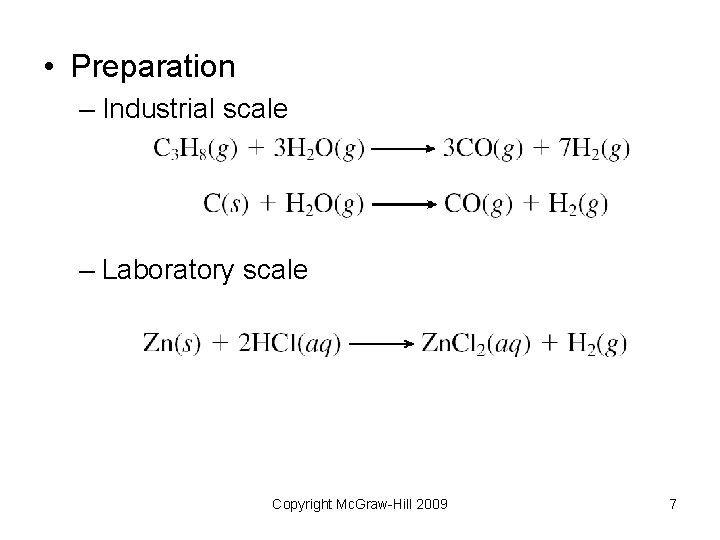
• Preparation – Industrial scale – Laboratory scale Copyright Mc. Graw-Hill 2009 7
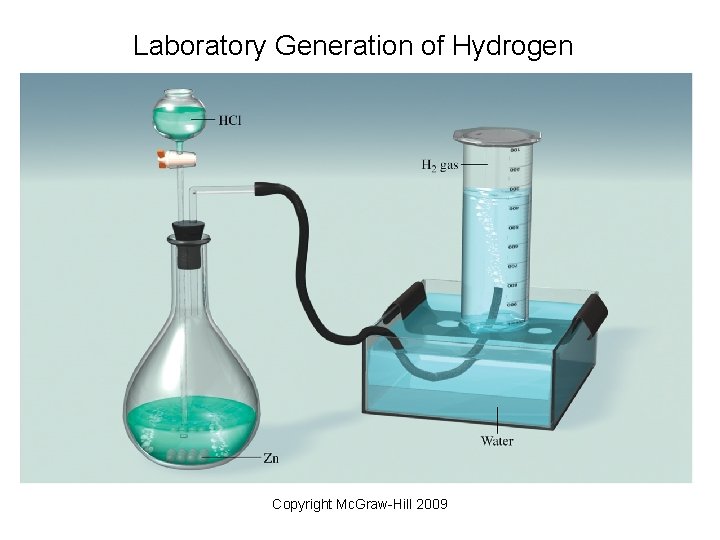
Laboratory Generation of Hydrogen Copyright Mc. Graw-Hill 2009
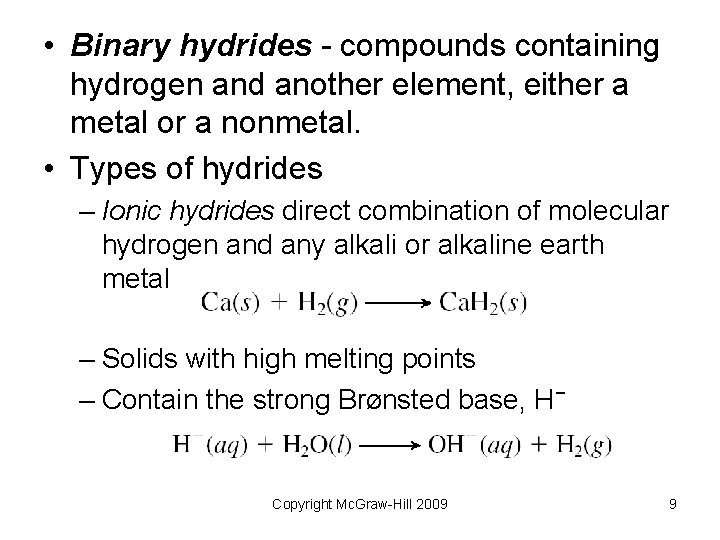
• Binary hydrides - compounds containing hydrogen and another element, either a metal or a nonmetal. • Types of hydrides – Ionic hydrides direct combination of molecular hydrogen and any alkali or alkaline earth metal – Solids with high melting points – Contain the strong BrØnsted base, H− Copyright Mc. Graw-Hill 2009 9
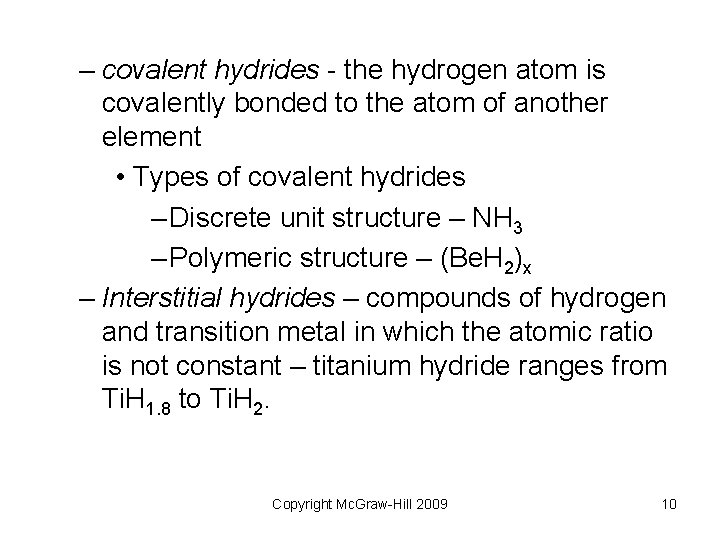
– covalent hydrides - the hydrogen atom is covalently bonded to the atom of another element • Types of covalent hydrides – Discrete unit structure – NH 3 – Polymeric structure – (Be. H 2)x – Interstitial hydrides – compounds of hydrogen and transition metal in which the atomic ratio is not constant – titanium hydride ranges from Ti. H 1. 8 to Ti. H 2. Copyright Mc. Graw-Hill 2009 10
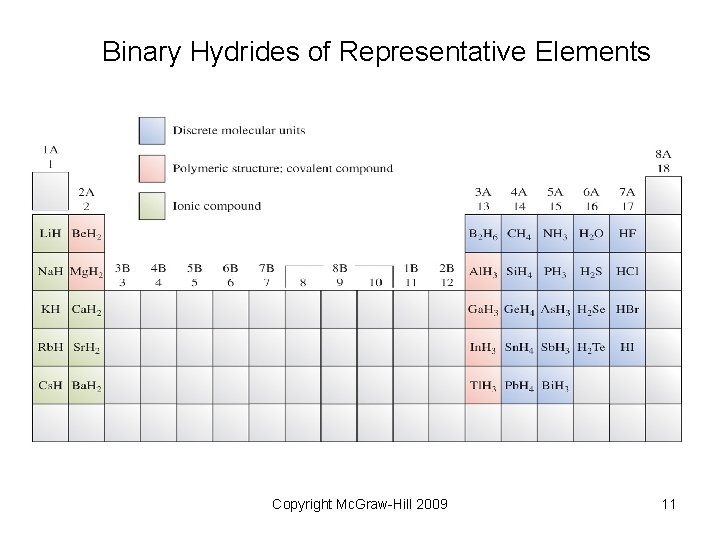
Binary Hydrides of Representative Elements Copyright Mc. Graw-Hill 2009 11
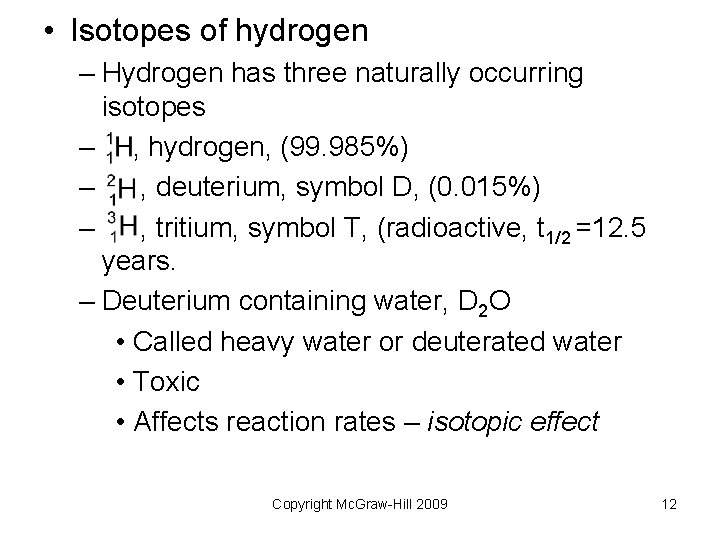
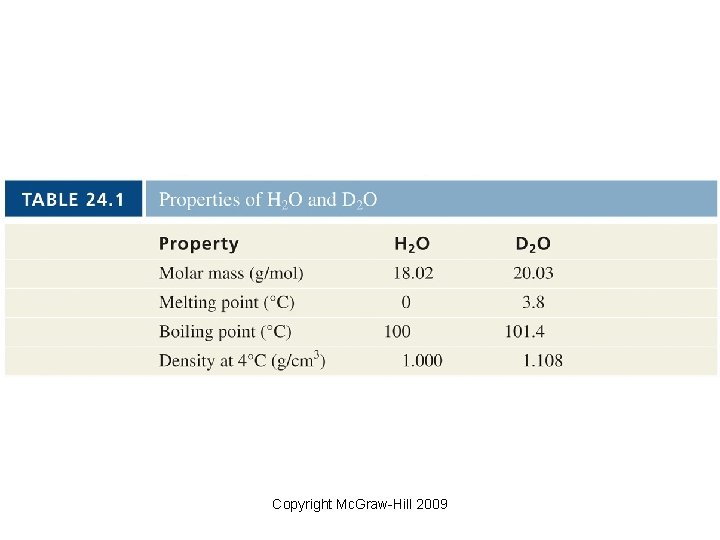
• Isotopes of hydrogen – Hydrogen has three naturally occurring isotopes – , hydrogen, (99. 985%) – , deuterium, symbol D, (0. 015%) – , tritium, symbol T, (radioactive, t 1/2 =12. 5 years. – Deuterium containing water, D 2 O • Called heavy water or deuterated water • Toxic • Affects reaction rates – isotopic effect Copyright Mc. Graw-Hill 2009 12
Copyright Mc. Graw-Hill 2009
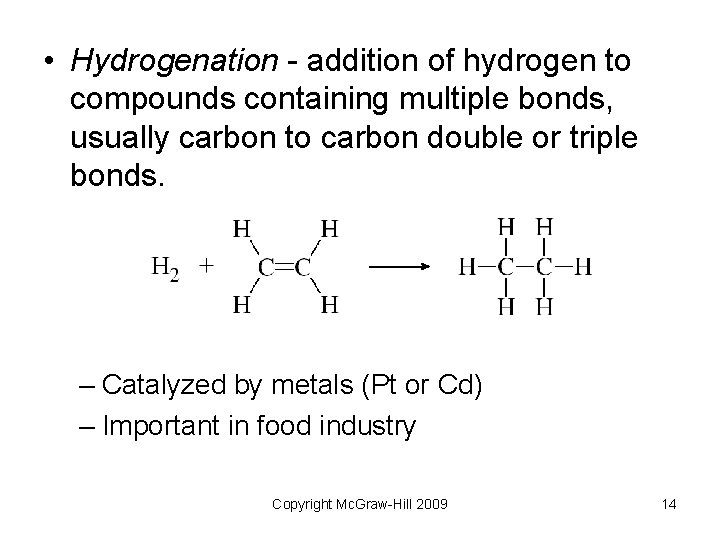
• Hydrogenation - addition of hydrogen to compounds containing multiple bonds, usually carbon to carbon double or triple bonds. – Catalyzed by metals (Pt or Cd) – Important in food industry Copyright Mc. Graw-Hill 2009 14
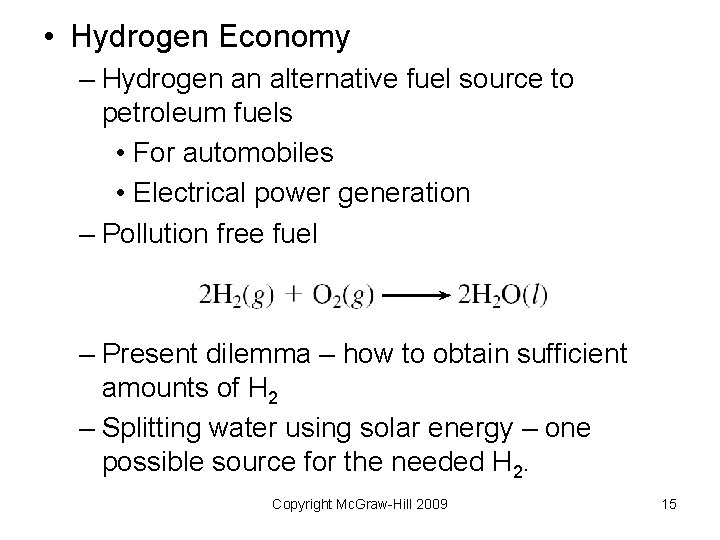
• Hydrogen Economy – Hydrogen an alternative fuel source to petroleum fuels • For automobiles • Electrical power generation – Pollution free fuel – Present dilemma – how to obtain sufficient amounts of H 2 – Splitting water using solar energy – one possible source for the needed H 2. Copyright Mc. Graw-Hill 2009 15
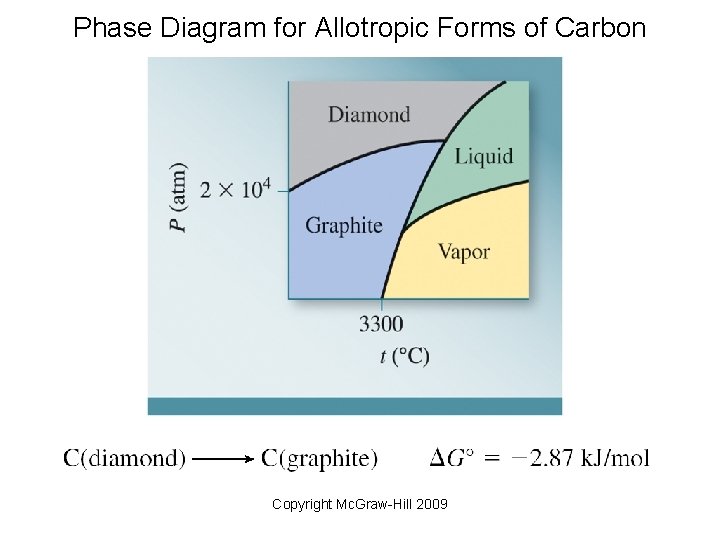
24. 3 Carbon • 0. 09 % by mass of Earth’s crust • An essential element of living matter • A component of natural gas, petroleum and coal. • Combines with oxygen to form carbon dioxide in the atmosphere • Occur as carbonates in limestone and chalk. • Found free in allotropic forms of diamond and graphite Copyright Mc. Graw-Hill 2009 16
Phase Diagram for Allotropic Forms of Carbon Copyright Mc. Graw-Hill 2009
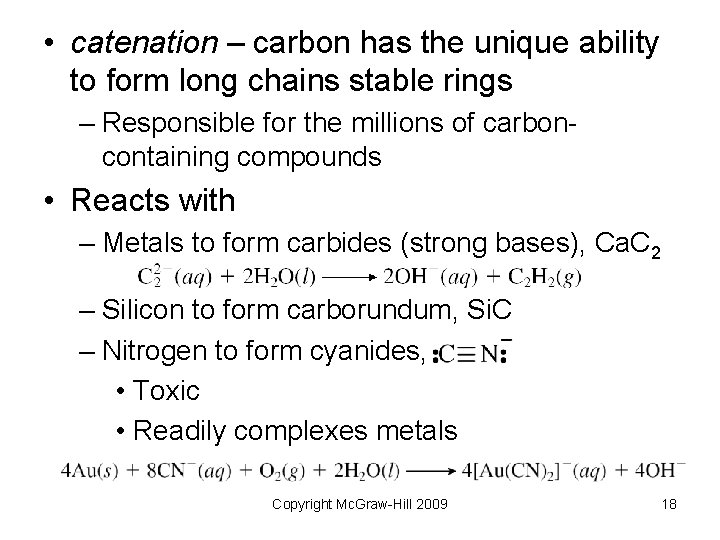
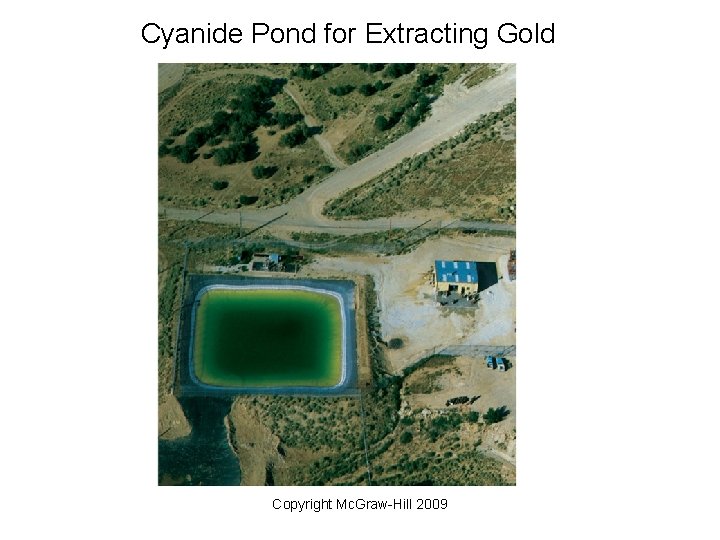
• catenation – carbon has the unique ability to form long chains stable rings – Responsible for the millions of carboncontaining compounds • Reacts with – Metals to form carbides (strong bases), Ca. C 2 – Silicon to form carborundum, Si. C – Nitrogen to form cyanides, • Toxic • Readily complexes metals Copyright Mc. Graw-Hill 2009 18
Cyanide Pond for Extracting Gold Copyright Mc. Graw-Hill 2009
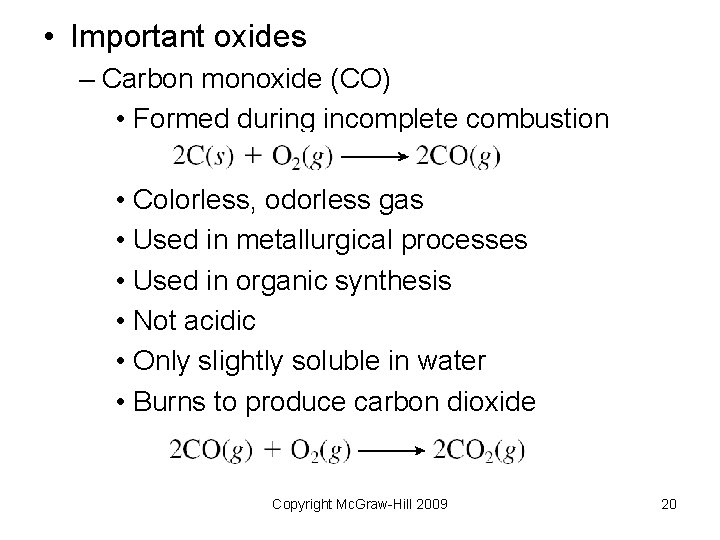
• Important oxides – Carbon monoxide (CO) • Formed during incomplete combustion • Colorless, odorless gas • Used in metallurgical processes • Used in organic synthesis • Not acidic • Only slightly soluble in water • Burns to produce carbon dioxide Copyright Mc. Graw-Hill 2009 20
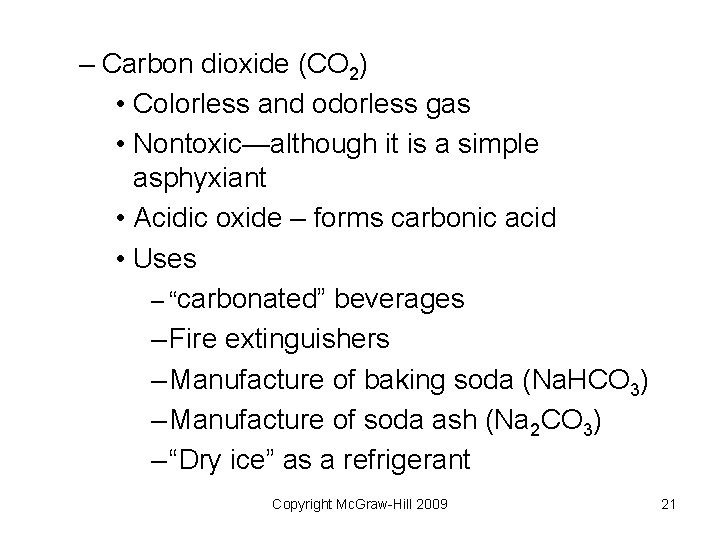
– Carbon dioxide (CO 2) • Colorless and odorless gas • Nontoxic—although it is a simple asphyxiant • Acidic oxide – forms carbonic acid • Uses – “carbonated” beverages – Fire extinguishers – Manufacture of baking soda (Na. HCO 3) – Manufacture of soda ash (Na 2 CO 3) – “Dry ice” as a refrigerant Copyright Mc. Graw-Hill 2009 21
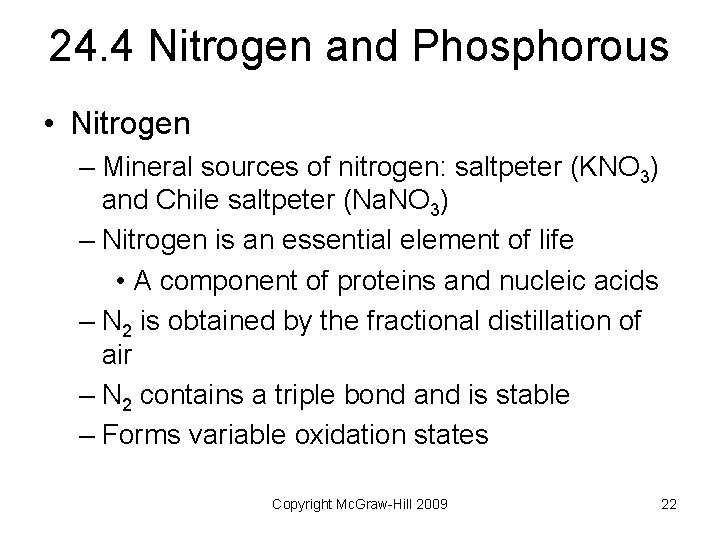
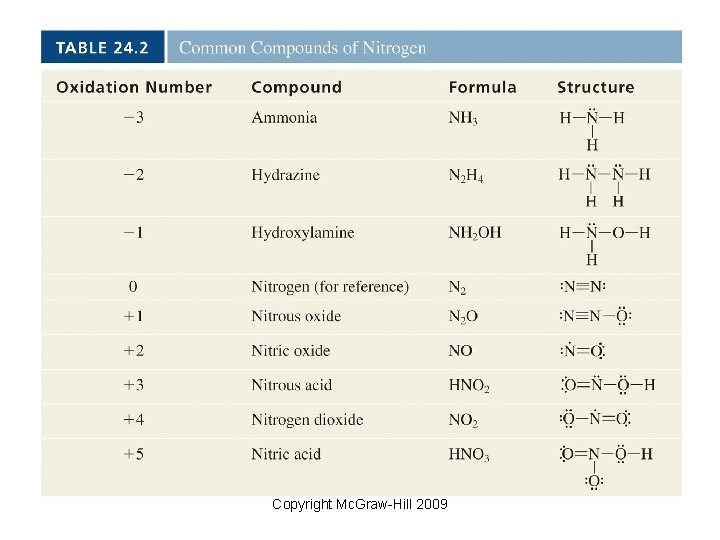
24. 4 Nitrogen and Phosphorous • Nitrogen – Mineral sources of nitrogen: saltpeter (KNO 3) and Chile saltpeter (Na. NO 3) – Nitrogen is an essential element of life • A component of proteins and nucleic acids – N 2 is obtained by the fractional distillation of air – N 2 contains a triple bond and is stable – Forms variable oxidation states Copyright Mc. Graw-Hill 2009 22
Copyright Mc. Graw-Hill 2009
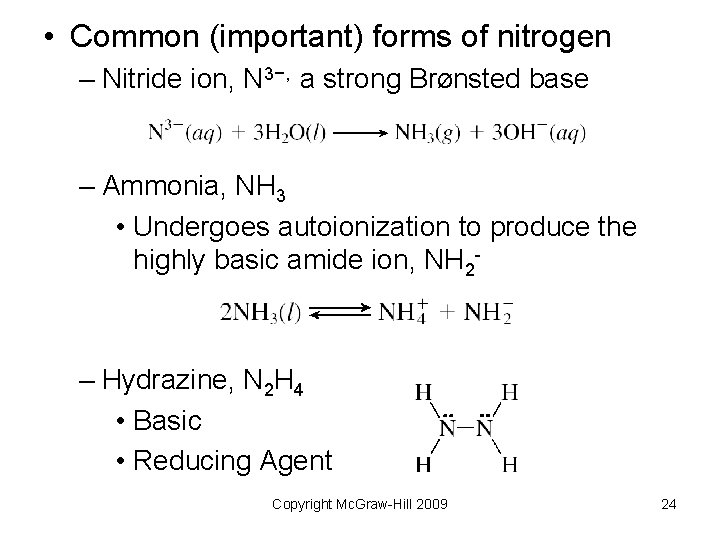
• Common (important) forms of nitrogen – Nitride ion, N 3−, a strong BrØnsted base – Ammonia, NH 3 • Undergoes autoionization to produce the highly basic amide ion, NH 2 - – Hydrazine, N 2 H 4 • Basic • Reducing Agent Copyright Mc. Graw-Hill 2009 24
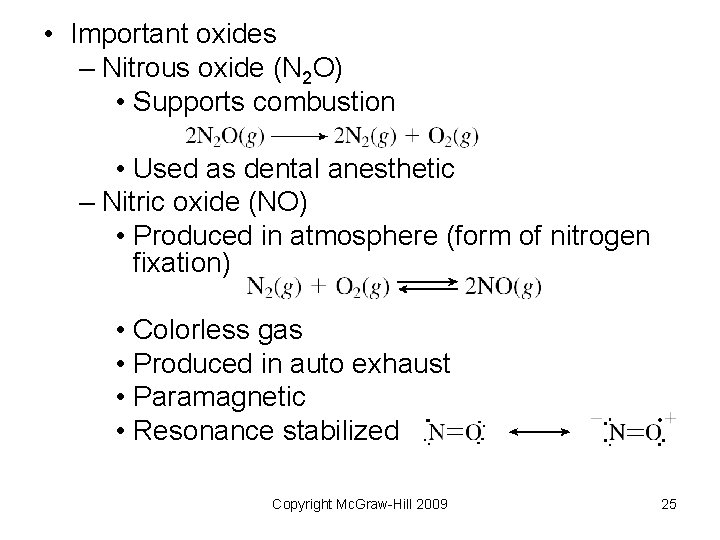
• Important oxides – Nitrous oxide (N 2 O) • Supports combustion • Used as dental anesthetic – Nitric oxide (NO) • Produced in atmosphere (form of nitrogen fixation) • Colorless gas • Produced in auto exhaust • Paramagnetic • Resonance stabilized Copyright Mc. Graw-Hill 2009 25
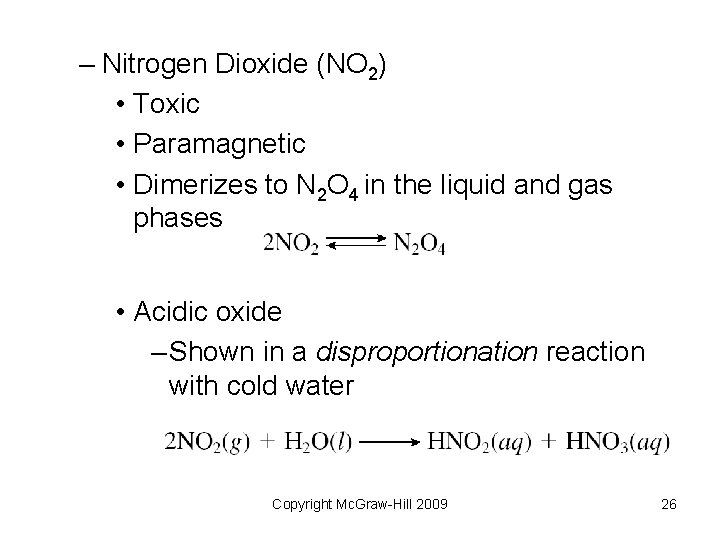
– Nitrogen Dioxide (NO 2) • Toxic • Paramagnetic • Dimerizes to N 2 O 4 in the liquid and gas phases • Acidic oxide – Shown in a disproportionation reaction with cold water Copyright Mc. Graw-Hill 2009 26
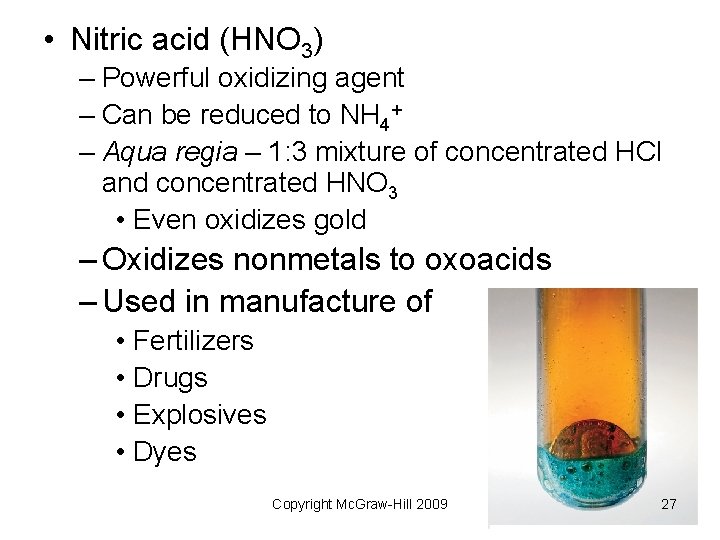
• Nitric acid (HNO 3) – Powerful oxidizing agent – Can be reduced to NH 4+ – Aqua regia – 1: 3 mixture of concentrated HCl and concentrated HNO 3 • Even oxidizes gold – Oxidizes nonmetals to oxoacids – Used in manufacture of • Fertilizers • Drugs • Explosives • Dyes Copyright Mc. Graw-Hill 2009 27
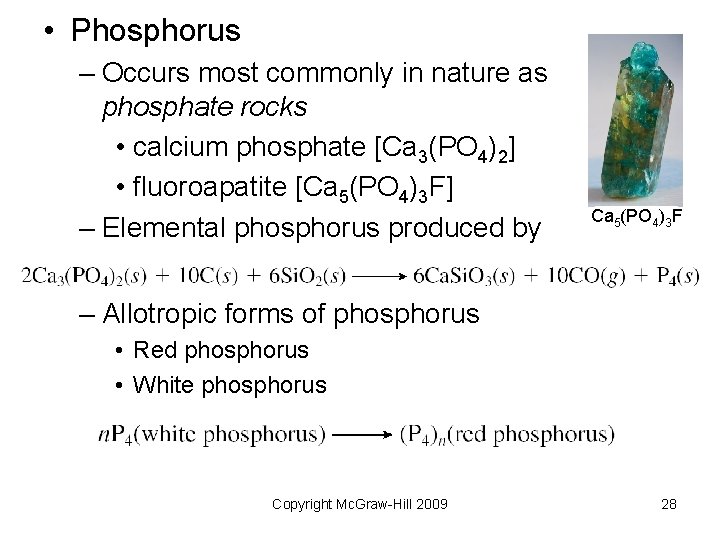
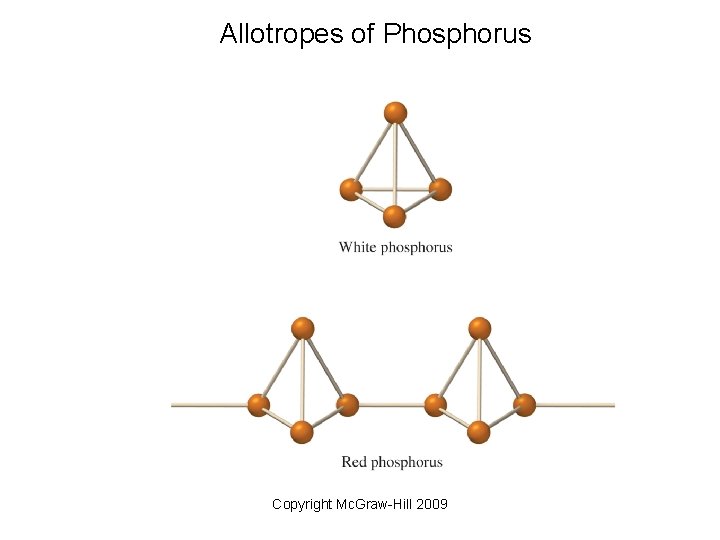
• Phosphorus – Occurs most commonly in nature as phosphate rocks • calcium phosphate [Ca 3(PO 4)2] • fluoroapatite [Ca 5(PO 4)3 F] – Elemental phosphorus produced by Ca 5(PO 4)3 F – Allotropic forms of phosphorus • Red phosphorus • White phosphorus Copyright Mc. Graw-Hill 2009 28
Allotropes of Phosphorus Copyright Mc. Graw-Hill 2009
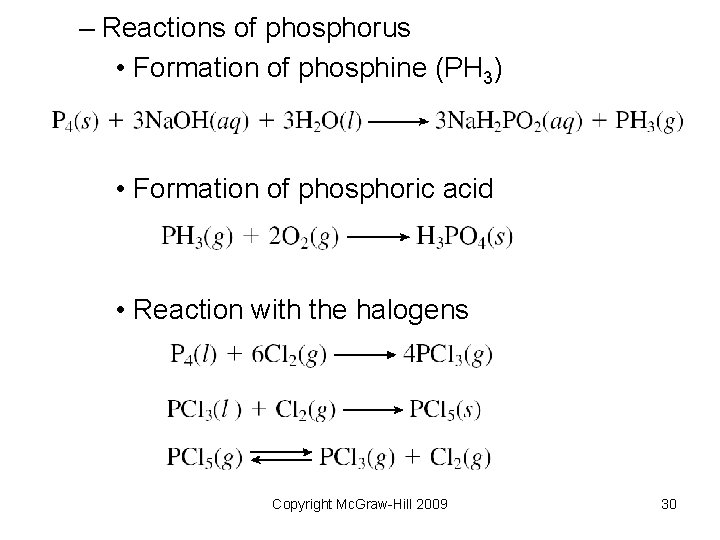
– Reactions of phosphorus • Formation of phosphine (PH 3) • Formation of phosphoric acid • Reaction with the halogens Copyright Mc. Graw-Hill 2009 30
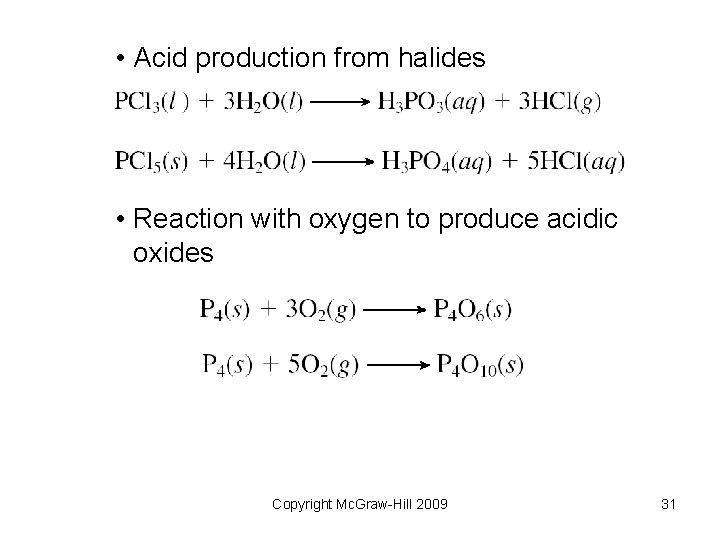
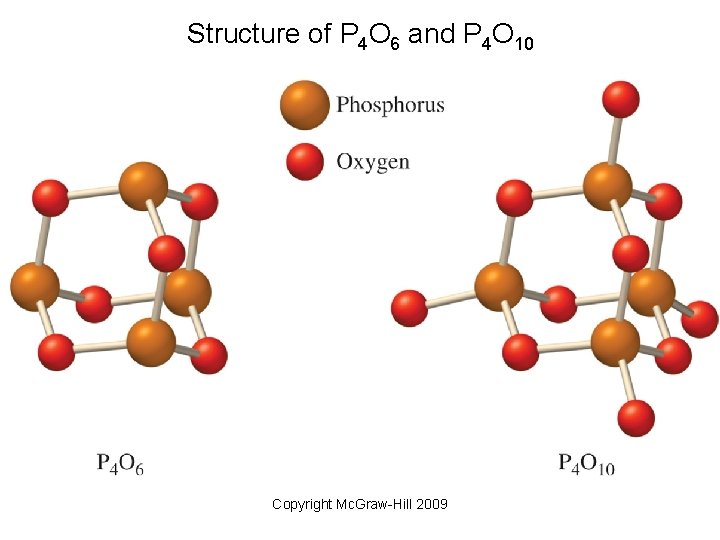
• Acid production from halides • Reaction with oxygen to produce acidic oxides Copyright Mc. Graw-Hill 2009 31
Structure of P 4 O 6 and P 4 O 10 Copyright Mc. Graw-Hill 2009
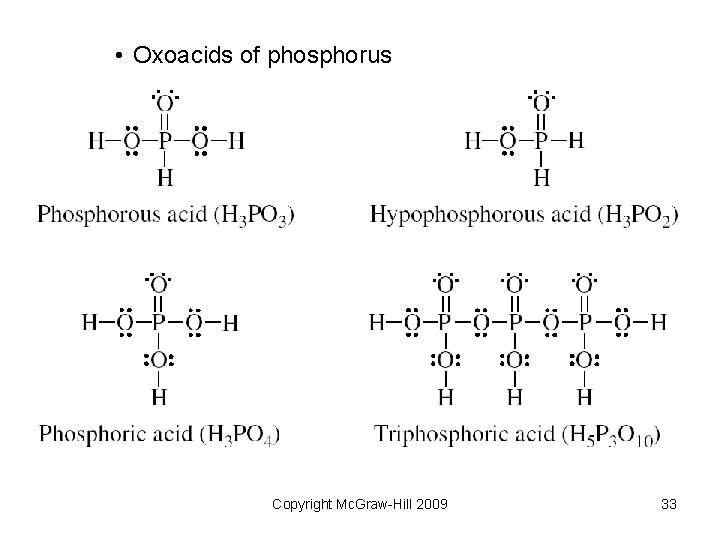
• Oxoacids of phosphorus Copyright Mc. Graw-Hill 2009 33
24. 5 Oxygen and Sulfur • Oxygen – Most abundant element in Earth’s crust (46% by mass) – Atmosphere contains about 21% by volume (23% by mass) – Diatomic molecule (O 2) in the free state – Essential for human life – Alloptropic forms: O 2 and O 3 (ozone) – Strong oxidizing and bleaching agent Copyright Mc. Graw-Hill 2009 34
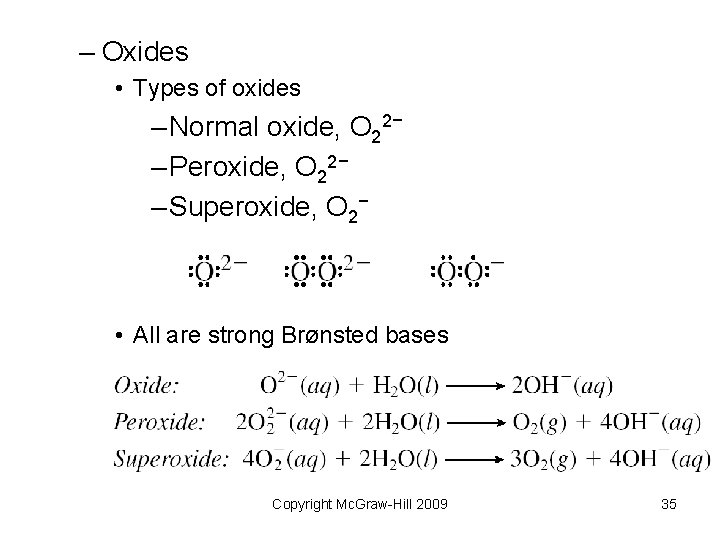
– Oxides • Types of oxides – Normal oxide, O 22− – Peroxide, O 22− – Superoxide, O 2− • All are strong BrØnsted bases Copyright Mc. Graw-Hill 2009 35
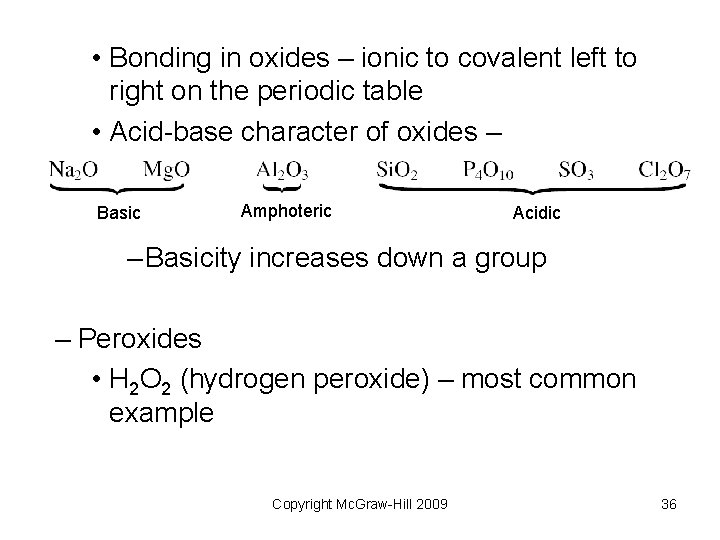
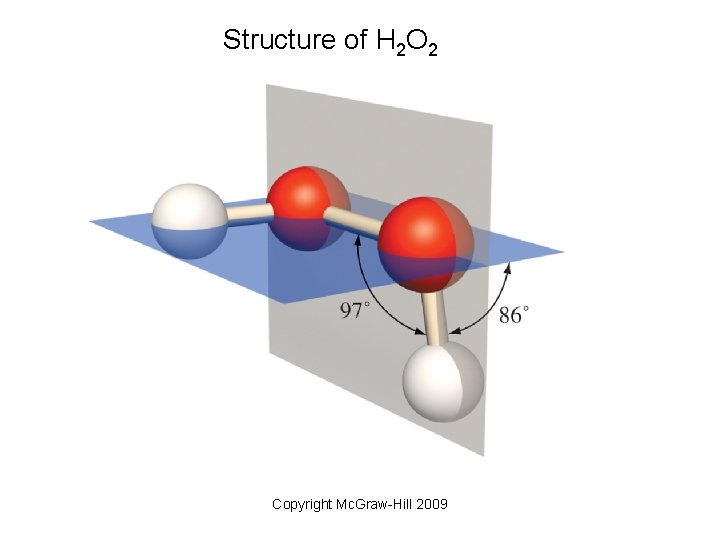
• Bonding in oxides – ionic to covalent left to right on the periodic table • Acid-base character of oxides – Basic Amphoteric Acidic – Basicity increases down a group – Peroxides • H 2 O 2 (hydrogen peroxide) – most common example Copyright Mc. Graw-Hill 2009 36
Structure of H 2 O 2 Copyright Mc. Graw-Hill 2009
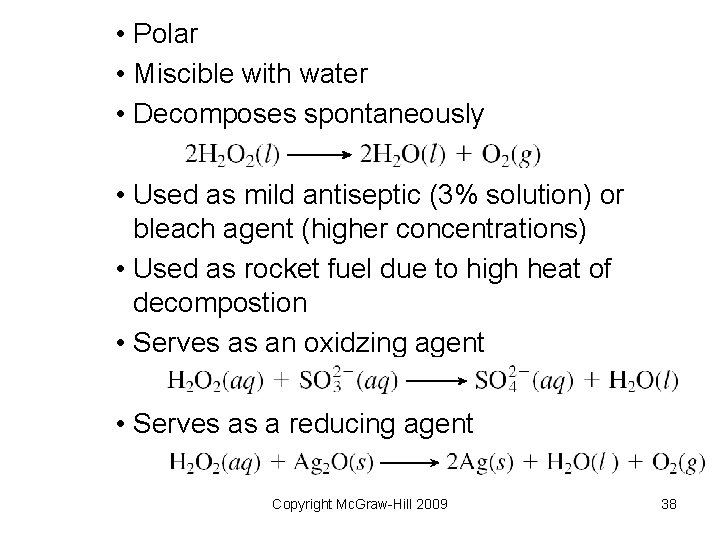
• Polar • Miscible with water • Decomposes spontaneously • Used as mild antiseptic (3% solution) or bleach agent (higher concentrations) • Used as rocket fuel due to high heat of decompostion • Serves as an oxidzing agent • Serves as a reducing agent Copyright Mc. Graw-Hill 2009 38
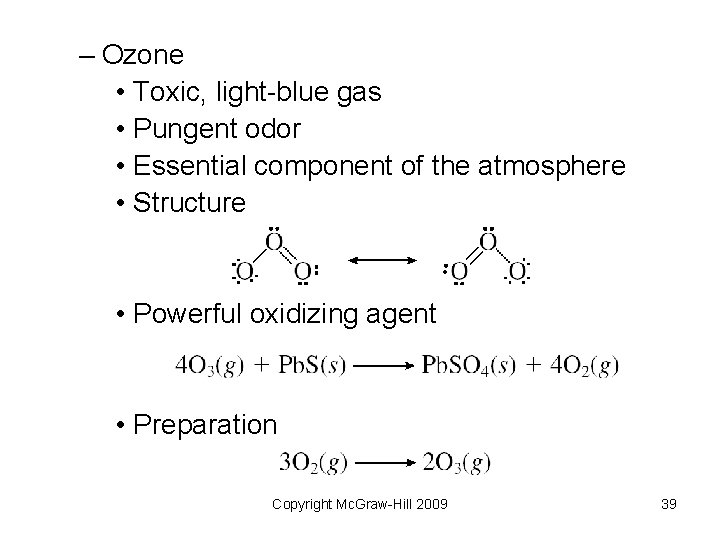
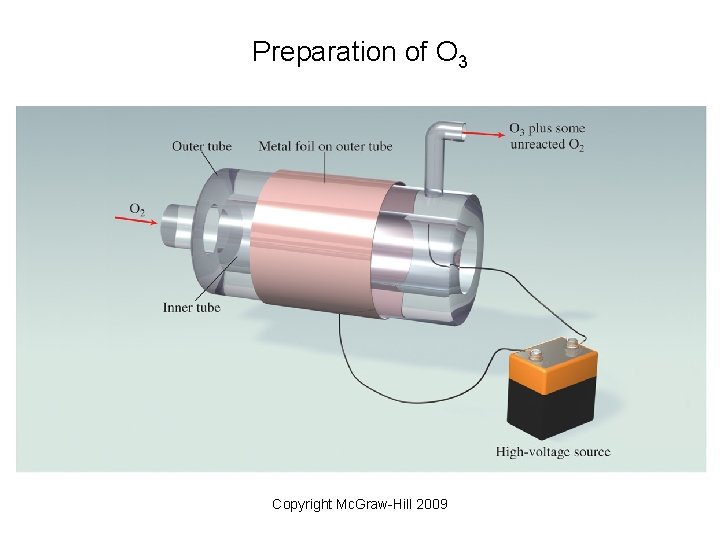
– Ozone • Toxic, light-blue gas • Pungent odor • Essential component of the atmosphere • Structure • Powerful oxidizing agent • Preparation Copyright Mc. Graw-Hill 2009 39
Preparation of O 3 Copyright Mc. Graw-Hill 2009
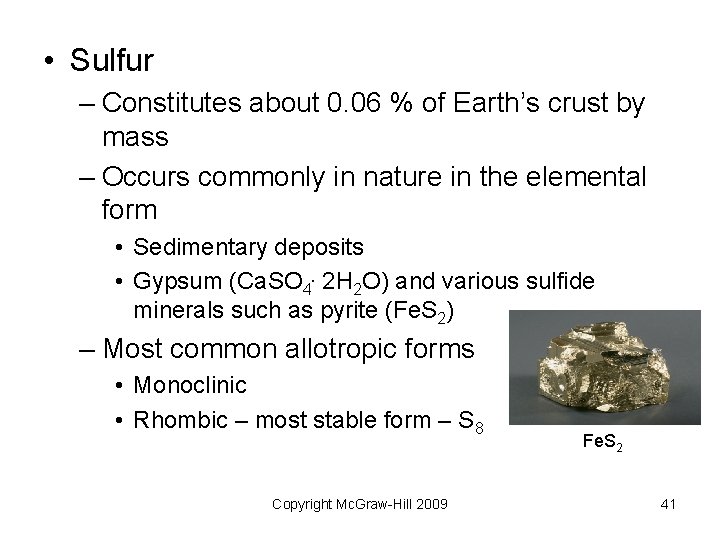
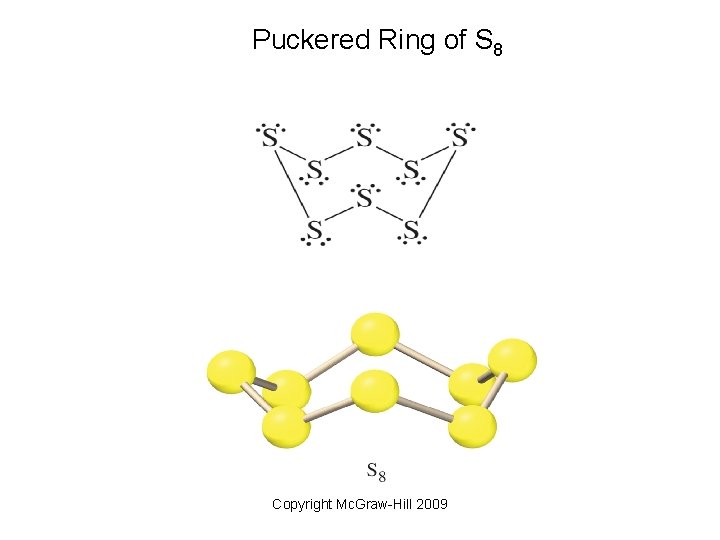
• Sulfur – Constitutes about 0. 06 % of Earth’s crust by mass – Occurs commonly in nature in the elemental form • Sedimentary deposits • Gypsum (Ca. SO 4. 2 H 2 O) and various sulfide minerals such as pyrite (Fe. S 2) – Most common allotropic forms • Monoclinic • Rhombic – most stable form – S 8 Copyright Mc. Graw-Hill 2009 Fe. S 2 41
Puckered Ring of S 8 Copyright Mc. Graw-Hill 2009
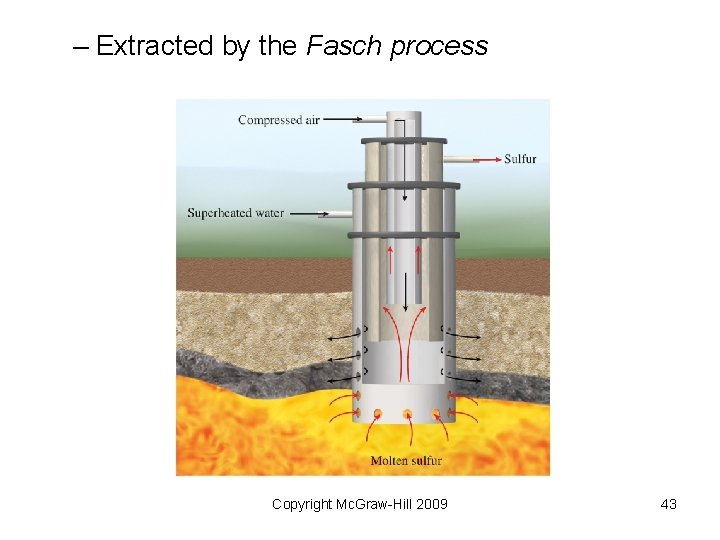
– Extracted by the Fasch process Copyright Mc. Graw-Hill 2009 43
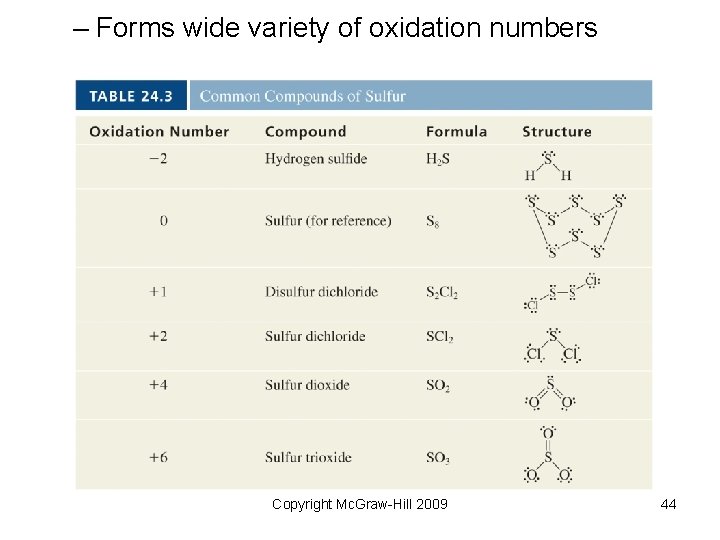
– Forms wide variety of oxidation numbers Copyright Mc. Graw-Hill 2009 44
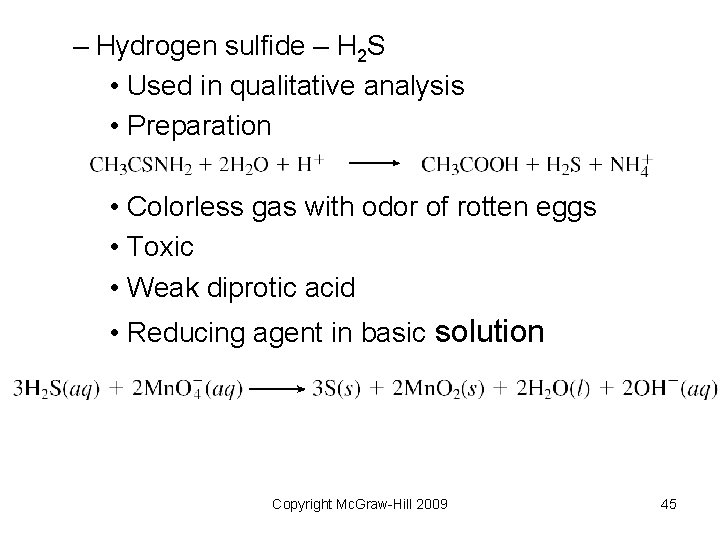
– Hydrogen sulfide – H 2 S • Used in qualitative analysis • Preparation • Colorless gas with odor of rotten eggs • Toxic • Weak diprotic acid • Reducing agent in basic solution Copyright Mc. Graw-Hill 2009 45
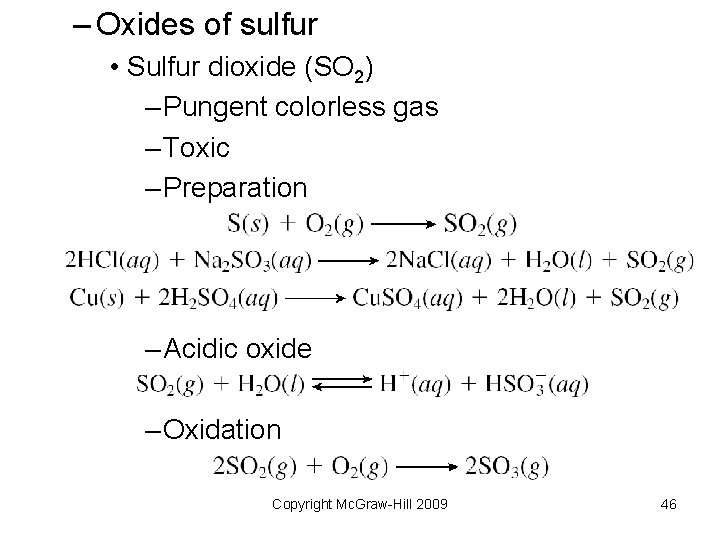
– Oxides of sulfur • Sulfur dioxide (SO 2) – Pungent colorless gas – Toxic – Preparation – Acidic oxide – Oxidation Copyright Mc. Graw-Hill 2009 46
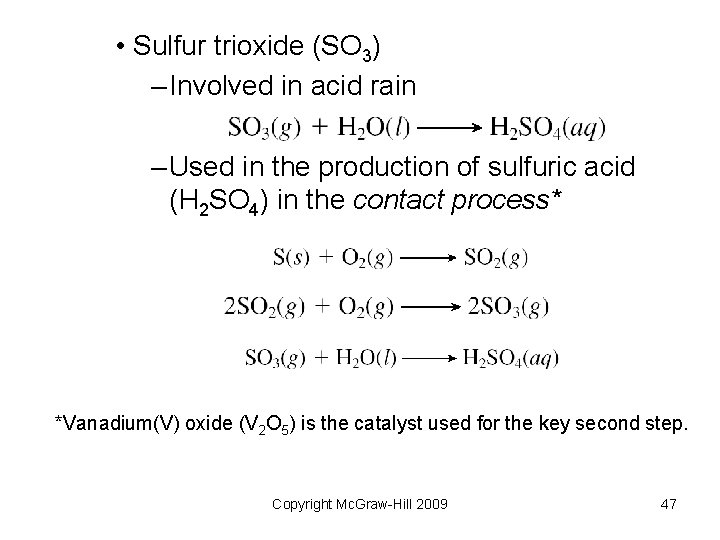
• Sulfur trioxide (SO 3) – Involved in acid rain – Used in the production of sulfuric acid (H 2 SO 4) in the contact process* *Vanadium(V) oxide (V 2 O 5) is the catalyst used for the key second step. Copyright Mc. Graw-Hill 2009 47
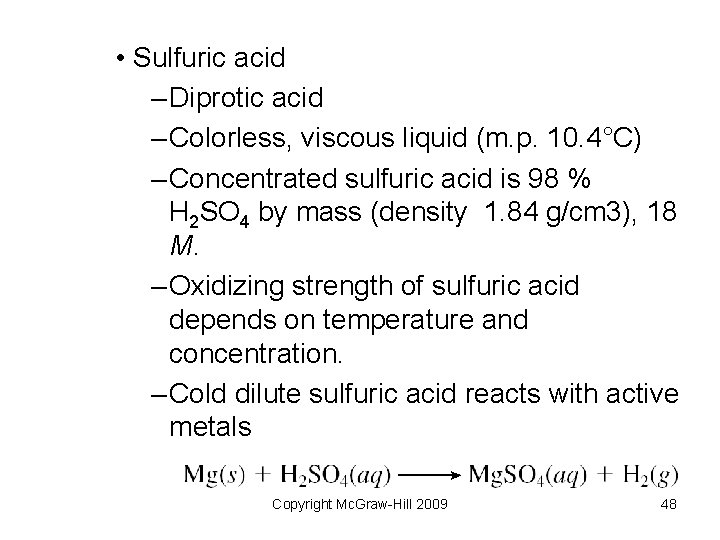
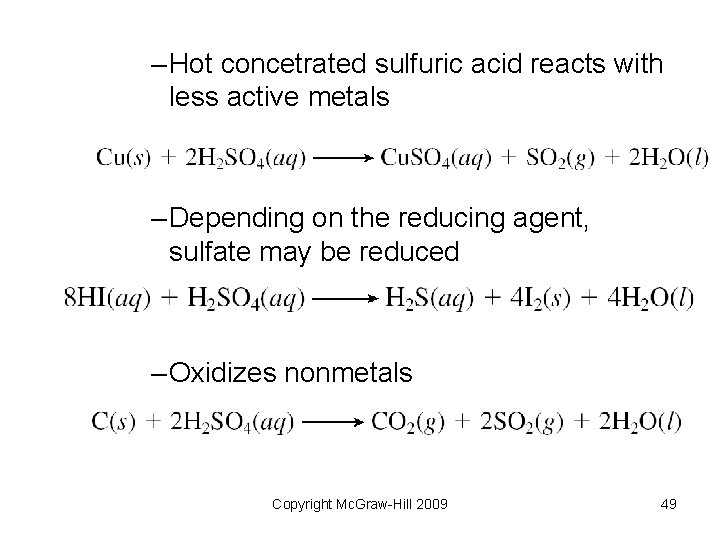
• Sulfuric acid – Diprotic acid – Colorless, viscous liquid (m. p. 10. 4°C) – Concentrated sulfuric acid is 98 % H 2 SO 4 by mass (density 1. 84 g/cm 3), 18 M. – Oxidizing strength of sulfuric acid depends on temperature and concentration. – Cold dilute sulfuric acid reacts with active metals Copyright Mc. Graw-Hill 2009 48
– Hot concetrated sulfuric acid reacts with less active metals – Depending on the reducing agent, sulfate may be reduced – Oxidizes nonmetals Copyright Mc. Graw-Hill 2009 49
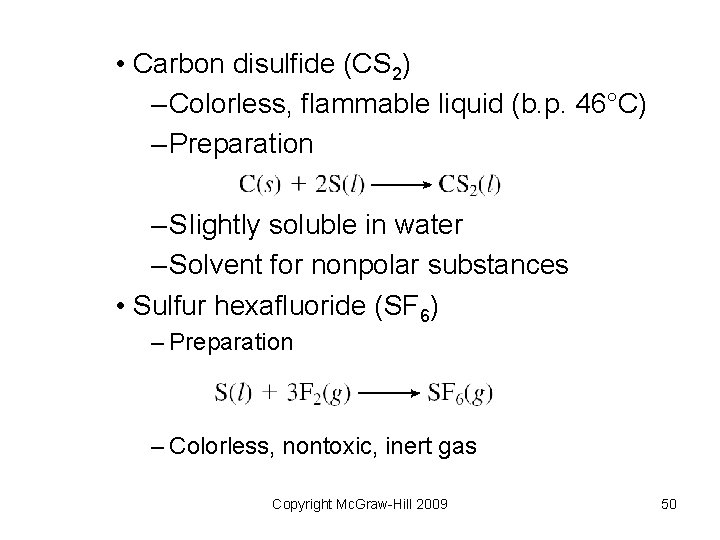
• Carbon disulfide (CS 2) – Colorless, flammable liquid (b. p. 46°C) – Preparation – SIightly soluble in water – Solvent for nonpolar substances • Sulfur hexafluoride (SF 6) – Preparation – Colorless, nontoxic, inert gas Copyright Mc. Graw-Hill 2009 50
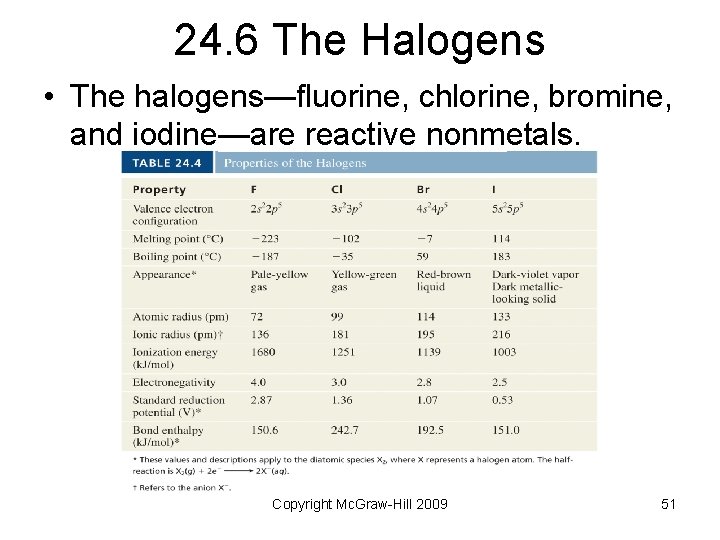
24. 6 The Halogens • The halogens—fluorine, chlorine, bromine, and iodine—are reactive nonmetals. Copyright Mc. Graw-Hill 2009 51
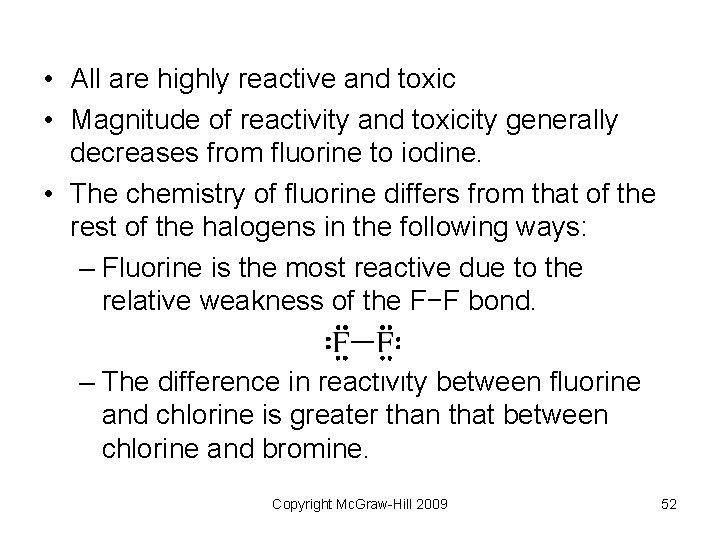
• All are highly reactive and toxic • Magnitude of reactivity and toxicity generally decreases from fluorine to iodine. • The chemistry of fluorine differs from that of the rest of the halogens in the following ways: – Fluorine is the most reactive due to the relative weakness of the F−F bond. – The difference in reactivity between fluorine and chlorine is greater than that between chlorine and bromine. Copyright Mc. Graw-Hill 2009 52
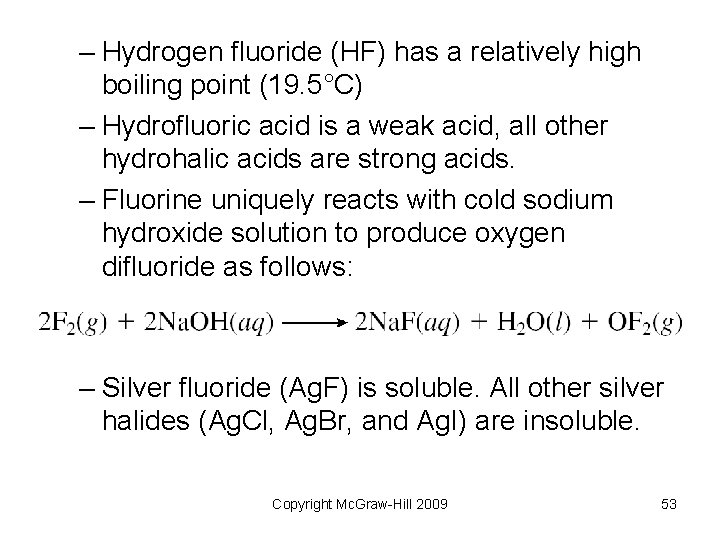
– Hydrogen fluoride (HF) has a relatively high boiling point (19. 5°C) – Hydrofluoric acid is a weak acid, all other hydrohalic acids are strong acids. – Fluorine uniquely reacts with cold sodium hydroxide solution to produce oxygen difluoride as follows: – Silver fluoride (Ag. F) is soluble. All other silver halides (Ag. Cl, Ag. Br, and Ag. I) are insoluble. Copyright Mc. Graw-Hill 2009 53
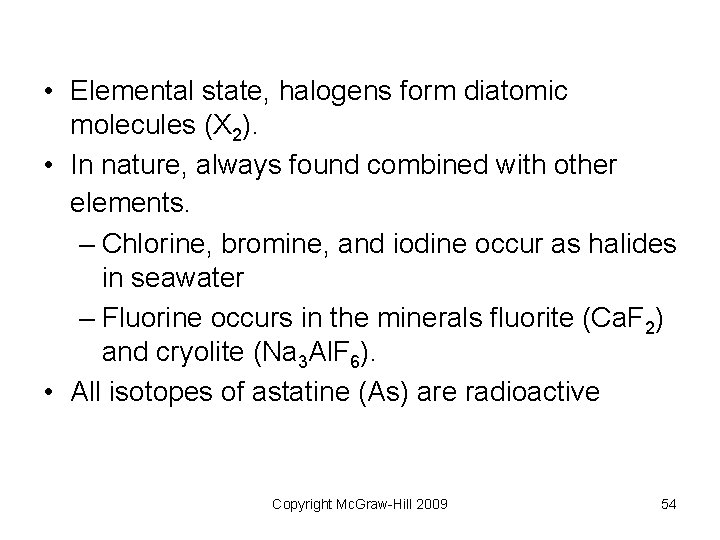
• Elemental state, halogens form diatomic molecules (X 2). • In nature, always found combined with other elements. – Chlorine, bromine, and iodine occur as halides in seawater – Fluorine occurs in the minerals fluorite (Ca. F 2) and cryolite (Na 3 Al. F 6). • All isotopes of astatine (As) are radioactive Copyright Mc. Graw-Hill 2009 54
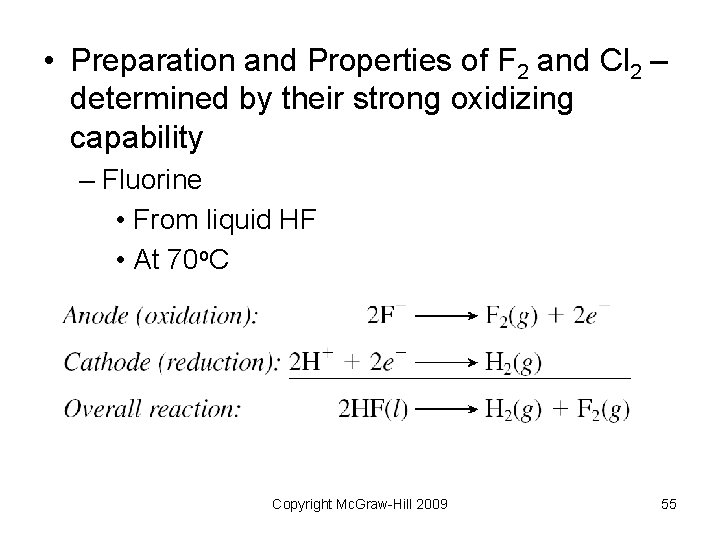
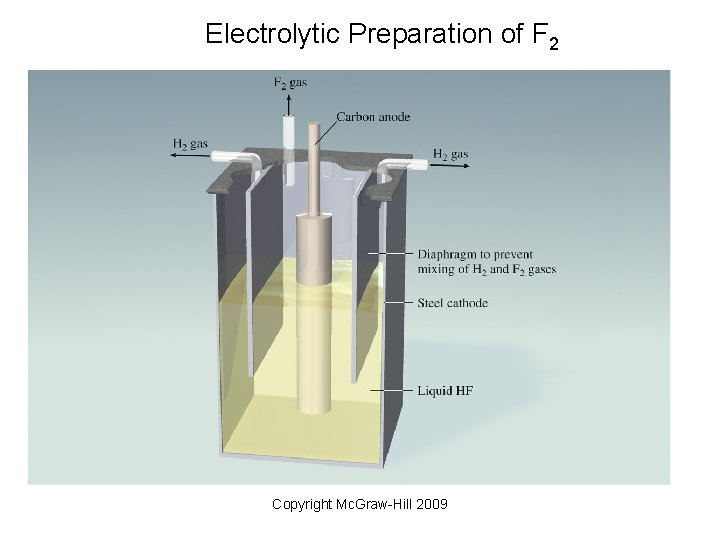
• Preparation and Properties of F 2 and Cl 2 – determined by their strong oxidizing capability – Fluorine • From liquid HF • At 70 o. C Copyright Mc. Graw-Hill 2009 55
Electrolytic Preparation of F 2 Copyright Mc. Graw-Hill 2009
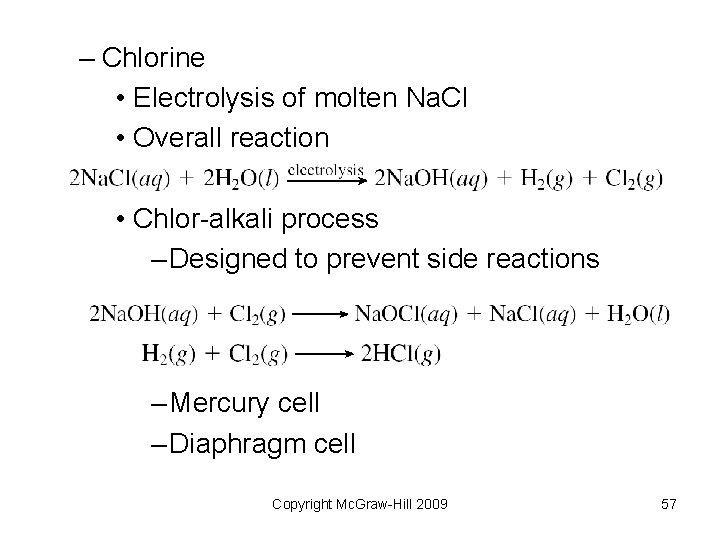
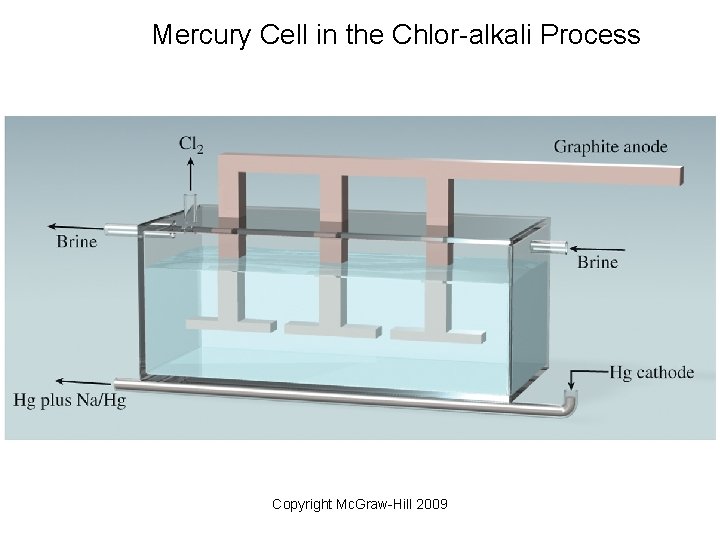
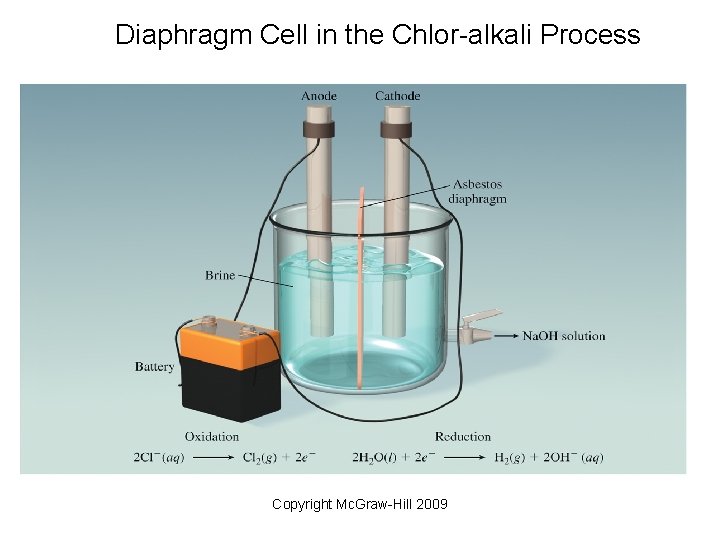
– Chlorine • Electrolysis of molten Na. Cl • Overall reaction • Chlor-alkali process – Designed to prevent side reactions – Mercury cell – Diaphragm cell Copyright Mc. Graw-Hill 2009 57
Mercury Cell in the Chlor-alkali Process Copyright Mc. Graw-Hill 2009
Diaphragm Cell in the Chlor-alkali Process Copyright Mc. Graw-Hill 2009
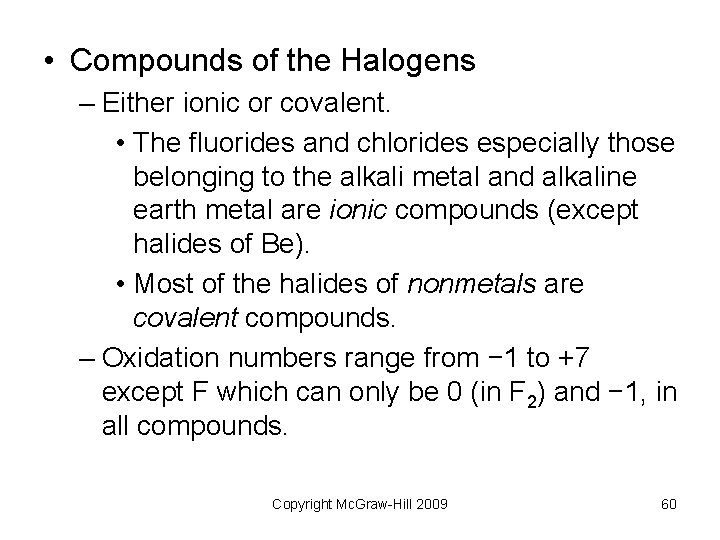
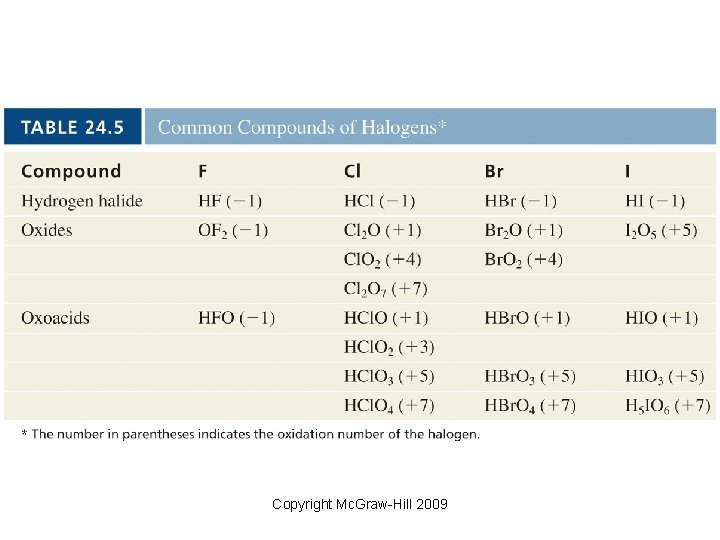
• Compounds of the Halogens – Either ionic or covalent. • The fluorides and chlorides especially those belonging to the alkali metal and alkaline earth metal are ionic compounds (except halides of Be). • Most of the halides of nonmetals are covalent compounds. – Oxidation numbers range from − 1 to +7 except F which can only be 0 (in F 2) and − 1, in all compounds. Copyright Mc. Graw-Hill 2009 60
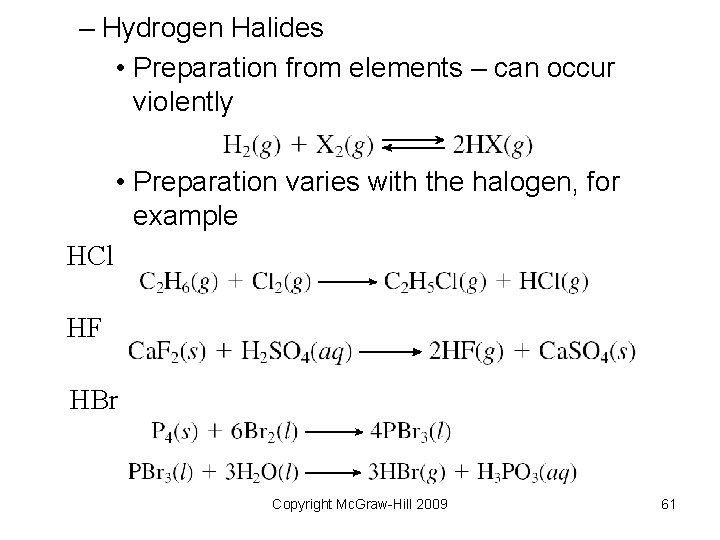
– Hydrogen Halides • Preparation from elements – can occur violently • Preparation varies with the halogen, for example HCl HF HBr Copyright Mc. Graw-Hill 2009 61
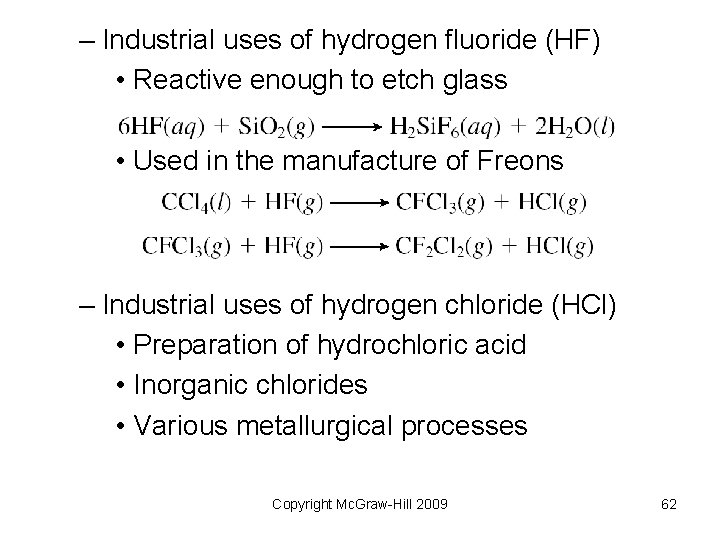
– Industrial uses of hydrogen fluoride (HF) • Reactive enough to etch glass • Used in the manufacture of Freons – Industrial uses of hydrogen chloride (HCl) • Preparation of hydrochloric acid • Inorganic chlorides • Various metallurgical processes Copyright Mc. Graw-Hill 2009 62
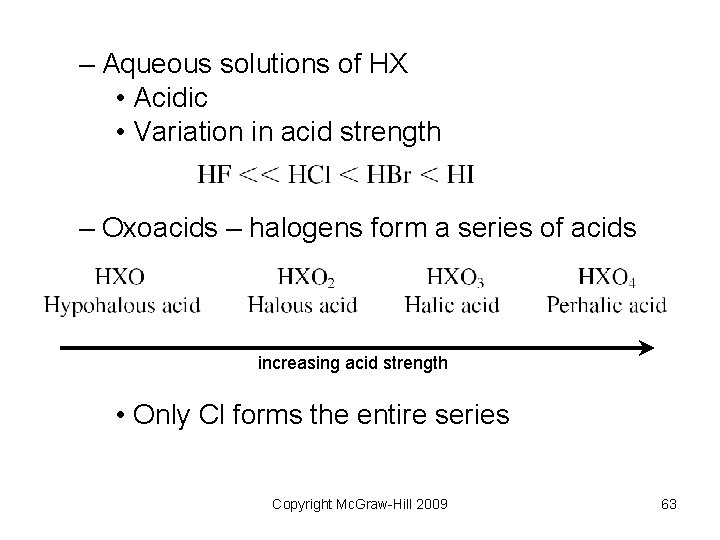
– Aqueous solutions of HX • Acidic • Variation in acid strength – Oxoacids – halogens form a series of acids increasing acid strength • Only Cl forms the entire series Copyright Mc. Graw-Hill 2009 63
Copyright Mc. Graw-Hill 2009
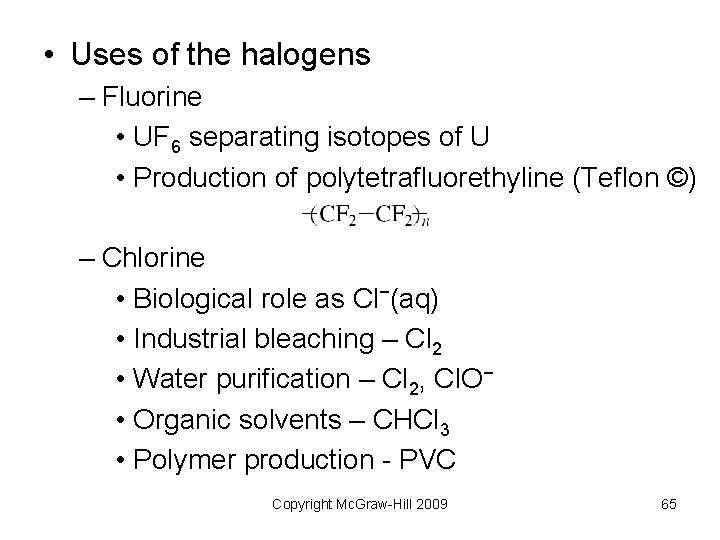
• Uses of the halogens – Fluorine • UF 6 separating isotopes of U • Production of polytetrafluorethyline (Teflon ©) – Chlorine • Biological role as Cl−(aq) • Industrial bleaching – Cl 2 • Water purification – Cl 2, Cl. O− • Organic solvents – CHCl 3 • Polymer production - PVC Copyright Mc. Graw-Hill 2009 65
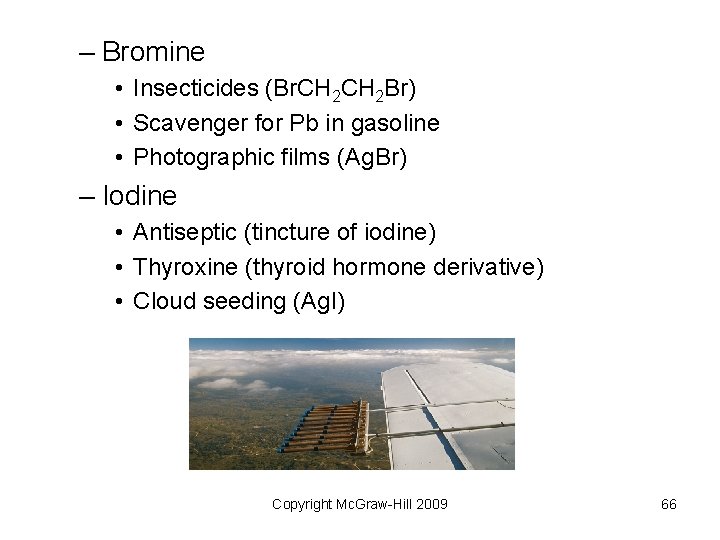
– Bromine • Insecticides (Br. CH 2 Br) • Scavenger for Pb in gasoline • Photographic films (Ag. Br) – Iodine • Antiseptic (tincture of iodine) • Thyroxine (thyroid hormone derivative) • Cloud seeding (Ag. I) Copyright Mc. Graw-Hill 2009 66
Key Points • General properties of the nonmetals • Hydrogen – Properties – Preparation – Binary Halides • Ionic • Covalent • Interstitial Copyright Mc. Graw-Hill 2009 67
– Isotopes of hydrogen • Hydrogen (protium) • Deuterium • Tritium – Hydrogenation – The hydrogen economy • Carbon – Properties – Allotropes • Diamond • Graphite Copyright Mc. Graw-Hill 2009 68
– Carbides – Cyanides – Oxides • Carbon monoxide • Carbon dioxide • Nitrogen and Phosphorus – Nitrogen • • Properties Nitrides Ammonia Hydrazine Copyright Mc. Graw-Hill 2009 69
• Oxides – Nitrous oxide – Nitric oxide – Nitrogen dioxide • Nitric Acid – Phosphorus • Properties • Allotropes – White phosphorus – Red phosphorus • Phosphine • Halogen compounds Copyright Mc. Graw-Hill 2009 70
• Oxides • Oxoacids • Oxygen and Sulfur – Oxygen • Properties • Allotropes • Oxides – Normal oxide – Peroxide – Superoxide • Acidity of oxides Copyright Mc. Graw-Hill 2009 71
• Hydrogen peroxide • Ozone – Sulfur • Properties • Industrial production • Hydrogen sulfide • Oxides – Sulfur dioxide – Sulfur trioxide • Sulfuric Acid – Production – Uses Copyright Mc. Graw-Hill 2009 72
• Carbon disulfide • Sulfur hexafluoride • The Halogens – Properties • Special properties of fluorine – Preparation and Properites • Preparation of fluorine • Preparation of chlorine – chlor-alkali process – Mercury Cell – Diaphragm cell Copyright Mc. Graw-Hill 2009 73
• Hydrogen Halides • Oxoacids – Uses of the halogens • Fluorine • Chlorine • Bromine • Iodine Copyright Mc. Graw-Hill 2009 74