
Insert Lesson Title Here Vocabulary angle vertex right
Insert Lesson Title Here Vocabulary angle vertex right angle acute angle obtuse angle straight angle complementary angles supplementary angles
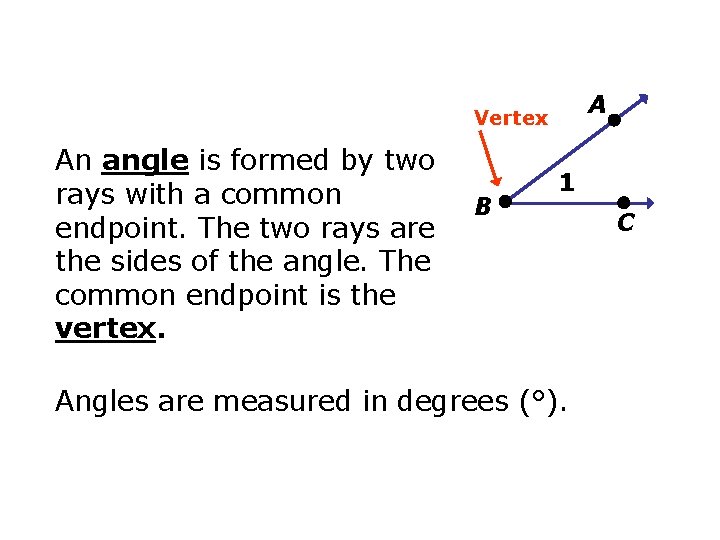
A Vertex An angle is formed by two rays with a common endpoint. The two rays are the sides of the angle. The common endpoint is the vertex. B 1 Angles are measured in degrees (°). C
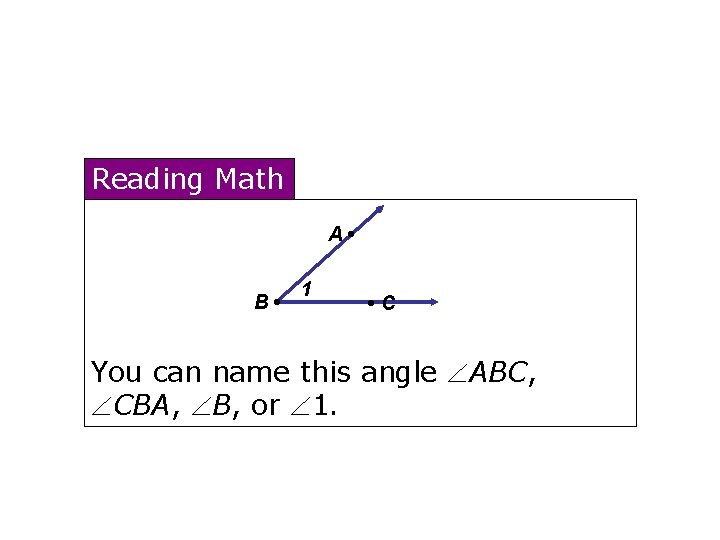
Reading Math A • B • 1 • C You can name this angle ABC, CBA, B, or 1.
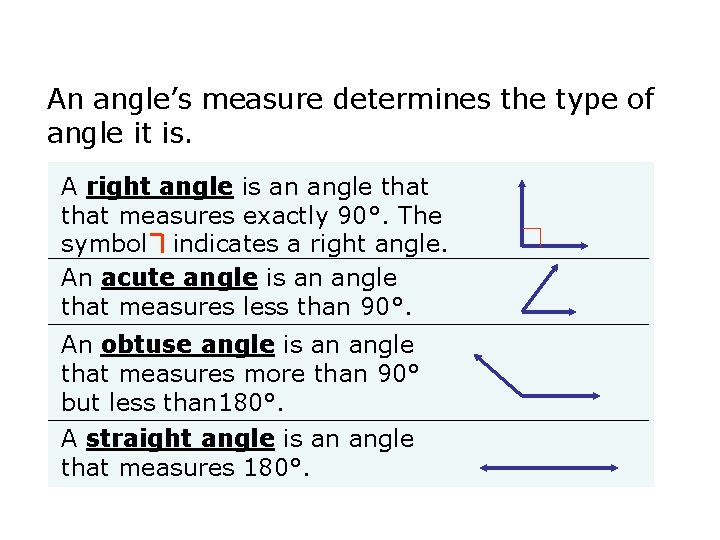
An angle’s measure determines the type of angle it is. A right angle is an angle that measures exactly 90°. The symbol indicates a right angle. An acute angle is an angle that measures less than 90°. An obtuse angle is an angle that measures more than 90° but less than 180°. A straight angle is an angle that measures 180°.
If the sum of the measures of two angles is 90°, then the angles are complementary angles. If the sum of the measures of two angles is 180°, then the angles are supplementary angles.

Adjacent angles have a common vertex and a common side, but no common interior points. Angles 2 and 3 in the diagram are adjacent. Adjacent angles formed by two intersecting lines are supplementary
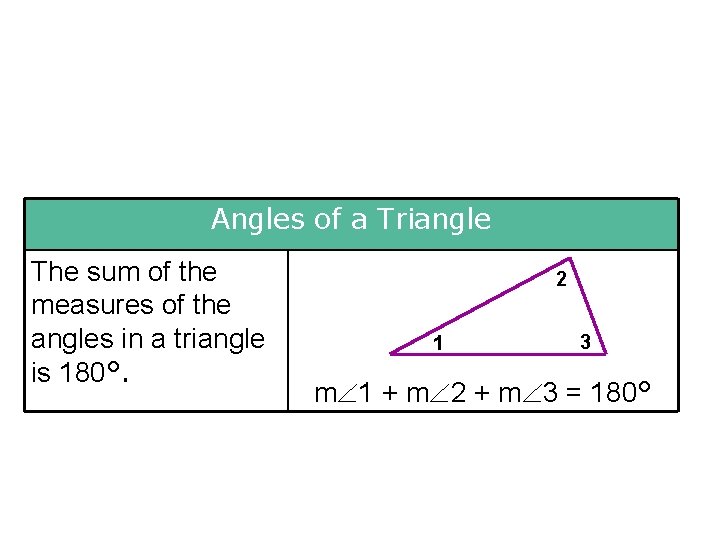
Angles of a Triangle The sum of the measures of the angles in a triangle is 180°. 2 1 3 m 1 + m 2 + m 3 = 180°
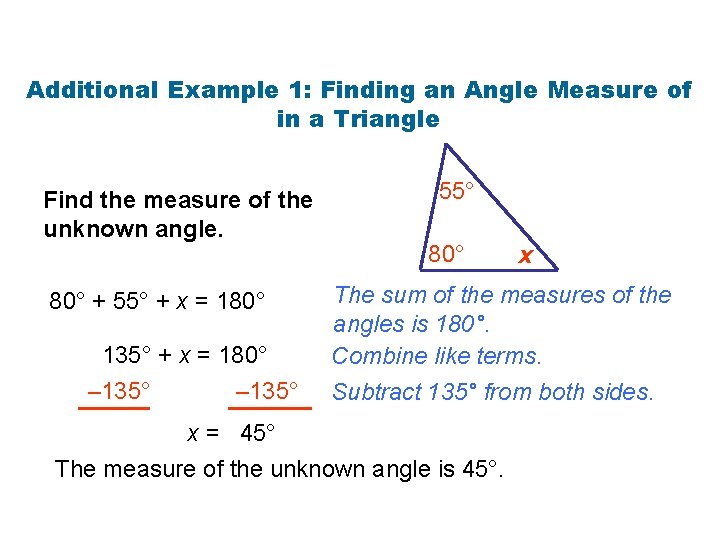
Additional Example 1: Finding an Angle Measure of in a Triangle Find the measure of the unknown angle. 80° + 55° + x = 180° 135° + x = 180° – 135° 55° 80° x The sum of the measures of the angles is 180°. Combine like terms. Subtract 135° from both sides. x = 45° The measure of the unknown angle is 45°.
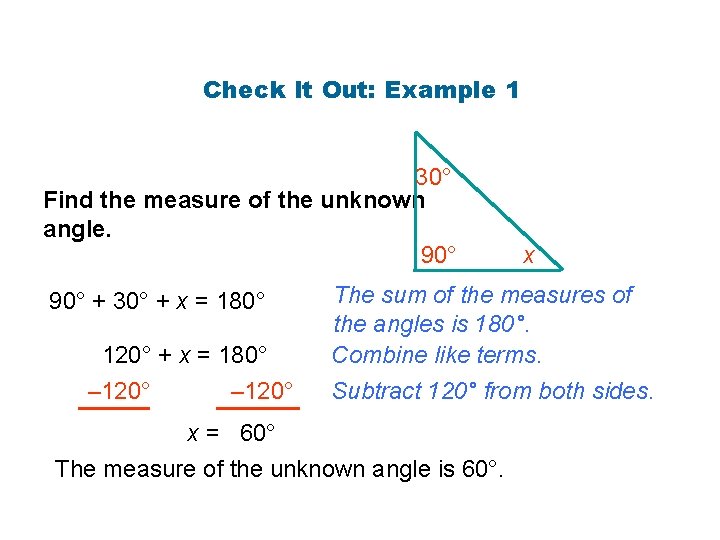
Check It Out: Example 1 30° Find the measure of the unknown angle. 90° + 30° + x = 180° 120° + x = 180° – 120° x The sum of the measures of the angles is 180°. Combine like terms. Subtract 120° from both sides. x = 60° The measure of the unknown angle is 60°.
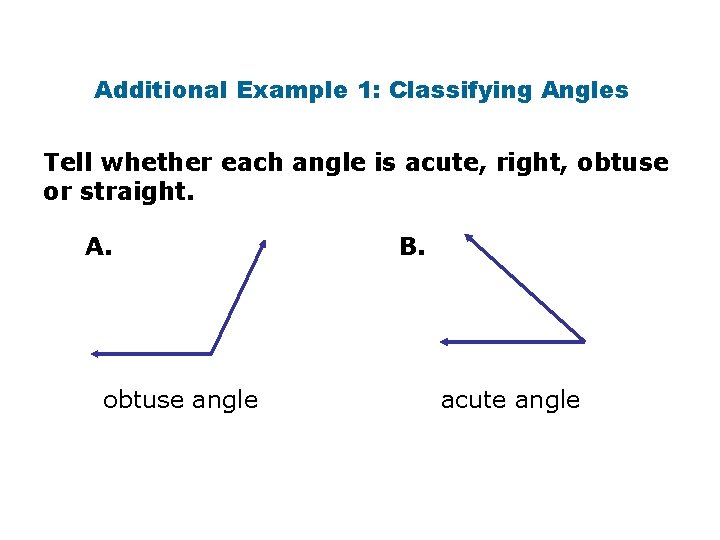
Additional Example 1: Classifying Angles Tell whether each angle is acute, right, obtuse or straight. A. obtuse angle B. acute angle
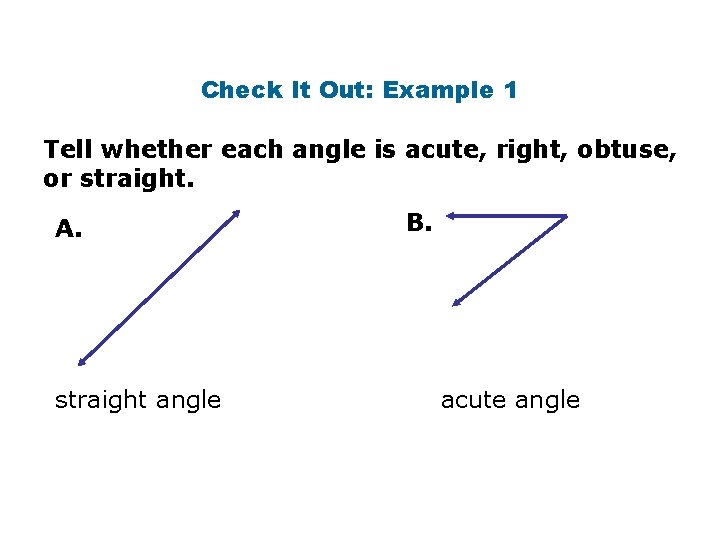
Insert Lesson Title Here Check It Out: Example 1 Tell whether each angle is acute, right, obtuse, or straight. A. straight angle B. acute angle
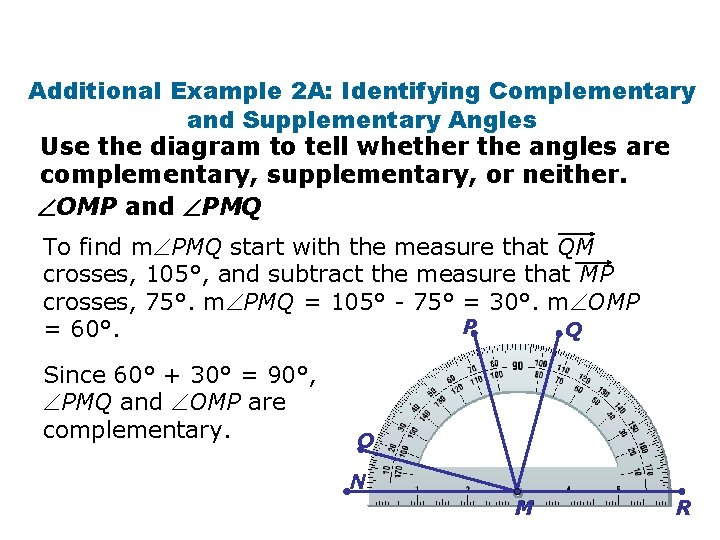
Additional Example 2 A: Identifying Complementary and Supplementary Angles Use the diagram to tell whether the angles are complementary, supplementary, or neither. OMP and PMQ To find m PMQ start with the measure that QM crosses, 105°, and subtract the measure that MP crosses, 75°. m PMQ = 105° - 75° = 30°. m OMP P Q = 60°. Since 60° + 30° = 90°, PMQ and OMP are complementary. O N M R
Reading Math If the angle you are measuring appears obtuse, then it measure is greater than 90°. If the angle is acute, its measure is less than 90°.
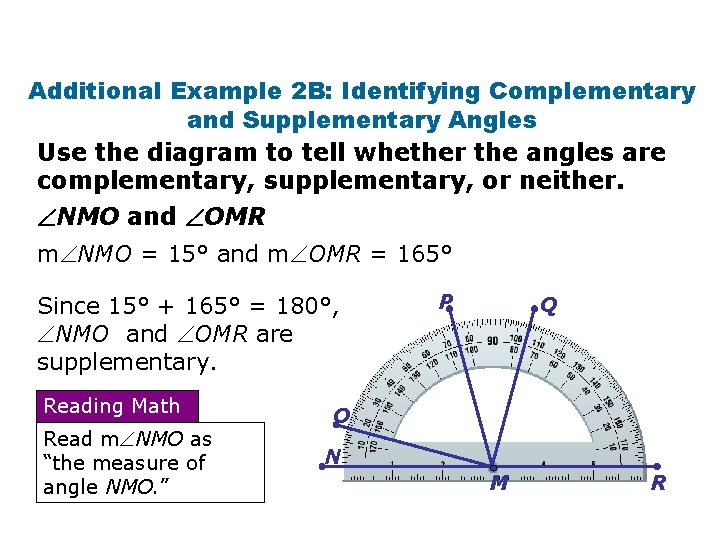
Additional Example 2 B: Identifying Complementary and Supplementary Angles Use the diagram to tell whether the angles are complementary, supplementary, or neither. NMO and OMR m NMO = 15° and m OMR = 165° Since 15° + 165° = 180°, NMO and OMR are supplementary. Reading Math Read m NMO as “the measure of angle NMO. ” P Q O N M R
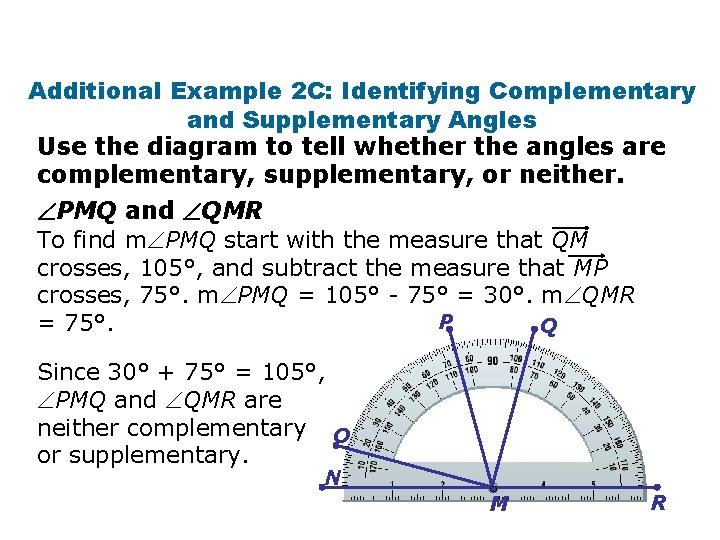
Additional Example 2 C: Identifying Complementary and Supplementary Angles Use the diagram to tell whether the angles are complementary, supplementary, or neither. PMQ and QMR To find m PMQ start with the measure that QM crosses, 105°, and subtract the measure that MP crosses, 75°. m PMQ = 105° - 75° = 30°. m QMR P = 75°. Q Since 30° + 75° = 105°, PMQ and QMR are neither complementary O or supplementary. N M R
- Slides: 15