
INSECTIVORES Placental Mammals 1 by Mark Insectivores Placental
INSECTIVORES Placental Mammals 1 by Mark
Insectivores (Placental Mammals) • Mammals that are insectivores are placental mammals: • Placental mammals are advanced mammals whose young are born at a relatively advanced stage (more advanced than the young of other mammals, the monotremes and marsupials). • Before birth, the young are nourished through a placenta. • The placenta is a specialized embryonic organ that is attached the mother's uterus and delivers oxygen and nutrients to the young. • There almost 4, 000 known species of placental mammals. • There are more rodents and bats than other types of placental mammals.
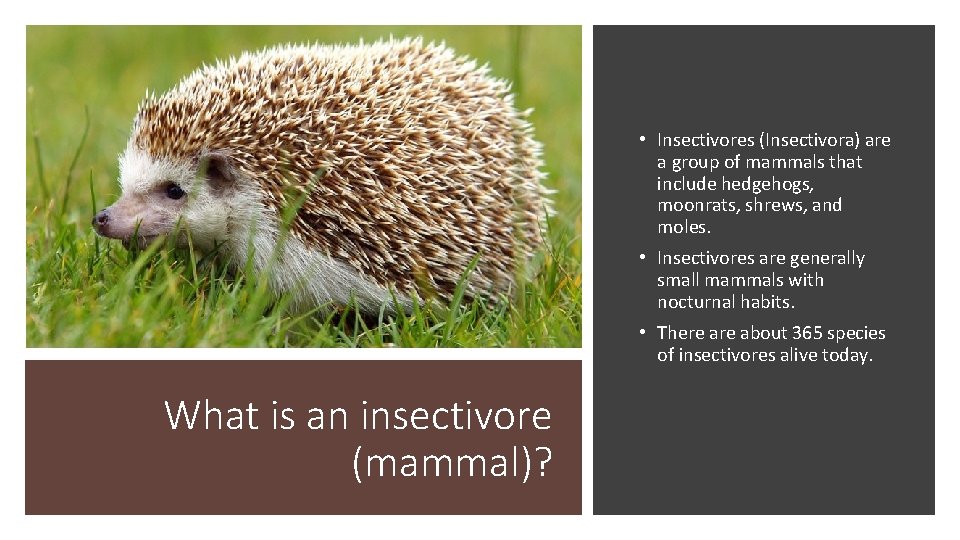
• Insectivores (Insectivora) are a group of mammals that include hedgehogs, moonrats, shrews, and moles. • Insectivores are generally small mammals with nocturnal habits. • There about 365 species of insectivores alive today. What is an insectivore (mammal)?
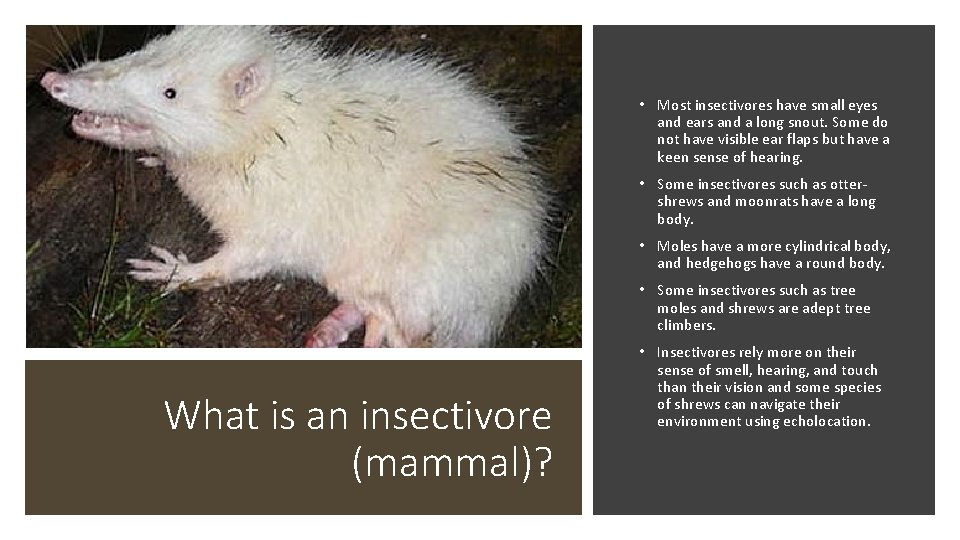
• Most insectivores have small eyes and ears and a long snout. Some do not have visible ear flaps but have a keen sense of hearing. • Some insectivores such as ottershrews and moonrats have a long body. • Moles have a more cylindrical body, and hedgehogs have a round body. • Some insectivores such as tree moles and shrews are adept tree climbers. What is an insectivore (mammal)? • Insectivores rely more on their sense of smell, hearing, and touch than their vision and some species of shrews can navigate their environment using echolocation.
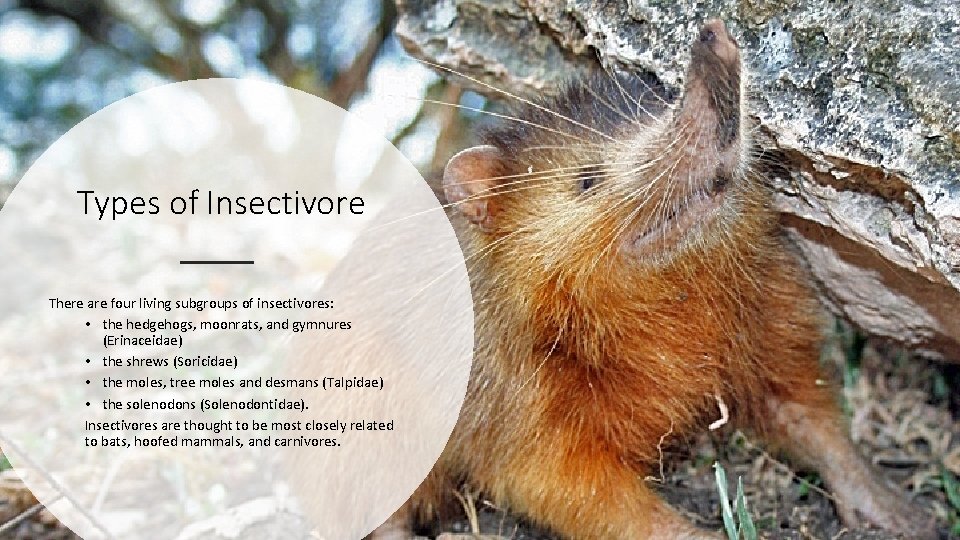
Types of Insectivore There are four living subgroups of insectivores: • the hedgehogs, moonrats, and gymnures (Erinaceidae) • the shrews (Soricidae) • the moles, tree moles and desmans (Talpidae) • the solenodons (Solenodontidae). Insectivores are thought to be most closely related to bats, hoofed mammals, and carnivores.
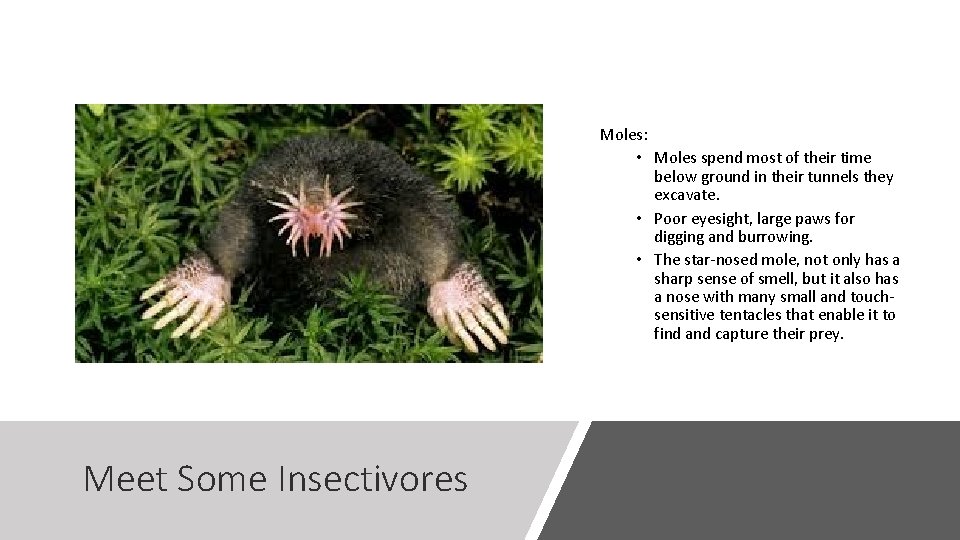
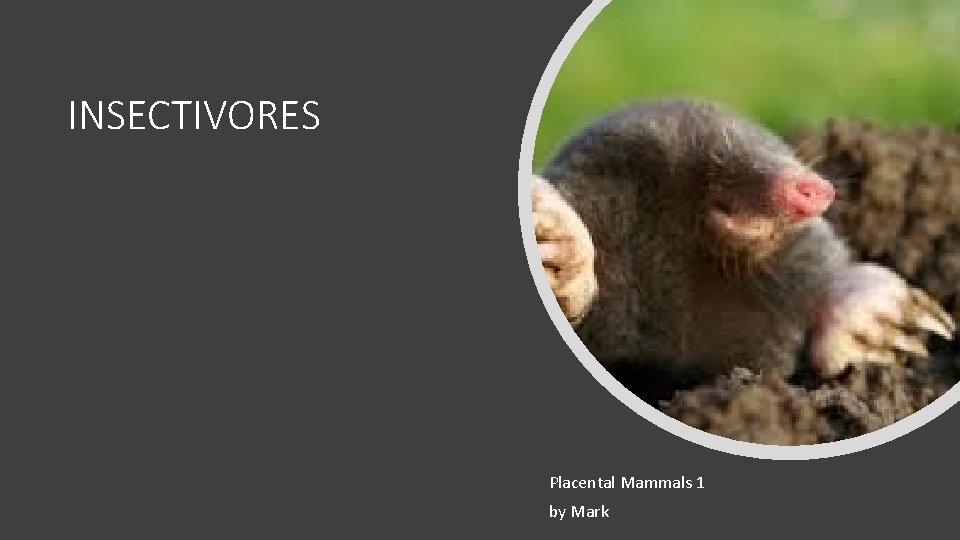
Moles: • Moles spend most of their time below ground in their tunnels they excavate. • Poor eyesight, large paws for digging and burrowing. • The star-nosed mole, not only has a sharp sense of smell, but it also has a nose with many small and touchsensitive tentacles that enable it to find and capture their prey. Meet Some Insectivores
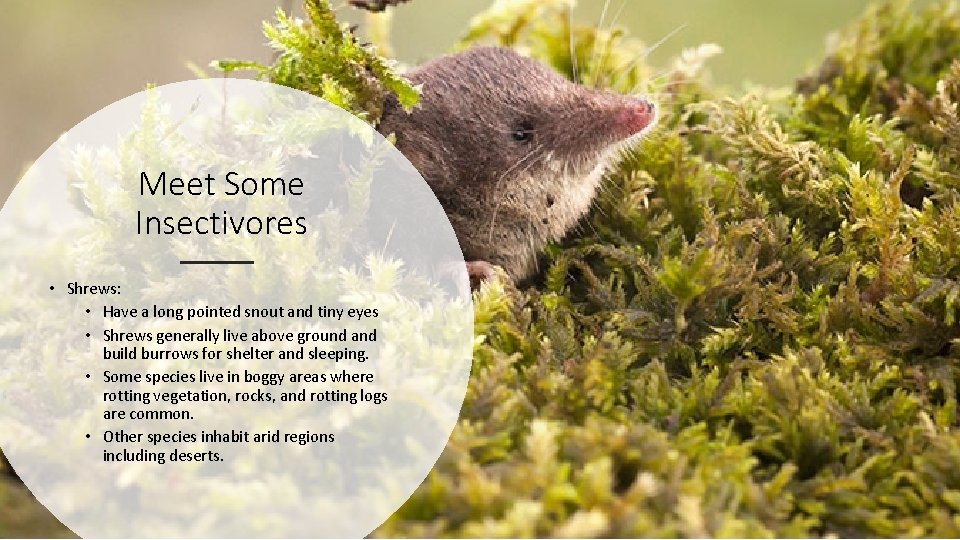
Meet Some Insectivores • Shrews: • Have a long pointed snout and tiny eyes • Shrews generally live above ground and build burrows for shelter and sleeping. • Some species live in boggy areas where rotting vegetation, rocks, and rotting logs are common. • Other species inhabit arid regions including deserts.
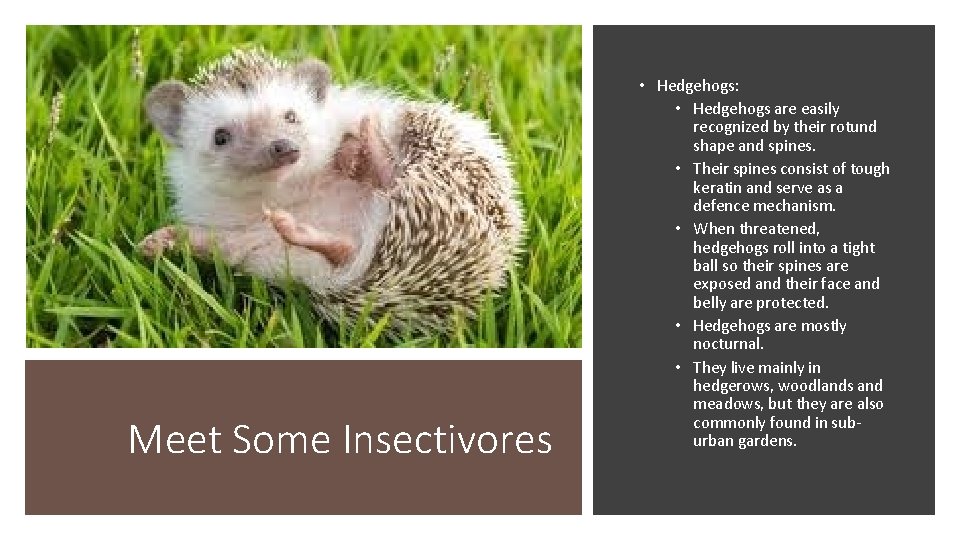
Meet Some Insectivores • Hedgehogs: • Hedgehogs are easily recognized by their rotund shape and spines. • Their spines consist of tough keratin and serve as a defence mechanism. • When threatened, hedgehogs roll into a tight ball so their spines are exposed and their face and belly are protected. • Hedgehogs are mostly nocturnal. • They live mainly in hedgerows, woodlands and meadows, but they are also commonly found in suburban gardens.
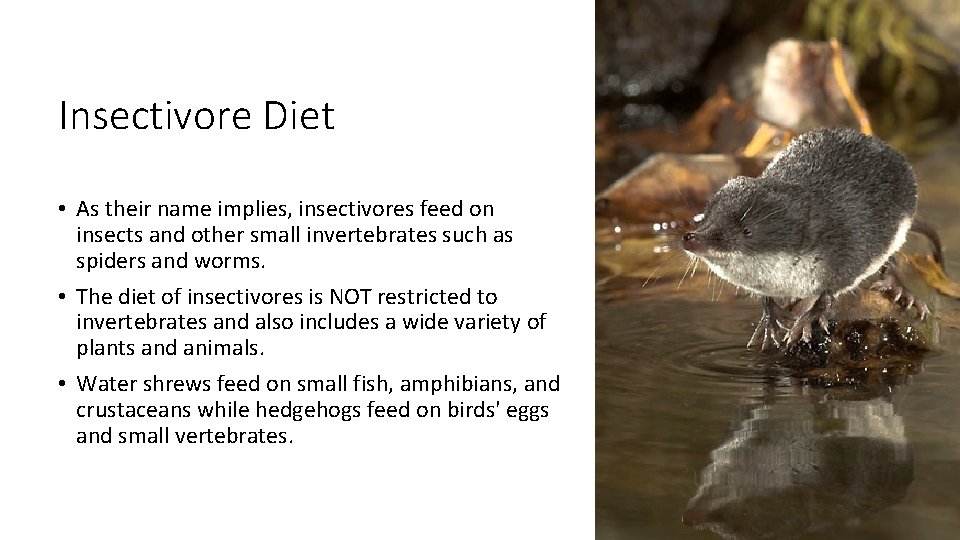
Insectivore Diet • As their name implies, insectivores feed on insects and other small invertebrates such as spiders and worms. • The diet of insectivores is NOT restricted to invertebrates and also includes a wide variety of plants and animals. • Water shrews feed on small fish, amphibians, and crustaceans while hedgehogs feed on birds' eggs and small vertebrates.
The End
- Slides: 10