
Insect development and life history Ch 6 Life
![Insect development [Box 6. 1] • Transcription factors – – Molecular switches Turn on/off](https://slidetodoc.com/presentation_image_h2/854f276e3b0db4fb3ba24277dd4c8ec5/image-3.jpg "Insect development [Box 6. 1] • Transcription factors – – Molecular switches Turn on/off")

- Slides: 31
Insect development and life history (Ch. 6) • Life history: timing and scope of key events in an organism's lifetime, as shaped by natural or sexual selection – – – Size at birth/hatching Age at first reproduction Reproductive lifespan Size and number of offspring Senescence • Tied to life tables (BSC 201)
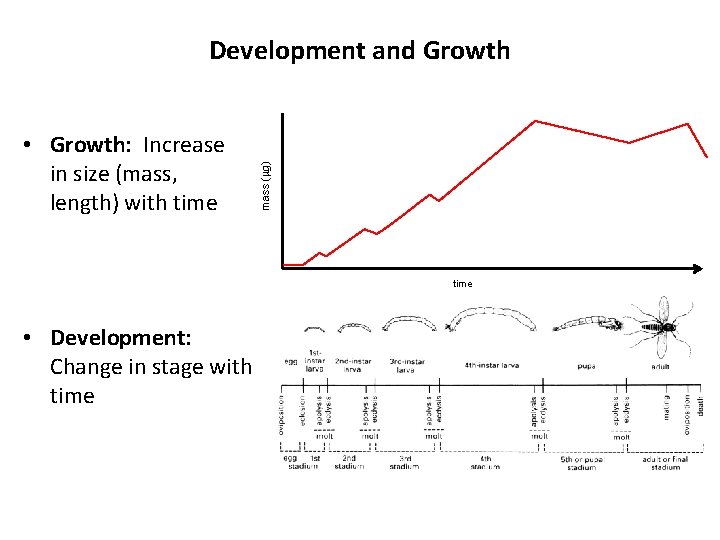
• Growth: Increase in size (mass, length) with time mass (mg) Development and Growth time • Development: Change in stage with time
Insect development [Box 6. 1] • Transcription factors – – Molecular switches Turn on/off other genes Cis-regulatory [same DNA strand] Regulate in a hierarchy in early embryo • Hox (homeotic) – Expression localized; creates segmental identity – Stimulates development of limbs, other structures – Gene structure, position on chromosome, evolutionarily conserved – Order of expression follows position on chromosome (start=head) – Pleiotropy common • Particular Hox genes may regulate 100 s of others Bicoid m. RNA Maternal anterior Kruppel zygotic zonation Hairy zygotic Segmentation wingless zygotic Segment polarity
• • • Growth Length change is discontinuous Constrained by hard exoskeleton Molt increment: increase in length between instars Instar: the insect between two molts Stadium: the time between two molts Entognatha, apterygote insects – indeterminate growth – Molting continues entire life, including adults • Pterygote insects – adults (Imagines) do not molt – Exception: Ephemeroptera subimago (winged, sexually immature, molts to imago)
Paleoptera (e. g. , Mayfly): Hemimetaboly A figure adapted from a review by Sehnal and colleagues (1996). Holometaboly Erezyilmaz D F Integr. Comp. Biol. 2006; 46: 795 -807 © 2006 The Author(s)
terms • Exopterygote: Wing rudiments present in immatures; Gradually increase in size over development – Hemimetabolous development – Includes Paleoptera and some Neoptera • Endopterygote: wing rudiments absent in immatures; wings develop from internal structures – imaginal disks – Pupal stage = reorganization of the body – Holometabolous development
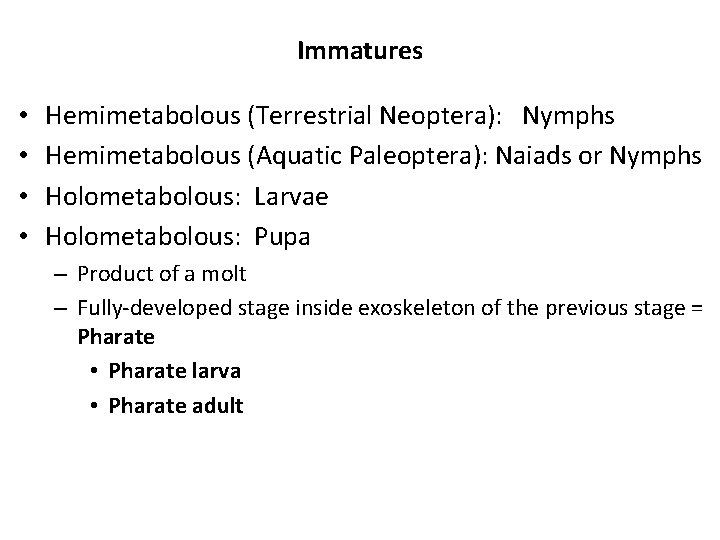
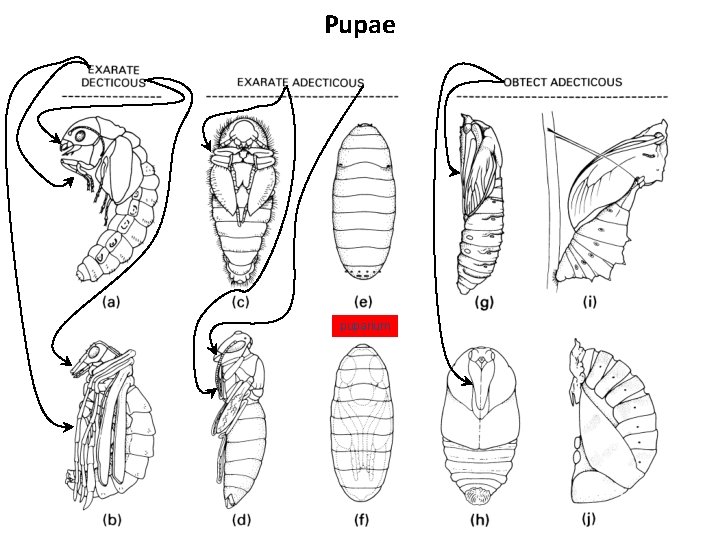
Immatures • • Hemimetabolous (Terrestrial Neoptera): Nymphs Hemimetabolous (Aquatic Paleoptera): Naiads or Nymphs Holometabolous: Larvae Holometabolous: Pupa – Product of a molt – Fully-developed stage inside exoskeleton of the previous stage = Pharate • Pharate larva • Pharate adult
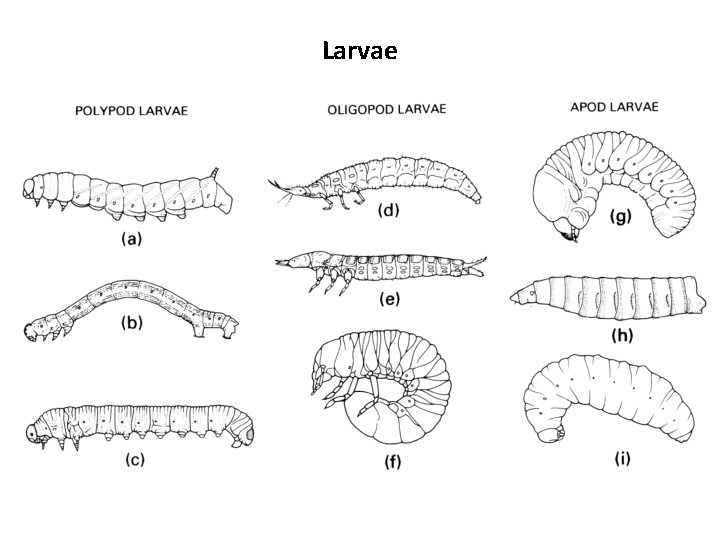
Larvae
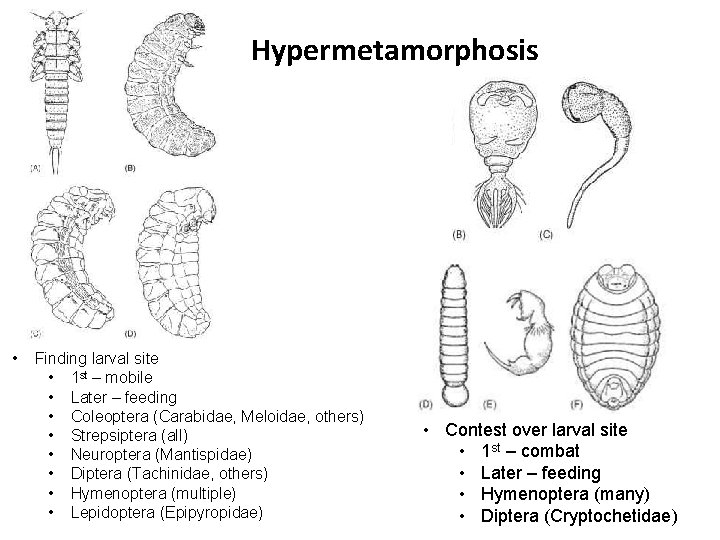
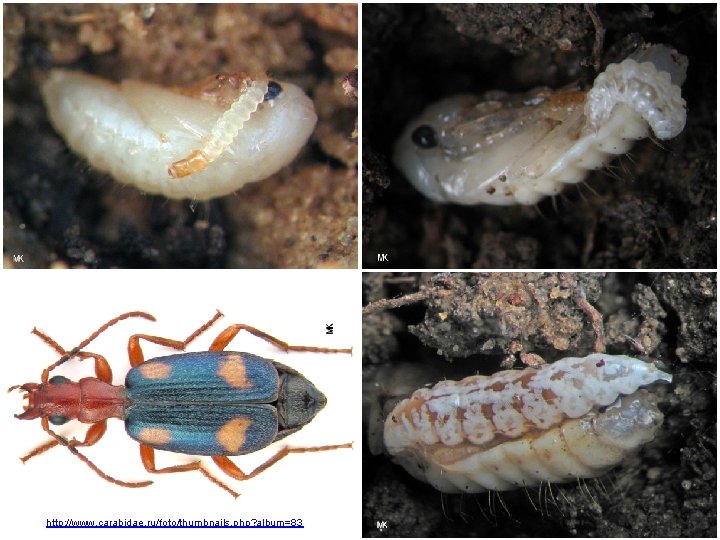
Hypermetamorphosis • Finding larval site • 1 st – mobile • Later – feeding • Coleoptera (Carabidae, Meloidae, others) • Strepsiptera (all) • Neuroptera (Mantispidae) • Diptera (Tachinidae, others) • Hymenoptera (multiple) • Lepidoptera (Epipyropidae) • Contest over larval site • 1 st – combat • Later – feeding • Hymenoptera (many) • Diptera (Cryptochetidae)
http: //www. carabidae. ru/foto/thumbnails. php? album=83
Pupae puparium
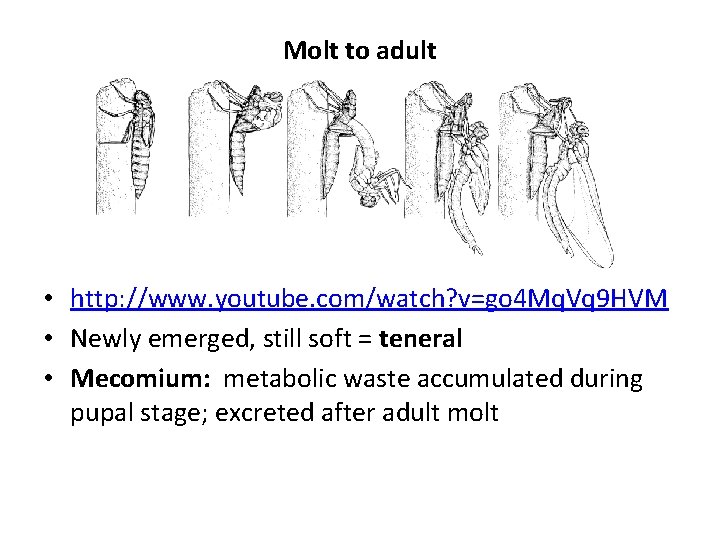
Molt to adult • http: //www. youtube. com/watch? v=go 4 Mq. Vq 9 HVM • Newly emerged, still soft = teneral • Mecomium: metabolic waste accumulated during pupal stage; excreted after adult molt
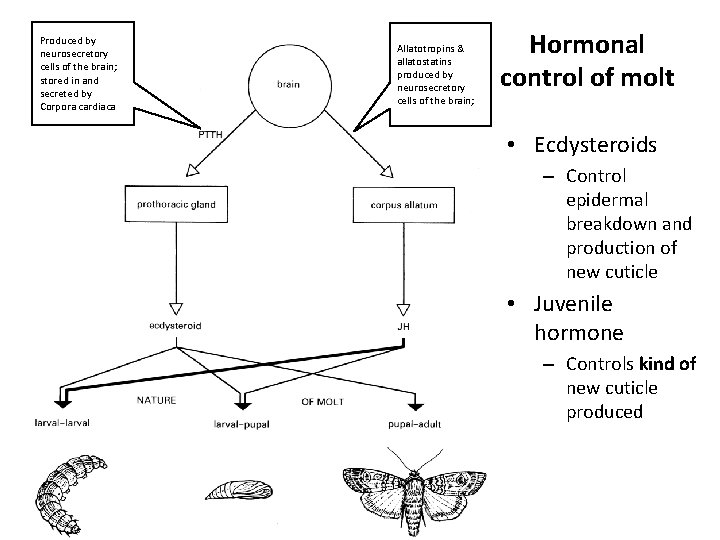
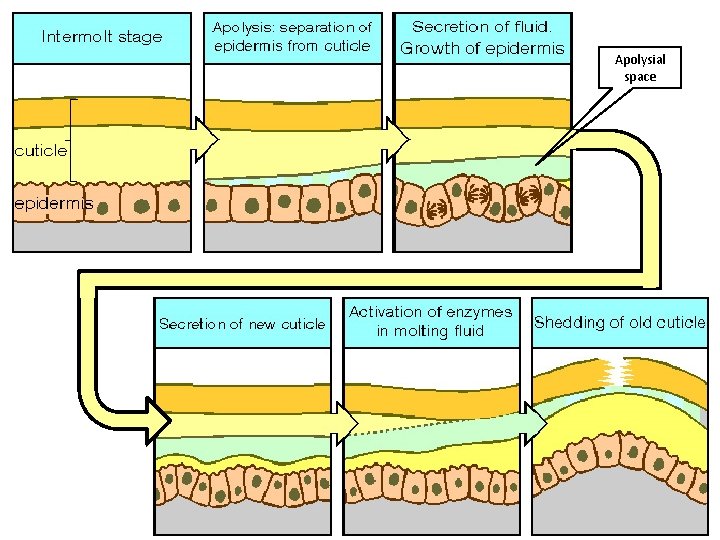
Produced by neurosecretory cells of the brain; stored in and secreted by Corpora cardiaca Allatotropins & allatostatins produced by neurosecretory cells of the brain; Hormonal control of molt • Ecdysteroids – Control epidermal breakdown and production of new cuticle • Juvenile hormone – Controls kind of new cuticle produced
Apolysial space
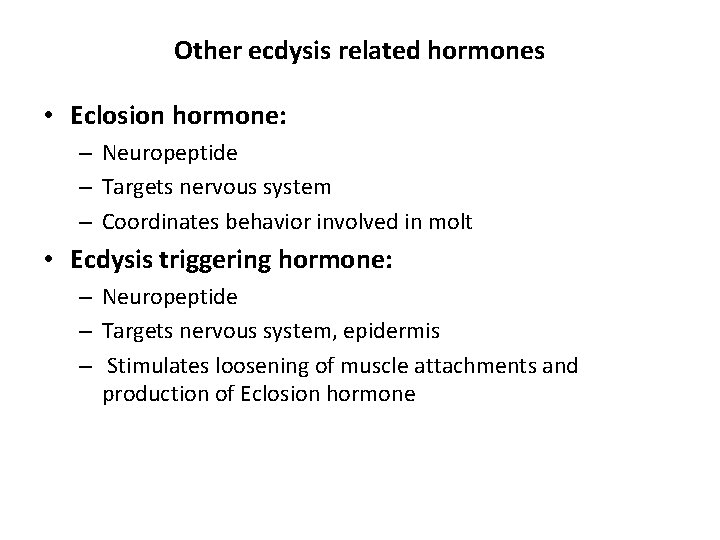
Other ecdysis related hormones • Eclosion hormone: – Neuropeptide – Targets nervous system – Coordinates behavior involved in molt • Ecdysis triggering hormone: – Neuropeptide – Targets nervous system, epidermis – Stimulates loosening of muscle attachments and production of Eclosion hormone
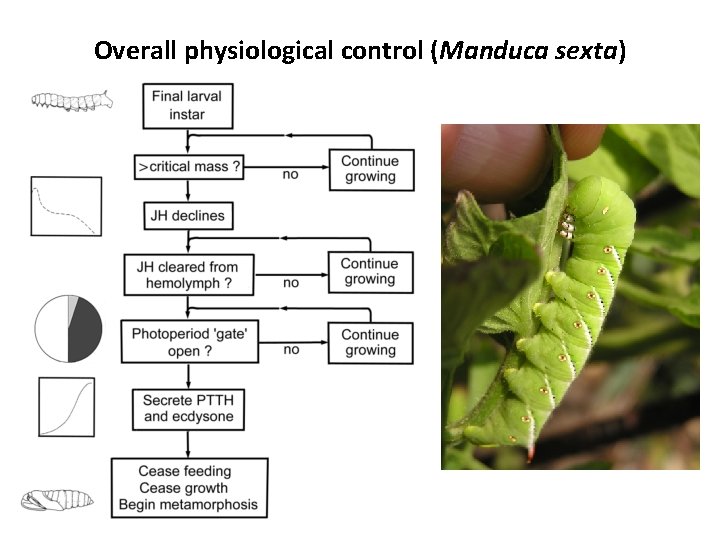
Overall physiological control (Manduca sexta)
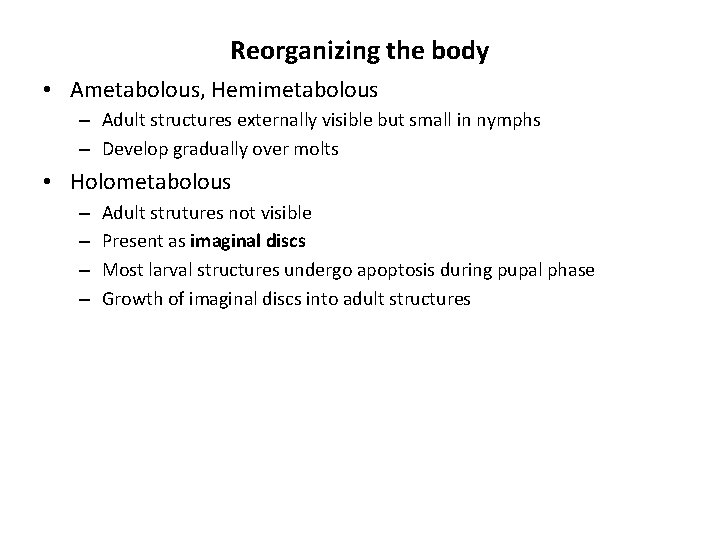
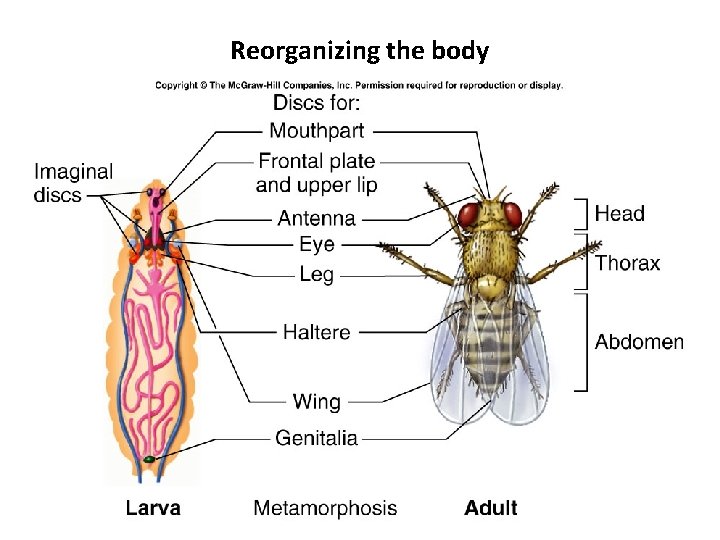
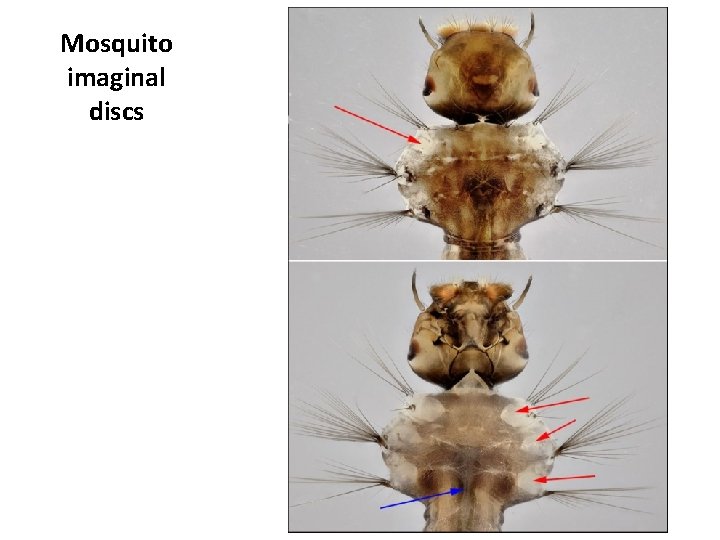
Reorganizing the body • Ametabolous, Hemimetabolous – Adult structures externally visible but small in nymphs – Develop gradually over molts • Holometabolous – – Adult strutures not visible Present as imaginal discs Most larval structures undergo apoptosis during pupal phase Growth of imaginal discs into adult structures
Reorganizing the body
Mosquito imaginal discs
Voltinism • • Number of generations per year Univoltine Bivoltine Multivoltine or Polyvoltine Semivoltine Changes with latitude within a single species Varies widely among species. Some take much longer than 1 year – Cicadas – Large Dragonflies
Diapause • Arrested development • With physiological changes that require particular physiological cues to resume development • Return to favorable conditions is not sufficient – Warming up is not enough • • Usually photoperiod is the cue. Often cold period is necessary Across groups, any stage Adults and larvae can move and be active and feed – Development (change in stage) does not occur
Diapause • Dormancy Diapause • Dormancy – Diapause – Quiescence: development halted as a direct effect of unfavorable conditions (e. g. , cold) – Summer dormancy: Aestivation (dry conditions) – Winter dormancy: Hibernation (cold conditions)
Why photoperiod? • Photoperiod is the most reliable cue to seasonal changes in environment (at a given location) • Temperature, moisture, food quality, etc. can all vary from year to year, day to day – May provide an inappropriate cue to resume development – Getting it wrong has enormous fitness cost – Investigations comparing effects of cold adaptation vs. timing of development • Selective effect on timing is much stronger
Environmental extremes • Freezing: Tolerance or avoidance • Arctic, antarctic: Tolerate as low as -80 o. C • Mechanisms – Ice nucleation (Tolerance) • Induce ice crystals outside of cells • Minimize cell damage • Proteins, lipids, urate granules – Supercooling (Avoidance) • Remain liquid at sub 0 o. C • Glycerol, propylene glycol, ethlyene glycol; • trehalose, sorbitol
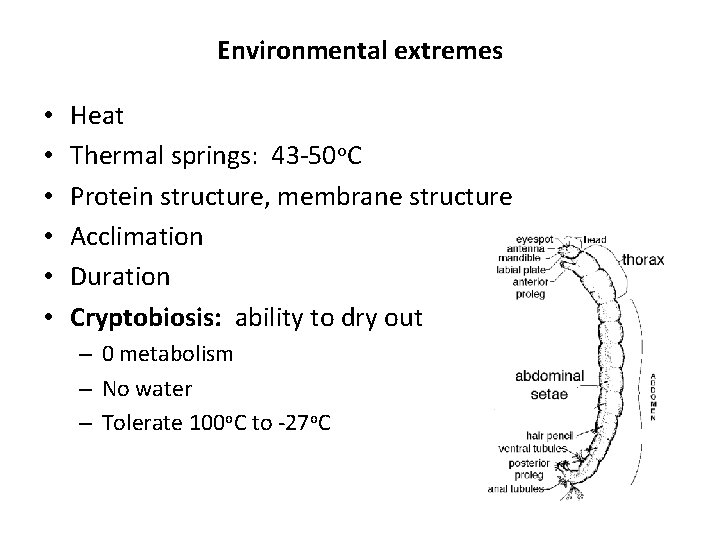
Environmental extremes • • • Heat Thermal springs: 43 -50 o. C Protein structure, membrane structure Acclimation Duration Cryptobiosis: ability to dry out – 0 metabolism – No water – Tolerate 100 o. C to -27 o. C
Migration • Dispersal vs. Migration • Definitions vary. – Seasonal movement – Physiologically cued movement – Physiological and behavioral changes • Reproduction shuts down – sometimes reproductive diapause • Energy stored, diverted to flight • Usually pre-reproductive individuals migrate • Reproduction commences after migration
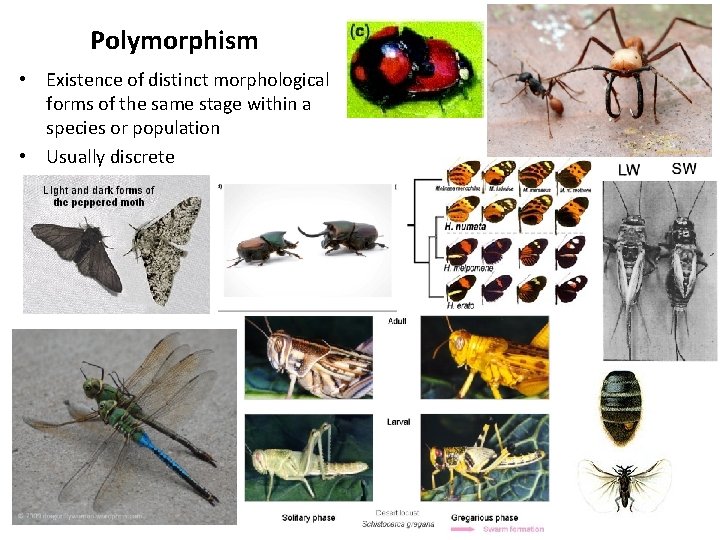
Polymorphism • Existence of distinct morphological forms of the same stage within a species or population • Usually discrete
Kinds of polymorphism • Genetic – Color, melanism – Mimicry, crypsis – Maintained by balancing selection or geneflow • Environmental {polyphenism} – – – Diet Growth and Size Social environment Behavior correlates with morphology (Mating, dispersal) May be adaptive instance of phenotypic plasticity
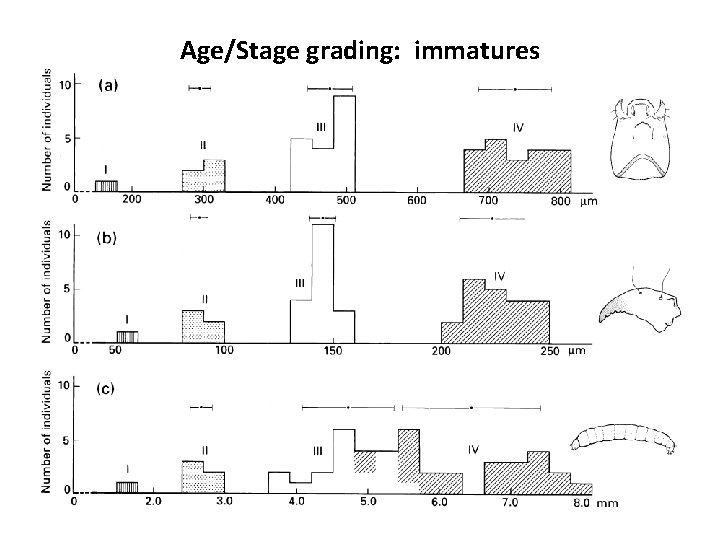
Age/Stage grading: immatures
Size and stage • Dyar’s rule: Ratio of linear size of stage i to stage i-1 is a constant between 1. 3 and 1. 7 • Przibram’s rule: Mass doubles each instar • Both have lots of exceptions and sources of variation • Different body parts grow allometrically – Don’t all increase at the same rate – Horn polymorphism in dung beetles
Age grading of adults • Reproductive structures – Stage, not age • Cuticular components – Hydrocarbons – Cuticular growth lines – All dependent on temperature, not just age