
Inquiry in Mathematics Learning and Teaching Barbara Jaworski
Inquiry in Mathematics Learning and Teaching Barbara Jaworski Loughborough University, UK Summer School -- Alexandropoulis -- 2009
Better mathematics? n n n How can students (pupils) learn mathematics better? How can teachers provide better opportunities for students to learn mathematics? What kinds of activity in classrooms contribute to deeper mathematical understandings? How can didacticians (mathematics educators) contribute to improving mathematics learning and teaching? What roles should/can students, teachers and didacticians play in the developmental process Summer School -- Alexandropoulis -- 2009 2
This session 10 minutes – introduction 20 minutes – working as a group 20 minutes – feedback from groups 30 minutes – input from BJ 10 minutes – questions/discussion Summer School -- Alexandropoulis -- 2009 3
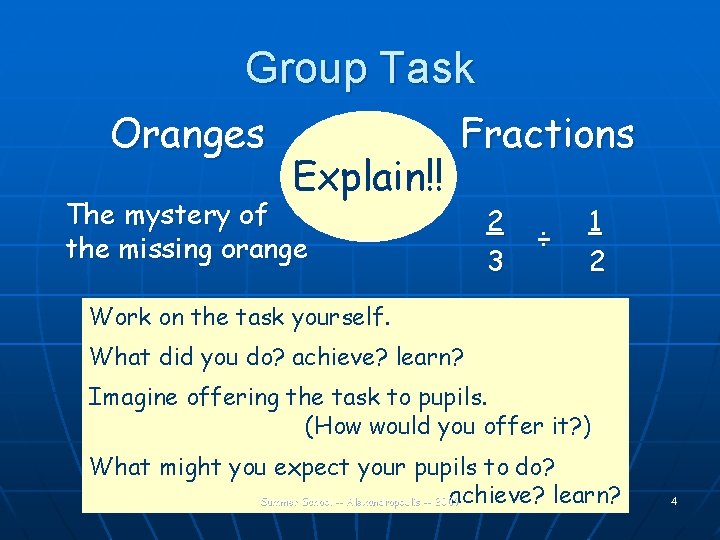
Group Task Oranges Explain!! Fractions The mystery of the missing orange 2 3 ÷ 1 2 Work on the task yourself. What did you do? achieve? learn? Imagine offering the task to pupils. (How would you offer it? ) What might you expect your pupils to do? achieve? learn? Summer School -- Alexandropoulis -- 2009 4
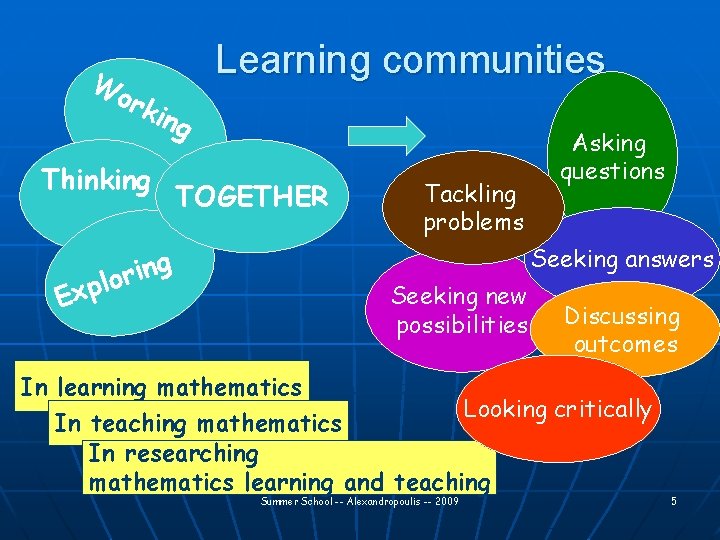
Wo rki ng Thinking Learning communities TOGETHER Tackling problems Asking questions Seeking answers g n i r o l p x E Seeking new possibilities Discussing outcomes In learning mathematics Looking critically In teaching mathematics In researching mathematics learning and teaching Summer School -- Alexandropoulis -- 2009 5
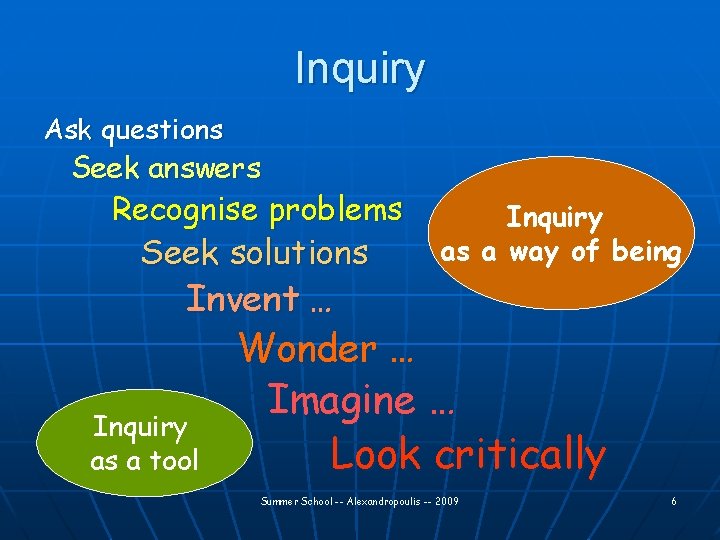
Inquiry Ask questions Seek answers Recognise problems Seek solutions Inquiry as a way of being Invent … Wonder … Inquiry as a tool Imagine … Look critically Summer School -- Alexandropoulis -- 2009 6
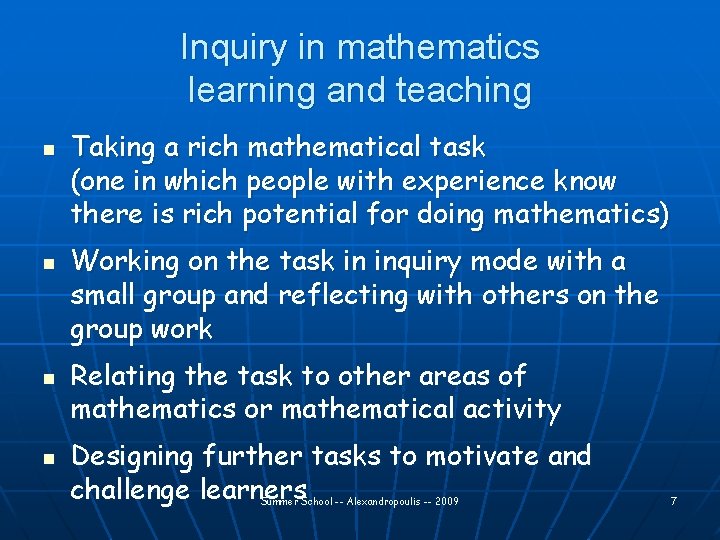
Inquiry in mathematics learning and teaching n n Taking a rich mathematical task (one in which people with experience know there is rich potential for doing mathematics) Working on the task in inquiry mode with a small group and reflecting with others on the group work Relating the task to other areas of mathematics or mathematical activity Designing further tasks to motivate and challenge learners Summer School -- Alexandropoulis -- 2009 7
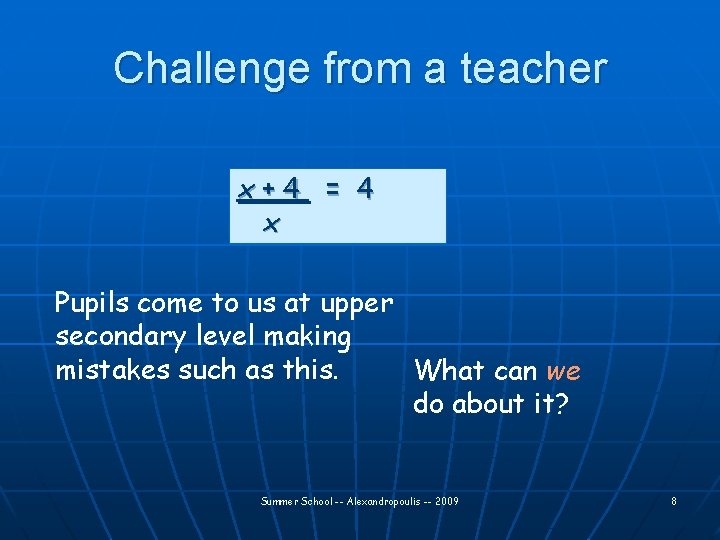
Challenge from a teacher x+4 = 4 x Pupils come to us at upper secondary level making mistakes such as this. What can we do about it? Summer School -- Alexandropoulis -- 2009 8
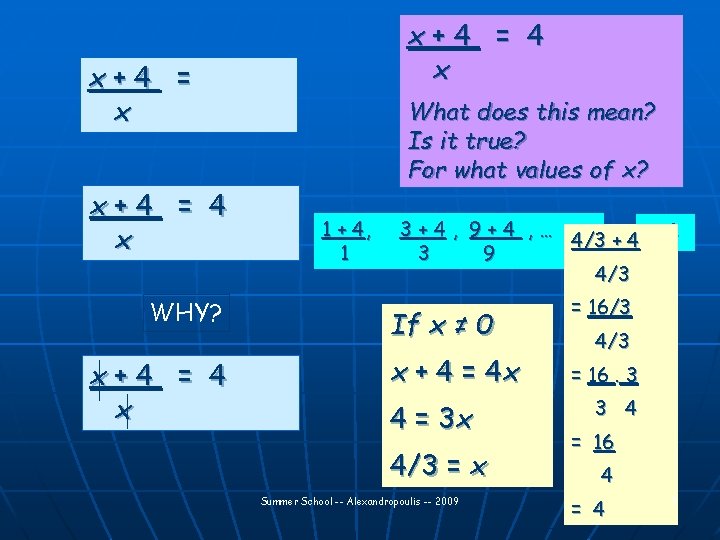
x+4 = 4 x WHY? x+4 = 4 x What does this mean? Is it true? For what values of x? 1 + 4, 1 3+4, 9+4 , … 4/3 + 4 ≠ 4 3 9 4/3 If x ≠ 0 x + 4 = 4 x 4 = 3 x 4/3 = x Summer School -- Alexandropoulis -- 2009 = 16/3 4/3 = 16. 3 3 4 = 16 4 = 4 9
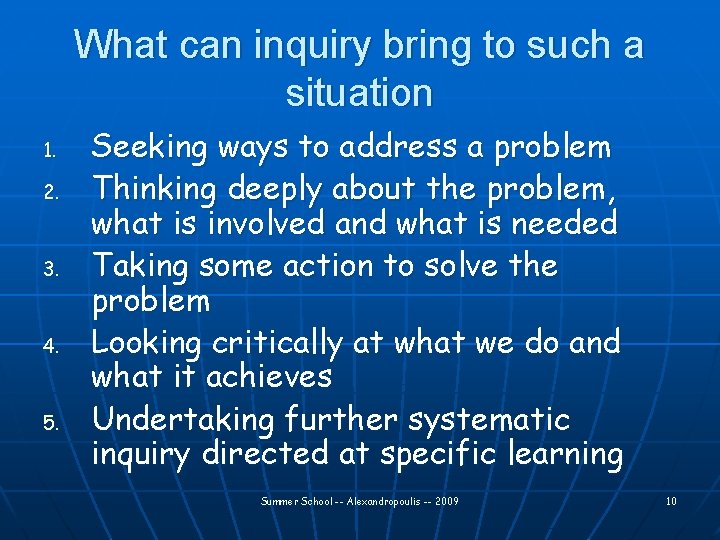
What can inquiry bring to such a situation 1. 2. 3. 4. 5. Seeking ways to address a problem Thinking deeply about the problem, what is involved and what is needed Taking some action to solve the problem Looking critically at what we do and what it achieves Undertaking further systematic inquiry directed at specific learning Summer School -- Alexandropoulis -- 2009 10
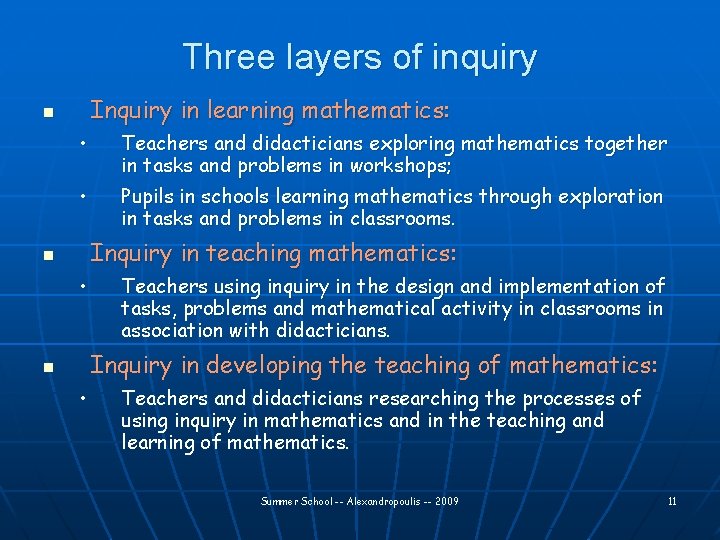
Three layers of inquiry Inquiry in learning mathematics: n • Teachers and didacticians exploring mathematics together in tasks and problems in workshops; • Pupils in schools learning mathematics through exploration in tasks and problems in classrooms. Inquiry in teaching mathematics: n • Teachers using inquiry in the design and implementation of tasks, problems and mathematical activity in classrooms in association with didacticians. Inquiry in developing the teaching of mathematics: n • Teachers and didacticians researching the processes of using inquiry in mathematics and in the teaching and learning of mathematics. Summer School -- Alexandropoulis -- 2009 11
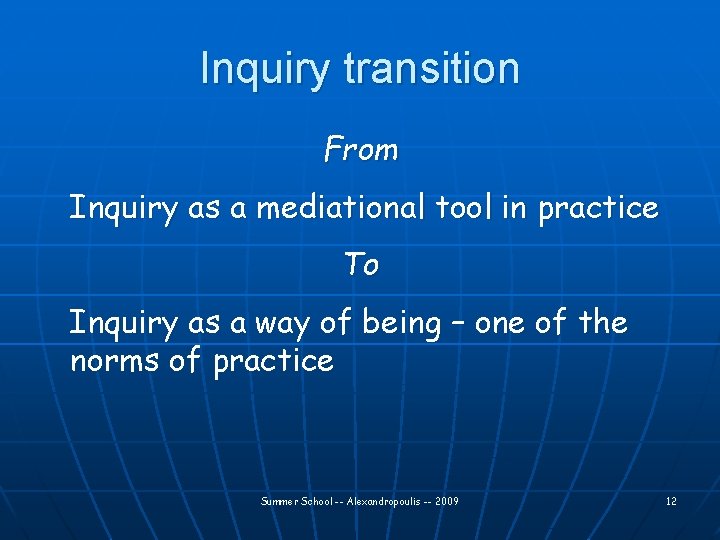
Inquiry transition From Inquiry as a mediational tool in practice To Inquiry as a way of being – one of the norms of practice Summer School -- Alexandropoulis -- 2009 12
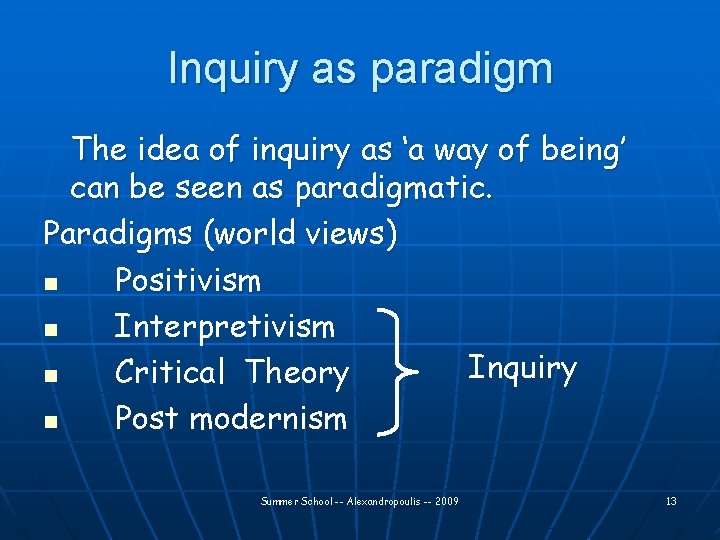
Inquiry as paradigm The idea of inquiry as ‘a way of being’ can be seen as paradigmatic. Paradigms (world views) n Positivism n Interpretivism Inquiry n Critical Theory n Post modernism Summer School -- Alexandropoulis -- 2009 13
Positivism n n Seeking objectivity and truth through defining social situations in scientific terms usually involving quantification, measure and logic: defining measurable variables; designing comparable situations; giving absolute values; not leaving open to interpretation. Justification most often through statistical analysis or study of carefully controlled experimental conditions. Summer School -- Alexandropoulis -- 2009 14
Interpretivism n n Recognising social situations as complex and seeking to describe and characterise them through interpretation: seeking meaning in observed actions and interactions; gaining insight to people’s perspectives on who they are and what they do. Justification through detailed description and multiple sources of explanation and evidence to support interpretation and throw light on what is studied; being critical about the perspectives one brings to interpretation Summer School -- Alexandropoulis -- 2009 15
Critical theory n n Going beyond descriptive interpretation to recognise that social situations embody deeply political human issues and power relationships that research should seek to uncover and address such issues: revealing relationships which limit or oppress; bringing critical analysis to accepted traditions to offer opportunities for change. Justification through action and interaction that examine deeply and overtly ways of thinking, reveal factors and conditions that suppress individuals or groups and provide emancipatory/empowering opportunity through giving voice, enabling and enfranchising. Summer School -- Alexandropoulis -- 2009 16
Postmodernism n n Going beyond modernism which rationalises, structures and seeks to explain by categorising and compartmentalising: bringing and valuing multiple perspectives and methods; questioning the dominance of any one view of the world, deconstructing to reveal the limiting nature of imposed structures; revolt against control. Justification in revellation; coversation and negotiation, opening up; not pretending to compartmentalise; revealing complexity and chaos. Summer School -- Alexandropoulis -- 2009 17
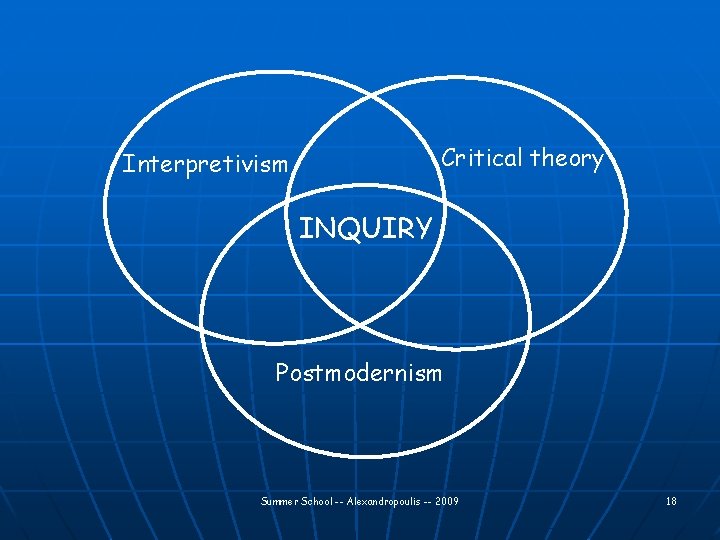
Critical theory Interpretivism INQUIRY Postmodernism Summer School -- Alexandropoulis -- 2009 18
tomorrow … … inquiry in Developmental Research Summer School -- Alexandropoulis -- 2009 19

Thank You Summer School -- Alexandropoulis -- 2009

Summer School -- Alexandropoulis -- 2009 21
Inquiry in Developmental Research in Mathematics Education Summer School -- Alexandropoulis -- 2009 22
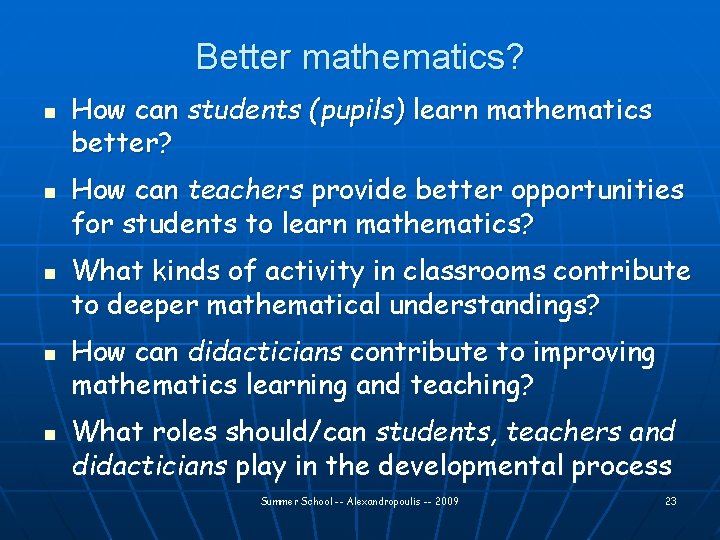
Better mathematics? n n n How can students (pupils) learn mathematics better? How can teachers provide better opportunities for students to learn mathematics? What kinds of activity in classrooms contribute to deeper mathematical understandings? How can didacticians contribute to improving mathematics learning and teaching? What roles should/can students, teachers and didacticians play in the developmental process Summer School -- Alexandropoulis -- 2009 23
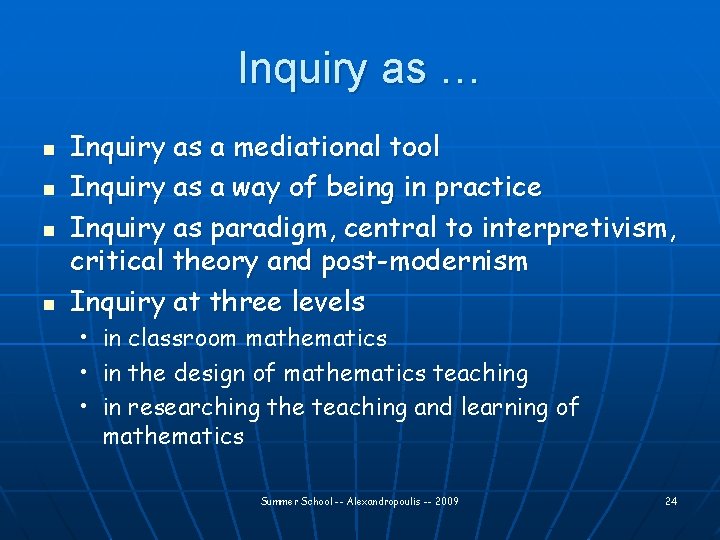
Inquiry as … n n Inquiry as a mediational tool Inquiry as a way of being in practice Inquiry as paradigm, central to interpretivism, critical theory and post-modernism Inquiry at three levels • • • in classroom mathematics in the design of mathematics teaching in researching the teaching and learning of mathematics Summer School -- Alexandropoulis -- 2009 24
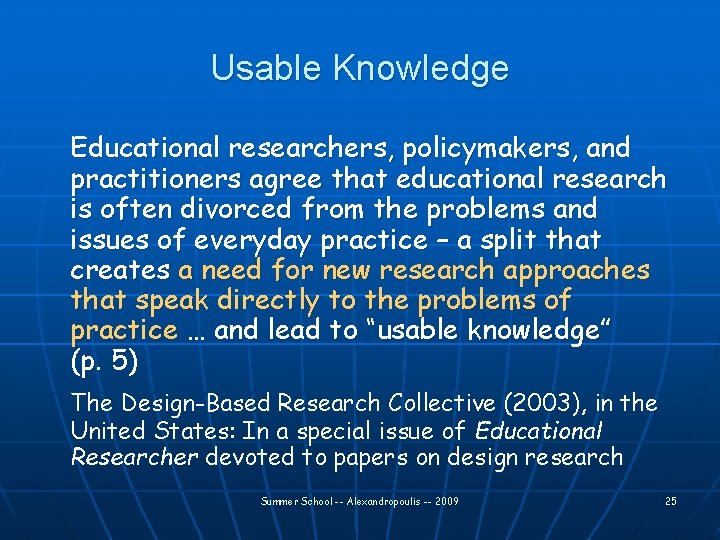
Usable Knowledge Educational researchers, policymakers, and practitioners agree that educational research is often divorced from the problems and issues of everyday practice – a split that creates a need for new research approaches that speak directly to the problems of practice … and lead to “usable knowledge” (p. 5) The Design-Based Research Collective (2003), in the United States: In a special issue of Educational Researcher devoted to papers on design research Summer School -- Alexandropoulis -- 2009 25
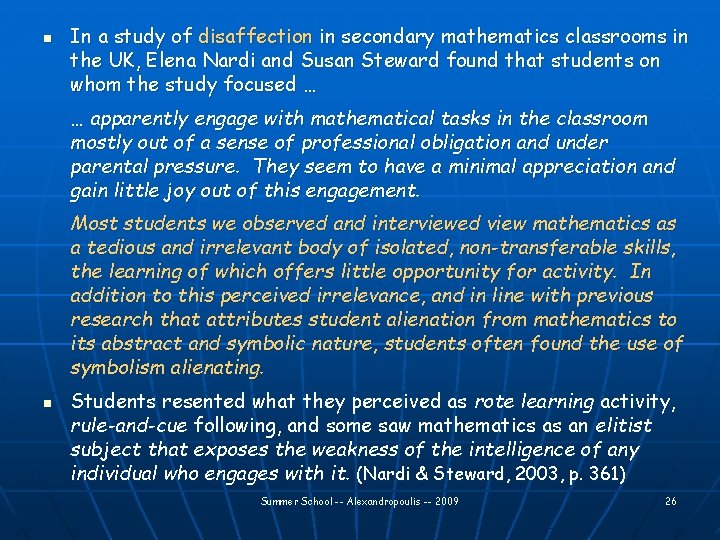
n In a study of disaffection in secondary mathematics classrooms in the UK, Elena Nardi and Susan Steward found that students on whom the study focused … … apparently engage with mathematical tasks in the classroom mostly out of a sense of professional obligation and under parental pressure. They seem to have a minimal appreciation and gain little joy out of this engagement. Most students we observed and interviewed view mathematics as a tedious and irrelevant body of isolated, non-transferable skills, the learning of which offers little opportunity for activity. In addition to this perceived irrelevance, and in line with previous research that attributes student alienation from mathematics to its abstract and symbolic nature, students often found the use of symbolism alienating. n Students resented what they perceived as rote learning activity, rule-and-cue following, and some saw mathematics as an elitist subject that exposes the weakness of the intelligence of any individual who engages with it. (Nardi & Steward, 2003, p. 361) Summer School -- Alexandropoulis -- 2009 26
n n How can we address “the problems of practice”? And how can research help? Summer School -- Alexandropoulis -- 2009 27
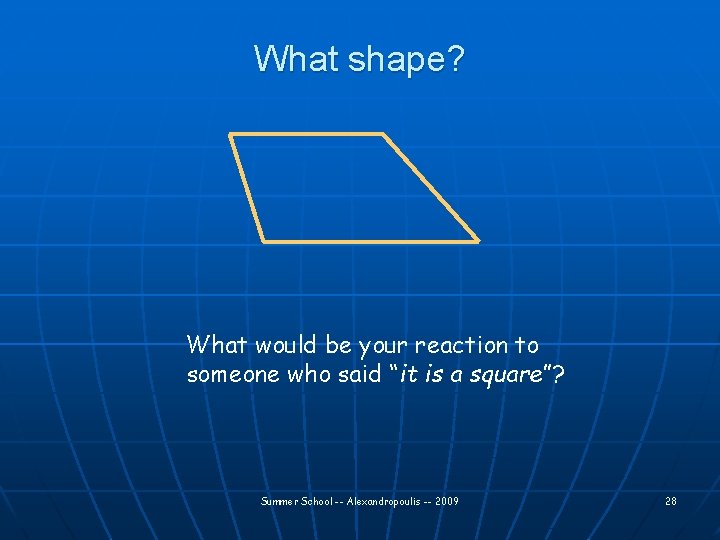
What shape? What would be your reaction to someone who said “it is a square”? Summer School -- Alexandropoulis -- 2009 28
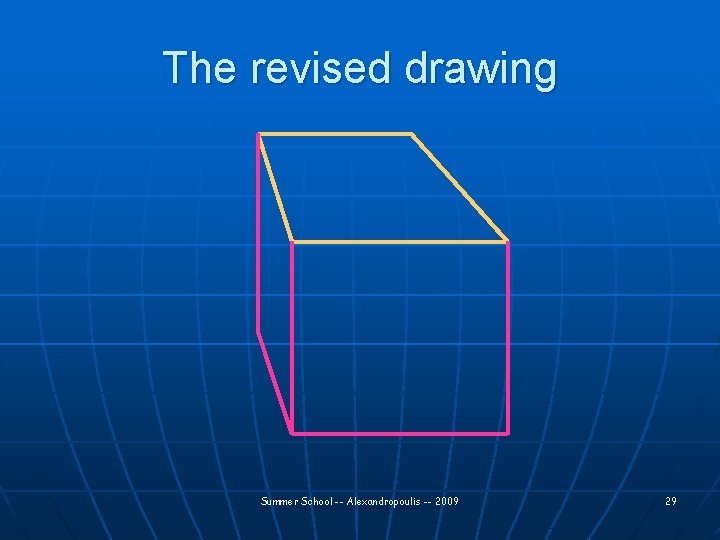
The revised drawing Summer School -- Alexandropoulis -- 2009 29
Daffodils Margaret Brown (1979, p. 362) reports from research into 11 -12 year old children’s solutions to problems involving number operations. A question asked A gardener has 391 daffodils. These are to be planted in 23 flowerbeds. Each flowerbed is to have the same number of daffodils. How do you work out how many daffodils will be planted in each flowerbed? The following interview took place between a student YG and the interviewer MB: Summer School -- Alexandropoulis -- 2009 30
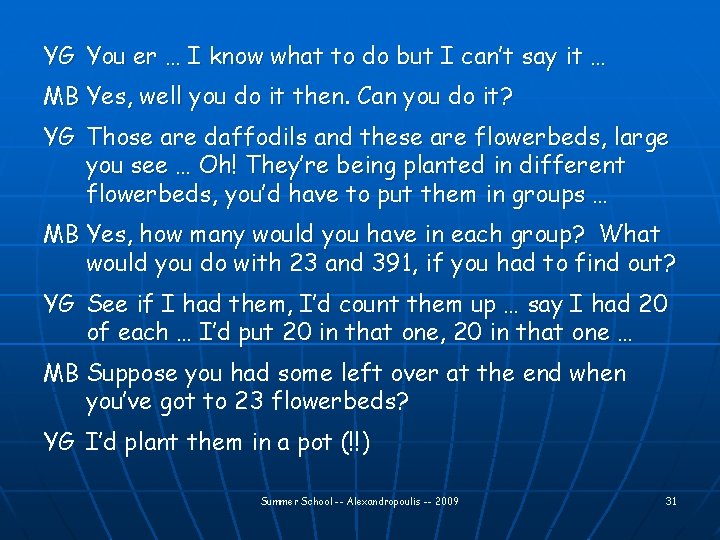
YG You er … I know what to do but I can’t say it … MB Yes, well you do it then. Can you do it? YG Those are daffodils and these are flowerbeds, large you see … Oh! They’re being planted in different flowerbeds, you’d have to put them in groups … MB Yes, how many would you have in each group? What would you do with 23 and 391, if you had to find out? YG See if I had them, I’d count them up … say I had 20 of each … I’d put 20 in that one, 20 in that one … MB Suppose you had some left over at the end when you’ve got to 23 flowerbeds? YG I’d plant them in a pot (!!) Summer School -- Alexandropoulis -- 2009 31
New tasks for old. n n In Adapting and Extending Secondary Mathematics Activities: New tasks for old, Stephanie Prestage and Pat Perks (2001) look at traditional tasks such as one finds in a text book They suggest an alternative perspective on the task so that it offers students something to think about or explore; engaging student in mathematical inquiry. An example relating to Pythagoras Theorem is What right angled triangles can you find with an hypotenuse of 17 cm? (Page 25) n n Such a task is different from traditional exercises which ask more direct questions with single right or wrong answers. Solving the problem requires the algorithm to be used many times as a pupil makes decisions about the number and types of solutions. This is better than a worksheet any day, and requires little preparation. (Prestage and Perks, 2001, p. 25) 32 Summer School -- Alexandropoulis -- 2009
3 examples n n n How do these three examples address the problems of disaffection? It’s a square – depending on how you look at it Daffodils – plant remainder in a pot New tasks for old – Pythagoras task What research will contribute to a batter understanding of disaffection and how we can deal with it? Summer School -- Alexandropoulis -- 2009 33
Developmental Research in Mathematics Education … a) b) Research which promotes the development of mathematics teaching and learning while simultaneously studying the practices and processes involved; or as an integral part of studying the practices and processes involved Summer School -- Alexandropoulis -- 2009 34
Implicitly Much research that studies practices and processes in mathematics learning and/or teaching is implicitly developmental in that it promotes development without this being an intended factor in the research design. (Jaworski, 2003) Summer School -- Alexandropoulis -- 2009 35
Explicitly Research that is explicitly developmental sets out to promote development as part of the design of the research. Research and development are often reflexively related to each other, so that separation of aspects of research and development is difficult. Summer School -- Alexandropoulis -- 2009 36
Co-learning agreement In a co-learning agreement, researchers and practitioners are both participants in processes of education and systems of schooling. Both are engaged in action and reflection. By working together, each might learn something about the world of the other. Of equal importance, however, each may learn something more about his or her own world and its connections to institutions and schooling (Wagner, 1997, p. 16). Summer School -- Alexandropoulis -- 2009 37
Co-learning agreement In a co-learning agreement, teachers and didacticians are both participants and researchers in processes of education and systems of schooling. Both are engaged in action and reflection. By working together, each might learn something about the world of the other. Of equal importance, however, each may learn something more about his or her own world and its connections to institutions and schooling (Wagner, 1997, p. 16). Summer School -- Alexandropoulis -- 2009 38
Examples of Co-Learning Inquiry The Mathematics Teacher Enquiry Project – a study of teaching development resulting from teachers’ own classroom research as insiders Here teachers were invited (by outsider researchers) to ask and explore their own questions relating to issues in learning and teaching mathematics. Outsider research showed that teachers’ enquiry, in collaboration with other researchers, led to enhanced thinking and developments in teaching. Outsider researchers themselves learned significantly from their study of teachers’ activity. (Jaworski, 1998. See also, Hall, 1997; Edwards, 1998) Summer School -- Alexandropoulis -- 2009 39
The teaching triad project Collaboration between teachers and (outsider) researchers to study the use of the teaching triad as a developmental tool, while using the triad to analyse teaching, led to deeper understandings of the teaching triad as a tool for teaching development as well as for analyzing and understanding teaching complexity. (Potari and Jaworski, 2002; J & P 2009). Summer School -- Alexandropoulis -- 2009 40
Learning Communities in Mathematics A developmental research project aiming to improve the learning and teaching of mathematics in schools through a design involving teachers and didacticians working together for mutual learning. (e. g. , Jaworski, 2005, 2006, 2008) Summer School -- Alexandropoulis -- 2009 41
Linear Algebra Project n n Two mathematics educators and a mathematician collaborate to study the teaching of linear algebra They document the aims of the teaching and the design of teaching They attempt to characterise the teaching through a detailed study of data from teacher, lectures and students They seek to develop an inquiry discourse through which teaching can be developed. (Jaworski, Treffert-Thomas & Bartsch, 2009) Summer School -- Alexandropoulis -- 2009 42
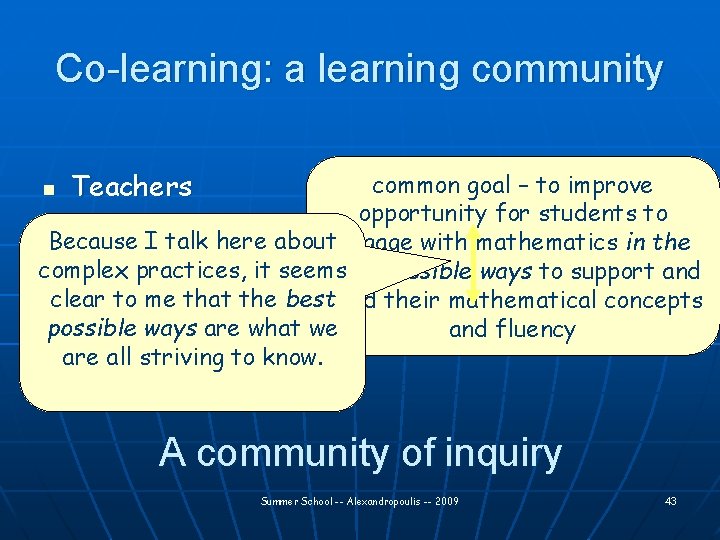
Co-learning: a learning community Teacher-researchers common goal – to improve n Teachers opportunity for students to Because I talk here aboutengage with mathematics in the complex practices, it seems best possible ways to support and n their Teacher-educatorclear to me that the best build mathematical concepts n Didacticians/teacher researchers possible ways are what we and fluency educators etc. are all striving to know. n A community of inquiry Summer School -- Alexandropoulis -- 2009 43
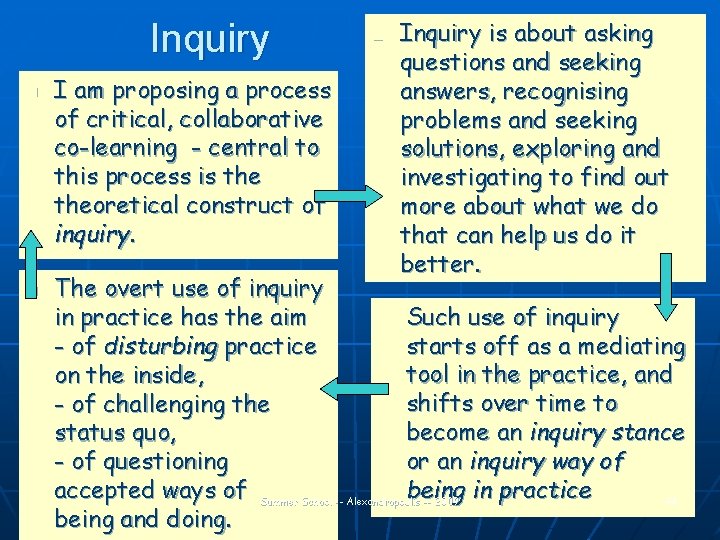
Inquiry n n I am proposing a process of critical, collaborative co-learning - central to this process is theoretical construct of inquiry. n Inquiry is about asking questions and seeking answers, recognising problems and seeking solutions, exploring and investigating to find out more about what we do that can help us do it better. The overt use of inquiry n Such use of inquiry in practice has the aim starts off as a mediating - of disturbing practice tool in the practice, and on the inside, shifts over time to - of challenging the become an inquiry stance status quo, or an inquiry way of - of questioning being in practice accepted ways of Summer School -- Alexandropoulis 44 -- 2009 being and doing.
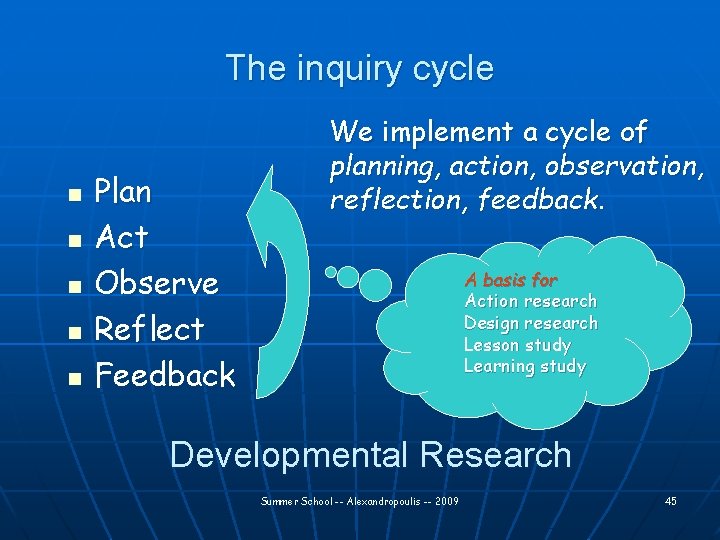
The inquiry cycle n n n Plan Act Observe Reflect Feedback We implement a cycle of planning, action, observation, reflection, feedback. A basis for Action research Design research Lesson study Learning study Developmental Research Summer School -- Alexandropoulis -- 2009 45
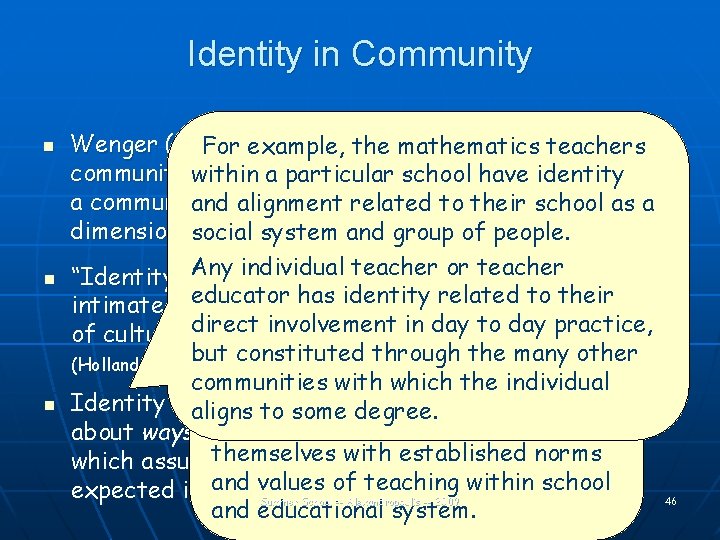
Identity in Community n n n Wenger (1998) ofthe people belonging teachers to a n. For speaks example, mathematics community within of practice, havingschool identity with regard to a particular have identity a community ofalignment practice, related in termstooftheir three and school as a dimensions: social engagement, imagination alignment. system and group ofand people. individual teacher or teacher “Identity is. Any an. For concept that figuratively combines the example, in practices of has identity related to their intimate oreducator personal world with the collective space mathematics learning and teaching, involvement in day to day practice, of cultural direct forms and social relations”. participants engage in their practice but constituted through the many other (Holland, Lachicotte , Skinner and Cain, 1998, p. use 5) alongside their peers, communities with which the individual imagination in interpreting their own Identity refers to ways of being and we can talk aligns to some degree. roles in in the practice and align about ways of being teaching-learning situations, with what established norms which assumethemselves alignment with is normal and values of teaching within school expected in those situations. 46 Summer School -- Alexandropoulis -- 2009 and educational system.
From Alignment to Critical Alignment n A community of practice becomes a community of inquiry when participants take on an inquiry identity … … that is, they start overtly to ask questions about their practice, while still, necessarily, aligning with its norms. n In the beginning, inquiry might be seen as a tool enabling investigation into or exploration of aspects of practice – a critical scrutiny of practice. Summer School -- Alexandropoulis -- 2009 47
n n n Thus, we see an inquiry identity growing within a Co. P and the people involved becoming inquirers in their practice; individuals, and the community as a whole, develop an inquiry way of being in practice, so that inquiry becomes a norm of practice with which to align. We might see the use of inquiry as a tool to be a form of critical alignment; that is engagement in and alignment with the practices of the community, while at the same time asking questions and reflecting critically. Critical alignment, through inquiry, is seen to be at the roots of an overt developmental process in which knowledge grows in practice. Summer School -- Alexandropoulis -- 2009 48
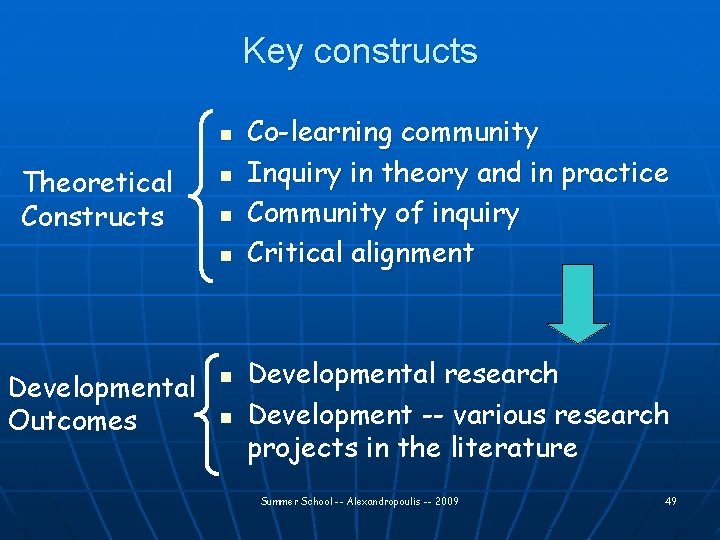
Key constructs n Theoretical Constructs n n n Developmental Outcomes n n Co-learning community Inquiry in theory and in practice Community of inquiry Critical alignment Developmental research Development -- various research projects in the literature Summer School -- Alexandropoulis -- 2009 49
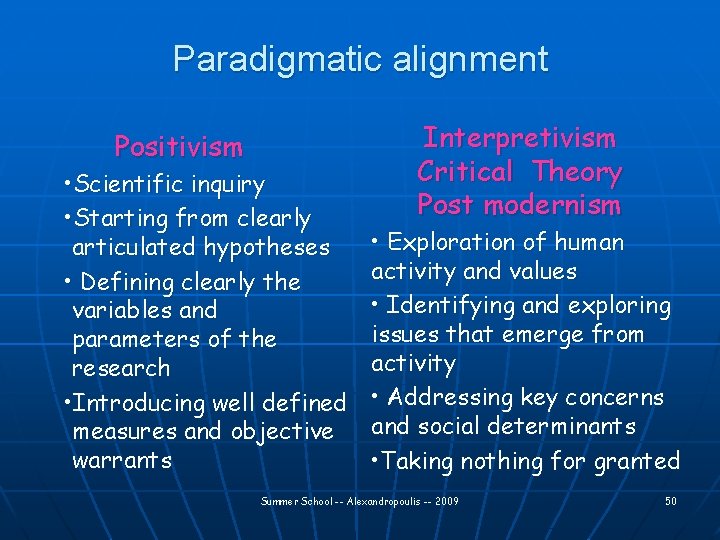
Paradigmatic alignment Positivism • Scientific inquiry • Starting from clearly articulated hypotheses • Defining clearly the variables and parameters of the research • Introducing well defined measures and objective warrants Interpretivism Critical Theory Post modernism • Exploration of human activity and values • Identifying and exploring issues that emerge from activity • Addressing key concerns and social determinants • Taking nothing for granted Summer School -- Alexandropoulis -- 2009 50

Thank You Summer School -- Alexandropoulis -- 2009
- Slides: 51