
InputOutput Organization 1 Lecture 37 Overview Peripheral Devices

- Slides: 3
Input/Output Organization 1 Lecture 37 Overview Ø Peripheral Devices Ø Input-Output Interface Ø Asynchronous Data Transfer Ø Modes of Transfer Ø Priority Interrupt Ø Direct Memory Access Ø Input-Output Processor Ø Serial Communication CSE 211, Computer Organization and Architecture Harjeet Kaur, CSE/IT
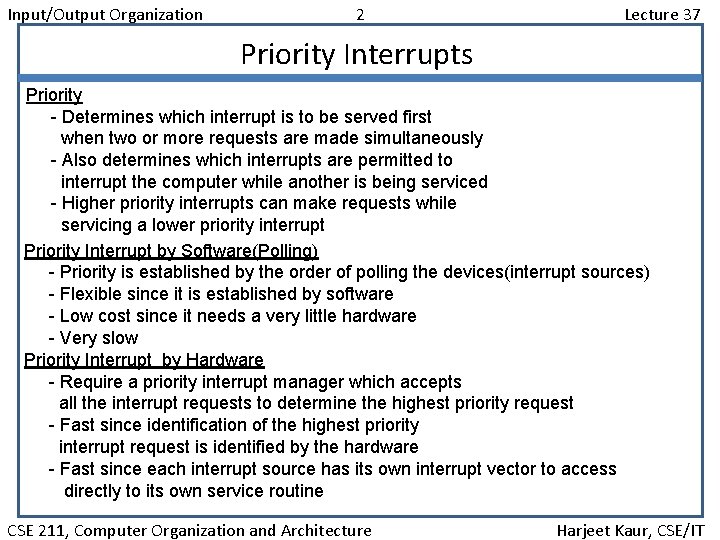
Input/Output Organization 2 Lecture 37 Priority Interrupts Priority - Determines which interrupt is to be served first when two or more requests are made simultaneously - Also determines which interrupts are permitted to interrupt the computer while another is being serviced - Higher priority interrupts can make requests while servicing a lower priority interrupt Priority Interrupt by Software(Polling) - Priority is established by the order of polling the devices(interrupt sources) - Flexible since it is established by software - Low cost since it needs a very little hardware - Very slow Priority Interrupt by Hardware - Require a priority interrupt manager which accepts all the interrupt requests to determine the highest priority request - Fast since identification of the highest priority interrupt request is identified by the hardware - Fast since each interrupt source has its own interrupt vector to access directly to its own service routine CSE 211, Computer Organization and Architecture Harjeet Kaur, CSE/IT
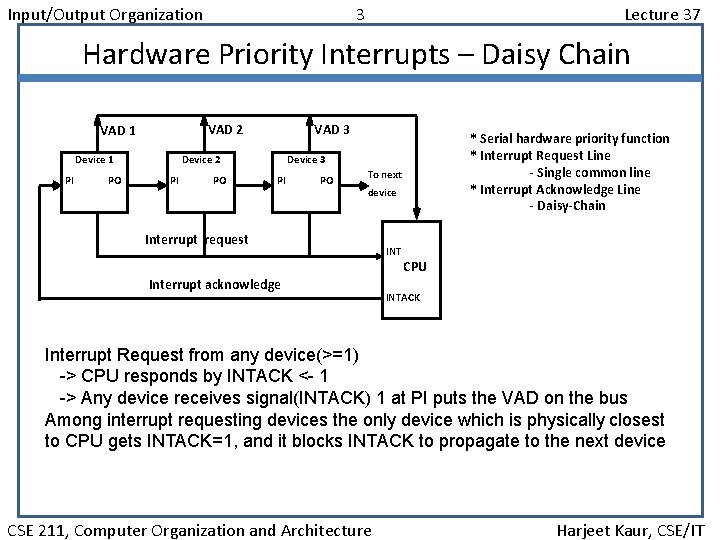
Input/Output Organization 3 Lecture 37 Hardware Priority Interrupts – Daisy Chain VAD 2 VAD 1 Device 1 PI PO VAD 3 Device 2 PI PO * Serial hardware priority function * Interrupt Request Line - Single common line * Interrupt Acknowledge Line - Daisy-Chain Device 3 PI PO To next device Interrupt request INT CPU Interrupt acknowledge INTACK Interrupt Request from any device(>=1) -> CPU responds by INTACK <- 1 -> Any device receives signal(INTACK) 1 at PI puts the VAD on the bus Among interrupt requesting devices the only device which is physically closest to CPU gets INTACK=1, and it blocks INTACK to propagate to the next device CSE 211, Computer Organization and Architecture Harjeet Kaur, CSE/IT