
Input Output Models Finite 3 5 Application in
![Open Leontief Model The matrix A = [aij], i, j = 1, 2, …](https://slidetodoc.com/presentation_image_h/a00279743cee3b450a843038b5d912a8/image-7.jpg "Open Leontief Model The matrix A = [aij], i, j = 1, 2, …")


- Slides: 26
Input Output Models Finite 3 -5
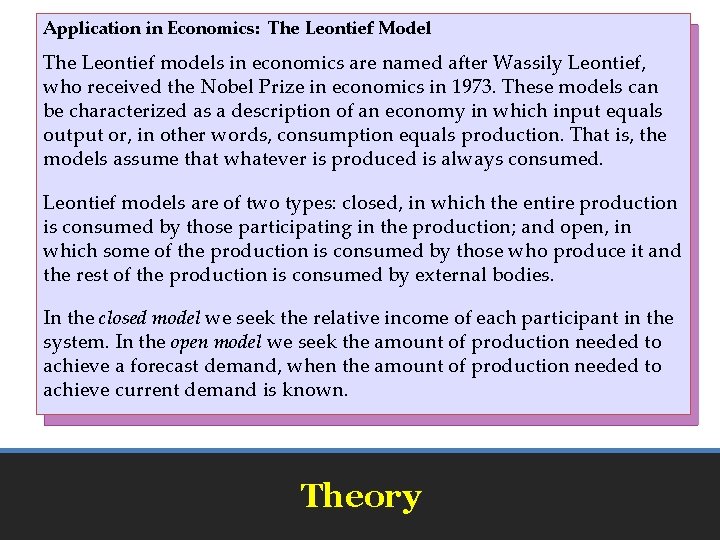
Application in Economics: The Leontief Model The Leontief models in economics are named after Wassily Leontief, who received the Nobel Prize in economics in 1973. These models can be characterized as a description of an economy in which input equals output or, in other words, consumption equals production. That is, the models assume that whatever is produced is always consumed. Leontief models are of two types: closed, in which the entire production is consumed by those participating in the production; and open, in which some of the production is consumed by those who produce it and the rest of the production is consumed by external bodies. In the closed model we seek the relative income of each participant in the system. In the open model we seek the amount of production needed to achieve a forecast demand, when the amount of production needed to achieve current demand is known. Theory
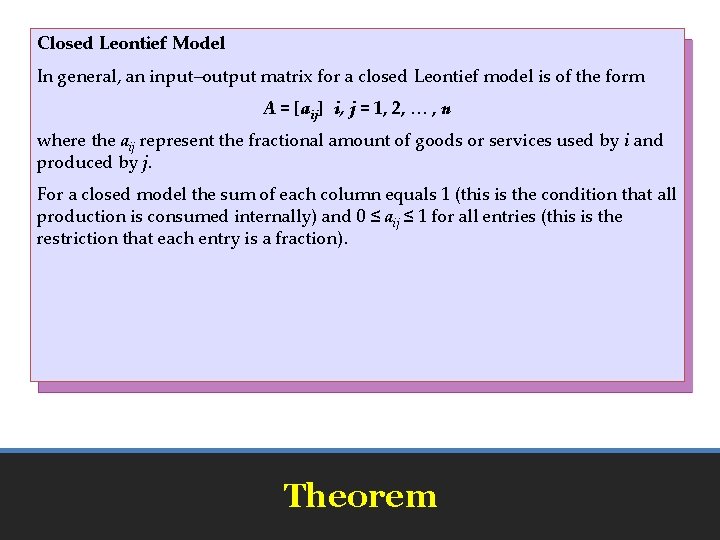
Closed Leontief Model In general, an input–output matrix for a closed Leontief model is of the form A = [aij] i, j = 1, 2, … , n where the aij represent the fractional amount of goods or services used by i and produced by j. For a closed model the sum of each column equals 1 (this is the condition that all production is consumed internally) and 0 ≤ aij ≤ 1 for all entries (this is the restriction that each entry is a fraction). Theorem
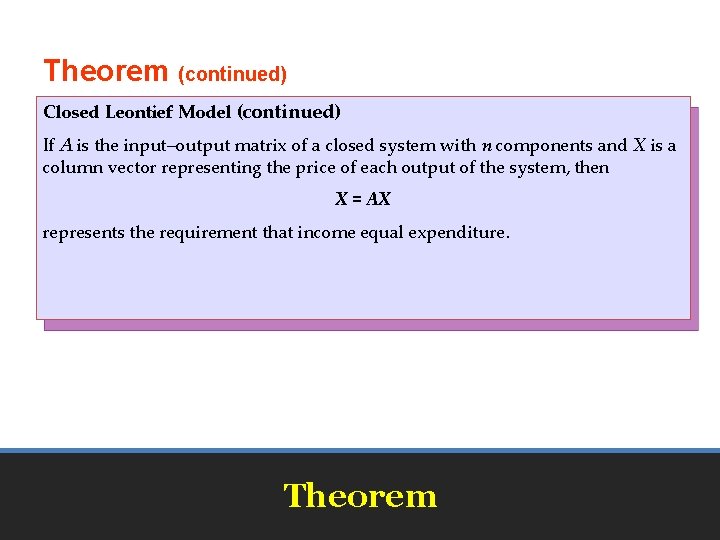
Theorem (continued) Closed Leontief Model (continued) If A is the input–output matrix of a closed system with n components and X is a column vector representing the price of each output of the system, then X = AX represents the requirement that income equal expenditure. Theorem
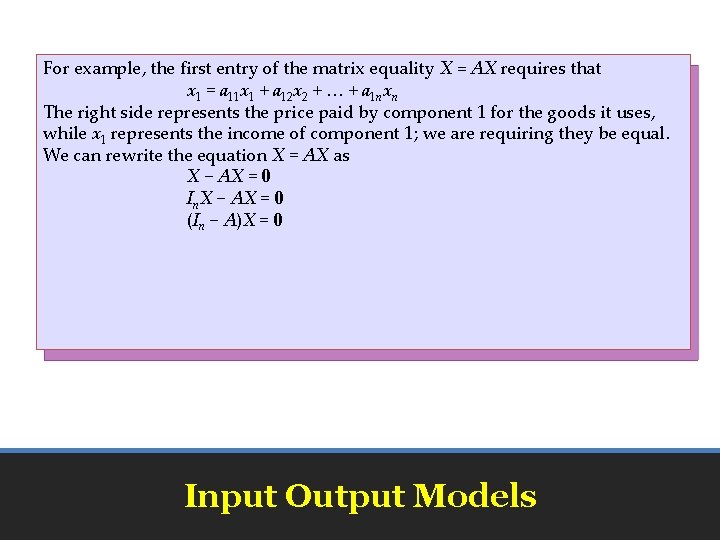
For example, the first entry of the matrix equality X = AX requires that x 1 = a 11 x 1 + a 12 x 2 + … + a 1 nxn The right side represents the price paid by component 1 for the goods it uses, while x 1 represents the income of component 1; we are requiring they be equal. We can rewrite the equation X = AX as X − AX = 0 In. X − AX = 0 (In − A)X = 0 Input Output Models
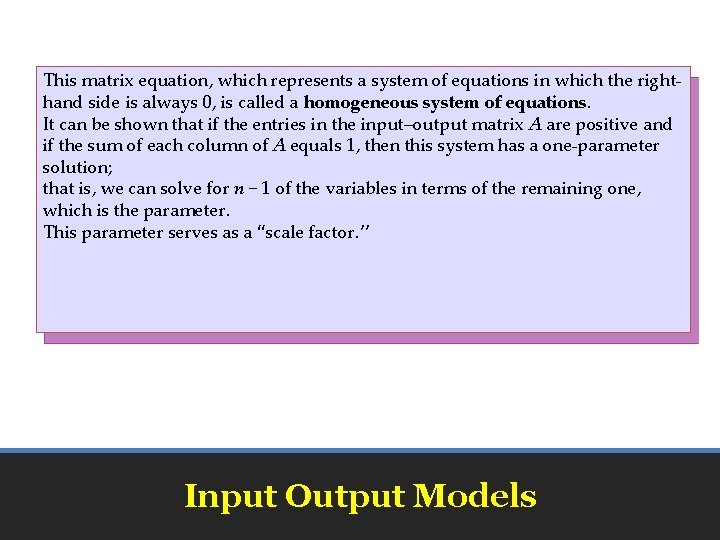
This matrix equation, which represents a system of equations in which the righthand side is always 0, is called a homogeneous system of equations. It can be shown that if the entries in the input–output matrix A are positive and if the sum of each column of A equals 1, then this system has a one-parameter solution; that is, we can solve for n − 1 of the variables in terms of the remaining one, which is the parameter. This parameter serves as a “scale factor. ’’ Input Output Models
Open Leontief Model The matrix A = [aij], i, j = 1, 2, … , n of the open model is defined to consist of entries aij, where aij is the amount of output of industry j required for one unit of output of industry i. If X is a column vector representing the production of each industry in the system and D is a column vector representing future demand for goods produced in the system, then X = AX + D Input Output Models
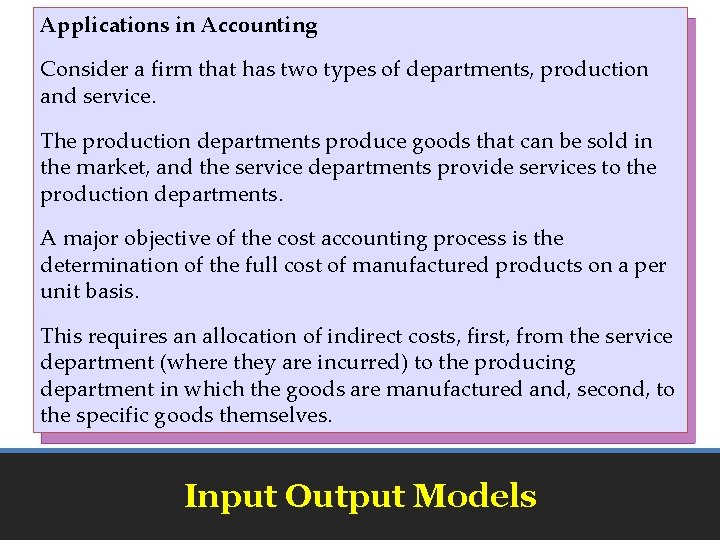
Applications in Accounting Consider a firm that has two types of departments, production and service. The production departments produce goods that can be sold in the market, and the service departments provide services to the production departments. A major objective of the cost accounting process is the determination of the full cost of manufactured products on a per unit basis. This requires an allocation of indirect costs, first, from the service department (where they are incurred) to the producing department in which the goods are manufactured and, second, to the specific goods themselves. Input Output Models
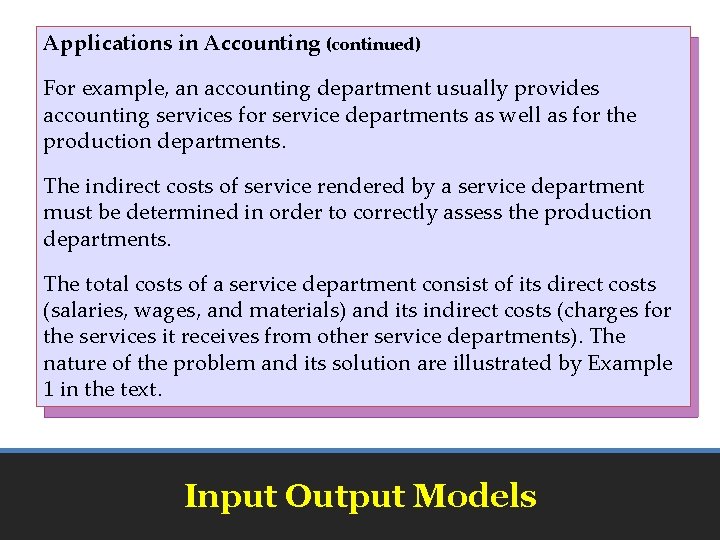
Applications in Accounting (continued) For example, an accounting department usually provides accounting services for service departments as well as for the production departments. The indirect costs of service rendered by a service department must be determined in order to correctly assess the production departments. The total costs of a service department consist of its direct costs (salaries, wages, and materials) and its indirect costs (charges for the services it receives from other service departments). The nature of the problem and its solution are illustrated by Example 1 in the text. Input Output Models
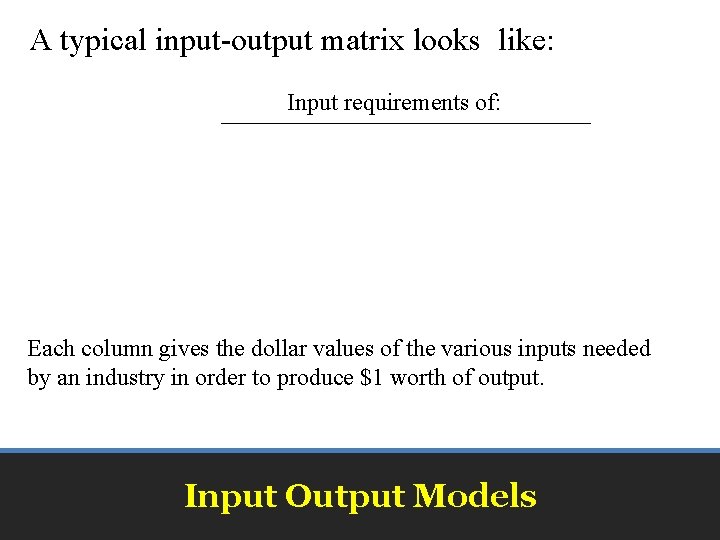
A typical input-output matrix looks like: Input requirements of: Each column gives the dollar values of the various inputs needed by an industry in order to produce $1 worth of output. Input Output Models
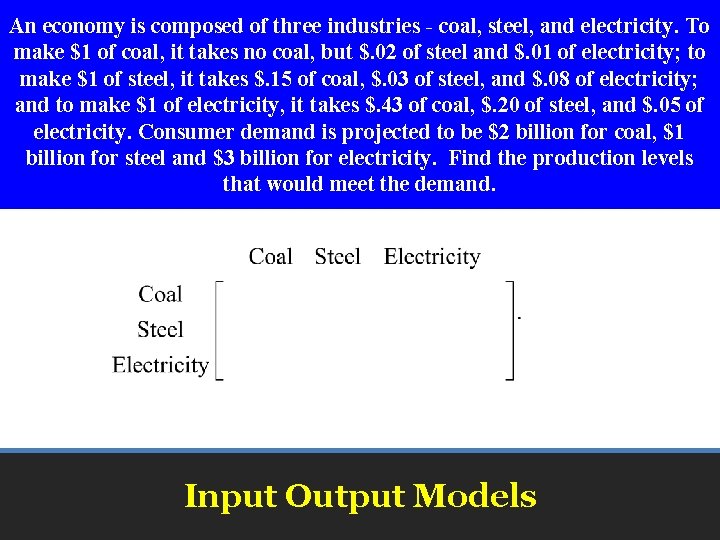
An economy is composed of three industries - coal, steel, and electricity. To make $1 of coal, it takes no coal, but $. 02 of steel and $. 01 of electricity; to make $1 of steel, it takes $. 15 of coal, $. 03 of steel, and $. 08 of electricity; and to make $1 of electricity, it takes $. 43 of coal, $. 20 of steel, and $. 05 of electricity. Consumer demand is projected to be $2 billion for coal, $1 billion for steel and $3 billion for electricity. Find the production levels that would meet the demand. Input Output Models
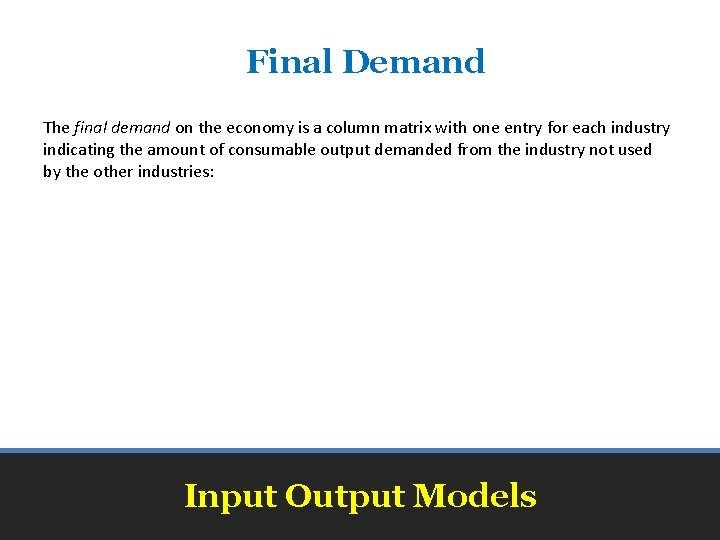
Final Demand The final demand on the economy is a column matrix with one entry for each industry indicating the amount of consumable output demanded from the industry not used by the other industries: Input Output Models
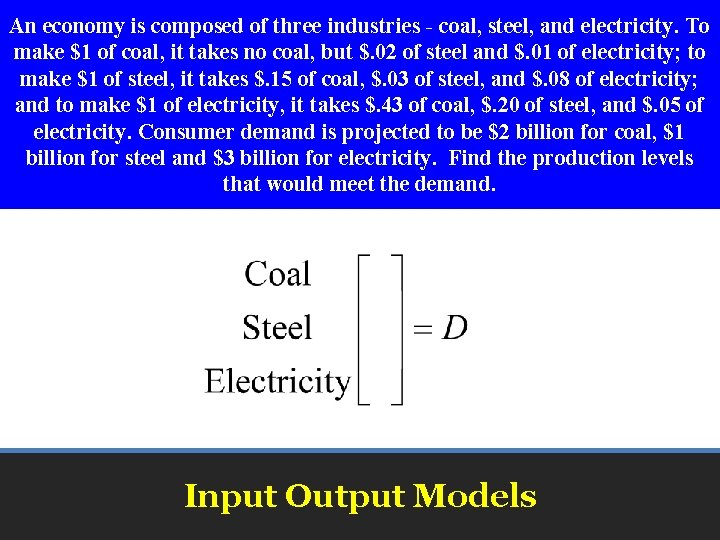
An economy is composed of three industries - coal, steel, and electricity. To make $1 of coal, it takes no coal, but $. 02 of steel and $. 01 of electricity; to make $1 of steel, it takes $. 15 of coal, $. 03 of steel, and $. 08 of electricity; and to make $1 of electricity, it takes $. 43 of coal, $. 20 of steel, and $. 05 of electricity. Consumer demand is projected to be $2 billion for coal, $1 billion for steel and $3 billion for electricity. Find the production levels that would meet the demand. Input Output Models
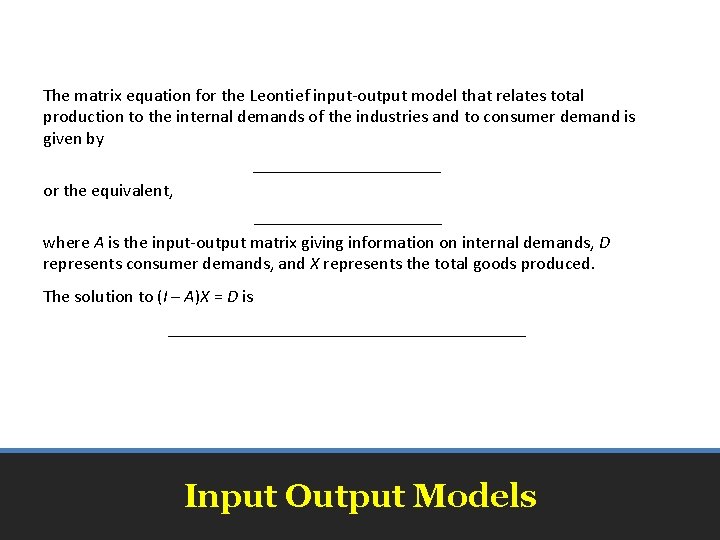
The matrix equation for the Leontief input-output model that relates total production to the internal demands of the industries and to consumer demand is given by ___________ or the equivalent, ___________ where A is the input-output matrix giving information on internal demands, D represents consumer demands, and X represents the total goods produced. The solution to (I – A)X = D is ____________________ Input Output Models
An economy is composed of three industries - coal, steel, and electricity. To make $1 of coal, it takes no coal, but $. 02 of steel and $. 01 of electricity; to make $1 of steel, it takes $. 15 of coal, $. 03 of steel, and $. 08 of electricity; and to make $1 of electricity, it takes $. 43 of coal, $. 20 of steel, and $. 05 of electricity. Consumer demand is projected to be $2 billion for coal, $1 billion for steel and $3 billion for electricity. Find the production levels that would meet the demand. Input Output Models
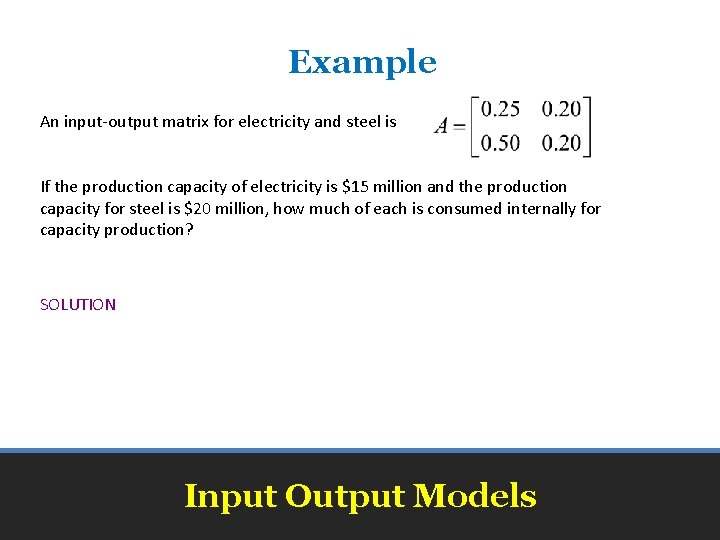
Example An input-output matrix for electricity and steel is If the production capacity of electricity is $15 million and the production capacity for steel is $20 million, how much of each is consumed internally for capacity production? SOLUTION Input Output Models
Input Output Models
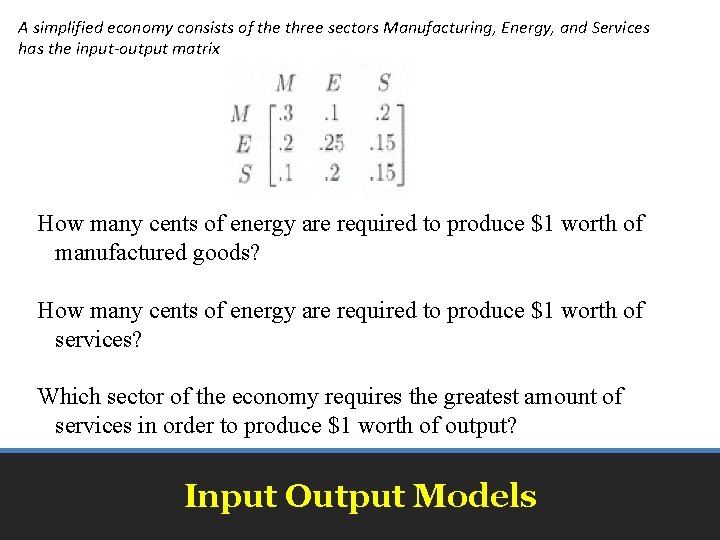
A simplified economy consists of the three sectors Manufacturing, Energy, and Services has the input-output matrix How many cents of energy are required to produce $1 worth of manufactured goods? How many cents of energy are required to produce $1 worth of services? Which sector of the economy requires the greatest amount of services in order to produce $1 worth of output? Input Output Models
What is the dollar amount of the energy costs needed to produce 10 million dollars worth of goods from each sector? Input Output Models
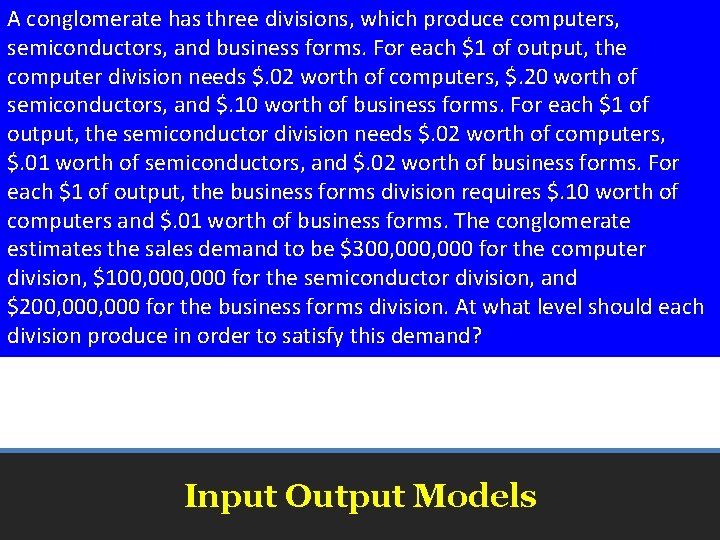
A conglomerate has three divisions, which produce computers, semiconductors, and business forms. For each $1 of output, the computer division needs $. 02 worth of computers, $. 20 worth of semiconductors, and $. 10 worth of business forms. For each $1 of output, the semiconductor division needs $. 02 worth of computers, $. 01 worth of semiconductors, and $. 02 worth of business forms. For each $1 of output, the business forms division requires $. 10 worth of computers and $. 01 worth of business forms. The conglomerate estimates the sales demand to be $300, 000 for the computer division, $100, 000 for the semiconductor division, and $200, 000 for the business forms division. At what level should each division produce in order to satisfy this demand? Input Output Models
Suppose that the conglomerate of the previous example is faced with an increase of 50% in demand for computers, a doubling in demand for semiconductors, and a decrease of 50% in demand for business forms. At what levels should the various divisions produce in order to satisfy the new demand? Input Output Models
Suppose that the conglomerate experiences a doubling in the demand for business forms. At what levels should the computer and semiconductor divisions produce? Input Output Models
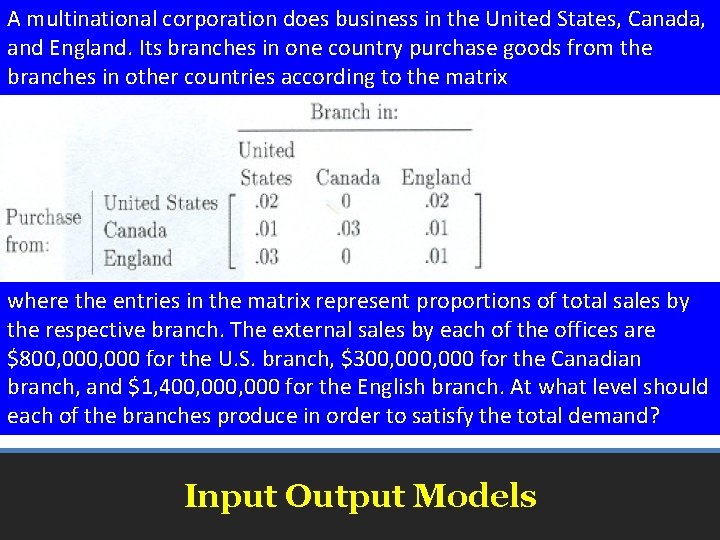
A multinational corporation does business in the United States, Canada, and England. Its branches in one country purchase goods from the branches in other countries according to the matrix where the entries in the matrix represent proportions of total sales by the respective branch. The external sales by each of the offices are $800, 000 for the U. S. branch, $300, 000 for the Canadian branch, and $1, 400, 000 for the English branch. At what level should each of the branches produce in order to satisfy the total demand? Input Output Models
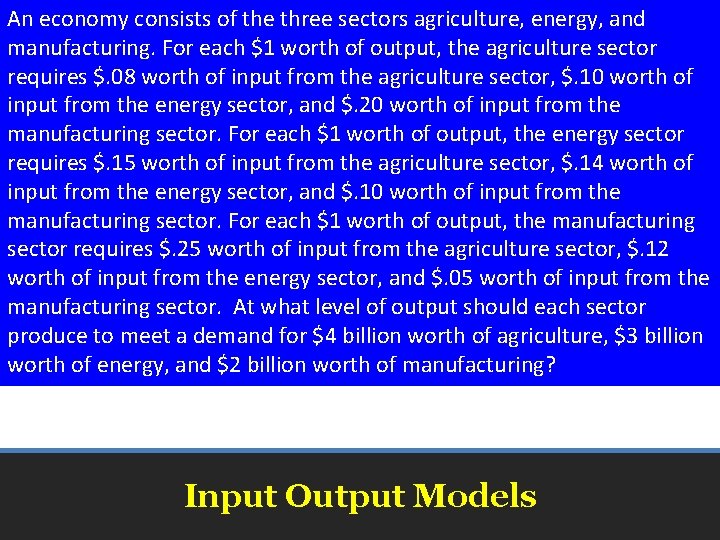
An economy consists of the three sectors agriculture, energy, and manufacturing. For each $1 worth of output, the agriculture sector requires $. 08 worth of input from the agriculture sector, $. 10 worth of input from the energy sector, and $. 20 worth of input from the manufacturing sector. For each $1 worth of output, the energy sector requires $. 15 worth of input from the agriculture sector, $. 14 worth of input from the energy sector, and $. 10 worth of input from the manufacturing sector. For each $1 worth of output, the manufacturing sector requires $. 25 worth of input from the agriculture sector, $. 12 worth of input from the energy sector, and $. 05 worth of input from the manufacturing sector. At what level of output should each sector produce to meet a demand for $4 billion worth of agriculture, $3 billion worth of energy, and $2 billion worth of manufacturing? Input Output Models
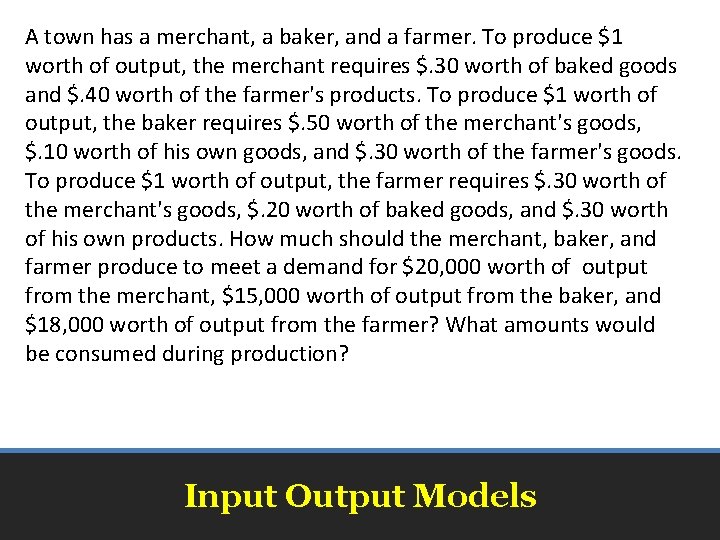
A town has a merchant, a baker, and a farmer. To produce $1 worth of output, the merchant requires $. 30 worth of baked goods and $. 40 worth of the farmer's products. To produce $1 worth of output, the baker requires $. 50 worth of the merchant's goods, $. 10 worth of his own goods, and $. 30 worth of the farmer's goods. To produce $1 worth of output, the farmer requires $. 30 worth of the merchant's goods, $. 20 worth of baked goods, and $. 30 worth of his own products. How much should the merchant, baker, and farmer produce to meet a demand for $20, 000 worth of output from the merchant, $15, 000 worth of output from the baker, and $18, 000 worth of output from the farmer? What amounts would be consumed during production? Input Output Models
• Homework • Pages 102 – 104 • 5, 9, 21, 24 Input Output Models