
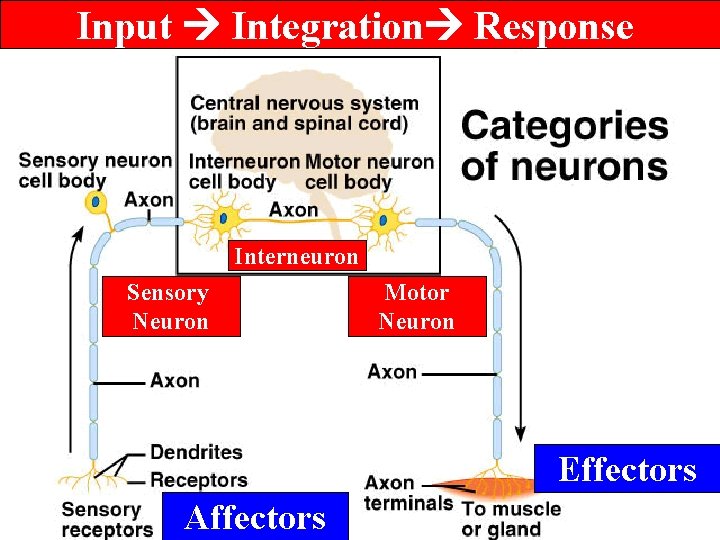
Input Integration Response Interneuron Sensory Neuron Motor Neuron



- Slides: 35
Input Integration Response Interneuron Sensory Neuron Motor Neuron Effectors Affectors
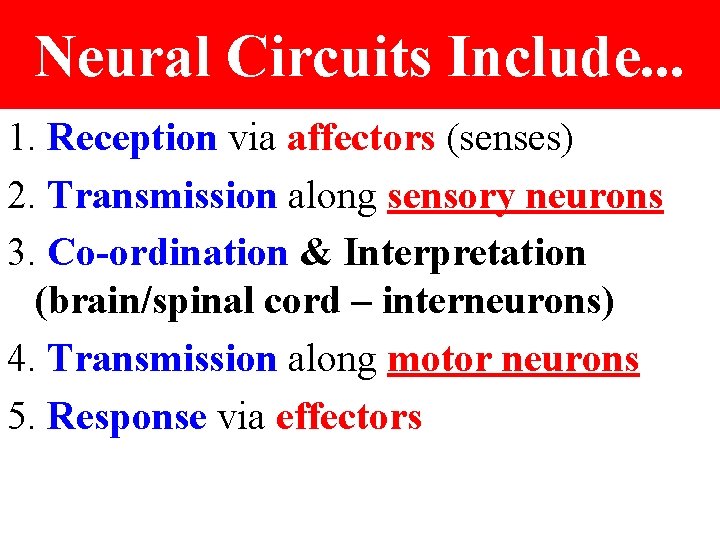
Neural Circuits Include. . . 1. Reception via affectors (senses) 2. Transmission along sensory neurons 3. Co-ordination & Interpretation (brain/spinal cord – interneurons) 4. Transmission along motor neurons 5. Response via effectors
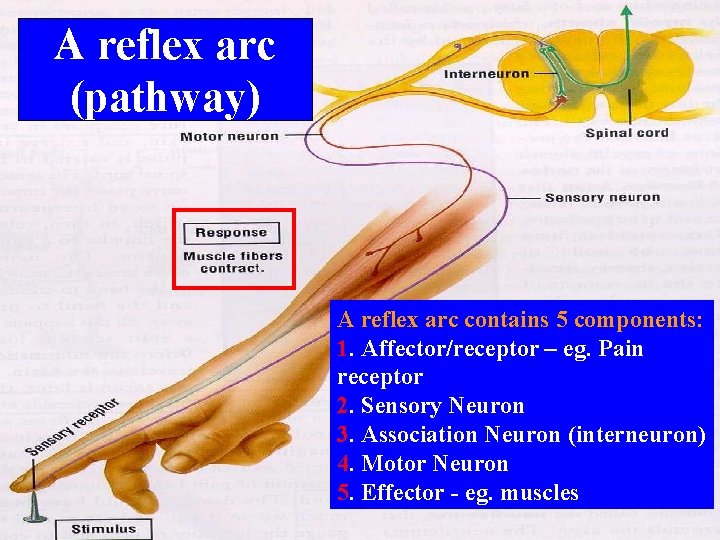
A reflex arc (pathway) A reflex arc contains 5 components: 1. Affector/receptor – eg. Pain receptor 2. Sensory Neuron 3. Association Neuron (interneuron) 4. Motor Neuron 5. Effector - eg. muscles
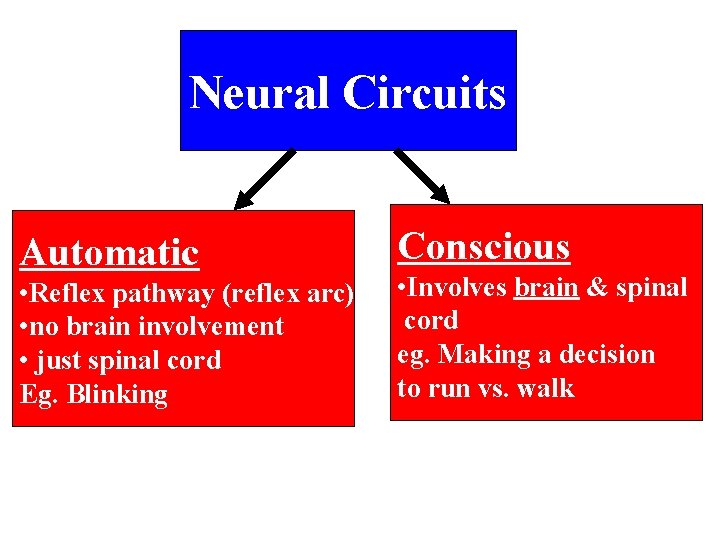
Neural Circuits Automatic • Reflex pathway (reflex arc) • no brain involvement • just spinal cord Eg. Blinking Conscious • Involves brain & spinal cord eg. Making a decision to run vs. walk
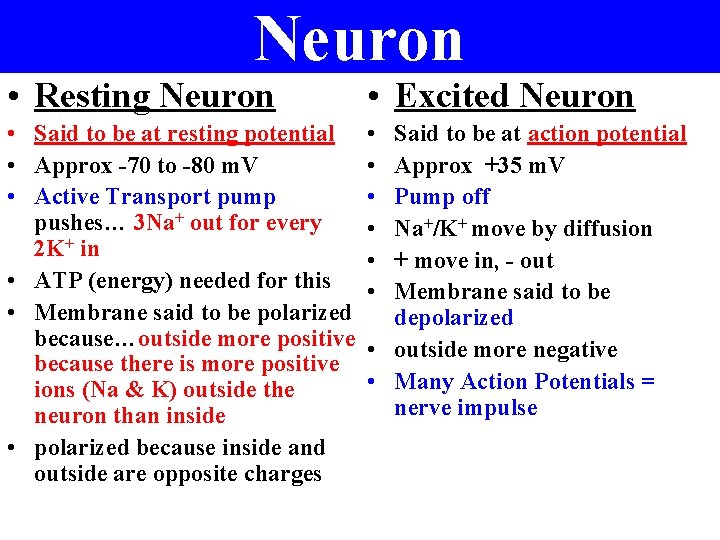
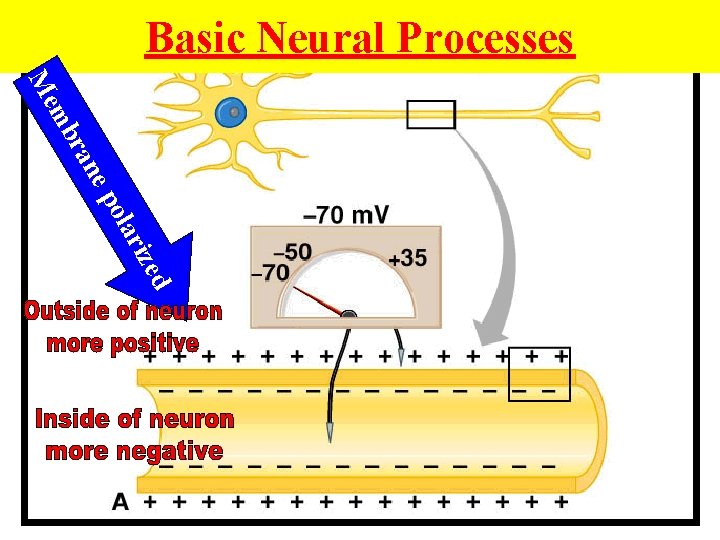
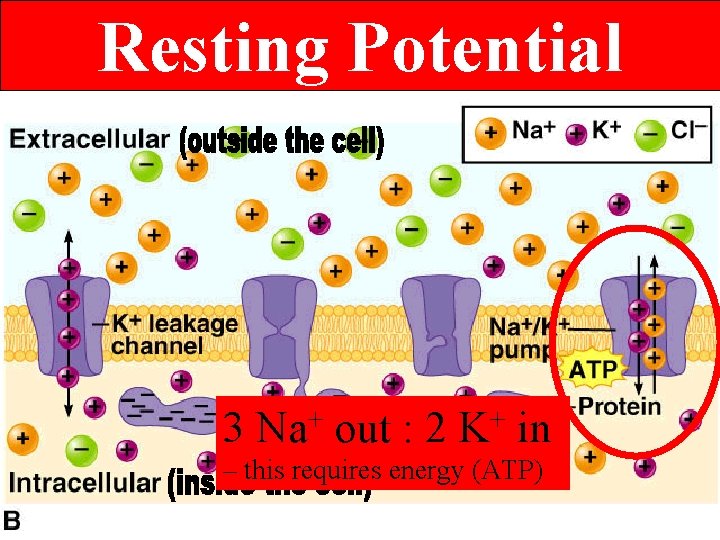
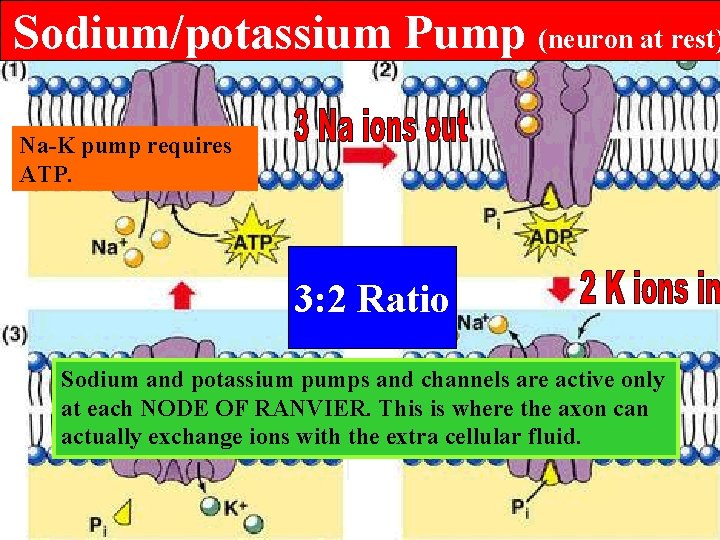
Neuron • Resting Neuron • Excited Neuron • Said to be at resting potential • Approx -70 to -80 m. V • Active Transport pump pushes… 3 Na+ out for every 2 K+ in • ATP (energy) needed for this • Membrane said to be polarized because…outside more positive because there is more positive ions (Na & K) outside the neuron than inside • polarized because inside and outside are opposite charges • • • Said to be at action potential Approx +35 m. V Pump off Na+/K+ move by diffusion + move in, - out Membrane said to be depolarized • outside more negative • Many Action Potentials = nerve impulse
Basic Neural Processes ep ran mb Me ed riz ola
Resting Potential 3 Na+ out : 2 K+ in – this requires energy (ATP)
Sodium/potassium Pump (neuron at rest) Na-K pump requires ATP. 3: 2 Ratio Sodium and potassium pumps and channels are active only at each NODE OF RANVIER. This is where the axon can actually exchange ions with the extra cellular fluid.
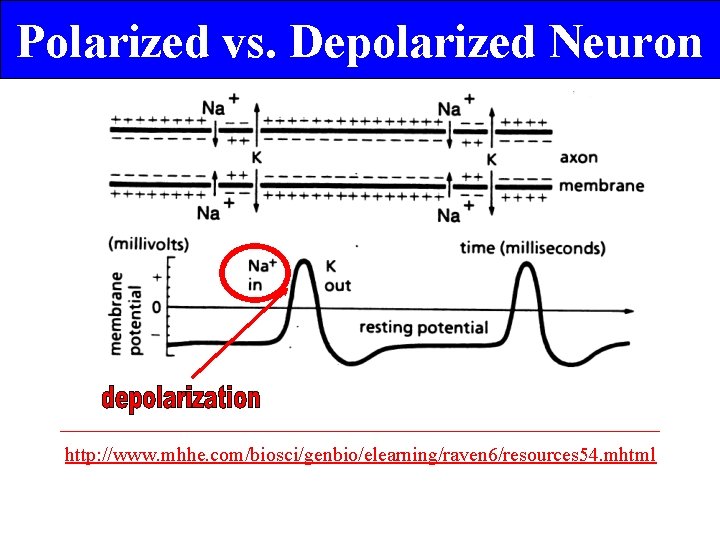
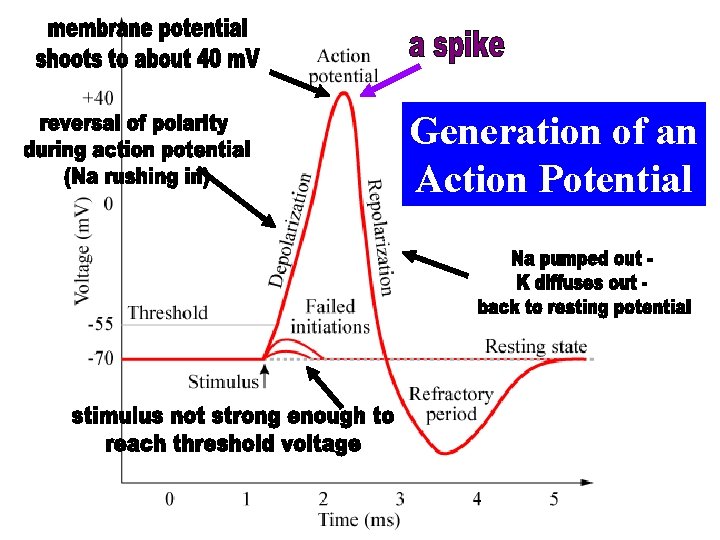
• Electrical, chemical, or mechanical stimulus will alter the resting potential by causing more sodium to leak back into the neuron; this changes the polarity slightly • If the stimulus is strong enough to bring the inside to about -55 m. V, a THRESHOLD voltage has been reached. • Once this occurs, the sodium channels immediately open wide and potassium channels close. • This causes the inside to be more positive than the outside, due to the rushing in of positive Na ions (Depolarization of Neuron).
Polarized vs. Depolarized Neuron http: //www. mhhe. com/biosci/genbio/elearning/raven 6/resources 54. mhtml
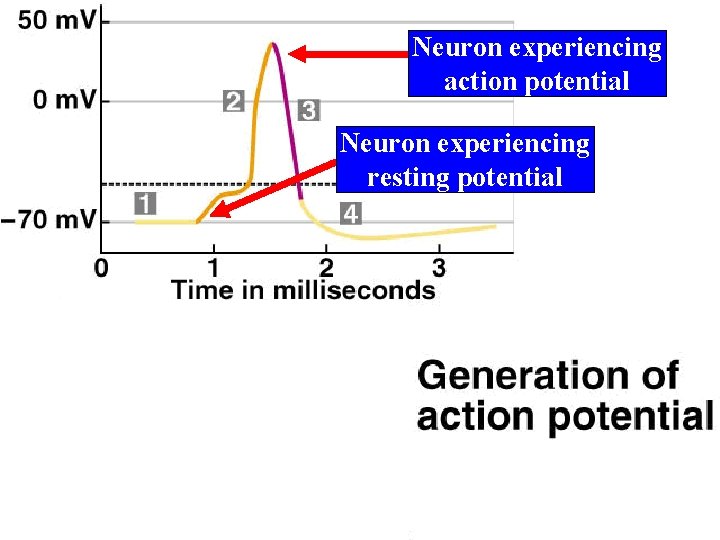
Neuron experiencing action potential Neuron experiencing resting potential
Generation of an Action Potential
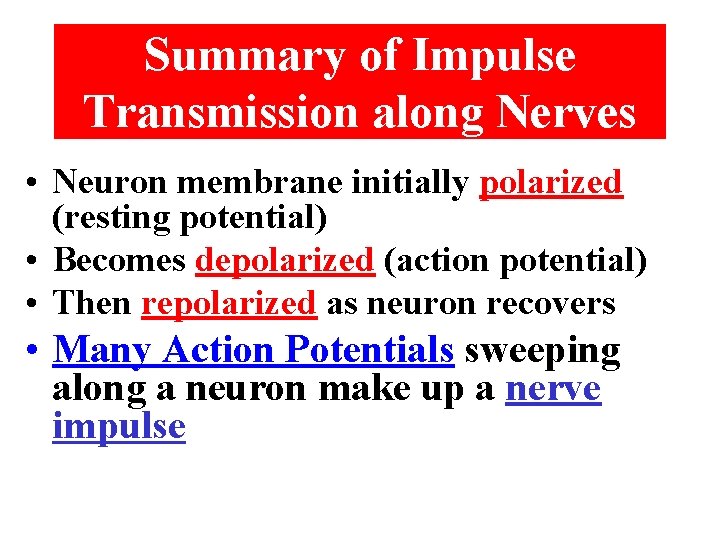
Summary of Impulse Transmission along Nerves • Neuron membrane initially polarized (resting potential) • Becomes depolarized (action potential) • Then repolarized as neuron recovers • Many Action Potentials sweeping along a neuron make up a nerve impulse
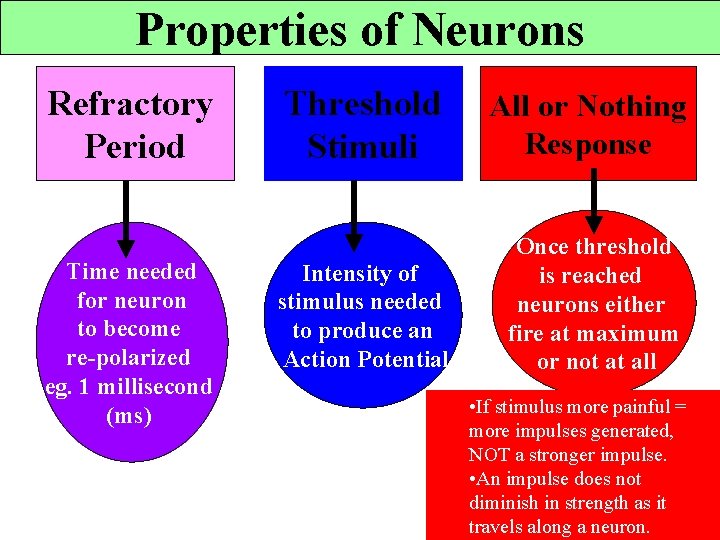
Properties of Neurons Refractory Period Time needed for neuron to become re-polarized eg. 1 millisecond (ms) Threshold Stimuli All or Nothing Response Intensity of stimulus needed to produce an Action Potential Once threshold is reached neurons either fire at maximum or not at all • If stimulus more painful = more impulses generated, NOT a stronger impulse. • An impulse does not diminish in strength as it travels along a neuron.
This is cool! Excellent website
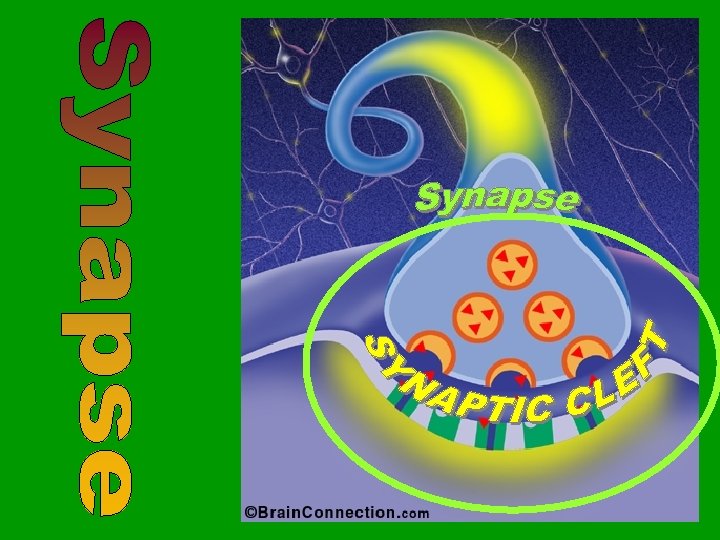
The Synapse Pre SF Post SF Excellent website
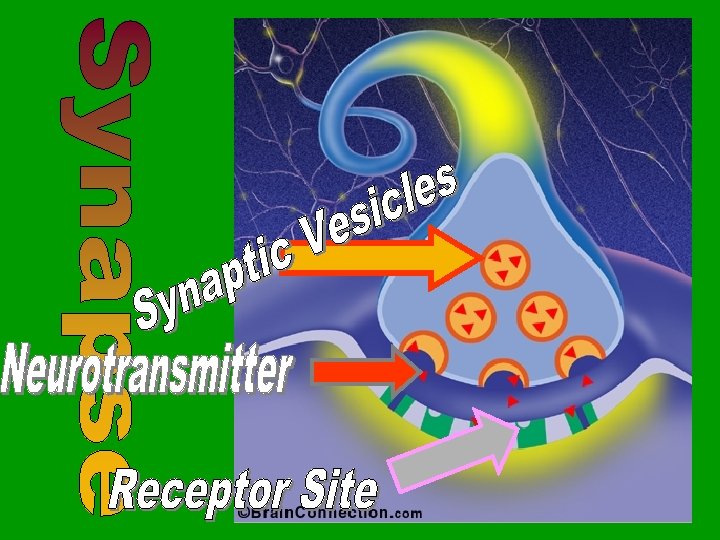
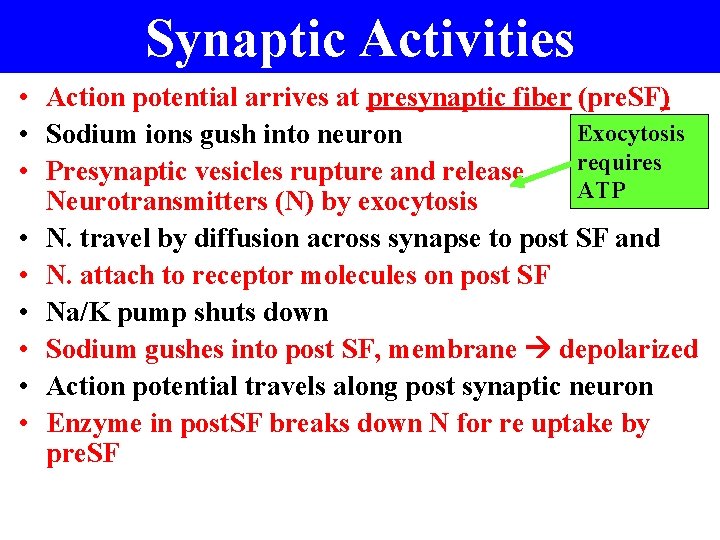
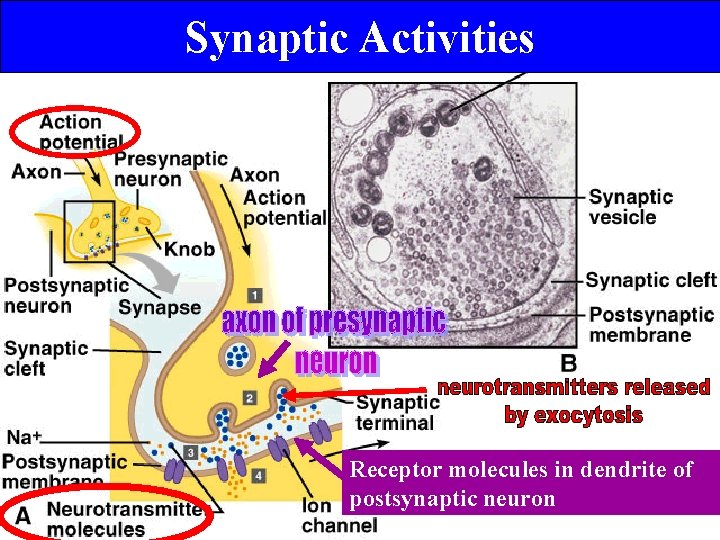
Synaptic Activities • Action potential arrives at presynaptic fiber (pre. SF) Exocytosis • Sodium ions gush into neuron requires • Presynaptic vesicles rupture and release ATP Neurotransmitters (N) by exocytosis • N. travel by diffusion across synapse to post SF and • N. attach to receptor molecules on post SF • Na/K pump shuts down • Sodium gushes into post SF, membrane depolarized • Action potential travels along post synaptic neuron • Enzyme in post. SF breaks down N for re uptake by pre. SF
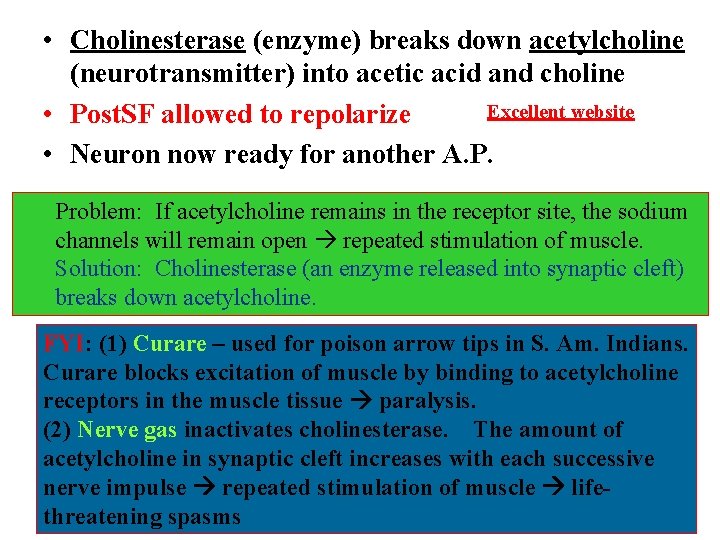
• Cholinesterase (enzyme) breaks down acetylcholine (neurotransmitter) into acetic acid and choline Excellent website • Post. SF allowed to repolarize • Neuron now ready for another A. P. Problem: If acetylcholine remains in the receptor site, the sodium channels will remain open repeated stimulation of muscle. Solution: Cholinesterase (an enzyme released into synaptic cleft) breaks down acetylcholine. FYI: (1) Curare – used for poison arrow tips in S. Am. Indians. Curare blocks excitation of muscle by binding to acetylcholine receptors in the muscle tissue paralysis. (2) Nerve gas inactivates cholinesterase. The amount of acetylcholine in synaptic cleft increases with each successive nerve impulse repeated stimulation of muscle lifethreatening spasms
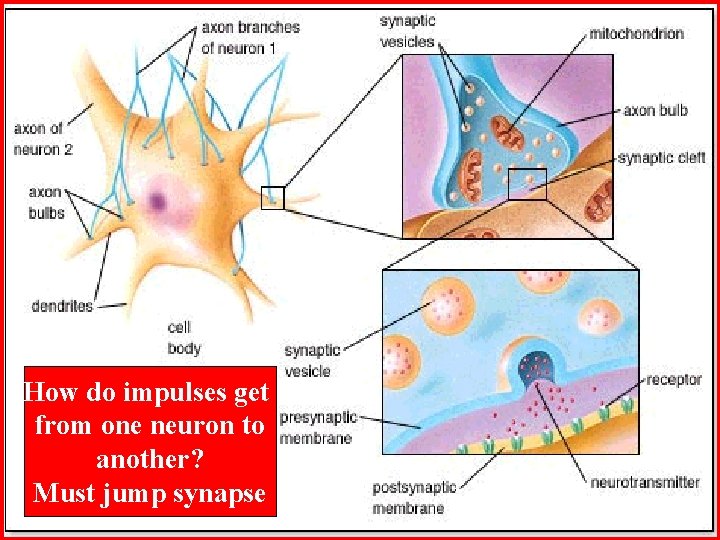
How do impulses get from one neuron to another? Must jump synapse
Synaptic Activities Receptor molecules in dendrite of postsynaptic neuron
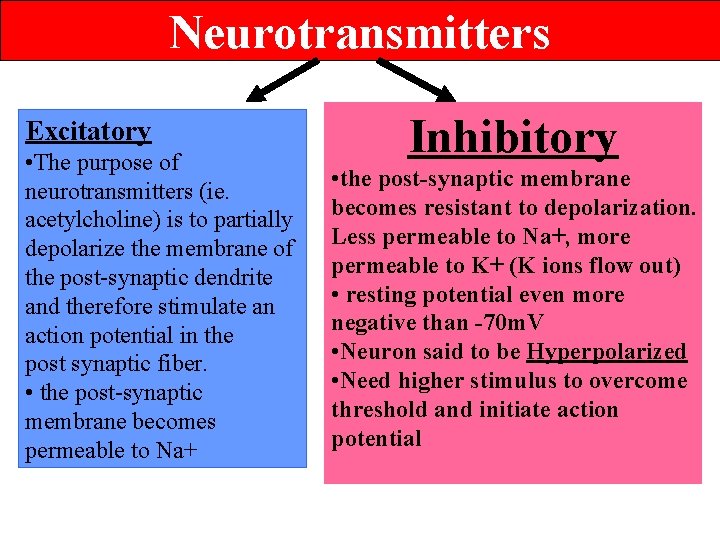
Neurotransmitters Excitatory • The purpose of neurotransmitters (ie. acetylcholine) is to partially depolarize the membrane of the post-synaptic dendrite and therefore stimulate an action potential in the post synaptic fiber. • the post-synaptic membrane becomes permeable to Na+ Inhibitory • the post-synaptic membrane becomes resistant to depolarization. Less permeable to Na+, more permeable to K+ (K ions flow out) • resting potential even more negative than -70 m. V • Neuron said to be Hyperpolarized • Need higher stimulus to overcome threshold and initiate action potential
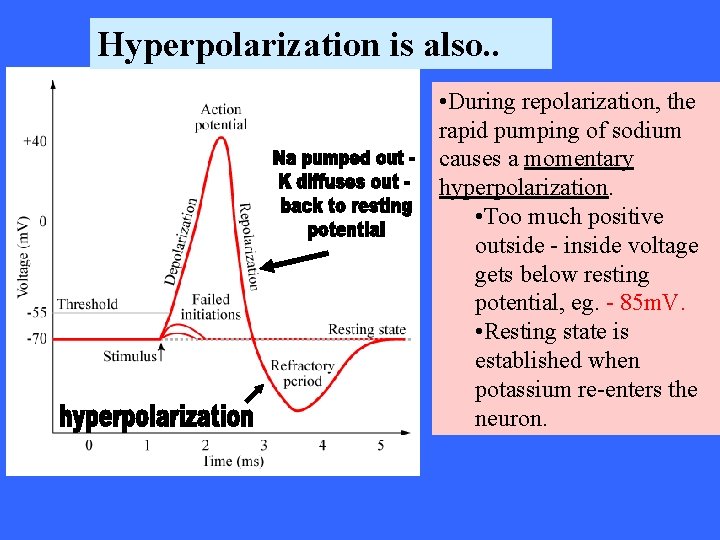
Hyperpolarization is also. . • During repolarization, the rapid pumping of sodium causes a momentary hyperpolarization. • Too much positive outside - inside voltage gets below resting potential, eg. - 85 m. V. • Resting state is established when potassium re-enters the neuron.
Summation • The production of an Action Potential in one neuron often requires the sum of 2 excitatory neurons! • Stimulation of these 2 neurons is necessary to cause a sufficient amount of neurotransmitter to be released to cause depolarization of the post Synaptic Fiber.
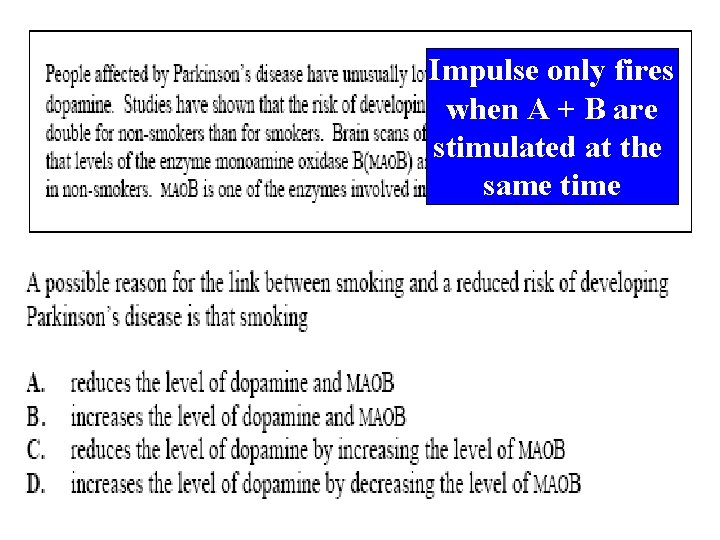
Impulse only fires when A + B are stimulated at the same time
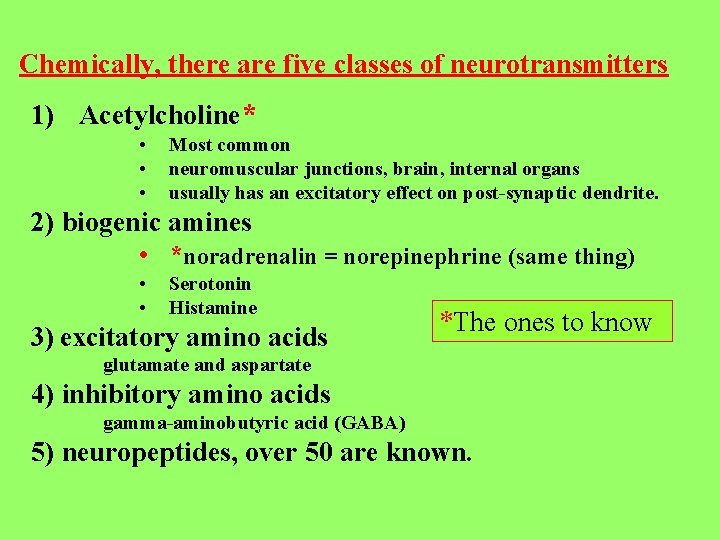
Chemically, there are five classes of neurotransmitters 1) Acetylcholine* • • • Most common neuromuscular junctions, brain, internal organs usually has an excitatory effect on post-synaptic dendrite. 2) biogenic amines • *noradrenalin = norepinephrine (same thing) • • Serotonin Histamine 3) excitatory amino acids *The ones to know glutamate and aspartate 4) inhibitory amino acids gamma-aminobutyric acid (GABA) 5) neuropeptides, over 50 are known.
Neurotransmitters Alcohol and Neurotransmitters Drugs and Neurotransmitters
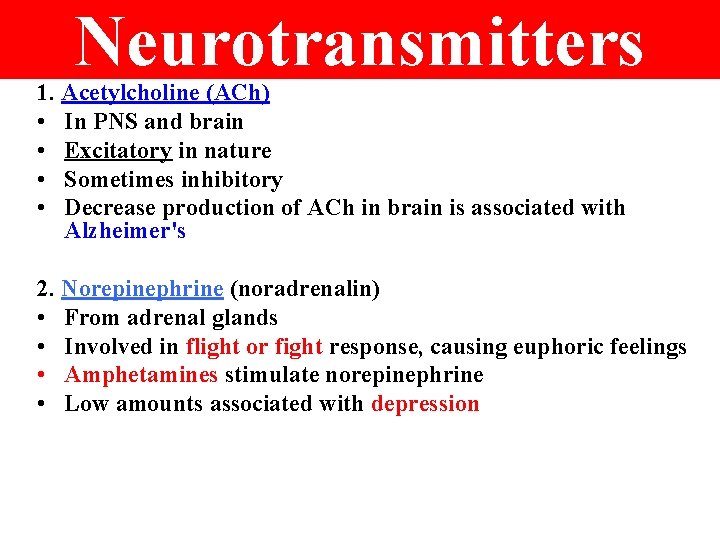
Neurotransmitters 1. Acetylcholine (ACh) • In PNS and brain • Excitatory in nature • Sometimes inhibitory • Decrease production of ACh in brain is associated with Alzheimer's 2. Norepinephrine (noradrenalin) • From adrenal glands • Involved in flight or fight response, causing euphoric feelings • Amphetamines stimulate norepinephrine • Low amounts associated with depression
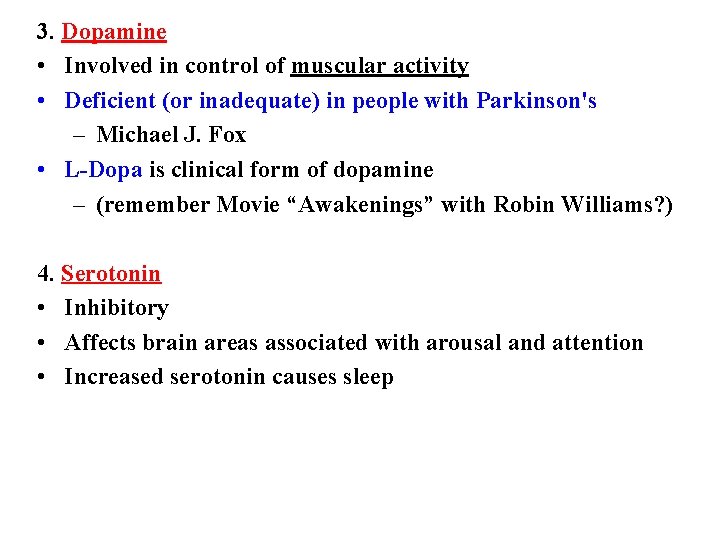
3. Dopamine • Involved in control of muscular activity • Deficient (or inadequate) in people with Parkinson's – Michael J. Fox • L-Dopa is clinical form of dopamine – (remember Movie “Awakenings” with Robin Williams? ) 4. Serotonin • Inhibitory • Affects brain areas associated with arousal and attention • Increased serotonin causes sleep
5. GABA (gamma aminobutyric acid) • Major inhibitory neurotransmitter • Low levels linked to Huntington’s disease 6. Endorphins (‘morphine-like’ substances) • generally inhibitory • Natural pain killers (and relieve stress, elevate mood) • Effects mimicked by morphine, heroin, methadone Red heads and pain – latest research
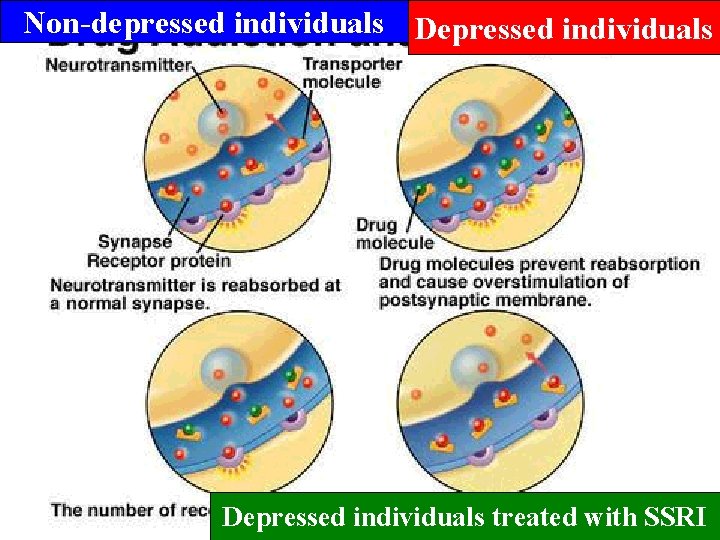
FYI: Depression and Serotonin • Serotonin is lacking in the synapses of people suffering from depression • Thought to be taken back up too quickly by Pre Synaptic Fiber • Drugs can be used to prevent reuptake of Serotonin • These include Prozac and Zoloft
Non-depressed individuals Depressed individuals treated with SSRI
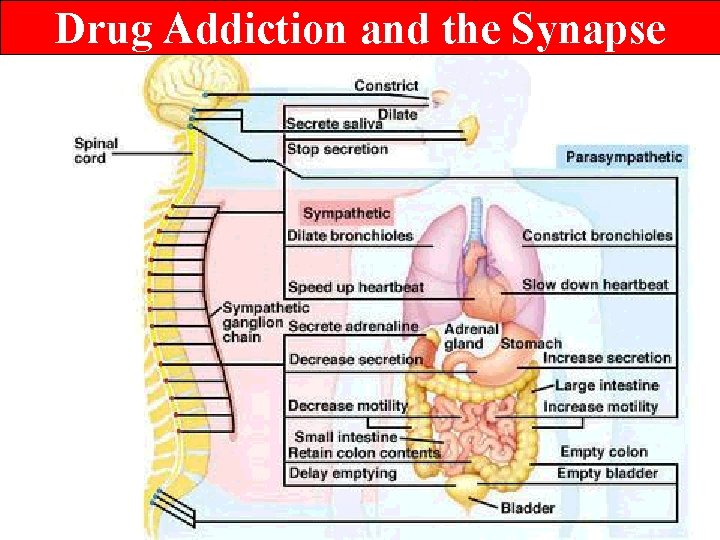
Drug Addiction and the Synapse