
Input Elimination Transformations for Scalable Verification and Trace
Input Elimination Transformations for Scalable Verification and Trace Reconstruction Raj Kumar Gajavelly, Jason Baumgartner, Alexander Ivrii, Robert L Kanzelman, Shiladitya Ghosh FMCAD 2019 1
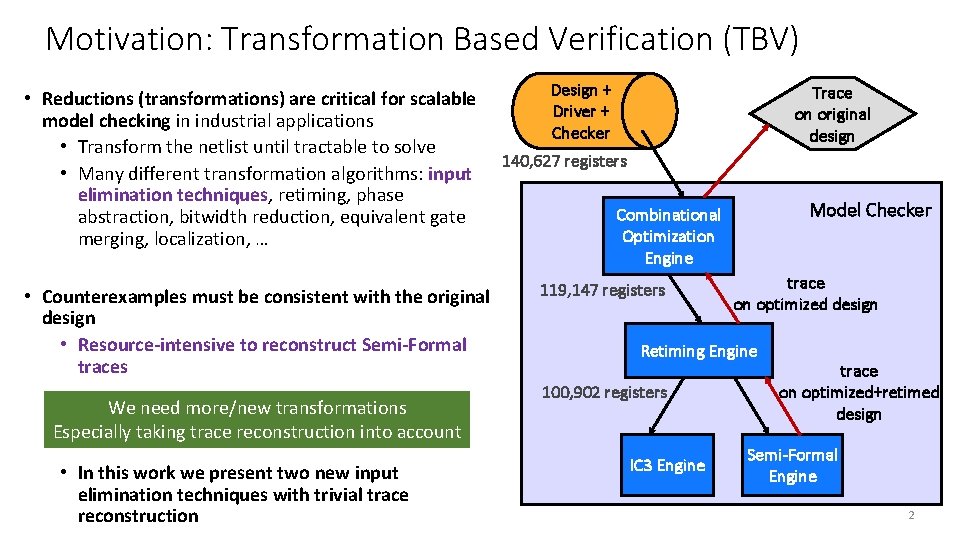
Motivation: Transformation Based Verification (TBV) • Reductions (transformations) are critical for scalable model checking in industrial applications • Transform the netlist until tractable to solve • Many different transformation algorithms: input elimination techniques, retiming, phase abstraction, bitwidth reduction, equivalent gate merging, localization, … • Counterexamples must be consistent with the original design • Resource-intensive to reconstruct Semi-Formal traces We need more/new transformations Especially taking trace reconstruction into account • In this work we present two new input elimination techniques with trivial trace reconstruction Design + Driver + Checker Trace on original design 140, 627 registers Model Checker Combinational Optimization Engine 119, 147 registers trace on optimized design Retiming Engine 100, 902 registers IC 3 Engine trace on optimized+retimed design Semi-Formal Engine 2
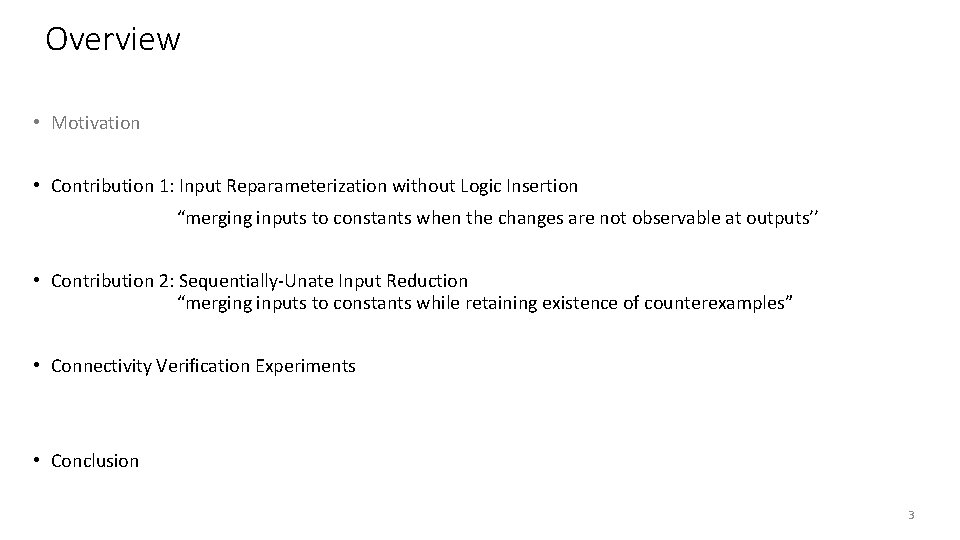
Overview • Motivation • Contribution 1: Input Reparameterization without Logic Insertion “merging inputs to constants when the changes are not observable at outputs’’ • Contribution 2: Sequentially-Unate Input Reduction “merging inputs to constants while retaining existence of counterexamples” • Connectivity Verification Experiments • Conclusion 3
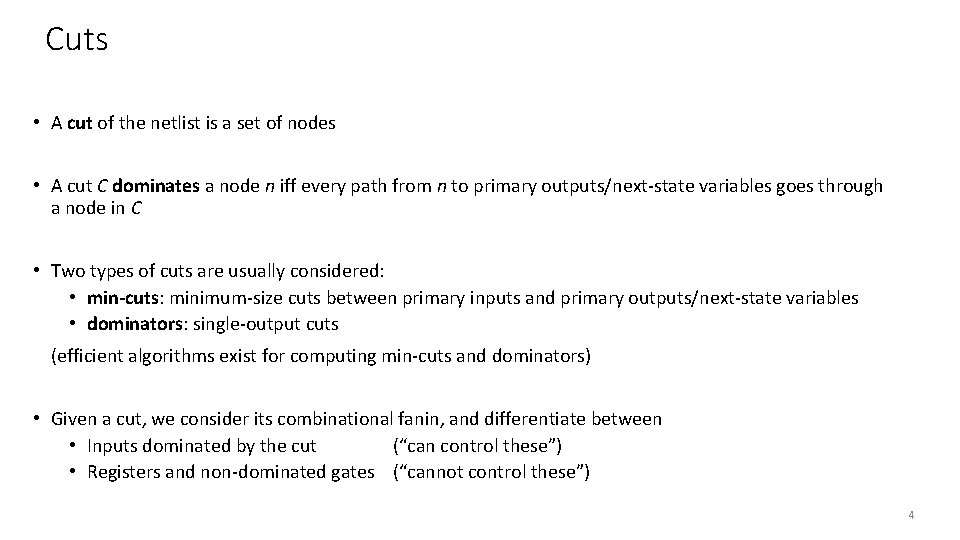
Cuts • A cut of the netlist is a set of nodes • A cut C dominates a node n iff every path from n to primary outputs/next-state variables goes through a node in C • Two types of cuts are usually considered: • min-cuts: minimum-size cuts between primary inputs and primary outputs/next-state variables • dominators: single-output cuts (efficient algorithms exist for computing min-cuts and dominators) • Given a cut, we consider its combinational fanin, and differentiate between • Inputs dominated by the cut (“can control these”) • Registers and non-dominated gates (“cannot control these”) 4
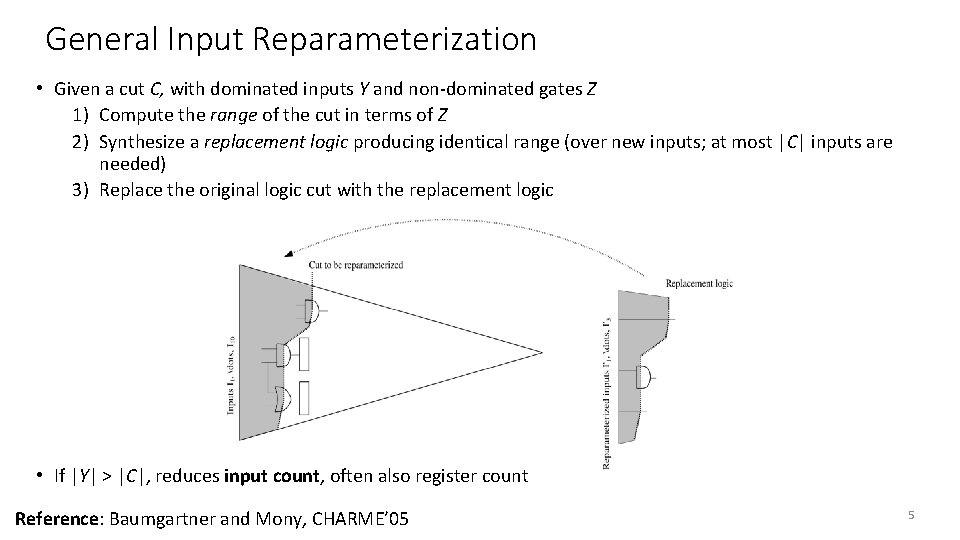
General Input Reparameterization • Given a cut C, with dominated inputs Y and non-dominated gates Z 1) Compute the range of the cut in terms of Z 2) Synthesize a replacement logic producing identical range (over new inputs; at most |C| inputs are needed) 3) Replace the original logic cut with the replacement logic • If |Y| > |C|, reduces input count, often also register count Reference: Baumgartner and Mony, CHARME’ 05 5
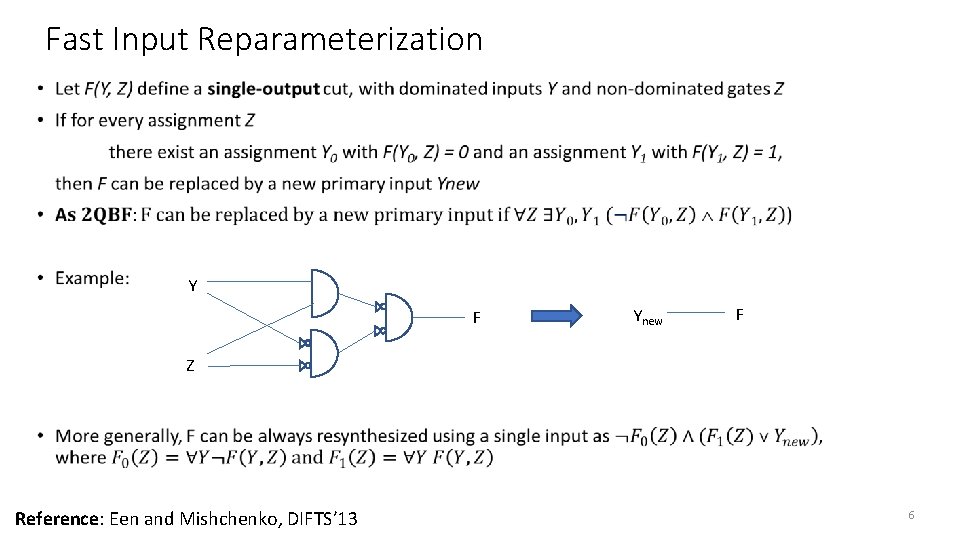
Fast Input Reparameterization • Y F Ynew F Z Reference: Een and Mishchenko, DIFTS’ 13 6
Input Reparameterization: Challenges • Range computation can be expensive • CHARME 05: use BDDs to compute range of multi-output min-cuts • DIFTS 13: use truth-tables to compute range of 1 -output, 8 -input dominators • MUCH faster, though lossy: can’t reduce multi-output cuts • Trace reconstruction can be expensive: lifting the counterexample to the original netlist is typically performed by calling a SAT-solver (on the original logic cut) to find valuation to original inputs producing the same valuation to cut gates • E. g. , if logic is XOR-rich and pathological for SAT solving • Especially if the trace is LONG, e. g. coming from semi-formal falsification • Done once per counterexample: benchmarks with many fails can be runtime-dominated by trace reconstruction • Nevertheless, input reparameterization techniques yield substantial verification speedups • Typically beneficial to iterate the two: maximal reductions with minimal resource • Often interleaved with logic optimization, localization 7
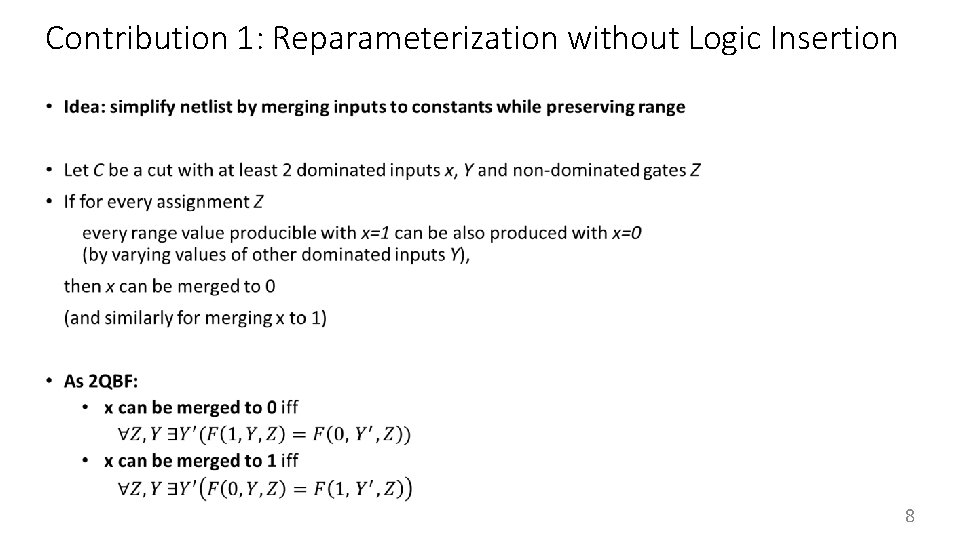
Contribution 1: Reparameterization without Logic Insertion • 8
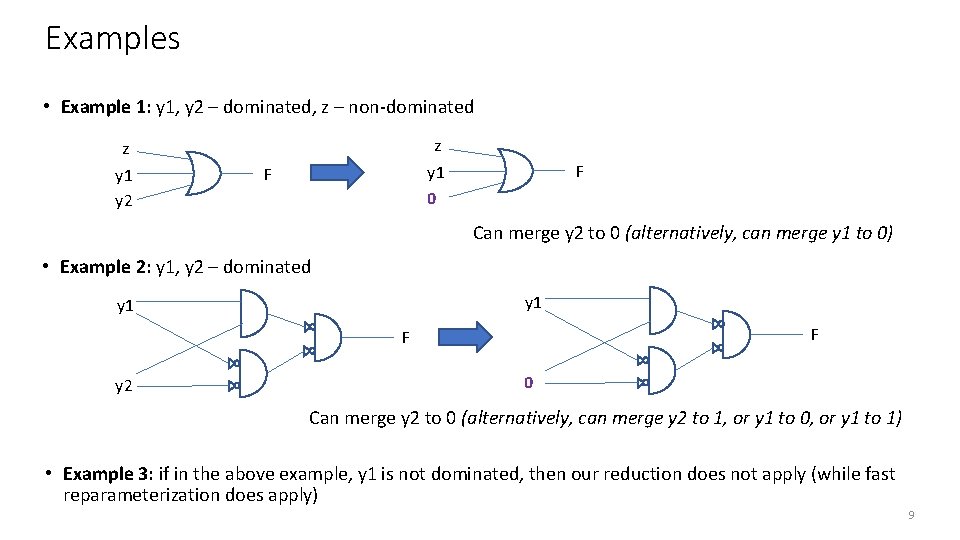
Examples • Example 1: y 1, y 2 – dominated, z – non-dominated z y 1 y 2 z y 1 0 F F Can merge y 2 to 0 (alternatively, can merge y 1 to 0) • Example 2: y 1, y 2 – dominated y 1 F F y 2 0 Can merge y 2 to 0 (alternatively, can merge y 2 to 1, or y 1 to 0, or y 1 to 1) • Example 3: if in the above example, y 1 is not dominated, then our reduction does not apply (while fast reparameterization does apply) 9
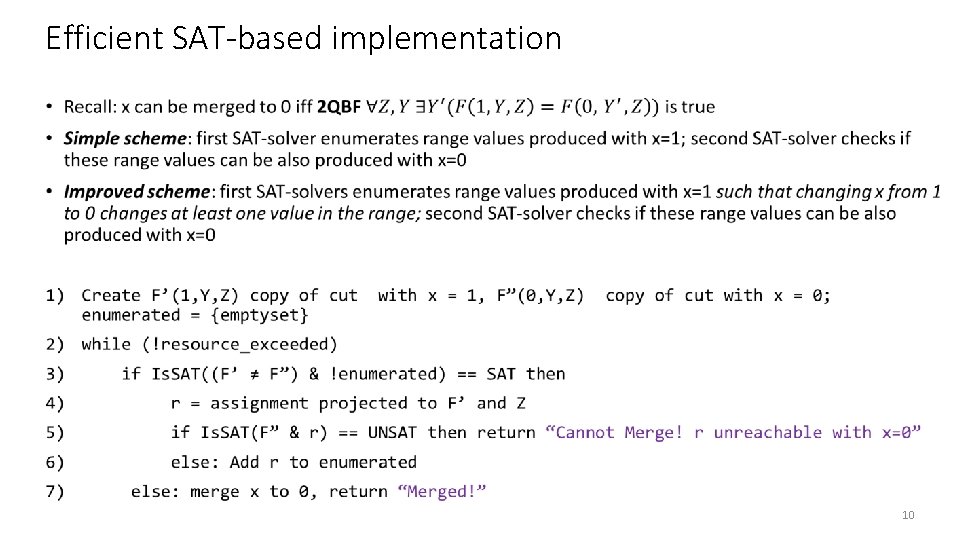
Efficient SAT-based implementation • 10
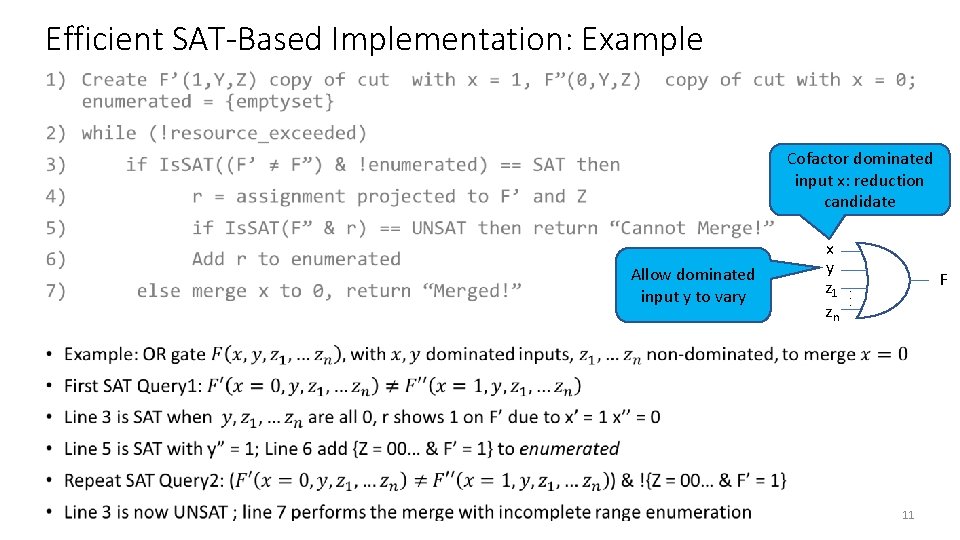
Efficient SAT-Based Implementation: Example • Cofactor dominated input x: reduction candidate Allow dominated input y to vary x y z 1 zn F . . . 11
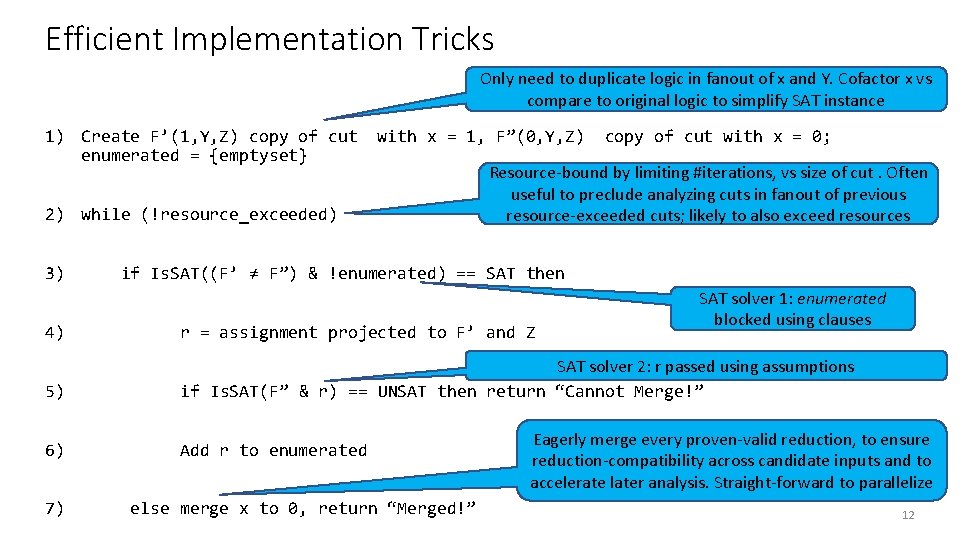
Efficient Implementation Tricks Only need to duplicate logic in fanout of x and Y. Cofactor x vs compare to original logic to simplify SAT instance 1) Create F’(1, Y, Z) copy of cut enumerated = {emptyset} with x = 1, F”(0, Y, Z) 2) while (!resource_exceeded) 3) copy of cut with x = 0; Resource-bound by limiting #iterations, vs size of cut. Often useful to preclude analyzing cuts in fanout of previous resource-exceeded cuts; likely to also exceed resources if Is. SAT((F’ ≠ F”) & !enumerated) == SAT then SAT solver 1: enumerated blocked using clauses 4) r = assignment projected to F’ and Z 5) SAT solver 2: r passed using assumptions if Is. SAT(F” & r) == UNSAT then return “Cannot Merge!” 6) Add r to enumerated 7) else merge x to 0, return “Merged!” Eagerly merge every proven-valid reduction, to ensure reduction-compatibility across candidate inputs and to accelerate later analysis. Straight-forward to parallelize 12
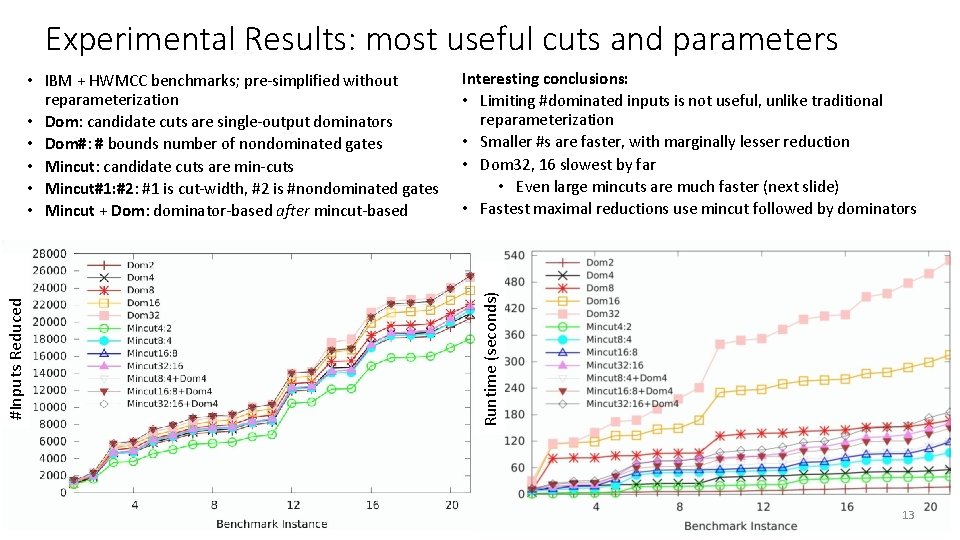
Experimental Results: most useful cuts and parameters Interesting conclusions: • Limiting #dominated inputs is not useful, unlike traditional reparameterization • Smaller #s are faster, with marginally lesser reduction • Dom 32, 16 slowest by far • Even large mincuts are much faster (next slide) • Fastest maximal reductions use mincut followed by dominators Runtime (seconds) #Inputs Reduced • IBM + HWMCC benchmarks; pre-simplified without reparameterization • Dom: candidate cuts are single-output dominators • Dom#: # bounds number of nondominated gates • Mincut: candidate cuts are min-cuts • Mincut#1: #2: #1 is cut-width, #2 is #nondominated gates • Mincut + Dom: dominator-based after mincut-based 13
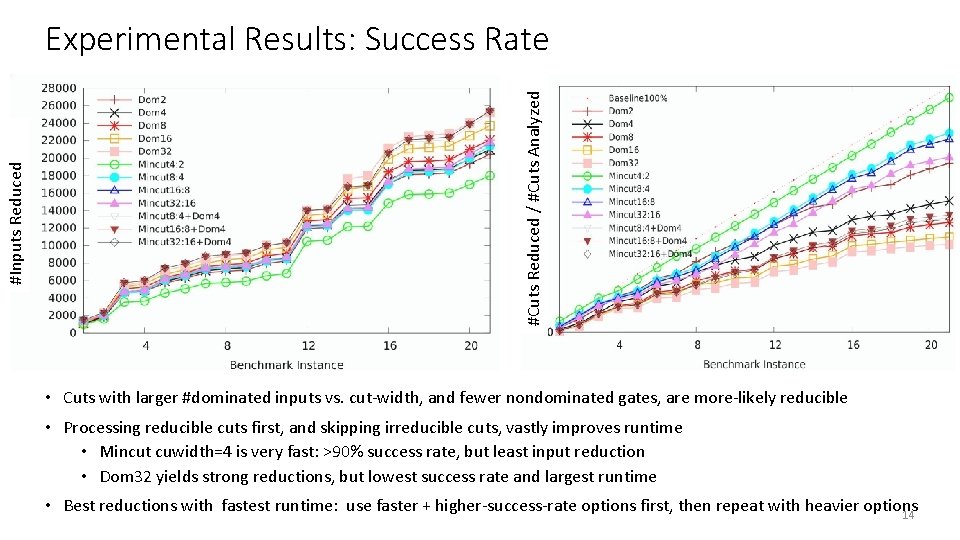
#Cuts Reduced / #Cuts Analyzed #Inputs Reduced Experimental Results: Success Rate • Cuts with larger #dominated inputs vs. cut-width, and fewer nondominated gates, are more-likely reducible • Processing reducible cuts first, and skipping irreducible cuts, vastly improves runtime • Mincut cuwidth=4 is very fast: >90% success rate, but least input reduction • Dom 32 yields strong reductions, but lowest success rate and largest runtime • Best reductions with fastest runtime: use faster + higher-success-rate options first, then repeat with heavier options 14
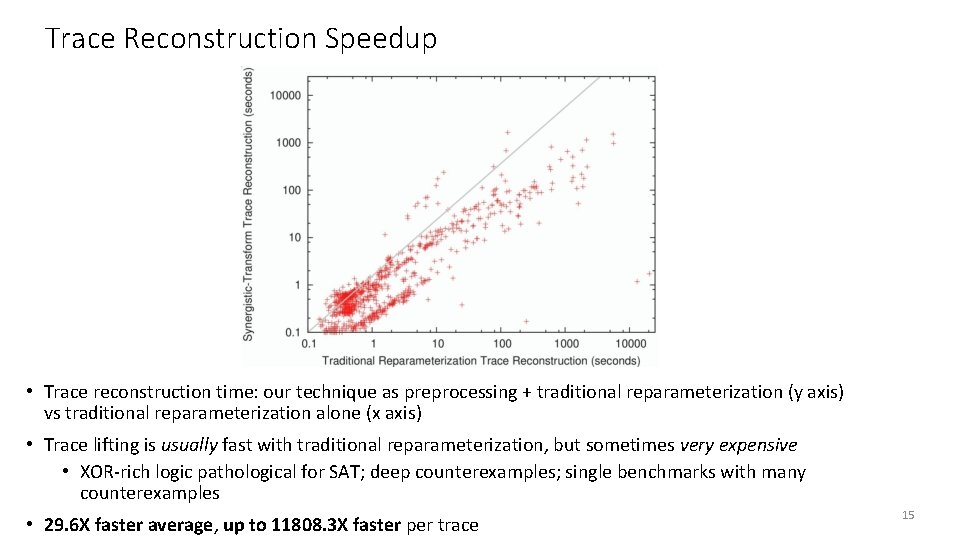
Trace Reconstruction Speedup • Trace reconstruction time: our technique as preprocessing + traditional reparameterization (y axis) vs traditional reparameterization alone (x axis) • Trace lifting is usually fast with traditional reparameterization, but sometimes very expensive • XOR-rich logic pathological for SAT; deep counterexamples; single benchmarks with many counterexamples • 29. 6 X faster average, up to 11808. 3 X faster per trace 15
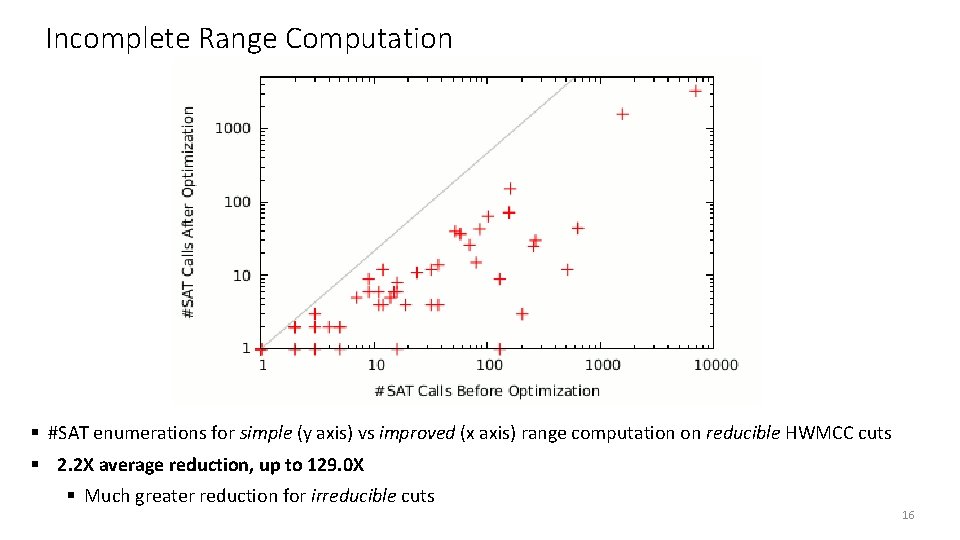
Incomplete Range Computation § #SAT enumerations for simple (y axis) vs improved (x axis) range computation on reducible HWMCC cuts § 2. 2 X average reduction, up to 129. 0 X § Much greater reduction for irreducible cuts 16
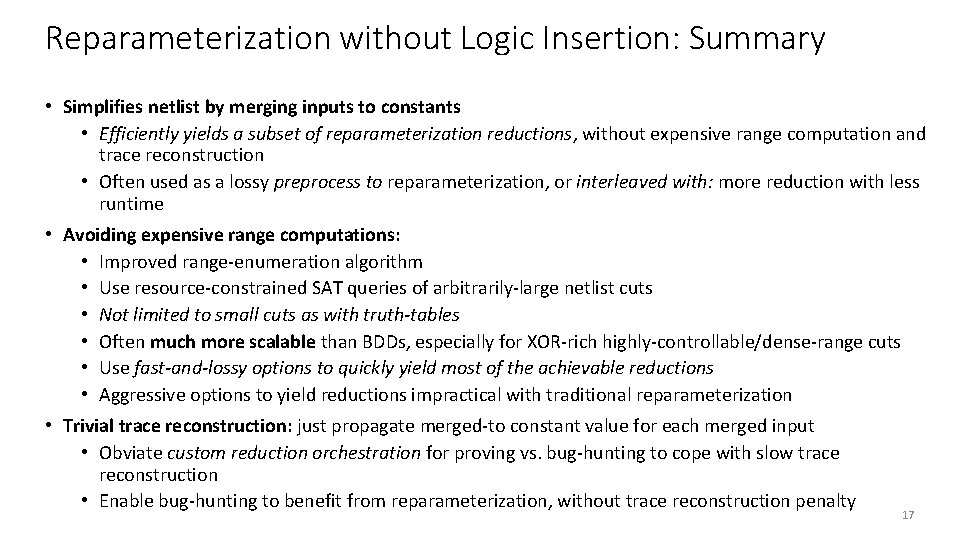
Reparameterization without Logic Insertion: Summary • Simplifies netlist by merging inputs to constants • Efficiently yields a subset of reparameterization reductions, without expensive range computation and trace reconstruction • Often used as a lossy preprocess to reparameterization, or interleaved with: more reduction with less runtime • Avoiding expensive range computations: • Improved range-enumeration algorithm • Use resource-constrained SAT queries of arbitrarily-large netlist cuts • Not limited to small cuts as with truth-tables • Often much more scalable than BDDs, especially for XOR-rich highly-controllable/dense-range cuts • Use fast-and-lossy options to quickly yield most of the achievable reductions • Aggressive options to yield reductions impractical with traditional reparameterization • Trivial trace reconstruction: just propagate merged-to constant value for each merged input • Obviate custom reduction orchestration for proving vs. bug-hunting to cope with slow trace reconstruction • Enable bug-hunting to benefit from reparameterization, without trace reconstruction penalty 17
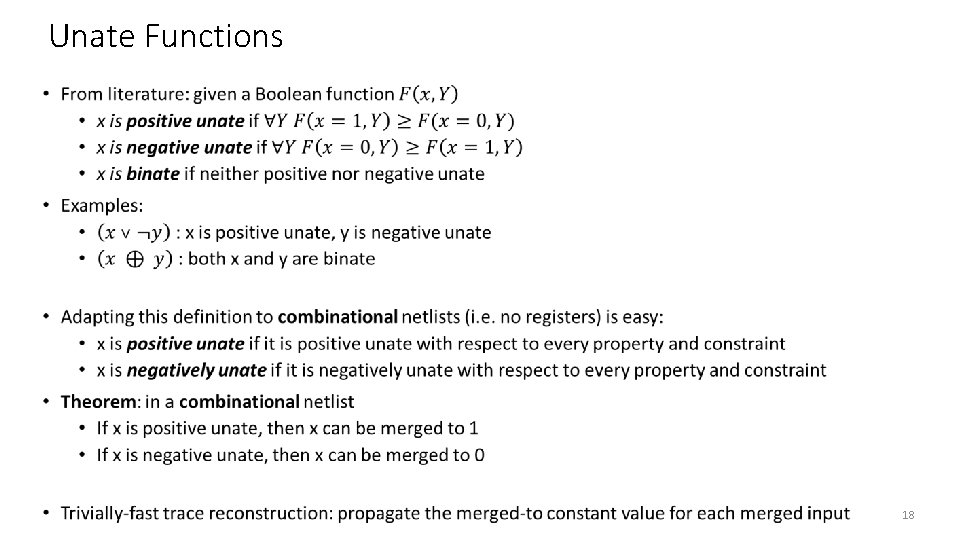
Unate Functions • 18
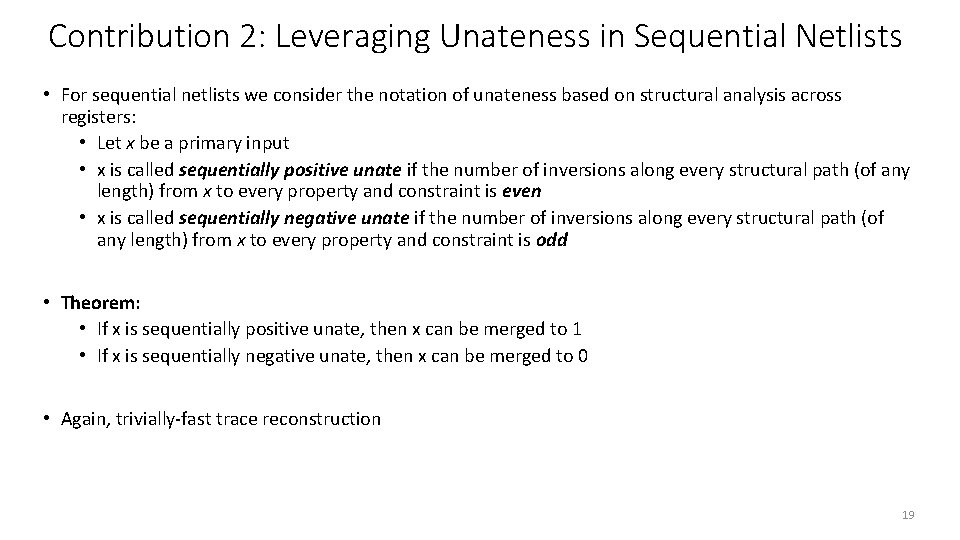
Contribution 2: Leveraging Unateness in Sequential Netlists • For sequential netlists we consider the notation of unateness based on structural analysis across registers: • Let x be a primary input • x is called sequentially positive unate if the number of inversions along every structural path (of any length) from x to every property and constraint is even • x is called sequentially negative unate if the number of inversions along every structural path (of any length) from x to every property and constraint is odd • Theorem: • If x is sequentially positive unate, then x can be merged to 1 • If x is sequentially negative unate, then x can be merged to 0 • Again, trivially-fast trace reconstruction 19
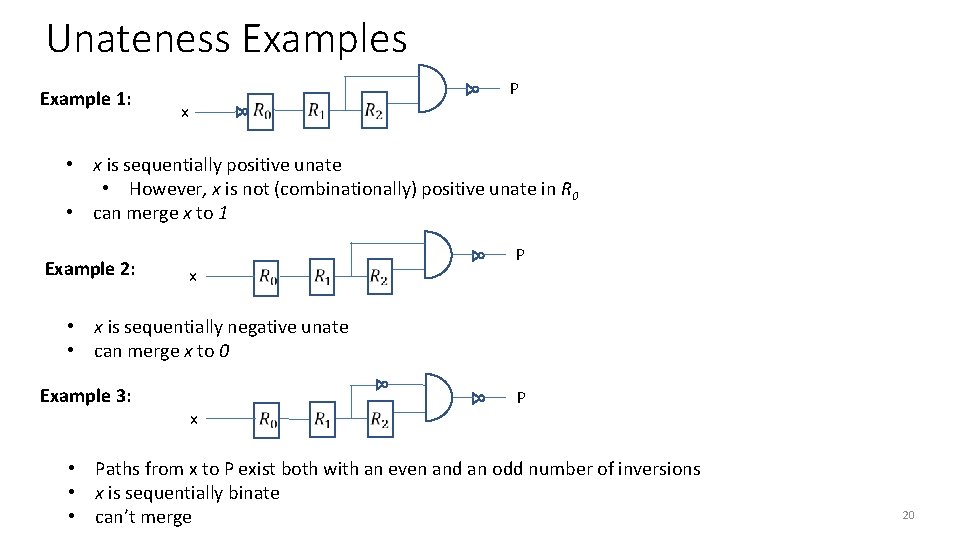
Unateness Example 1: P x • x is sequentially positive unate • However, x is not (combinationally) positive unate in R 0 • can merge x to 1 Example 2: x P • x is sequentially negative unate • can merge x to 0 Example 3: x P • Paths from x to P exist both with an even and an odd number of inversions • x is sequentially binate • can’t merge 20
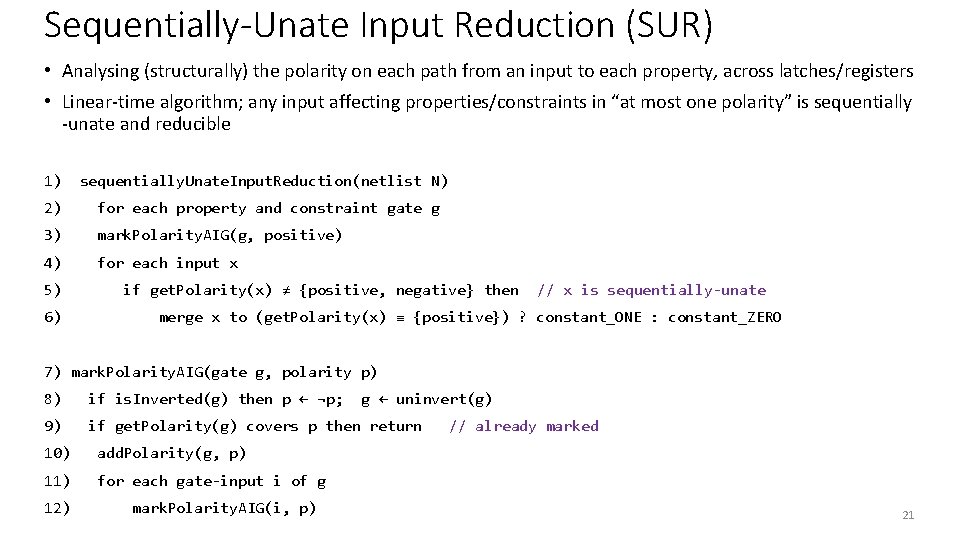
Sequentially-Unate Input Reduction (SUR) • Analysing (structurally) the polarity on each path from an input to each property, across latches/registers • Linear-time algorithm; any input affecting properties/constraints in “at most one polarity” is sequentially -unate and reducible 1) sequentially. Unate. Input. Reduction(netlist N) 2) for each property and constraint gate g 3) mark. Polarity. AIG(g, positive) 4) for each input x 5) 6) if get. Polarity(x) ≠ {positive, negative} then // x is sequentially-unate merge x to (get. Polarity(x) ≡ {positive}) ? constant_ONE : constant_ZERO 7) mark. Polarity. AIG(gate g, polarity p) 8) if is. Inverted(g) then p ← ¬p; 9) if get. Polarity(g) covers p then return 10) add. Polarity(g, p) 11) for each gate-input i of g 12) mark. Polarity. AIG(i, p) g ← uninvert(g) // already marked 21
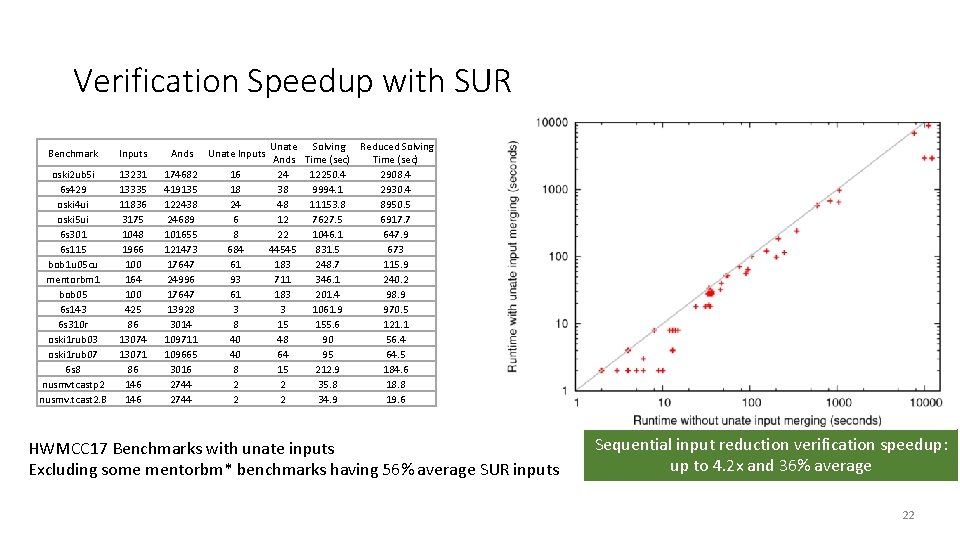
Verification Speedup with SUR Benchmark Inputs Ands Unate Inputs oski 2 ub 5 i 6 s 429 oski 4 ui oski 5 ui 6 s 301 6 s 115 bob 1 u 05 cu mentorbm 1 bob 05 6 s 143 6 s 310 r oski 1 rub 03 oski 1 rub 07 6 s 8 nusmvtcastp 2 nusmv. tcast 2. B 13231 13335 11836 3175 1048 1966 100 164 100 425 86 13074 13071 86 146 174682 419135 122438 24689 101655 121473 17647 24996 17647 13928 3014 109711 109665 3016 2744 16 18 24 6 8 684 61 93 61 3 8 40 40 8 2 2 Unate Solving Reduced Solving Ands Time (sec) 24 12250. 4 2908. 4 38 9994. 1 2930. 4 48 11153. 8 8950. 5 12 7627. 5 6917. 7 22 1046. 1 647. 9 44545 831. 5 673 183 248. 7 115. 9 711 346. 1 240. 2 183 201. 4 98. 9 3 1061. 9 970. 5 15 155. 6 121. 1 48 90 56. 4 64 95 64. 5 15 212. 9 184. 6 2 35. 8 18. 8 2 34. 9 19. 6 HWMCC 17 Benchmarks with unate inputs Excluding some mentorbm* benchmarks having 56% average SUR inputs Sequential input reduction verification speedup: up to 4. 2 x and 36% average 22
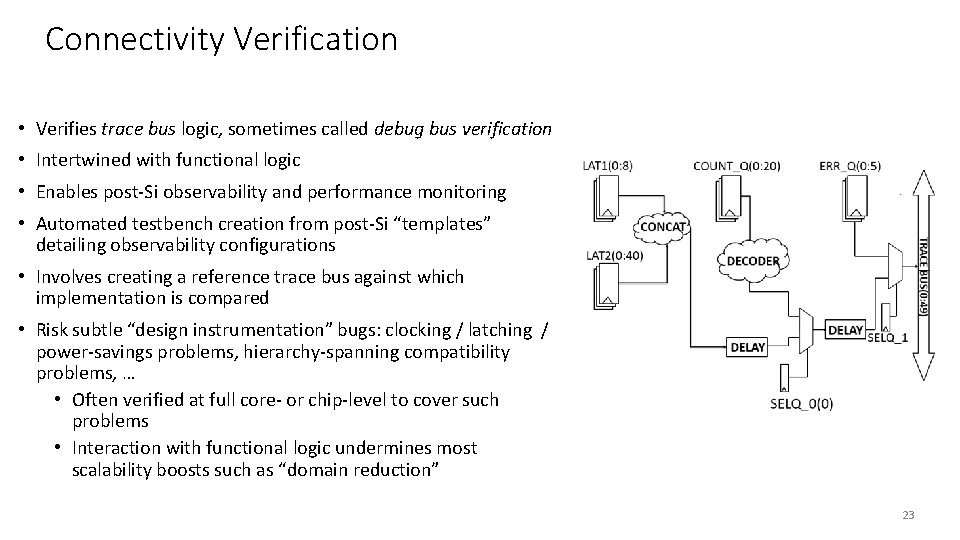
Connectivity Verification • Verifies trace bus logic, sometimes called debug bus verification • Intertwined with functional logic • Enables post-Si observability and performance monitoring • Automated testbench creation from post-Si “templates” detailing observability configurations • Involves creating a reference trace bus against which implementation is compared • Risk subtle “design instrumentation” bugs: clocking / latching / power-savings problems, hierarchy-spanning compatibility problems, … • Often verified at full core- or chip-level to cover such problems • Interaction with functional logic undermines most scalability boosts such as “domain reduction” 23
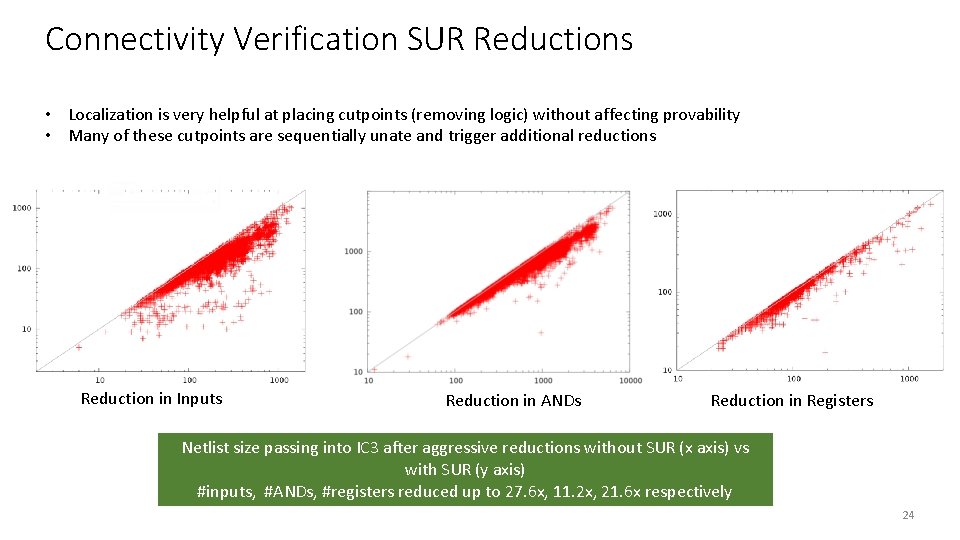
Connectivity Verification SUR Reductions • Localization is very helpful at placing cutpoints (removing logic) without affecting provability • Many of these cutpoints are sequentially unate and trigger additional reductions Reduction in Inputs Reduction in ANDs Reduction in Registers Netlist size passing into IC 3 after aggressive reductions without SUR (x axis) vs with SUR (y axis) #inputs, #ANDs, #registers reduced up to 27. 6 x, 11. 2 x, 21. 6 x respectively 24
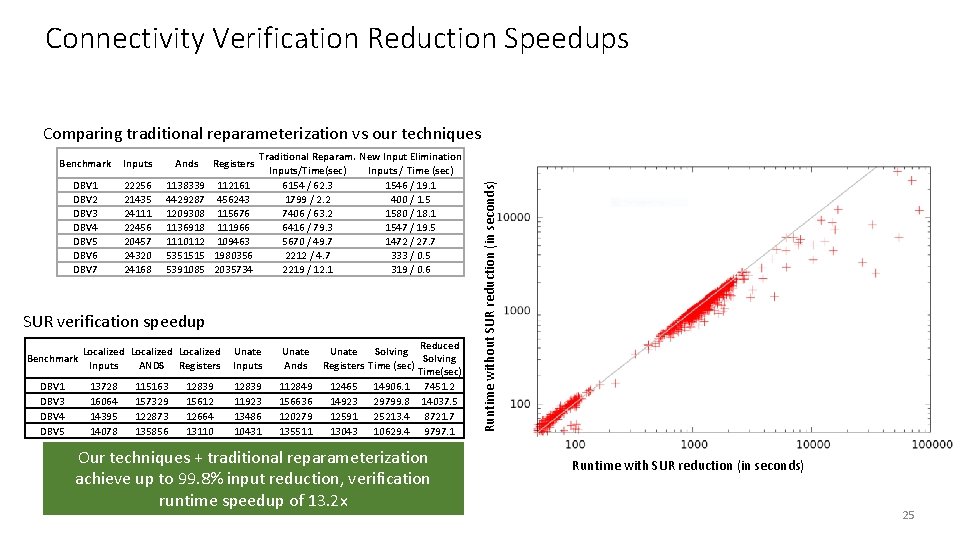
Connectivity Verification Reduction Speedups Benchmark Inputs DBV 1 DBV 2 DBV 3 DBV 4 DBV 5 DBV 6 DBV 7 22256 21435 24111 22456 20457 24320 24168 Ands Registers 1138339 112161 4429287 456243 1209308 115676 1136918 111966 1110112 109463 5351515 1980356 5391085 2035734 Traditional Reparam. New Input Elimination Inputs/Time(sec) Inputs / Time (sec) 6154 / 62. 3 1546 / 19. 1 1799 / 2. 2 400 / 1. 5 7406 / 63. 2 1580 / 18. 1 6416 / 79. 3 1547 / 19. 5 5670 / 49. 7 1472 / 27. 7 2212 / 4. 7 333 / 0. 5 2219 / 12. 1 319 / 0. 6 SUR verification speedup Benchmark DBV 1 DBV 3 DBV 4 DBV 5 Localized Inputs ANDS Registers 13728 16064 14395 14078 115163 157329 122873 135856 12839 15612 12664 13110 Unate Inputs Unate Ands 12839 11923 13486 10431 112849 156636 120279 135511 Reduced Unate Solving Registers Time (sec) Time(sec) 12465 14906. 1 7451. 2 14923 29799. 8 14037. 5 12591 25213. 4 8721. 7 13043 10629. 4 9797. 1 Our techniques + traditional reparameterization achieve up to 99. 8% input reduction, verification runtime speedup of 13. 2 x Runtime without SUR reduction (in seconds) Comparing traditional reparameterization vs our techniques Runtime with SUR reduction (in seconds) 25
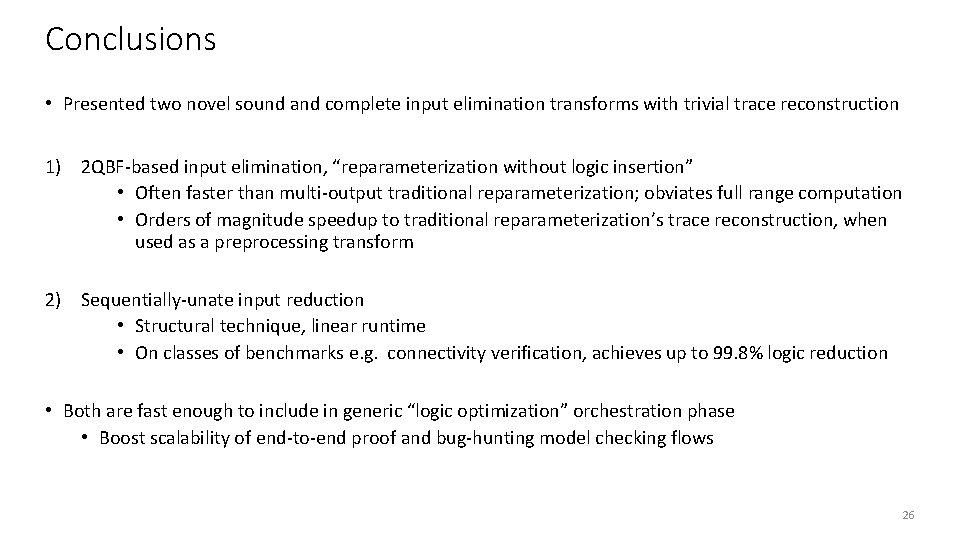
Conclusions • Presented two novel sound and complete input elimination transforms with trivial trace reconstruction 1) 2 QBF-based input elimination, “reparameterization without logic insertion” • Often faster than multi-output traditional reparameterization; obviates full range computation • Orders of magnitude speedup to traditional reparameterization’s trace reconstruction, when used as a preprocessing transform 2) Sequentially-unate input reduction • Structural technique, linear runtime • On classes of benchmarks e. g. connectivity verification, achieves up to 99. 8% logic reduction • Both are fast enough to include in generic “logic optimization” orchestration phase • Boost scalability of end-to-end proof and bug-hunting model checking flows 26

Questions? 27
- Slides: 27