
INPO Update Operational Excellence Outcomes and Configuration Management


- Slides: 39
INPO Update Operational Excellence Outcomes and Configuration Management Glenn J. Neises, INPO Sr. Evaluator June 2004 CMBG
Session Content • • • INPO Mission and Cornerstones Operational Excellence Outcomes Overview Configuration Management Overview INPO Perspectives Configuration Management Current Themes Future
INPO’s Mission To promote the highest levels of safety and reliability – to promote excellence – in the operation of nuclear electric generating plants
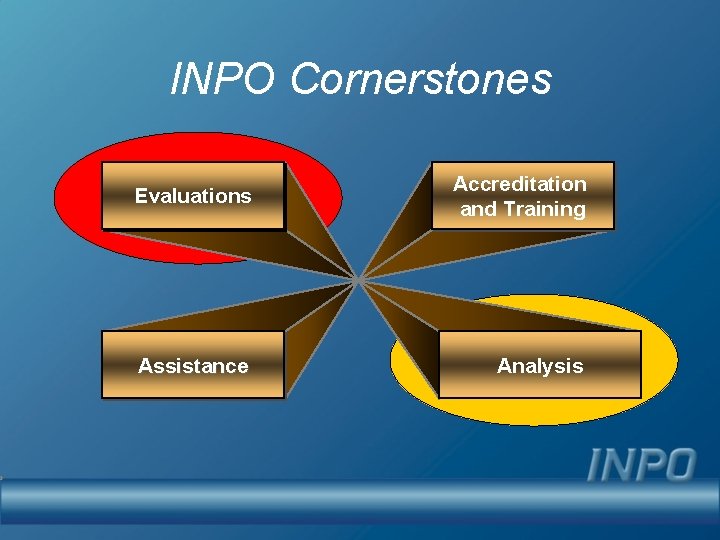
INPO Cornerstones Evaluations Accreditation and Training Assistance Analysis
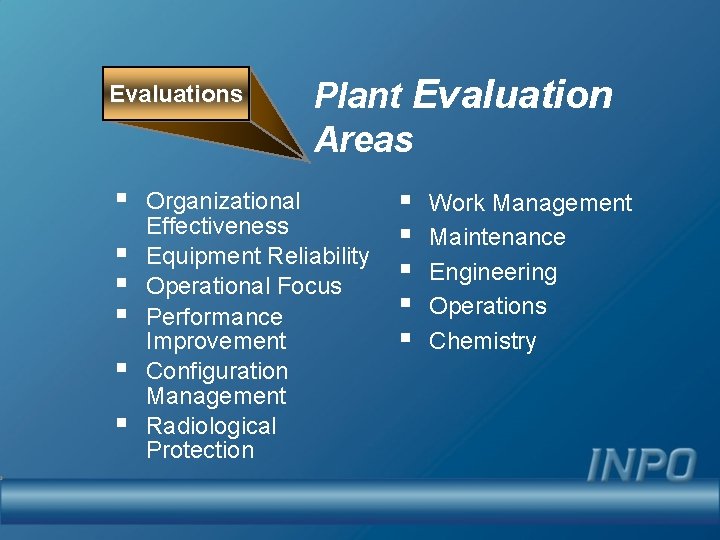
Evaluations § § § Plant Evaluation Areas Organizational Effectiveness Equipment Reliability Operational Focus Performance Improvement Configuration Management Radiological Protection § § § Work Management Maintenance Engineering Operations Chemistry
Analysis § Analysis of industry trends and data § Detect emerging industry trends § Predict future performance issues § Evaluation focus areas
Operational Excellence Outcomes
Why OEO? • • • Changed industry High levels of safety and reliability A few stations unable to keep pace Events revealed increased effort needed in several areas A few activities important to operational excellence not evaluated Robust self-assessment and corrective action programs
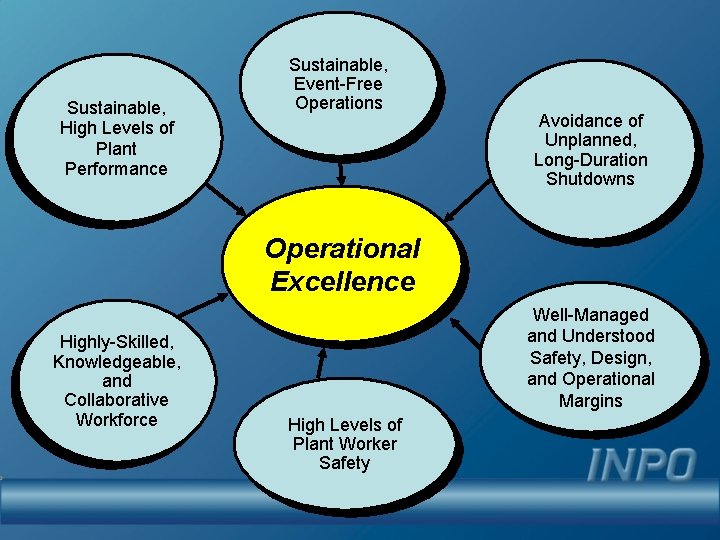
Sustainable, High Levels of Plant Performance Sustainable, Event-Free Operations Avoidance of Unplanned, Long-Duration Shutdowns Operational Excellence Highly-Skilled, Knowledgeable, and Collaborative Workforce Well-Managed and Understood Safety, Design, and Operational Margins High Levels of Plant Worker Safety
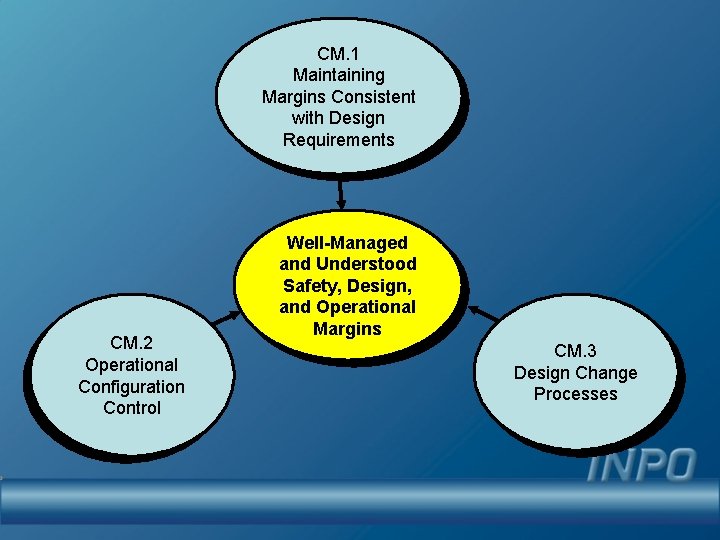
CM. 1 Maintaining Margins Consistent with Design Requirements CM. 2 Operational Configuration Control Well-Managed and Understood Safety, Design, and Operational Margins CM. 3 Design Change Processes
Configuration Management Overview
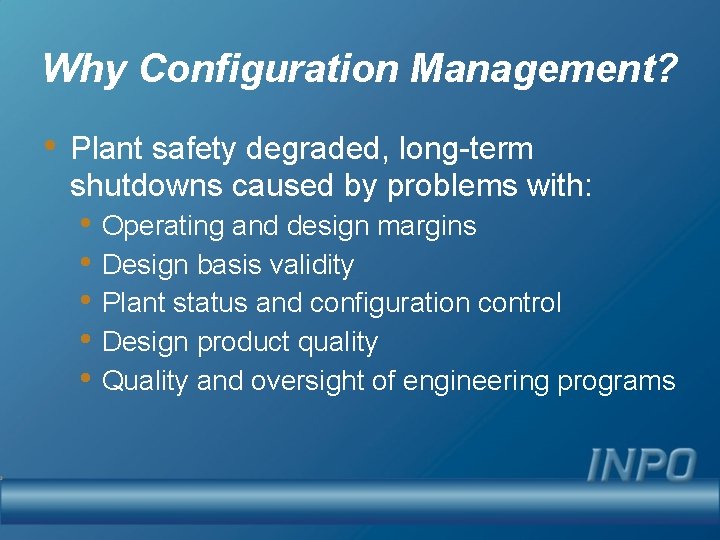
Why Configuration Management? • Plant safety degraded, long-term shutdowns caused by problems with: • Operating and design margins • Design basis validity • Plant status and configuration control • Design product quality • Quality and oversight of engineering programs
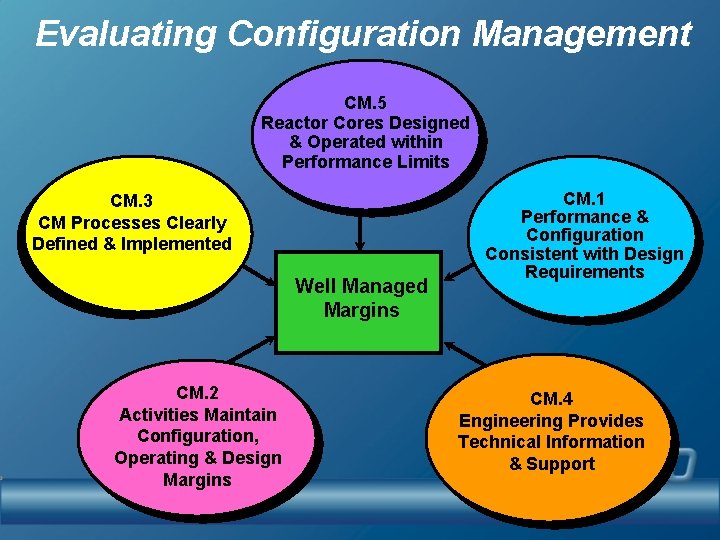
Evaluating Configuration Management CM. 5 Reactor Cores Designed & Operated within Performance Limits CM. 3 CM Processes Clearly Defined & Implemented Well Managed Margins CM. 2 Activities Maintain Configuration, Operating & Design Margins CM. 1 Performance & Configuration Consistent with Design Requirements CM. 4 Engineering Provides Technical Information & Support
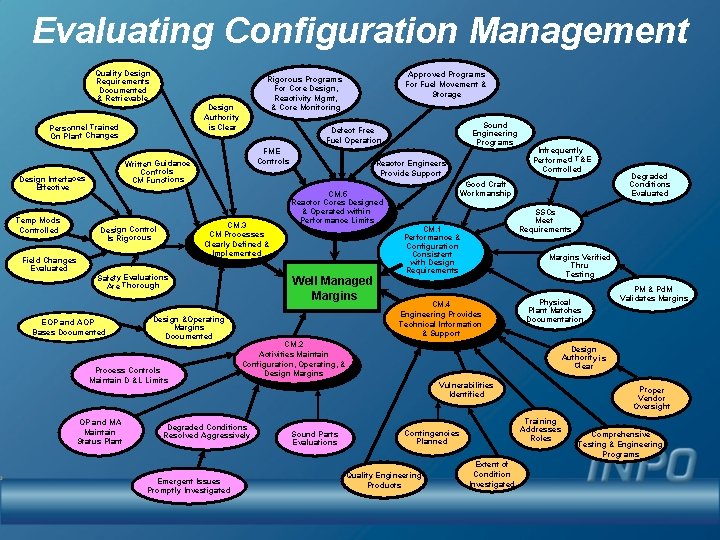
Evaluating Configuration Management Quality Design Requirements Documented & Retrievable Design Authority is Clear Personnel Trained On Plant Changes Temp Mods Controlled Field Changes Evaluated FME Controls CM. 3 CM Processes Clearly Defined & Implemented Design Control Is Rigorous Safety Evaluations Are Thorough EOP and AOP Bases Documented Design &Operating Margins Documented Process Controls Maintain D &L Limits OP and MA Maintain Status Plant Reactor Engineers Provide Support Infrequently Performed T&E Controlled Good Craft Workmanship CM. 5 Reactor Cores Designed & Operated within Performance Limits Well Managed Margins CM. 1 Performance & Configuration Consistent with Design Requirements Margins Verified Thru Testing CM. 4 Engineering Provides Technical Information & Support Physical Plant Matches Documentation PM & Pd. M Validates Margins Design Authority is Clear Vulnerabilities Identified Sound Parts Evaluations Degraded Conditions Evaluated SSCs Meet Requirements CM. 2 Activities Maintain Configuration, Operating, & Design Margins Degraded Conditions Resolved Aggressively Emergent Issues Promptly Investigated Sound Engineering Programs Defect Free Fuel Operation Written Guidance Controls CM Functions Design Interfaces Effective Approved Programs For Fuel Movement & Storage Rigorous Programs For Core Design, Reactivity Mgmt, & Core Monitoring Training Addresses Roles Contingencies Planned Quality Engineering Products Proper Vendor Oversight Extent of Condition Investigated Comprehensive Testing & Engineering Programs
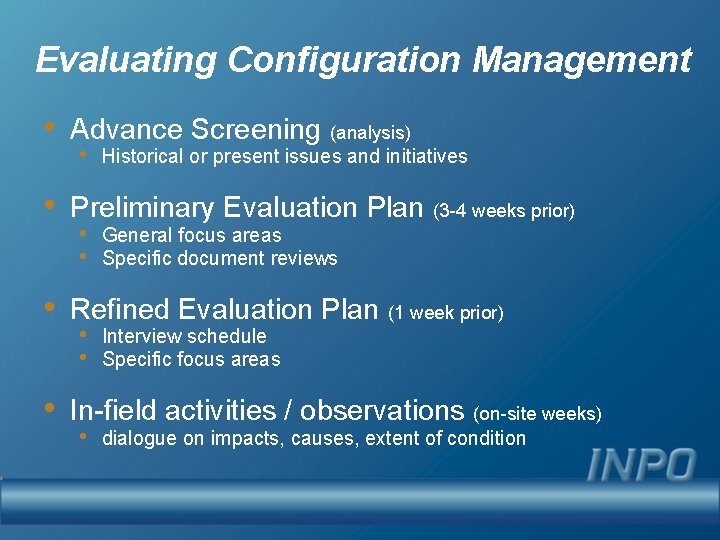
Evaluating Configuration Management • Advance Screening (analysis) • Preliminary Evaluation Plan (3 -4 weeks prior) • Refined Evaluation Plan (1 week prior) • In-field activities / observations (on-site weeks) • • • Historical or present issues and initiatives General focus areas Specific document reviews Interview schedule Specific focus areas dialogue on impacts, causes, extent of condition
INPO Perspectives
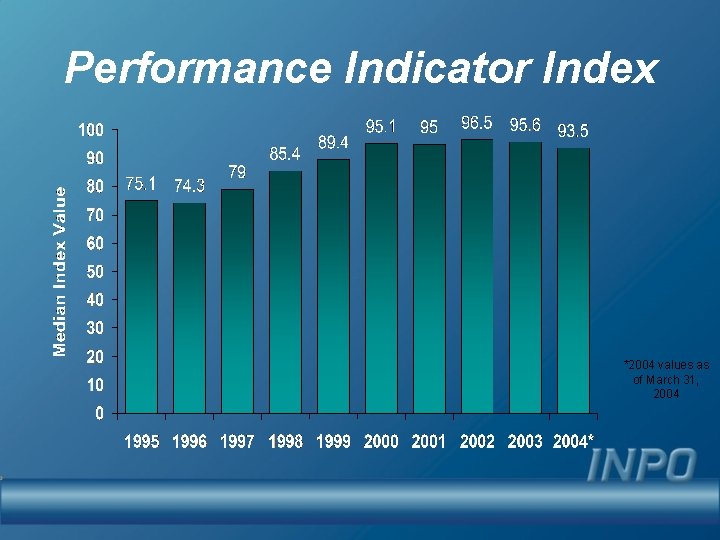
Performance Indicator Index *2004 values as of March 31, 2004
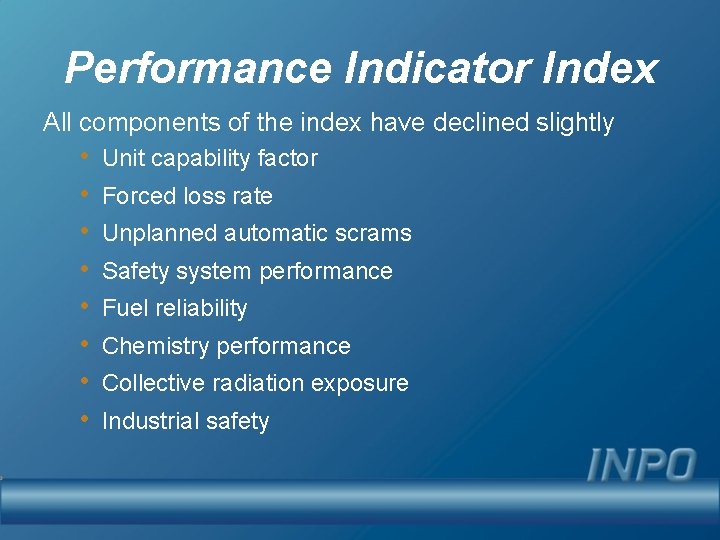
Performance Indicator Index All components of the index have declined slightly • • Unit capability factor Forced loss rate Unplanned automatic scrams Safety system performance Fuel reliability Chemistry performance Collective radiation exposure Industrial safety
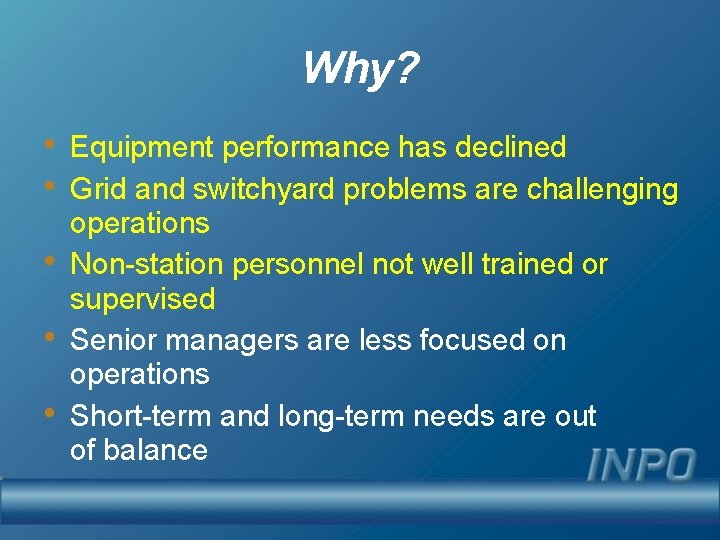
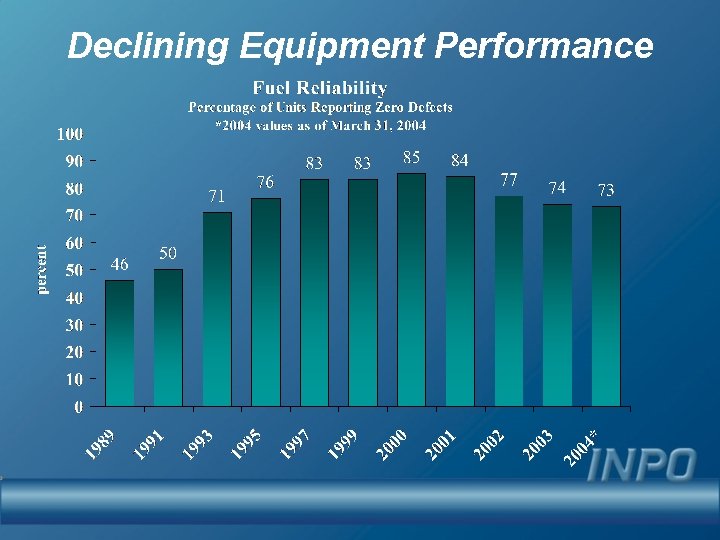
Why? • • • Equipment performance has declined Grid and switchyard problems are challenging operations Non-station personnel not well trained or supervised Senior managers are less focused on operations Short-term and long-term needs are out of balance
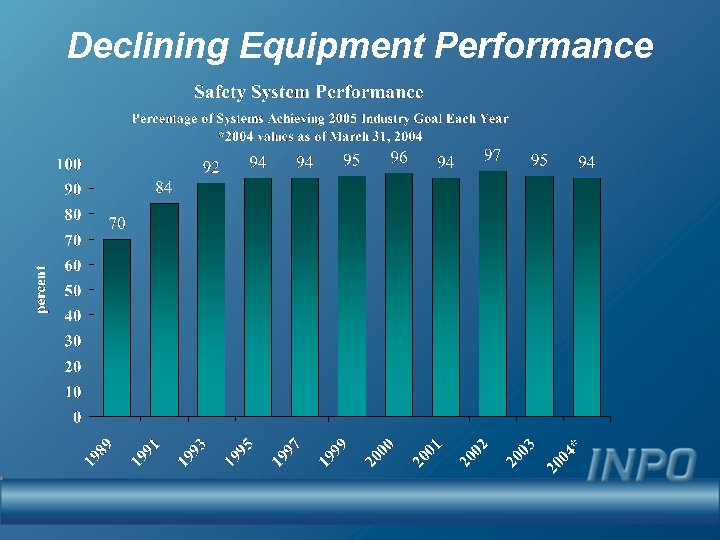
Declining Equipment Performance
Declining Equipment Performance
Configuration Management Current Themes
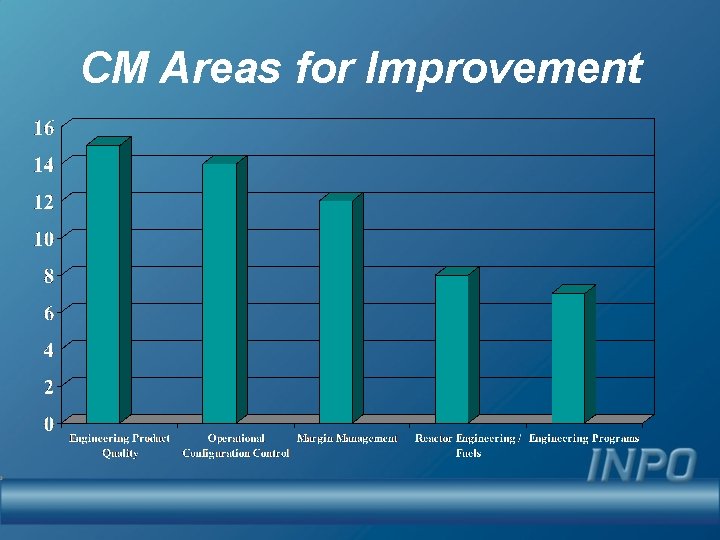
CM Areas for Improvement
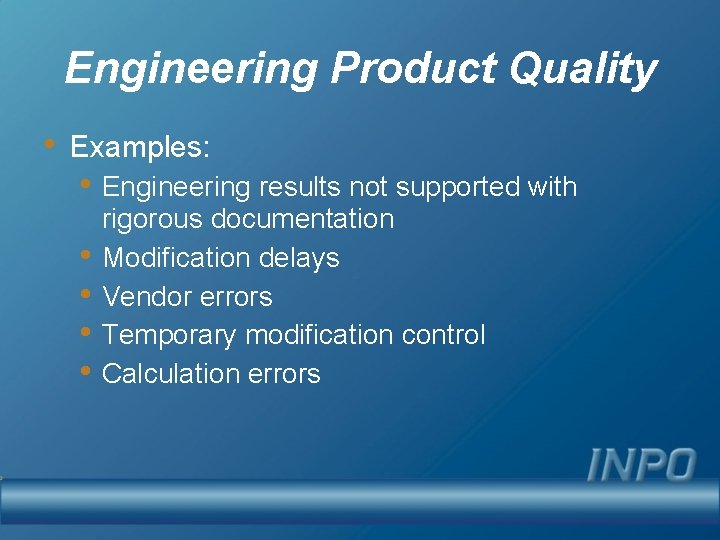
Engineering Product Quality • Examples: • Engineering results not supported with • • rigorous documentation Modification delays Vendor errors Temporary modification control Calculation errors
Engineering Product Quality • Causes: • Supervisor engagement • Lack of operating experience use • Preparation & verification not thorough • Lack of human performance tool use • Inadequate modification review meetings • Inadequate vendor oversight • Insufficient verification or testing for vendor-supplied designs
Operational Configuration Control • Examples: • Changes to the plant without approved • • • engineering documents Uncontrolled temp power / temp mods Long term open operability determinations Mispositionings resulting in equipment damage Uncontrolled equipment and setpoint changes Blocking of protective equipment trips Protective doors locked open
Operational Configuration Control • Causes: • • • Personnel lack an understanding of the design change process Indicators limited to component mispositionings Human performance weaknesses Inadequate engineering management oversight Tolerance of temporary, unauthorized changes CM viewed by station personnel as a design engineering role as opposed to a station role
Margin Management • Examples: • • • Low operational margin on safety-related components Safety-related heat exchanger tube blockage Design documents & calcs not updated Errors in operability determinations Modifications don’t consider all operating regimes Modifications cause significantly reduced operational margins
Margin Management • Causes: • Lack of operating margin focus • Inadequate testing and monitoring programs • Insufficient understanding of design information • Station management did not challenge and question • power uprate evaluations Power uprate was a fast-track project, and time pressure contributed to insufficient reviews
Reactor Engineering & Fuel • Examples: • • Fuel Failures Reactor engineering support & communication with operations Incorrect values entered into computer calculations Causes: • • High localized power due to control rod movement No long-term, integrated plan to achieve zero fuel defects Unclear expectations for reactor engineering support Inadequate human performance tool use
Engineering Programs • • Examples: • • Program results not verified or in error Testing not adequately performed Causes: • • Inadequate management oversight Insufficient coordination between modification & testing program Inadequate program and component health monitoring Turnover of program engineers
Recurring Causes • Management oversight • Human performance • Oversight of non-station personnel • Procedure / process adherence or adequacy
Future What else is out there
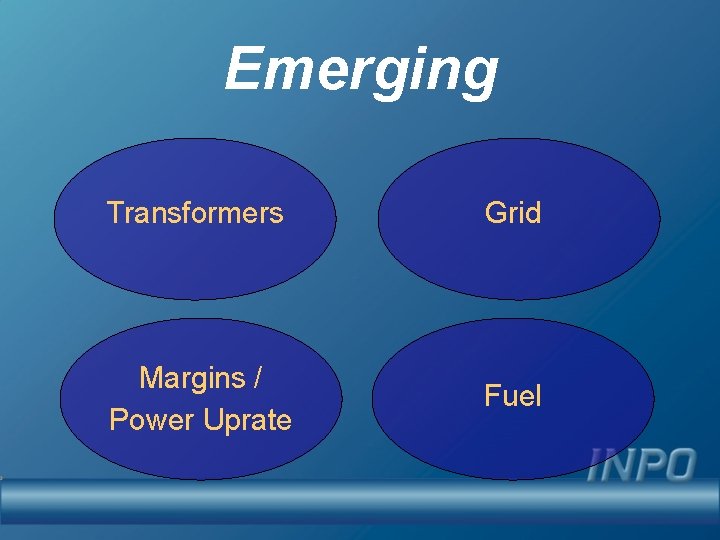
Emerging Transformers Grid Margins / Power Uprate Fuel
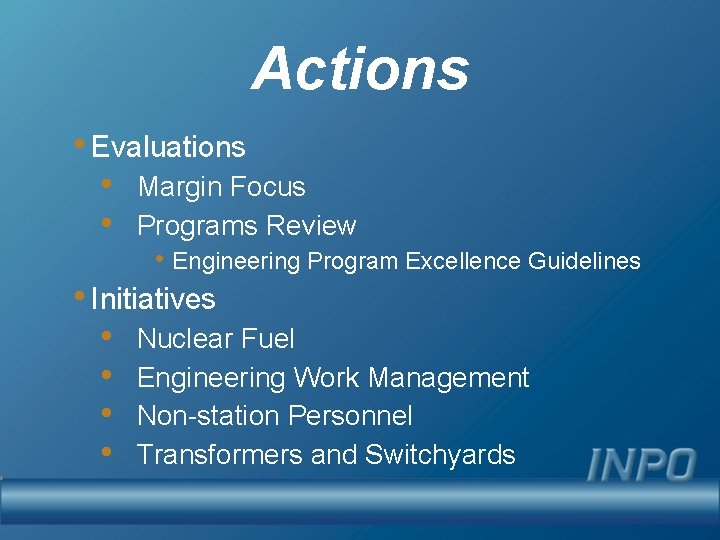
Actions • Evaluations • • Margin Focus Programs Review • • Nuclear Fuel Engineering Work Management Non-station Personnel Transformers and Switchyards • Engineering Program Excellence Guidelines • Initiatives
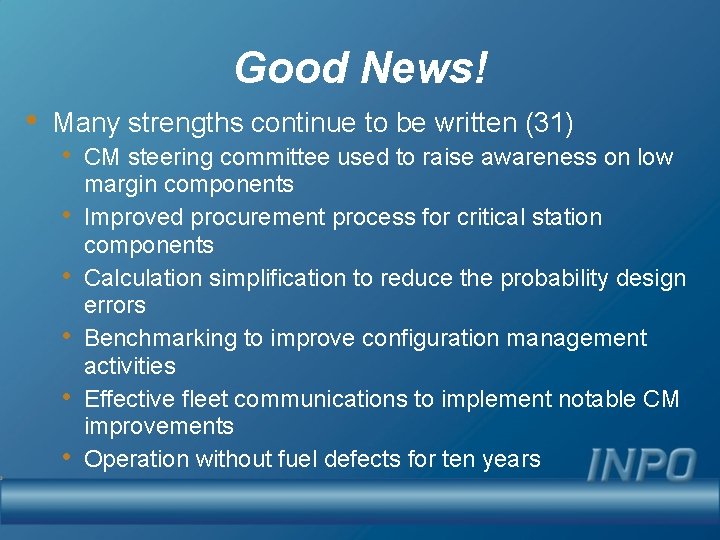
Good News! • Many strengths continue to be written (31) • • • CM steering committee used to raise awareness on low margin components Improved procurement process for critical station components Calculation simplification to reduce the probability design errors Benchmarking to improve configuration management activities Effective fleet communications to implement notable CM improvements Operation without fuel defects for ten years
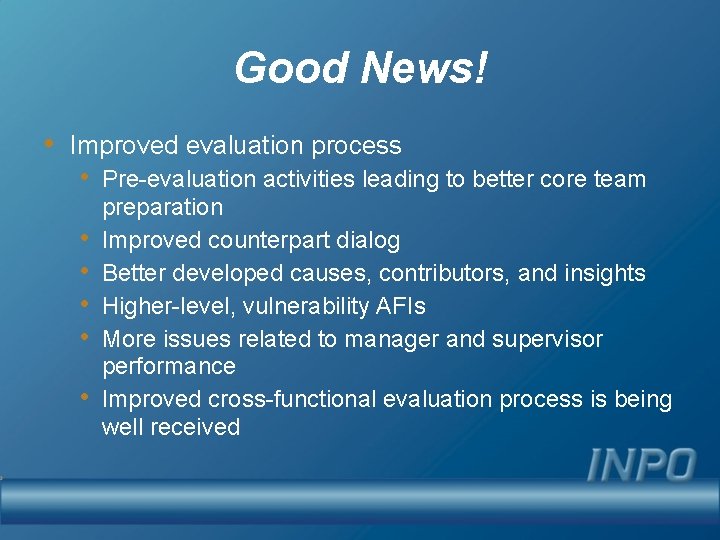
Good News! • Improved evaluation process • • • Pre-evaluation activities leading to better core team preparation Improved counterpart dialog Better developed causes, contributors, and insights Higher-level, vulnerability AFIs More issues related to manager and supervisor performance Improved cross-functional evaluation process is being well received
Margins • “By decreasing our margins, we are relying more and more heavily on our operators, engineers, and managers to make the right decisions, and to make them in a timely manner. ” Zack T. Pate WANO Biennial General Meeting March 2002
Discussion