
INPC 2007 Tokyo June 3 8 2007 Elastic
- Slides: 48
INPC 2007, Tokyo, June 3 -8, 2007 Elastic Form Factors of the Proton, Neutron and Deuteron Michael Kohl MIT-Bates, Middleton, MA 01949 USA
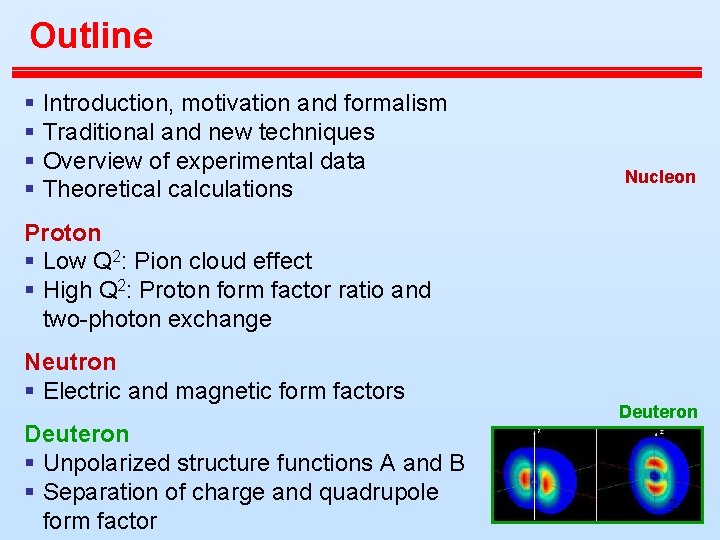
Outline § Introduction, motivation and formalism § Traditional and new techniques § Overview of experimental data § Theoretical calculations Nucleon Proton § Low Q 2: Pion cloud effect § High Q 2: Proton form factor ratio and two-photon exchange Neutron § Electric and magnetic form factors Deuteron § Unpolarized structure functions A and B § Separation of charge and quadrupole form factor Deuteron 2
Elastic Electromagnetic Form Factors … § Fundamental quantities § Describe internal structure of the nucleons and the deuteron § Related to spatial distribution of charge and magnetism § Rigorous tests of nucleon and deuteron models § Ultimately calculable by Lattice-QCD § Input for nuclear structure and parity violation experiments 50 years of ever increasing activity § Tremendous progress in experiment and theory over last decade § New techniques / polarization experiments § Unexpected results 3
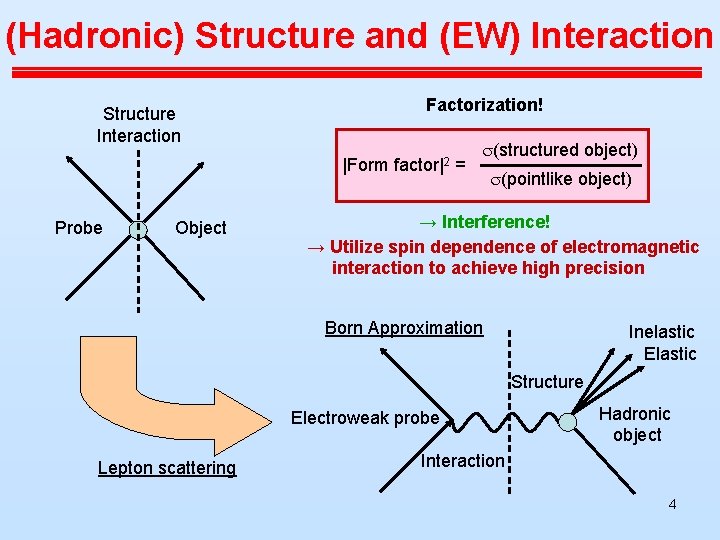
(Hadronic) Structure and (EW) Interaction Factorization! Structure Interaction |Form Probe Object factor|2 = s(structured object) s(pointlike object) → Interference! → Utilize spin dependence of electromagnetic interaction to achieve high precision Born Approximation Inelastic Elastic Structure Electroweak probe Lepton scattering Hadronic object Interaction 4
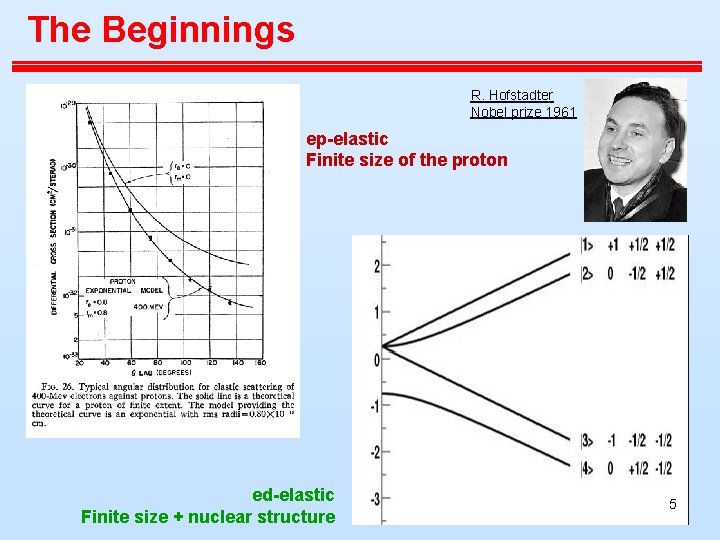
The Beginnings R. Hofstadter Nobel prize 1961 ep-elastic Finite size of the proton ed-elastic Finite size + nuclear structure 5
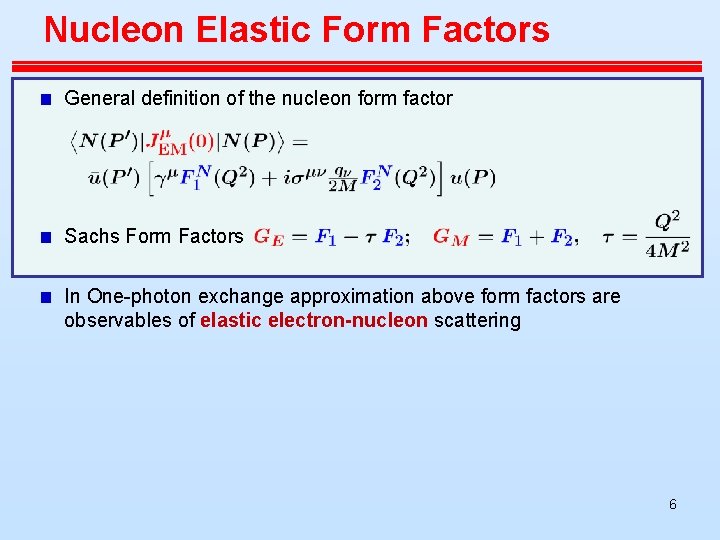
Nucleon Elastic Form Factors General definition of the nucleon form factor Sachs Form Factors In One-photon exchange approximation above form factors are observables of elastic electron-nucleon scattering 6
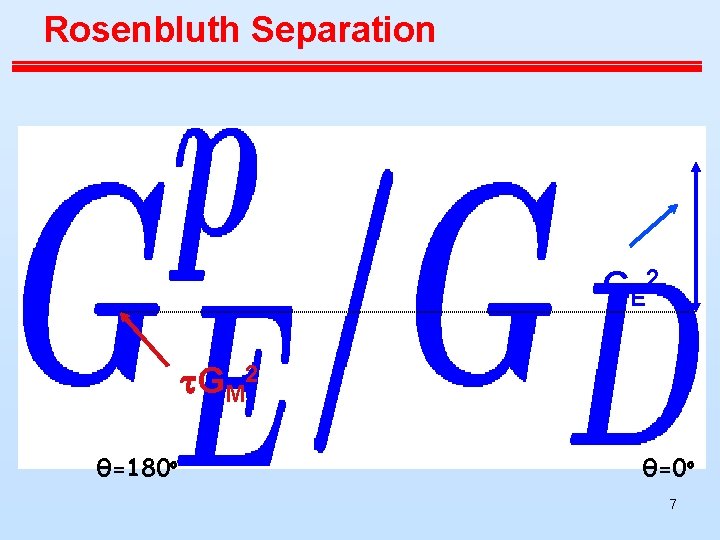
Rosenbluth Separation GE 2 t. GM 2 θ=180 o θ=0 o 7
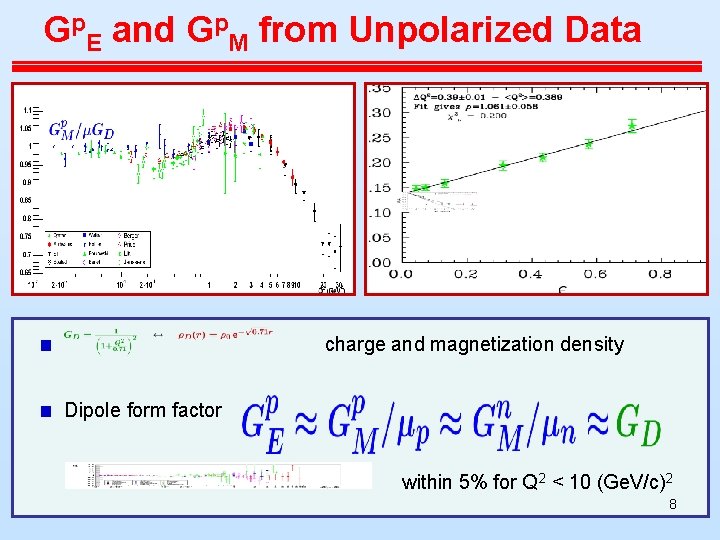
Gp. E and Gp. M from Unpolarized Data charge and magnetization density Dipole form factor within 5% for Q 2 < 10 (Ge. V/c)2 8
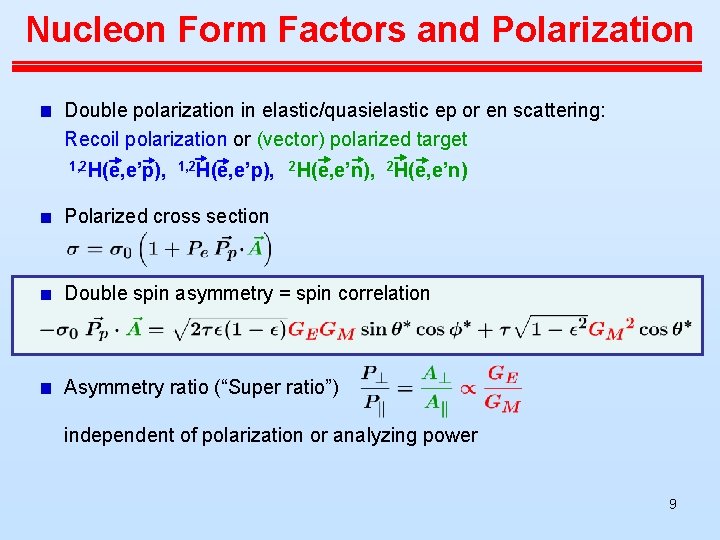
Nucleon Form Factors and Polarization Double polarization in elastic/quasielastic ep or en scattering: Recoil polarization or (vector) polarized target 1, 2 H(e, e’p), 2 H(e, e’n), 2 H(e, e’n) Polarized cross section Double spin asymmetry = spin correlation Asymmetry ratio (“Super ratio”) independent of polarization or analyzing power 9
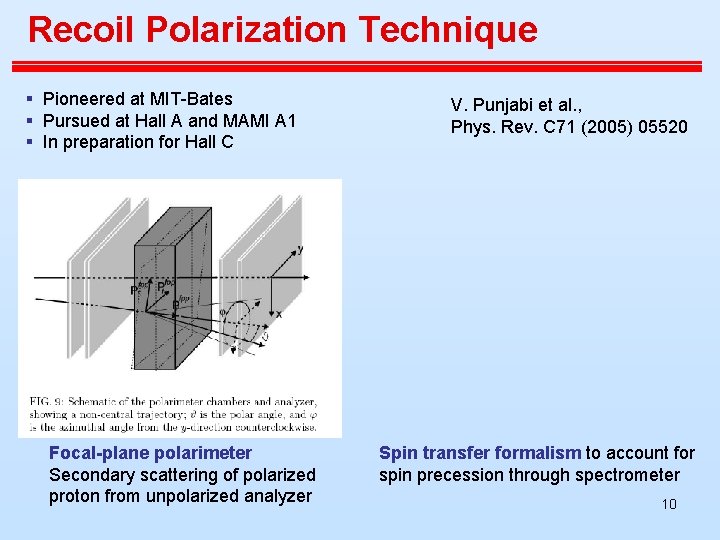
Recoil Polarization Technique § Pioneered at MIT-Bates § Pursued at Hall A and MAMI A 1 § In preparation for Hall C Focal-plane polarimeter Secondary scattering of polarized proton from unpolarized analyzer V. Punjabi et al. , Phys. Rev. C 71 (2005) 05520 Spin transfer formalism to account for spin precession through spectrometer 10
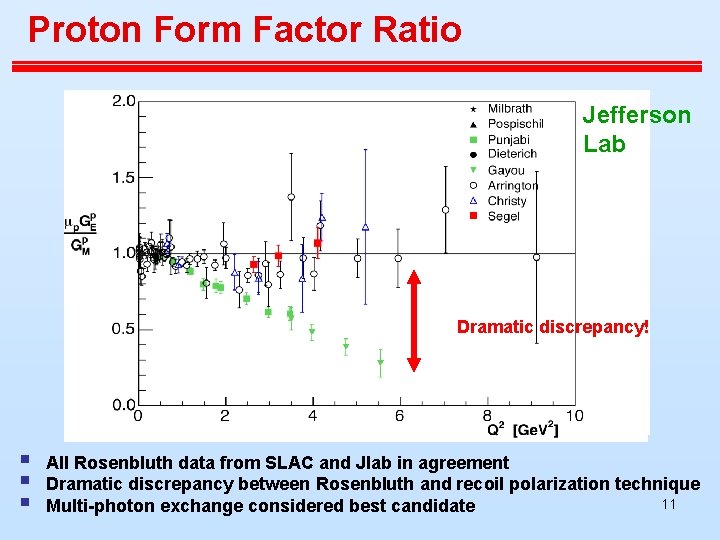
Proton Form Factor Ratio Jefferson Lab Dramatic discrepancy! § § § All Rosenbluth data from SLAC and Jlab in agreement Dramatic discrepancy between Rosenbluth and recoil polarization technique 11 Multi-photon exchange considered best candidate
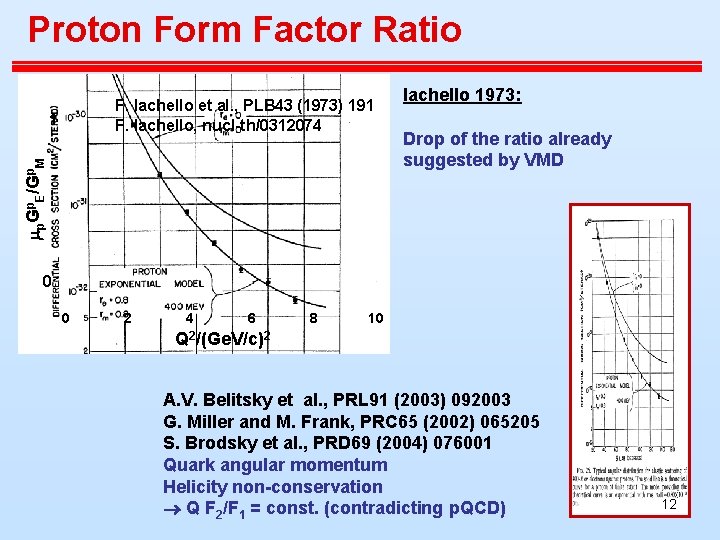
Proton Form Factor Ratio F. Iachello et al. , PLB 43 (1973) 191 F. Iachello, nucl-th/0312074 mp. Gp. E/Gp. M 1 Iachello 1973: Drop of the ratio already suggested by VMD 0 0 2 4 6 8 10 Q 2/(Ge. V/c)2 A. V. Belitsky et al. , PRL 91 (2003) 092003 G. Miller and M. Frank, PRC 65 (2002) 065205 S. Brodsky et al. , PRD 69 (2004) 076001 Quark angular momentum Helicity non-conservation Q F 2/F 1 = const. (contradicting p. QCD) 12
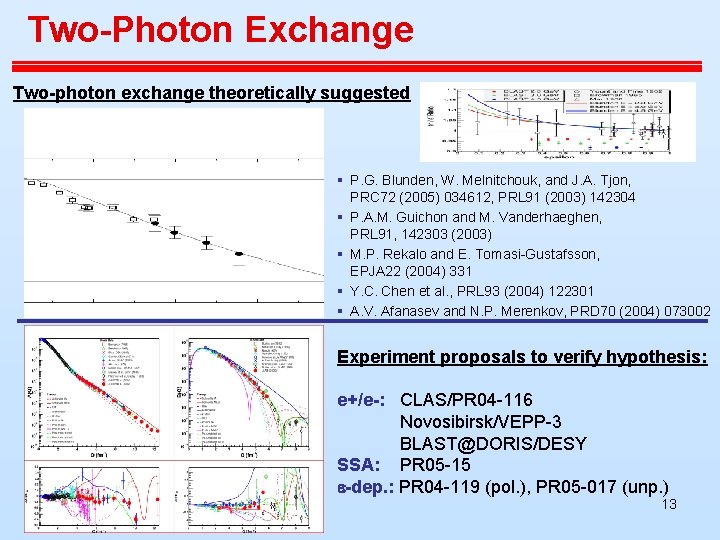
Two-Photon Exchange Two-photon exchange theoretically suggested § P. G. Blunden, W. Melnitchouk, and J. A. Tjon, PRC 72 (2005) 034612, PRL 91 (2003) 142304 § P. A. M. Guichon and M. Vanderhaeghen, PRL 91, 142303 (2003) § M. P. Rekalo and E. Tomasi-Gustafsson, EPJA 22 (2004) 331 § Y. C. Chen et al. , PRL 93 (2004) 122301 § A. V. Afanasev and N. P. Merenkov, PRD 70 (2004) 073002 Experiment proposals to verify hypothesis: e+/e-: CLAS/PR 04 -116 Novosibirsk/VEPP-3 BLAST@DORIS/DESY SSA: PR 05 -15 e-dep. : PR 04 -119 (pol. ), PR 05 -017 (unp. ) 13
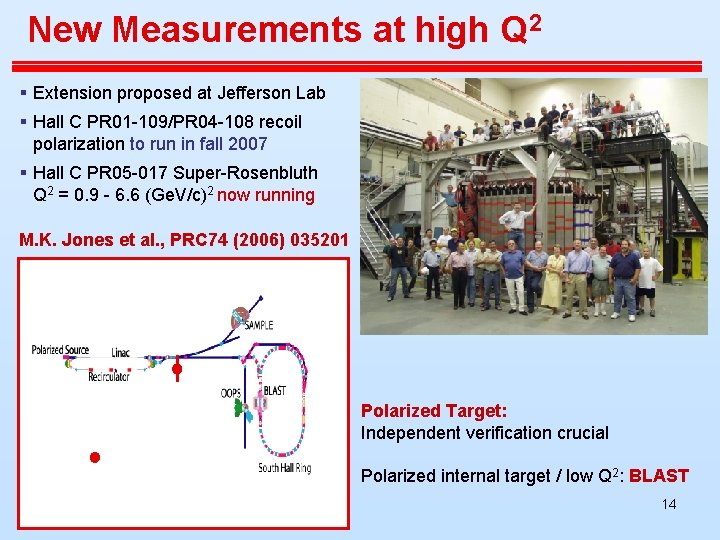
New Measurements at high Q 2 § Extension proposed at Jefferson Lab § Hall C PR 01 -109/PR 04 -108 recoil polarization to run in fall 2007 § Hall C PR 05 -017 Super-Rosenbluth Q 2 = 0. 9 - 6. 6 (Ge. V/c)2 now running M. K. Jones et al. , PRC 74 (2006) 035201 Polarized Target: Independent verification crucial Polarized internal target / low Q 2: BLAST 14
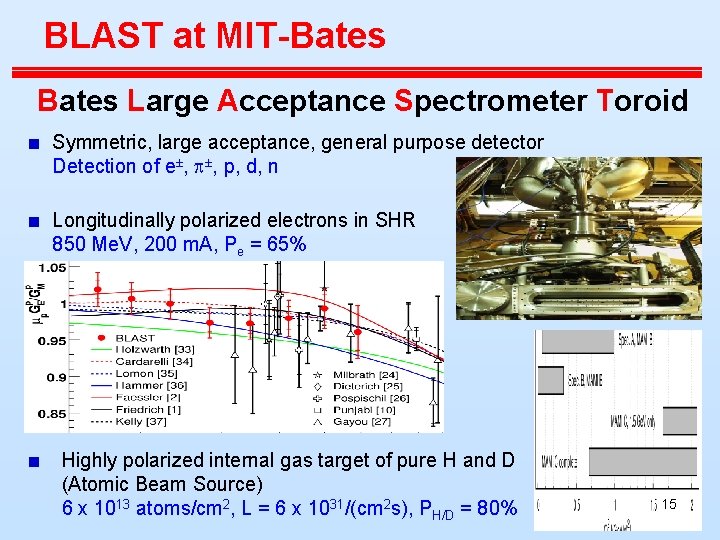
BLAST at MIT-Bates Large Acceptance Spectrometer Toroid Symmetric, large acceptance, general purpose detector Detection of e±, p, d, n Longitudinally polarized electrons in SHR 850 Me. V, 200 m. A, Pe = 65% Highly polarized internal gas target of pure H and D (Atomic Beam Source) 6 x 10¹³ atoms/cm 2, L = 6 x 1031/(cm 2 s), PH/D = 80% 15
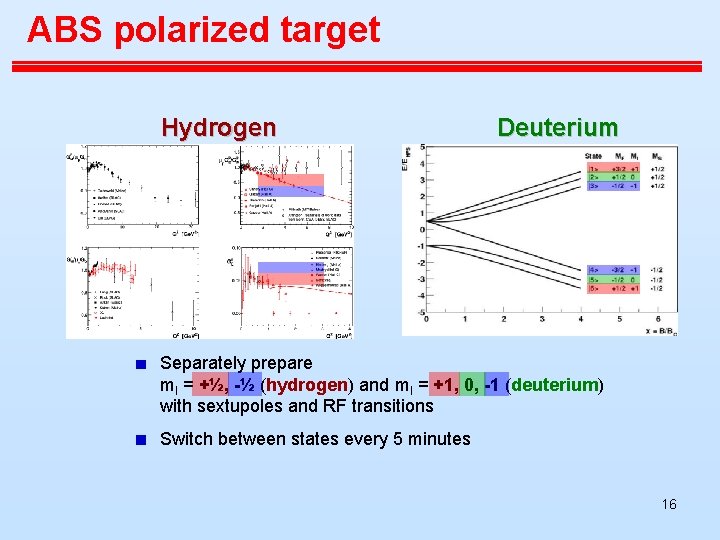
ABS polarized target Hydrogen Deuterium Separately prepare m. I = +½, -½ (hydrogen) and m. I = +1, 0, -1 (deuterium) with sextupoles and RF transitions Switch between states every 5 minutes 16
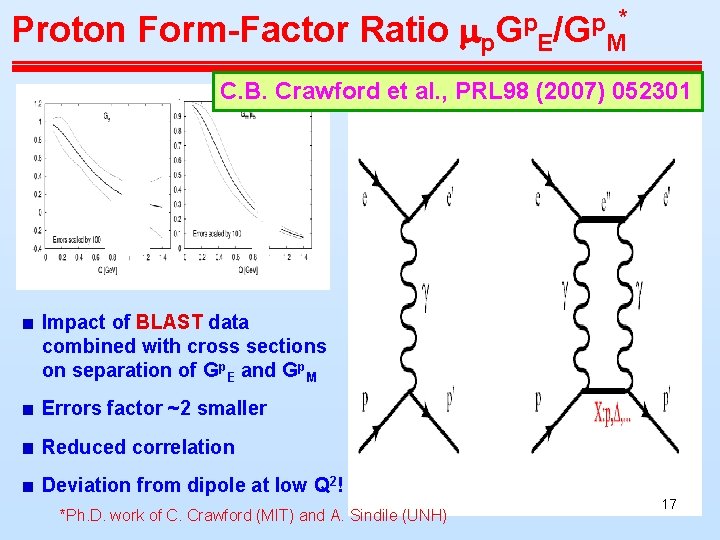
Proton Form-Factor Ratio mp Gp * p E/G M C. B. Crawford et al. , PRL 98 (2007) 052301 Impact of BLAST data combined with cross sections on separation of Gp. E and Gp. M Errors factor ~2 smaller Reduced correlation Deviation from dipole at low Q 2! *Ph. D. work of C. Crawford (MIT) and A. Sindile (UNH) 17
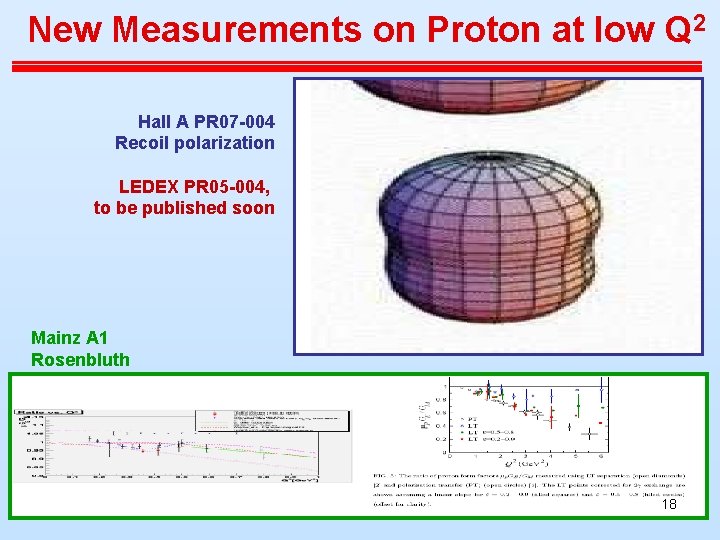
New Measurements on Proton at low Q 2 Hall A PR 07 -004 Recoil polarization LEDEX PR 05 -004, to be published soon Mainz A 1 Rosenbluth 18
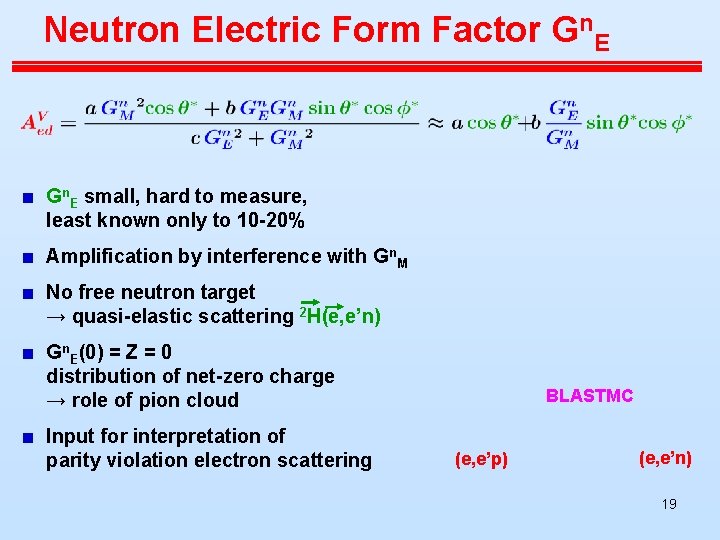
Neutron Electric Form Factor Gn. E small, hard to measure, least known only to 10 -20% Amplification by interference with Gn. M No free neutron target → quasi-elastic scattering 2 H(e, e’n) Gn. E(0) = Z = 0 distribution of net-zero charge → role of pion cloud Input for interpretation of parity violation electron scattering BLASTMC (e, e’p) (e, e’n) 19
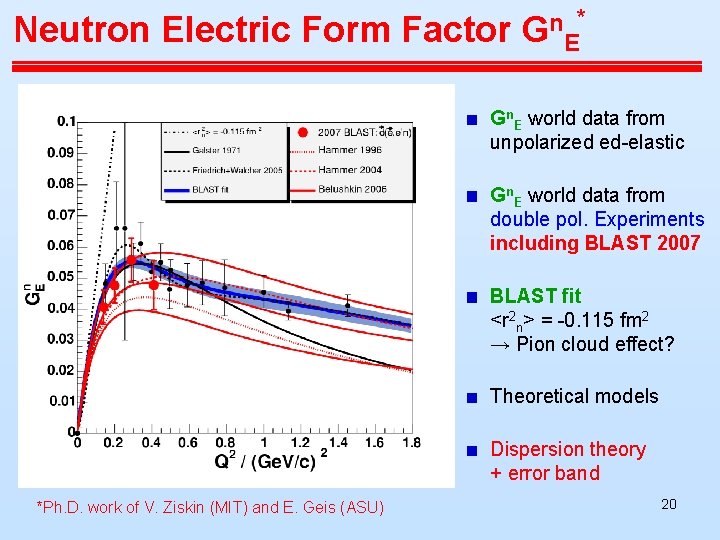
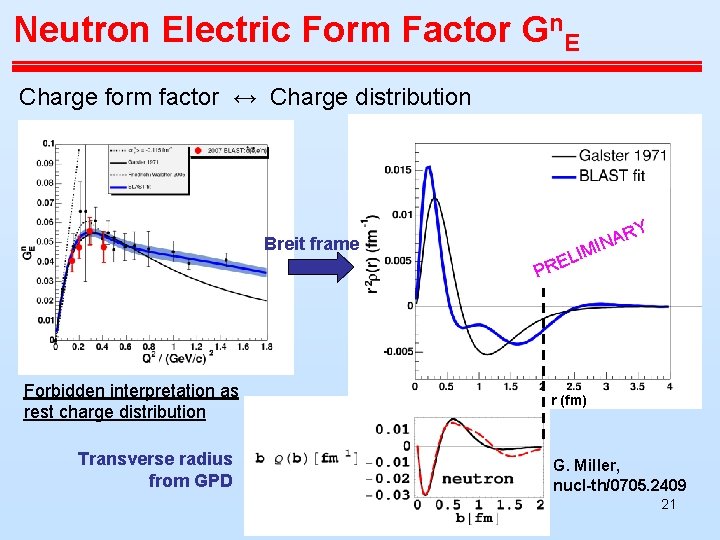
Neutron Electric Form Factor * n G E Gn. E world data from unpolarized ed-elastic Gn. E world data from double pol. Experiments including BLAST 2007 BLAST fit <r 2 n> = -0. 115 fm 2 → Pion cloud effect? RY A IN M ELI R P Theoretical models Dispersion theory + error band *Ph. D. work of V. Ziskin (MIT) and E. Geis (ASU) 20
Neutron Electric Form Factor Gn. E Charge form factor ↔ Charge distribution Breit frame Forbidden interpretation as rest charge distribution Transverse radius from GPD RY Y A R N NIA M I I L M RLEI E P R P r (fm) G. Miller, nucl-th/0705. 2409 21
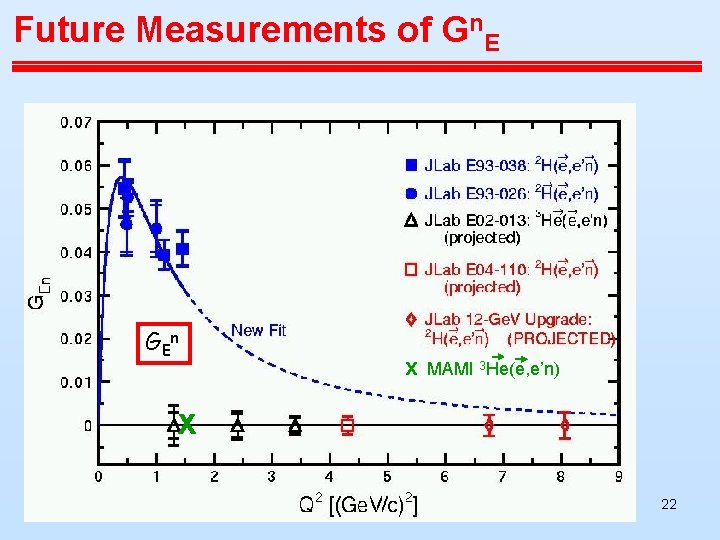
Future Measurements of Gn. E G En x MAMI 3 He(e, e’n) x 22
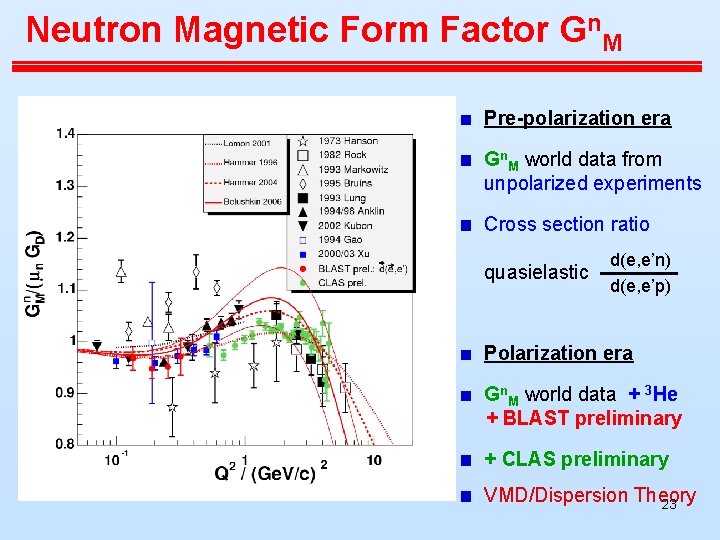
Neutron Magnetic Form Factor Gn. M Pre-polarization era Gn. M world data from unpolarized experiments Cross section ratio quasielastic d(e, e’n) d(e, e’p) Polarization era Gn. M world data + 3 He + BLAST preliminary + CLAS preliminary VMD/Dispersion Theory 23
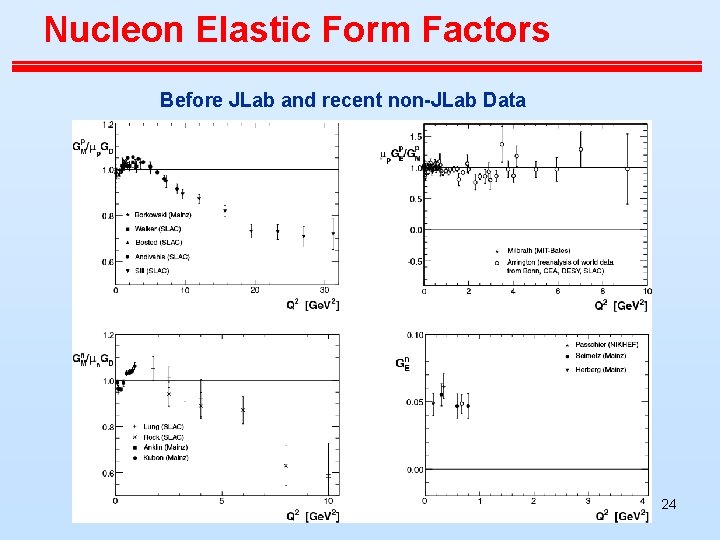
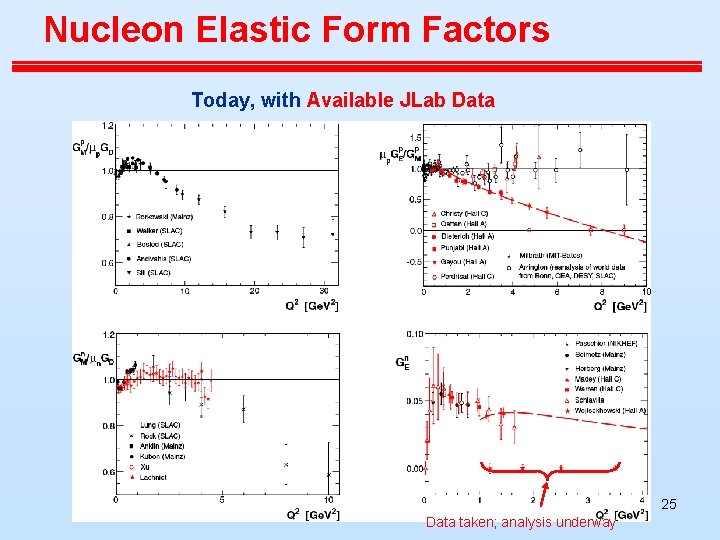
Nucleon Elastic Form Factors Before JLab and recent non-JLab Data 24
Nucleon Elastic Form Factors Today, with Available JLab Data 25 Data taken; analysis underway
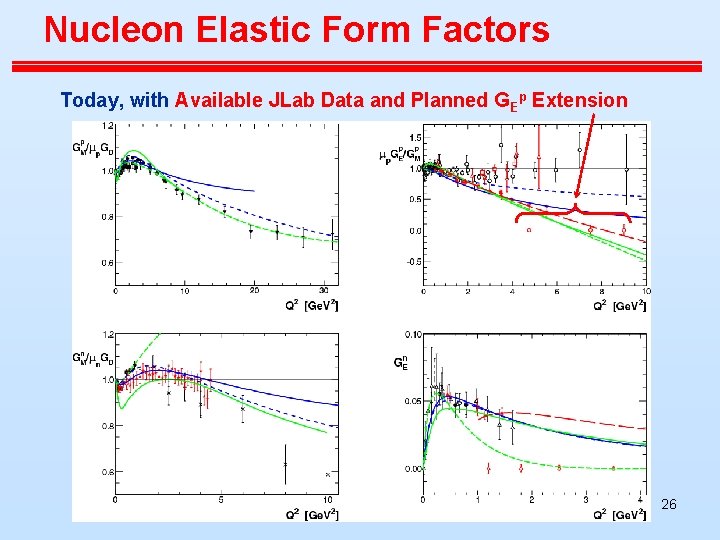
Nucleon Elastic Form Factors Today, with Available JLab Data and Planned GEp Extension 26
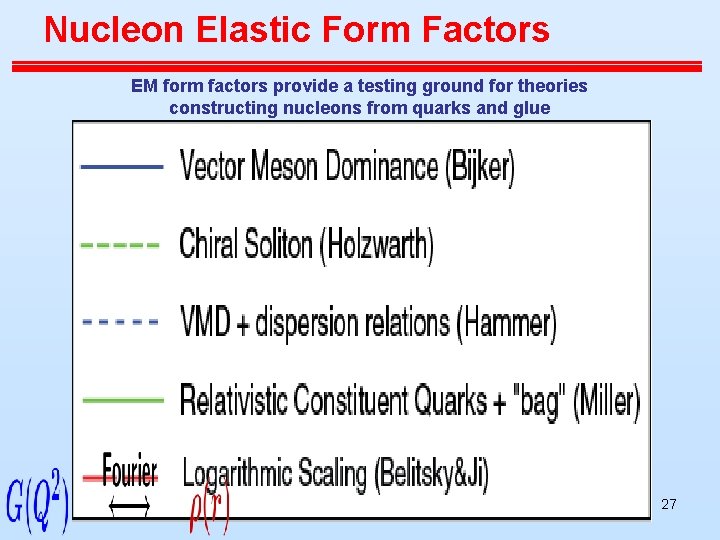
Nucleon Elastic Form Factors EM form factors provide a testing ground for theories constructing nucleons from quarks and glue 27
Deuteron 28
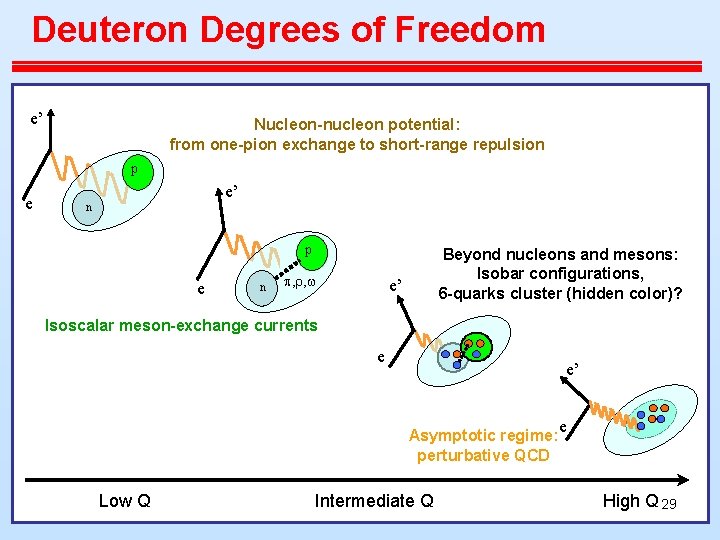
Deuteron Degrees of Freedom e’ Nucleon-nucleon potential: from one-pion exchange to short-range repulsion p e e’ n p e n p, r, w Beyond nucleons and mesons: Isobar configurations, 6 -quarks cluster (hidden color)? e’ Isoscalar meson-exchange currents e e’ Asymptotic regime: perturbative QCD Low Q Intermediate Q e High Q 29
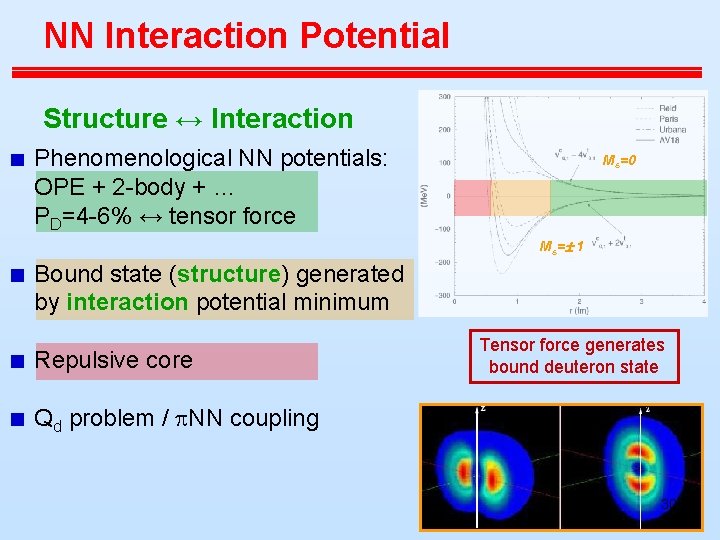
NN Interaction Potential Structure ↔ Interaction Phenomenological NN potentials: OPE + 2 -body + … PD=4 -6% ↔ tensor force Ms=0 Ms= 1 Bound state (structure) generated by interaction potential minimum Repulsive core Tensor force generates bound deuteron state Qd problem / p. NN coupling 30
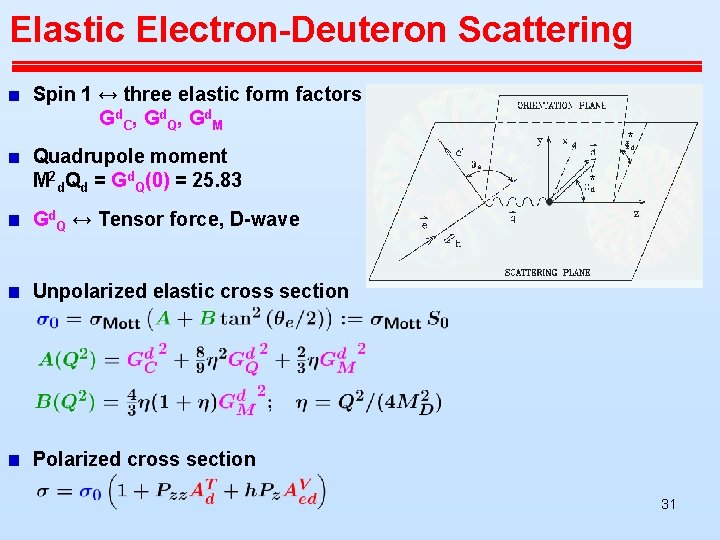
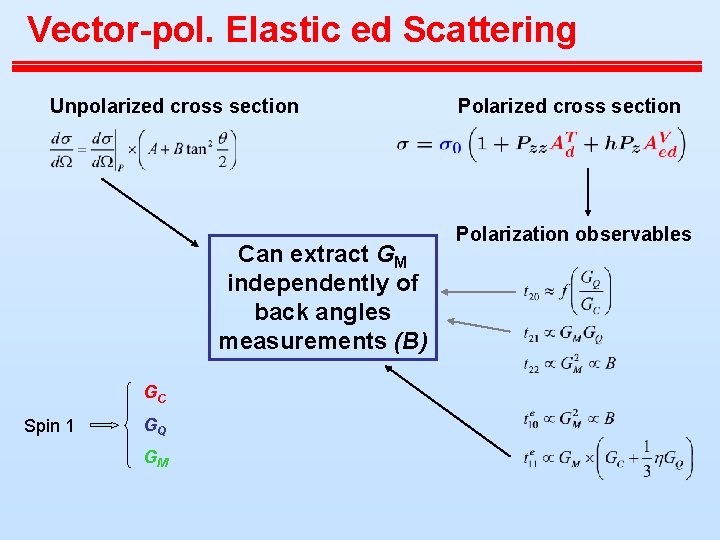
Elastic Electron-Deuteron Scattering Spin 1 ↔ three elastic form factors Gd. C, Gd. Q, Gd. M Quadrupole moment M 2 d. Qd = Gd. Q(0) = 25. 83 * * Gd. Q ↔ Tensor force, D-wave Unpolarized elastic cross section Polarized cross section 31
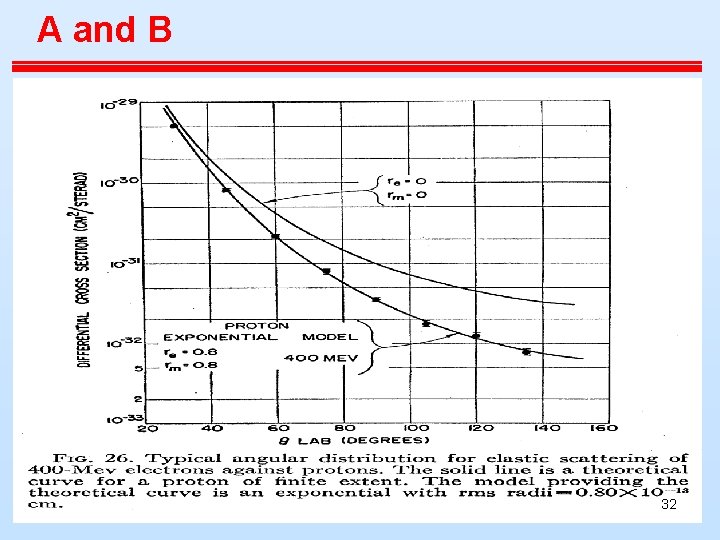
A and B 32
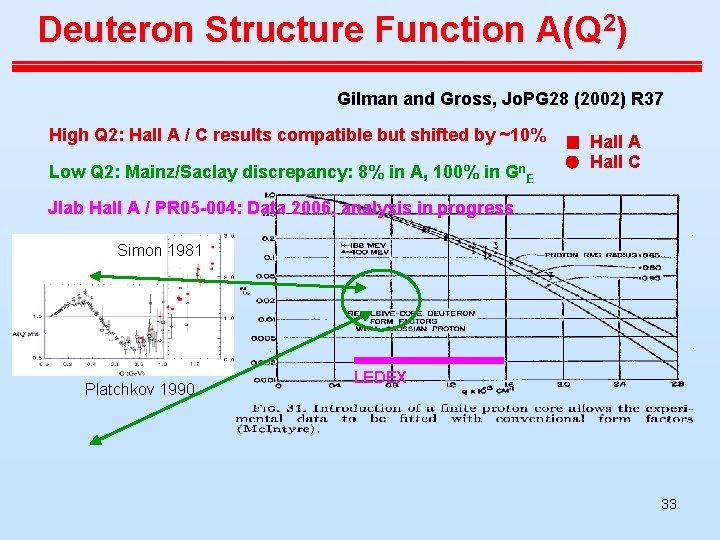
Deuteron Structure Function A(Q 2) Gilman and Gross, Jo. PG 28 (2002) R 37 High Q 2: Hall A / C results compatible but shifted by ~10% Low Q 2: Mainz/Saclay discrepancy: 8% in A, 100% in Gn. E Hall A Hall C Jlab Hall A / PR 05 -004: Data 2006, analysis in progress Simon 1981 Platchkov 1990 LEDEX 33
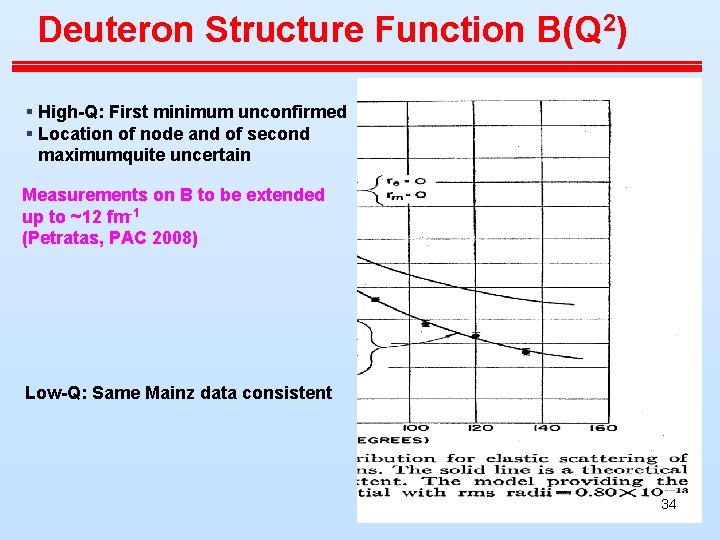
Deuteron Structure Function B(Q 2) § High-Q: First minimum unconfirmed § Location of node and of second maximumquite uncertain Measurements on B to be extended up to ~12 fm-1 (Petratas, PAC 2008) Low-Q: Same Mainz data consistent 34
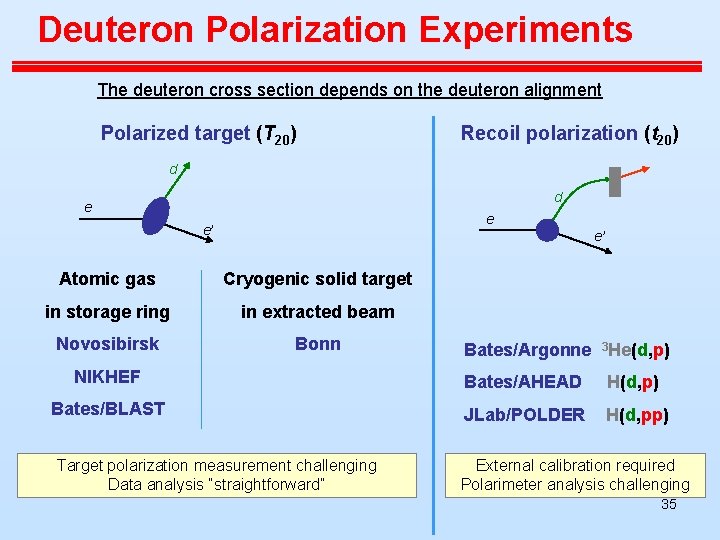
Deuteron Polarization Experiments The deuteron cross section depends on the deuteron alignment Polarized target (T 20) Recoil polarization (t 20) d d e e e’ e’ Atomic gas Cryogenic solid target in storage ring in extracted beam Novosibirsk Bonn Bates/Argonne 3 He(d, p) NIKHEF Bates/AHEAD H(d, p) Bates/BLAST JLab/POLDER H(d, pp) Target polarization measurement challenging Data analysis “straightforward” External calibration required Polarimeter analysis challenging 35
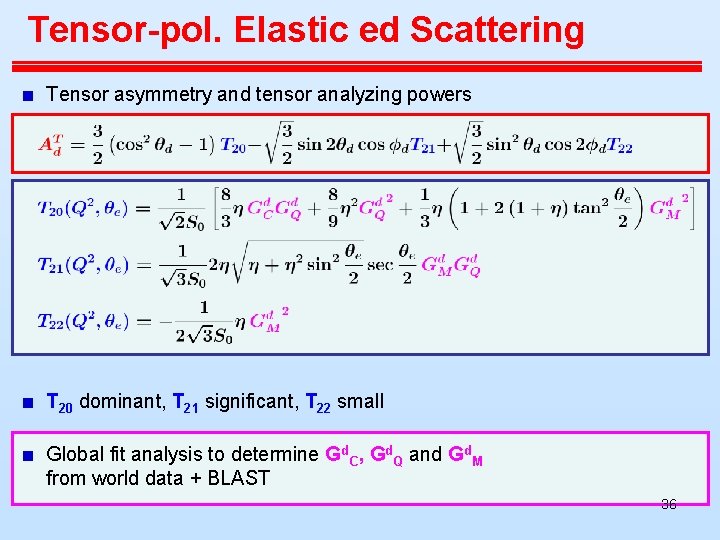
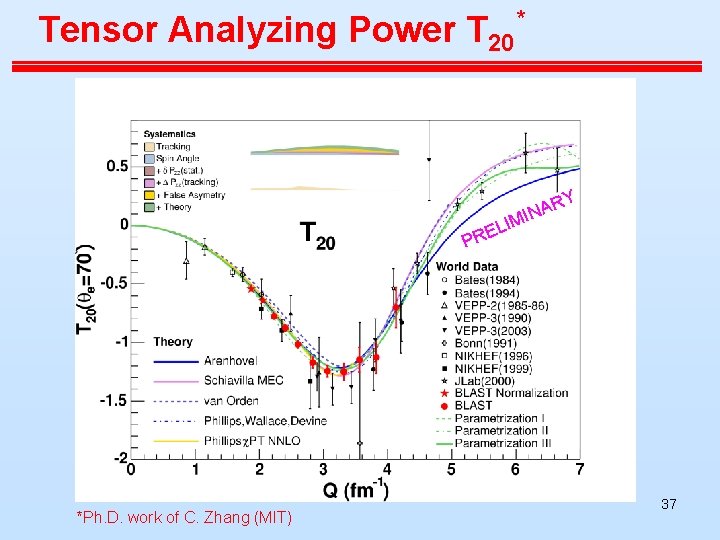
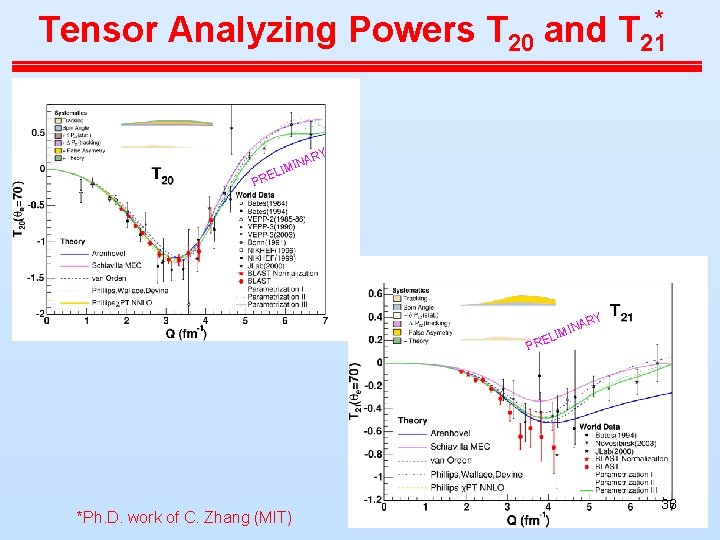
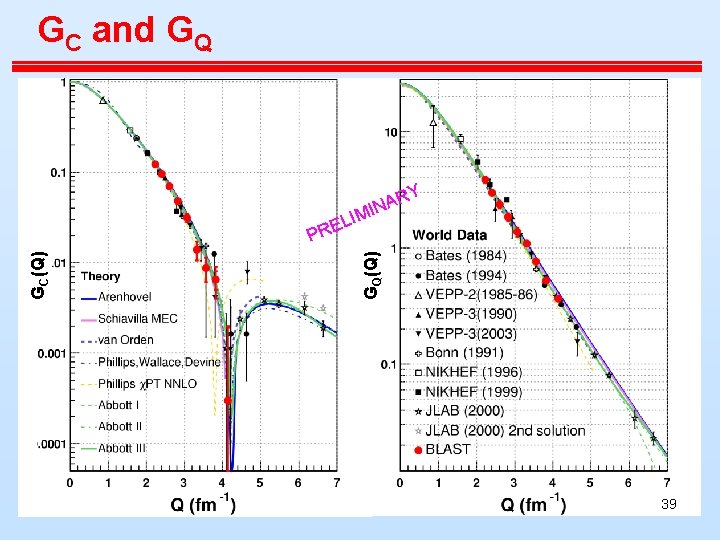
Tensor-pol. Elastic ed Scattering Tensor asymmetry and tensor analyzing powers T 20 dominant, T 21 significant, T 22 small Global fit analysis to determine Gd. C, Gd. Q and Gd. M from world data + BLAST 36
Tensor Analyzing Power T 20 * RY A N IMI EL R P *Ph. D. work of C. Zhang (MIT) 37
Tensor Analyzing Powers T 20 and * T 21 RY NA IMI EL PR *Ph. D. work of C. Zhang (MIT) 38
GC and GQ RY A IN GQ(Q) GC(Q) LIM E PR 39
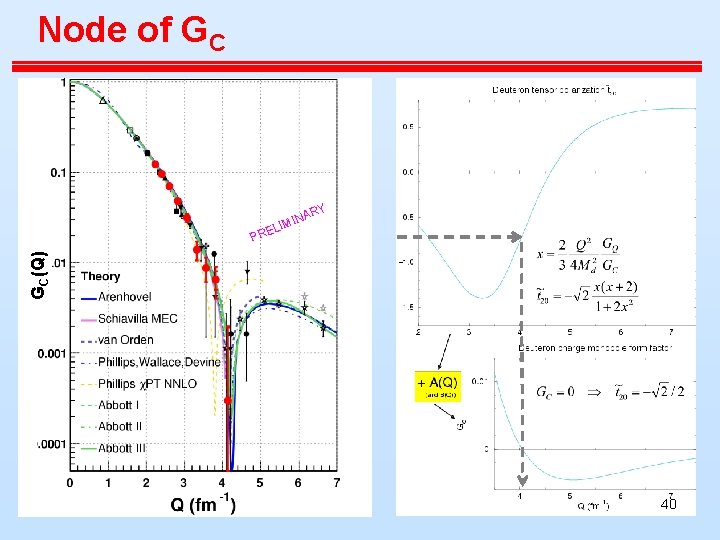
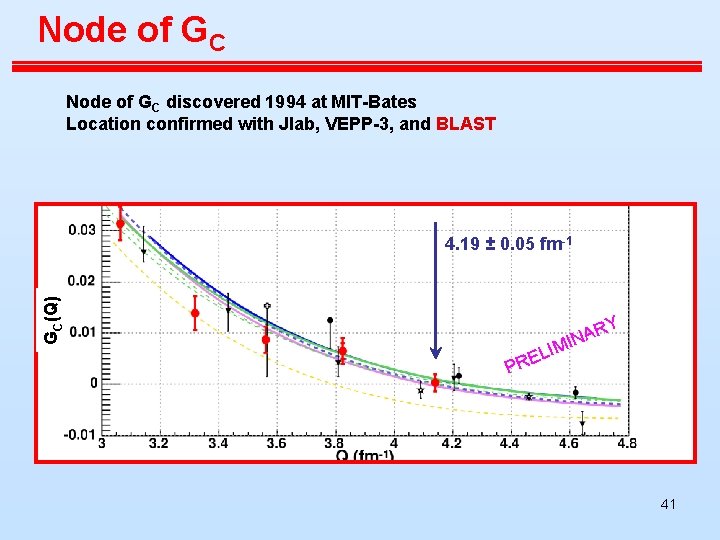
Node of GC RY EL GC(Q) PR NA IMI 40
Node of GC discovered 1994 at MIT-Bates Location confirmed with Jlab, VEPP-3, and BLAST GC(Q) 4. 19 ± 0. 05 fm-1 RY A IN M ELI R P 41
Vector-pol. Elastic ed Scattering Unpolarized cross section Can extract GM independently of back angles measurements (B) GC Spin 1 GQ GM Polarized cross section Polarization observables
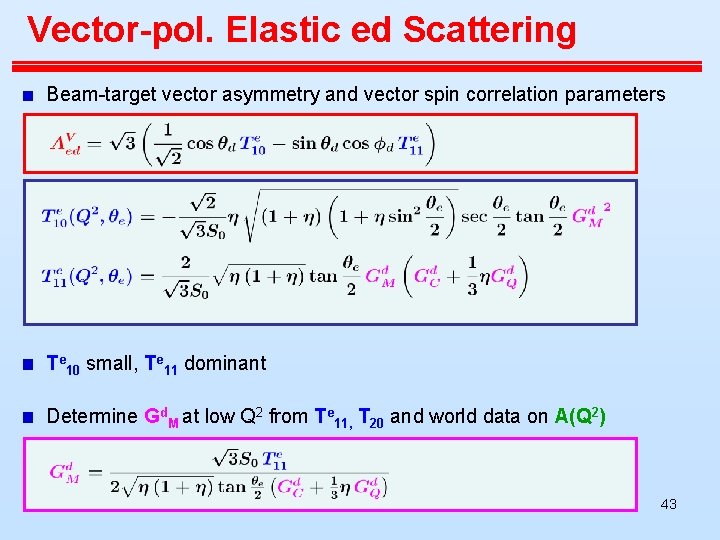
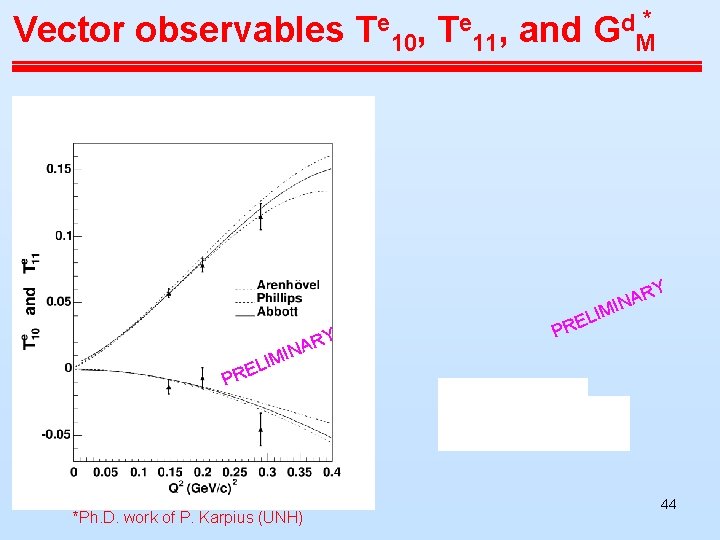
Vector-pol. Elastic ed Scattering Beam-target vector asymmetry and vector spin correlation parameters Te 10 small, Te 11 dominant Determine Gd. M at low Q 2 from Te 11, T 20 and world data on A(Q 2) 43
Vector observables Te 10, Te 11, and * d G M RY A IN M Y M LI RE R INA ELI R P P *Ph. D. work of P. Karpius (UNH) 44
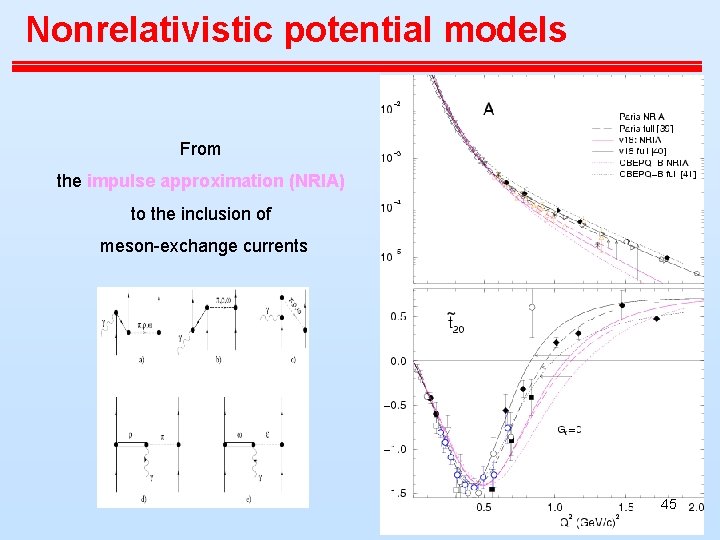
Nonrelativistic potential models From the impulse approximation (NRIA) to the inclusion of meson-exchange currents 45
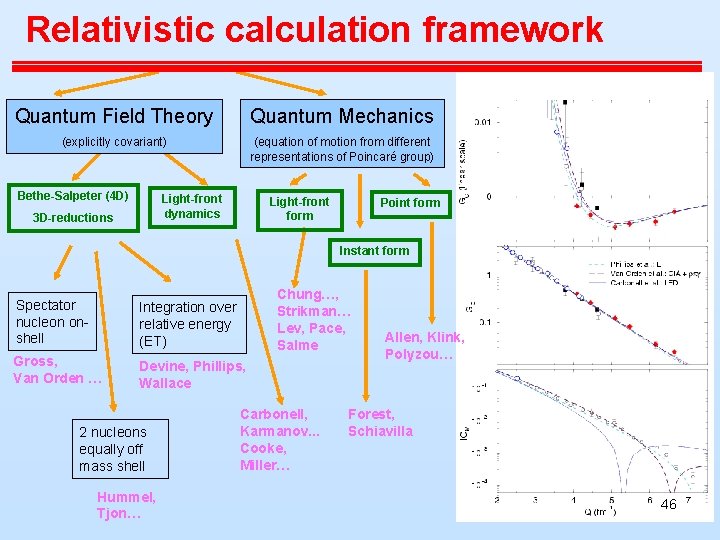
Relativistic calculation framework Quantum Field Theory Quantum Mechanics (explicitly covariant) (equation of motion from different representations of Poincaré group) Bethe-Salpeter (4 D) Light-front dynamics 3 D-reductions Light-front form Point form Instant form Chung…, Strikman… Lev, Pace, Salme Spectator nucleon onshell Integration over relative energy (ET) Gross, Van Orden … Devine, Phillips, Wallace 2 nucleons equally off mass shell Hummel, Tjon… Carbonell, Karmanov. . . Cooke, Miller… Allen, Klink, Polyzou… Forest, Schiavilla 46
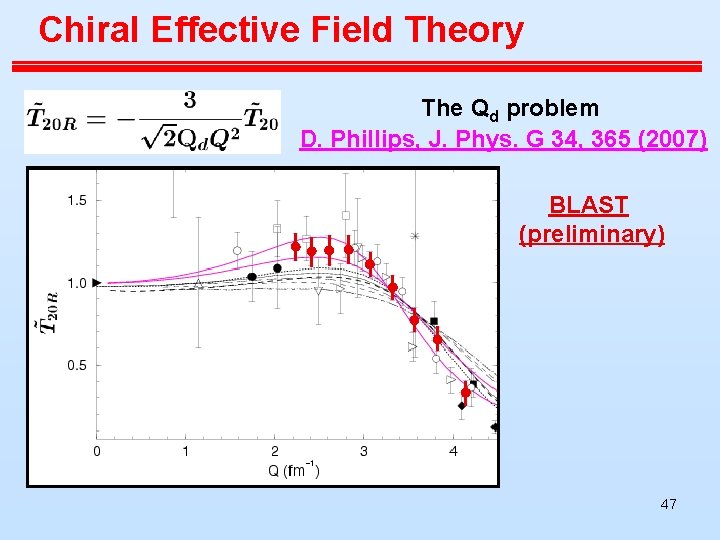
Chiral Effective Field Theory The Qd problem D. Phillips, J. Phys. G 34, 365 (2007) BLAST (preliminary) 47
Summary Nucleon and Deuteron electromagnetic elastic form factors Tremendous progress during last decade High precision, low systematics through polarization experiments Worldwide activity at its peak Nucleon: q High-Q 2 surprise in Gp. E/Gp. M; strong impact on theoretical picture Evidence for two-photon exchange effects q New precise picture of Gn. E for Q 2<1. 5 (Ge. V/c)2, Gn. M <5 (Ge. V/c)2 q Evidence for structure beyond GDipole at low Q 2 in all form factors Deuteron: q Precision measurement of T 20 allows to separate GC and GQ q First measurement of Te 11 allows to determine GM at low Q 2 q Some problems in data unresolved q Progress in theory: Relativistic calculations, Chiral EFT 48