
Inorganic Arsenic Contents of the regulation v Regulation
- Slides: 35
Inorganic Arsenic
Contents of the regulation v Regulation is limited to: • copper aceto-arsenite and • all inorganic compounds containing arsenic except arsine v. A copy of the regulation is available to employees v Regulated areas 1 a
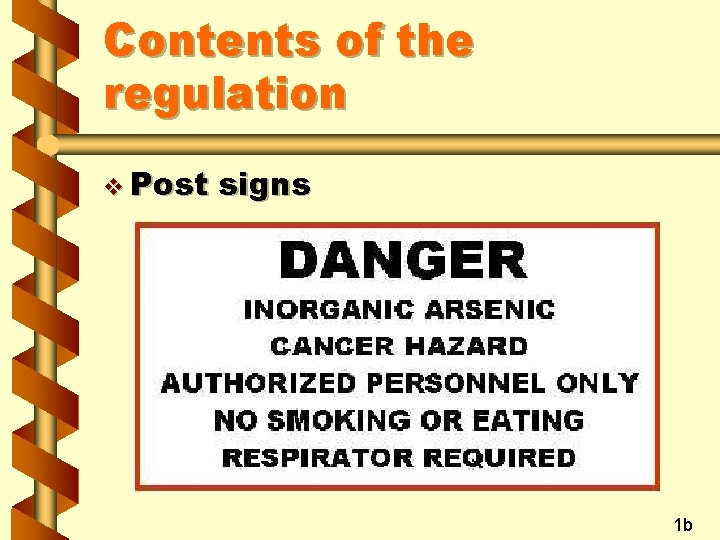
Contents of the regulation v Post signs 1 b
Contents of the regulation v Only authorized persons may enter regulated areas v List job titles/functions of those allowed to access regulated areas 1 c
Contents of the regulation v Make monitoring program clear to employees • Company has obligation to control exposures v Permissible exposure limits v Engineering and work practice controls 1 d
Contents of the regulation v Inform employees: • at least quarterly for employees who have optional use of respirators • at least annually of the information in the regulation 1 e
Contents of the regulation v Training must include: • proper work practices • emergency procedures • proper use of PPE v Employees must be able to observe air monitoring 1 f
Contents of the regulation v Air monitoring depends upon the following factors: • Above the action level but below the PEL - at least every 6 months • Changes in personnel, processes, controls 1 g
Contents of the regulation v Companies must develop and implement a written compliance plan 1 h
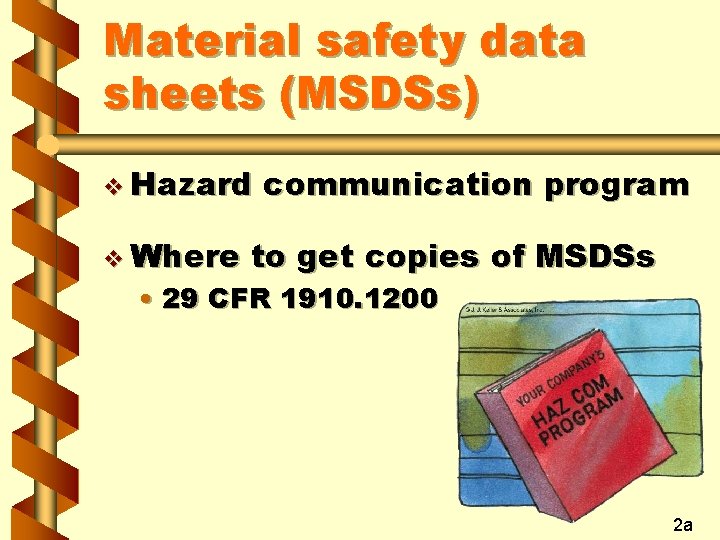
Material safety data sheets (MSDSs) v Hazard v Where communication program to get copies of MSDSs • 29 CFR 1910. 1200 2 a
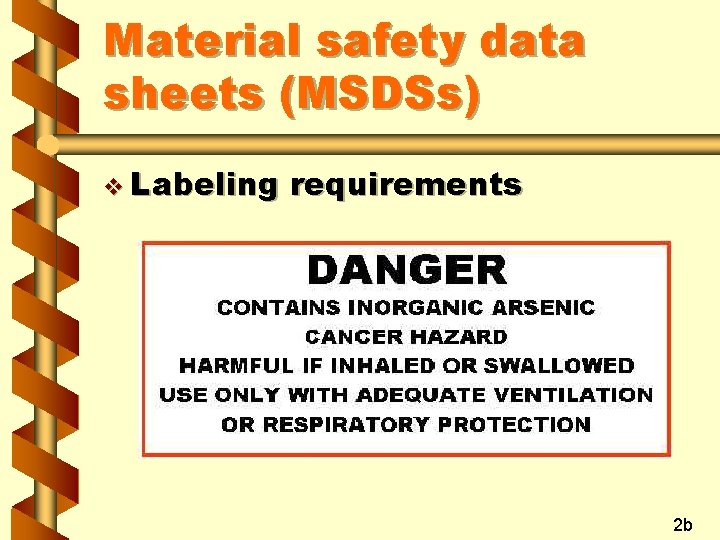
Material safety data sheets (MSDSs) v Labeling requirements 2 b
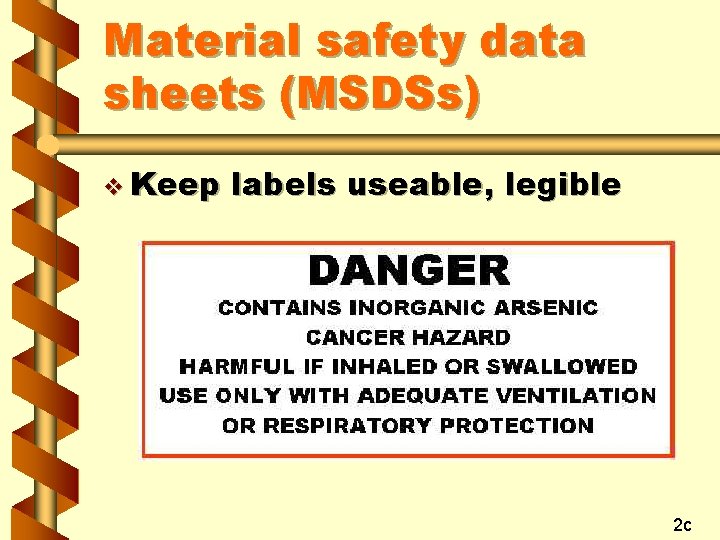
Material safety data sheets (MSDSs) v Keep labels useable, legible 2 c
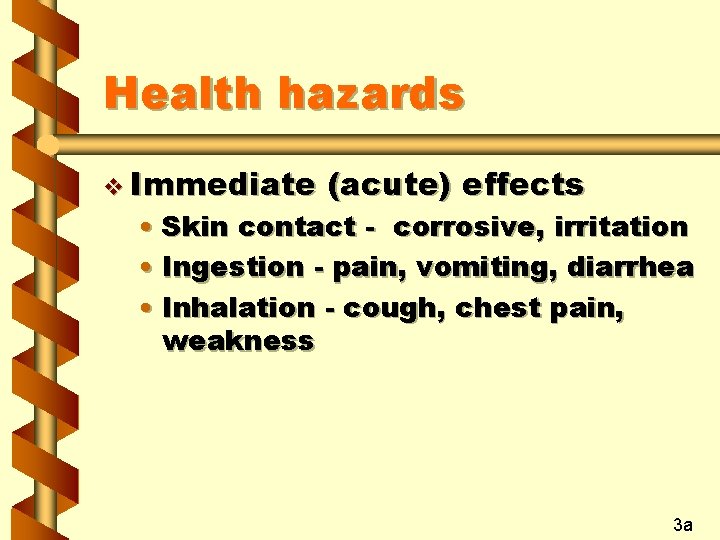
Health hazards v Immediate (acute) effects • Skin contact - corrosive, irritation • Ingestion - pain, vomiting, diarrhea • Inhalation - cough, chest pain, weakness 3 a
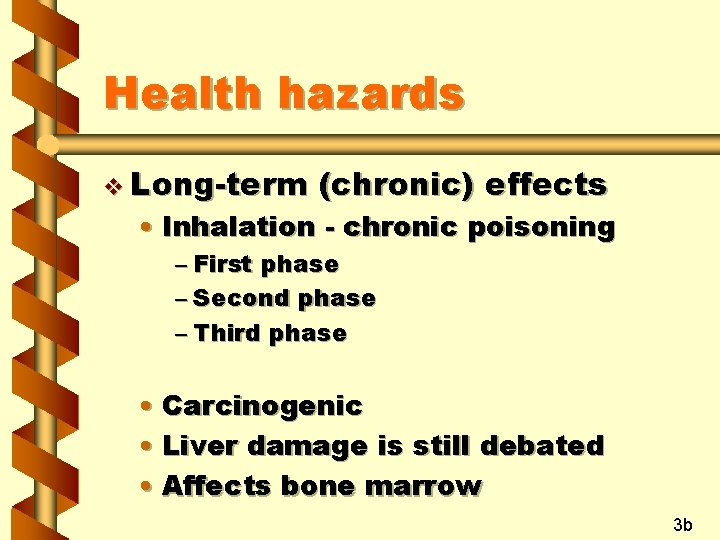
Health hazards v Long-term (chronic) effects • Inhalation - chronic poisoning – First phase – Second phase – Third phase • Carcinogenic • Liver damage is still debated • Affects bone marrow 3 b
Engineering controls v Primary methods of exposure v Review controls and practices control 4 a
Emergency procedures v Everyone must understand his/her duties/assignments v Know how to report emergencies 5 a
Emergency procedures v Know how to evacuate safely v Know facility emergency plan v Respond training within scope of 5 b
Medical surveillance v Required for all employees: • exposed above the action level for 30+ days/year • exposed during an emergency • showing signs/ symptoms of exposure 6 a
Medical surveillance v Exposure thresholds are determined without respirator use 6 b
Medical surveillance v Examinations will be: • prior to assignment • at least annually for employees under 45 years old with fewer than 10 years of exposure over the action level 6 c
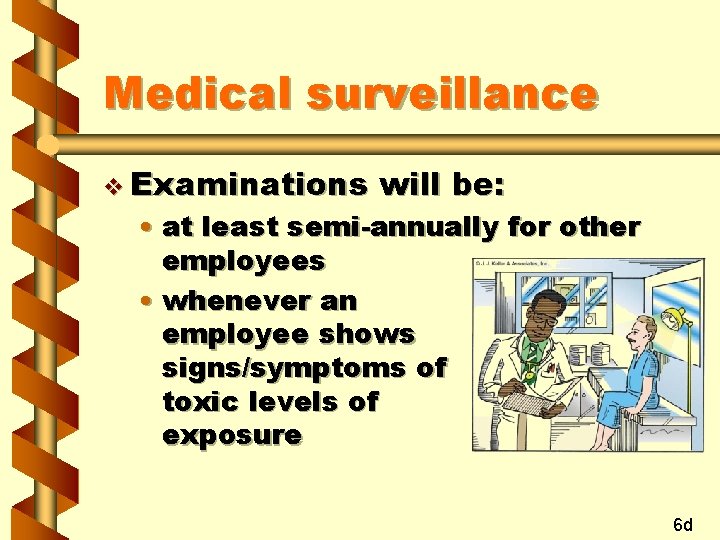
Medical surveillance v Examinations will be: • at least semi-annually for other employees • whenever an employee shows signs/symptoms of toxic levels of exposure 6 d
Medical surveillance v Examination includes: • work and medical history • posterior/anterior chest x-ray • nasal and skin examination • sputum cytology exam • any other tests deemed necessary 6 e
Medical surveillance v Physician including: gives written opinion, • all test results • the physician’s opinion about employee’s medical condition • recommended limitations 6 f
Medical surveillance v Physician including: gives written opinion, • a statement that the employee has been informed of results • if there is a need for further treatment 6 g
Medical surveillance v Records are required to be retained by the employer: • X-rays for the most recent five years • Cytologic exam slide and written descriptions for the most recent five years 6 h
Medical surveillance v Records are required to be retained by the employer: • Cytologic exam slide with demonstrated atypia if atypia persists for three years 6 i
Medical surveillance v Records are required to be retained by the employer: • overall retention is for 40 years; or • the employee’s term of employment plus 20 years, whichever is longer v Employees have the right to access records 6 j
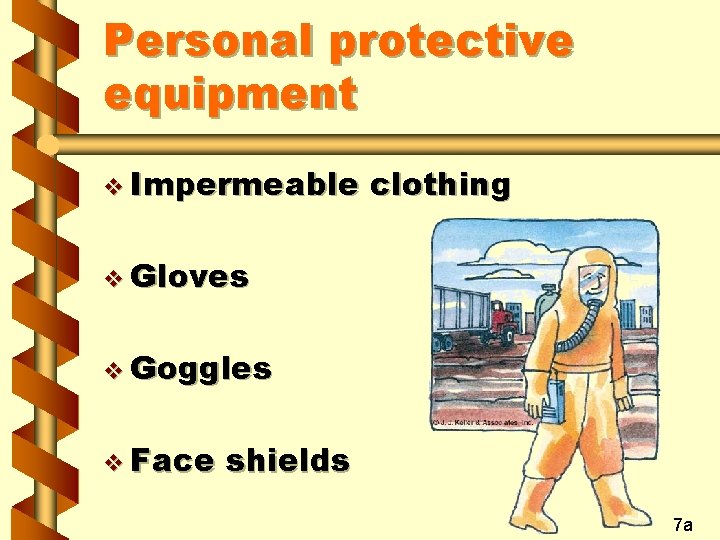
Personal protective equipment v Impermeable clothing v Gloves v Goggles v Face shields 7 a
Personal protective equipment v Other protective gear v Selection, use, inspection, limitations, cleaning and disposal 7 b
Personal protective equipment v Changing v Lunch rooms v Removing/storing clothing contaminated 7 c
Personal protective equipment v Exposed workers must: • wash face and hands before eating, drinking, smoking, applying cosmetics • take showers at the end of the shift 7 d
Personal protective equipment v Don’t take contaminated clothing home v Blowing or shaking clothes to remove arsenic is prohibited 7 e
Personal protective equipment v Respirators are required: • during the period necessary to install or implement engineering/work practice controls • in operations where engineering/work practice controls are not feasible 7 f
Personal protective equipment v Respirators are required: • in work operations where engineering/work practice controls do not reduce exposure below the PEL • in emergencies 7 g
Personal protective equipment v Workers have an affirmative duty to wear respirators v Periodic required respirator fit tests are 7 h