
Innovativeness and Adopter Categories Change in Rural America


- Slides: 23
Innovativeness and Adopter Categories
Change in Rural America • Adoption Diffusion Process • How affects you. • Major Rural Changes
Innovativeness • The degree to which an individual or other unit of adoption is relatively earlier in adopting new ideas than other members of the social system • Not everyone adopts at the same time • People can be classified by their adoption habits
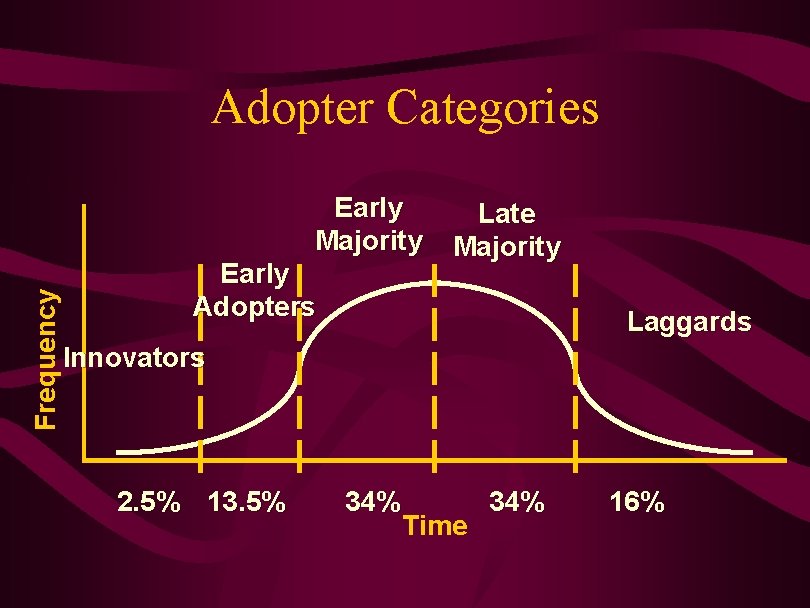
Adopter Categories Frequency Early Majority Early Adopters Late Majority Laggards Innovators 2. 5% 13. 5% 34% Time 34% 16%
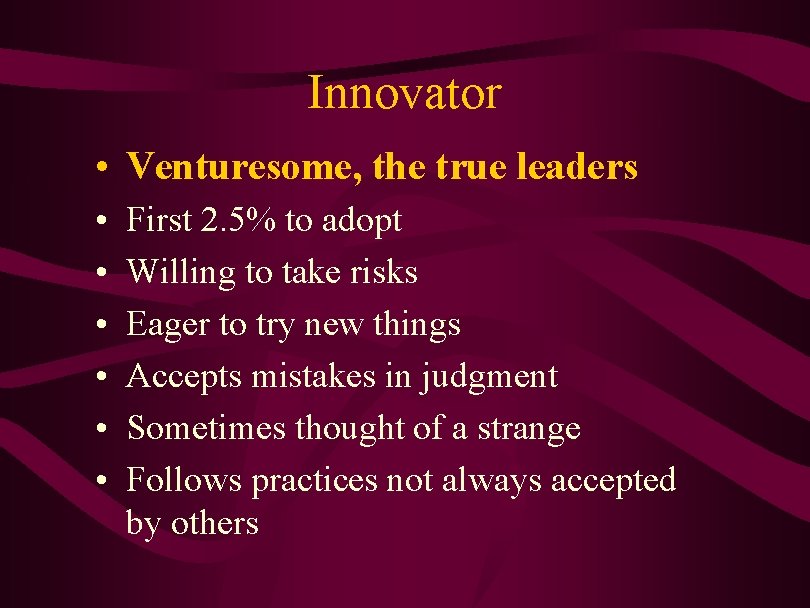
Innovator • Venturesome, the true leaders • • • First 2. 5% to adopt Willing to take risks Eager to try new things Accepts mistakes in judgment Sometimes thought of a strange Follows practices not always accepted by others
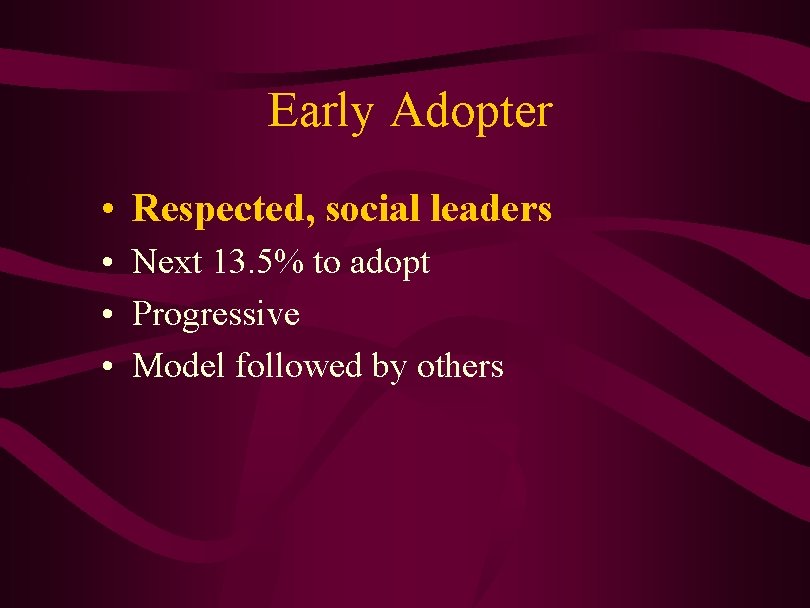
Early Adopter • Respected, social leaders • Next 13. 5% to adopt • Progressive • Model followed by others
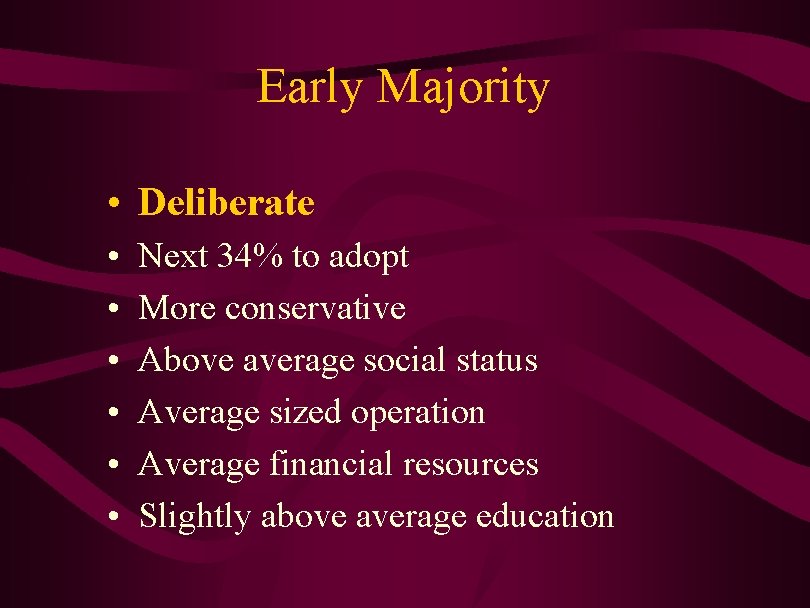
Early Majority • Deliberate • • • Next 34% to adopt More conservative Above average social status Average sized operation Average financial resources Slightly above average education
Late Majority • Skeptical • Next 34% to adopt • Questions new ideas
Late Majority • • • 34 percent Skeptical Traditional Little activity in formal organizations Secures ideas from peers in same category
Laggard • Traditional • • Last 16% May or may not adopt Adoption lags far behind awareness May be suspicious of other leaders
New Terms • • Consolidation Homogenization Globalization Value differences Electronic Age Public confidence Diversification
More New Terms • Linkage • Primary relationships • Specialization
Twelve Major Rural Social Changes 1. 2. 3. 4. Farm productivity increased while number of farmers decreased Farm and non-farm sector increasingly linked. Farming becoming more specialized. Rural-urban value differences decreasing.
5. 6. 7. Rural areas becoming more cosmopolitan. Institutions becoming consolidated. Primary relationships decreasing and secondary relationships increasing.
8. 9 10. • Agricultural industry becoming internationalized. Rural business sector areas becoming more homogeneous. Food production practices, policies and products being questioned by public.
11. Electronic and biotechnological age is changing society. 12. Population movement away from city.
T/F Statements T F 1. Sociologists argue that to be successful diffusion is a continual process that must change within one year. T F 2. The floral industry is an example of a globalized agricultural industry. T F 3. Rural areas in the USA have experienced little consolidation. T F 4. About 10 percent of a population is categorized at innovators. . .
T F 5. Agriculture is becoming more specialized and globalized. T F 6. Leaders of a community usually fall into the innovator category. . . T F 7. Most adopters are in the late majority category. T F 8. one may be an innovator in an area and a laggard in another area.
T T F 9. Rural farmers have been one of the last groups to adopt electronic technology. T F 10. Cosmopoliteness means “worldliness. ” T F 11. Innovators are the true leaders in innovation, but are not thought of as so.
T F 12. In all diffusion, a product or knowledge must be accomplished at least to the early adopter category. T F 13. College students are usually homogeneous in their beliefs. . T F 14. Rap music has moved to the laggard category for the US population.
T F 18. Subway sandwich shops in rural America is an example of consolidation of institutions. T F 19. All innovations are adopted by a majority of intended users. T F 20. About 5 percent of US population is considered farmers.
T F 15. In the “community control” era of change, little interaction took place between rural and urban citizens. T F 16. Compared to urban counterparts, rural change has been slow. T F 17. Innovators or laggards would more likely shop for clothing at a Salvation Army than would elderly majority category adopters.
T F 18. Subway sandwich shops in rural America is an example of consolidation of institutions. T F 19. All innovations are adopted by a majority of intended users. T F 20. About 5 percent of US population is considered farmers.