
Innovative Vehicle Concept for the Integration of Alternative

- Slides: 28
Innovative Vehicle Concept for the Integration of Alternative Power Trains P. Steinle, M. Kriescher und Prof. H. E. Friedrich, 17. März 2010 » Stuttgarter Symposium «
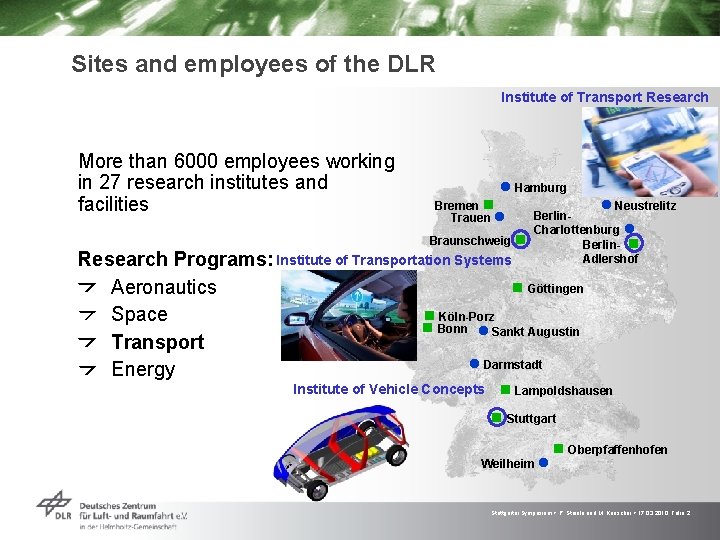
Sites and employees of the DLR Institute of Transport Research More than 6000 employees working in 27 research institutes and facilities Hamburg Bremen n Trauen Braunschweig n Neustrelitz Berlin. Charlottenburg Berlin-- n Adlershof Research Programs: Institute of Transportation Systems n Göttingen Aeronautics n Köln-Porz Space n Bonn Sankt Augustin Transport Darmstadt Energy Institute of Vehicle Concepts n Lampoldshausen n Stuttgart Weilheim n Oberpfaffenhofen Stuttgarter Symposium > P. Steinle und M. Kriescher > 17. 03. 2010, Folie 2
Table of contents Motivation Lightweight design strategies General Requirements Two different approaches Rib and Space-Frame Hybrid structures Summary and Conclusion Stuttgarter Symposium > P. Steinle und M. Kriescher > 17. 03. 2010, Folie 3
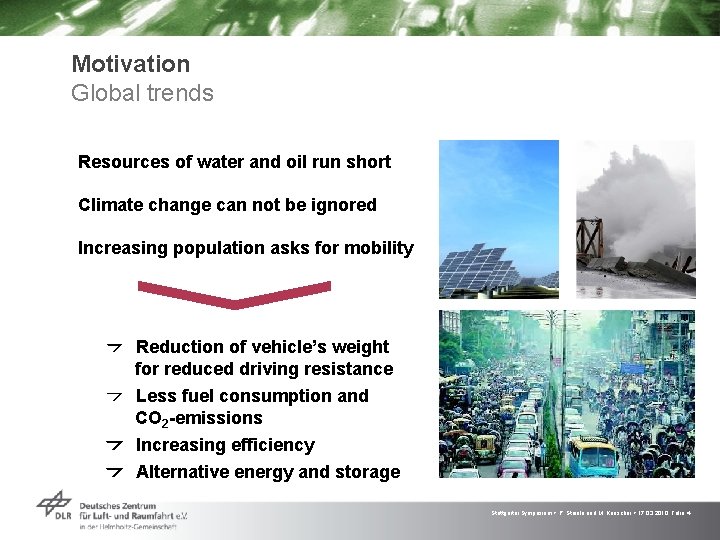
Motivation Global trends Resources of water and oil run short Climate change can not be ignored Increasing population asks for mobility Reduction of vehicle’s weight for reduced driving resistance Less fuel consumption and CO 2 -emissions Increasing efficiency Alternative energy and storage Stuttgarter Symposium > P. Steinle und M. Kriescher > 17. 03. 2010, Folie 4
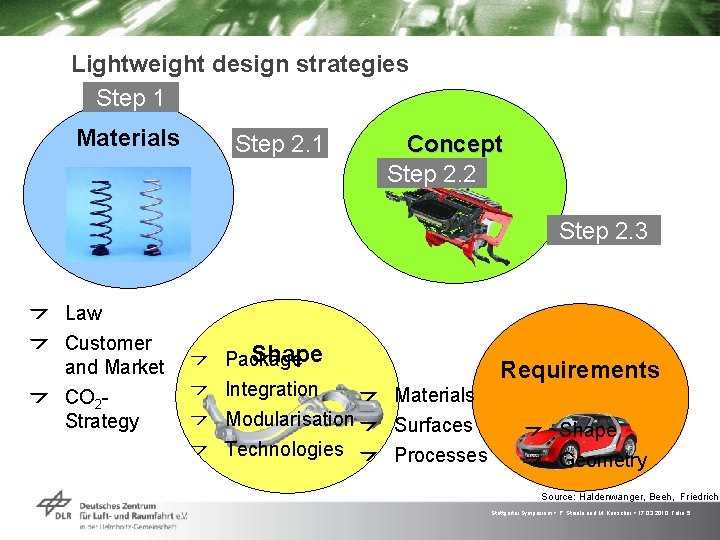
Lightweight design strategies Step 1 Materials Step 2. 1 Concept Step 2. 2 Step 2. 3 Law Customer and Market CO 2 Strategy Shape Package Integration Modularisation Technologies Requirements Materials Surfaces Processes Shape Geometry Source: Haldenwanger, Beeh, Friedrich Stuttgarter Symposium > P. Steinle und M. Kriescher > 17. 03. 2010, Folie 5
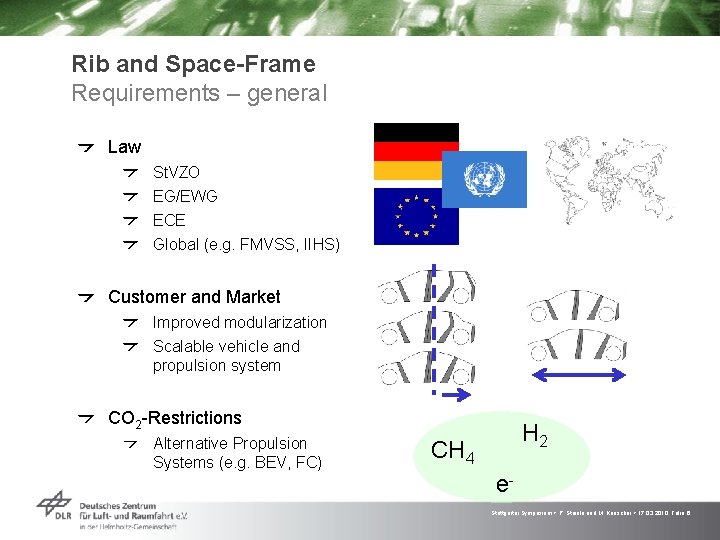
Rib and Space-Frame Requirements – general Law St. VZO EG/EWG ECE Global (e. g. FMVSS, IIHS) Customer and Market Improved modularization Scalable vehicle and propulsion system CO 2 -Restrictions Alternative Propulsion Systems (e. g. BEV, FC) H 2 CH 4 e- Stuttgarter Symposium > P. Steinle und M. Kriescher > 17. 03. 2010, Folie 6
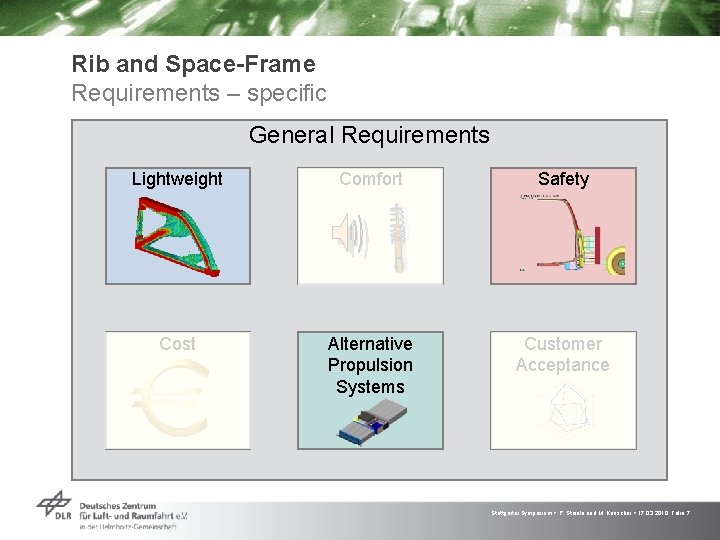
Rib and Space-Frame Requirements – specific General Requirements Lightweight Comfort Safety Cost Alternative Propulsion Systems Customer Acceptance Stuttgarter Symposium > P. Steinle und M. Kriescher > 17. 03. 2010, Folie 7
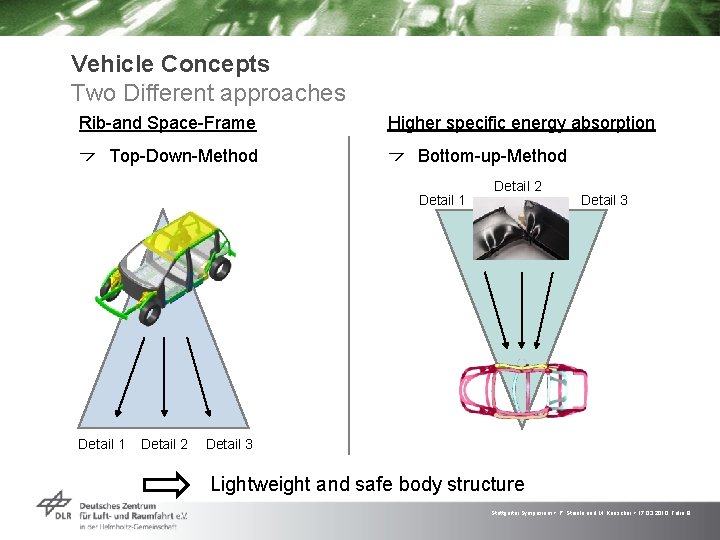
Vehicle Concepts Two Different approaches Rib-and Space-Frame Top-Down-Method Higher specific energy absorption Bottom-up-Method Detail 1 Detail 2 Detail 3 Lightweight and safe body structure Stuttgarter Symposium > P. Steinle und M. Kriescher > 17. 03. 2010, Folie 8
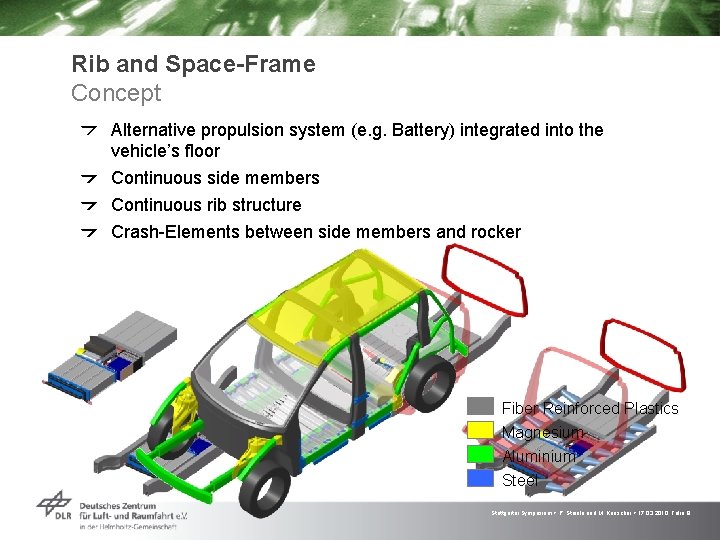
Rib and Space-Frame Concept Alternative propulsion system (e. g. Battery) integrated into the vehicle’s floor Continuous side members Continuous rib structure Crash-Elements between side members and rocker Fiber Reinforced Plastics Magnesium Aluminium Steel Stuttgarter Symposium > P. Steinle und M. Kriescher > 17. 03. 2010, Folie 9
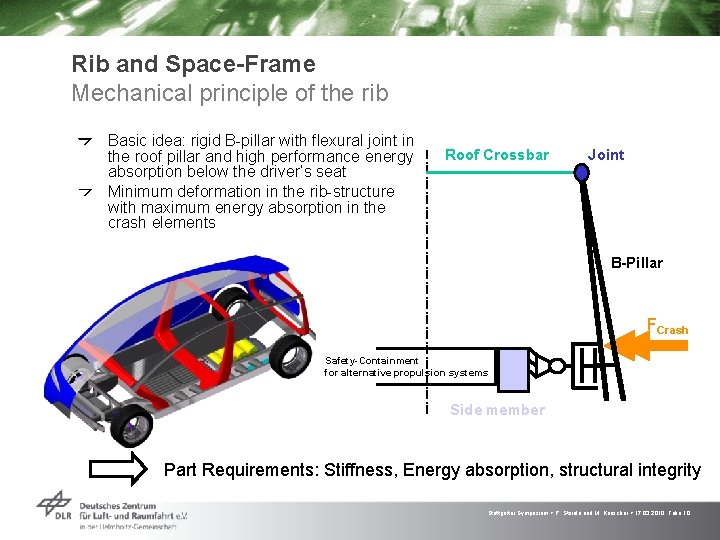
Rib and Space-Frame Mechanical principle of the rib Basic idea: rigid B-pillar with flexural joint in the roof pillar and high performance energy absorption below the driver’s seat Minimum deformation in the rib-structure with maximum energy absorption in the crash elements Roof Crossbar Joint B-Pillar FCrash Safety-Containment for alternative propulsion systems Side member Part Requirements: Stiffness, Energy absorption, structural integrity Stuttgarter Symposium > P. Steinle und M. Kriescher > 17. 03. 2010, Folie 10
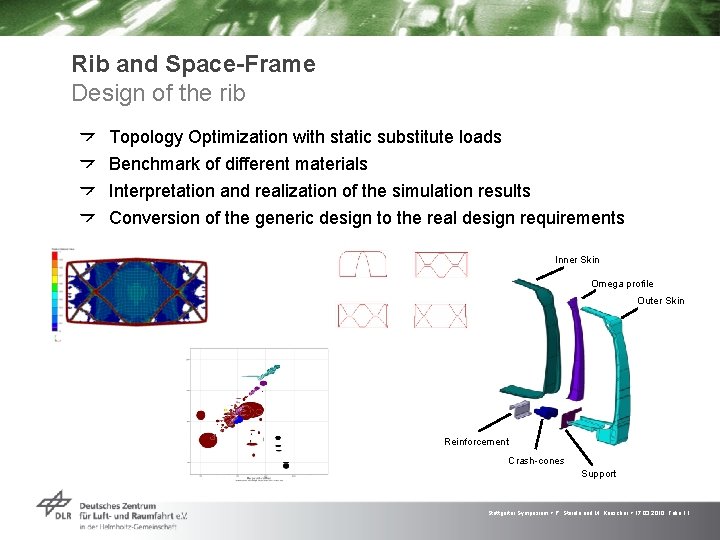
Rib and Space-Frame Design of the rib Topology Optimization with static substitute loads Benchmark of different materials Interpretation and realization of the simulation results Conversion of the generic design to the real design requirements Inner Skin Omega profile Outer Skin Reinforcement Crash-cones Support Stuttgarter Symposium > P. Steinle und M. Kriescher > 17. 03. 2010, Folie 11
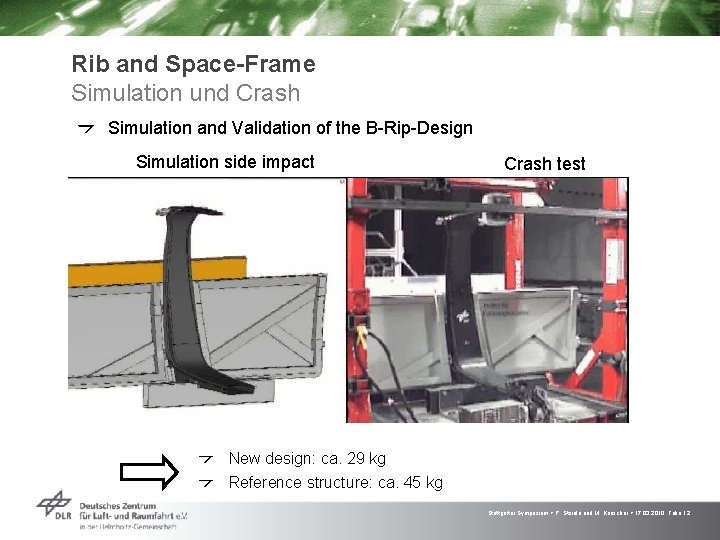
Rib and Space-Frame Simulation und Crash Simulation and Validation of the B-Rip-Design Simulation side impact Crash test New design: ca. 29 kg Reference structure: ca. 45 kg Stuttgarter Symposium > P. Steinle und M. Kriescher > 17. 03. 2010, Folie 12
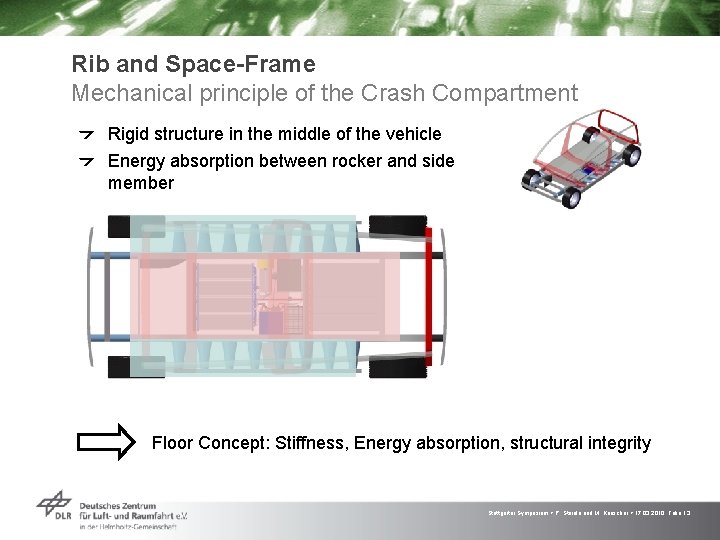
Rib and Space-Frame Mechanical principle of the Crash Compartment Rigid structure in the middle of the vehicle Energy absorption between rocker and side member Floor Concept: Stiffness, Energy absorption, structural integrity Stuttgarter Symposium > P. Steinle und M. Kriescher > 17. 03. 2010, Folie 13
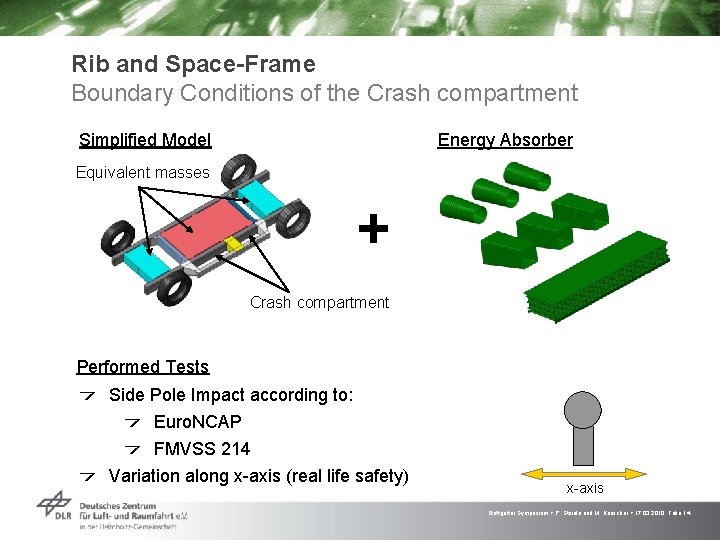
Rib and Space-Frame Boundary Conditions of the Crash compartment Simplified Model Energy Absorber Equivalent masses + Crash compartment Performed Tests Side Pole Impact according to: Euro. NCAP FMVSS 214 Variation along x-axis (real life safety) x-axis Stuttgarter Symposium > P. Steinle und M. Kriescher > 17. 03. 2010, Folie 14
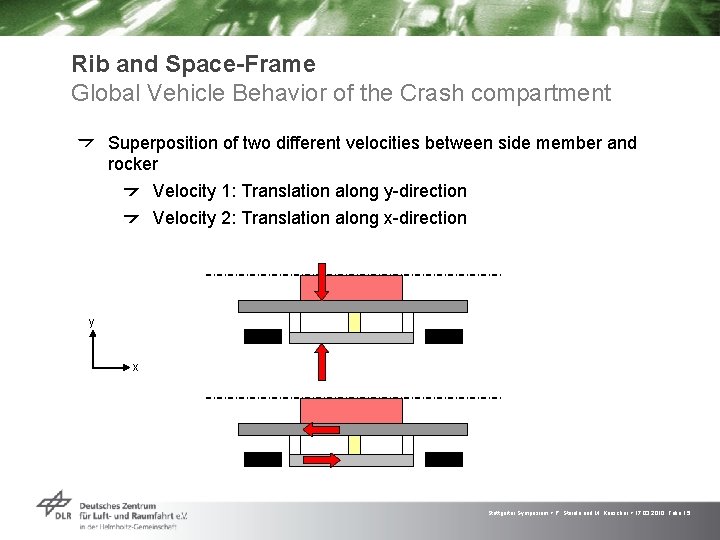
Rib and Space-Frame Global Vehicle Behavior of the Crash compartment Superposition of two different velocities between side member and rocker Velocity 1: Translation along y-direction Velocity 2: Translation along x-direction y x Stuttgarter Symposium > P. Steinle und M. Kriescher > 17. 03. 2010, Folie 15
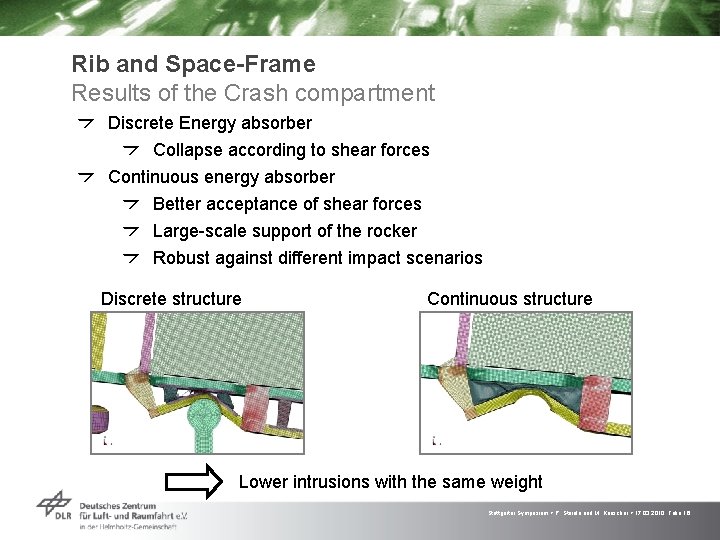
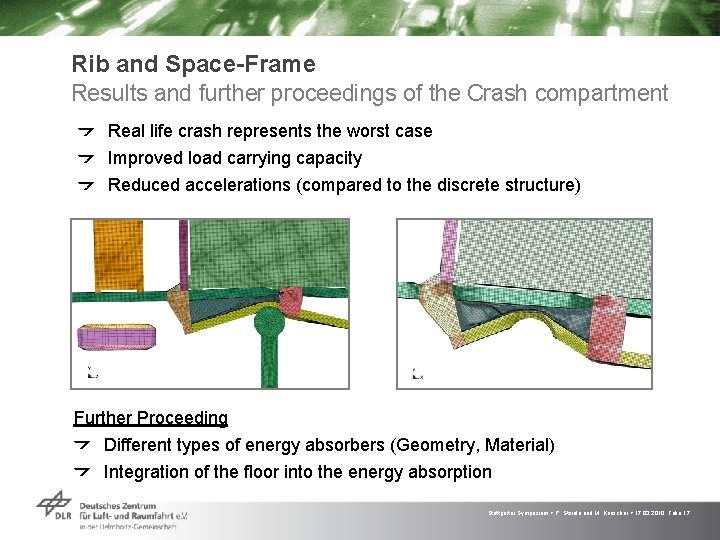
Rib and Space-Frame Results of the Crash compartment Discrete Energy absorber Collapse according to shear forces Continuous energy absorber Better acceptance of shear forces Large-scale support of the rocker Robust against different impact scenarios Discrete structure Continuous structure Lower intrusions with the same weight Stuttgarter Symposium > P. Steinle und M. Kriescher > 17. 03. 2010, Folie 16
Rib and Space-Frame Results and further proceedings of the Crash compartment Real life crash represents the worst case Improved load carrying capacity Reduced accelerations (compared to the discrete structure) Further Proceeding Different types of energy absorbers (Geometry, Material) Integration of the floor into the energy absorption Stuttgarter Symposium > P. Steinle und M. Kriescher > 17. 03. 2010, Folie 17
Table of contents Motivation Lightweight design strategies General Requirements Two different approaches Rib and Space-Frame Hybrid structures Summary and Conclusion Stuttgarter Symposium > P. Steinle und M. Kriescher > 17. 03. 2010, Folie 18
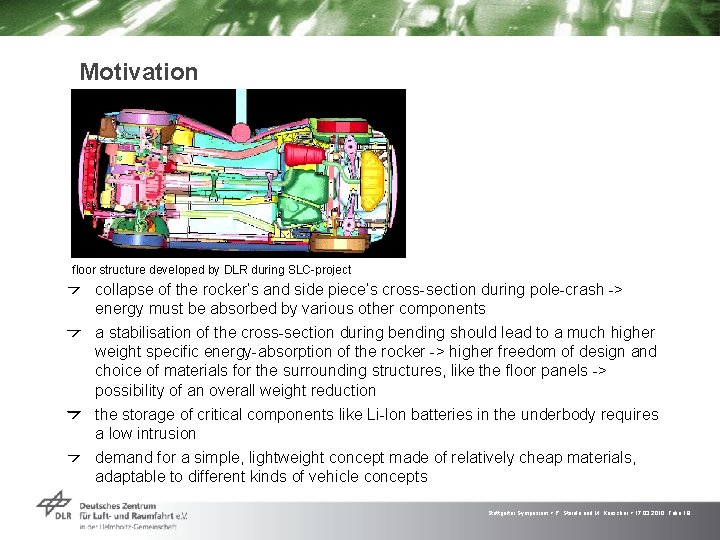
Motivation floor structure developed by DLR during SLC-project collapse of the rocker‘s and side piece‘s cross-section during pole-crash -> energy must be absorbed by various other components a stabilisation of the cross-section during bending should lead to a much higher weight specific energy-absorption of the rocker -> higher freedom of design and choice of materials for the surrounding structures, like the floor panels -> possibility of an overall weight reduction the storage of critical components like Li-Ion batteries in the underbody requires a low intrusion demand for a simple, lightweight concept made of relatively cheap materials, adaptable to different kinds of vehicle concepts Stuttgarter Symposium > P. Steinle und M. Kriescher > 17. 03. 2010, Folie 19
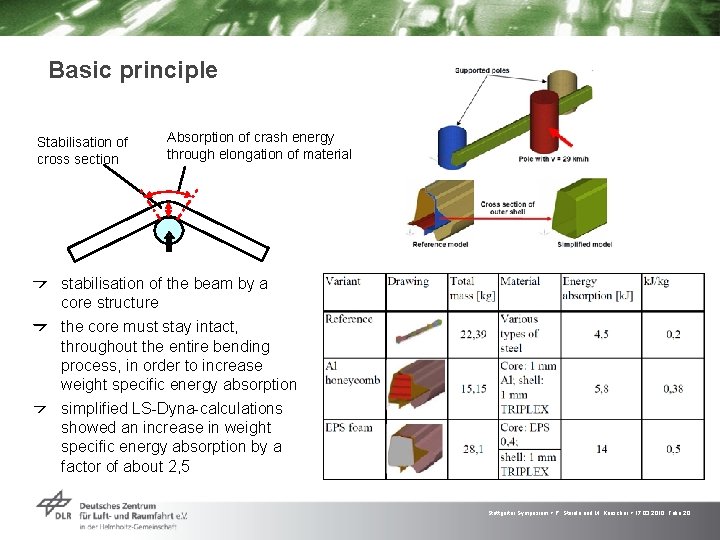
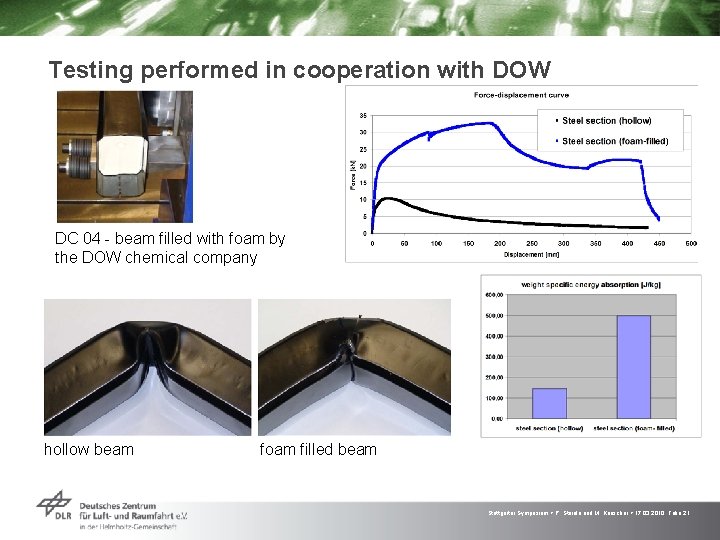
Basic principle Stabilisation of cross section Absorption of crash energy through elongation of material stabilisation of the beam by a core structure the core must stay intact, throughout the entire bending process, in order to increase weight specific energy absorption simplified LS-Dyna-calculations showed an increase in weight specific energy absorption by a factor of about 2, 5 Stuttgarter Symposium > P. Steinle und M. Kriescher > 17. 03. 2010, Folie 20
Testing performed in cooperation with DOW DC 04 - beam filled with foam by the DOW chemical company hollow beam foam filled beam Stuttgarter Symposium > P. Steinle und M. Kriescher > 17. 03. 2010, Folie 21
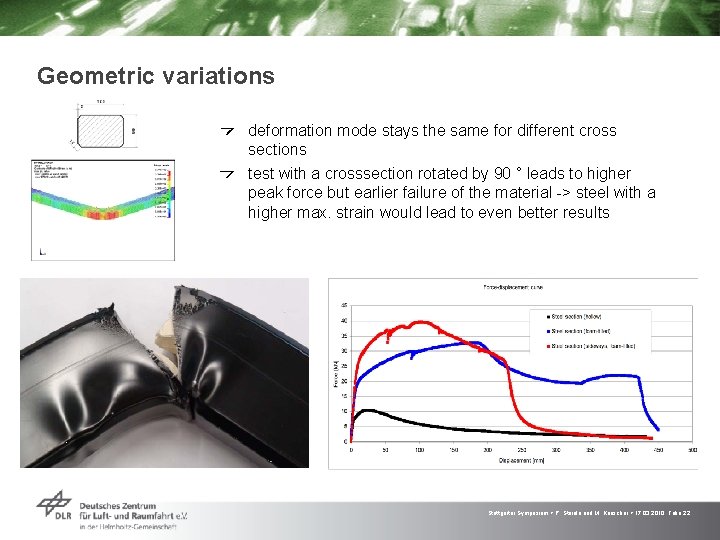
Geometric variations deformation mode stays the same for different cross sections test with a crosssection rotated by 90 ° leads to higher peak force but earlier failure of the material -> steel with a higher max. strain would lead to even better results Stuttgarter Symposium > P. Steinle und M. Kriescher > 17. 03. 2010, Folie 22
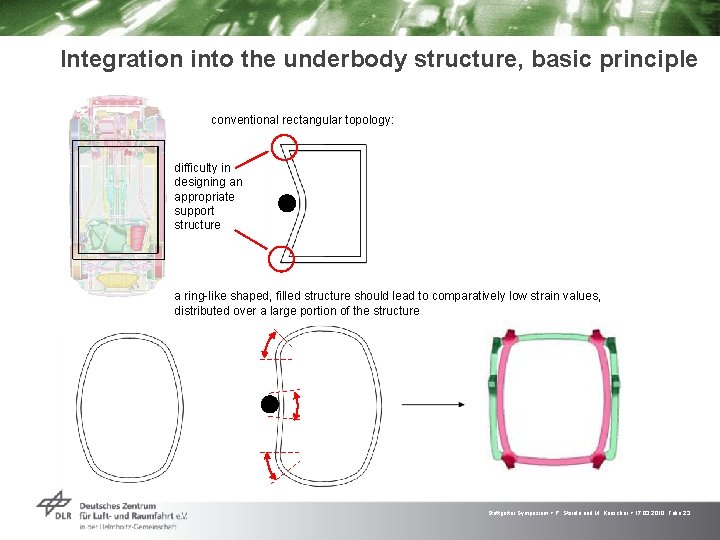
Integration into the underbody structure, basic principle conventional rectangular topology: difficulty in designing an appropriate support structure a ring-like shaped, filled structure should lead to comparatively low strain values, distributed over a large portion of the structure Stuttgarter Symposium > P. Steinle und M. Kriescher > 17. 03. 2010, Folie 23
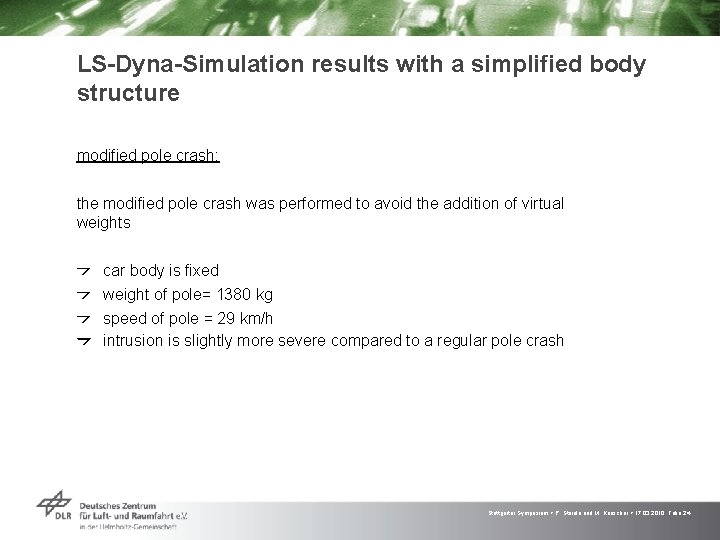
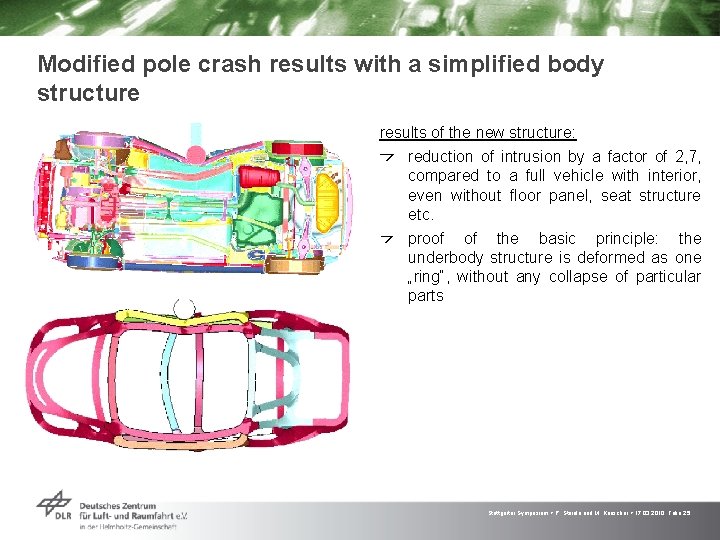
LS-Dyna-Simulation results with a simplified body structure modified pole crash: the modified pole crash was performed to avoid the addition of virtual weights car body is fixed weight of pole= 1380 kg speed of pole = 29 km/h intrusion is slightly more severe compared to a regular pole crash Stuttgarter Symposium > P. Steinle und M. Kriescher > 17. 03. 2010, Folie 24
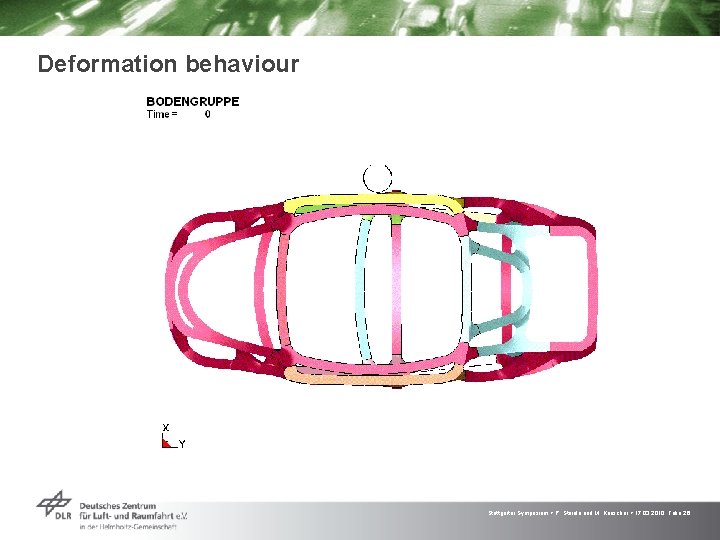
Modified pole crash results with a simplified body structure results of the new structure: reduction of intrusion by a factor of 2, 7, compared to a full vehicle with interior, even without floor panel, seat structure etc. proof of the basic principle: the underbody structure is deformed as one „ring“, without any collapse of particular parts Stuttgarter Symposium > P. Steinle und M. Kriescher > 17. 03. 2010, Folie 25
Deformation behaviour Stuttgarter Symposium > P. Steinle und M. Kriescher > 17. 03. 2010, Folie 26
Summary and conclusions Two different approaches for lightweight and safe vehicle structures for small/medium and large scale production DLR Rib and Space-Frame with high intrusion resistance of the B-Rip and Crash compartment An underbody structure composed of a ring-like filled structure results in a very high intrusion resistance during pole crash. A large portion of the underbody could therefore be used for the storage of critical components like Li-Ion batteries A more detailed car body structure is needed to make accurate weight predictions Optimization of the structure by decreasing intrusion resistance in favor of reduced weight seems reasonable For further questions and to see a model of the car body please visit our exhibition stand Stuttgarter Symposium > P. Steinle und M. Kriescher > 17. 03. 2010, Folie 27
Thank you for your attention