
Innovative technology to meet the demands of the

- Slides: 32
Innovative technology to meet the demands of the White Biotechnology revolution of Chemical Production John Villadsen Department of Chemical Engineering, DTU, Lyngby, DK -and University of Trinidad and Tobago Lecture given in Port of Spain April 2, 2008
Here are some products of White Biotechnology • Transportation fuels • New intermediates for the bulk chemical industry • New food and feed And the technology is Fermentation and Bio-catalysis
Transportation fuels • Bio-ethanol • Bio-butanol • Bio-diesel Ethanol can be used in mixtures with gasoline in up to 85 % by volume. In Brazil 40 % of all private cars drive on 85 % ethanol, the remainder on 25 % ethanol. Brazil, USA, India, and perhaps Australia and Thailand will be able to make bioethanol as cheap as gasoline. Butanol can be used by all cars, alone or in mixtures with gasoline. It is (as yet) more expensive than ethanol. England perhaps other EU countries) and USA are comitted to produce bio-butanol by 2008.
Production methods for bio-fuels • Bio-ethanol is produced by fermentation from 1. Cane sugar or starch (first generation processes) 2. Cellulosic material (second generation processes) First generation processes: Sugar is fermented using yeast or bacteria (Saccharomyces cerevisiae, Zymomonas sp. ) Starch is hydrolysed to glucose and used as above Second generation processes: Straw, wood chips etc, are hydrolyzed to glucose and other sugars. Thereafter treated as in First generation processes
Production methods for bio-fuels • Bio-butanol is produced from sugar, household waste or some other carbon source. Here the bacterium Clostridium acetobutylicum is used About 50 % of the sugar can be converted to butanol, another 25 % to acetone and the remainder to biomass and ethanol. The price of butanol is 1100 US$ per ton The world market is about 1. 3 million tons/year BP and Du. Pont are comitted to produce bio-butanol on the British market by 2008
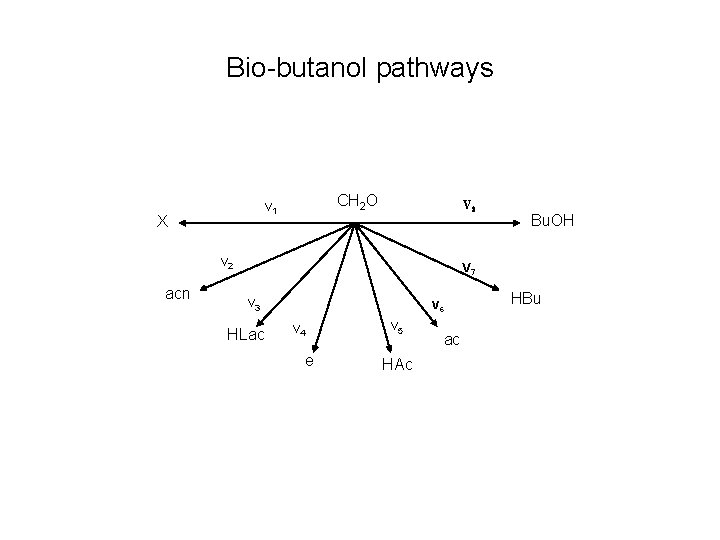
Bio-butanol pathways CH 2 O v 1 X V 8 v 2 acn Bu. OH V 7 v 3 HLac V 6 v 4 e v 5 HAc ac HBu
Production methods for bio-fuels • Bio-diesel is produced from animal fat (lard) or from vegetable oil (e. g. rape seed oil) using a catalytic transesterification process (acid, base or enzymes) Glycerol-fatty acid + CH 3 OH→Me-fatty acid + glycerol A methanol based bio-diesel is very similar to high grade oil-derived diesel, but no sulphur, less NOx etc. This could be a fine outlet for a large Me. OH-production! As a byproduct glycerol is formed. This could be the starting point for a chemistry based on glycerol
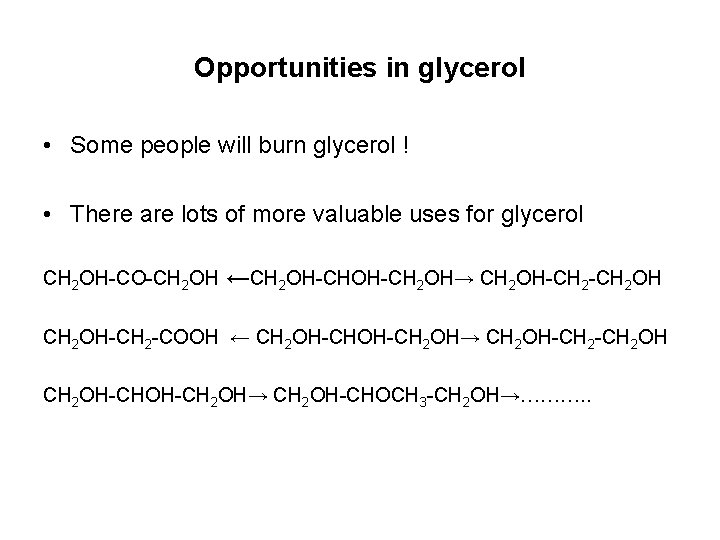
Opportunities in glycerol • Some people will burn glycerol ! • There are lots of more valuable uses for glycerol CH 2 OH-CO-CH 2 OH ←CH 2 OH-CH 2 OH→ CH 2 OH-CH 2 OH-CH 2 -COOH ← CH 2 OH-CH 2 OH→ CH 2 OH-CH 2 OH→ CH 2 OH-CHOCH 3 -CH 2 OH→………. .
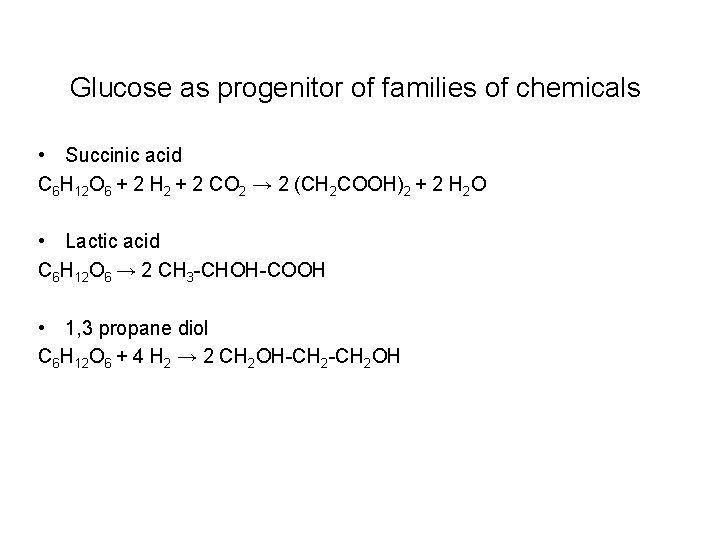
The new raw materials for production of chemicals Glucose Either directly or derived from starch or cellulosic material Polymers (poly-lactic acid, poly-esters) Solvents (butanol, acetone etc) Pharmaceuticals (antibiotics, proteins and hormones, therapeutic amino -acids, and many others) Foods and food ingredients (new sugars, dairy products, citric acid, lactic acid, emulsifiers, thickeners, pro-biotic diets) - or glucose can be converted to another compound which can serve as starting point for a family of chemicals Succinic acid, (CH 2 COOH)2, is a good example.
Glucose as progenitor of families of chemicals • Succinic acid C 6 H 12 O 6 + 2 H 2 + 2 CO 2 → 2 (CH 2 COOH)2 + 2 H 2 O • Lactic acid C 6 H 12 O 6 → 2 CH 3 -CHOH-COOH • 1, 3 propane diol C 6 H 12 O 6 + 4 H 2 → 2 CH 2 OH-CH 2 OH
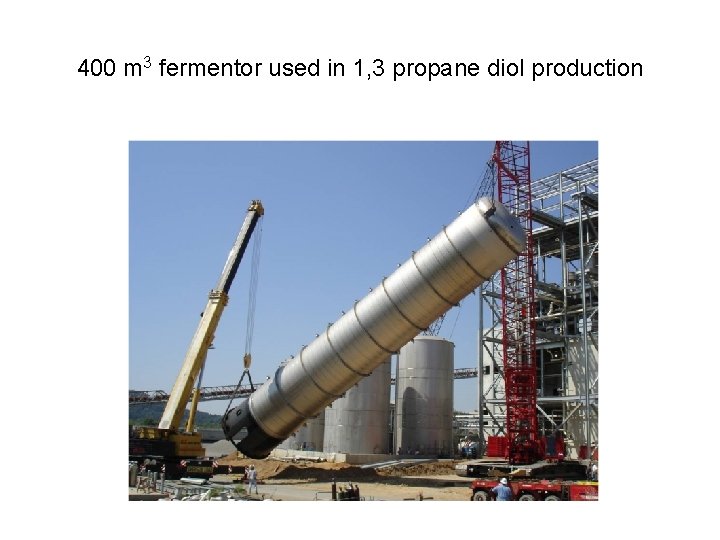
400 m 3 fermentor used in 1, 3 propane diol production
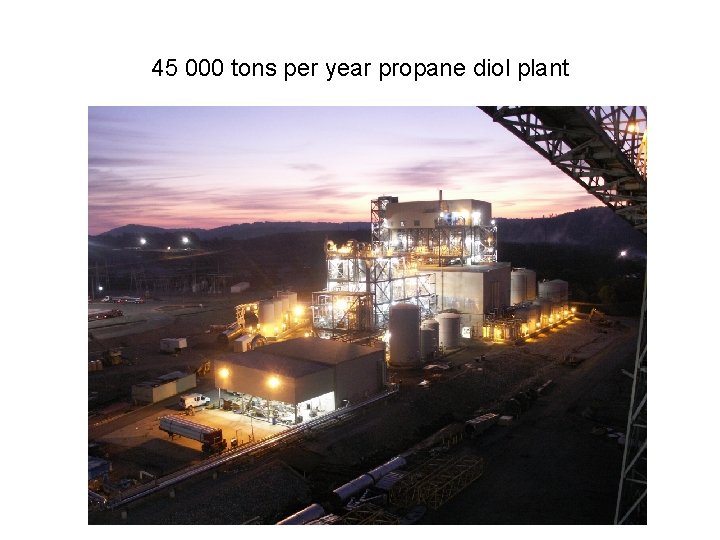
45 000 tons per year propane diol plant
Which disciplines are needed to work in Biotechnology? • Fundamental Bio-Sciences Microbiology and Biochemistry a. The functioning of the living cell: DNA, RNA, Proteins → Growth b. The Chemistry of Life: Pathways, Metabolites, Energy • Applied Physics and Mathematics as in Chemical Engineering The concept of model-driven experimental science a. Steady- and unsteady state Pathway Fluxes b. The interpretation of large amounts of uncertain data Design and optimization of large-scale processes a. Reactor design and design of separation processes.
Illustrative Examples Lactobionic Acid Lactose (Galactose-Glucose) + O 2 → Lactobionic Acid A chemical reaction in H 2 O at 38 o. C using a commercial enzyme Method of investigation: a. Find the kinetics of the reaction as a function of [O 2] and [Lactose] b. Run Pilot Plant experiments to find influence of O 2 transfer c. If successful: Contact a large Chemical company (remember patent rights!)
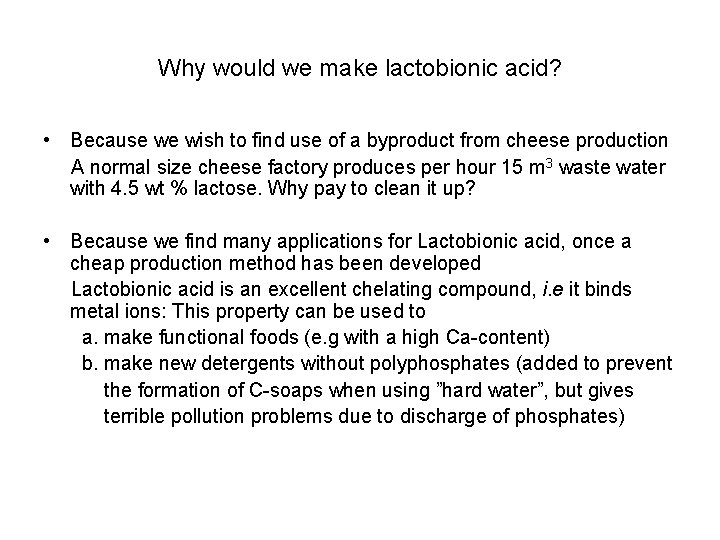
Why would we make lactobionic acid? • Because we wish to find use of a byproduct from cheese production A normal size cheese factory produces per hour 15 m 3 waste water with 4. 5 wt % lactose. Why pay to clean it up? • Because we find many applications for Lactobionic acid, once a cheap production method has been developed Lactobionic acid is an excellent chelating compound, i. e it binds metal ions: This property can be used to a. make functional foods (e. g with a high Ca-content) b. make new detergents without polyphosphates (added to prevent the formation of C-soaps when using ”hard water”, but gives terrible pollution problems due to discharge of phosphates)
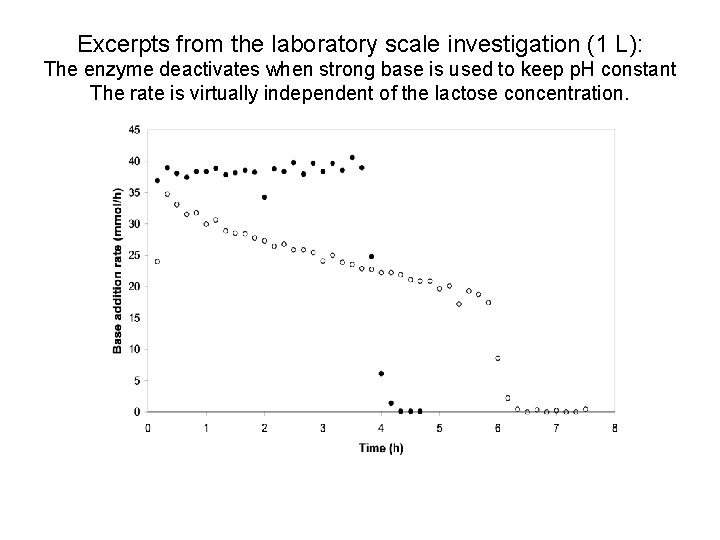
Excerpts from the laboratory scale investigation (1 L): The enzyme deactivates when strong base is used to keep p. H constant The rate is virtually independent of the lactose concentration.
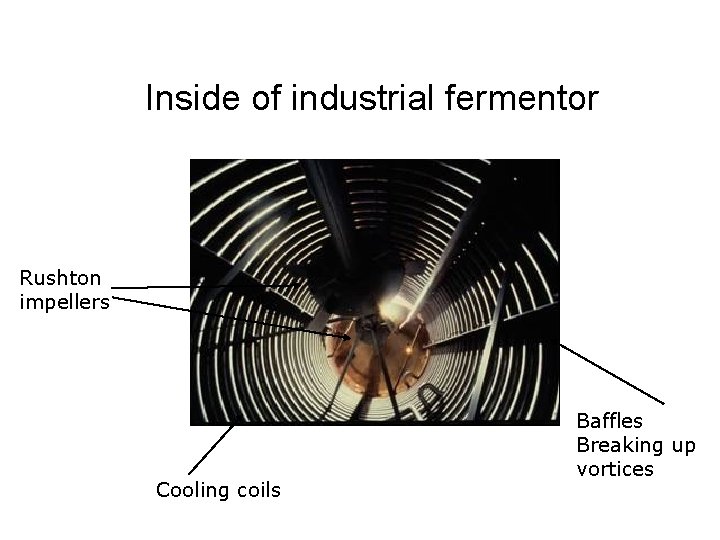
Inside of industrial fermentor Rushton impellers Cooling coils Baffles Breaking up vortices
Typical functions of impellers in fermentors • Bulk blending of liquid substrates to avoid gradients that can cause a lowered yield. • Dispersion of gaseous substrates, e. g. air, enriched air or pure oxygen to achieve mass transfer. • Increasing heat transfer.
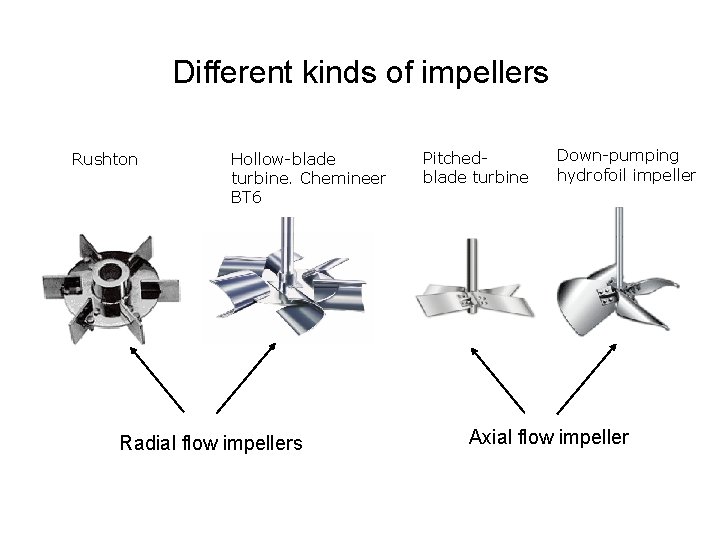
Different kinds of impellers Rushton Hollow-blade turbine. Chemineer BT 6 Radial flow impellers Pitchedblade turbine Down-pumping hydrofoil impeller Axial flow impeller
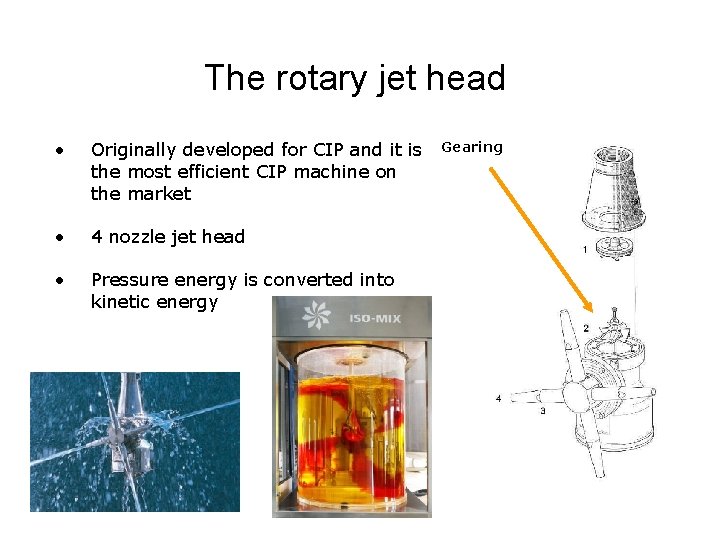
The rotary jet head • Originally developed for CIP and it is the most efficient CIP machine on the market • 4 nozzle jet head • Pressure energy is converted into kinetic energy Gearing
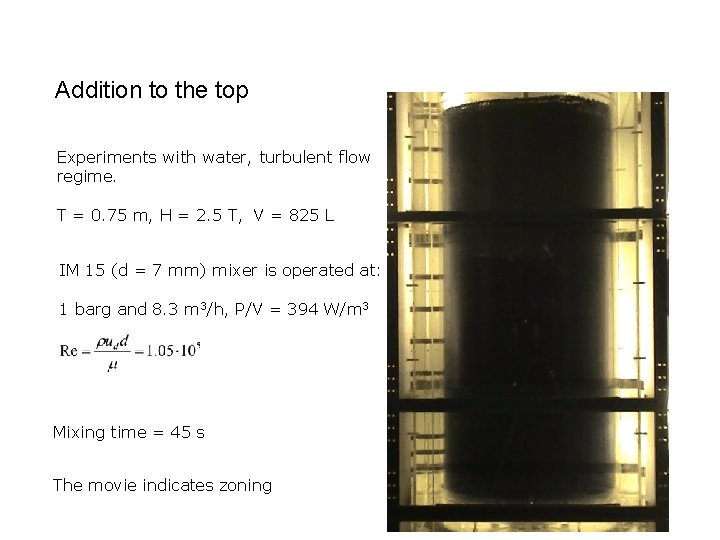
Addition to the top Experiments with water, turbulent flow regime. T = 0. 75 m, H = 2. 5 T, V = 825 L IM 15 (d = 7 mm) mixer is operated at: 1 barg and 8. 3 m 3/h, P/V = 394 W/m 3 Mixing time = 45 s The movie indicates zoning
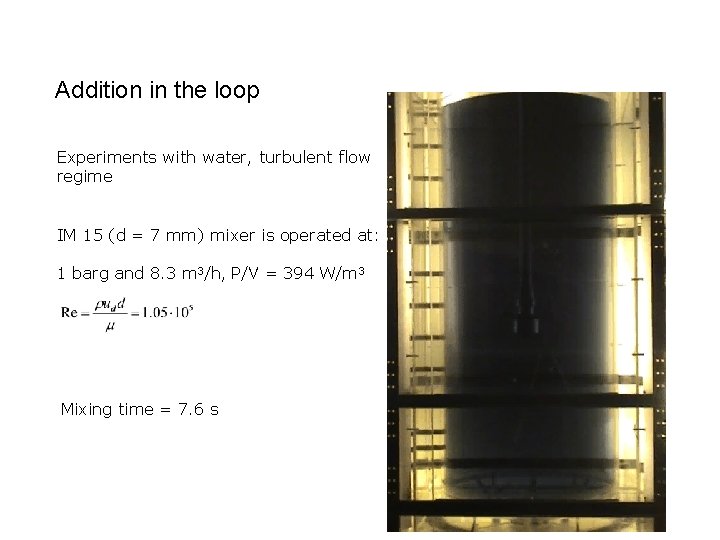
Addition in the loop Experiments with water, turbulent flow regime IM 15 (d = 7 mm) mixer is operated at: 1 barg and 8. 3 m 3/h, P/V = 394 W/m 3 Mixing time = 7. 6 s
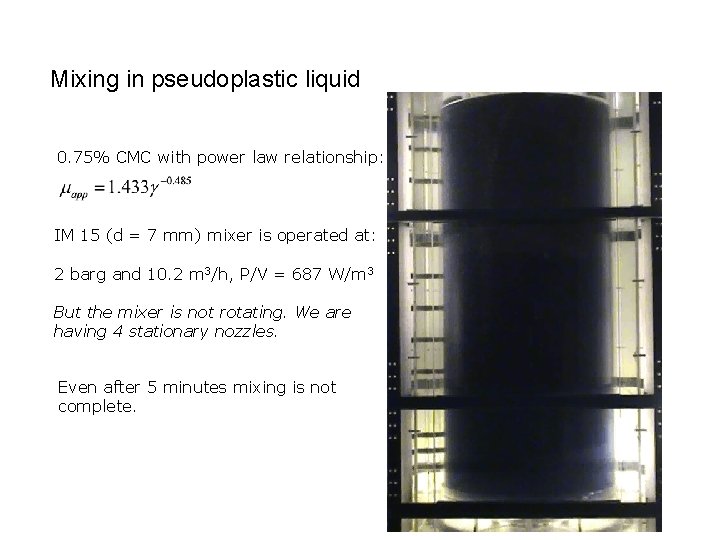
Mixing in pseudoplastic liquid 0. 75% CMC with power law relationship: IM 15 (d = 7 mm) mixer is operated at: 2 barg and 10. 2 m 3/h, P/V = 687 W/m 3 But the mixer is not rotating. We are having 4 stationary nozzles. Even after 5 minutes mixing is not complete.
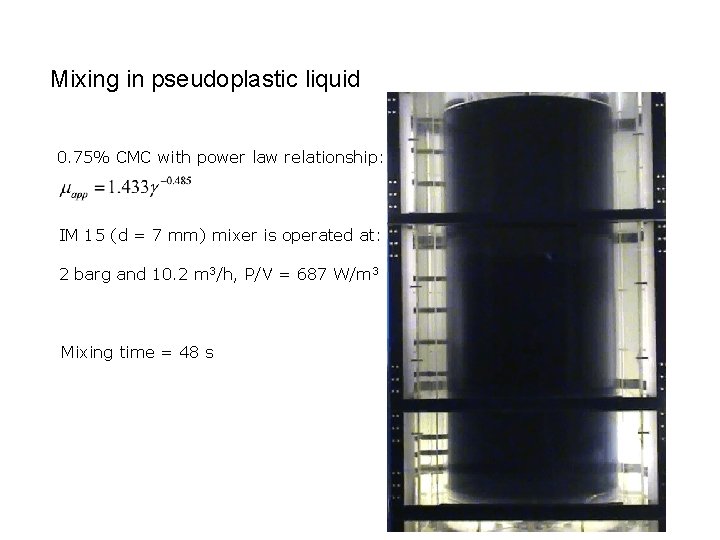
Mixing in pseudoplastic liquid 0. 75% CMC with power law relationship: IM 15 (d = 7 mm) mixer is operated at: 2 barg and 10. 2 m 3/h, P/V = 687 W/m 3 Mixing time = 48 s
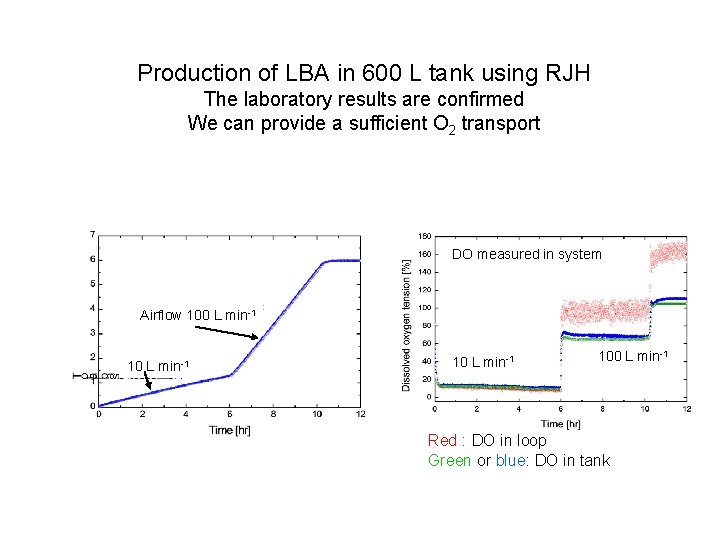
Production of LBA in 600 L tank using RJH The laboratory results are confirmed We can provide a sufficient O 2 transport DO measured in system Airflow 100 L min-1 100 L min-1 Red : DO in loop Green or blue: DO in tank
The production of Single Cell Protein from Methane or Methanol Why would this process be contemplated? 1. 2. 3. 4. 5. 6. Most animals require a diet with both plant- and animal protein Animal protein (fish-meal) is rapidly becoming expensive The protein obtained from SCP production is animal protein The price of fish-meal is now 1200 US $/ ton – up from 700 US $/ ton in mid – 2006. SCP from CH 4 or CH 3 OH is indistinguishable from fish-meal ”Natural” microorganisms (no GMO) are used.
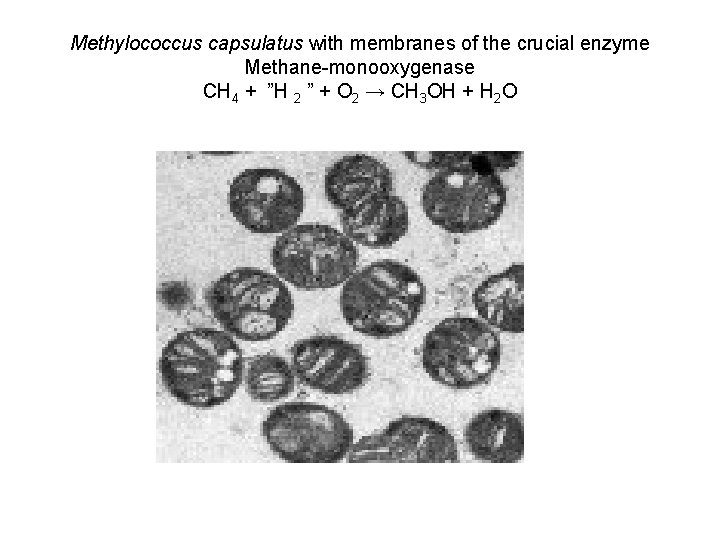
Methylococcus capsulatus with membranes of the crucial enzyme Methane-monooxygenase CH 4 + ”H 2 ” + O 2 → CH 3 OH + H 2 O
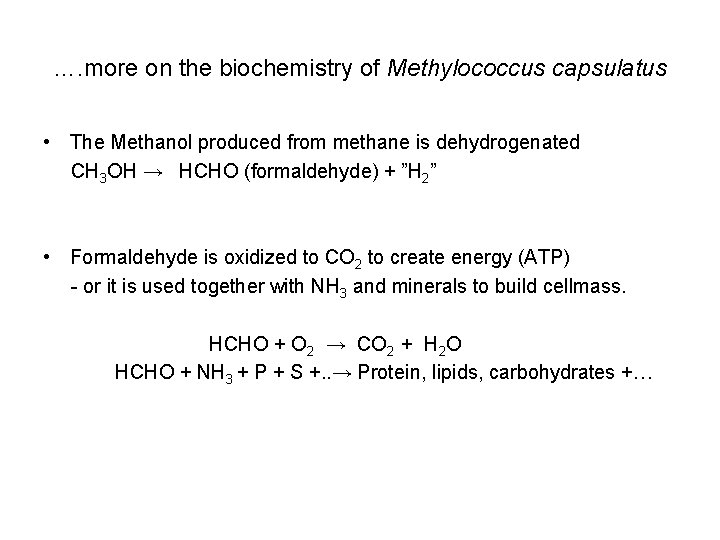
…. more on the biochemistry of Methylococcus capsulatus • The Methanol produced from methane is dehydrogenated CH 3 OH → HCHO (formaldehyde) + ”H 2” • Formaldehyde is oxidized to CO 2 to create energy (ATP) - or it is used together with NH 3 and minerals to build cellmass. HCHO + O 2 → CO 2 + H 2 O HCHO + NH 3 + P + S +. . → Protein, lipids, carbohydrates +…
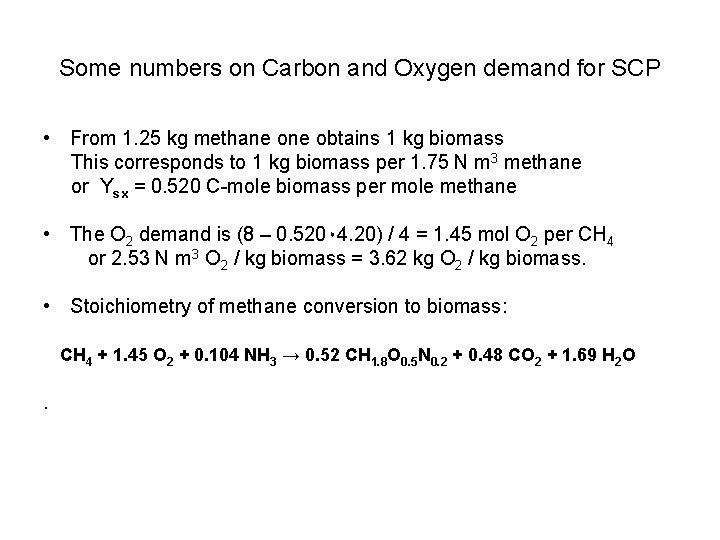
Some numbers on Carbon and Oxygen demand for SCP • From 1. 25 kg methane obtains 1 kg biomass This corresponds to 1 kg biomass per 1. 75 N m 3 methane or Ysx = 0. 520 C-mole biomass per mole methane • The O 2 demand is (8 – 0. 520٠ 4. 20) / 4 = 1. 45 mol O 2 per CH 4 or 2. 53 N m 3 O 2 / kg biomass = 3. 62 kg O 2 / kg biomass. • Stoichiometry of methane conversion to biomass: CH 4 + 1. 45 O 2 + 0. 104 NH 3 → 0. 52 CH 1. 8 O 0. 5 N 0. 2 + 0. 48 CO 2 + 1. 69 H 2 O .
Some process conditions 1. Continuous fermentation at 45 o. C and 1 -3 bar pressure (to improve mass transfer of gases to liquid) 2. The flow rate of liquid through the reactor is 1 volume/ volume reactor /5 hours (D = 0. 2 h-1) 3. The gas flow rate is much, much higher
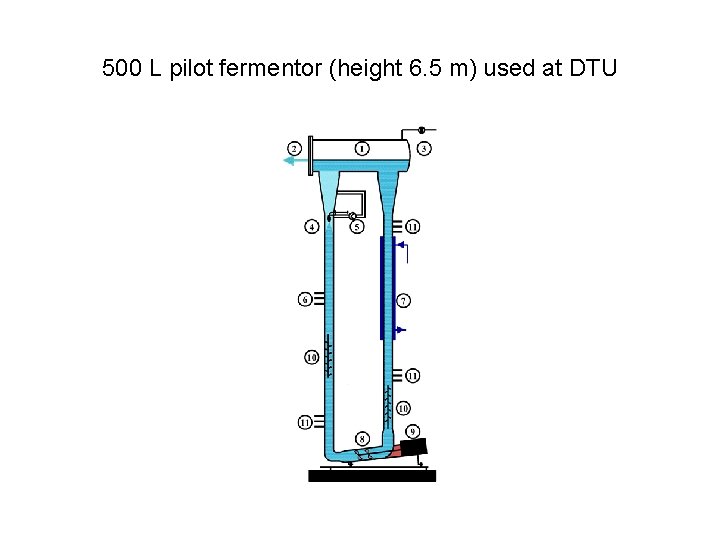
500 L pilot fermentor (height 6. 5 m) used at DTU
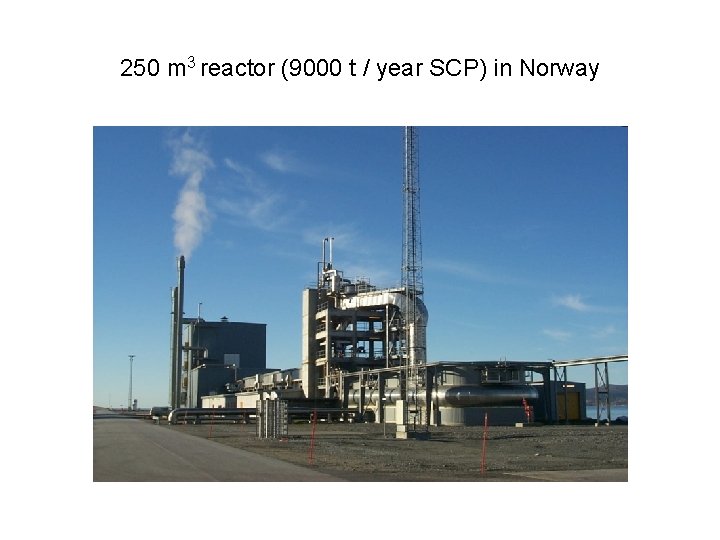
250 m 3 reactor (9000 t / year SCP) in Norway