
Innovative Methods to assess a nutritional situation Brussels
Innovative Methods to assess a nutritional situation Brussels, CRED CEDAT, June 9 & 10, 2011 Damien PEREYRA, Epidemiologist Cécile SALPETEUR, HIV & Nutrition Research Advisor
Content § § Pastoralist Survey Method (PSM) – applied research Listening Posts – applied research ACF Main sources of data Examples of ACF databases 2
Pastoralist Survey Method (PSM) § Aim: to design, test and validate a new method for assessing the nutrition condition in pastoralist populations § Rationale: • Vulnerability of pastoralists to shocks • Lack of suitable survey method § Progress: Method designed & peer reviewed in 2007 First field test in Mali in 2008 Second test in Ethiopia in March 2010 Third test in Chad in May 2011 § Funding: ACF and donors in each country § Scientific partners: Anne Marie Mayer, Mark Myatt, Paul Baxter – independent consultants 3
Innovations of PSM § § § Qualitative phase + quantitative phase Case definition of SAM Sampling frame Bootstrap estimator Specific worksheet with formulas 4
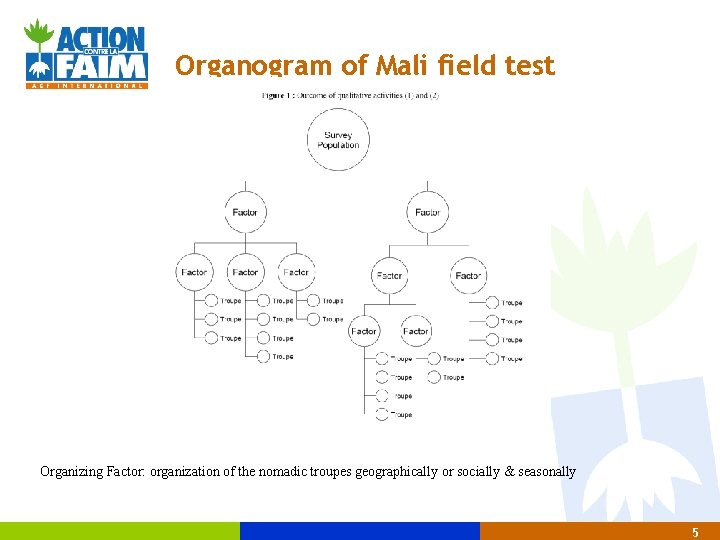
Organogram of Mali field test Organizing Factor: organization of the nomadic troupes geographically or socially & seasonally 5

PSM Sampling Sample size depends on • Prevalence estimate (15%) • Precision (3%) • Average PSU size (15) § Sample size = 43 PSUs § Systematic sample of PSUs based on Social Organising Factor (e. g. water points) Average PSU size § PSU: Primary Sampling Units 6
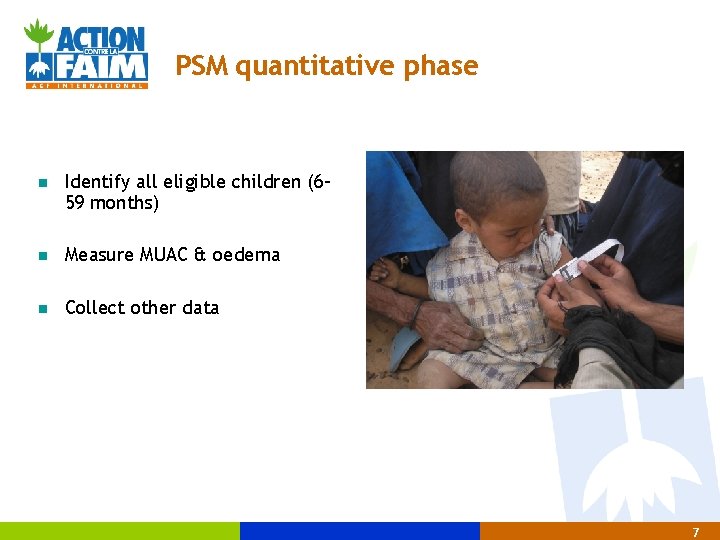
PSM quantitative phase Identify all eligible children (659 months) Measure MUAC & oedema Collect other data 7
PSM dissemination § § § § FEX article, issue #35, on Mali experience, 2008 Poster at ALNAP fair, London, Nov 2009 Presentation at MSF Scientific Day, London, May 2010 Abstract at Porto WPHN conference, Sept 2010 Article in a peer reviewed journal on the 3 experiences - 2011 Sharing of survey guideline & toolbox via a website? Uptake by stakeholders in pastoralist areas 8
Listening Posts – surveillance system § Aim: to design, test and validate a new method for Surveillance system which will be replicable and sustainable and which collects basic data on food prices, terms of trade and nutritional status § Rationale: § • 2008 Food price crisis impact on nut status unknown • Absence or inadequate methods to link food insecurity and economic status to malnutrition Progress: Method designed & peer reviewed in 2009 ACF field test in Burkina Faso in 2010 -2011 (ongoing) SC UK field test in Zimbabwe in 2010 -2011 (ongoing) Soon a third test in Liberia in 2011 by ACF § Funding: ACF, SC UK and donors in each country § Scientific partners: Mark Myatt – independent consultant 9
Listening Posts project >> HUnger Monitoring System (HUMS) § § § Livelihoods zones mapping with sentinel sites selected Small cohort of children 6 -24 mo with renewed inclusions Frequency: quarterly data collection Data on • Staple food prices, • Terms of trade • Anthropometry • Food diversity and food frequency • Contextual information And possibly secondary data on: • Feeding centre admissions • Changes in the minimum cost of a healthy diet • Food access • Coping strategies 10
HUMS dissemination § § § Presentation of the concept at WFP meeting, June 2009 Presentation at a meeting hosted by Institute of Medicine ‘Mitigating the Nutritional Impacts of the Global Food Price Crisis’ in Washington in July 2009 Article in a peer reviewed journal on the 3 experiences - 2012 Sharing of survey guideline & toolbox via a website? Uptake by stakeholders in existing national surveillance systems 11
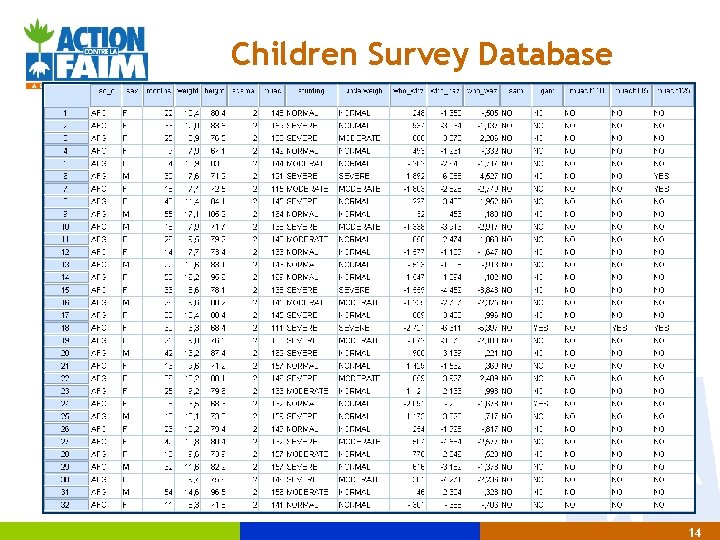
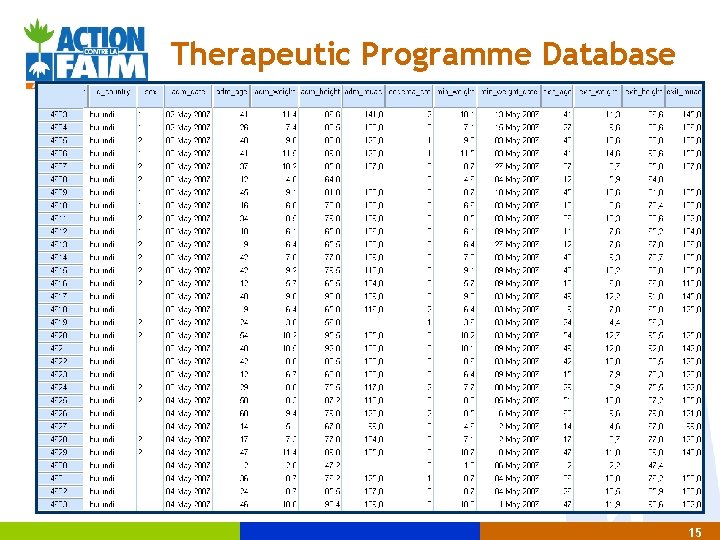
ACF Main sources of data § SMART SURVEYS: • Nut. Surv. DB: with around 1000 surveys from the 90’s until now • Children Surv. DB: with around 370 000 children from 25 countries (from around 400 cluster surveys 2001 -2010) § THERAPEUTIC PROGRAMMES: • Therapeutic Prog. DB: with around 73 000 SAM children treated in 9 countries by ACF from 2005 until now. • Monthly report data: collected monthly with beneficiaries information (data not centralized). § RESEARCH PROJECTS: ad hoc databases 12
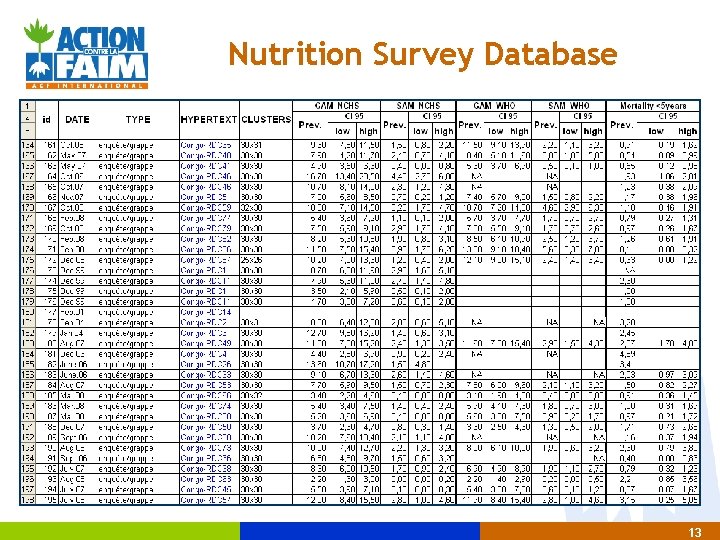
Nutrition Survey Database 13
Children Survey Database 14
Therapeutic Programme Database 15
Improving data collection and use § § § How to estimate incidence of acute malnutrition to better tailor nutrition programmes size & resources? • Partnership with Health and Nutrition Tracking Service (HNTS) project (C. Prudhon et al. ) How to improve validity of nut surveys conducted by NGOs? • SMART project: partnership with Centre for Disease Control & Prevention (CDC) How to improve causal analysis of acute malnutrition to better address it? • Nutritional Causal Analysis (NCA) applied research project: partnership with Tufts University How to transmit Knowledge to field teams !! 16

THANKS 17
- Slides: 17