
Innovative Information and Communication Technology ICT in City

- Slides: 23
Innovative Information and Communication Technology (ICT) in City Sanitation Planning Presented by : Yashwant Soni & Dr. Megha Phansalkar Micro Technologies (India) Ltd.
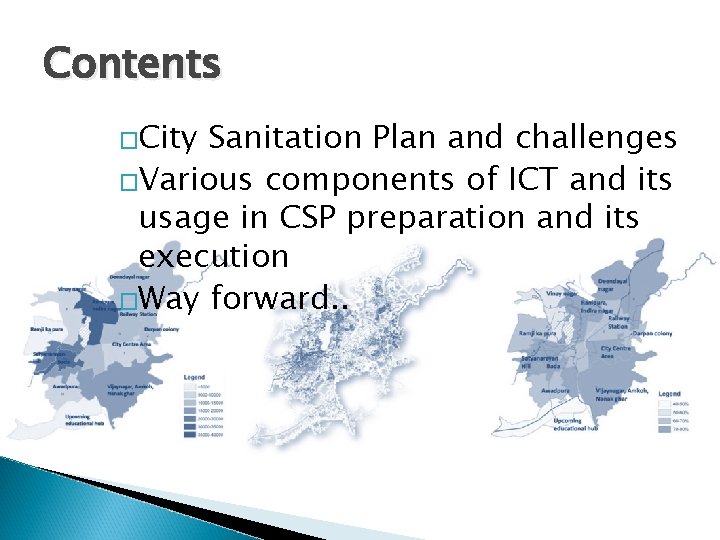
Contents �City Sanitation Plan and challenges �Various components of ICT and its usage in CSP preparation and its execution �Way forward. .
Need of City Sanitation Plan � Initiated under National Urban Sanitation Programme (NUSP) � Aims to provide/ strengthen Household level sanitation facilities and to carry safe disposal and treatment of solid and liquid waste � Active community participation in sanitation management process � As per Mo. UD, 40% cities in India needs immediate remedial measures in sanitation � Hence every ULB should have updated information on sanitation which will become the base for developing CSP.
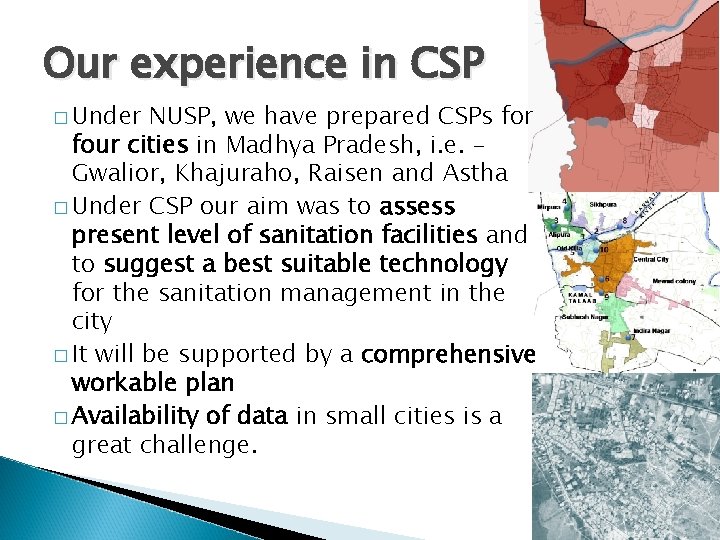
Our experience in CSP � Under NUSP, we have prepared CSPs for four cities in Madhya Pradesh, i. e. – Gwalior, Khajuraho, Raisen and Astha � Under CSP our aim was to assess present level of sanitation facilities and to suggest a best suitable technology for the sanitation management in the city � It will be supported by a comprehensive workable plan � Availability of data in small cities is a great challenge.
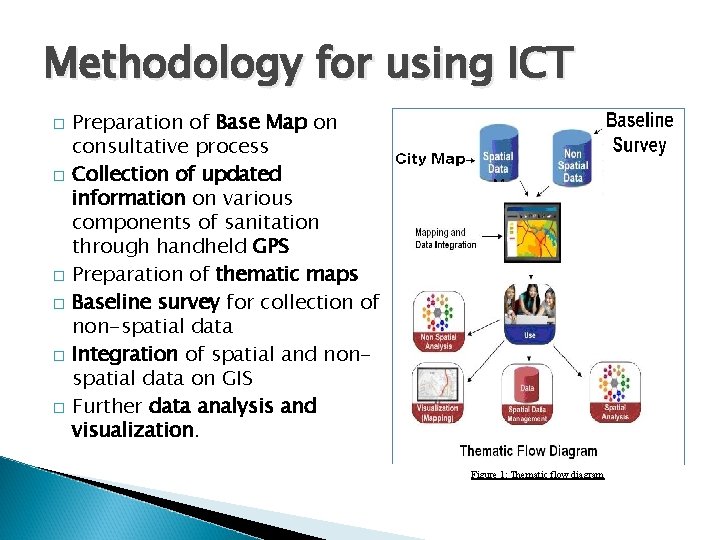
Methodology for using ICT � � � Preparation of Base Map on consultative process Collection of updated information on various components of sanitation through handheld GPS Preparation of thematic maps Baseline survey for collection of non-spatial data Integration of spatial and nonspatial data on GIS Further data analysis and visualization. Figure 1: Thematic flow diagram
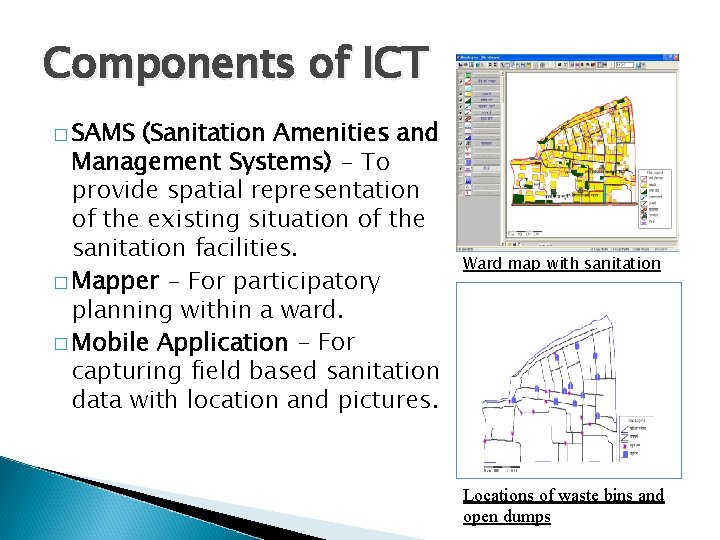
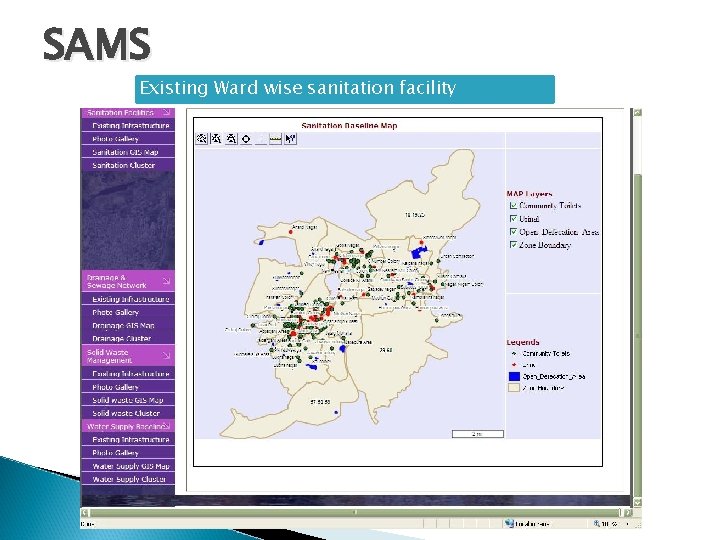
Components of ICT � SAMS (Sanitation Amenities and Management Systems) - To provide spatial representation of the existing situation of the sanitation facilities. � Mapper - For participatory planning within a ward. � Mobile Application - For capturing field based sanitation data with location and pictures. Ward map with sanitation Locations of waste bins and open dumps
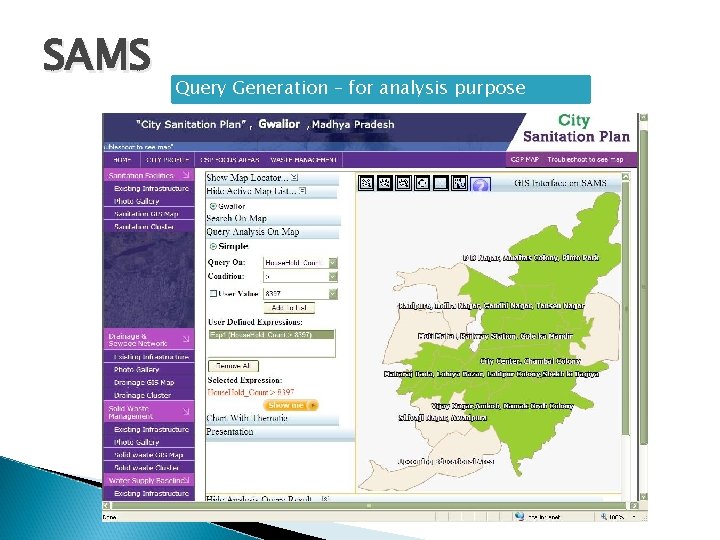
SAMS – Key Features � User friendly web application designed to assist activities related to CSP � Accessible for any body and anywhere with internet connection � Helps in query generation analysis and getting different reports � Spatial representation of relevant information which can be visualised by the user � Cross sectoral analysis � Data management and Report generation � Decision making tool for local bodies through smart data management � Main technology used for SAMS is Java.
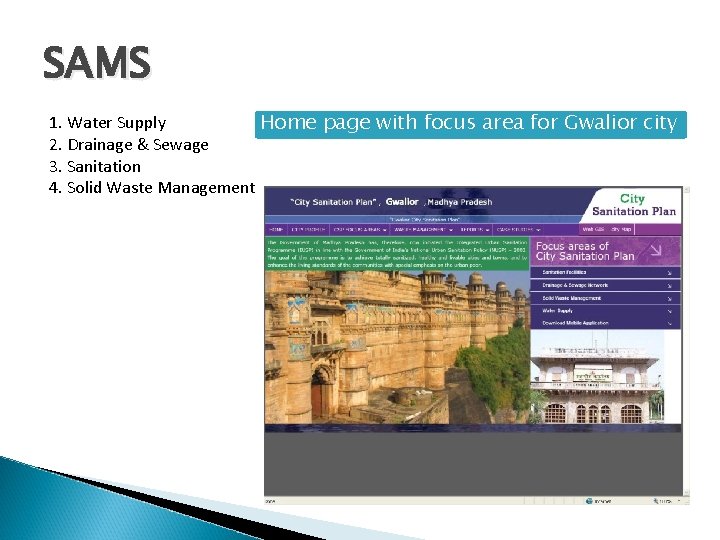
SAMS 1. Water Supply Home page with focus area for Gwalior city 2. Drainage & Sewage 3. Sanitation 4. Solid Waste Management
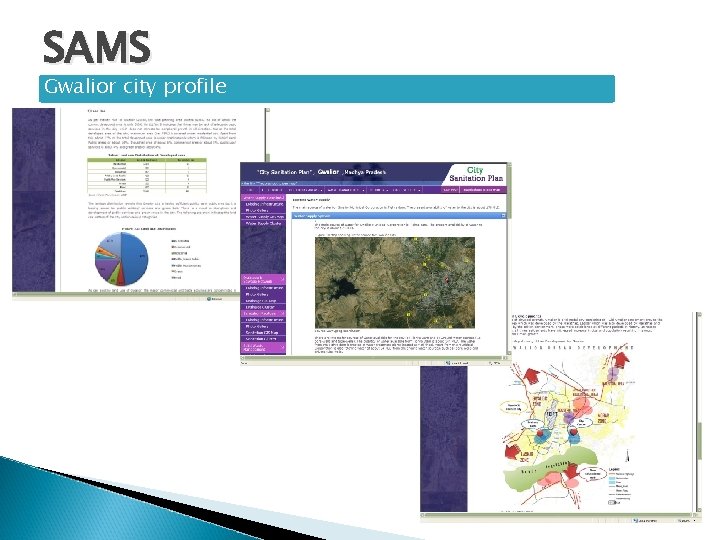
SAMS Gwalior city profile
SAMS Existing Ward wise sanitation facility
SAMS Query Generation – for analysis purpose
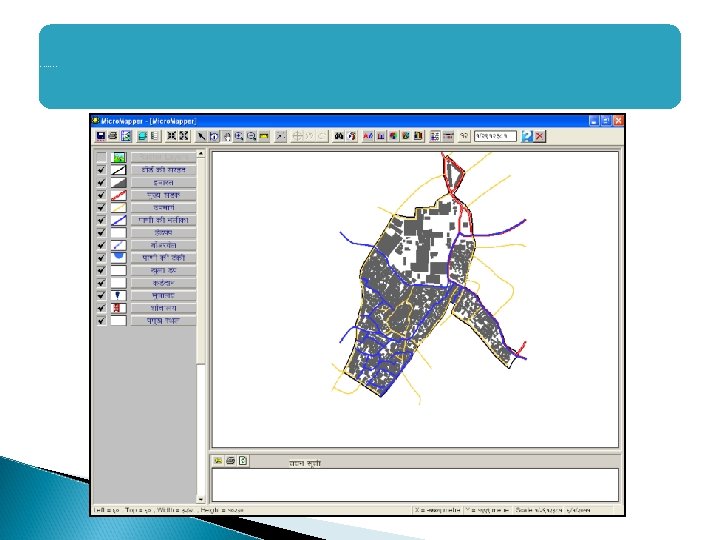
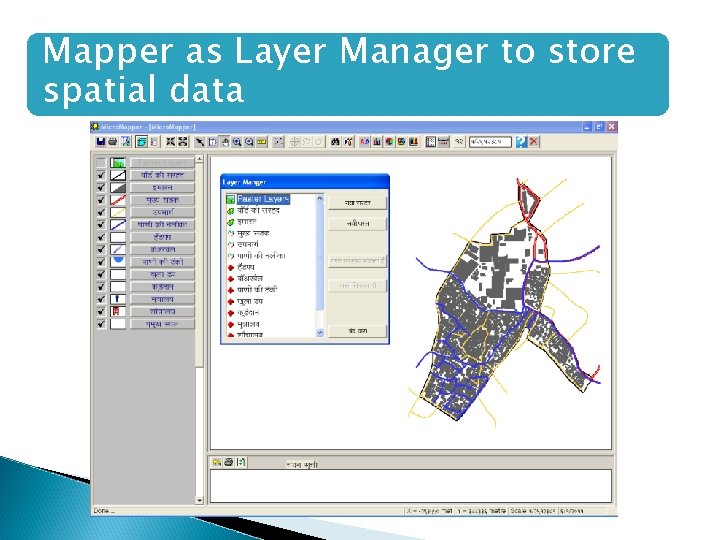
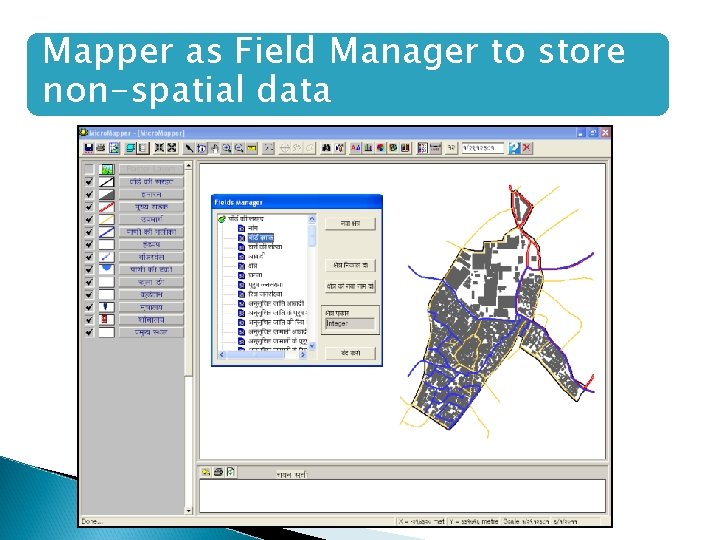
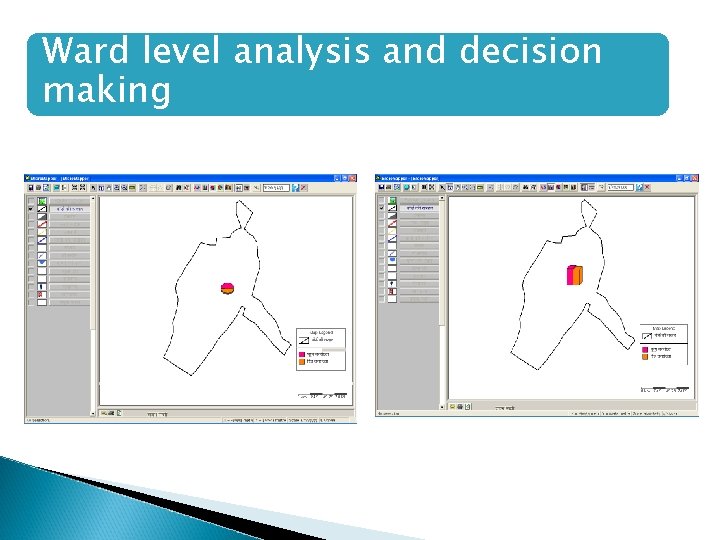
Mapper � User friendly desktop based GIS Mapping tool � Effective tool for community participation - Ward level information collection, storing, data updating, planning and decision making � Available in local regional language � Used for local area mapping through participatory planning � Simplifies data representation & updation – create and modify the data through layers � Useful tool for Planning and decision making at local level.
Mapper used in Resource Mapping
Mapper as Layer Manager to store spatial data
Mapper as Field Manager to store non-spatial data
Ward level analysis and decision making
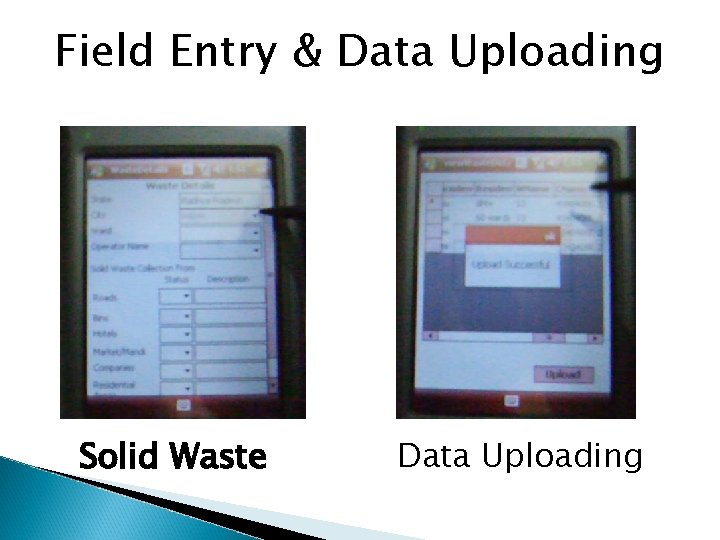
Mobile application �Mobile based application tool �Tool for monitoring of CSP execution �Useful in updation of current status of services from the field �Upgrade the real time data and useful for O&M in the sectors like, water supply, Sanitation and SWM �Secure and reliable data transfer �Enabled with GPRS and GSM technologies �Report generation as per requirement.
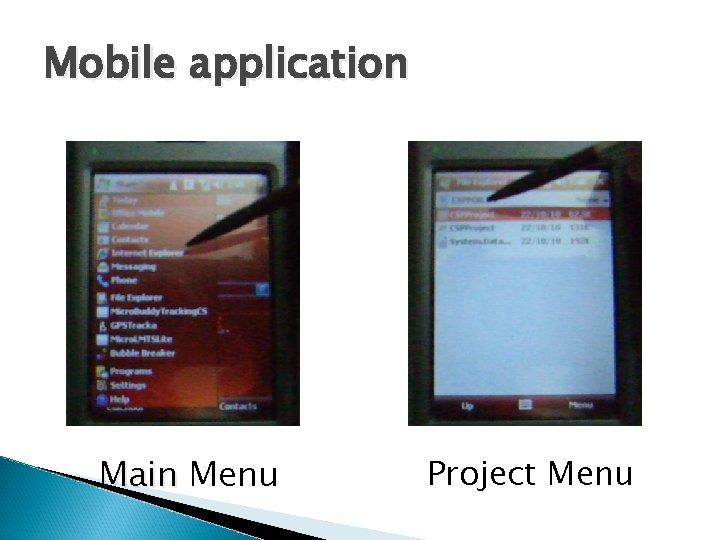
Mobile application Main Menu Project Menu
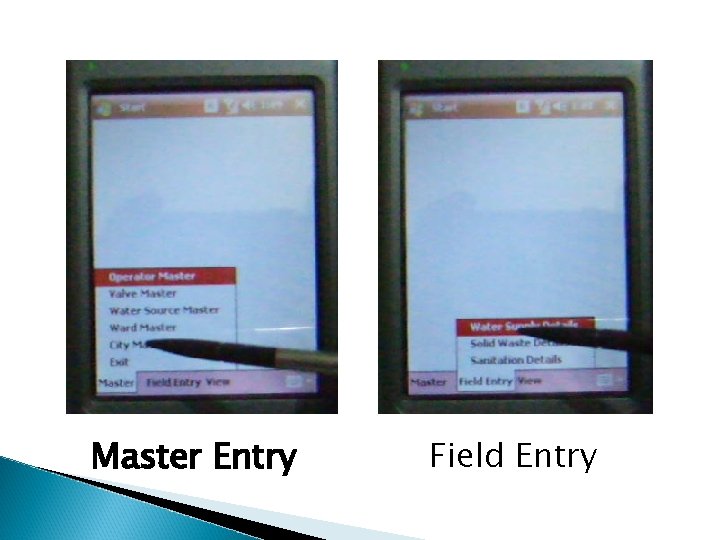
Master Entry Field Entry
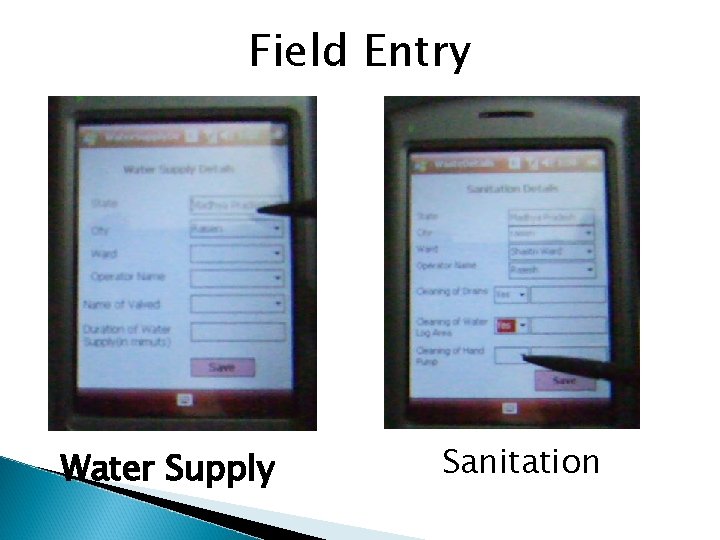
Field Entry Water Supply Sanitation
Field Entry & Data Uploading Solid Waste Data Uploading
Way Forward � Helps in effective data collection, management and decision making process � Need to disseminate such technology among the community � Need to develop a generic application of ICT tools which will help in data collection, management and assessment � It facilitates participatory planning and interaction between service provider and end users � Need to develop an integrated approach to get more involvement of stakeholders (service provider and user) for sustainable management of services.
Thank You