
Innovative Charge Breeding Techniques ICBT P Uji F

Innovative Charge Breeding Techniques (ICBT) P. Ujić, F. J. C. Wenander, L. Standylo, P. Delahaye, Y. Blumenfeld, J. F. Cam, J. Choinski, B-M. Retailleau, E. Traykov,
CABOTO in Dallas - CONFIDENTIAL • EBIS activities at CERN • HIL ECRIS test stand status (HIL Warsaw) • Performances of the EBIS debuncher (GANIL) 13/10/2015 Overview 2
EBIS activities at CERN F. Wenander for the CERN EBIS team 3
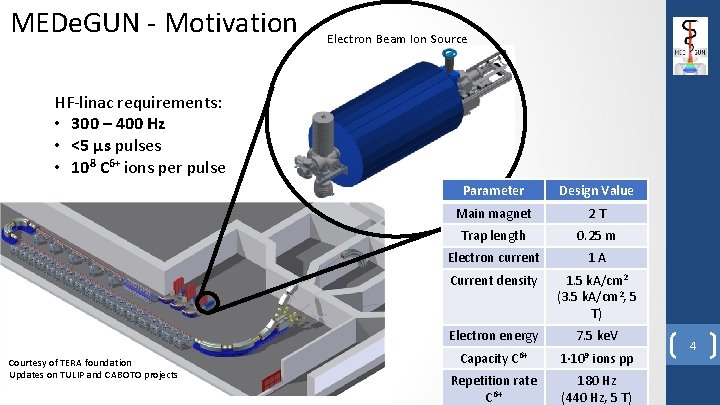
MEDe. GUN - Motivation Electron Beam Ion Source HF-linac requirements: • 300 – 400 Hz • <5 µs pulses • 108 C 6+ ions per pulse Courtesy of TERA foundation Updates on TULIP and CABOTO projects Parameter Design Value Main magnet 2 T Trap length 0. 25 m Electron current 1 A Current density 1. 5 k. A/cm 2 (3. 5 k. A/cm 2, 5 T) Electron energy 7. 5 ke. V Capacity C 6+ 1· 109 ions pp Repetition rate C 6+ 180 Hz (440 Hz, 5 T) 4
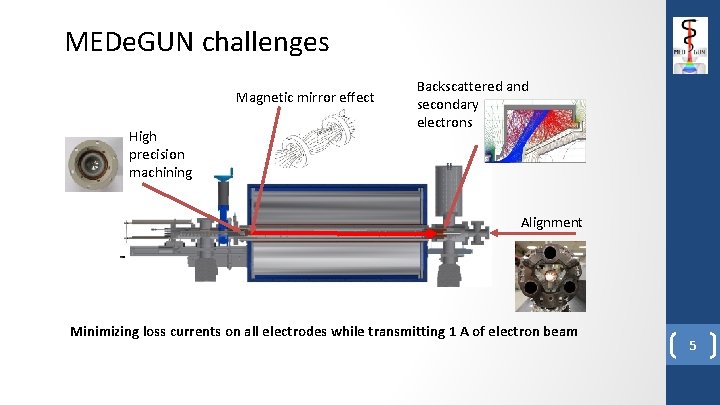
MEDe. GUN challenges Magnetic mirror effect High precision machining Backscattered and secondary electrons Alignment Minimizing loss currents on all electrodes while transmitting 1 A of electron beam 5
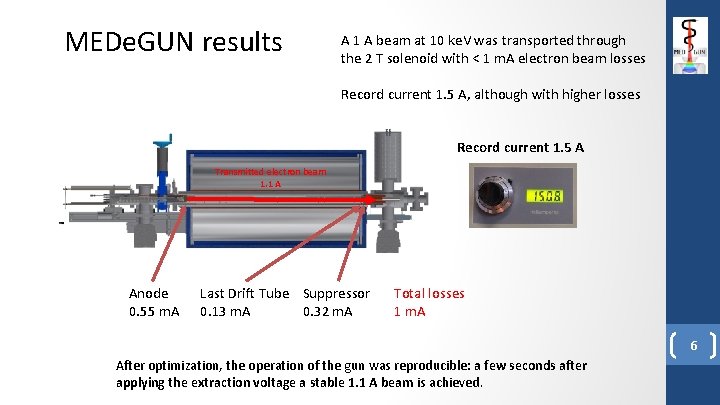
MEDe. GUN results A 1 A beam at 10 ke. V was transported through the 2 T solenoid with < 1 m. A electron beam losses Record current 1. 5 A, although with higher losses Record current 1. 5 A Transmitted electron beam 1. 1 A Anode 0. 55 m. A Last Drift Tube Suppressor 0. 13 m. A 0. 32 m. A Total losses 1 m. A 6 After optimization, the operation of the gun was reproducible: a few seconds after applying the extraction voltage a stable 1. 1 A beam is achieved.
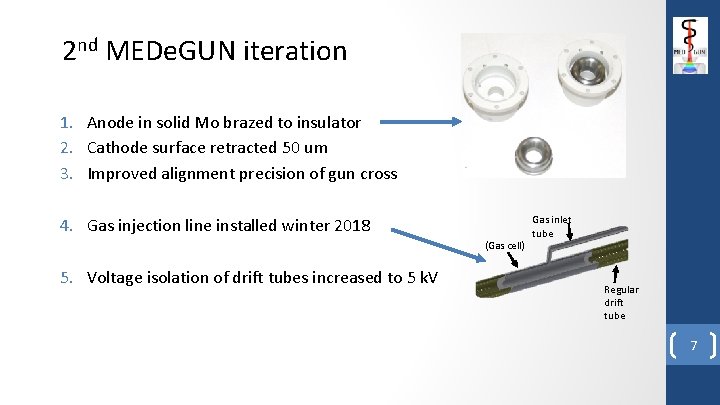
2 nd MEDe. GUN iteration 1. Anode in solid Mo brazed to insulator 2. Cathode surface retracted 50 um 3. Improved alignment precision of gun cross 4. Gas injection line installed winter 2018 (Gas cell) 5. Voltage isolation of drift tubes increased to 5 k. V Gas inlet tube Regular drift tube 7
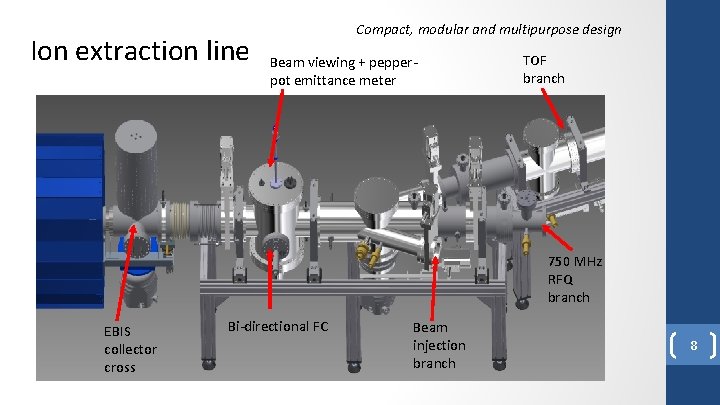
Ion extraction line Compact, modular and multipurpose design Beam viewing + pepperpot emittance meter TOF branch 750 MHz RFQ branch EBIS collector cross Bi-directional FC Beam injection branch 8
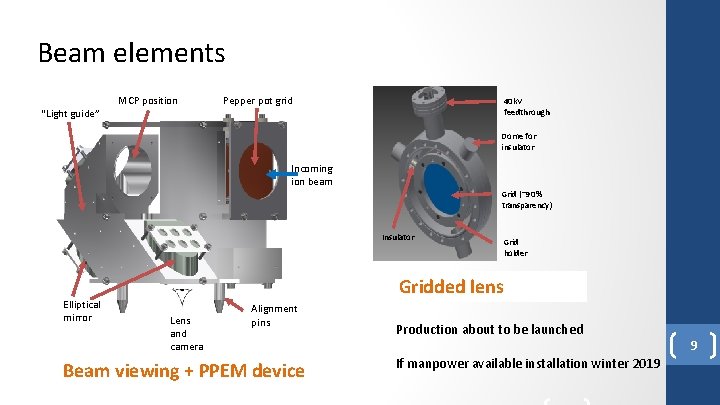
Beam elements “Light guide” MCP position Pepper pot grid 40 k. V feedthrough Dome for insulator Incoming ion beam Grid (~90% transparency) Insulator Elliptical mirror Grid holder Gridded lens Lens and camera Alignment pins Beam viewing + PPEM device Production about to be launched If manpower available installation winter 2019 9
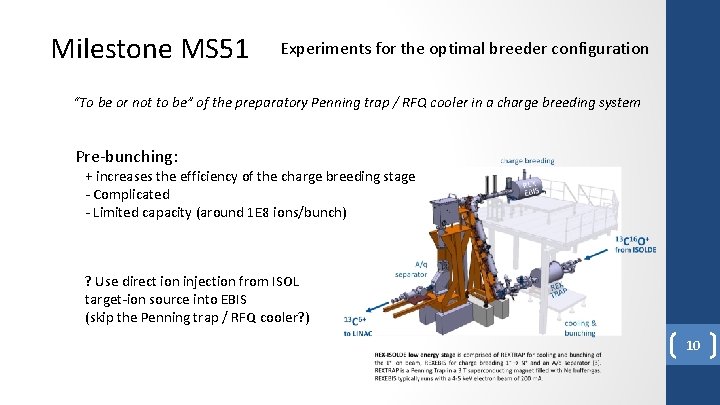
Milestone MS 51 Experiments for the optimal breeder configuration “To be or not to be” of the preparatory Penning trap / RFQ cooler in a charge breeding system Pre-bunching: + increases the efficiency of the charge breeding stage - Complicated - Limited capacity (around 1 E 8 ions/bunch) ? Use direct ion injection from ISOL target-ion source into EBIS (skip the Penning trap / RFQ cooler? ) 10
Milestone MS 51 Results 1. cw efficiency lower than pulsed – already known and explained 2. cw efficiency decrease with higher ion current – new! a. injection and trapping conditions (space-charge) changes during injection cycle b. increased space-charge compensation -> high energy ions are lost from the trap region 3. cw efficiency decreases with period time longer accumulation times give rise to higher ion energy caused by electron-ion heating 4. trapping capacity of EBIS one order of magnitude lower than expected don’t manage to make full use of the electron beam space charge due to the high energy of the injected ions 11
Milestone MS 51 Recommendation for a EURISOL facility A preparatory cooling stage is therefore still recommended, although instead of using a Penning trap, a simpler RFQ cooler-buncher is advised. To address the increased ion currents expected from EURISOL, where the space-charge limitation in the cooler-buncher will pose problems, the charge breeding repetition rate has to be increased as the number of ions per bunch is inversely proportional to the repetition rate. Shorter charge breeding times is attained by increasing the electron current density inside the EBIS. The MEDe. GUN electron gun design aims to increase the current density by a factor 15, and thereby reduce the charge breeding time with a similar value, compared to the present 100 -150 A/cm 2 at REXEBIS. 12
Conclusions and outlook Outlook 3. Upcoming 2 nd commissioning round of MEDe. GUN. 4. Ion extraction line under construction CABOTO in Dallas - CONFIDENTIAL 1. MEDe. GUN design current reached. 2. Tests shows that an RFQ cooler or Penning trap is mandatory for an EBIS, even for high-intensity beams. 13/10/2015 Results 13
HIL ECRIS test stand status
Introduction → 2013: start program for ECR ion sources performance improvement at HIL → collaboration with the EMILIE project Goals: → Development of a model for 1+ ion beam introduction into existing ECR source → Design of effective system formation, injection and extraction of 1+ beam Planned to upgrade and development of ECRIS test bench for charge breeding purposes: → Build an ion source for production of 1+ ion beam and combine it with working ECRIS → Buil a 1+ ion beam injection system → Optimization of CB operation
Motivations Depending on the optical characteristics of the 1+ ion beam entrance in the charge breeder, the charge breeding efficiency may be increased significantly. → Numerical calculations of 1+ ion beam injection into plasma chamber of the HIL ECR test bench axial injection → gives a small fraction of interaction of 1+ ion beam with plasma and it is necessary to change series of parameters to optimize charge breeding efficiency Assumptions: → Possibility of controlling the energy of the 1+ ion beam and a residence time in plasma → Adjusting two parameters (E, tres) independently could increase efficiency of 1+ ion beam capture → 1+ ion beam residence time in plasma is expected to be increase with extended beam path through plasma chamber Goal: Create a model of non-axial 1+ ion beam injection to conventional ECR ion source and to increase charge breeding efficiency and better understanding of this process →
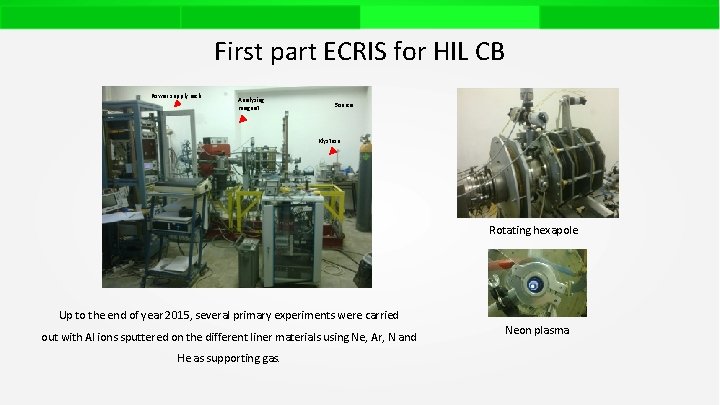
First part ECRIS for HIL CB Power supply rack Analysing magnet Source Klystron Rotating hexapole Up to the end of year 2015, several primary experiments were carried out with Al ions sputtered on the different liner materials using Ne, Ar, N and He as supporting gas. Neon plasma

Ion injection setup 1+ puller RF tube: +DVinfl Axial symmetric Decererated beam inflector 1+ beam +DVinfl 1+ source Deceleration of 1+ ion beam may lead to the optimal velocity for their capture in the plasma - Energy of 1+ ion beam will be controlled by cathode potential - Magnitude of a beam inflection will be controlled by inflector potential
![Magnetic and electrostatic field B[T] Two gap deceleration system allows better control of the](http://slidetodoc.com/presentation_image/40fa4b4167ffbe77fab7c37d0fa5b342/image-19.jpg "Magnetic and electrostatic field B[T] Two gap deceleration system allows better control of the")
Magnetic and electrostatic field B[T] Two gap deceleration system allows better control of the incoming beam Positions of the deflecting electrode and beam outlet x[mm] Magnetic field used in calculations was reconstructed from measured one.
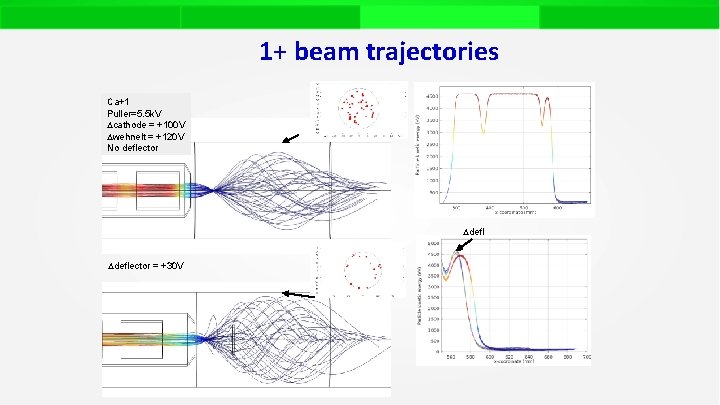
1+ beam trajectories Ca+1 Puller=5. 5 k. V Dcathode = +100 V Dwehnelt = +120 V No deflector Ddeflector = +30 V
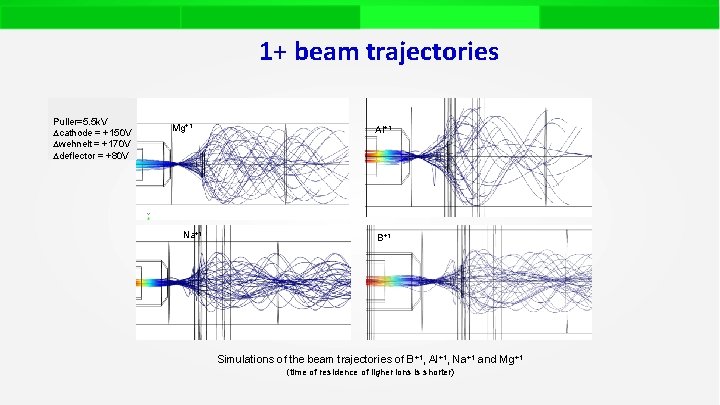
1+ beam trajectories Puller=5. 5 k. V Dcathode = +150 V Dwehnelt = +170 V Ddeflector = +80 V Mg+1 Na+1 Al+1 B+1 Simulations of the beam trajectories of B+1, Al+1, Na+1 and Mg+1 (time of residence of ligher ions is shorter)

Ion injection setup parts First tests of the 1+ ion beam transmission trough the ECR magnetic trap with and without magnetic field were conducted. Injection system will be mounted to RF coupler tube. Prototype of thermal Li+1 source (current 0. 5 -1. 5 μA) Latest measurements aimed to check performance of deflector Preliminary results were promising
Performances of the EBIS debuncher
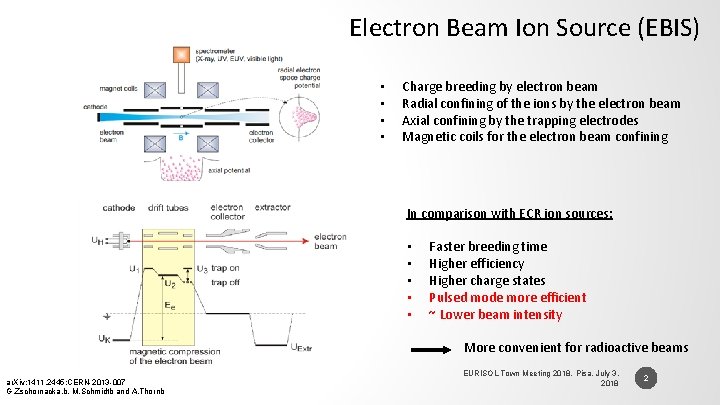
Electron Beam Ion Source (EBIS) • • Charge breeding by electron beam Radial confining of the ions by the electron beam Axial confining by the trapping electrodes Magnetic coils for the electron beam confining In comparison with ECR ion sources: • • • Faster breeding time Higher efficiency Higher charge states Pulsed mode more efficient ~ Lower beam intensity More convenient for radioactive beams ar. Xiv: 1411. 2445; CERN-2013 -007 G. Zschornacka, b, M. Schmidtb and A. Thornb EURISOL Town Meeting 2018, Pisa, July 3, 2018 2
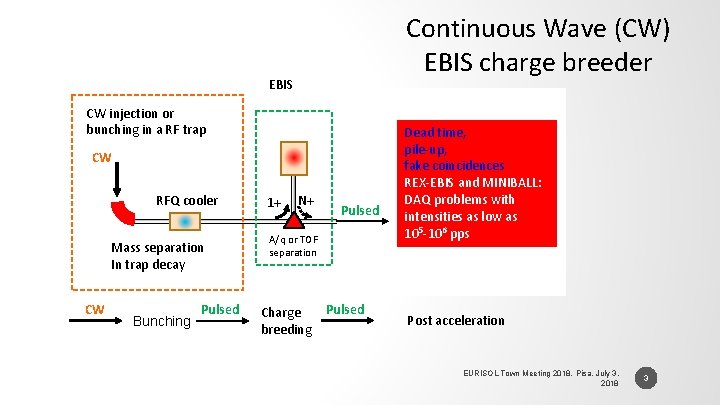
Continuous Wave (CW) EBIS charge breeder EBIS CW injection or bunching in a RF trap CW RFQ cooler Mass separation In trap decay CW Bunching Pulsed 1+ N+ A/q or TOF separation Charge breeding Dead time, Slow extraction pile-up, fake coincidences REX-EBIS and MINIBALL: Buffer trap DAQ problems with (Pseudo) CW Pulsed intensities as low as 105 -106 pps Linear RFQ trap Using the energy spread Pulsed Post acceleration EURISOL Town Meeting 2018, Pisa, July 3, 2018 3
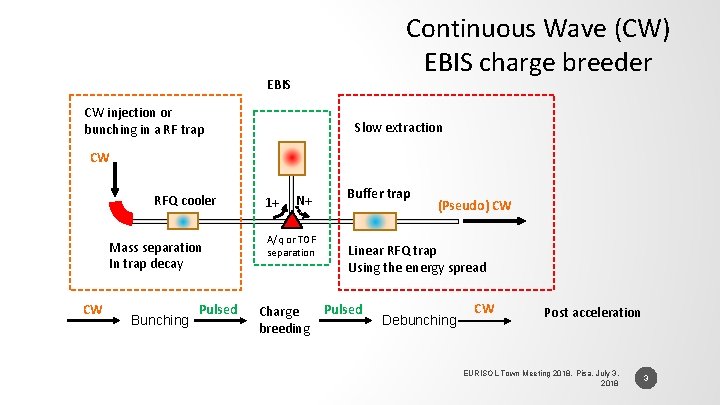
Continuous Wave (CW) EBIS charge breeder EBIS CW injection or bunching in a RF trap Slow extraction CW RFQ cooler Mass separation In trap decay CW Bunching Pulsed 1+ N+ A/q or TOF separation Charge breeding Buffer trap (Pseudo) CW Linear RFQ trap Using the energy spread Pulsed Debunching CW Post acceleration EURISOL Town Meeting 2018, Pisa, July 3, 2018 3
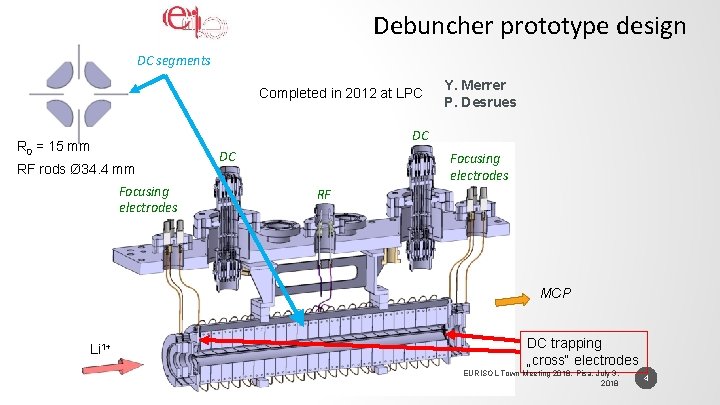
Debuncher prototype design DC segments Completed in 2012 at LPC Y. Merrer P. Desrues DC R 0 = 15 mm RF rods Ø 34. 4 mm Focusing electrodes DC Focusing electrodes RF MCP Li 1+ DC trapping „cross“ electrodes EURISOL Town Meeting 2018, Pisa, July 3, 2018 4
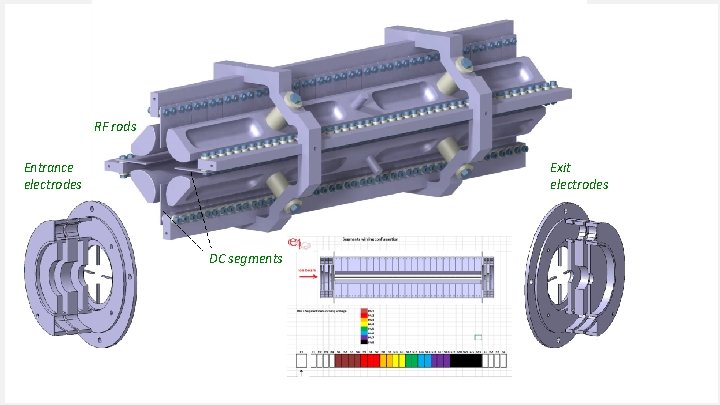
Debuncher prototype design DC segments Completed in 2012 at LPC RF rods R 0 = 15 mm Entrance RF rods Ø 34. 4 mm electrodes Focusing Y. Merrer P. Desrues DC DC Focusing electrodes RF electrodes Exit electrodes DC segments MCP Li 1+ DC trapping „cross“ electrodes EURISOL Town Meeting 2018, Pisa, July 3, 2018 28
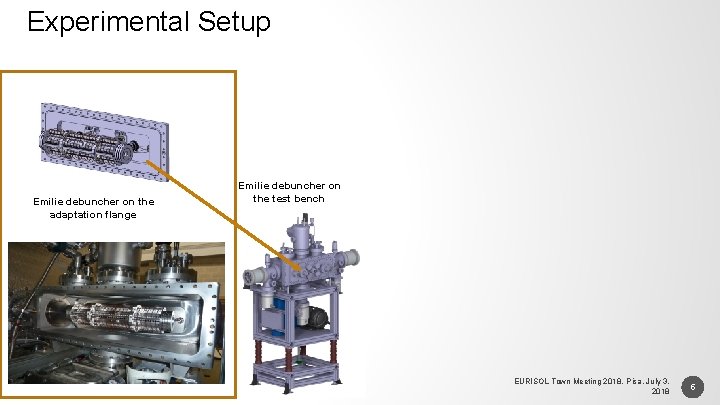
Experimental Setup Emilie debuncher on the adaptation flange Emilie debuncher on the test bench EURISOL Town Meeting 2018, Pisa, July 3, 2018 5
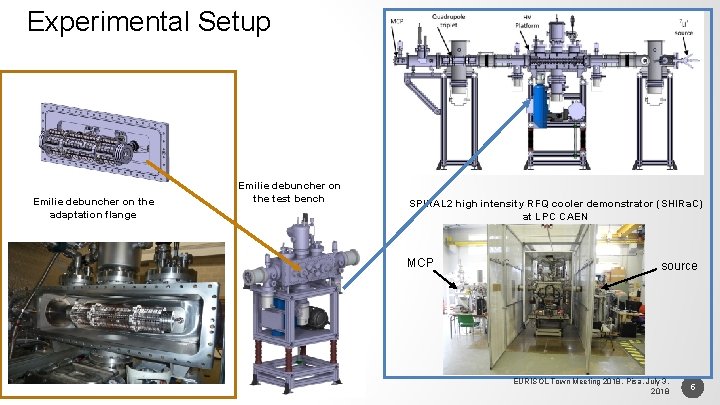
Experimental Setup Emilie debuncher on the adaptation flange Emilie debuncher on the test bench SPIRAL 2 high intensity RFQ cooler demonstrator (SHIRa. C) at LPC CAEN MCP source EURISOL Town Meeting 2018, Pisa, July 3, 2018 5
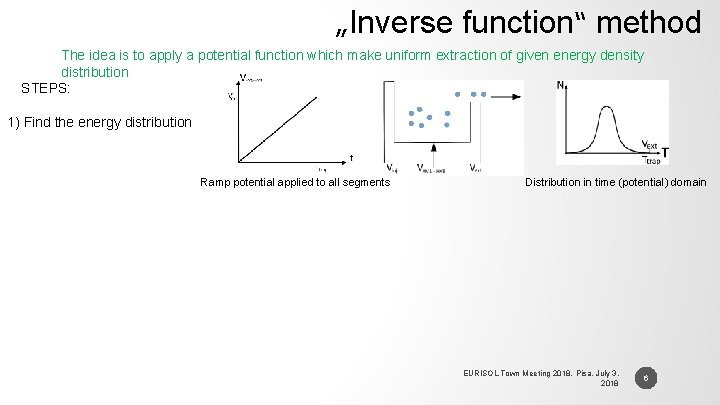
„Inverse function“ method The idea is to apply a potential function which make uniform extraction of given energy density distribution STEPS: 1) Find the energy distribution Ramp potential applied to all segments Distribution in time (potential) domain EURISOL Town Meeting 2018, Pisa, July 3, 2018 6
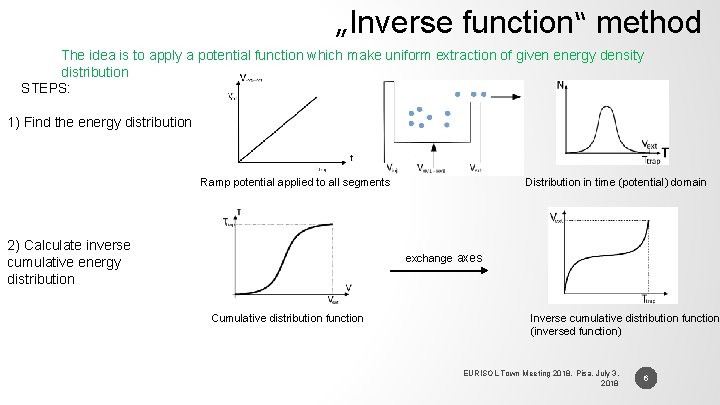
„Inverse function“ method The idea is to apply a potential function which make uniform extraction of given energy density distribution STEPS: 1) Find the energy distribution Ramp potential applied to all segments 2) Calculate inverse cumulative energy distribution Distribution in time (potential) domain exchange axes Cumulative distribution function Inverse cumulative distribution function (inversed function) EURISOL Town Meeting 2018, Pisa, July 3, 2018 6
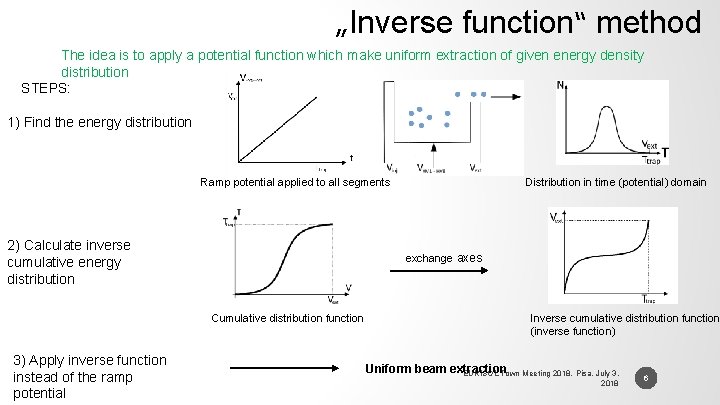
„Inverse function“ method The idea is to apply a potential function which make uniform extraction of given energy density distribution STEPS: 1) Find the energy distribution Ramp potential applied to all segments 2) Calculate inverse cumulative energy distribution exchange axes Cumulative distribution function 3) Apply inverse function instead of the ramp potential Distribution in time (potential) domain Inverse cumulative distribution function (inverse function) Uniform beam extraction EURISOL Town Meeting 2018, Pisa, July 3, 2018 6
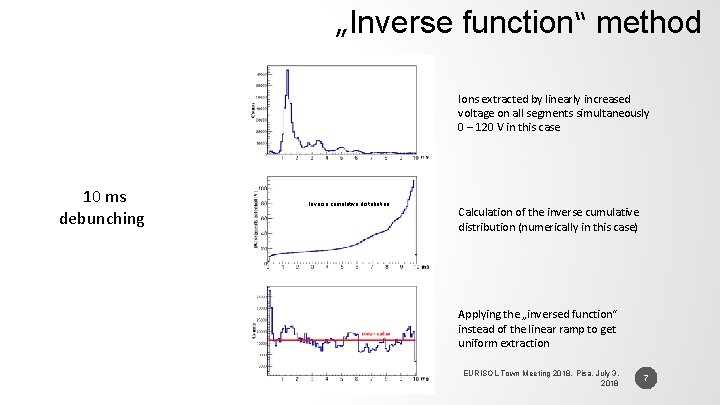
„Inverse function“ method Ions extracted by linearly increased voltage on all segments simultaneously 0 – 120 V in this case 10 ms debunching Inverse cumulative distribution Calculation of the inverse cumulative distribution (numerically in this case) Applying the „inversed function“ instead of the linear ramp to get uniform extraction EURISOL Town Meeting 2018, Pisa, July 3, 2018 7
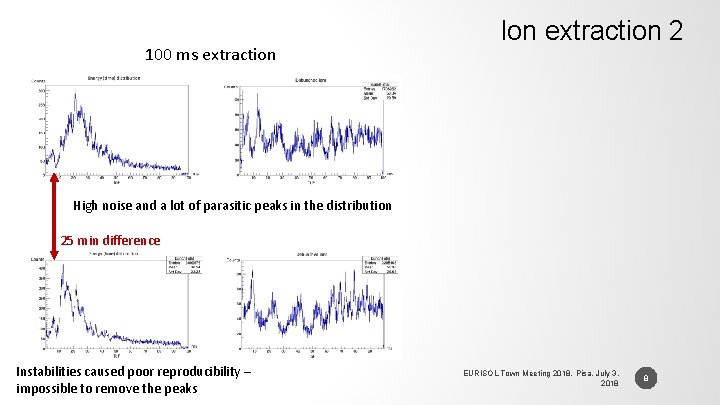
100 ms extraction Ion extraction 2 High noise and a lot of parasitic peaks in the distribution 25 min difference Instabilities caused poor reproducibility – impossible to remove the peaks EURISOL Town Meeting 2018, Pisa, July 3, 2018 8
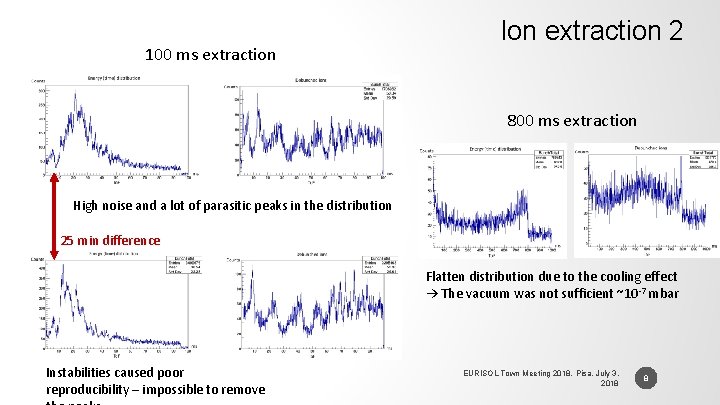
100 ms extraction Ion extraction 2 800 ms extraction High noise and a lot of parasitic peaks in the distribution 25 min difference Flatten distribution due to the cooling effect → The vacuum was not sufficient ~10 -7 mbar Instabilities caused poor reproducibility – impossible to remove EURISOL Town Meeting 2018, Pisa, July 3, 2018 8
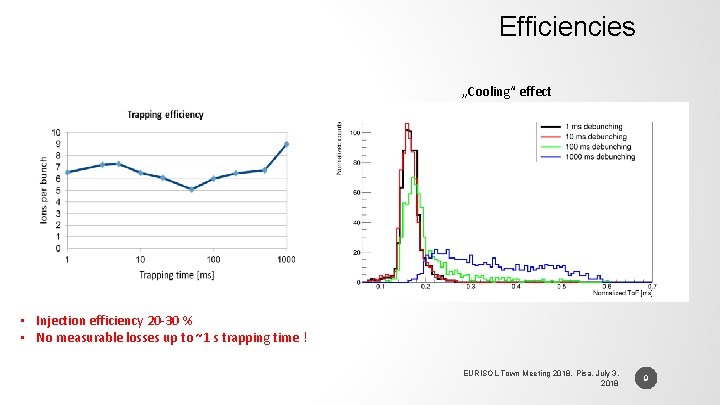
Efficiencies „Cooling“ effect • Injection efficiency 20 -30 % • No measurable losses up to ~1 s trapping time ! EURISOL Town Meeting 2018, Pisa, July 3, 2018 9
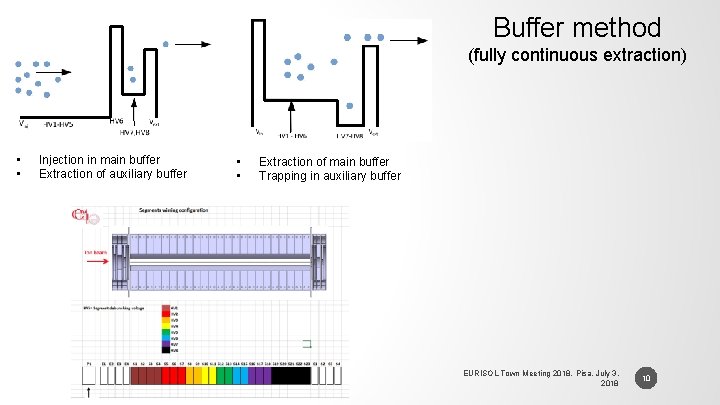
Buffer method (fully continuous extraction) • • Injection in main buffer Extraction of auxiliary buffer • • Extraction of main buffer Trapping in auxiliary buffer EURISOL Town Meeting 2018, Pisa, July 3, 2018 10
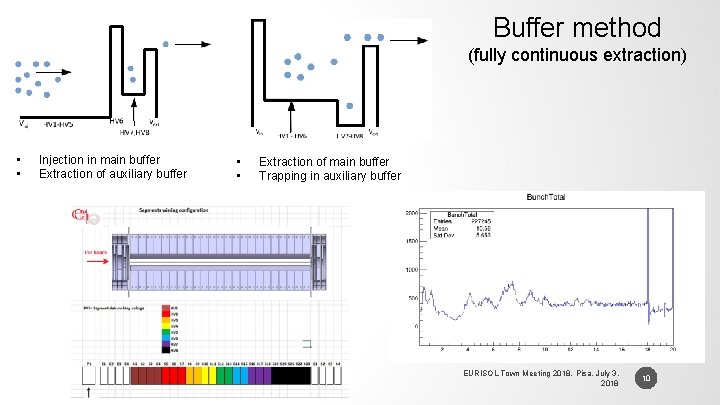
Buffer method (fully continuous extraction) • • Injection in main buffer Extraction of auxiliary buffer • • Extraction of main buffer Trapping in auxiliary buffer EURISOL Town Meeting 2018, Pisa, July 3, 2018 10
Conclusions/results: • Uniform ion extraction for trapping times up to ~1 s • Ultra-high vacuum level (<10 -11 mbar) necessary • An optimized ion optics is needed Outlook/projection • • Test of the space charge effects will be necessary in the next step Projections for the use of such device with operational or future EBIS devices are encouraging EURISOL Town Meeting 2018, Pisa, July 3, 2018 11

Thank you for your attention !
- Slides: 41