
Innovative Bayesian Approaches in Medical Device Trials Xuefeng

Innovative Bayesian Approaches in Medical Device Trials Xuefeng Li FDA/CDRH/OCEA 2020 BIOP Regulatory-Industry Statistical Workshop 1
Outline I. Background II. Recent innovative Bayesian methods 1. Propensity score Integrated power prior model 2. Dynamic power prior model III. Discussion 2
I. Bayesian Applications at CDRH • CDRH Bayesian guidance on 2010 • About 30 original pre-market applications (PMA) and PMA supplements have been approved since 1999 with a Bayesian analysis as primary. Several are for diagnostic devices. • Many investigational device exemptions (IDE) have also been approved. • Several applications for “substantial equivalence” (510(k)s) • A number of reviews are in process. 3
I. External Evidence Methods (EEM) Project • Project launched formally in April 2019 by Medical Device Innovation Consortium (MDIC) • MDIC is the first-ever public-private partnership created with the sole objective of advancing medical device regulatory science for patient benefit • Aims to establish a more predictable pathway for use of EEM • One objective is to develop a statistical framework of methodologies to use EE • Many of the methodologies are Bayesian 4
I. Bayesian Models to Incorporate Priors • Bayesian Hierarchical Model • Power prior model (Ibrahim and Chen 2000) • Commensurate prior model (Hobbs et al 2004) • Robust prior model (Schmidli et al 2014) • MDIC dynamic borrowing model (Haddad et al 2017) • Propensity score integrated power prior model (Wang et al 2019) • Dynamic power prior model (Thompson et al 2020) 5
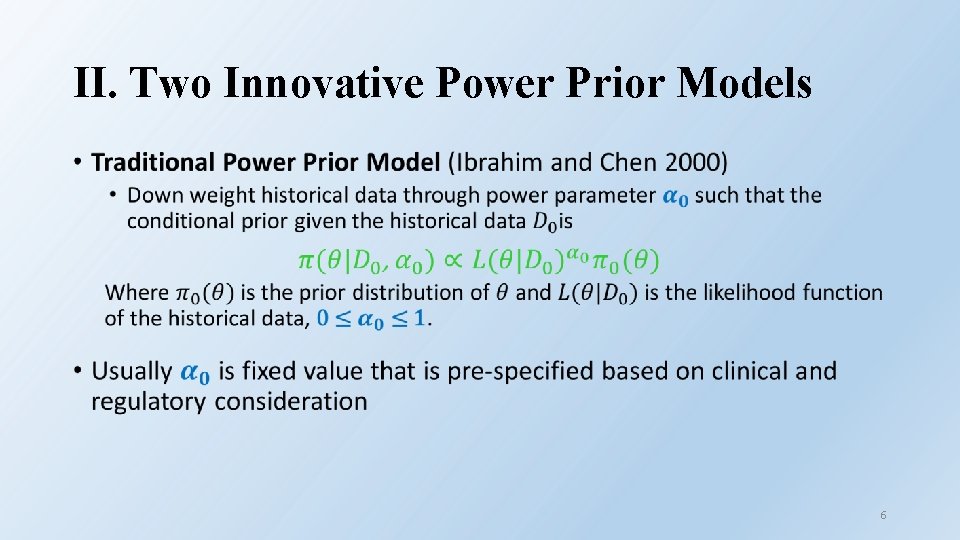
II. Two Innovative Power Prior Models • 6
II. New Discounting Ideas • Two new ideas to determine α 0 • Depend on the similarity of baseline covariates between external patients and current patients (Wang et al 2019) • Depend on the similarity of outcome between external study and current study (Thompson et al 2020) 7
II. 1. Propensity Score Integrated Power Prior Model (PSPP) • Propensity score matching • To balance observed covariates between the prior patients and the current patients • Two-stage outcome-free design to decide α 0 • Performed by independent statistician with no access to outcome data • Stage I: Specify key baseline covariates to estimate Propensity Score and for stratification • Stage II: Run PS modeling, assess covariate balance and submit the PS design • Power prior model for outcome data analysis 8
II. 1. PSPP Model – An Example • An investigational study for indication expansion of an approved device. • Plenty of off-label use data were captured in a patient registry. • Based on clinical and statistical evaluations, the registry was thought relevant to the prospective study with adequate reliability. • Planned to conduct a single-arm investigational study and borrow some data from the registry to save sample size in the prospective investigational study. 9
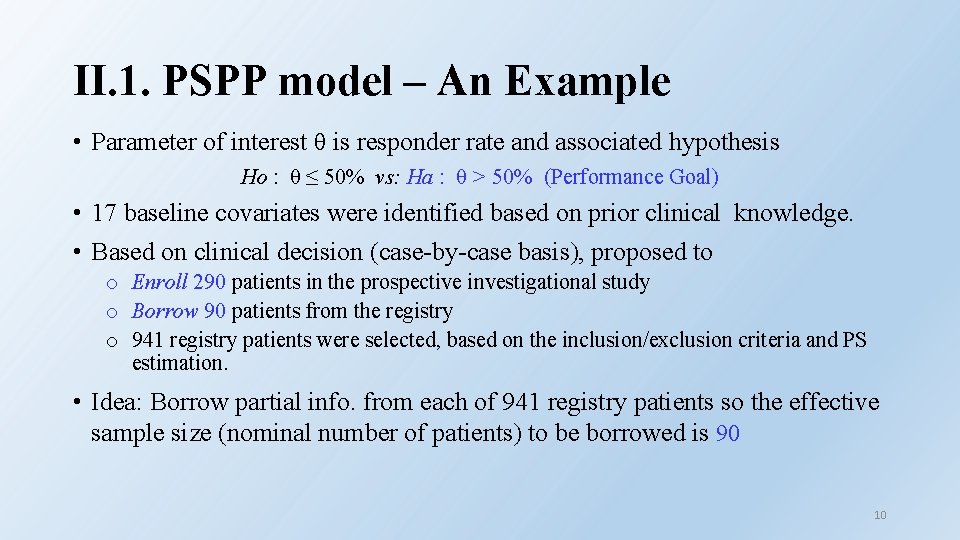
II. 1. PSPP model – An Example • Parameter of interest θ is responder rate and associated hypothesis Ho : θ ≤ 50% vs: Ha : θ > 50% (Performance Goal) • 17 baseline covariates were identified based on prior clinical knowledge. • Based on clinical decision (case-by-case basis), proposed to o Enroll 290 patients in the prospective investigational study o Borrow 90 patients from the registry o 941 registry patients were selected, based on the inclusion/exclusion criteria and PS estimation. • Idea: Borrow partial info. from each of 941 registry patients so the effective sample size (nominal number of patients) to be borrowed is 90 10
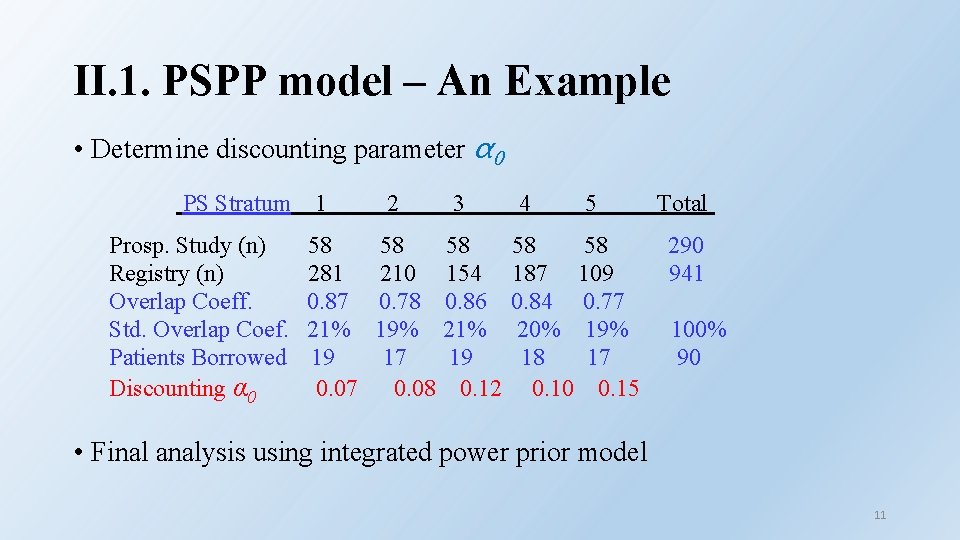
II. 1. PSPP model – An Example • Determine discounting parameter α 0 PS Stratum Prosp. Study (n) Registry (n) Overlap Coeff. Std. Overlap Coef. Patients Borrowed Discounting α 0 1 58 281 0. 87 21% 19 0. 07 2 3 58 58 210 154 0. 78 0. 86 19% 21% 17 19 0. 08 0. 12 4 5 58 58 187 109 0. 84 0. 77 20% 19% 18 17 0. 10 0. 15 Total 290 941 100% 90 • Final analysis using integrated power prior model 11
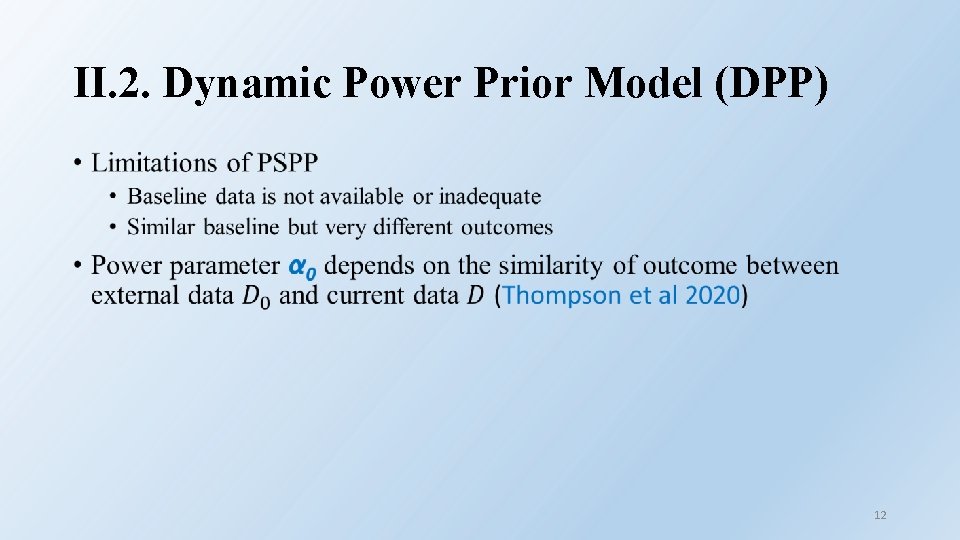
II. 2. Dynamic Power Prior Model (DPP) • 12
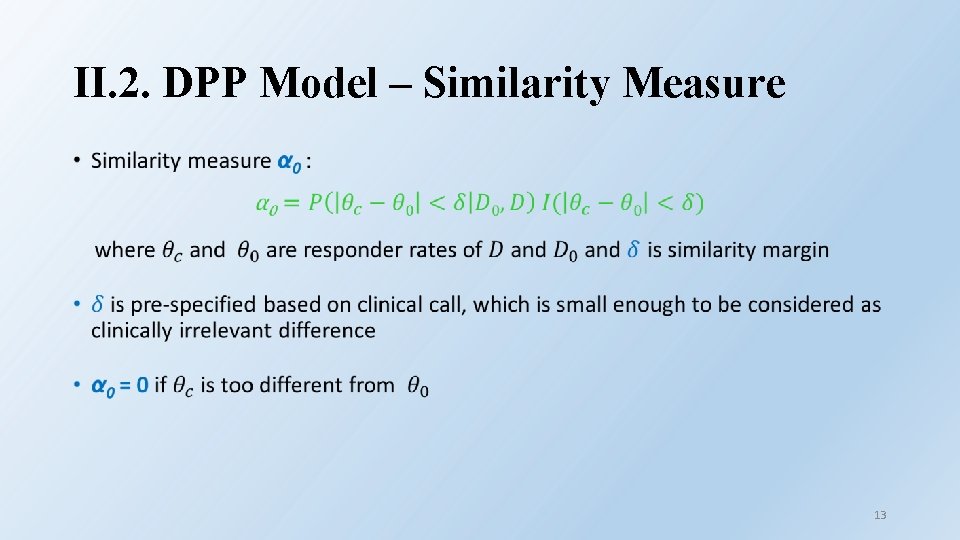
II. 2. DPP Model – Similarity Measure • 13
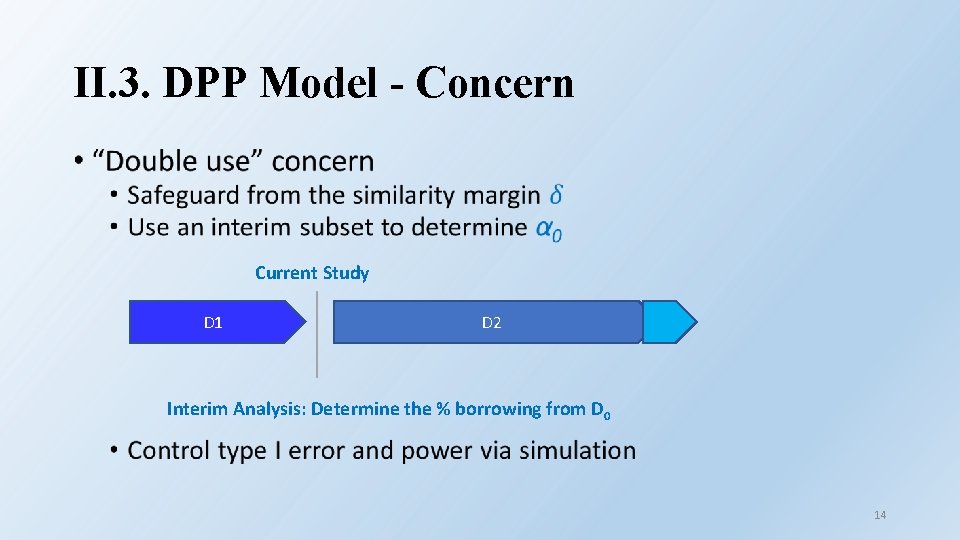
II. 3. DPP Model - Concern • Current Study D 1 D 2 Interim Analysis: Determine the % borrowing from D 0 14
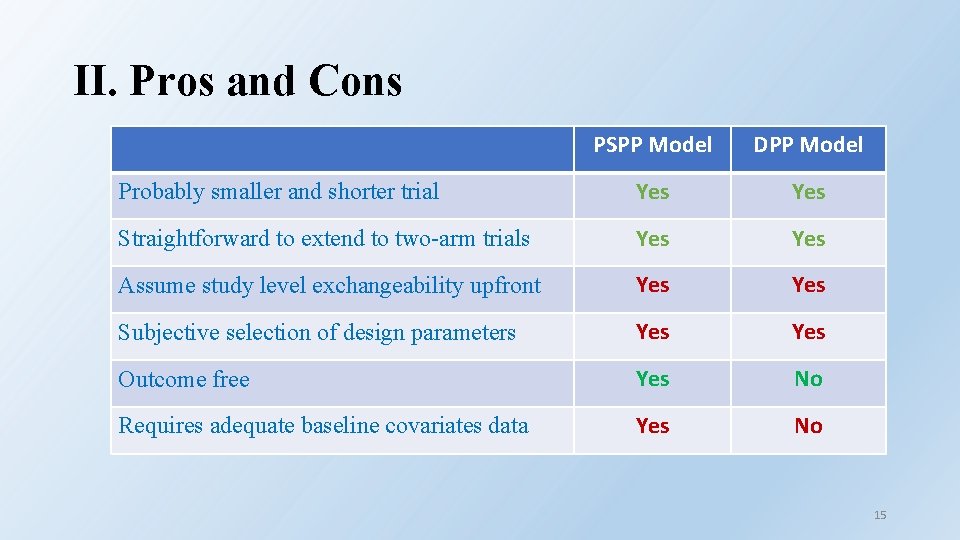
II. Pros and Cons PSPP Model DPP Model Probably smaller and shorter trial Yes Straightforward to extend to two-arm trials Yes Assume study level exchangeability upfront Yes Subjective selection of design parameters Yes Outcome free Yes No Requires adequate baseline covariates data Yes No 15
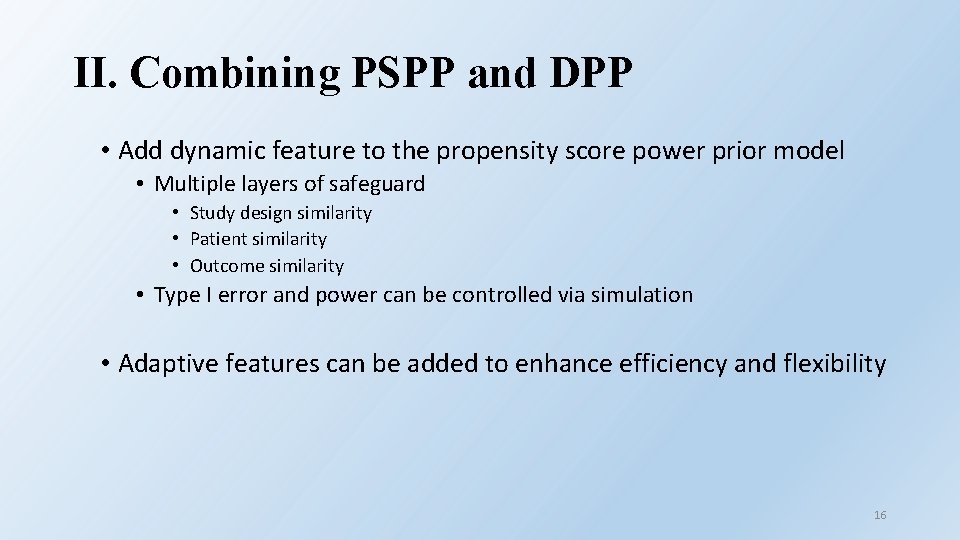
II. Combining PSPP and DPP • Add dynamic feature to the propensity score power prior model • Multiple layers of safeguard • Study design similarity • Patient similarity • Outcome similarity • Type I error and power can be controlled via simulation • Adaptive features can be added to enhance efficiency and flexibility 16
III. Remarks • Always check exchangeability before borrowing • Propensity score power prior method • Should be used when adequate baseline information is available • Dynamic power prior method • Add one more layer of safeguard on borrowing • Call for more innovative Bayesian designs 17
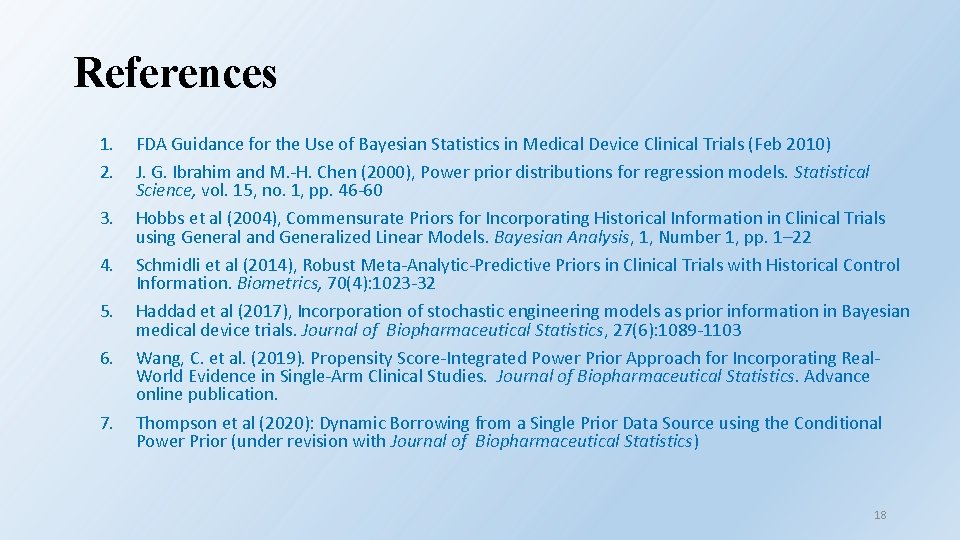
References 1. 2. 3. 4. 5. 6. 7. FDA Guidance for the Use of Bayesian Statistics in Medical Device Clinical Trials (Feb 2010) J. G. Ibrahim and M. -H. Chen (2000), Power prior distributions for regression models. Statistical Science, vol. 15, no. 1, pp. 46 -60 Hobbs et al (2004), Commensurate Priors for Incorporating Historical Information in Clinical Trials using General and Generalized Linear Models. Bayesian Analysis, 1, Number 1, pp. 1– 22 Schmidli et al (2014), Robust Meta-Analytic-Predictive Priors in Clinical Trials with Historical Control Information. Biometrics, 70(4): 1023 -32 Haddad et al (2017), Incorporation of stochastic engineering models as prior information in Bayesian medical device trials. Journal of Biopharmaceutical Statistics, 27(6): 1089 -1103 Wang, C. et al. (2019). Propensity Score-Integrated Power Prior Approach for Incorporating Real. World Evidence in Single-Arm Clinical Studies. Journal of Biopharmaceutical Statistics. Advance online publication. Thompson et al (2020): Dynamic Borrowing from a Single Prior Data Source using the Conditional Power Prior (under revision with Journal of Biopharmaceutical Statistics) 18
- Slides: 18