
INNOVATIVE APPROACH TO ENHANCE PROTECTED AGRICULTURE IN MARGINAL
- Slides: 12
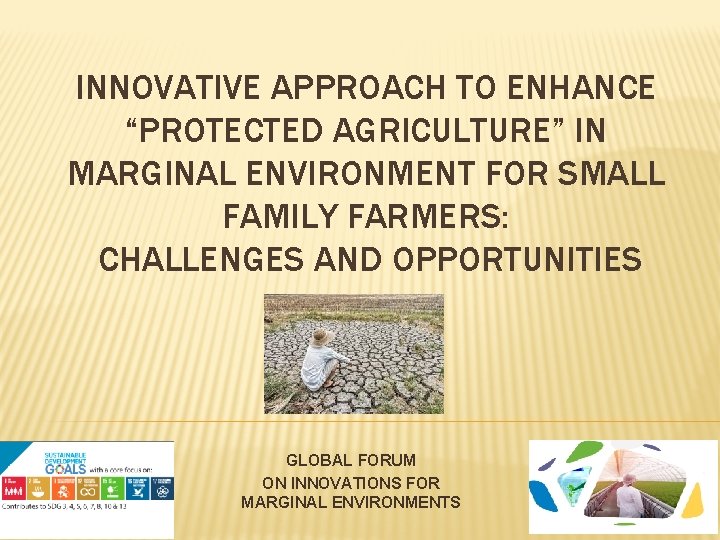
INNOVATIVE APPROACH TO ENHANCE “PROTECTED AGRICULTURE” IN MARGINAL ENVIRONMENT FOR SMALL FAMILY FARMERS: CHALLENGES AND OPPORTUNITIES GLOBAL FORUM ON INNOVATIONS FOR MARGINAL ENVIRONMENTS
PROTECTED AGRICULTURE IN MARGINAL ENVIRONMENT; PROLOG � � � Water scarcity is the most important and restrictive challenge for agriculture and rural livelihoods in the Middle East and North Africa. Climate change accelerating the complexity of this dilemma, reducing agricultural productivity and worsening daily life. Growing poverty and number of hunger, This destructive process ultimately faced SDG 1 and SDG 2 with a real threat Technological approaches alone, such as localised modern irrigation, are not sufficient to address the agricultural water saving requirements. There is an urgent need to develop further innovative appropriate approaches and technologies while integrating adequate comprehensive management and effective governance at national and global levels.
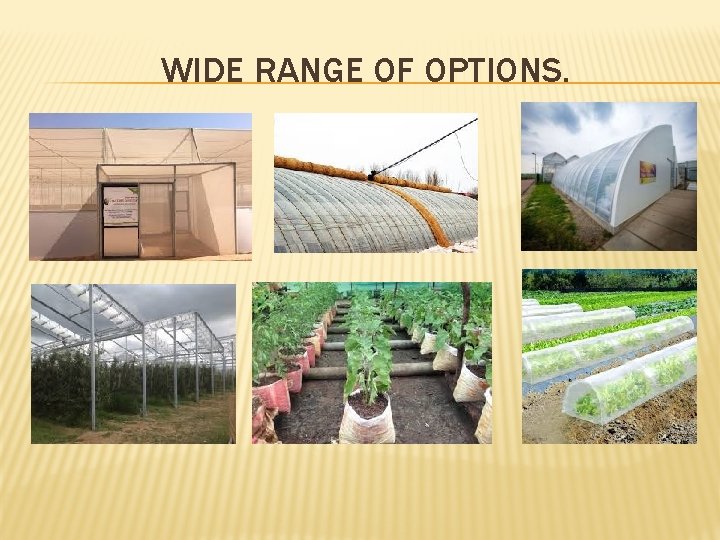
WHAT IS PROTECTED AGRICULTURE � � Protected agriculture, allow greater control over the growing environment like temperatures, light, moisture of plants and protect it from any possible external factors which may disturb the healthy growth and production. Protected agriculture, control the cultivation environment by reducing the ETP substantially. Protected agriculture, is a comprehensive integrated approach and economically is more productive and environmentally more adaptive Protected agriculture, has wide range of options which formulated to any given circumstances to addresses the physical, biological and social aspects of sustainable crop intensification in marginalised environment.
‘ PROTECTED AGRICULTURE � � � Saving on water requirements (consumption) for crop production, reduce the ETP Extended cropping season resulting in higher productivity per m 2 of land, and m 3 of water, Control (according to level of technology) over climate parameters (wind, temperature, rain, humidity, hail…. ) Enrichment of organic carbon in the soil (application of organic fertilisers), Comfortable working conditions, Labour intensive job creation and income generation. More labour / m 2, High value crops (horticulture) more $ per m 2, Entrepreneurship (business model) for small scale agriculture Crop diversity for health, linked to “nutrition” security Control over soil erosion, Gender sensitive (women, youth, ) (comfortable working conditions) Could be managed with non chemical pest and disease
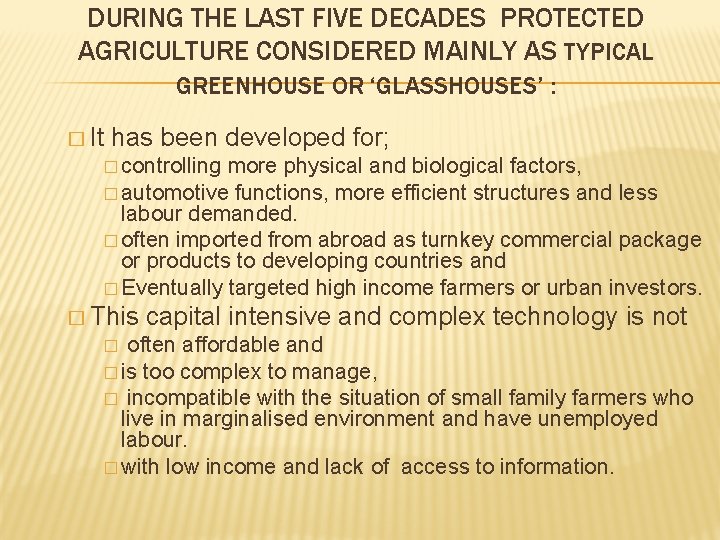
DURING THE LAST FIVE DECADES PROTECTED AGRICULTURE CONSIDERED MAINLY AS TYPICAL GREENHOUSE OR ‘GLASSHOUSES’ : � It has been developed for; � controlling more physical and biological factors, � automotive functions, more efficient structures and less labour demanded. � often imported from abroad as turnkey commercial package or products to developing countries and � Eventually targeted high income farmers or urban investors. � This capital intensive and complex technology is not often affordable and � is too complex to manage, � incompatible with the situation of small family farmers who live in marginalised environment and have unemployed labour. � with low income and lack of access to information. �
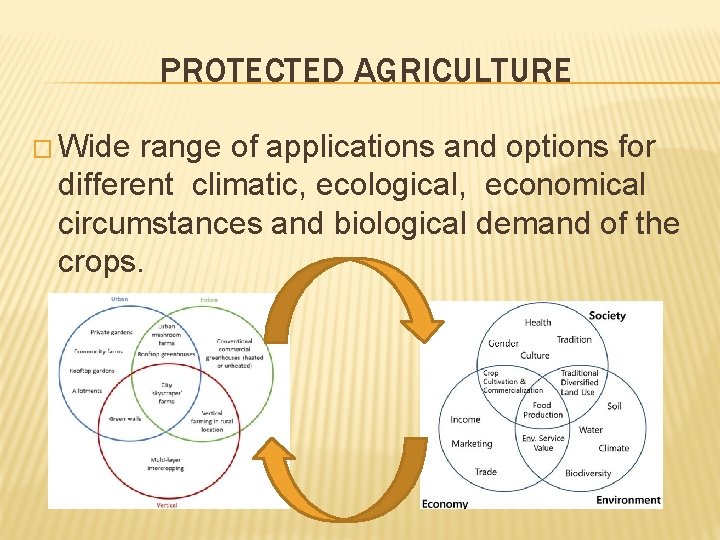
PROTECTED AGRICULTURE � Wide range of applications and options for different climatic, ecological, economical circumstances and biological demand of the crops.
WIDE RANGE OF OPTIONS.
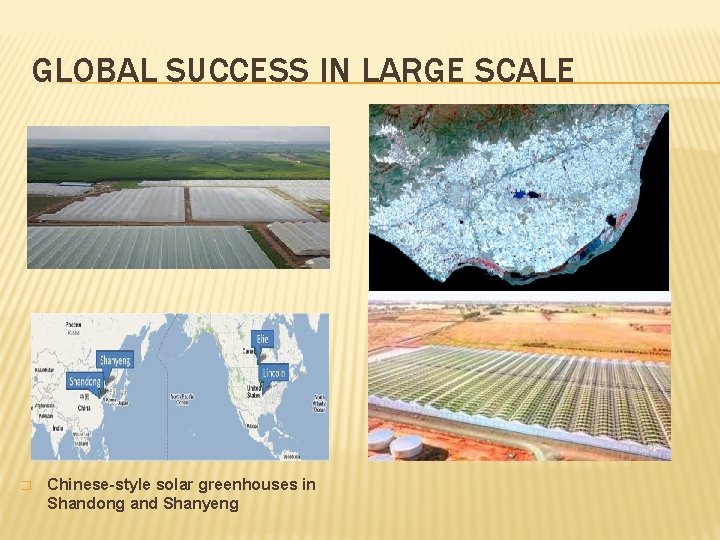
GLOBAL SUCCESS IN LARGE SCALE � Chinese-style solar greenhouses in Shandong and Shanyeng
HOW INNOVATION COULD ENHANCE THE PROCESS FOR SMALL FAMILY FARMERS � Innovation Is the process which bring new or existing products, processes or ways of organisation into use for the first time in a specific context in order to increase effectiveness, competitiveness, resilience to shocks or environmental sustainability and thereby contribute to food security and nutrition, economic development or sustainable natural resource management. ”
AGRICULTURAL INNOVATION � is a process not a products or just new or sophisticated technology, � includes: policies, management and organizing the new notion to action, � is contextual, and need to be available, accessible and affordable to be appropriate to the any given situation and target group. � Success of Innovation Is result based to increase effectiveness, competitiveness, resilience , sustainability and contribute to food
MAIN CHARACTERISTICS OF SMALLHOLDER FAMILY FARMERS. � � � They produce relatively small volumes on relatively small plots of land generally less well-resourced than commercial-scale farmers. They are usually considered part of the informal economy (because they may not be registered, tend to be excluded from aspects of labour legislation, lack social protection and have limited records). Smallholder production in many developing countries remains at subsistence levels but they may produce an export commodity as a main livelihood activity or as one of many activities. They are often very vulnerable in supply chains in local, national and international market. Smallholders typically lack access to credit, receive little technical support and often have low productivity. Smallholders generally rely on labour-intensive production methods and family labour.
LESSON LEARNED: � The issue should be considered in three aspects: Governance, management and leadership, � Technological � Financial � Appropriate, accessible and affordable technology to be created to any given context. � Further collaboration is needed: � Global, � Regional, � National. � � Private public partnership is essential