
Innovation Portfolio Planning Action Plan and Next Steps
- Slides: 10
Innovation Portfolio Planning Action Plan and Next Steps 9 May 2016 Kevin Grant kevin@kgrant. info https: //aboutkevingrant. com “Rather than hoping that their future will emerge from a collection of ad hoc efforts, smart organizations manage for total innovation system. ” (Harvard Business Review)
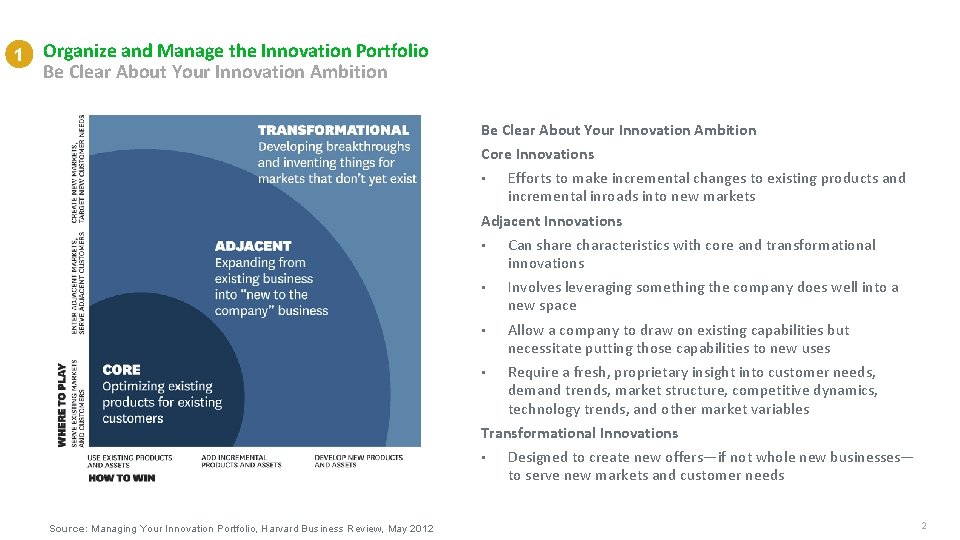
1 Organize and Manage the Innovation Portfolio Be Clear About Your Innovation Ambition Core Innovations • Efforts to make incremental changes to existing products and incremental inroads into new markets Adjacent Innovations • Can share characteristics with core and transformational innovations • Involves leveraging something the company does well into a new space • Allow a company to draw on existing capabilities but necessitate putting those capabilities to new uses • Require a fresh, proprietary insight into customer needs, demand trends, market structure, competitive dynamics, technology trends, and other market variables Transformational Innovations • Source: Managing Your Innovation Portfolio, Harvard Business Review, May 2012 Designed to create new offers—if not whole new businesses— to serve new markets and customer needs 2
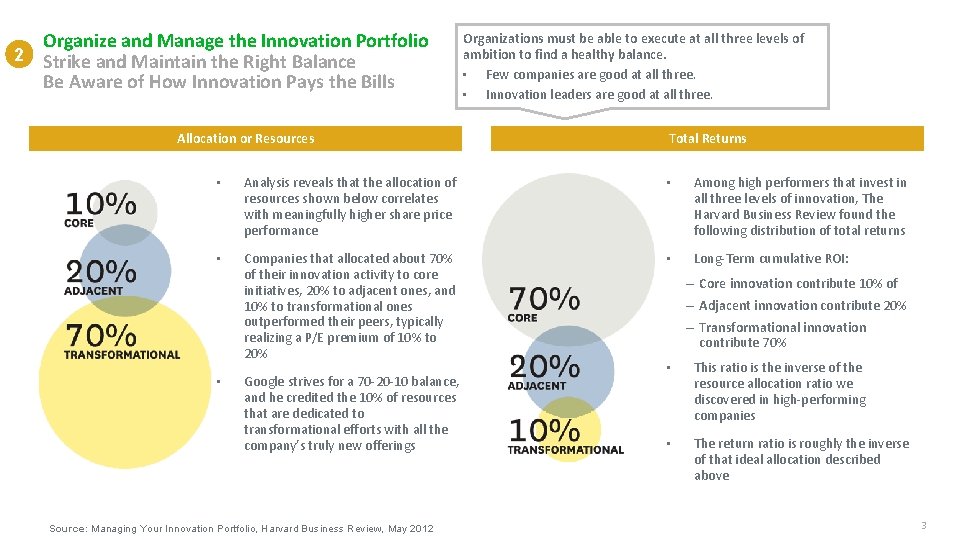
Organize and Manage the Innovation Portfolio 2 Strike and Maintain the Right Balance Be Aware of How Innovation Pays the Bills Allocation or Resources Organizations must be able to execute at all three levels of ambition to find a healthy balance. • Few companies are good at all three. • Innovation leaders are good at all three. Total Returns • Analysis reveals that the allocation of resources shown below correlates with meaningfully higher share price performance • Among high performers that invest in all three levels of innovation, The Harvard Business Review found the following distribution of total returns • Companies that allocated about 70% of their innovation activity to core initiatives, 20% to adjacent ones, and 10% to transformational ones outperformed their peers, typically realizing a P/E premium of 10% to 20% • Long-Term cumulative ROI: • Google strives for a 70 -20 -10 balance, and he credited the 10% of resources that are dedicated to transformational efforts with all the company’s truly new offerings Source: Managing Your Innovation Portfolio, Harvard Business Review, May 2012 – Core innovation contribute 10% of – Adjacent innovation contribute 20% – Transformational innovation contribute 70% • This ratio is the inverse of the resource allocation ratio we discovered in high-performing companies • The return ratio is roughly the inverse of that ideal allocation described above 3
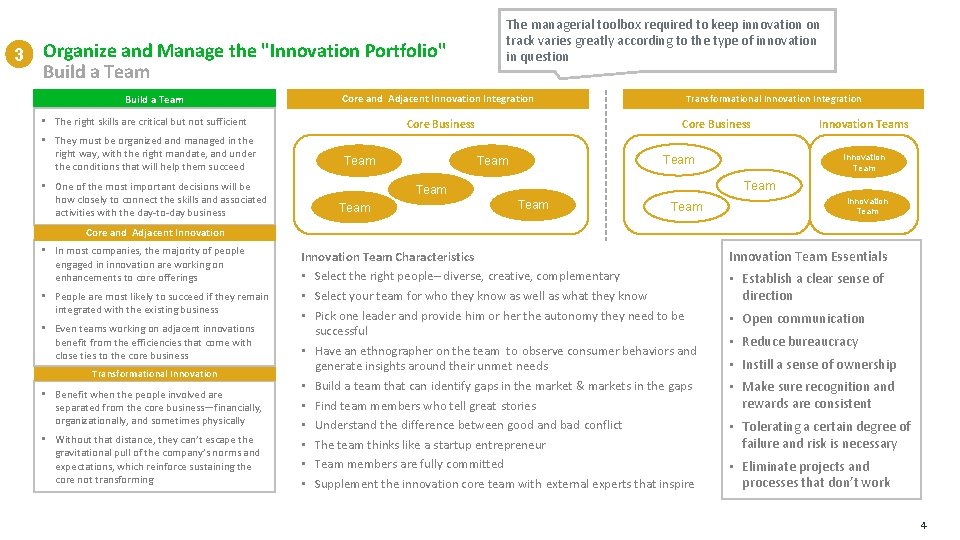
3 Organize and Manage the "Innovation Portfolio'' Build a Team Core and Adjacent Innovation Integration • The right skills are critical but not sufficient • They must be organized and managed in the right way, with the right mandate, and under the conditions that will help them succeed • One of the most important decisions will be how closely to connect the skills and associated activities with the day-to-day business The managerial toolbox required to keep innovation on track varies greatly according to the type of innovation in question Core Business Team Innovation Teams Innovation Team Transformational Innovation Integration Team Innovation Team Core and Adjacent Innovation • In most companies, the majority of people engaged in innovation are working on enhancements to core offerings • People are most likely to succeed if they remain integrated with the existing business • Even teams working on adjacent innovations benefit from the efficiencies that come with close ties to the core business Transformational Innovation • Benefit when the people involved are separated from the core business—financially, organizationally, and sometimes physically • Without that distance, they can’t escape the gravitational pull of the company’s norms and expectations, which reinforce sustaining the core not transforming Innovation Team Characteristics Innovation Team Essentials • Select the right people– diverse, creative, complementary • Select your team for who they know as well as what they know • Pick one leader and provide him or her the autonomy they need to be successful • Have an ethnographer on the team to observe consumer behaviors and generate insights around their unmet needs • Build a team that can identify gaps in the market & markets in the gaps • Find team members who tell great stories • Understand the difference between good and bad conflict • The team thinks like a startup entrepreneur • Team members are fully committed • Supplement the innovation core team with external experts that inspire • Establish a clear sense of direction • Open communication • Reduce bureaucracy • Instill a sense of ownership • Make sure recognition and rewards are consistent • Tolerating a certain degree of failure and risk is necessary • Eliminate projects and processes that don’t work 4
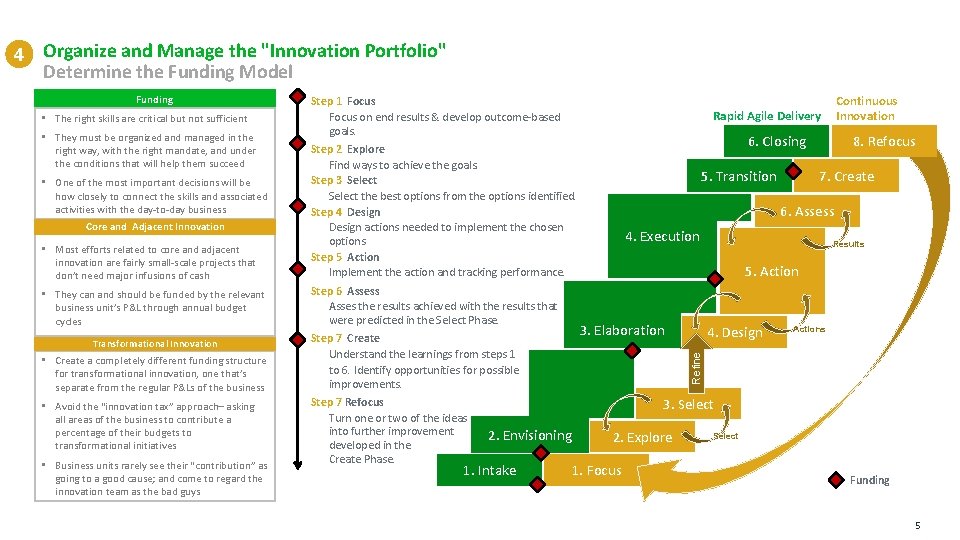
Organize and Manage the "Innovation Portfolio'' Determine the Funding Model Funding • The right skills are critical but not sufficient • They must be organized and managed in the right way, with the right mandate, and under the conditions that will help them succeed Step 1 Focus on end results & develop outcome-based goals. Rapid Agile Delivery • Most efforts related to core and adjacent innovation are fairly small-scale projects that don’t need major infusions of cash Step 2 Explore Find ways to achieve the goals. Step 3 Select the best options from the options identified. Step 4 Design actions needed to implement the chosen options Step 5 Action Implement the action and tracking performance. • They can and should be funded by the relevant business unit’s P&L through annual budget cycles Step 6 Assess Asses the results achieved with the results that were predicted in the Select Phase. • One of the most important decisions will be how closely to connect the skills and associated activities with the day-to-day business Core and Adjacent Innovation Transformational Innovation • Create a completely different funding structure for transformational innovation, one that’s separate from the regular P&Ls of the business • Avoid the “innovation tax” approach– asking all areas of the business to contribute a percentage of their budgets to transformational initiatives • Business units rarely see their “contribution” as going to a good cause; and come to regard the innovation team as the bad guys Step 7 Create Understand the learnings from steps 1 to 6. Identify opportunities for possible improvements. Step 7 Refocus Turn one or two of the ideas into further improvement developed in the Create Phase. Continuous Innovation 6. Closing 5. Transition 8. Refocus 7. Create 6. Assess 4. Execution Results 5. Action 3. Elaboration 4. Design Actions Refine 4 3. Select 2. Envisioning 1. Intake 2. Explore 1. Focus Select Funding 5
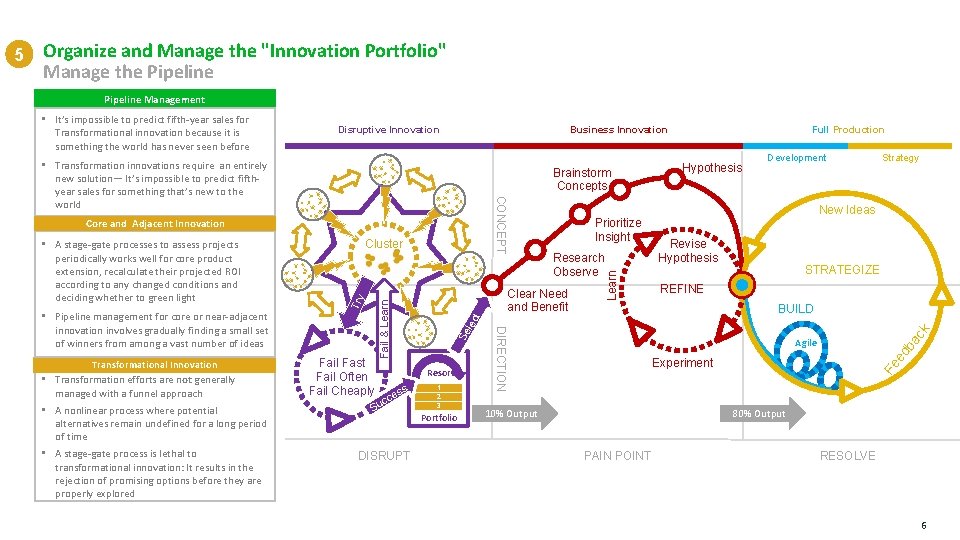
Organize and Manage the "Innovation Portfolio'' Manage the Pipeline Management Business Innovation Brainstorm Concepts Transformational Innovation • Transformation efforts are not generally managed with a funnel approach • A nonlinear process where potential alternatives remain undefined for a long period of time • A stage-gate process is lethal to transformational innovation: It results in the rejection of promising options before they are properly explored Fail Fast Fail Often Fail Cheaply Su Research Observe Clear Need and Benefit New Ideas Revise Hypothesis REFINE t lec Se Resort ss e cc DISRUPT 1 2 3 Portfolio Strategy STRATEGIZE c BUILD DIRECTION • Pipeline management for core or near-adjacent innovation involves gradually finding a small set of winners from among a vast number of ideas Cluster Fail & Learn • A stage-gate processes to assess projects periodically works well for core product extension, recalculate their projected ROI according to any changed conditions and deciding whether to green light Prioritize Insight Development ck CONCEPT Core and Adjacent Innovation Hypothesis Agile ed ba • Transformation innovations require an entirely new solution— It’s impossible to predict fifthyear sales for something that’s new to the world Full Production Experiment 10% Output Fe Disruptive Innovation Learn • It’s impossible to predict fifth-year sales for Transformational innovation because it is something the world has never seen before Try 5 80% Output PAIN POINT RESOLVE 6
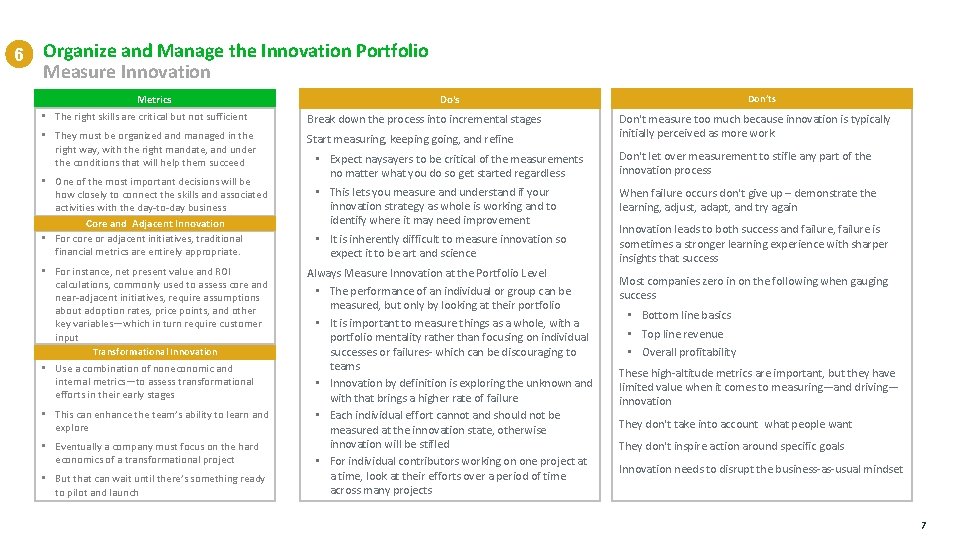
6 Organize and Manage the Innovation Portfolio Measure Innovation Metrics Do's • The right skills are critical but not sufficient Break down the process into incremental stages • They must be organized and managed in the right way, with the right mandate, and under the conditions that will help them succeed Start measuring, keeping going, and refine • One of the most important decisions will be how closely to connect the skills and associated activities with the day-to-day business Core and Adjacent Innovation • For core or adjacent initiatives, traditional financial metrics are entirely appropriate. • For instance, net present value and ROI calculations, commonly used to assess core and near-adjacent initiatives, require assumptions about adoption rates, price points, and other key variables—which in turn require customer input Transformational Innovation • Use a combination of noneconomic and internal metrics—to assess transformational efforts in their early stages • This can enhance the team’s ability to learn and explore • Eventually a company must focus on the hard economics of a transformational project • But that can wait until there’s something ready to pilot and launch • Expect naysayers to be critical of the measurements no matter what you do so get started regardless • This lets you measure and understand if your innovation strategy as whole is working and to identify where it may need improvement • It is inherently difficult to measure innovation so expect it to be art and science Always Measure Innovation at the Portfolio Level • The performance of an individual or group can be measured, but only by looking at their portfolio • It is important to measure things as a whole, with a portfolio mentality rather than focusing on individual successes or failures- which can be discouraging to teams • Innovation by definition is exploring the unknown and with that brings a higher rate of failure • Each individual effort cannot and should not be measured at the innovation state, otherwise innovation will be stifled • For individual contributors working on one project at a time, look at their efforts over a period of time across many projects Don’ts Don't measure too much because innovation is typically initially perceived as more work Don't let over measurement to stifle any part of the innovation process When failure occurs don't give up – demonstrate the learning, adjust, adapt, and try again Innovation leads to both success and failure, failure is sometimes a stronger learning experience with sharper insights that success Most companies zero in on the following when gauging success • Bottom line basics • Top line revenue • Overall profitability These high-altitude metrics are important, but they have limited value when it comes to measuring—and driving— innovation They don't take into account what people want They don't inspire action around specific goals Innovation needs to disrupt the business-as-usual mindset 7
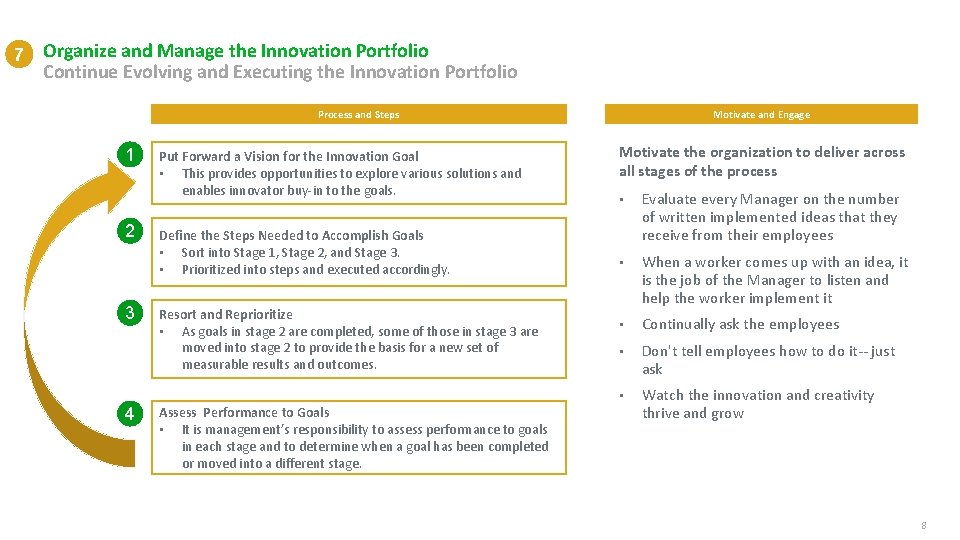
7 Organize and Manage the Innovation Portfolio Continue Evolving and Executing the Innovation Portfolio Motivate and Engage Process and Steps 1 2 3 4 Put Forward a Vision for the Innovation Goal • This provides opportunities to explore various solutions and enables innovator buy-in to the goals. Define the Steps Needed to Accomplish Goals • Sort into Stage 1, Stage 2, and Stage 3. • Prioritized into steps and executed accordingly. Resort and Reprioritize • As goals in stage 2 are completed, some of those in stage 3 are moved into stage 2 to provide the basis for a new set of measurable results and outcomes. Assess Performance to Goals • It is management’s responsibility to assess performance to goals in each stage and to determine when a goal has been completed or moved into a different stage. Motivate the organization to deliver across all stages of the process • Evaluate every Manager on the number of written implemented ideas that they receive from their employees • When a worker comes up with an idea, it is the job of the Manager to listen and help the worker implement it • Continually ask the employees • Don't tell employees how to do it-- just ask • Watch the innovation and creativity thrive and grow 8
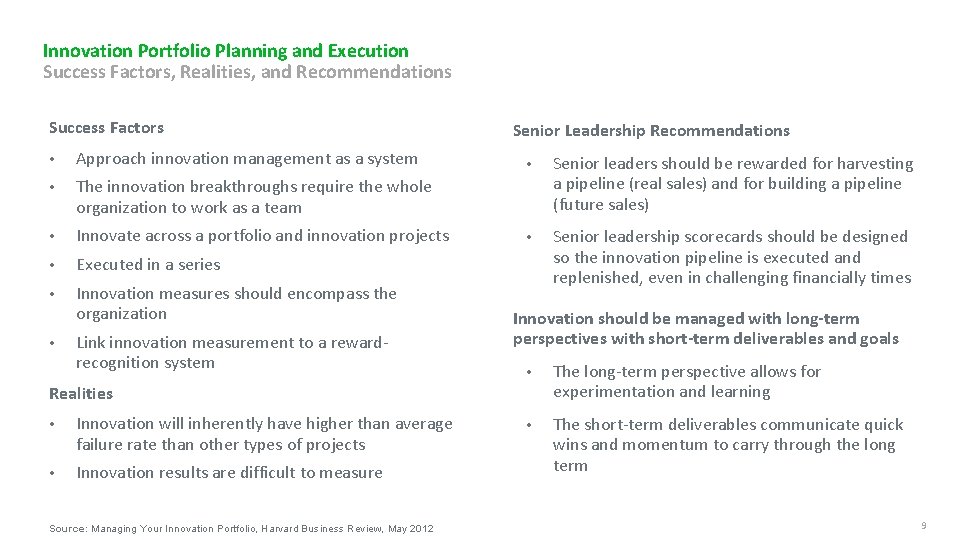
Innovation Portfolio Planning and Execution Success Factors, Realities, and Recommendations Success Factors • Approach innovation management as a system • The innovation breakthroughs require the whole organization to work as a team • Innovate across a portfolio and innovation projects • Executed in a series • Innovation measures should encompass the organization • Link innovation measurement to a rewardrecognition system Senior Leadership Recommendations • Senior leaders should be rewarded for harvesting a pipeline (real sales) and for building a pipeline (future sales) • Senior leadership scorecards should be designed so the innovation pipeline is executed and replenished, even in challenging financially times Innovation should be managed with long-term perspectives with short-term deliverables and goals • The long-term perspective allows for experimentation and learning • The short-term deliverables communicate quick wins and momentum to carry through the long term Realities • Innovation will inherently have higher than average failure rate than other types of projects • Innovation results are difficult to measure Source: Managing Your Innovation Portfolio, Harvard Business Review, May 2012 9
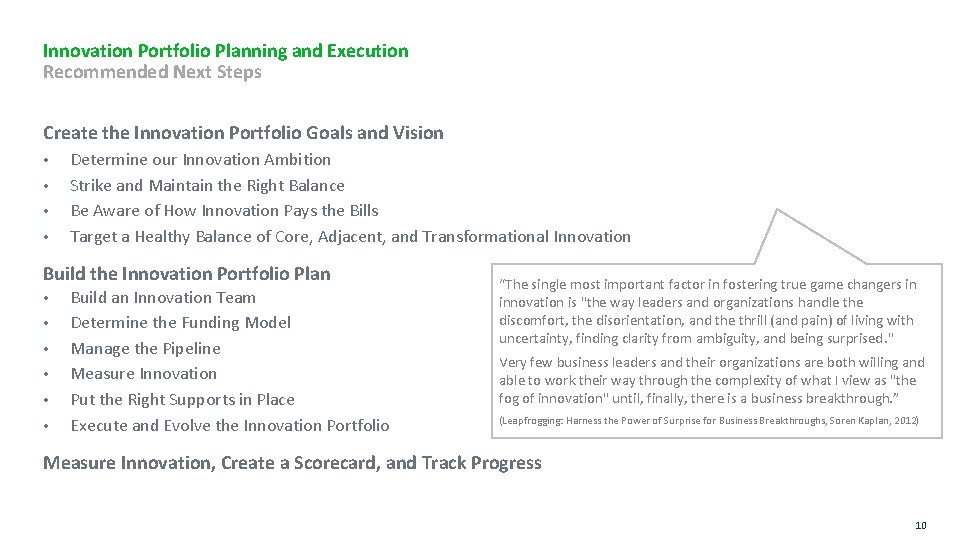
Innovation Portfolio Planning and Execution Recommended Next Steps Create the Innovation Portfolio Goals and Vision • • Determine our Innovation Ambition Strike and Maintain the Right Balance Be Aware of How Innovation Pays the Bills Target a Healthy Balance of Core, Adjacent, and Transformational Innovation Build the Innovation Portfolio Plan • • • Build an Innovation Team Determine the Funding Model Manage the Pipeline Measure Innovation Put the Right Supports in Place Execute and Evolve the Innovation Portfolio “The single most important factor in fostering true game changers in innovation is "the way leaders and organizations handle the discomfort, the disorientation, and the thrill (and pain) of living with uncertainty, finding clarity from ambiguity, and being surprised. " Very few business leaders and their organizations are both willing and able to work their way through the complexity of what I view as "the fog of innovation" until, finally, there is a business breakthrough. ” (Leapfrogging: Harness the Power of Surprise for Business Breakthroughs, Soren Kaplan, 2012) Measure Innovation, Create a Scorecard, and Track Progress 10