
Innovation Partnership Procurement by CoDesign Toolkit Challenge Canvas
Innovation Partnership: Procurement by Co-Design Toolkit Challenge Canvas Exercise
Goals: ● Articulate key assumptions about a challenge in healthcare • Embrace a end-user perspective • Think about the design and experience around the solution. • Think about outcomes and impact on the system if successful at meeting the challenge vs. status quo. IPPCD Toolkit: Challenge Canvas Exercise Ma. RS | 2
Instructions: Work as a team to complete the canvas 1. Under "Challenge Statement" write a succinct statement about a healthcare challenge. 2. Beside your Challenge Statement, write down a few ideas you might have to solve the challenge. 3. Describe three stakeholders you want to impact and how solving the challenge would affect their day to day. 4. Under "Outcomes, " write down short and long term outcomes you would measure to know that you were successful at solving the challenge. 5. Under "System Impact" write down a few thoughts about the effect on the healthcare system if the challenge is not addressed; as well as implications if you are wildly successful at solving the challenge. 6. Take a moment to reflect on the impact. Are there any foreseen unintended consequences caused by your approach? If so what would you change? IPPCD Toolkit: Challenge Canvas Exercise Ma. RS | 3

Challenge Statement: Idea(s) for addressing the challenge: Outcomes we would measure our success by: short long Stakeholders How solving the challenge will impact their day to day System Impact: If wildly successful at solving the challenge: If nothing changes and the challenge still persists: IPPCD Toolkit: Challenge Canvas Exercise Ma. RS | 4
Introduction: A good challenge question for complex, wicked systems • A how-can-we question – How can we boost the resilience of Ontario’s tender fruit sector in a way that balances business competitiveness, environmental and social good? – How can we redesign policies and regulations for sharing economy businesses to maximize public value? • Provides context, importance, urgency • Points to complexity, barriers and also opportunity and hope • Indicates how you will know when interventions and solutions work: early signs and signals, evidence, metrics: indicators and measures • Remember it’s iterative – start anywhere and go from there IPPCD Toolkit: Challenge Canvas Exercise Ma. RS | 5

1. How can we: improve _, do _, decide _ 2. So that… who can be _, become _ ? Structure of a challenge question 3. We have tried _, made progress but got stuck, don’t know how to decide, don’t know where to start 4. What make matters more complicated, complex … 5. This matters to constituencies, stakeholders because _ 6. We will know we are making progress by early signs, evidence, metrics IPPCD Toolkit: Challenge Canvas Exercise Ma. RS | 6
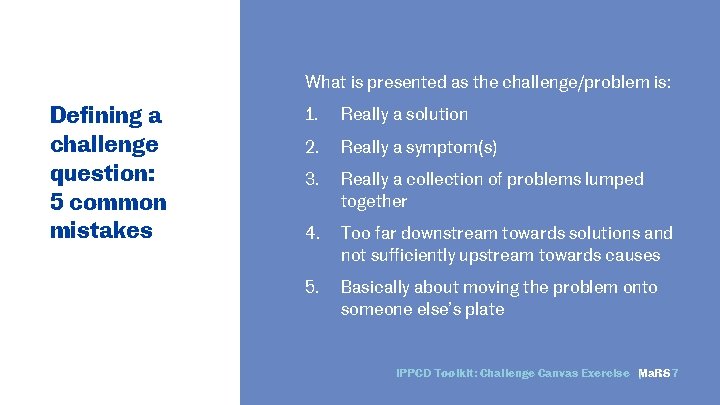
What is presented as the challenge/problem is: Defining a challenge question: 5 common mistakes 1. Really a solution 2. Really a symptom(s) 3. Really a collection of problems lumped together 4. Too far downstream towards solutions and not sufficiently upstream towards causes 5. Basically about moving the problem onto someone else’s plate IPPCD Toolkit: Challenge Canvas Exercise Ma. RS | 7

- Slides: 8