
Innovation Management Planning 10 Steps to Success Kevin
- Slides: 14
Innovation Management Planning 10 Steps to Success Kevin William Grant kevin@kgrant. info http: //professional-innovation-coach. com
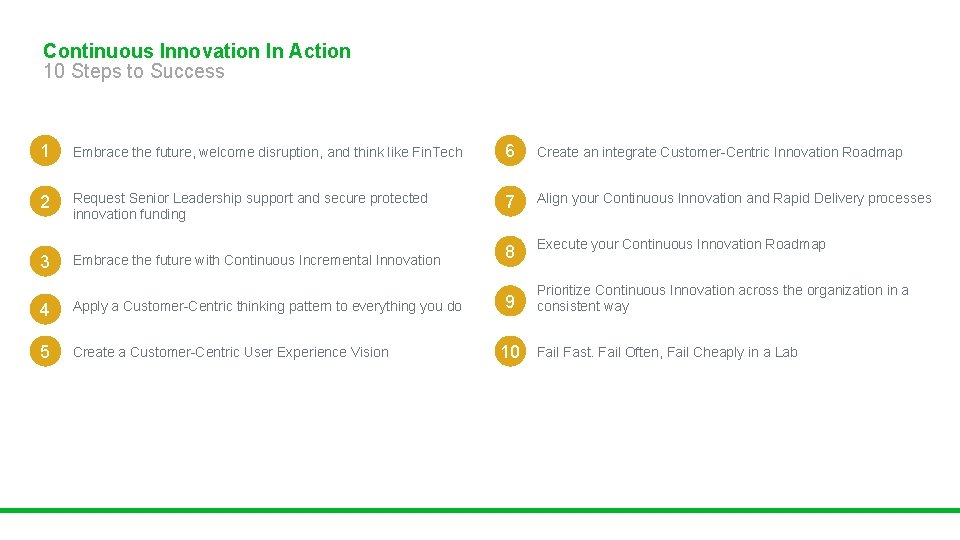
Continuous Innovation In Action 10 Steps to Success 1 Embrace the future, welcome disruption, and think like Fin. Tech 6 Create an integrate Customer-Centric Innovation Roadmap 2 Request Senior Leadership support and secure protected innovation funding 7 Align your Continuous Innovation and Rapid Delivery processes Execute your Continuous Innovation Roadmap Embrace the future with Continuous Incremental Innovation 8 4 Apply a Customer-Centric thinking pattern to everything you do 9 5 Create a Customer-Centric User Experience Vision 3 10 Prioritize Continuous Innovation across the organization in a consistent way Fail Fast. Fail Often, Fail Cheaply in a Lab
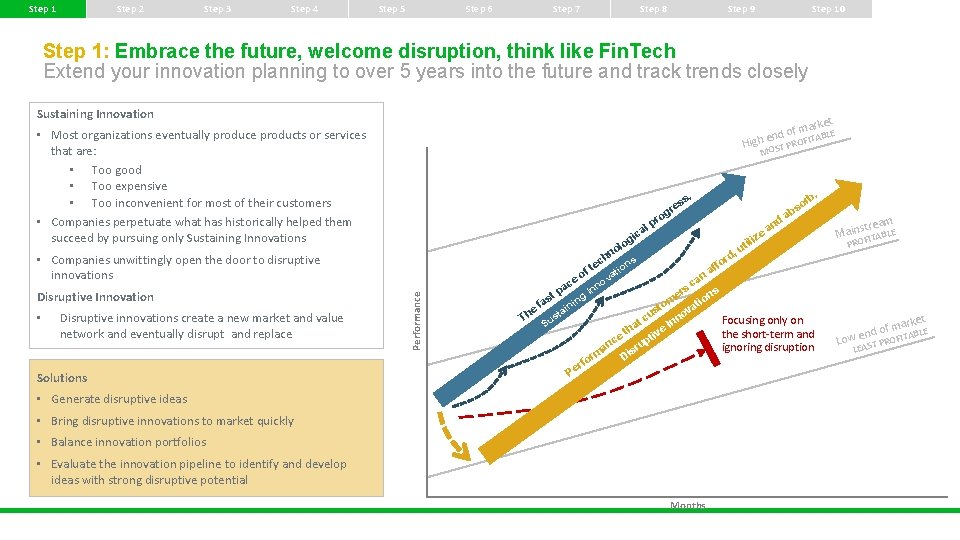
Step 1 Step 2 Step 3 Step 4 Step 5 Step 6 Step 7 Step 8 Step 9 Step 10 Step 1: Embrace the future, welcome disruption, think like Fin. Tech Extend your innovation planning to over 5 years into the future and track trends closely Sustaining Innovation et mark LE f o d B FITA h en • Most organizations eventually produce products or services Hig OST PRO M that are: • Too good • Too expensive • Too inconvenient for most of their customers . ss re • Companies perpetuate what has historically helped them succeed by pursuing only Sustaining Innovations • Companies unwittingly open the door to disruptive Disruptive Innovation • Disruptive innovations create a new market and value network and eventually disrupt and replace Solutions Performance innovations og d pr l an e ca i iz g til lo u o , hn rd ec ions fo t f at an e o nov c c a s n er t p ng I ns s o m i i a t to a e f tain ov us s c Th n u Focusing only on t n S ha ive I t the short-term and ce pt ignoring disruption an isru m r D rfo Pe • Generate disruptive ideas • Bring disruptive innovations to market quickly • Balance innovation portfolios • Evaluate the innovation pipeline to identify and develop ideas with strong disruptive potential Months . rb so ab m strea Main FITABLE PRO arket m f o E end TABL Low AST PROFI LE
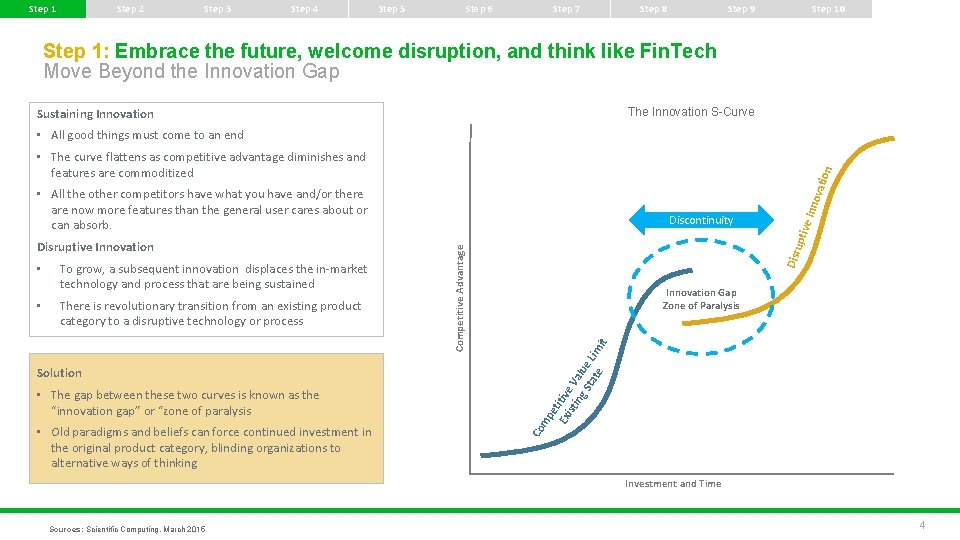
Step 1 Step 2 Step 3 Step 4 Step 5 Step 6 Step 7 Step 8 Step 9 Step 10 Step 1: Embrace the future, welcome disruption, and think like Fin. Tech Move Beyond the Innovation Gap The Innovation S-Curve Sustaining Innovation • All good things must come to an end • The curve flattens as competitive advantage diminishes and tion features are commoditized Solution • The gap between these two curves is known as the “innovation gap” or “zone of paralysis • Old paradigms and beliefs can force continued investment in Disr it et Ex itive ist ing Val Sta ue L te im There is revolutionary transition from an existing product category to a disruptive technology or process Innovation Gap Zone of Paralysis mp • To grow, a subsequent innovation displaces the in-market technology and process that are being sustained Co • Competitive Advantage Disruptive Innovation Discontinuity upti v are now more features than the general user cares about or can absorb. e In nov a • All the other competitors have what you have and/or there the original product category, blinding organizations to alternative ways of thinking Investment and Time Sources: Scientific Computing, March 2015 4
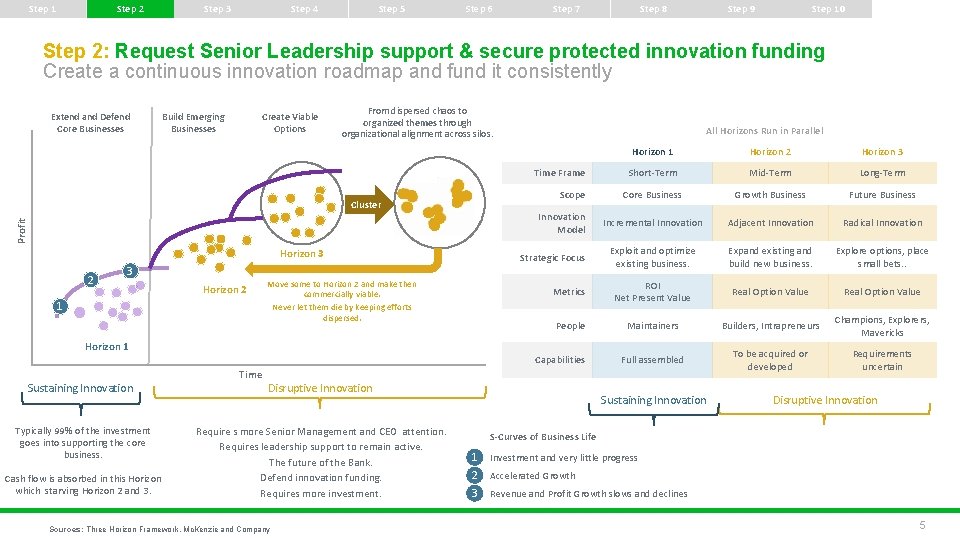
Step 1 Step 2 Step 3 Step 4 Step 5 Step 6 Step 7 Step 8 Step 9 Step 10 Step 2: Request Senior Leadership support & secure protected innovation funding Create a continuous innovation roadmap and fund it consistently Extend and Defend Core Businesses Build Emerging Businesses Create Viable Options From dispersed chaos to organized themes through organizational alignment across silos. All Horizons Run in Parallel Horizon 1 Horizon 2 Horizon 3 Short-Term Mid-Term Long-Term Core Business Growth Business Future Business Incremental Innovation Adjacent Innovation Radical Innovation Exploit and optimize existing business. Expand existing and build new business. Explore options, place small bets. . Metrics ROI Net Present Value Real Option Value People Maintainers Builders, Intrapreneurs Champions, Explorers, Mavericks Full assembled To be acquired or developed Requirements uncertain Time Frame Scope Cluster Profit Innovation Model Horizon 3 2 Strategic Focus 3 Horizon 2 1 Move some to Horizon 2 and make then commercially viable. Never let them die by keeping efforts dispersed. Horizon 1 Capabilities Sustaining Innovation Typically 99% of the investment goes into supporting the core business. Cash flow is absorbed in this Horizon which starving Horizon 2 and 3. Time Disruptive Innovation Require s more Senior Management and CEO attention. Requires leadership support to remain active. The future of the Bank. Defend innovation funding. Requires more investment. Sources: Three Horizon Framework, Mc. Kenzie and Company Sustaining Innovation Disruptive Innovation S-Curves of Business Life 1 2 3 Investment and very little progress Accelerated Growth Revenue and Profit Growth slows and declines 5
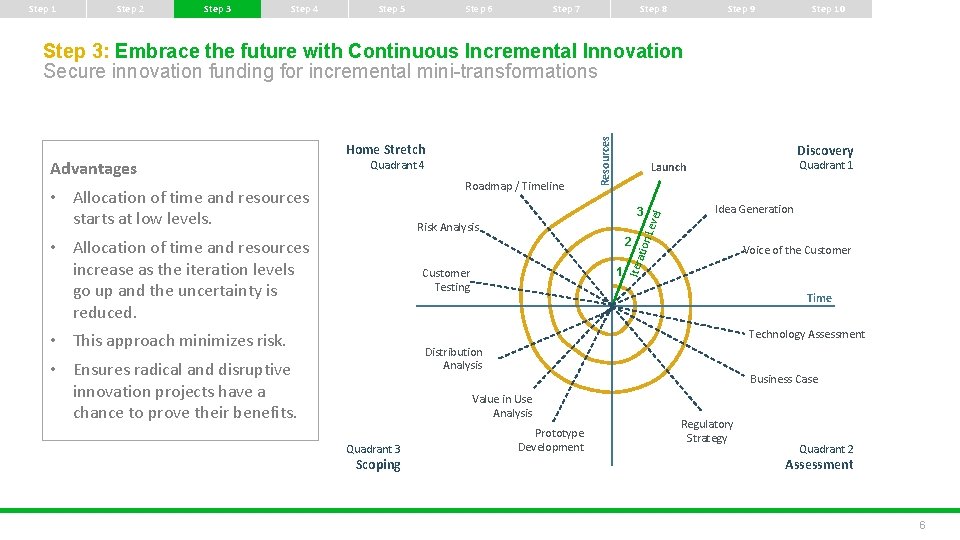
Step 1 Step 2 Step 3 Step 4 Step 5 Step 6 Step 7 Step 8 Step 9 Step 10 Quadrant 4 Roadmap / Timeline • Allocation of time and resources starts at low levels. Discovery 2 1 Customer Testing Idea Generation Risk Analysis Leve l 3 • Allocation of time and resources increase as the iteration levels go up and the uncertainty is reduced. Quadrant 1 Launch Voice of the Customer Itera Advantages Home Stretch Resources Step 3: Embrace the future with Continuous Incremental Innovation Secure innovation funding for incremental mini-transformations Time Technology Assessment • This approach minimizes risk. Distribution Analysis • Ensures radical and disruptive innovation projects have a chance to prove their benefits. Business Case Value in Use Analysis Quadrant 3 Scoping Prototype Development Regulatory Strategy Quadrant 2 Assessment 6
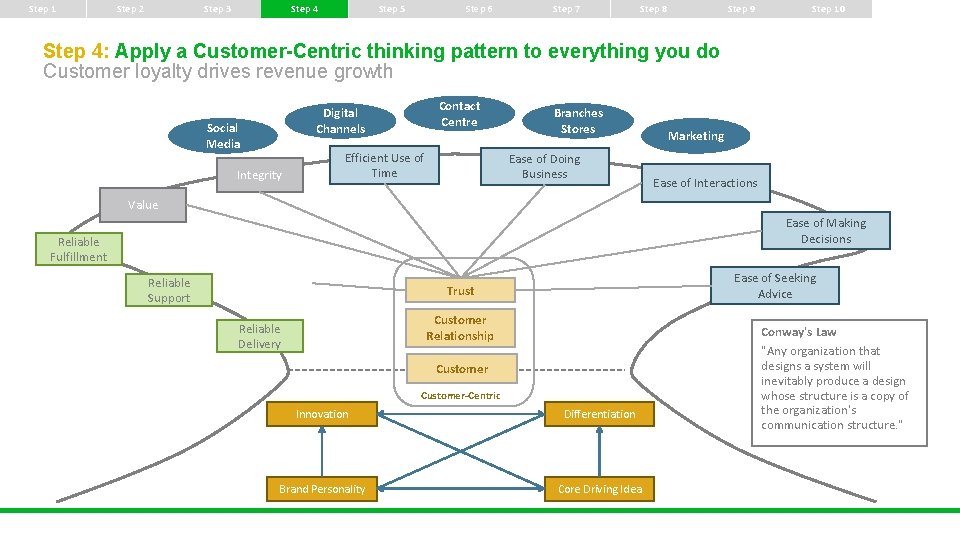
Step 1 Step 2 Step 3 Step 4 Step 5 Step 6 Step 7 Step 8 Step 9 Step 10 Step 4: Apply a Customer-Centric thinking pattern to everything you do Customer loyalty drives revenue growth Contact Centre Digital Channels Social Media Integrity Efficient Use of Time Branches Stores Ease of Doing Business Marketing Ease of Interactions Value Ease of Making Decisions Reliable Fulfillment Reliable Support Ease of Seeking Advice Trust Customer Relationship Reliable Delivery Customer-Centric Innovation Differentiation Brand Personality Core Driving Idea Conway's Law "Any organization that designs a system will inevitably produce a design whose structure is a copy of the organization's communication structure. "
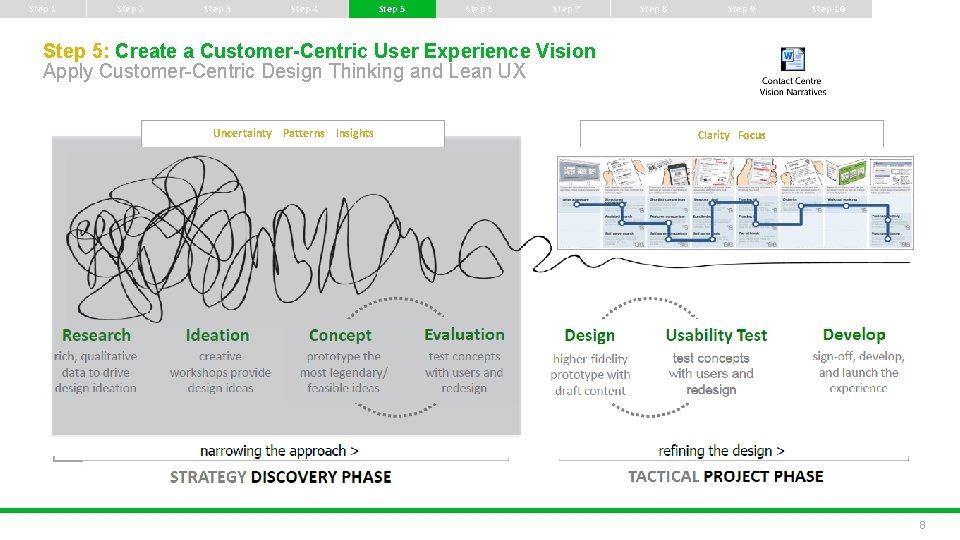
Step 1 Step 2 Step 3 Step 4 Step 5 Step 6 Step 7 Step 8 Step 9 Step 10 Step 5: Create a Customer-Centric User Experience Vision Apply Customer-Centric Design Thinking and Lean UX Uncertainty Patterns Insights Clarity Focus 8
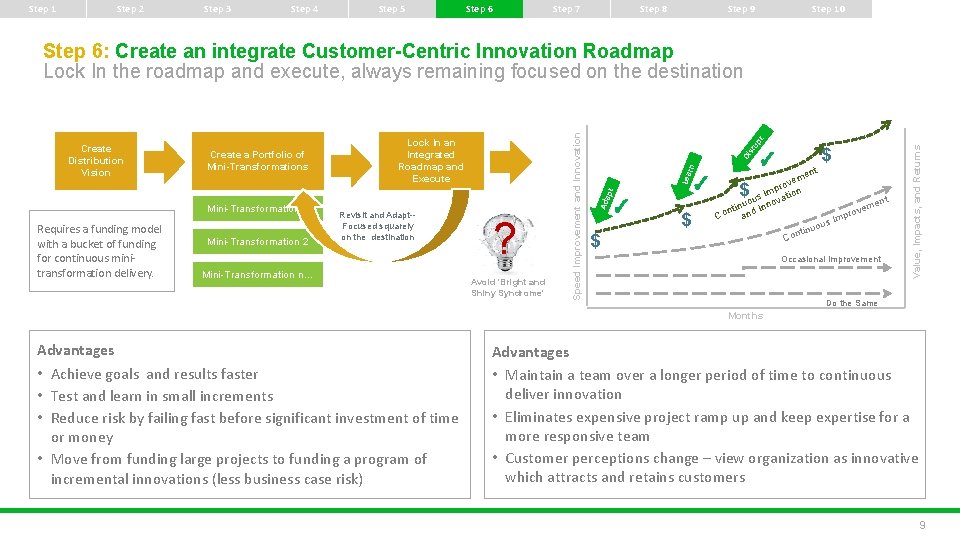
Step 1 Step 2 Step 3 Step 4 Step 5 Step 6 Step 7 Step 8 Step 9 Step 10 Requires a funding model with a bucket of funding for continuous minitransformation delivery. Mini-Transformation 2 Revisit and Adapt-Focused squarely on the destination Mini-Transformation n… ? Avoid 'Bright and Shiny Syndrome' pt sru Di rn Lea ✓ ✓ $ $ ✓ ent vem $ us Impvraotion uo Inno ntin Co and ous inu ont $ ve pro nt me Im C Occasional Improvement Value, Impacts, and Returns Mini-Transformation 1 Lock In an Integrated Roadmap and Execute pt Create a Portfolio of Mini-Transformations Ada Create Distribution Vision Speed Improvement and Innovation Step 6: Create an integrate Customer-Centric Innovation Roadmap Lock In the roadmap and execute, always remaining focused on the destination Do the Same Months Advantages • Achieve goals and results faster • Test and learn in small increments • Reduce risk by failing fast before significant investment of time or money • Move from funding large projects to funding a program of incremental innovations (less business case risk) Advantages • Maintain a team over a longer period of time to continuous deliver innovation • Eliminates expensive project ramp up and keep expertise for a more responsive team • Customer perceptions change – view organization as innovative which attracts and retains customers 9
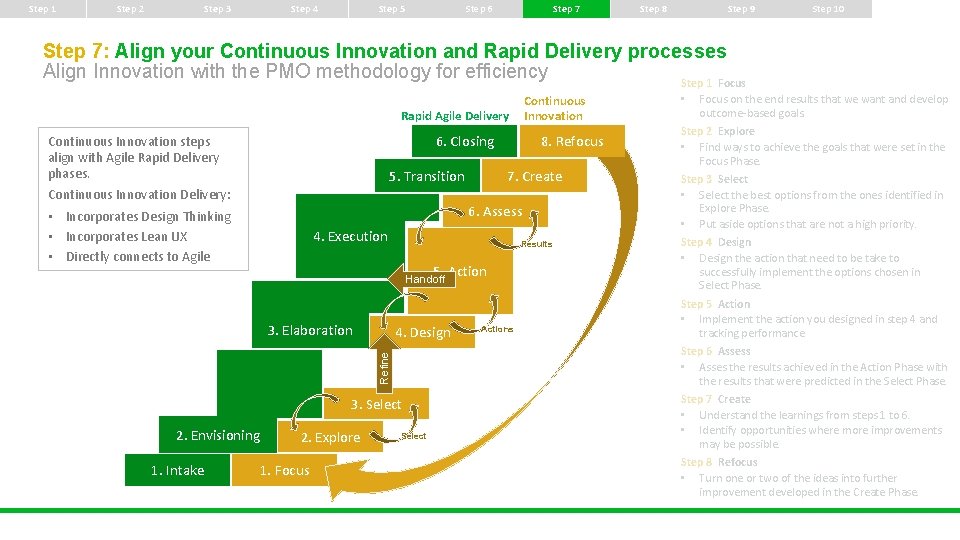
Step 1 Step 2 Step 3 Step 4 Step 5 Step 6 Step 7 Step 8 Step 9 Step 10 Step 7: Align your Continuous Innovation and Rapid Delivery processes Align Innovation with the PMO methodology for efficiency Step 1 Focus Continuous Innovation Rapid Agile Delivery 6. Closing Continuous Innovation steps align with Agile Rapid Delivery phases. 5. Transition Continuous Innovation Delivery: 8. Refocus 7. Create 6. Assess • Incorporates Design Thinking • Incorporates Lean UX • Directly connects to Agile 4. Execution Results 5. Action Handoff 3. Elaboration 4. Design Refine 1. Intake 2. Explore 1. Focus on the end results that we want and develop outcome-based goals. Step 2 Explore • Find ways to achieve the goals that were set in the Focus Phase. Step 3 Select • Select the best options from the ones identified in Explore Phase. • Put aside options that are not a high priority. Step 4 Design • Design the action that need to be take to successfully implement the options chosen in Select Phase. Step 5 Action • Implement the action you designed in step 4 and tracking performance. Step 6 Assess • Asses the results achieved in the Action Phase with the results that were predicted in the Select Phase. 3. Select 2. Envisioning Actions • Select Step 7 Create • Understand the learnings from steps 1 to 6. • Identify opportunities where more improvements may be possible. Step 8 Refocus • Turn one or two of the ideas into further improvement developed in the Create Phase.
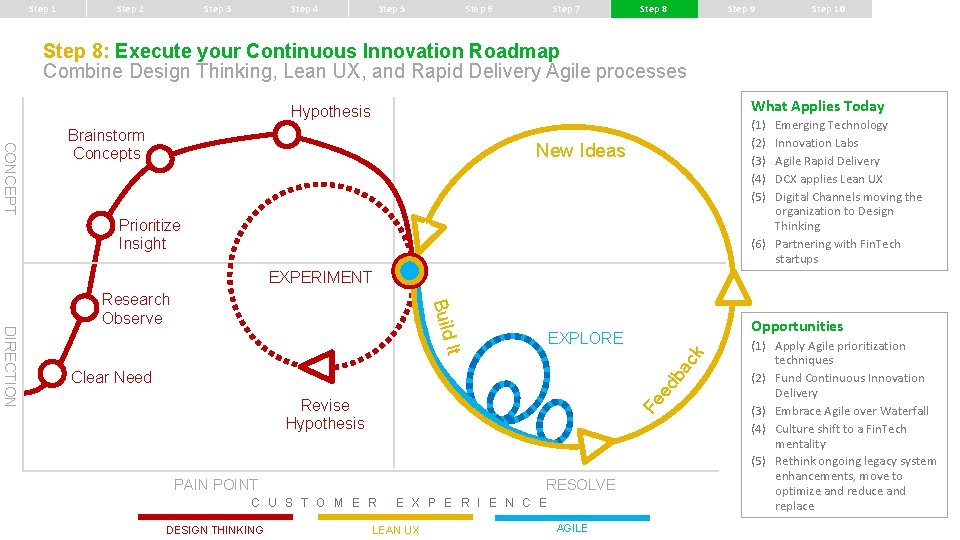
Step 1 Step 2 Step 3 Step 4 Step 5 Step 6 Step 7 Step 8 Step 9 Step 10 Step 8: Execute your Continuous Innovation Roadmap Combine Design Thinking, Lean UX, and Rapid Delivery Agile processes What Applies Today Hypothesis (1) (2) (3) (4) (5) Emerging Technology Innovation Labs Agile Rapid Delivery DCX applies Lean UX Digital Channels moving the organization to Design Thinking (6) Partnering with Fin. Tech startups New Ideas Prioritize Insight d c EXPERIMENT Build Opportunities EXPLORE It ba ed Clear Need Revise Hypothesis Fe DIRECTION Research Observe ck CONCEPT Brainstorm Concepts PAIN POINT RESOLVE C U S T O M E R DESIGN THINKING E X P E R I E N C E LEAN UX AGILE (1) Apply Agile prioritization techniques (2) Fund Continuous Innovation Delivery (3) Embrace Agile over Waterfall (4) Culture shift to a Fin. Tech mentality (5) Rethink ongoing legacy system enhancements, move to optimize and reduce and replace
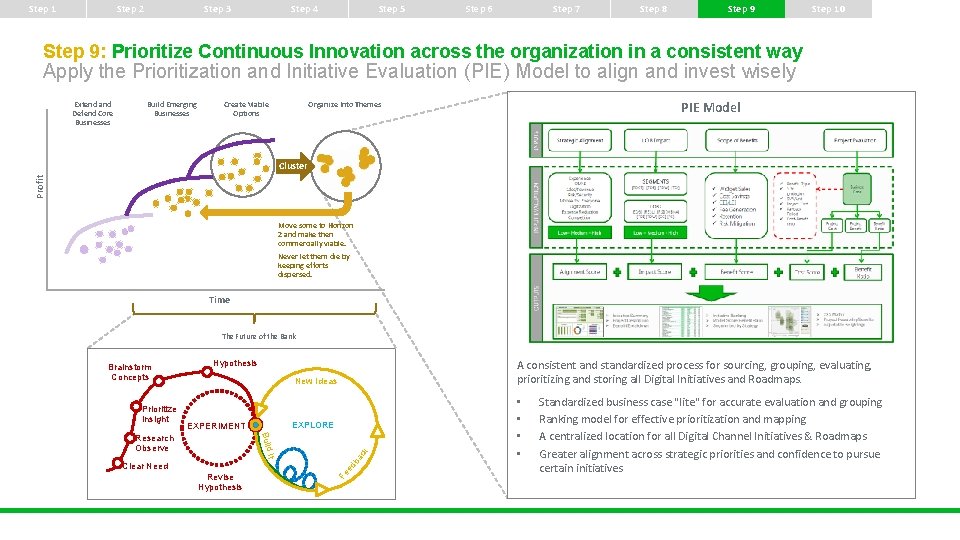
Step 1 Step 2 Step 3 Step 4 Step 5 Step 6 Step 7 Step 8 Step 9 Step 10 Step 9: Prioritize Continuous Innovation across the organization in a consistent way Apply the Prioritization and Initiative Evaluation (PIE) Model to align and invest wisely Extend and Defend Core Businesses Build Emerging Businesses Create Viable Options PIE Model Organize Into Themes Profit Cluster Move some to Horizon 2 and make then commercially viable. Never let them die by keeping efforts dispersed. PIE Process Diagram Goes Here Time The Future of the Bank Prioritize Insight Hypothesis New Ideas EXPLORE EXPERIMENT Build Research Observe It Clear Need Revise Hypothesis Fe ed ba ck Brainstorm Concepts A consistent and standardized process for sourcing, grouping, evaluating, prioritizing and storing all Digital Initiatives and Roadmaps. • • Standardized business case "lite" for accurate evaluation and grouping Ranking model for effective prioritization and mapping A centralized location for all Digital Channel Initiatives & Roadmaps Greater alignment across strategic priorities and confidence to pursue certain initiatives
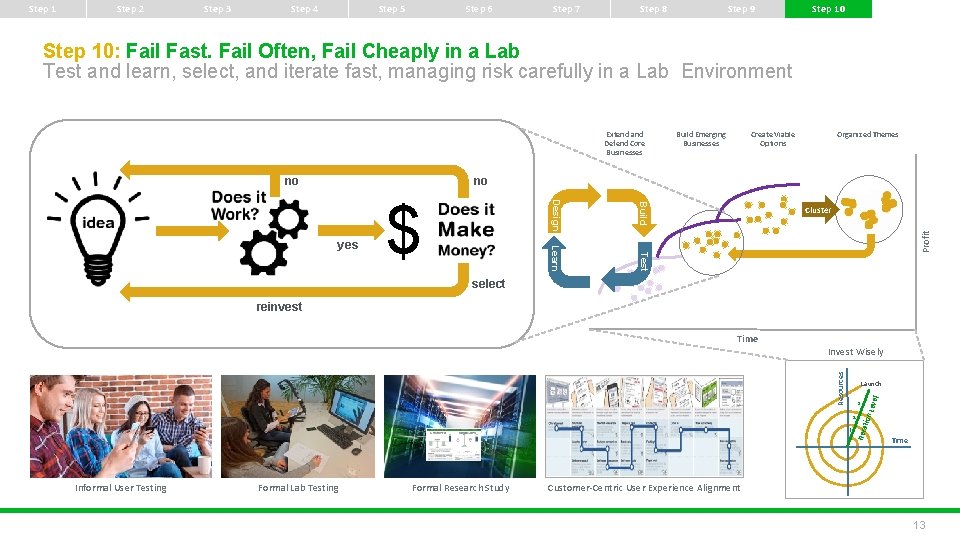
Step 1 Step 2 Step 3 Step 4 Step 5 Step 6 Step 7 Step 8 Step 9 Step 10: Fail Fast. Fail Often, Fail Cheaply in a Lab Test and learn, select, and iterate fast, managing risk carefully in a Lab Environment Extend and Defend Core Businesses Create Viable Options Organized Themes no Build Learn Test $ Design yes Cluster Profit no Build Emerging Businesses select reinvest Time Resources Invest Wisely Informal User Testing Formal Lab Testing Formal Research Study Itera 1 tion 3 2 Leve l Launch Time Customer-Centric User Experience Alignment 13
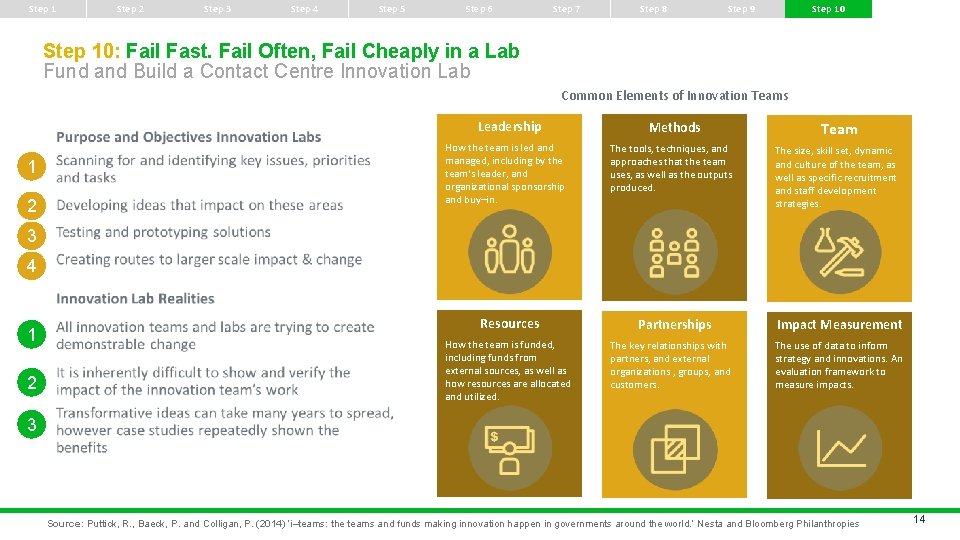
Step 1 Step 2 Step 3 Step 4 Step 5 Step 6 Step 7 Step 8 Step 9 Step 10: Fail Fast. Fail Often, Fail Cheaply in a Lab Fund and Build a Contact Centre Innovation Lab Common Elements of Innovation Teams Leadership 1 2 How the team is led and managed, including by the team's leader, and organizational sponsorship and buy–in. Methods The tools, techniques, and approaches that the team uses, as well as the outputs produced. Team The size, skill set, dynamic and culture of the team, as well as specific recruitment and staff development strategies. 3 4 1 2 Resources How the team is funded, including funds from external sources, as well as how resources are allocated and utilized. Partnerships The key relationships with partners, and external organizations , groups, and customers. Impact Measurement The use of data to inform strategy and innovations. An evaluation framework to measure impacts. 3 Source: Puttick, R. , Baeck, P. and Colligan, P. (2014) ‘i–teams: the teams and funds making innovation happen in governments around the world. ’ Nesta and Bloomberg Philanthropies 14