
INNOVATION MANAGEMENT how to grow your business through
INNOVATION MANAGEMENT how to grow your business through innovation Innovate! Steady… Ready…
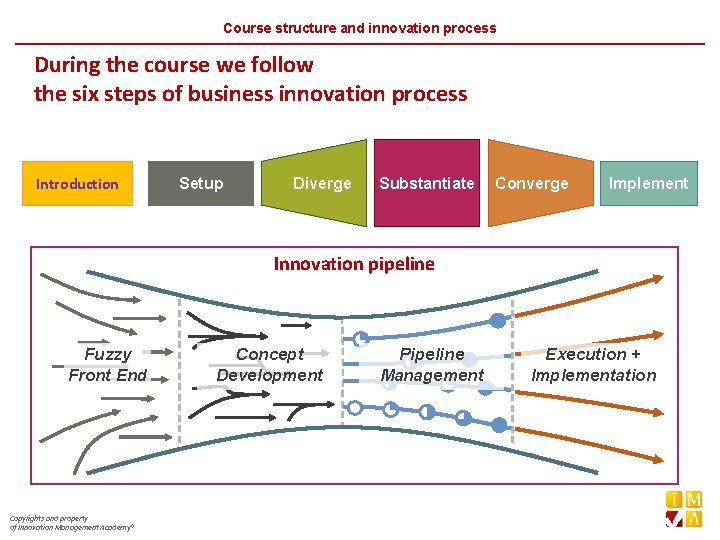
Course structure and innovation process During the course we follow the six steps of business innovation process Introduction Setup Diverge Substantiate Converge Implement Innovation pipeline Fuzzy Front End Copyrights and property of Innovation Management Academy® Concept Development Pipeline Management Execution + Implementation
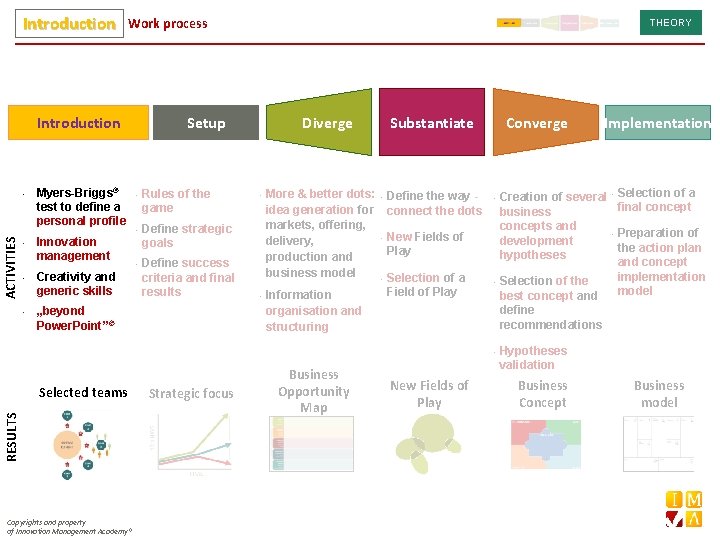
Introduction Work process ACTIVITIES Introduction • Myers-Briggs® test to define a personal profile • Innovation management • • Creativity and generic skills • Rules of the game • Define strategic goals • Define success criteria and final results RESULTS Copyrights and property of Innovation Management Academy® Strategic focus Substantiate Diverge Setup „beyond Power. Point”© Selected teams THEORY • • More & better dots: idea generation for markets, offering, delivery, production and business model Information organisation and structuring Business Opportunity Map • Define the way connect the dots • New Fields of Play • Selection of a Field of Play New Fields of Play Converge • Implementation Creation of several • business concepts and • development hypotheses • Selection of the best concept and define recommendations • Hypotheses validation Business Concept Selection of a final concept Preparation of the action plan and concept implementation model Business model
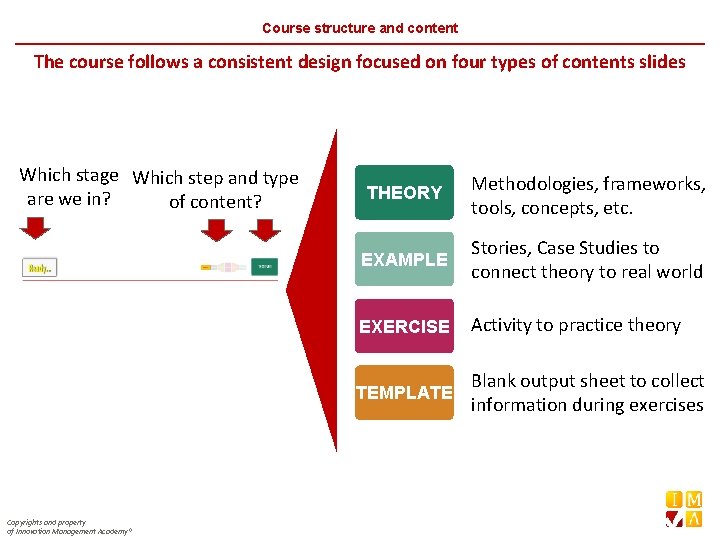
Course structure and content The course follows a consistent design focused on four types of contents slides Which stage Which step and type are we in? of content? Copyrights and property of Innovation Management Academy® THEORY Methodologies, frameworks, tools, concepts, etc. EXAMPLE Stories, Case Studies to connect theory to real world EXERCISE Activity to practice theory TEMPLATE Blank output sheet to collect information during exercises
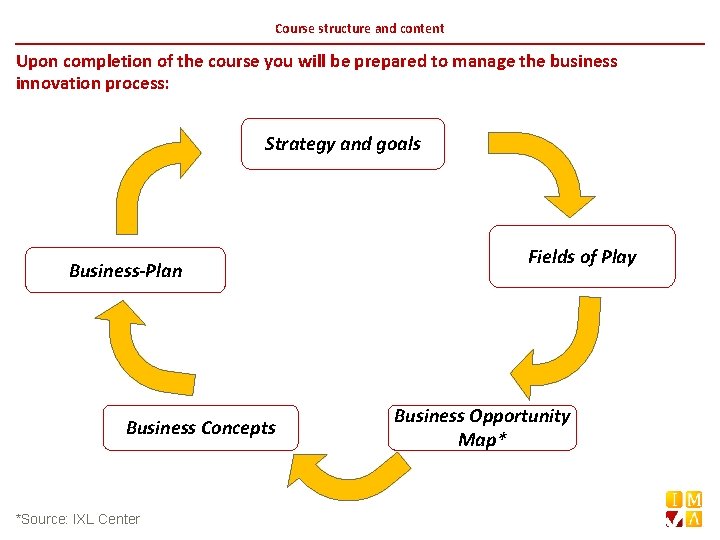
Course structure and content Upon completion of the course you will be prepared to manage the business innovation process: Strategy and goals Business-Plan Business Concepts *Source: IXL Center Fields of Play Business Opportunity Map*
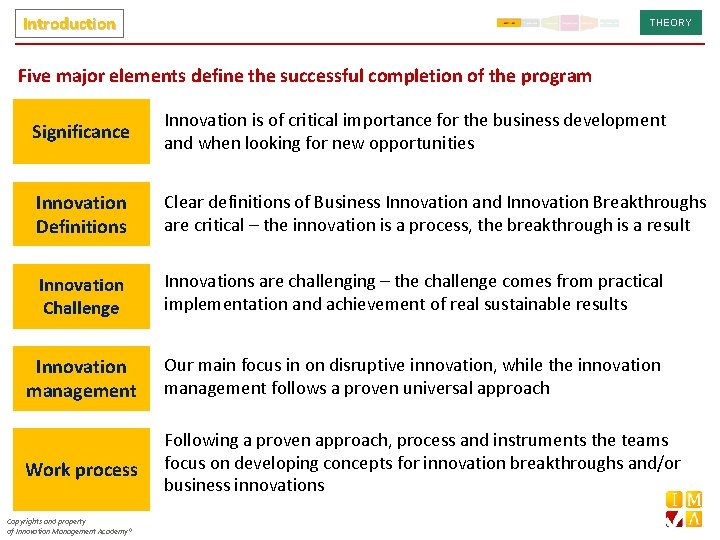
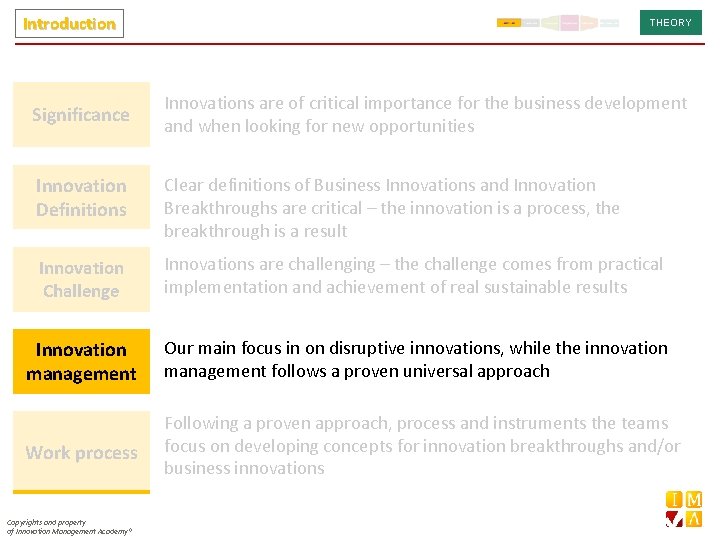
Introduction THEORY Five major elements define the successful completion of the program Significance Innovation is of critical importance for the business development and when looking for new opportunities Innovation Definitions Clear definitions of Business Innovation and Innovation Breakthroughs are critical – the innovation is a process, the breakthrough is a result Innovation Challenge Innovations are challenging – the challenge comes from practical implementation and achievement of real sustainable results Innovation management Our main focus in on disruptive innovation, while the innovation management follows a proven universal approach Work process Following a proven approach, process and instruments the teams focus on developing concepts for innovation breakthroughs and/or business innovations Copyrights and property of Innovation Management Academy®
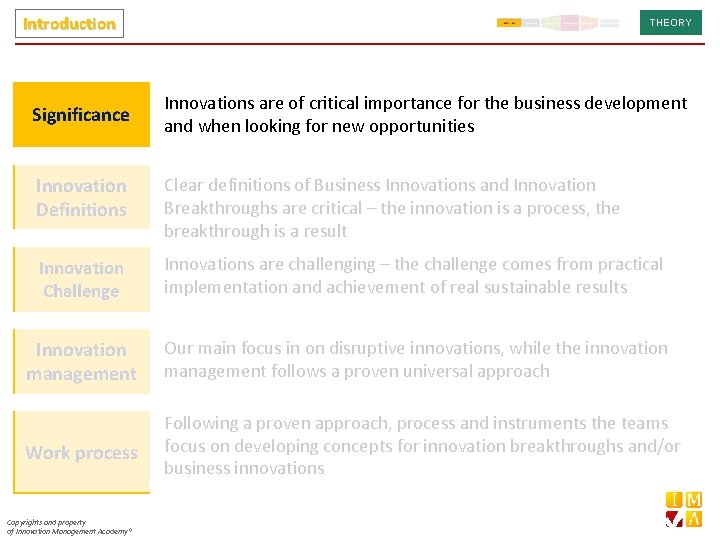
Introduction Significance THEORY Innovations are of critical importance for the business development and when looking for new opportunities Innovation Definitions Clear definitions of Business Innovations and Innovation Breakthroughs are critical – the innovation is a process, the breakthrough is a result Innovation Challenge Innovations are challenging – the challenge comes from practical implementation and achievement of real sustainable results Innovation management Our main focus in on disruptive innovations, while the innovation management follows a proven universal approach Work process Following a proven approach, process and instruments the teams focus on developing concepts for innovation breakthroughs and/or business innovations Copyrights and property of Innovation Management Academy® 7
Introduction Significance 3. COULD YOU GIVE EXAMPLES OF INNOVATIVE COMPANIES? Copyrights and property of Innovation Management Academy® THEORY
Introduction Significance 3. THEORY Activity 1. 1 Thinking about your daily life can you identify a change that has enhanced either a product or service that you use in the last 2 years? An example may be the introduction of an electronic ticketing system for public transport, or the introduction of touch and go payments using your debit card. Each person in your group needs to identify at least one product or service then you should answer the following questions. Finally create a table that shows the relationship between your answers. What is the change? Who does it impact on (everyone, only people who use the product or service)? What are the wider implications of the change (who may be indirectly affected)? Has everyone benefited from the change and why? Copyrights and property of Innovation Management Academy® 9
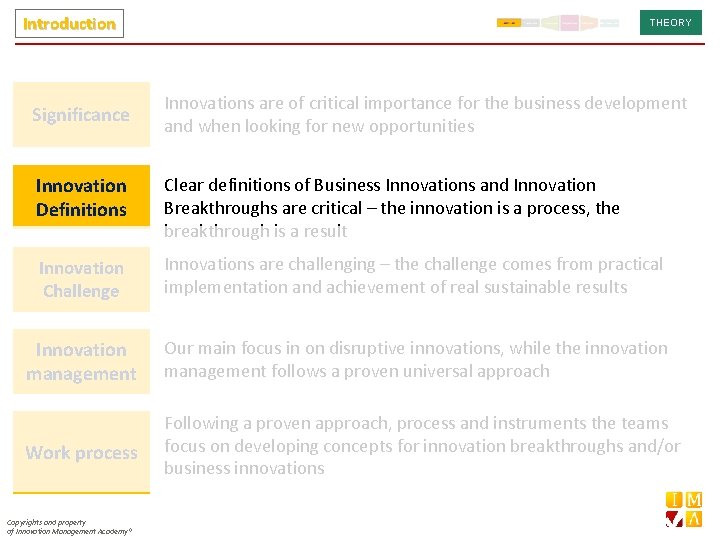
Introduction Significance THEORY Innovations are of critical importance for the business development and when looking for new opportunities Innovation Definitions Clear definitions of Business Innovations and Innovation Breakthroughs are critical – the innovation is a process, the breakthrough is a result Innovation Challenge Innovations are challenging – the challenge comes from practical implementation and achievement of real sustainable results Innovation management Our main focus in on disruptive innovations, while the innovation management follows a proven universal approach Work process Following a proven approach, process and instruments the teams focus on developing concepts for innovation breakthroughs and/or business innovations Copyrights and property of Innovation Management Academy® 10
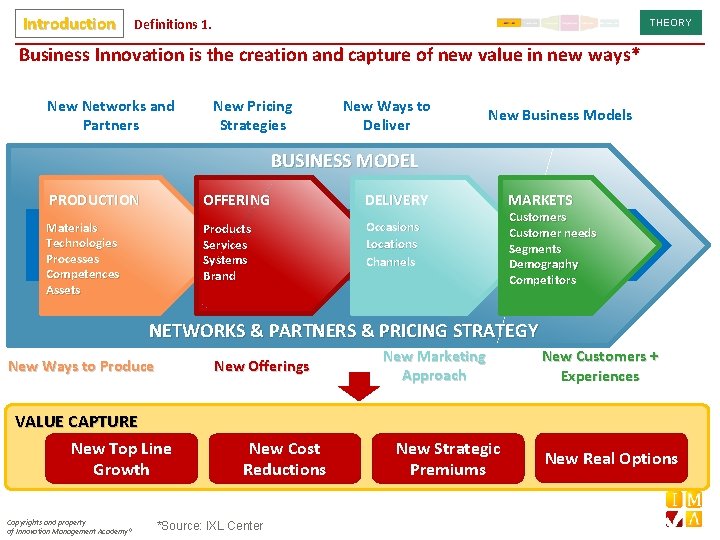
Introduction Definitions 1. THEORY Business Innovation is the creation and capture of new value in new ways* New Networks and Partners New Pricing Strategies New Ways to Deliver New Business Models BUSINESS MODEL PRODUCTION OFFERING DELIVERY Materials Technologies Processes Competences Assets Products Services Systems Brand Occasions Locations Channels MARKETS Customers Customer needs Segments Demography Competitors NETWORKS & PARTNERS & PRICING STRATEGY New Offerings New Ways to Produce VALUE CAPTURE New Top Line Growth Copyrights and property of Innovation Management Academy® New Cost Reductions *Source: IXL Center New Marketing Approach New Strategic Premiums New Customers + Experiences New Real Options 11
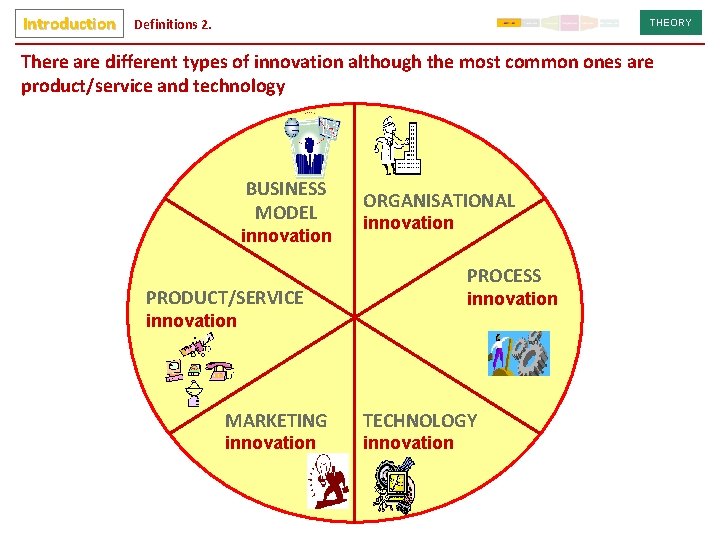
Introduction Definitions 2. THEORY There are different types of innovation although the most common ones are product/service and technology BUSINESS MODEL innovation ORGANISATIONAL innovation PROCESS PRODUCT/SERVICE innovation MARKETING TECHNOLOGY innovation
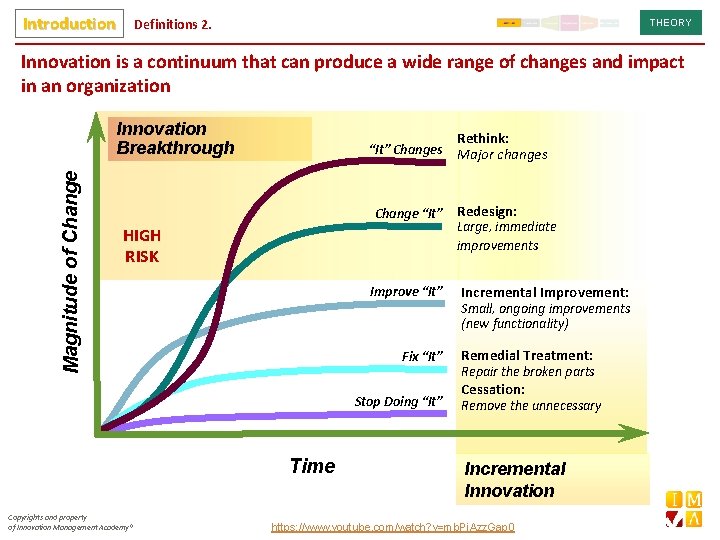
Introduction Definitions 2. THEORY Innovation is a continuum that can produce a wide range of changes and impact in an organization Magnitude of Change Innovation Breakthrough “It” Changes Change “It” HIGH RISK Improve “It” Fix “It” Stop Doing “It” Time Copyrights and property of Innovation Management Academy® Rethink: Major changes Redesign: Large, immediate improvements Incremental Improvement: Small, ongoing improvements (new functionality) Remedial Treatment: Repair the broken parts Cessation: Remove the unnecessary Incremental Innovation https: //www. youtube. com/watch? v=mb. Pi. Azz. Gap 0
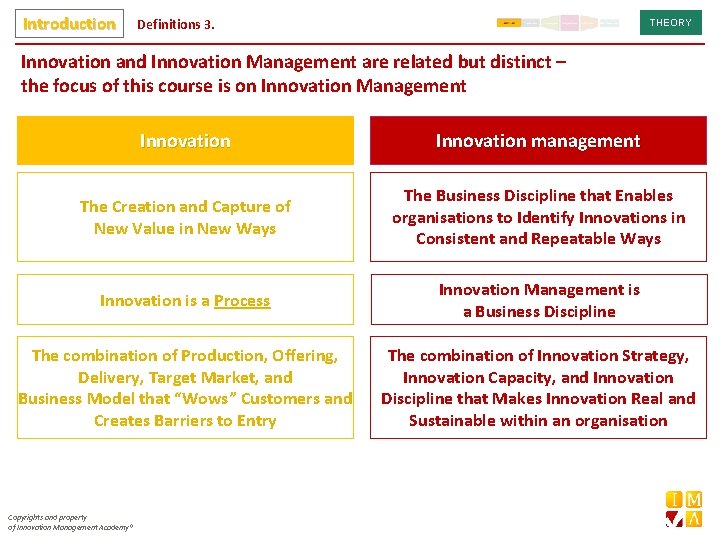
Introduction Definitions 3. THEORY Innovation and Innovation Management are related but distinct – the focus of this course is on Innovation Management Innovation management The Creation and Capture of New Value in New Ways The Business Discipline that Enables organisations to Identify Innovations in Consistent and Repeatable Ways Innovation is a Process Innovation Management is a Business Discipline The combination of Production, Offering, Delivery, Target Market, and Business Model that “Wows” Customers and Creates Barriers to Entry The combination of Innovation Strategy, Innovation Capacity, and Innovation Discipline that Makes Innovation Real and Sustainable within an organisation Copyrights and property of Innovation Management Academy®
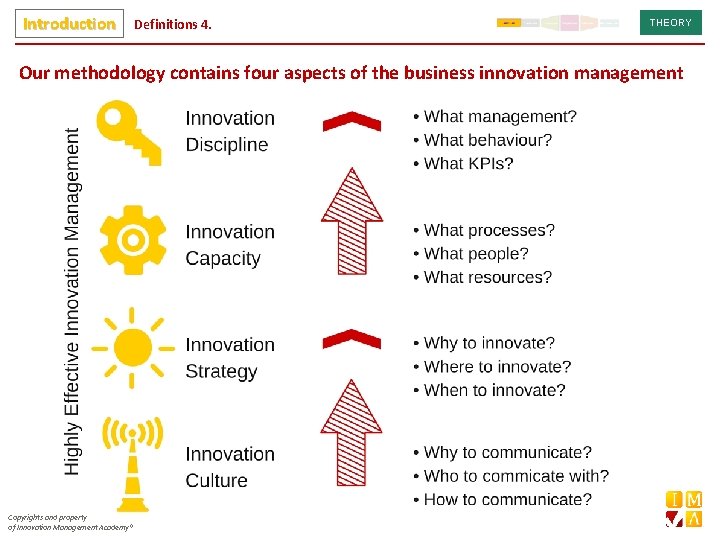
Introduction Definitions 4. THEORY Our methodology contains four aspects of the business innovation management Copyrights and property of Innovation Management Academy®
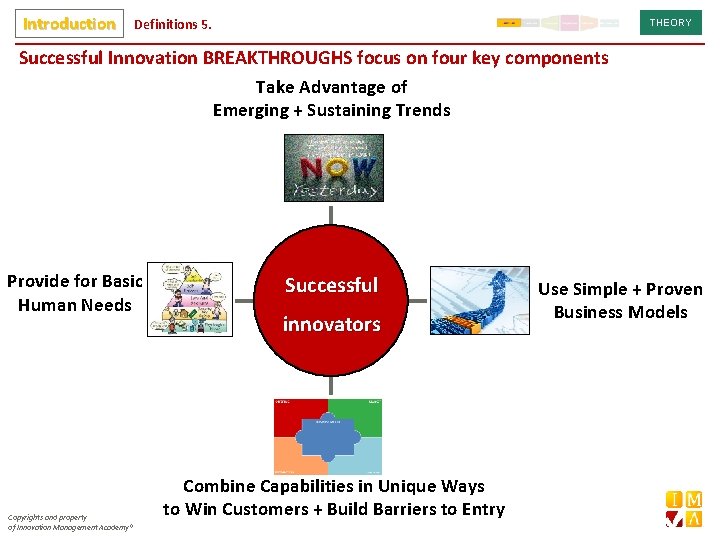
Introduction Definitions 5. THEORY Successful Innovation BREAKTHROUGHS focus on four key components Take Advantage of Emerging + Sustaining Trends Provide for Basic Human Needs Copyrights and property of Innovation Management Academy® Successful innovators Combine Capabilities in Unique Ways to Win Customers + Build Barriers to Entry Use Simple + Proven Business Models
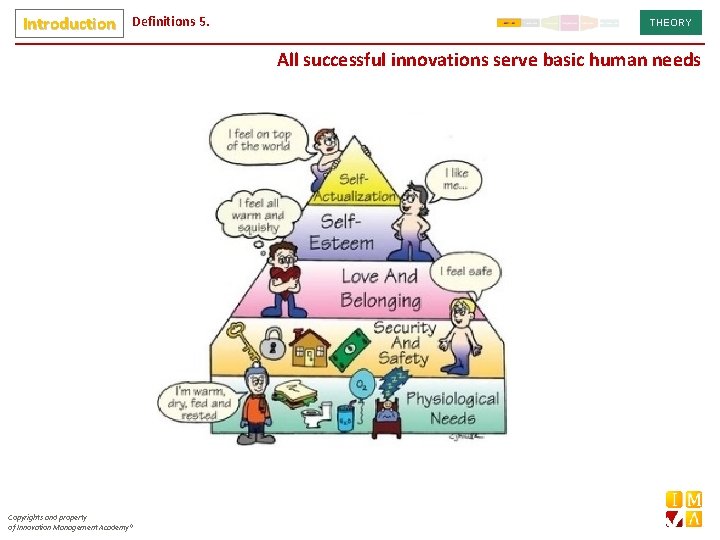
Introduction Definitions 5. THEORY All successful innovations serve basic human needs Copyrights and property of Innovation Management Academy®
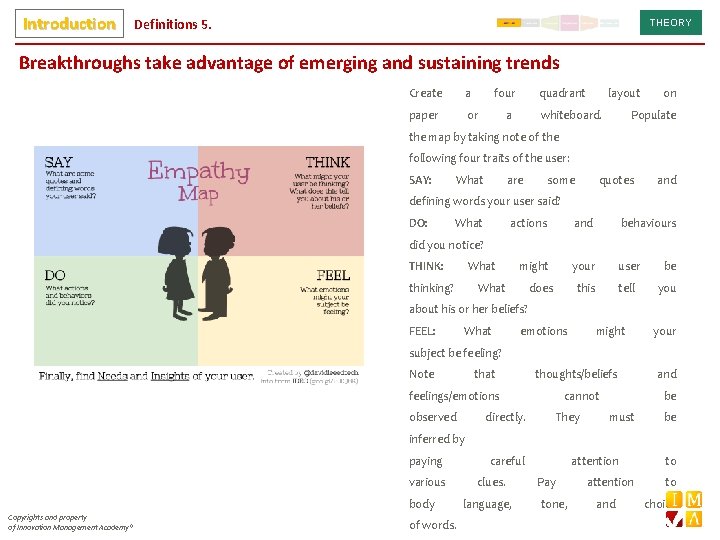
Introduction Definitions 5. THEORY Breakthroughs take advantage of emerging and sustaining trends Create a four paper or quadrant a layout whiteboard. on Populate the map by taking note of the following four traits of the user: SAY: What are some quotes and defining words your user said? DO: What actions and behaviours might your user be this tell you did you notice? THINK: What thinking? What does about his or her beliefs? FEEL: What emotions might your subject be feeling? Note that thoughts/beliefs feelings/emotions observed cannot directly. They and be must be inferred by paying various body Copyrights and property of Innovation Management Academy® of words. careful clues. language, attention Pay tone, attention and to to choice
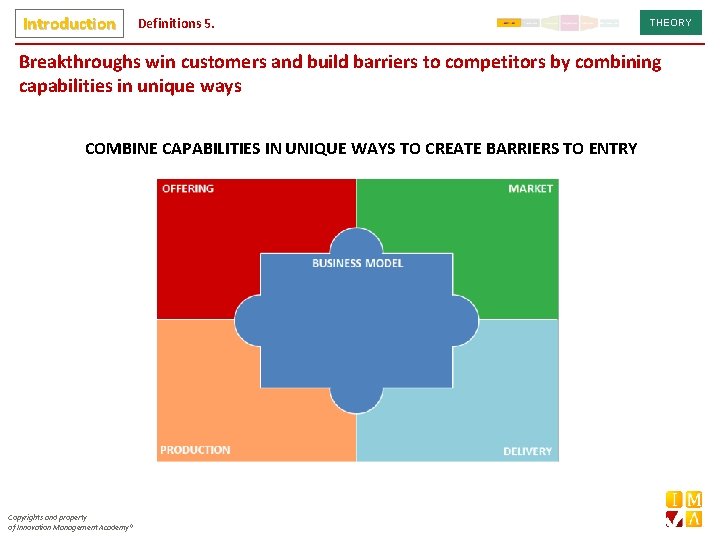
Introduction Definitions 5. THEORY Breakthroughs win customers and build barriers to competitors by combining capabilities in unique ways COMBINE CAPABILITIES IN UNIQUE WAYS TO CREATE BARRIERS TO ENTRY Copyrights and property of Innovation Management Academy®
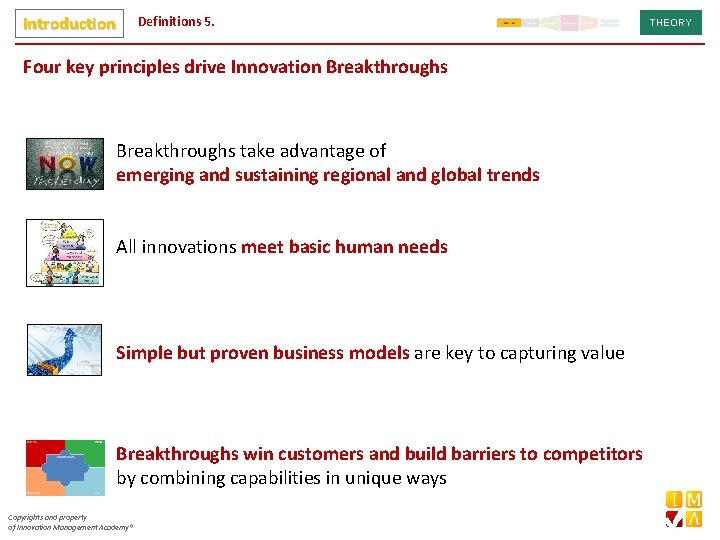
Introduction Definitions 5. Four key principles drive Innovation Breakthroughs take advantage of emerging and sustaining regional and global trends All innovations meet basic human needs Simple but proven business models are key to capturing value Breakthroughs win customers and build barriers to competitors by combining capabilities in unique ways Copyrights and property of Innovation Management Academy® THEORY
Introduction Significance THEORY Innovations are of critical importance for the business development and when looking for new opportunities Innovation Definitions Clear definitions of Business Innovations and Innovation Breakthroughs are critical – the innovation is a process, the breakthrough is a result Innovation Challenge Innovations are challenging – the challenge comes from practical implementation and achievement of real sustainable results Innovation management Our main focus in on disruptive innovations, while the innovation management follows a proven universal approach Work process Following a proven approach, process and instruments the teams focus on developing concepts for innovation breakthroughs and/or business innovations Copyrights and property of Innovation Management Academy® 21
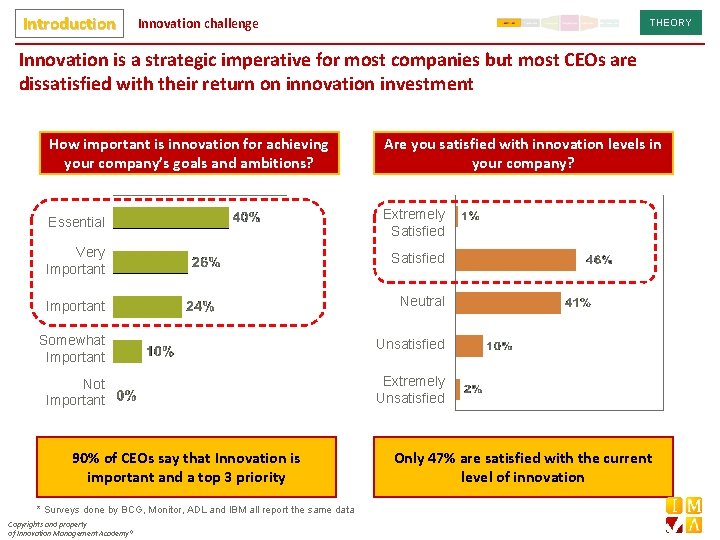
Introduction Innovation challenge THEORY Innovation is a strategic imperative for most companies but most CEOs are dissatisfied with their return on innovation investment How important is innovation for achieving your company’s goals and ambitions? Are you satisfied with innovation levels in your company? Essential Extremely Satisfied Very Important Satisfied Important Neutral Somewhat Important Unsatisfied Not Important Extremely Unsatisfied 90% of CEOs say that Innovation is important and a top 3 priority * Surveys done by BCG, Monitor, ADL and IBM all report the same data Copyrights and property of Innovation Management Academy® Only 47% are satisfied with the current level of innovation
Introduction Innovation challenge EXERCISE Activity 1. 2. : What are the challenges you face when you try to get out of the “box”? Copyrights and property of Innovation Management Academy®
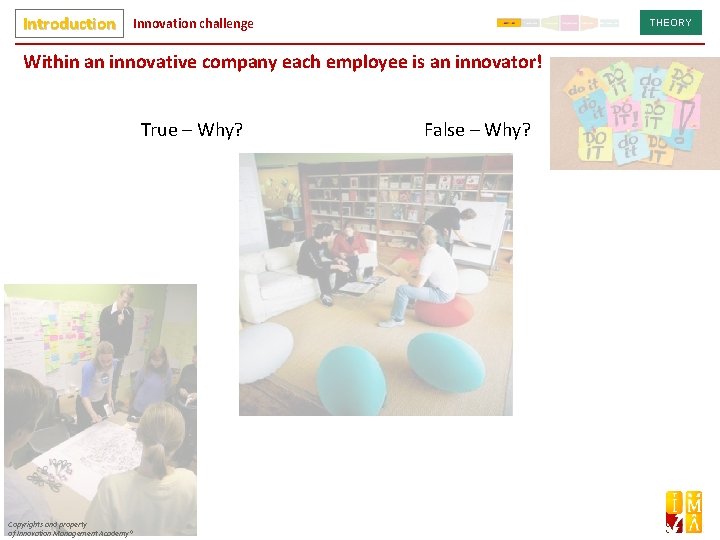
Introduction Innovation challenge THEORY Within an innovative company each employee is an innovator! True – Why? Copyrights and property of of Innovation Management Academy® False – Why?
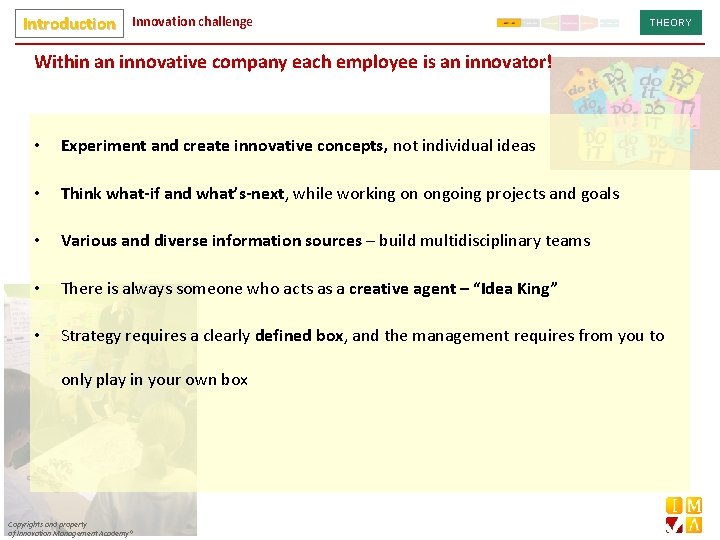
Introduction Innovation challenge THEORY Within an innovative company each employee is an innovator! • Experiment and create innovative concepts, not individual ideas • Think what-if and what’s-next, while working on ongoing projects and goals • Various and diverse information sources – build multidisciplinary teams • There is always someone who acts as a creative agent – “Idea King” • Strategy requires a clearly defined box, and the management requires from you to only play in your own box Copyrights and property of of Innovation Management Academy®
Introduction Innovation challenge Company culture and leadership to stimulate innovation • Senior management commitment and support; systematic approach • Direction and area of development of the company; portfolio for innovation development • EVERYBODY WORKS TOGETHER FOR THE GOOD OF APPLE • Idea generation and a moderate risk toleration • Communication, sharing and access for every employee Copyrights and property of Innovation Management Academy® THEORY
Introduction Significance THEORY Innovations are of critical importance for the business development and when looking for new opportunities Innovation Definitions Clear definitions of Business Innovations and Innovation Breakthroughs are critical – the innovation is a process, the breakthrough is a result Innovation Challenge Innovations are challenging – the challenge comes from practical implementation and achievement of real sustainable results Innovation management Our main focus in on disruptive innovations, while the innovation management follows a proven universal approach Work process Following a proven approach, process and instruments the teams focus on developing concepts for innovation breakthroughs and/or business innovations Copyrights and property of Innovation Management Academy® 27
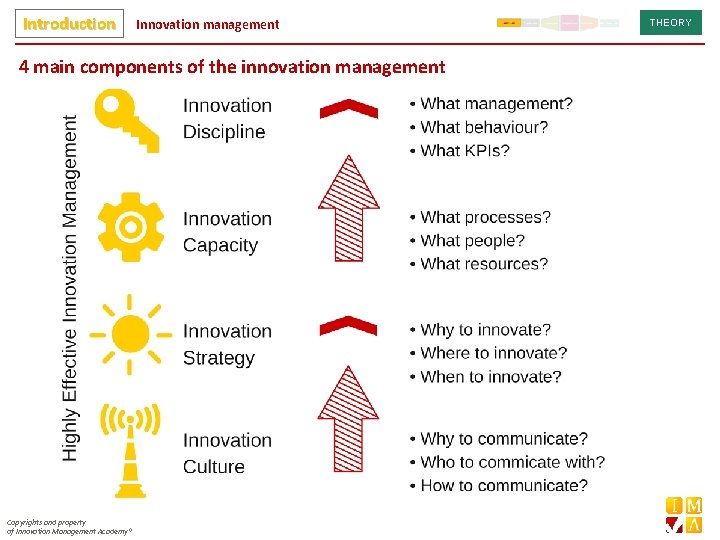
Introduction Innovation management 4 main components of the innovation management Copyrights and property of Innovation Management Academy® THEORY
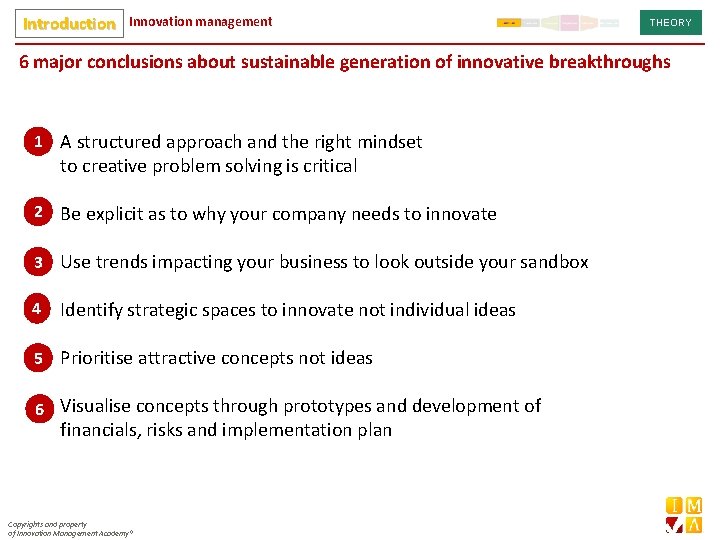
Introduction Innovation management THEORY 6 major conclusions about sustainable generation of innovative breakthroughs 1 1. A structured approach and the right mindset to creative problem solving is critical 2 2. Be explicit as to why your company needs to innovate 3 3. Use trends impacting your business to look outside your sandbox 44. Identify strategic spaces to innovate not individual ideas 5. Prioritise attractive concepts not ideas 5 6. 6 Visualise concepts through prototypes and development of financials, risks and implementation plan Copyrights and property of Innovation Management Academy®
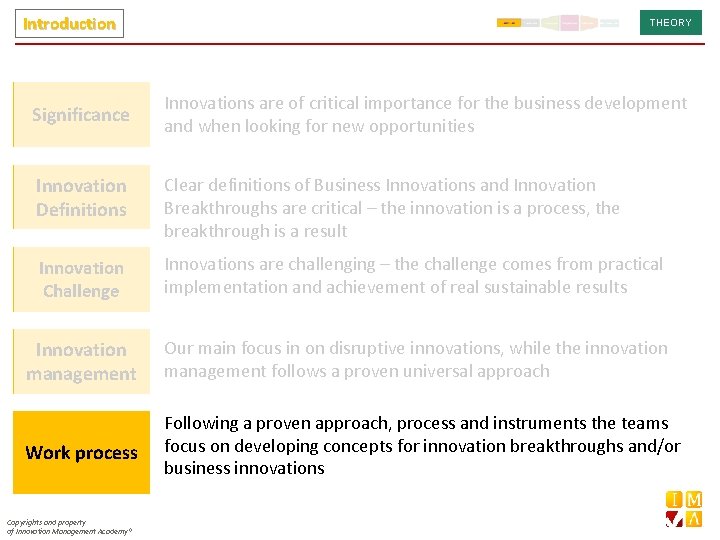
Introduction Significance THEORY Innovations are of critical importance for the business development and when looking for new opportunities Innovation Definitions Clear definitions of Business Innovations and Innovation Breakthroughs are critical – the innovation is a process, the breakthrough is a result Innovation Challenge Innovations are challenging – the challenge comes from practical implementation and achievement of real sustainable results Innovation management Our main focus in on disruptive innovations, while the innovation management follows a proven universal approach Work process Following a proven approach, process and instruments the teams focus on developing concepts for innovation breakthroughs and/or business innovations Copyrights and property of Innovation Management Academy® 30
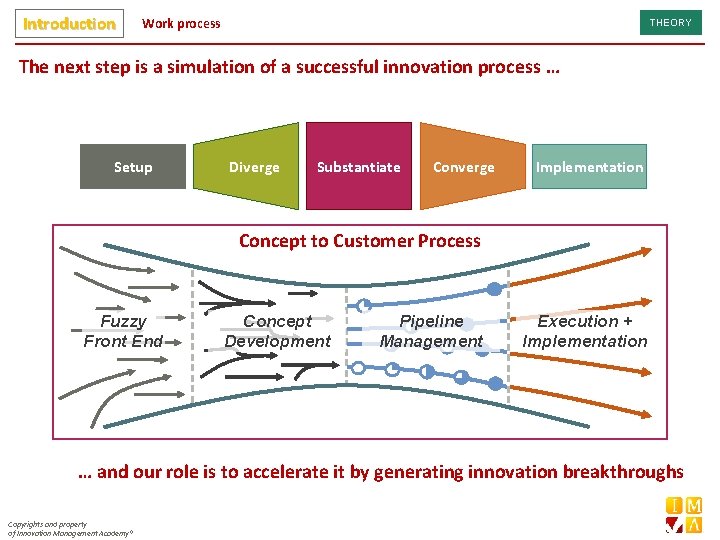
Introduction Work process THEORY The next step is a simulation of a successful innovation process … Setup Diverge Substantiate Converge Implementation Concept to Customer Process Fuzzy Front End Concept Development Pipeline Management Execution + Implementation … and our role is to accelerate it by generating innovation breakthroughs Copyrights and property of Innovation Management Academy®
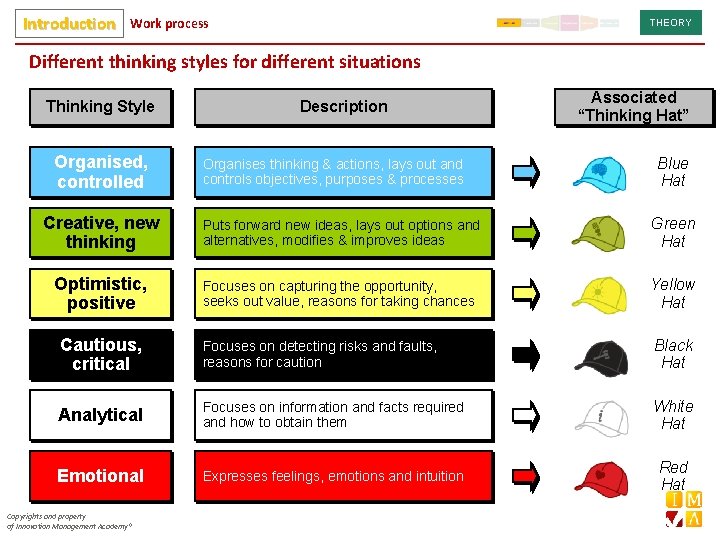
Introduction Work process THEORY Different thinking styles for different situations Thinking Style Organised, controlled Description Organises thinking & actions, lays out and controls objectives, purposes & processes Associated “Thinking Hat” Blue Hat Creative, new thinking Puts forward new ideas, lays out options and alternatives, modifies & improves ideas Green Hat Optimistic, positive Focuses on capturing the opportunity, seeks out value, reasons for taking chances Yellow Hat Cautious, critical Focuses on detecting risks and faults, reasons for caution Black Hat Analytical Focuses on information and facts required and how to obtain them White Hat Emotional Expresses feelings, emotions and intuition Red Hat Copyrights and property of Innovation Management Academy® 32
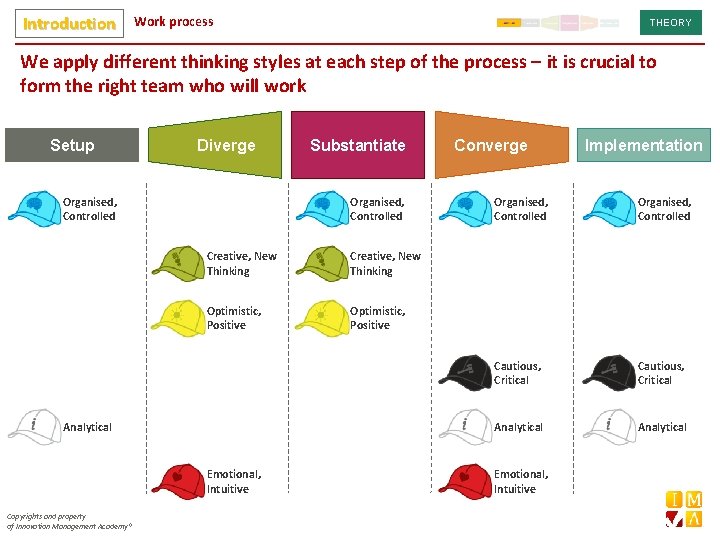
Introduction Work process THEORY We apply different thinking styles at each step of the process – it is crucial to form the right team who will work Setup Diverge Substantiate Converge Implementation Organised, Controlled Organized, Controlled Organised, Controlled Creative, New Thinking Creative, New Thinking Optimistic, Positive Optimistic, Positive Cautious, Critical Cautious, Critical Analytical Analytical Emotional, Intuitive Emotional, Intuitive Copyrights and property of Innovation Management Academy® 33
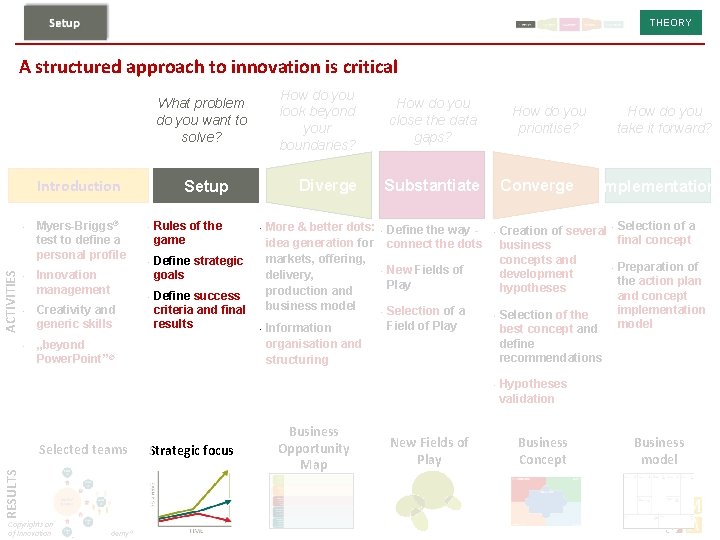
THEORY A structured approach to innovation is critical What problem do you want to solve? ACTIVITIES Introduction • Myers-Briggs® test to define a personal profile • Innovation management • • Creativity and generic skills • Rules of the game • Define strategic goals • Define success criteria and final results „beyond Power. Point”© Selected teams RESULTS Setup Copyrights and property of Innovation Management Academy® Strategic focus • • How do you look beyond your boundaries? How do you close the data gaps? Diverge Substantiate More & better dots: idea generation for markets, offering, delivery, production and business model Information organisation and structuring Business Opportunity Map • Define the way connect the dots • New Fields of Play • Selection of a Field of Play New Fields of Play How do you prioritise? Converge • How do you take it forward? Implementation Creation of several • business concepts and • development hypotheses • Selection of the best concept and define recommendations • Hypotheses validation Business Concept Selection of a final concept Preparation of the action plan and concept implementation model Business model
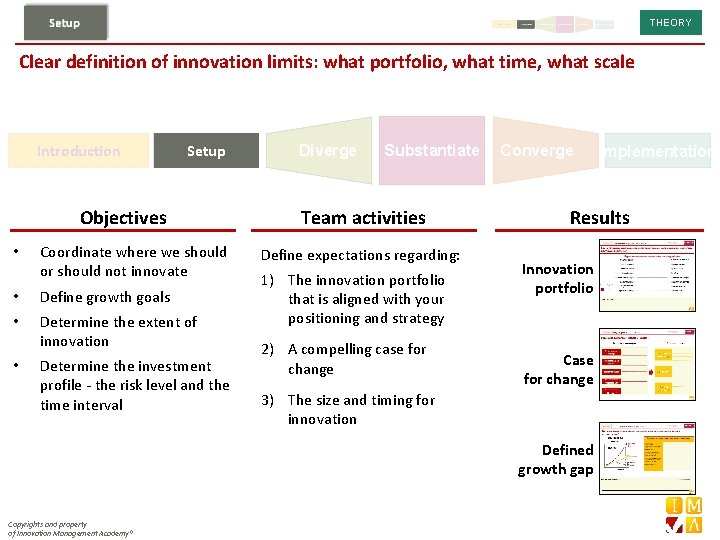
THEORY Clear definition of innovation limits: what portfolio, what time, what scale Introduction Setup Objectives • Coordinate where we should or should not innovate • Define growth goals • Determine the extent of innovation • Determine the investment profile - the risk level and the time interval Diverge Substantiate Team activities Define expectations regarding: 1) The innovation portfolio that is aligned with your positioning and strategy 2) A compelling case for change Converge Results Innovation portfolio Case for change 3) The size and timing for innovation Defined growth gap Copyrights and property of Innovation Management Academy® Implementation
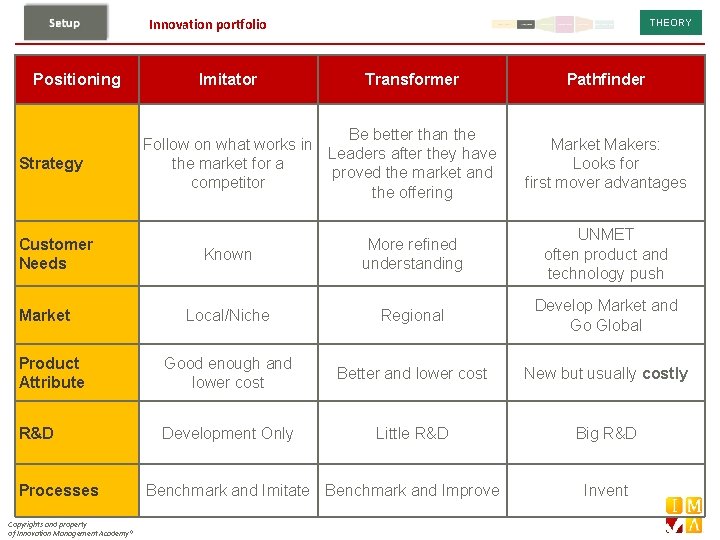
Innovation portfolio Positioning Strategy Imitator THEORY Transformer Be better than the Follow on what works in Leaders after they have the market for a proved the market and competitor the offering Pathfinder Market Makers: Looks for first mover advantages Known More refined understanding UNMET often product and technology push Local/Niche Regional Develop Market and Go Global Product Attribute Good enough and lower cost Better and lower cost New but usually costly R&D Development Only Little R&D Big R&D Customer Needs Market Processes Copyrights and property of Innovation Management Academy® Benchmark and Imitate Benchmark and Improve Invent
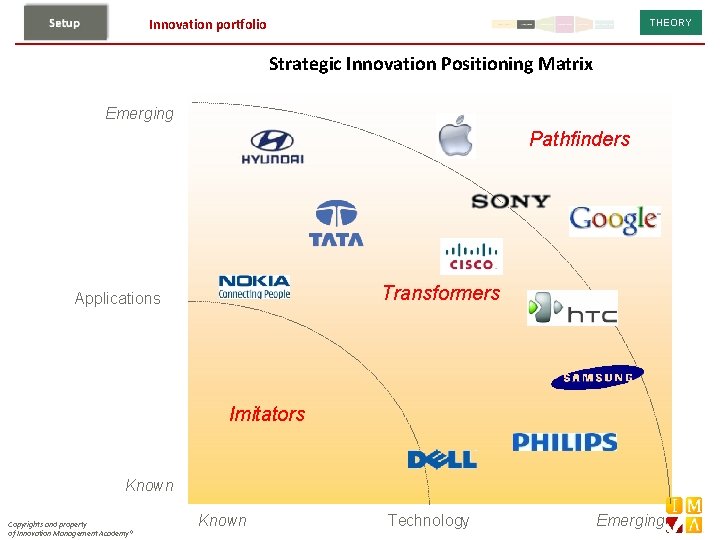
Innovation portfolio THEORY Strategic Innovation Positioning Matrix Emerging Pathfinders Transformers Applications Imitators Known Copyrights and property of Innovation Management Academy® Known Technology Emerging
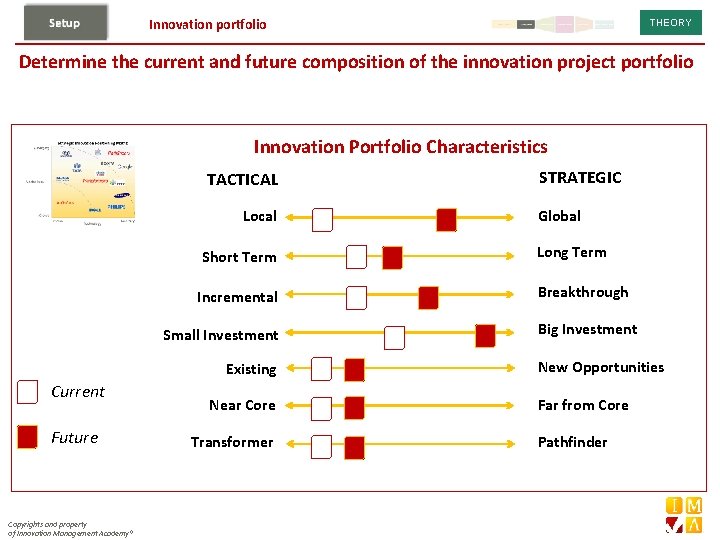
Innovation portfolio THEORY Determine the current and future composition of the innovation project portfolio Innovation Portfolio Characteristics TACTICAL Local Short Term Incremental Small Investment Existing Current Future Copyrights and property of Innovation Management Academy® Near Core Transformer STRATEGIC Global Long Term Breakthrough Big Investment New Opportunities Far from Core Pathfinder
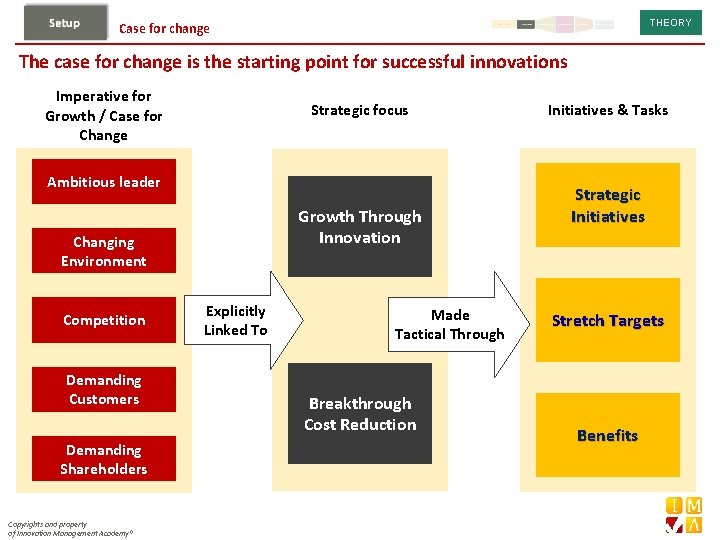
THEORY Case for change The case for change is the starting point for successful innovations Imperative for Growth / Case for Change Strategic focus Ambitious leader Growth Through Innovation Changing Environment Competition Demanding Customers Demanding Shareholders Copyrights and property of Innovation Management Academy® Explicitly Linked To Made Tactical Through Breakthrough Cost Reduction Initiatives & Tasks Strategic Initiatives Stretch Targets Benefits
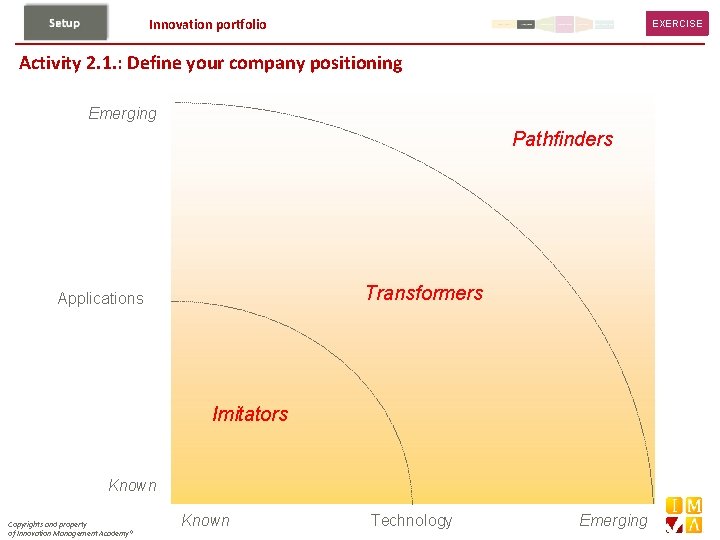
Innovation portfolio EXERCISE Activity 2. 1. : Define your company positioning Emerging Pathfinders Transformers Applications Imitators Known Copyrights and property of Innovation Management Academy® Known Technology Emerging
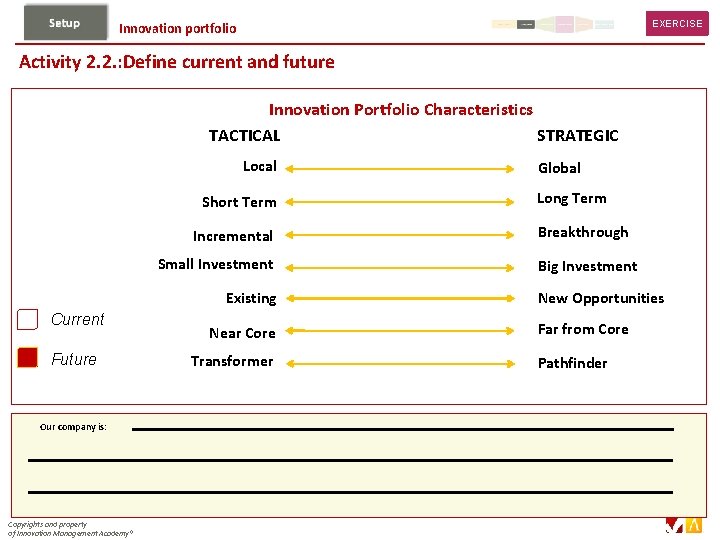
EXERCISE Innovation portfolio Activity 2. 2. : Define current and future Innovation Portfolio Characteristics STRATEGIC TACTICAL Local Short Term Incremental Small Investment Existing Current Future Our company is: Copyrights and property of Innovation Management Academy® Near Core Transformer Global Long Term Breakthrough Big Investment New Opportunities Far from Core Pathfinder
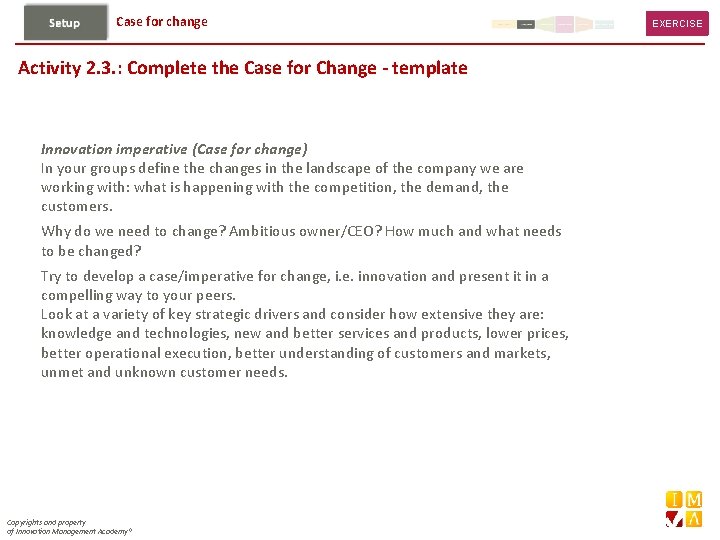
Case for change EXERCISE Activity 2. 3. : Complete the Case for Change - template Innovation imperative (Case for change) In your groups define the changes in the landscape of the company we are working with: what is happening with the competition, the demand, the customers. Why do we need to change? Ambitious owner/CEO? How much and what needs to be changed? Try to develop a case/imperative for change, i. e. innovation and present it in a compelling way to your peers. Look at a variety of key strategic drivers and consider how extensive they are: knowledge and technologies, new and better services and products, lower prices, better operational execution, better understanding of customers and markets, unmet and unknown customer needs. Copyrights and property of Innovation Management Academy® 42
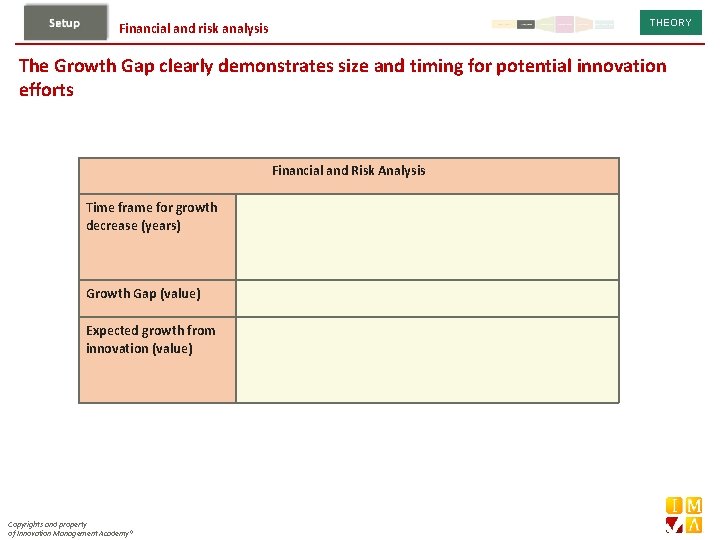
THEORY Financial and risk analysis The Growth Gap clearly demonstrates size and timing for potential innovation efforts Financial and Risk Analysis Time frame for growth decrease (years) Growth Gap (value) Expected growth from innovation (value) Copyrights and property of Innovation Management Academy®
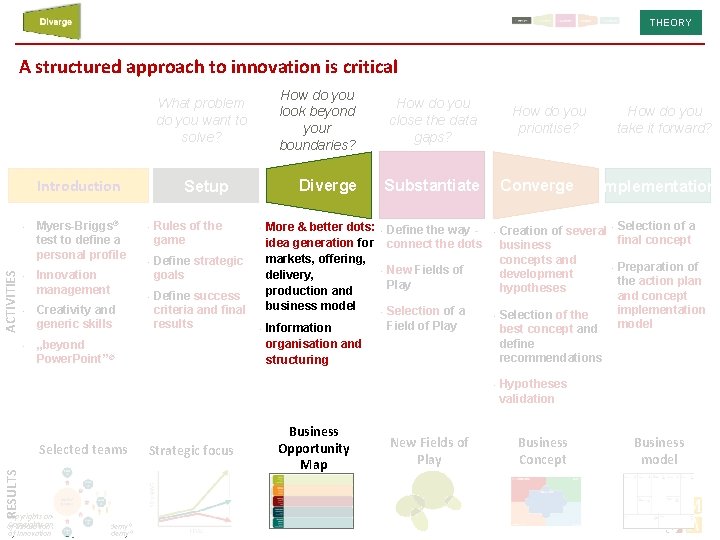
THEORY A structured approach to innovation is critical What problem do you want to solve? ACTIVITIES Introduction • Myers-Briggs® test to define a personal profile • Innovation management • • Creativity and generic skills • Rules of the game • Define strategic goals • Define success criteria and final results „beyond Power. Point”© Selected teams RESULTS Setup Copyrights and property Academy® of Innovation Management Academy® Strategic focus • • How do you look beyond your boundaries? How do you close the data gaps? Diverge Substantiate More & better dots: idea generation for markets, offering, delivery, production and business model Information organisation and structuring Business Opportunity Map • Define the way connect the dots • New Fields of Play • Selection of a Field of Play New Fields of Play How do you prioritise? Converge • How do you take it forward? Implementation Creation of several • business concepts and • development hypotheses • Selection of the best concept and define recommendations • Hypotheses validation Business Concept Selection of a final concept Preparation of the action plan and concept implementation model Business model 44
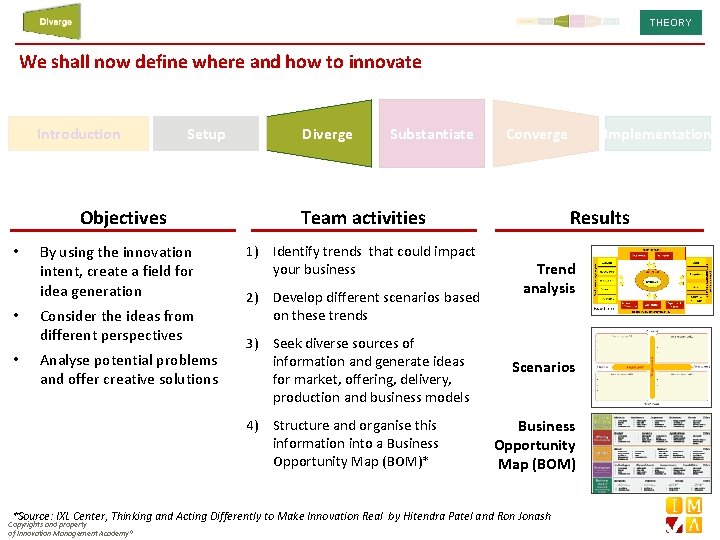
THEORY We shall now define where and how to innovate Introduction Setup Objectives • • • By using the innovation intent, create a field for idea generation Consider the ideas from different perspectives Analyse potential problems and offer creative solutions Diverge Substantiate Converge Team activities 1) Identify trends that could impact your business 2) Develop different scenarios based on these trends 3) Seek diverse sources of information and generate ideas for market, offering, delivery, production and business models 4) Structure and organise this information into a Business Opportunity Map (ВОМ)* Results Trend analysis Scenarios Business Opportunity Map (ВОМ) *Source: IXL Center, Thinking and Acting Differently to Make Innovation Real by Hitendra Patel and Ron Jonash Copyrights and property of Innovation Management Academy® Implementation
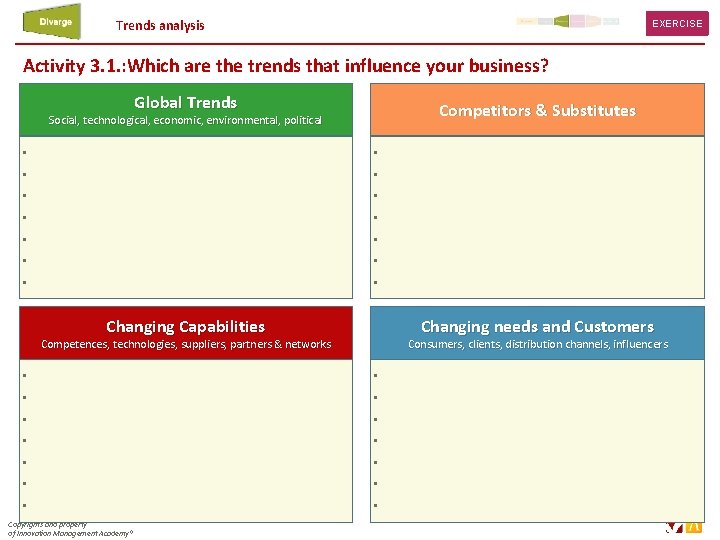
Trends analysis EXERCISE Activity 3. 1. : Which are the trends that influence your business? Global Trends Competitors & Substitutes Social, technological, economic, environmental, political • • • • Changing Capabilities Changing needs and Customers Competences, technologies, suppliers, partners & networks Consumers, clients, distribution channels, influencers • • • • Copyrights and property of Innovation Management Academy®
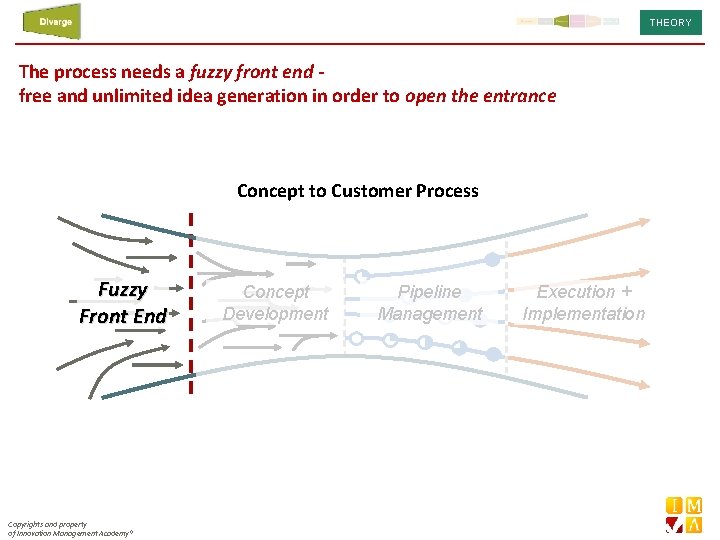
THEORY The process needs a fuzzy front end free and unlimited idea generation in order to open the entrance Concept to Customer Process Fuzzy Front End Copyrights and property of Innovation Management Academy® Concept Development Pipeline Management Execution + Implementation
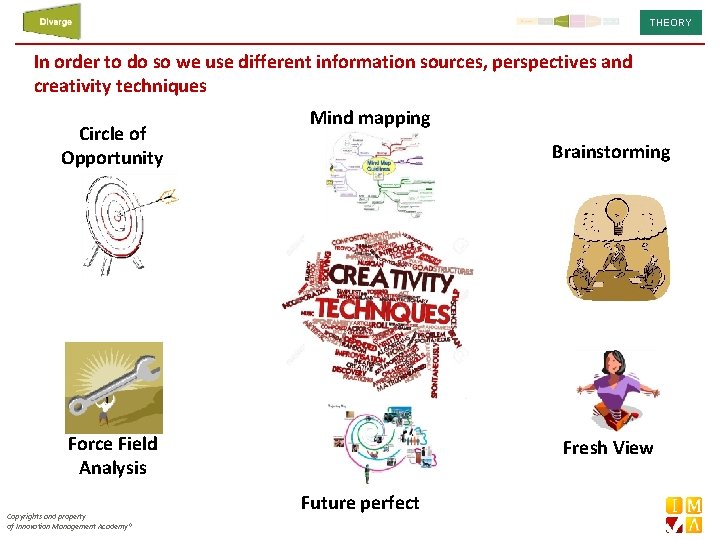
THEORY In order to do so we use different information sources, perspectives and creativity techniques Circle of Opportunity Mind mapping Brainstorming Force Field Analysis Copyrights and property of Innovation Management Academy® Fresh View Future perfect 48
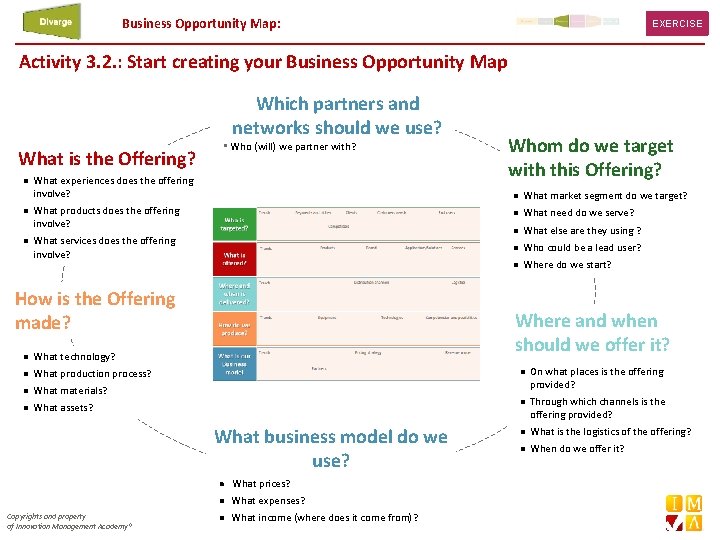
Business Opportunity Map: EXERCISE Activity 3. 2. : Start creating your Business Opportunity Map Which partners and networks should we use? What is the Offering? l • Who (will) we partner with? What experiences does the offering involve? Whom do we target with this Offering? Which market segment? l l What market segment do we target? l What products does the offering involve? l What need do we serve? What services does the offering involve? l What else are they using ? l l Who could be a lead user? l Where do we start? How is the Offering made? l What technology? l What production process? l What materials? l What assets? Where and when should we offer it? What business model do we use? Copyrights and property of Innovation Management Academy® l What prices? l What expenses? l What income (where does it come from)? l On what places is the offering provided? l Through which channels is the offering provided? l What is the logistics of the offering? l When do we offer it?

Business Opportunity Map THEORY Business Opportunity Map Information sources – interviews, internet, etc. Customers Clients Employees Experts Competitors Partners & suppliers Related industries Other industries & markets Governments & regulations Copyrights and property of Innovation Management Academy® l Organizes disparate and complex information, into a simple understandable format l Integrates market and capability perspectives from inside and outside the organisation l Provides structure l Functions visual communication tool for discussing new opportunity areas
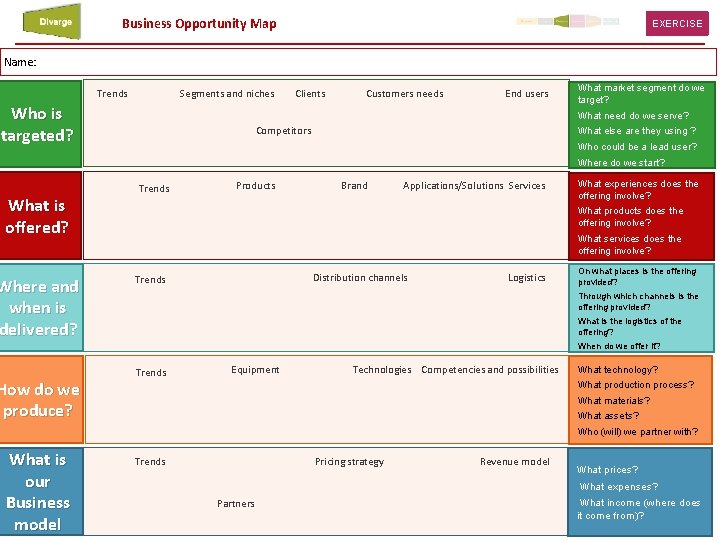
Business Opportunity Map EXERCISE Name: Trends Segments and niches Who is targeted? Clients Customers needs End users What market segment do we target? What need do we serve? Competitors What else are they using ? Who could be a lead user? Where do we start? What is offered? Where and when is delivered? How do we produce? Trends Products Brand Applications/Solutions Services What experiences does the offering involve? What products does the offering involve? What services does the offering involve? Distribution channels Trends Logistics On what places is the offering provided? Through which channels is the offering provided? What is the logistics of the offering? When do we offer it? Trends Equipment Technologies Competencies and possibilities What technology? What production process? What materials? What assets? Who (will) we partner with? What is Trends our Business Copyrights and property of model Innovation Management Academy® Pricing strategy Revenue model What prices? What expenses? Partners What income (where does it come from)?
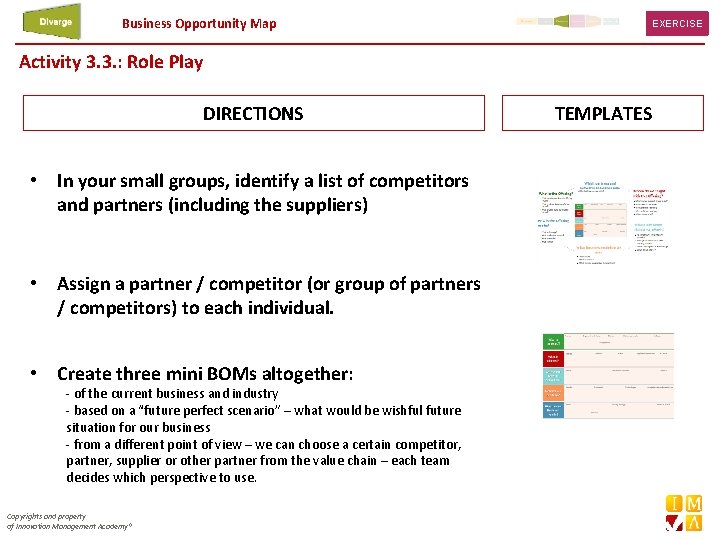
Business Opportunity Map EXERCISE Activity 3. 3. : Role Play DIRECTIONS • In your small groups, identify a list of competitors and partners (including the suppliers) • Assign a partner / competitor (or group of partners / competitors) to each individual. • Create three mini BOMs altogether: - of the current business and industry - based on a “future perfect scenario” – what would be wishful future situation for our business - from a different point of view – we can choose a certain competitor, partner, supplier or other partner from the value chain – each team decides which perspective to use. Copyrights and property of Innovation Management Academy® TEMPLATES
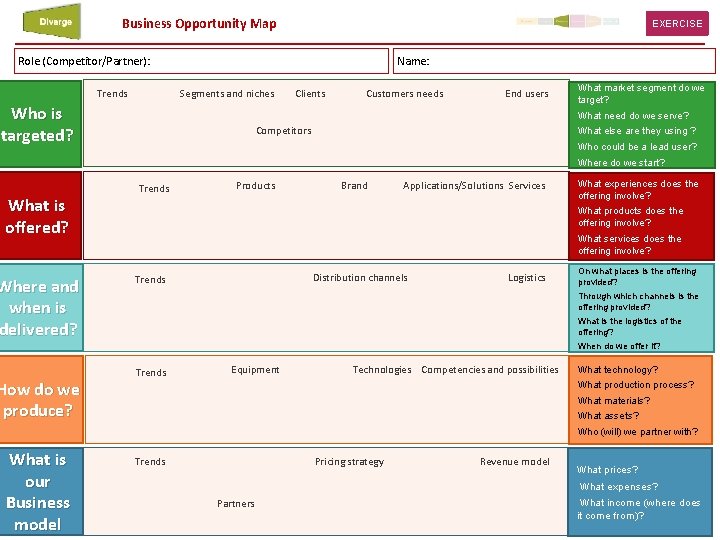
Business Opportunity Map EXERCISE Name: Role (Competitor/Partner): Trends Segments and niches Who is targeted? Clients Customers needs End users What market segment do we target? What need do we serve? Competitors What else are they using ? Who could be a lead user? Where do we start? What is offered? Where and when is delivered? How do we produce? Trends Products Brand Applications/Solutions Services What experiences does the offering involve? What products does the offering involve? What services does the offering involve? Distribution channels Trends Logistics On what places is the offering provided? Through which channels is the offering provided? What is the logistics of the offering? When do we offer it? Trends Equipment Technologies Competencies and possibilities What technology? What production process? What materials? What assets? Who (will) we partner with? What is Trends our Business Copyrights and property model of Innovation Management Academy® Pricing strategy Revenue model What prices? What expenses? Partners What income (where does it come from)? 53
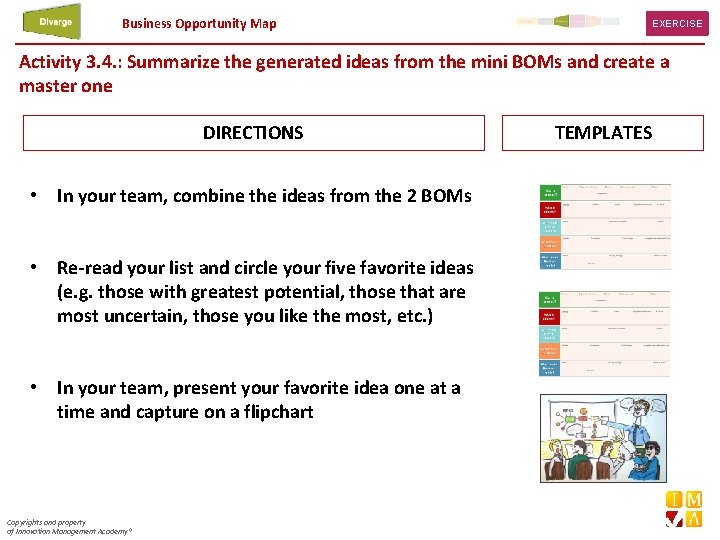
Business Opportunity Map EXERCISE Activity 3. 4. : Summarize the generated ideas from the mini BOMs and create a master one DIRECTIONS TEMPLATES • In your team, combine the ideas from the 2 BOMs • Re-read your list and circle your five favorite ideas (e. g. those with greatest potential, those that are most uncertain, those you like the most, etc. ) • In your team, present your favorite idea one at a time and capture on a flipchart Copyrights and property of Innovation Management Academy® 54
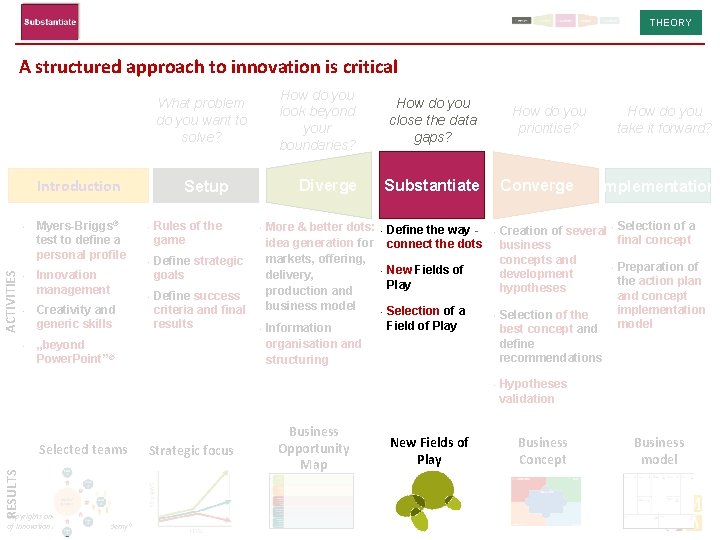
THEORY A structured approach to innovation is critical What problem do you want to solve? ACTIVITIES Introduction • Myers-Briggs® test to define a personal profile • Innovation management • • Creativity and generic skills • Rules of the game • Define strategic goals • Define success criteria and final results „beyond Power. Point”© Selected teams RESULTS Setup Copyrights and property of Innovation Management Academy® Strategic focus • • How do you look beyond your boundaries? How do you close the data gaps? Diverge Substantiate More & better dots: idea generation for markets, offering, delivery, production and business model Information organisation and structuring Business Opportunity Map • Define the way connect the dots • New Fields of Play • Selection of a Field of Play New Fields of Play How do you prioritise? Converge • How do you take it forward? Implementation Creation of several • business concepts and • development hypotheses • Selection of the best concept and define recommendations • Hypotheses validation Business Concept Selection of a final concept Preparation of the action plan and concept implementation model Business model 55
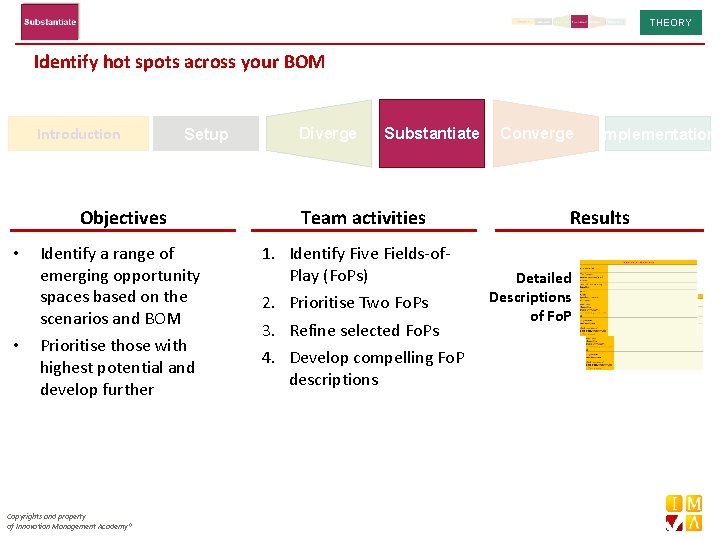
THEORY Identify hot spots across your BOM Introduction • • Setup Diverge Substantiate Objectives Team activities Identify a range of emerging opportunity spaces based on the scenarios and BOM 1. Identify Five Fields-of. Play (Fo. Ps) 2. Prioritise Two Fo. Ps 3. Refine selected Fo. Ps 4. Develop compelling Fo. P descriptions Prioritise those with highest potential and develop further Copyrights and property of Innovation Management Academy® Converge Implementation Results Detailed Descriptions of Fo. P
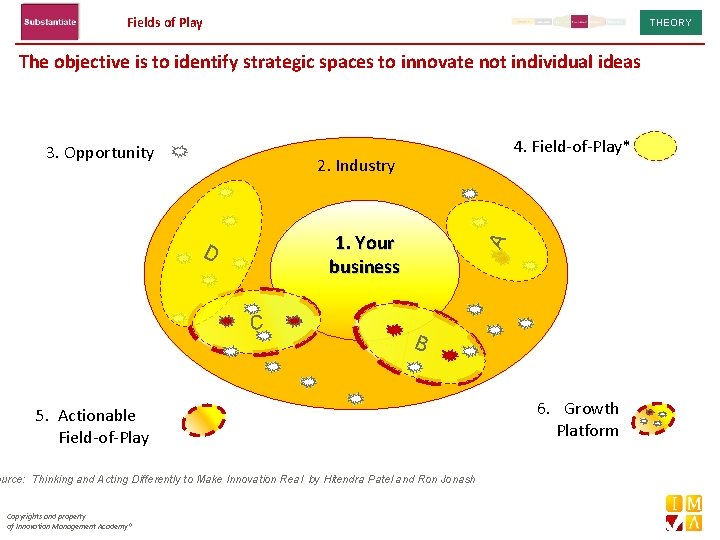
Fields of Play THEORY The objective is to identify strategic spaces to innovate not individual ideas 3. Opportunity 4. Field-of-Play* 2. Industry C A 1. Your business D B 5. Actionable Field-of-Play ource: Thinking and Acting Differently to Make Innovation Real by Hitendra Patel and Ron Jonash Copyrights and property of Innovation Management Academy® 6. Growth Platform
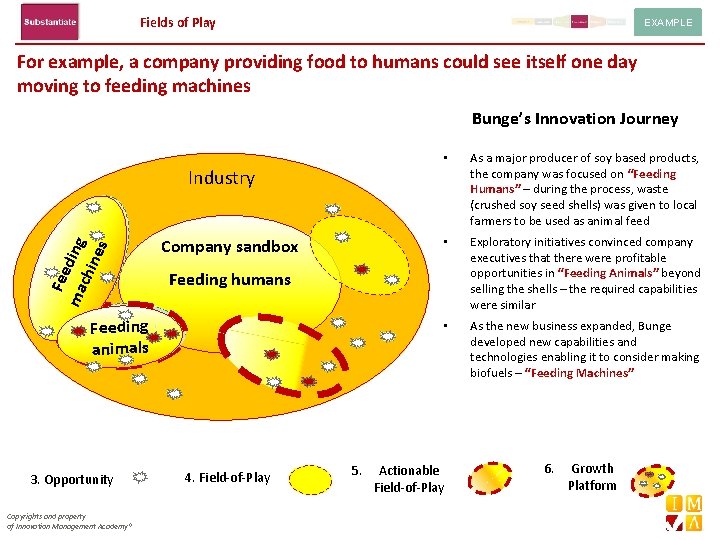
Fields of Play EXAMPLE For example, a company providing food to humans could see itself one day moving to feeding machines Bunge’s Innovation Journey • As a major producer of soy based products, the company was focused on “Feeding Humans” – during the process, waste (crushed soy seed shells) was given to local farmers to be used as animal feed • Exploratory initiatives convinced company executives that there were profitable opportunities in “Feeding Animals” beyond selling the shells – the required capabilities were similar • As the new business expanded, Bunge developed new capabilities and technologies enabling it to consider making biofuels – “Feeding Machines” Fee ma ding chi nes Industry Company sandbox Feeding humans Feeding animals 3. Opportunity Copyrights and property of Innovation Management Academy® 4. Field-of-Play 5. Actionable Field-of-Play 6. Growth Platform
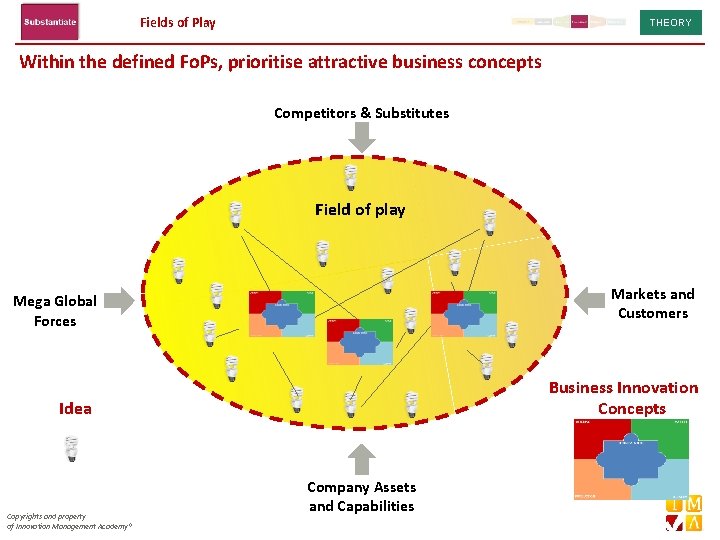
Fields of Play THEORY Within the defined Fo. Ps, prioritise attractive business concepts Competitors & Substitutes Field of play Markets and Customers Mega Global Forces Business Innovation Concepts Idea Copyrights and property of Innovation Management Academy® Company Assets and Capabilities
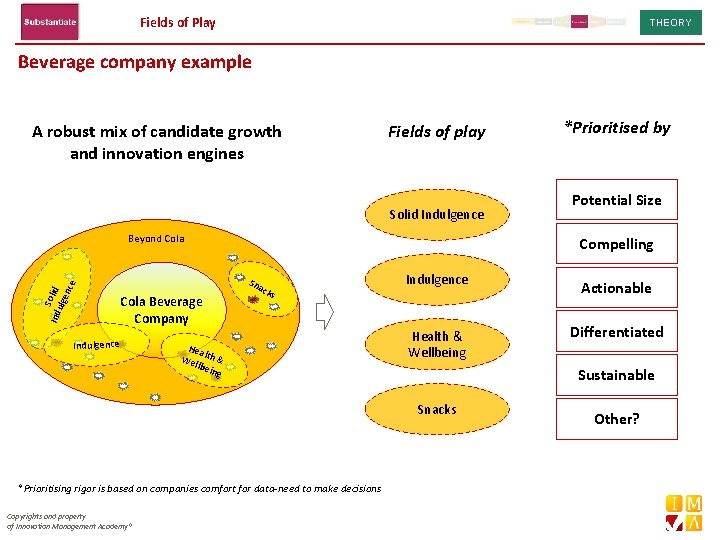
Fields of Play THEORY Beverage company example A robust mix of candidate growth and innovation engines Fields of play Solid Indulgence S Ind olid ulg enc e Beyond Cola Indulgence cks Hea We lth & llbe ing Indulgence Actionable Health & Wellbeing Differentiated Sustainable Snacks *Prioritising rigor is based on companies comfort for data-need to make decisions Copyrights and property of Innovation Management Academy® Potential Size Compelling Sna Cola Beverage Company *Prioritised by Other?
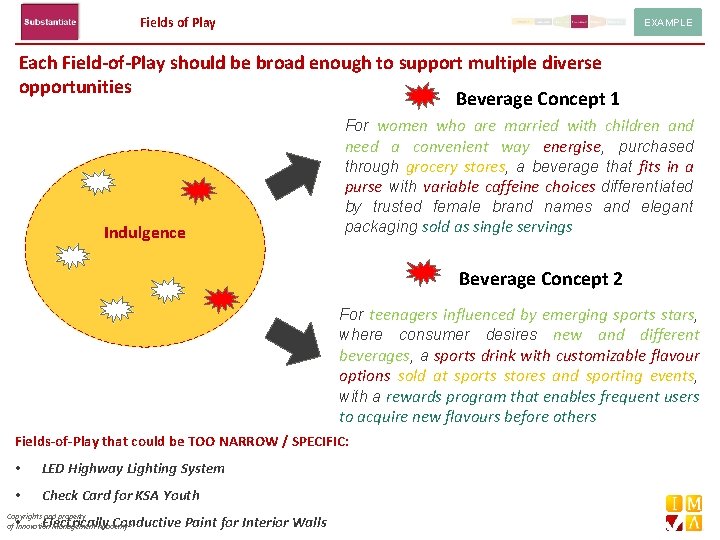
Fields of Play EXAMPLE Each Field-of-Play should be broad enough to support multiple diverse opportunities Beverage Concept 1 Indulgence For women who are married with children and need a convenient way energise, purchased through grocery stores, a beverage that fits in a purse with variable caffeine choices differentiated by trusted female brand names and elegant packaging sold as single servings Beverage Concept 2 For teenagers influenced by emerging sports stars, where consumer desires new and different beverages, a sports drink with customizable flavour options sold at sports stores and sporting events, with a rewards program that enables frequent users to acquire new flavours before others Fields-of-Play that could be TOO NARROW / SPECIFIC: • LED Highway Lighting System • Check Card for KSA Youth Copyrights and property of Innovation Management Academy® • Electrically Conductive Paint for Interior Walls
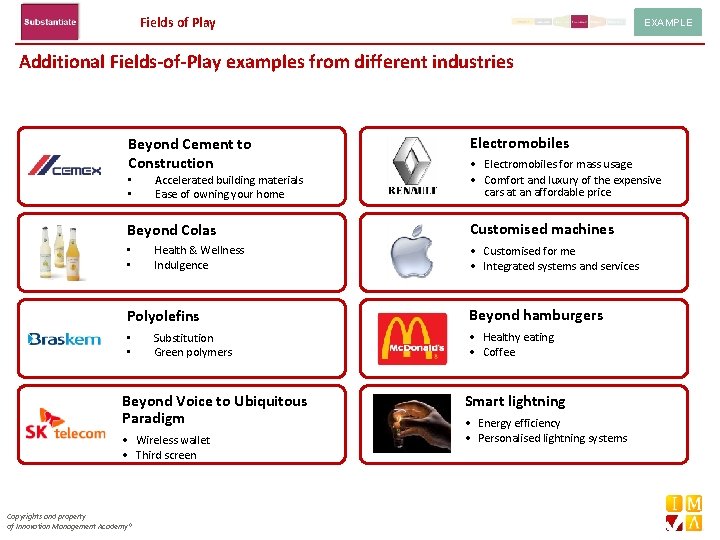
Fields of Play EXAMPLE Additional Fields-of-Play examples from different industries Beyond Cement to Construction Electromobiles Beyond Colas Customised machines • • Accelerated building materials Ease of owning your home Health & Wellness Indulgence Polyolefins • • Substitution Green polymers Beyond Voice to Ubiquitous Paradigm • Wireless wallet • Third screen Copyrights and property of Innovation Management Academy® • Electromobiles for mass usage • Comfort and luxury of the expensive cars at an affordable price • Customised for me • Integrated systems and services Beyond hamburgers • Healthy eating • Coffee Smart lightning • Energy efficiency • Personalised lightning systems
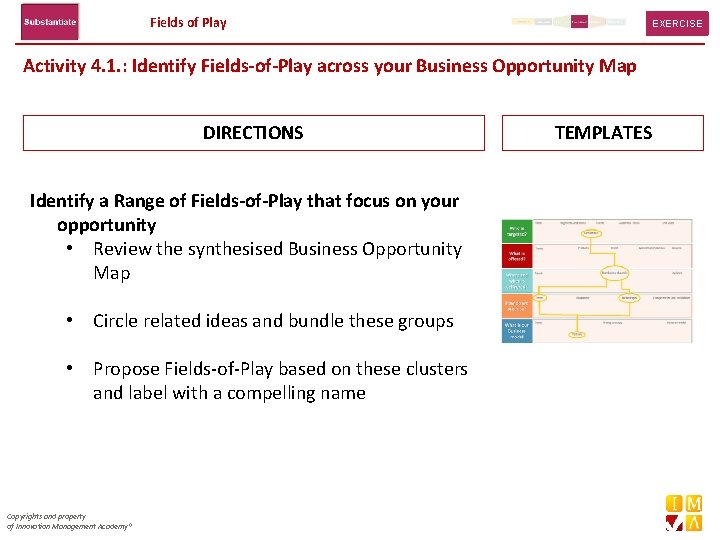
Fields of Play EXERCISE Activity 4. 1. : Identify Fields-of-Play across your Business Opportunity Map DIRECTIONS Identify a Range of Fields-of-Play that focus on your opportunity • Review the synthesised Business Opportunity Map • Circle related ideas and bundle these groups • Propose Fields-of-Play based on these clusters and label with a compelling name Copyrights and property of Innovation Management Academy® TEMPLATES
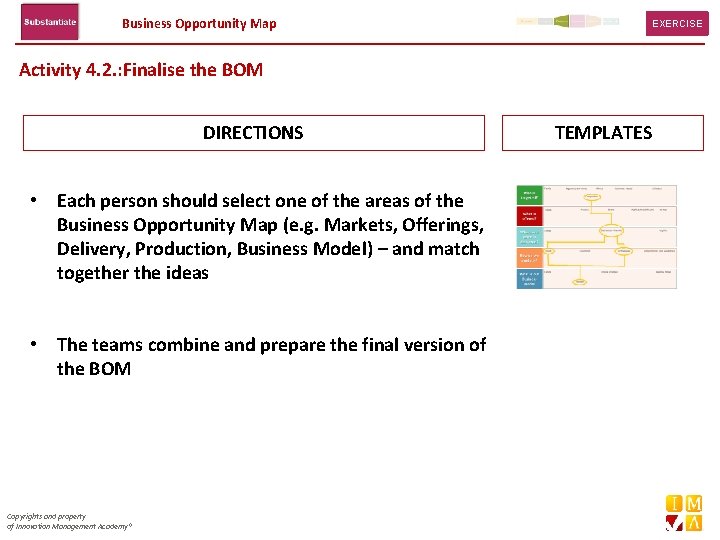
Business Opportunity Map EXERCISE Activity 4. 2. : Finalise the BOM DIRECTIONS • Each person should select one of the areas of the Business Opportunity Map (e. g. Markets, Offerings, Delivery, Production, Business Model) – and match together the ideas • The teams combine and prepare the final version of the BOM Copyrights and property of Innovation Management Academy® TEMPLATES
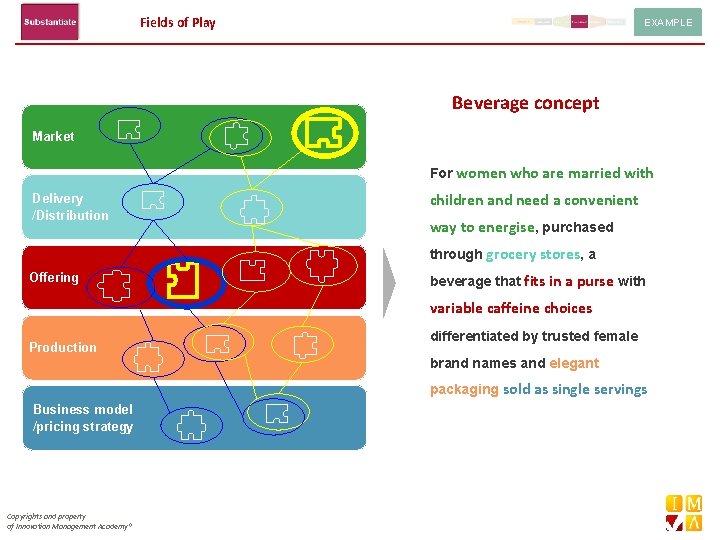
Fields of Play EXAMPLE Beverage concept Market For women who are married with Delivery /Distribution children and need a convenient way to energise, purchased through grocery stores, a Offering beverage that fits in a purse with variable caffeine choices Production differentiated by trusted female brand names and elegant packaging sold as single servings Business model /pricing strategy Copyrights and property of Innovation Management Academy®
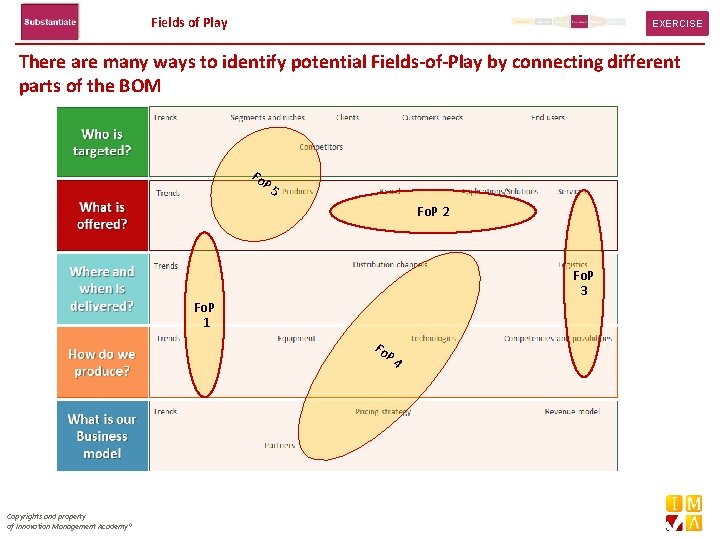
Fields of Play EXERCISE There are many ways to identify potential Fields-of-Play by connecting different parts of the BOM Fo P 5 Fo. P 2 Fo. P 3 Fo. P 1 Fo Copyrights and property of Innovation Management Academy® P 4
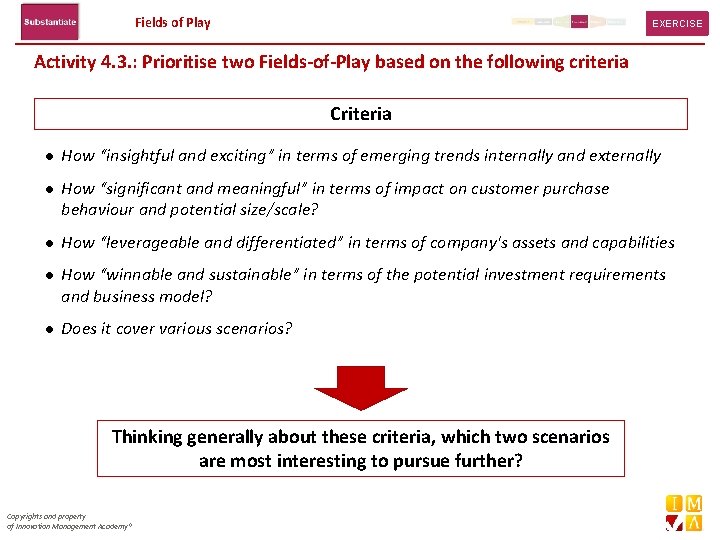
Fields of Play EXERCISE Activity 4. 3. : Prioritise two Fields-of-Play based on the following criteria Criteria l l l How “insightful and exciting” in terms of emerging trends internally and externally How “significant and meaningful” in terms of impact on customer purchase behaviour and potential size/scale? How “leverageable and differentiated” in terms of company's assets and capabilities How “winnable and sustainable” in terms of the potential investment requirements and business model? Does it cover various scenarios? Thinking generally about these criteria, which two scenarios are most interesting to pursue further? Copyrights and property of Innovation Management Academy®
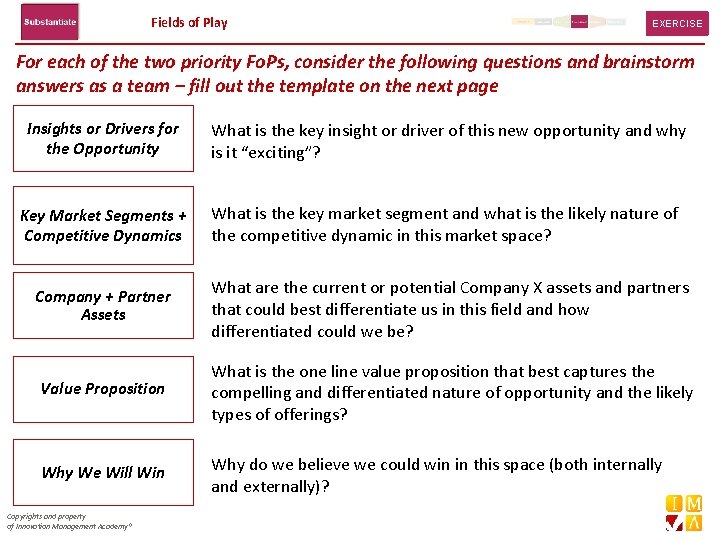
Fields of Play EXERCISE For each of the two priority Fo. Ps, consider the following questions and brainstorm answers as a team – fill out the template on the next page Insights or Drivers for the Opportunity What is the key insight or driver of this new opportunity and why is it “exciting”? Key Market Segments + Competitive Dynamics What is the key market segment and what is the likely nature of the competitive dynamic in this market space? Company + Partner Assets What are the current or potential Company X assets and partners that could best differentiate us in this field and how differentiated could we be? Value Proposition What is the one line value proposition that best captures the compelling and differentiated nature of opportunity and the likely types of offerings? Why We Will Win Why do we believe we could win in this space (both internally and externally)? Copyrights and property of Innovation Management Academy®
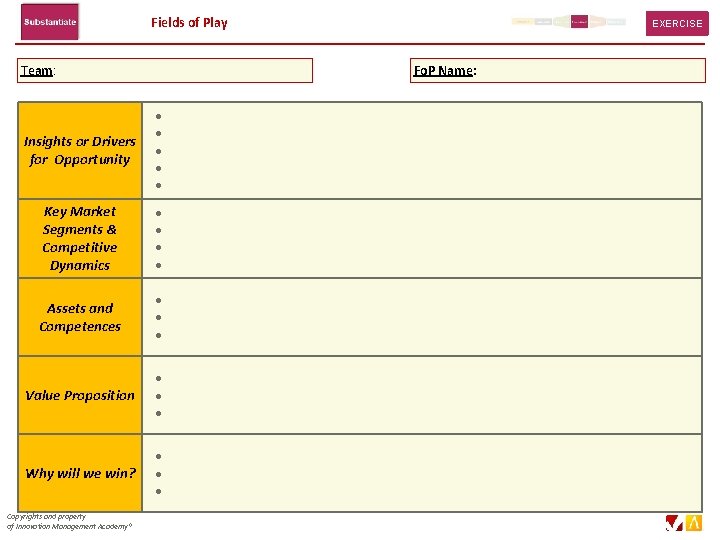
Fields of Play Team: Fo. P Name: l Insights or Drivers for Opportunity l l Key Market Segments & Competitive Dynamics Assets and Competences l l l l Value Proposition l l l Why will we win? l l Copyrights and property of Innovation Management Academy® EXERCISE
Fields of Play EXERCISE Summarize the journey and make a visualisation of the outcomes using images, drawings, videos, etc. It is time to present to the company representative Copyrights and property of Innovation Management Academy®
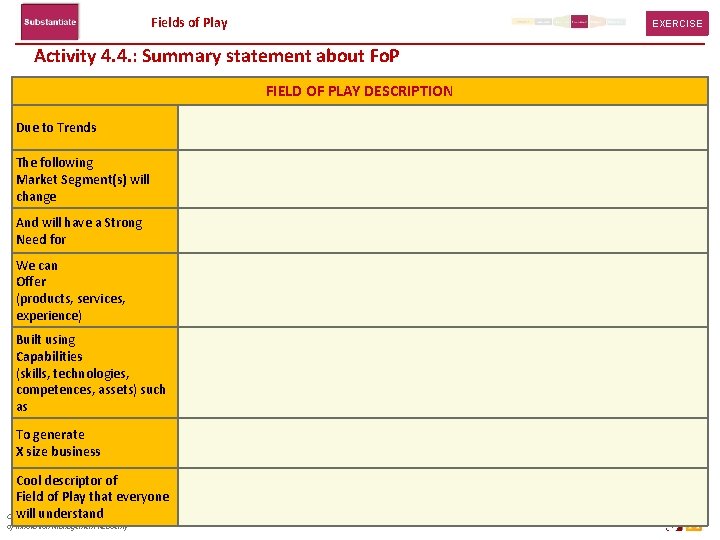
Fields of Play EXERCISE Activity 4. 4. : Summary statement about Fo. P FIELD OF PLAY DESCRIPTION Due to Trends The following Market Segment(s) will change And will have a Strong Need for We can Offer (products, services, experience) Built using Capabilities (skills, technologies, competences, assets) such as To generate X size business Cool descriptor of Field of Play that everyone will understand Copyrights and property of Innovation Management Academy®
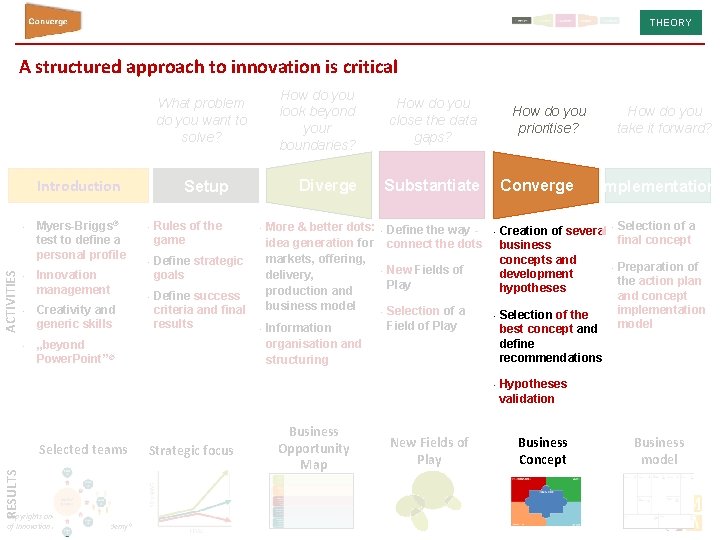
THEORY A structured approach to innovation is critical What problem do you want to solve? ACTIVITIES Introduction • Myers-Briggs® test to define a personal profile • Innovation management • • Creativity and generic skills • Rules of the game • Define strategic goals • Define success criteria and final results „beyond Power. Point”© Selected teams RESULTS Setup Copyrights and property of Innovation Management Academy® Strategic focus • • How do you look beyond your boundaries? How do you close the data gaps? Diverge Substantiate More & better dots: idea generation for markets, offering, delivery, production and business model Information organisation and structuring Business Opportunity Map • Define the way connect the dots • New Fields of Play • Selection of a Field of Play New Fields of Play How do you prioritise? Converge • How do you take it forward? Implementation Creation of several • business concepts and • development hypotheses • Selection of the best concept and define recommendations • Hypotheses validation Business Concept Selection of a final concept Preparation of the action plan and concept implementation model Business model 72
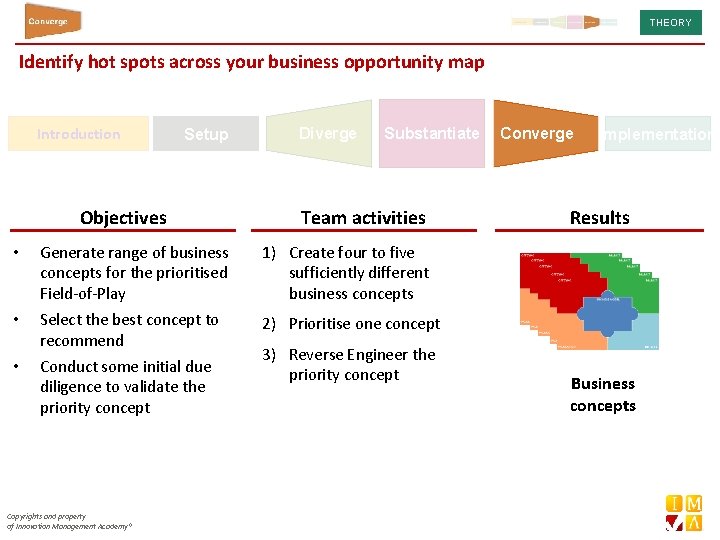
THEORY Identify hot spots across your business opportunity map Introduction Setup Objectives Diverge Substantiate Team activities • Generate range of business concepts for the prioritised Field-of-Play 1) Create four to five sufficiently different business concepts • Select the best concept to recommend 2) Prioritise one concept • Conduct some initial due diligence to validate the priority concept Copyrights and property of Innovation Management Academy® 3) Reverse Engineer the priority concept Converge Implementation Results Business concepts
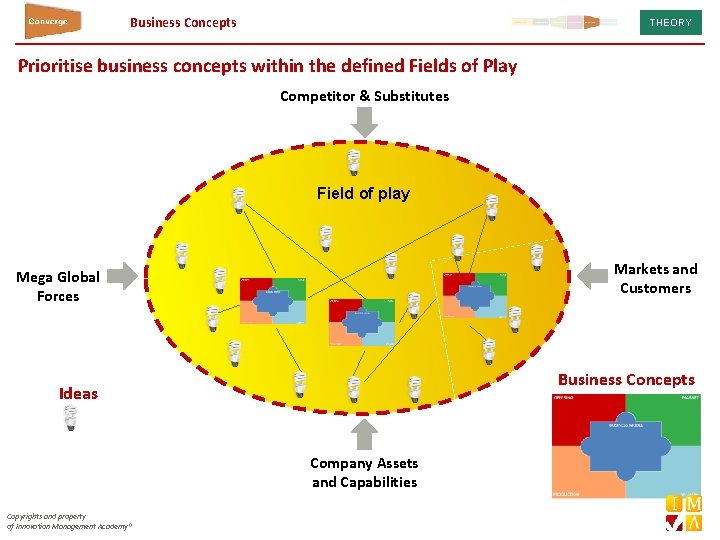
Business Concepts THEORY Prioritise business concepts within the defined Fields of Play Competitor & Substitutes Field of play Markets and Customers Mega Global Forces Business Concepts Ideas Company Assets and Capabilities Copyrights and property of Innovation Management Academy®
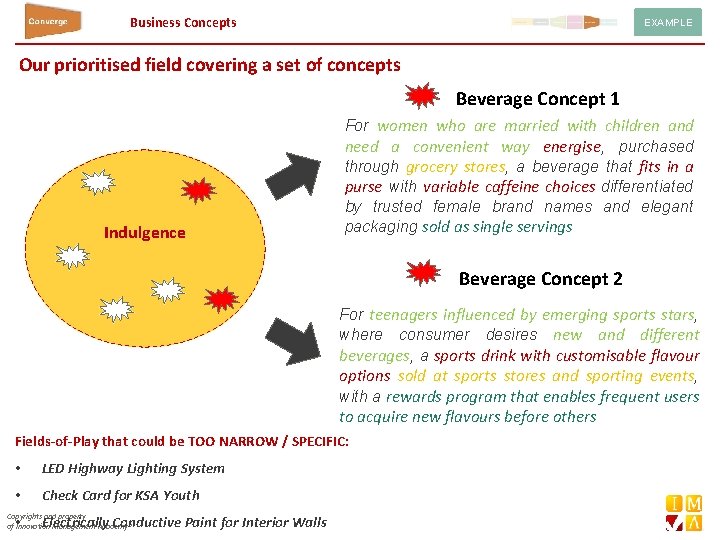
Business Concepts EXAMPLE Our prioritised field covering a set of concepts Beverage Concept 1 Indulgence For women who are married with children and need a convenient way energise, purchased through grocery stores, a beverage that fits in a purse with variable caffeine choices differentiated by trusted female brand names and elegant packaging sold as single servings Beverage Concept 2 For teenagers influenced by emerging sports stars, where consumer desires new and different beverages, a sports drink with customisable flavour options sold at sports stores and sporting events, with a rewards program that enables frequent users to acquire new flavours before others Fields-of-Play that could be TOO NARROW / SPECIFIC: • LED Highway Lighting System • Check Card for KSA Youth Copyrights and property of Innovation Management Academy® • Electrically Conductive Paint for Interior Walls
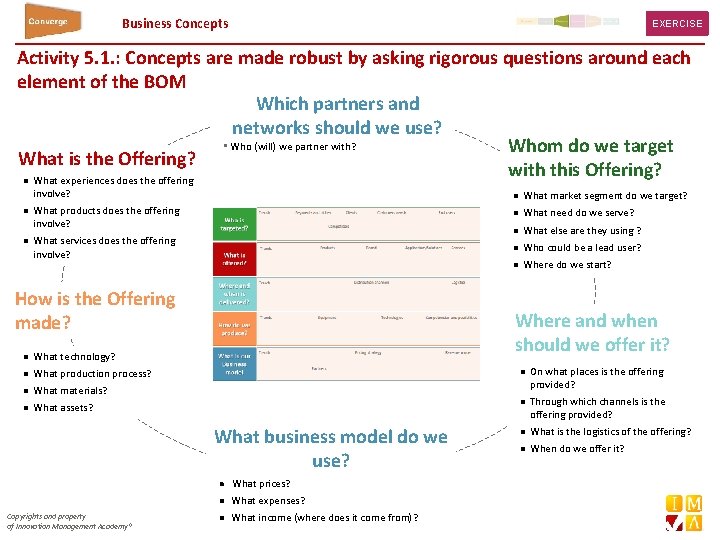
Business Concepts EXERCISE Activity 5. 1. : Concepts are made robust by asking rigorous questions around each element of the BOM Which partners and networks should we use? • Who (will) we partner with? Whom do we target What is the Offering? with this Offering? Which market segment? What experiences does the offering l l involve? l What market segment do we target? l What products does the offering involve? l What need do we serve? What services does the offering involve? l What else are they using ? l l Who could be a lead user? l Where do we start? How is the Offering made? l What technology? l What production process? l What materials? l What assets? Where and when should we offer it? What business model do we use? Copyrights and property of Innovation Management Academy® l What prices? l What expenses? l What income (where does it come from)? l On what places is the offering provided? l Through which channels is the offering provided? l What is the logistics of the offering? l When do we offer it? 76
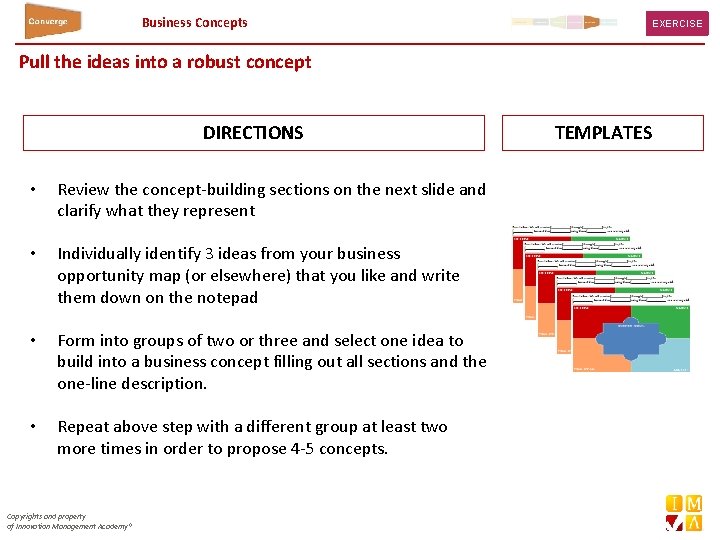
Business Concepts EXERCISE Pull the ideas into a robust concept DIRECTIONS • Review the concept-building sections on the next slide and clarify what they represent • Individually identify 3 ideas from your business opportunity map (or elsewhere) that you like and write them down on the notepad • Form into groups of two or three and select one idea to build into a business concept filling out all sections and the one-line description. • Repeat above step with a different group at least two more times in order to propose 4 -5 concepts. Copyrights and property of Innovation Management Academy® TEMPLATES
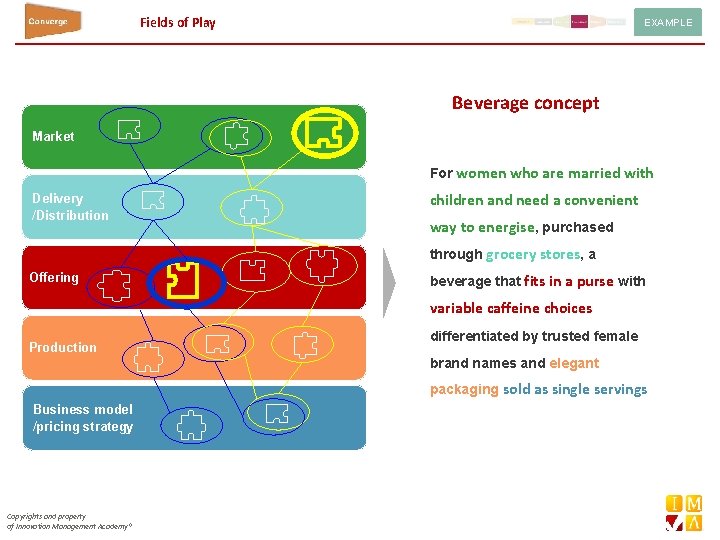
Fields of Play EXAMPLE Beverage concept Market For women who are married with Delivery /Distribution children and need a convenient way to energise, purchased through grocery stores, a Offering beverage that fits in a purse with variable caffeine choices Production differentiated by trusted female brand names and elegant packaging sold as single servings Business model /pricing strategy Copyrights and property of Innovation Management Academy®
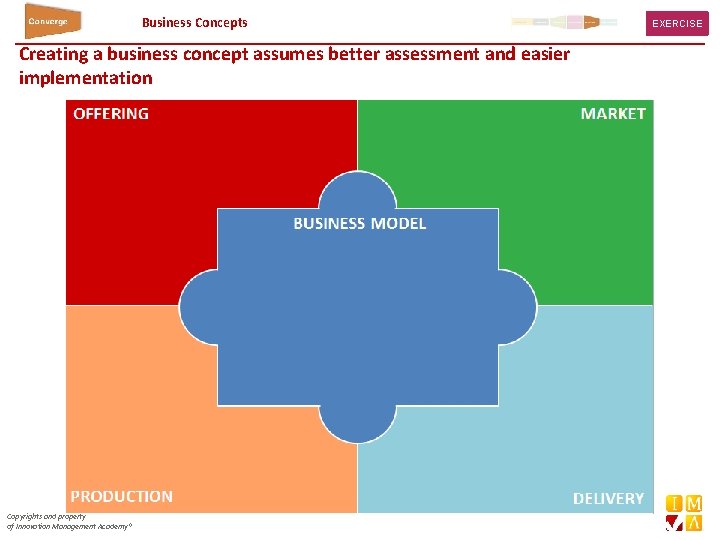
Business Concepts Creating a business concept assumes better assessment and easier implementation Copyrights and property of Innovation Management Academy® EXERCISE
![Business Concepts Team Name: EXERCISE Concept Name: Description: We will provide [______] through [______]](http://slidetodoc.com/presentation_image_h/9a9ccfa23ceabdd8ece78be6921e19dd/image-80.jpg "Business Concepts Team Name: EXERCISE Concept Name: Description: We will provide [______] through [______]")
Business Concepts Team Name: EXERCISE Concept Name: Description: We will provide [______] through [______] to / for [______] to meet this [______] using these [______] and winning with [______] Copyrights and property of Innovation Management Academy®
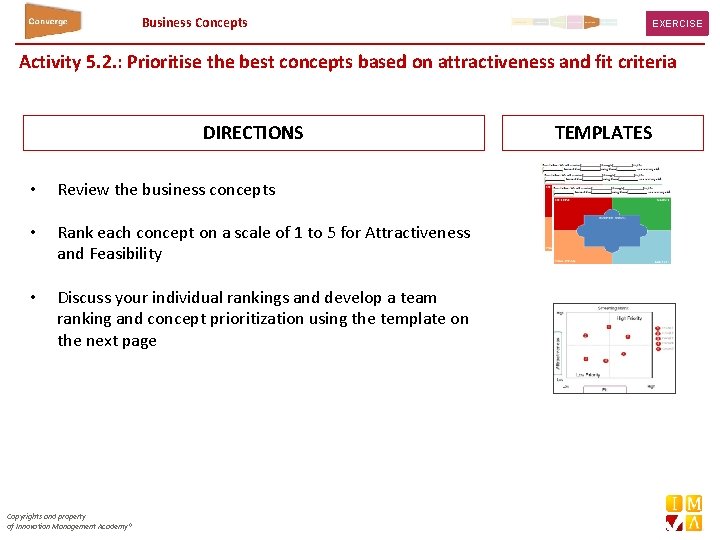
Business Concepts EXERCISE Activity 5. 2. : Prioritise the best concepts based on attractiveness and fit criteria DIRECTIONS • Review the business concepts • Rank each concept on a scale of 1 to 5 for Attractiveness and Feasibility • Discuss your individual rankings and develop a team ranking and concept prioritization using the template on the next page Copyrights and property of Innovation Management Academy® TEMPLATES
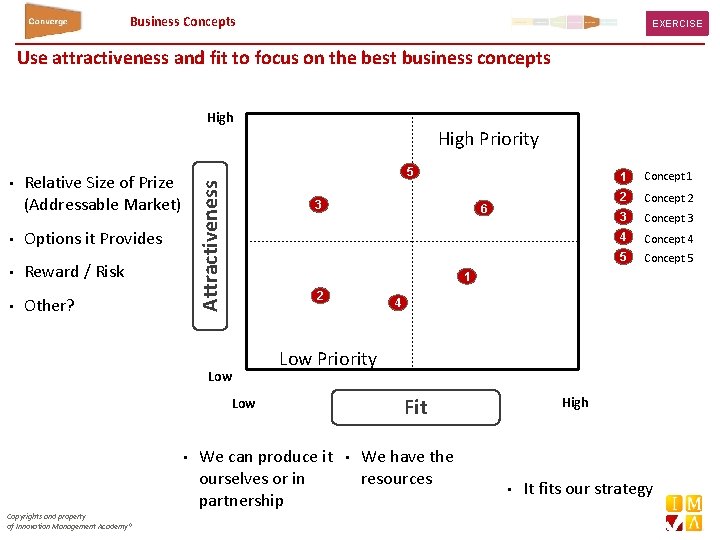
Business Concepts EXERCISE Use attractiveness and fit to focus on the best business concepts High Priority • Relative Size of Prize (Addressable Market) Attractiveness • 5 Options it Provides • Reward / Risk • Other? 3 6 2 2 Concept 2 3 Concept 3 4 Concept 4 5 Concept 5 4 Low Priority Fit Low Copyrights and property of Innovation Management Academy® Concept 1 1 Low • 1 We can produce it ourselves or in partnership • We have the resources High • It fits our strategy
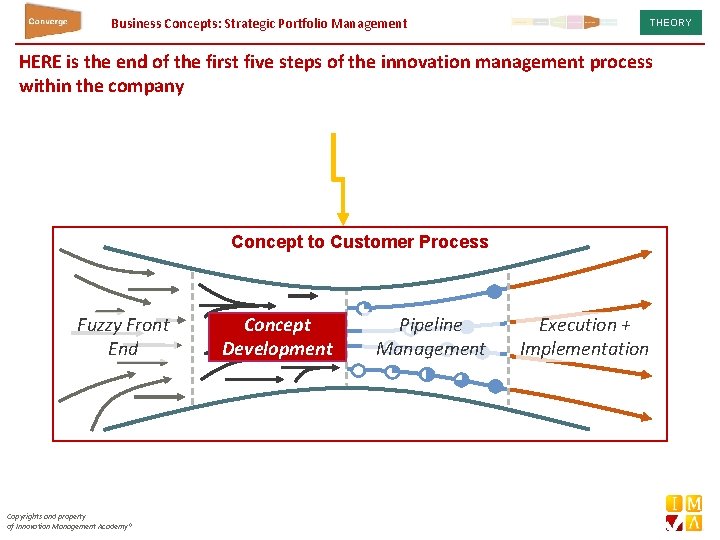
Business Concepts: Strategic Portfolio Management THEORY HERE is the end of the first five steps of the innovation management process within the company Concept to Customer Process Fuzzy Front End Copyrights and property of Innovation Management Academy® Concept Development Pipeline Management Execution + Implementation
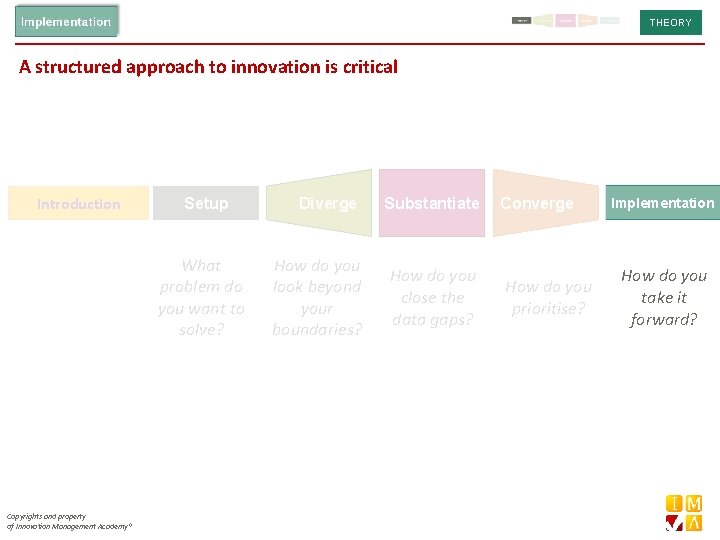
THEORY A structured approach to innovation is critical Introduction Setup What problem do you want to solve? Copyrights and property of Innovation Management Academy® Diverge Substantiate How do you look beyond your boundaries? How do you close the data gaps? Converge How do you prioritise? Implementation How do you take it forward? 84
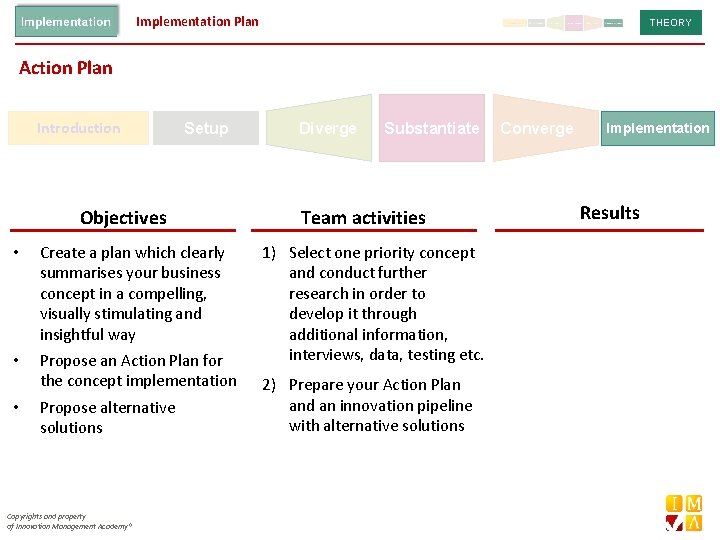
Implementation Plan THEORY Action Plan Introduction Setup Objectives • Create a plan which clearly summarises your business concept in a compelling, visually stimulating and insightful way • Propose an Action Plan for the concept implementation • Propose alternative solutions Copyrights and property of Innovation Management Academy® Diverge Substantiate Team activities 1) Select one priority concept and conduct further research in order to develop it through additional information, interviews, data, testing etc. 2) Prepare your Action Plan and an innovation pipeline with alternative solutions Converge Implementation Results
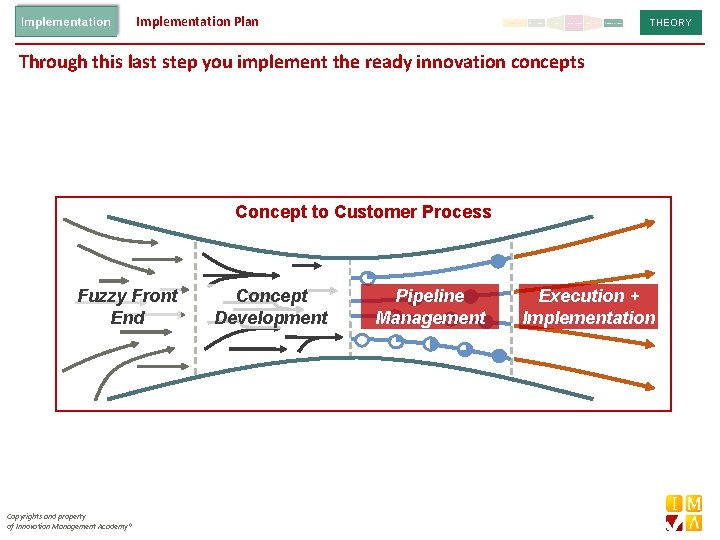
Implementation Plan THEORY Through this last step you implement the ready innovation concepts Concept to Customer Process Fuzzy Front End Copyrights and property of Innovation Management Academy® Concept Development Pipeline Management Execution + Implementation
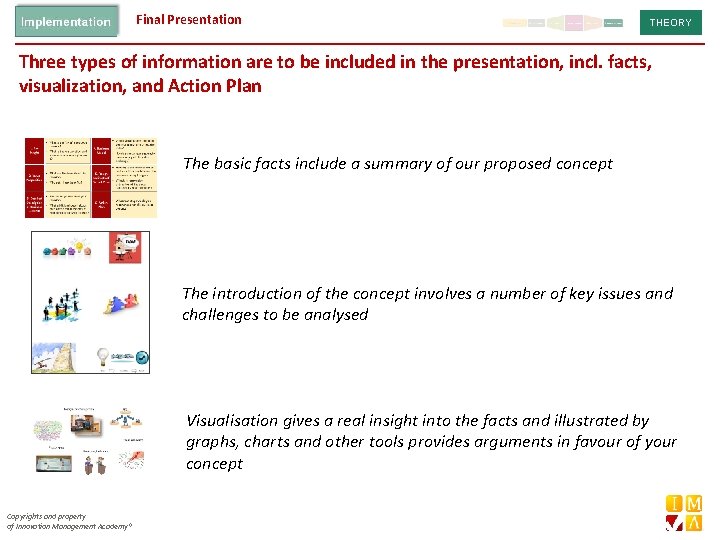
Final Presentation THEORY Three types of information are to be included in the presentation, incl. facts, visualization, and Action Plan The basic facts include a summary of our proposed concept The introduction of the concept involves a number of key issues and challenges to be analysed Visualisation gives a real insight into the facts and illustrated by graphs, charts and other tools provides arguments in favour of your concept Copyrights and property of Innovation Management Academy®
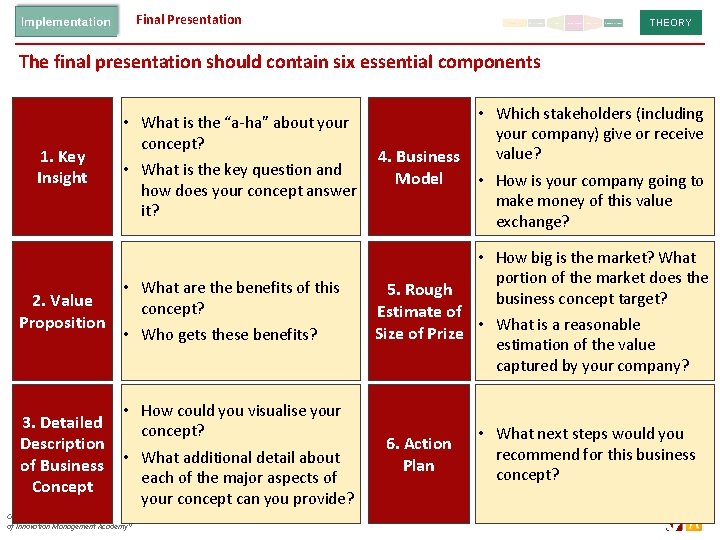
Final Presentation THEORY The final presentation should contain six essential components 1. Key Insight 2. Value Proposition • What is the “a-ha” about your concept? • What is the key question and how does your concept answer it? • What are the benefits of this concept? • Who gets these benefits? • How could you visualise your 3. Detailed concept? Description of Business • What additional detail about each of the major aspects of Concept your concept can you provide? Copyrights and property of Innovation Management Academy® • Which stakeholders (including your company) give or receive 3. Detailed value? 4. Business Description of Business Model • How is your company going to Concept make money of this value exchange? • How big is the market? What portion of the market does the business concept target? 5. Rough Estimate of Size of Prize • What is a reasonable estimation of the value captured by your company? 6. Action Plan • What next steps would you recommend for this business concept?
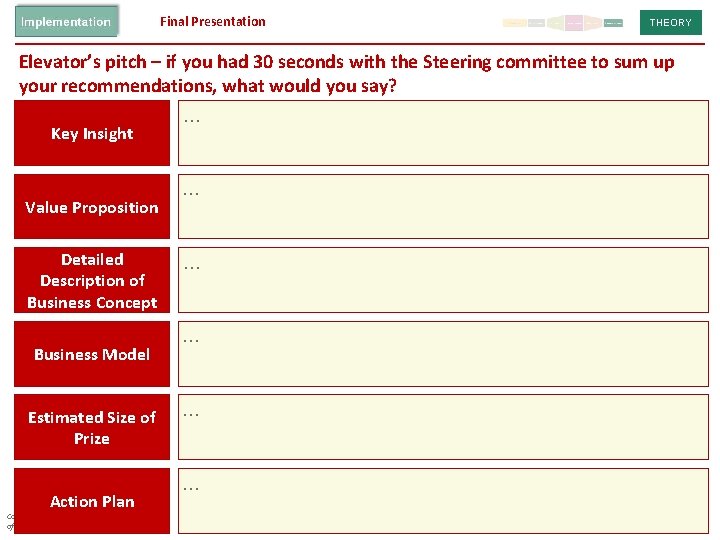
Final Presentation THEORY Elevator’s pitch – if you had 30 seconds with the Steering committee to sum up your recommendations, what would you say? Key Insight Value Proposition Detailed Description of Business Concept Business Model Estimated Size of Prize Action Plan Copyrights and property of Innovation Management Academy® … … …
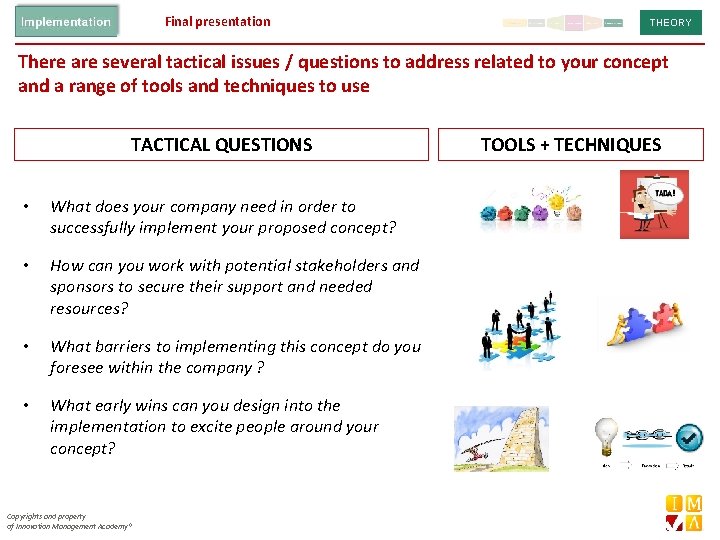
Final presentation THEORY There are several tactical issues / questions to address related to your concept and a range of tools and techniques to use TACTICAL QUESTIONS • What does your company need in order to successfully implement your proposed concept? • How can you work with potential stakeholders and sponsors to secure their support and needed resources? • What barriers to implementing this concept do you foresee within the company ? • What early wins can you design into the implementation to excite people around your concept? Copyrights and property of Innovation Management Academy® TOOLS + TECHNIQUES
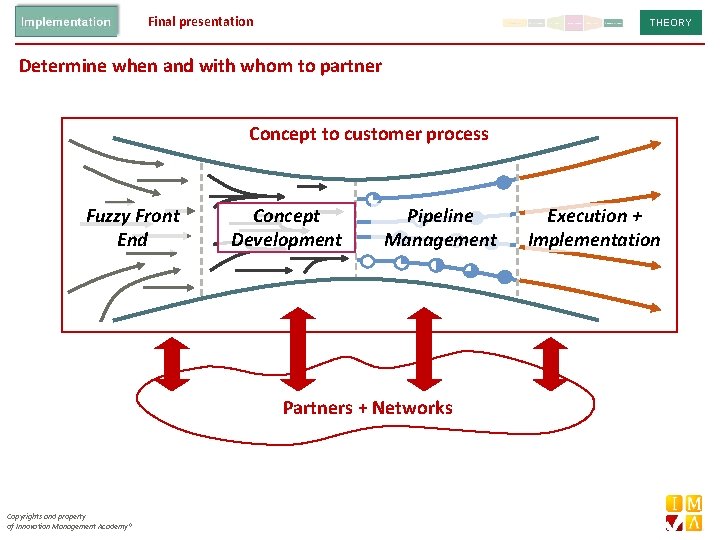
Final presentation THEORY Determine when and with whom to partner Concept to customer process Fuzzy Front End Concept Development Pipeline Management Execution + Implementation Partners + Networks Copyrights and property of Innovation Management Academy® 91
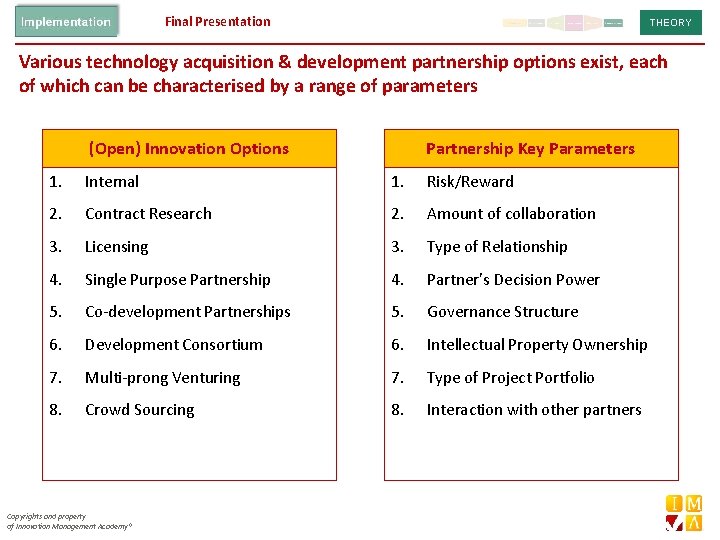
Final Presentation THEORY Various technology acquisition & development partnership options exist, each of which can be characterised by a range of parameters (Open) Innovation Options Partnership Key Parameters 1. Internal 1. Risk/Reward 2. Contract Research 2. Amount of collaboration 3. Licensing 3. Type of Relationship 4. Single Purpose Partnership 4. Partner’s Decision Power 5. Co-development Partnerships 5. Governance Structure 6. Development Consortium 6. Intellectual Property Ownership 7. Multi-prong Venturing 7. Type of Project Portfolio 8. Crowd Sourcing 8. Interaction with other partners Copyrights and property of Innovation Management Academy® 92
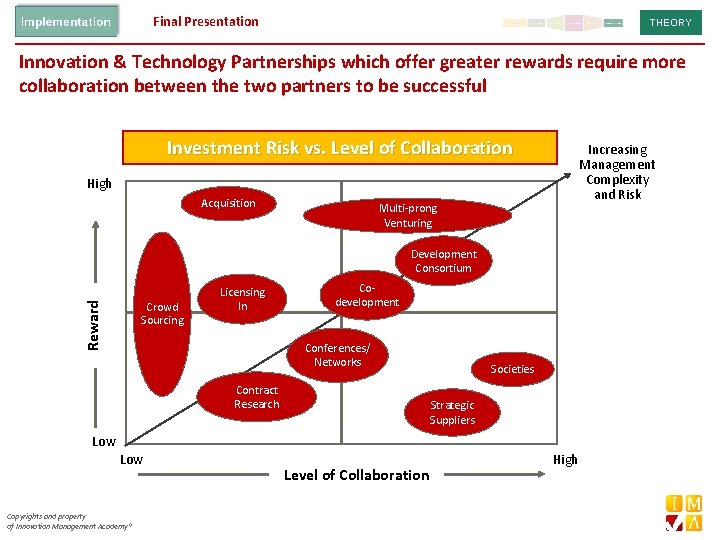
Final Presentation THEORY Innovation & Technology Partnerships which offer greater rewards require more collaboration between the two partners to be successful Investment Risk vs. Level of Collaboration Increasing Management Complexity and Risk High Acquisition Multi-prong Joint Venturing Venture Development Consortium Reward Crowd Sourcing Licensing In Codevelopment Strategic Conferences/ Suppliers Networks Contract Research Societies Strategic Suppliers Low Copyrights and property of Innovation Management Academy® Level of Collaboration High 93
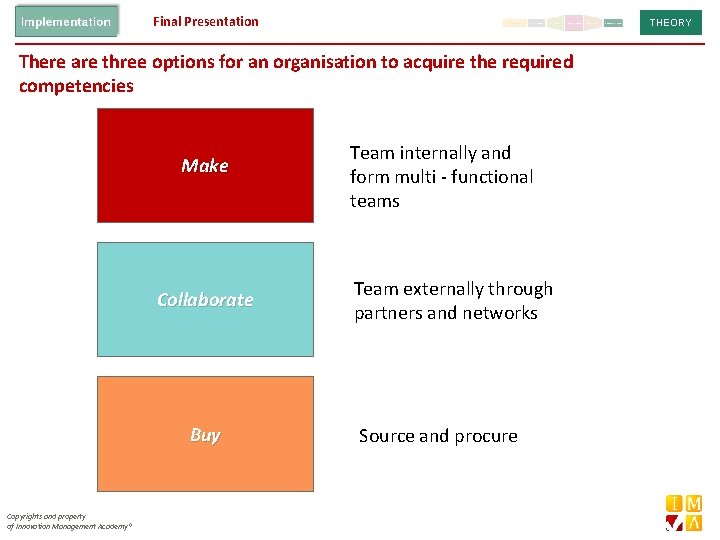
Final Presentation THEORY There are three options for an organisation to acquire the required competencies Make Collaborate Buy Copyrights and property of Innovation Management Academy® Team internally and form multi - functional teams Team externally through partners and networks Source and procure 94
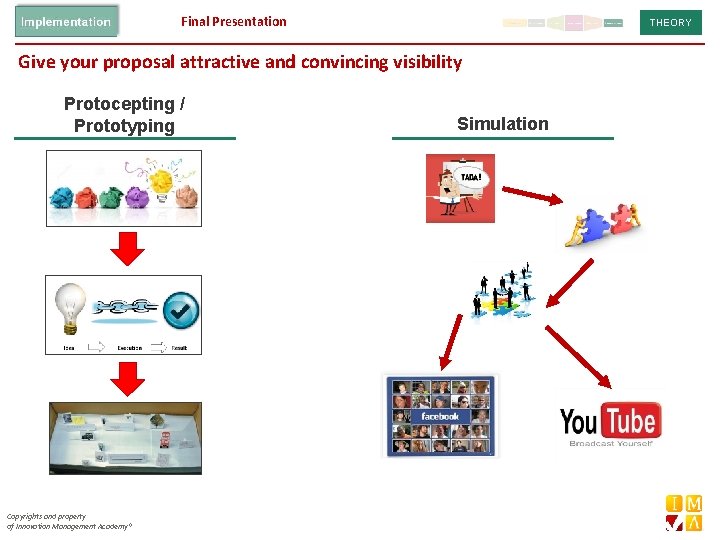
Final Presentation THEORY Give your proposal attractive and convincing visibility Protocepting / Прототипиране Prototyping Copyrights and property of Innovation Management Academy® Simulation 95
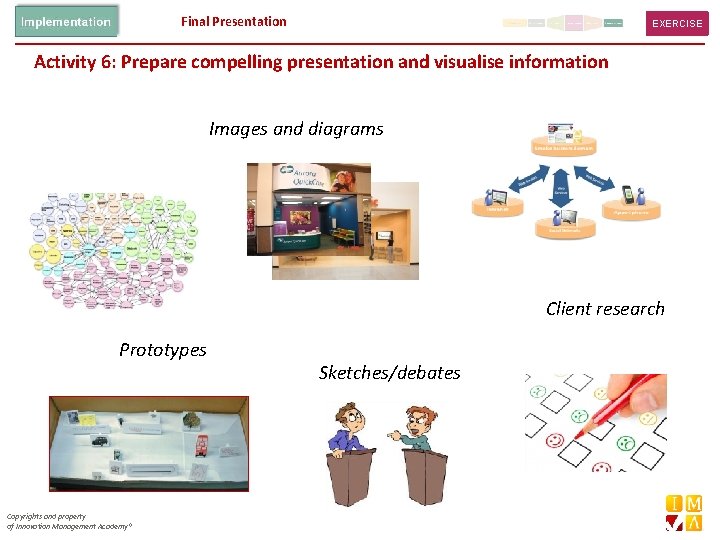
Final Presentation EXERCISE Activity 6: Prepare compelling presentation and visualise information Images and diagrams Client research Prototypes Copyrights and property of Innovation Management Academy® Sketches/debates 96
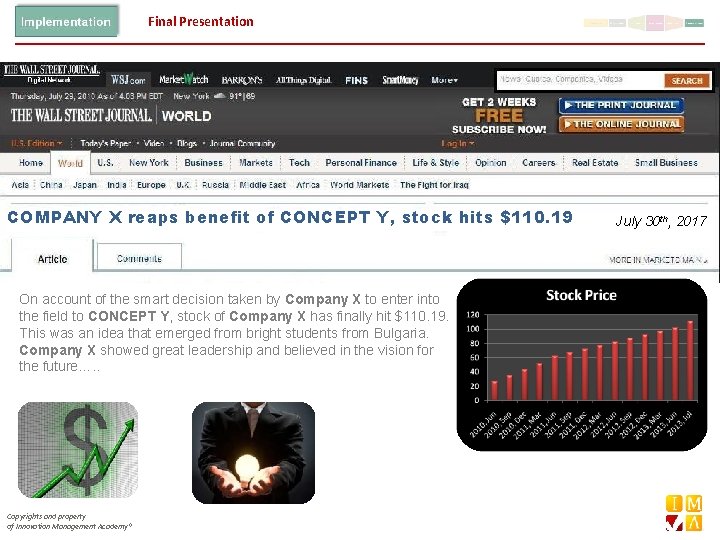
Final Presentation COMPANY X reaps benefit of CONCEPT Y, stock hits $110. 19 July 30 th, 2017 On account of the smart decision taken by Company X to enter into the field to CONCEPT Y, stock of Company X has finally hit $110. 19. This was an idea that emerged from bright students from Bulgaria. Company X showed great leadership and believed in the vision for the future…. . Copyrights and property of Innovation Management Academy® 97

THANK YOU!
HOW TO CONTACT US! @ m. koleva@hiron-mc. com, office@innovationmanagement. academy Ph: +359 2 489 0096; +359 887 648 282 www. innovationmanagement. academy Innovation Management Academy SEE Innovation Management Academy IMAcademy_BG Copyrights and property of Innovation Management Academy® 99
- Slides: 99