
Innovation in the editorial process Perspectives from Elsevier
- Slides: 14
Innovation in the editorial process Perspectives from Elsevier journal publishing Forum on the Dynamics of Science Publishing Cornell, 9 October 2008 Friso Veenstra Publisher, Earth & Planetary Sciences Elsevier S&T
A long history of science publishing The Publishing House of Elzevir was first established in 1580 by Lowys (Louis) Elzevir at the University of Leiden, Holland Galileo published his last work, “Discorsi e dimostrazioni matematiche, intoro a due nuoue scienze“ with Elzevir – despite being banned by the Inquisition – which is recognized as the first important work of modern physics Keeping to the tradition of publishing established by Lowys Elzevir, Jacobus George Robbers established the modern Elsevier Company in 1880 2
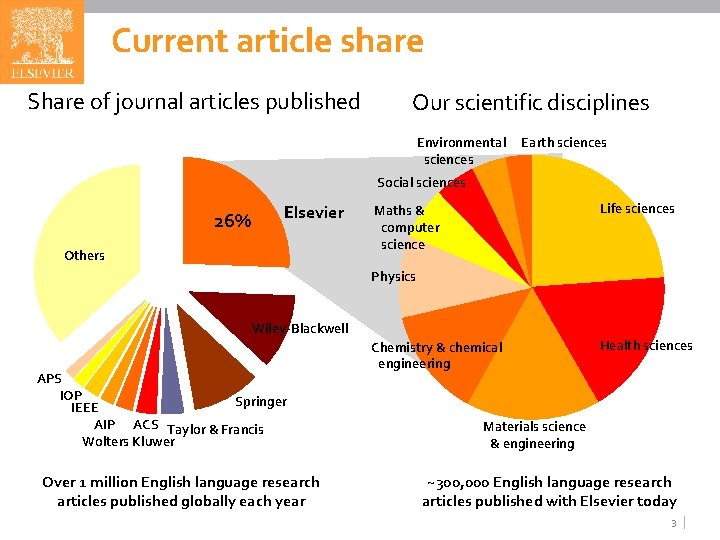
Current article share Share of journal articles published Our scientific disciplines Environmental sciences Earth sciences Social sciences 26% Elsevier Others Life sciences Maths & computer science Physics Wiley-Blackwell APS IOP Springer IEEE AIP ACS Taylor & Francis Wolters Kluwer Over 1 million English language research articles published globally each year Chemistry & chemical engineering Health sciences Materials science & engineering ~300, 000 English language research articles published with Elsevier today 3
Elsevier’s journal program today § Over 2, 000 journals spread over two divisions; “Science & Technology” and “Health Sciences” § S&T Journals managed by 6 publishing groups, each specialising in a cluster of subject areas § Each publishing group contains a number of journal portfolios specific to a discipline/community, e. g. , earth & planetary sciences. There are 46 journal portfolios in total § And I am responsible for journals in geochemistry, hydrology, atmospheric science, and planetary science …. 4
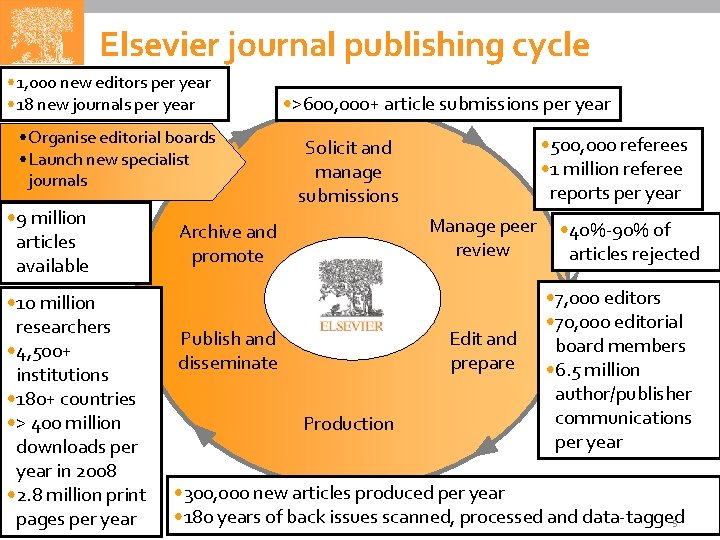
Elsevier journal publishing cycle • 1, 000 new editors per year • 18 new journals per year • Organise editorial boards • Launch new specialist journals • 9 million articles available • 10 million researchers • 4, 500+ institutions • 180+ countries • > 400 million downloads per year in 2008 • 2. 8 million print pages per year • >600, 000+ article submissions per year • 500, 000 referees • 1 million referee reports per year Solicit and manage submissions Manage peer review Archive and promote Publish and disseminate Edit and prepare Production • 40%-90% of articles rejected • 7, 000 editors • 70, 000 editorial board members • 6. 5 million author/publisher communications per year • 300, 000 new articles produced per year • 180 years of back issues scanned, processed and data-tagged 5
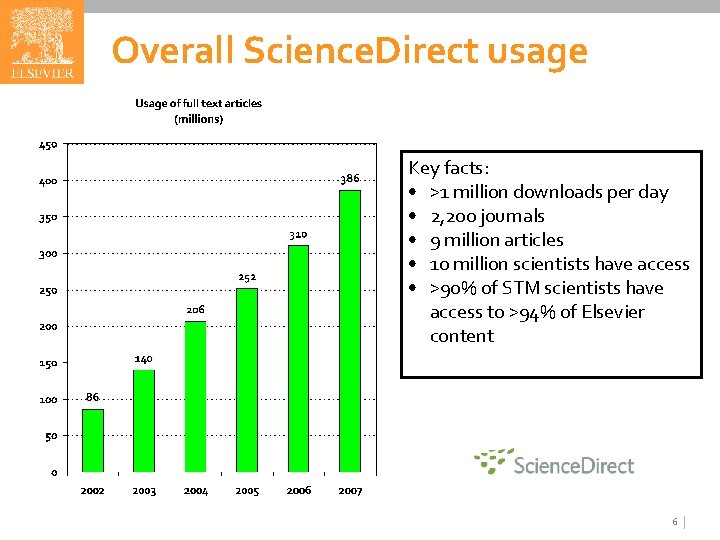
Overall Science. Direct usage Key facts: • >1 million downloads per day • 2, 200 journals • 9 million articles • 10 million scientists have access • >90% of STM scientists have access to >94% of Elsevier content 6
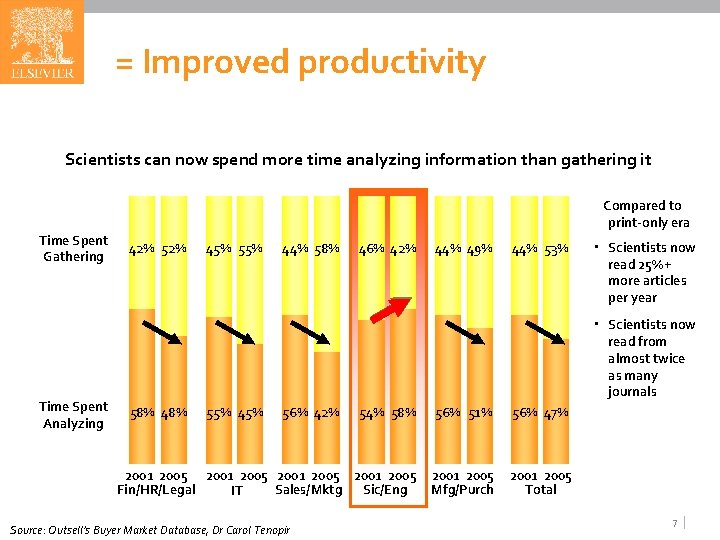
= Improved productivity Scientists can now spend more time analyzing information than gathering it Compared to print-only era Time Spent Gathering Time Spent Analyzing 42% 52% 45% 55% 44% 58% 46% 42% 44% 49% 44% 53% • Scientists now read 25%+ more articles per year • Scientists now read from almost twice as many journals 58% 48% 55% 45% 56% 42% 54% 58% 56% 51% 56% 47% 2001 2005 Sales/Mktg Sic/Eng Fin/HR/Legal IT 2001 2005 Mfg/Purch 2001 2005 Total Source: Outsell’s Buyer Market Database, Dr Carol Tenopir 7
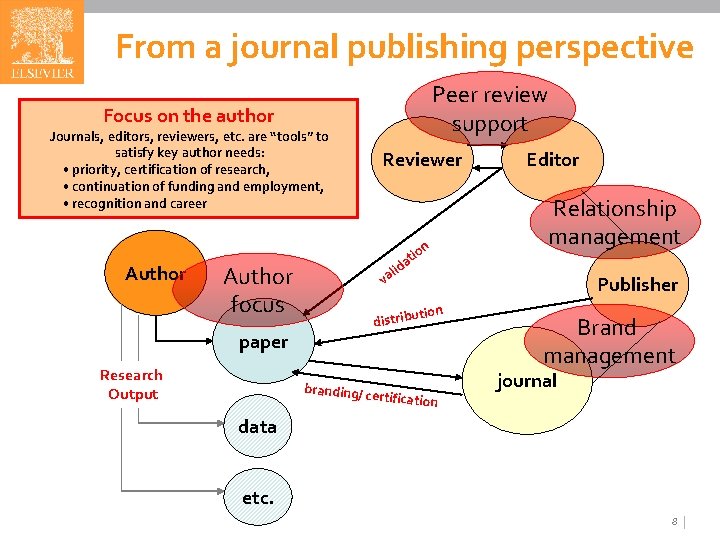
From a journal publishing perspective Peer review support Focus on the author Journals, editors, reviewers, etc. are “tools” to satisfy key author needs: • priority, certification of research, • continuation of funding and employment, • recognition and career Reviewer n Author Relationship management d li va Author focus Publisher ution distrib paper Research Output io at Editor branding/ c ertification Brand management journal data etc. 8
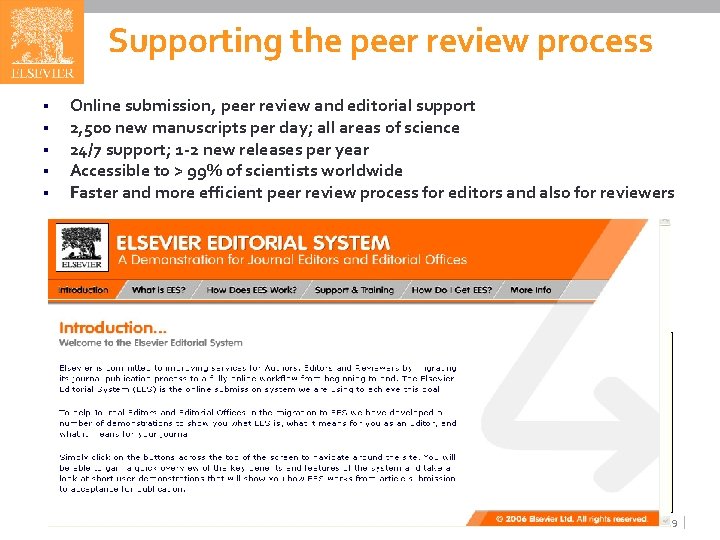
Supporting the peer review process § § § Online submission, peer review and editorial support 2, 500 new manuscripts per day; all areas of science 24/7 support; 1 -2 new releases per year Accessible to > 99% of scientists worldwide Faster and more efficient peer review process for editors and also for reviewers Final decision much faster: from 26 to 17 weeks! - /- 50% Reviewing times go down by 50% + 20 -30% Editors handle 20 – 30% more papers in the same amount of time 9
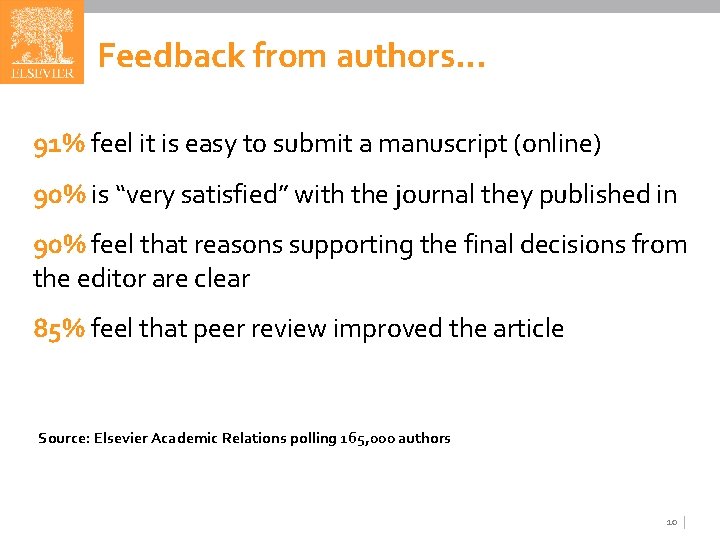
Feedback from authors… 91% feel it is easy to submit a manuscript (online) 90% is “very satisfied” with the journal they published in 90% feel that reasons supporting the final decisions from the editor are clear 85% feel that peer review improved the article Source: Elsevier Academic Relations polling 165, 000 authors 10
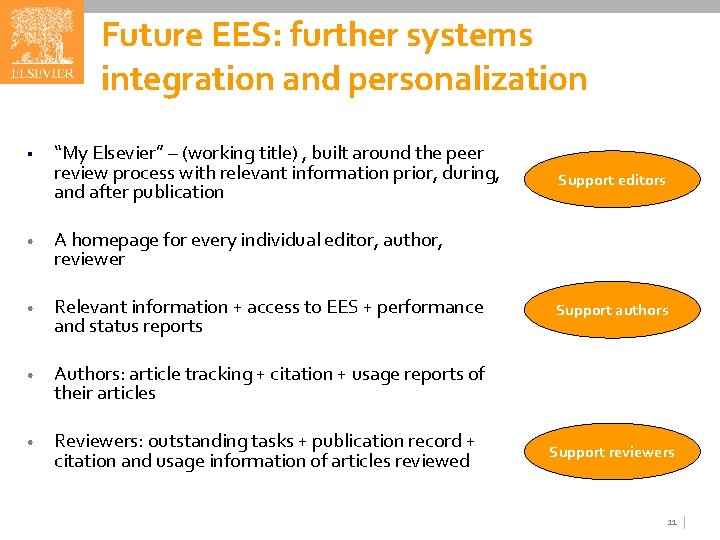
Future EES: further systems integration and personalization § “My Elsevier” – (working title) , built around the peer review process with relevant information prior, during, and after publication • A homepage for every individual editor, author, reviewer r • Relevant information + access to EES + performance and status reports • Authors: article tracking + citation + usage reports of their articles • Reviewers: outstanding tasks + publication record + citation and usage information of articles reviewed Support editors Support authors Support reviewers 11
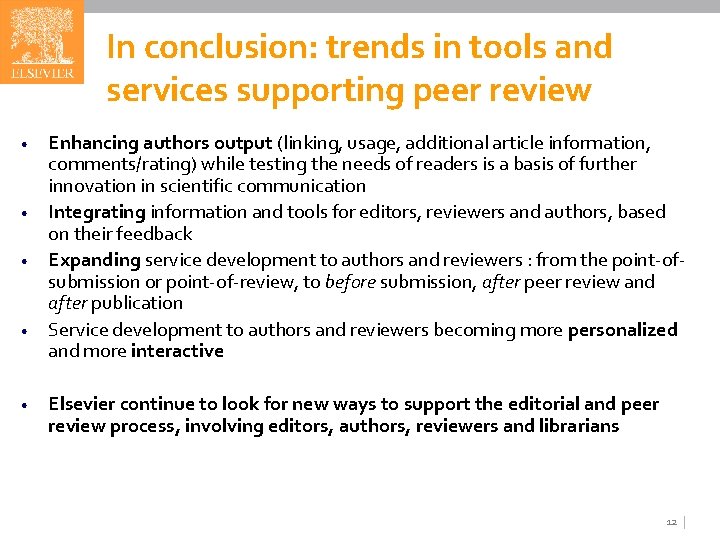
In conclusion: trends in tools and services supporting peer review • • • Enhancing authors output (linking, usage, additional article information, comments/rating) while testing the needs of readers is a basis of further innovation in scientific communication Integrating information and tools for editors, reviewers and authors, based on their feedback Expanding service development to authors and reviewers : from the point-ofsubmission or point-of-review, to before submission, after peer review and after publication Service development to authors and reviewers becoming more personalized and more interactive Elsevier continue to look for new ways to support the editorial and peer review process, involving editors, authors, reviewers and librarians 12
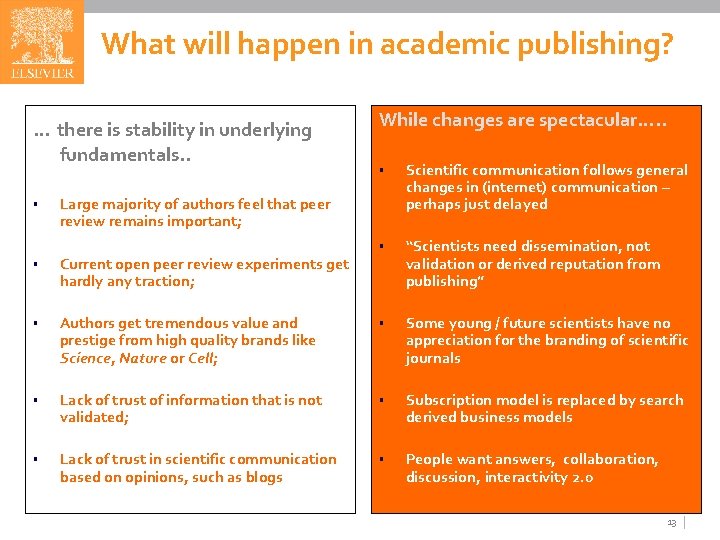
What will happen in academic publishing? … there is stability in underlying fundamentals. . § While changes are spectacular…. . § Scientific communication follows general changes in (internet) communication – perhaps just delayed § “Scientists need dissemination, not validation or derived reputation from publishing” Large majority of authors feel that peer review remains important; § Current open peer review experiments get hardly any traction; § Authors get tremendous value and prestige from high quality brands like Science, Nature or Cell; § Some young / future scientists have no appreciation for the branding of scientific journals § Lack of trust of information that is not validated; § Subscription model is replaced by search derived business models § Lack of trust in scientific communication based on opinions, such as blogs § People want answers, collaboration, discussion, interactivity 2. 0 13
Thank you Any questions? 14