
Innovation and Strategies in Supply Chain Management David

- Slides: 75
Innovation and Strategies in Supply Chain Management David Simchi-Levi Professor of Engineering Systems Massachusetts Institute of Technology Tel: 617 -253 -6160 E-mail: dslevi@mit. edu
Outline of the Presentation u Introduction u Push-Pull Systems u Supply Contracts ©Copyright 2004 D. Simchi-Levi
Today’s Supply Chain Pitfalls • • • Long Lead Times Uncertain Demand Complex Product Offering Component Availability System Variation Over Time ©Copyright 2004 D. Simchi-Levi
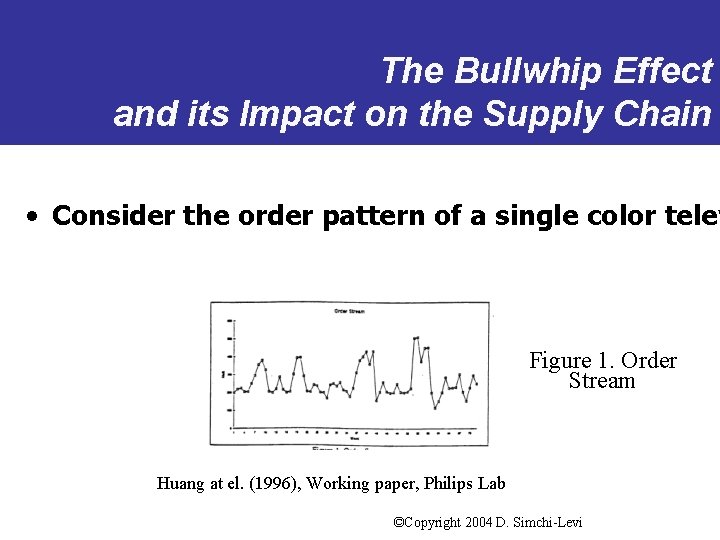
The Bullwhip Effect and its Impact on the Supply Chain • Consider the order pattern of a single color telev Figure 1. Order Stream Huang at el. (1996), Working paper, Philips Lab ©Copyright 2004 D. Simchi-Levi
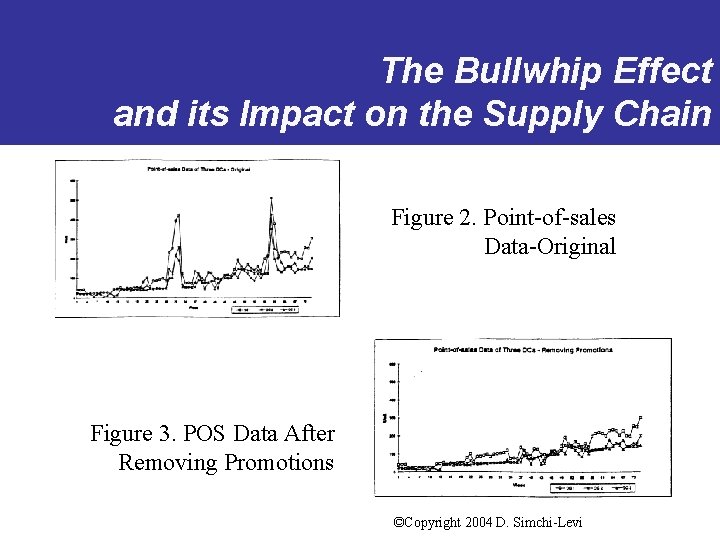
The Bullwhip Effect and its Impact on the Supply Chain Figure 2. Point-of-sales Data-Original Figure 3. POS Data After Removing Promotions ©Copyright 2004 D. Simchi-Levi
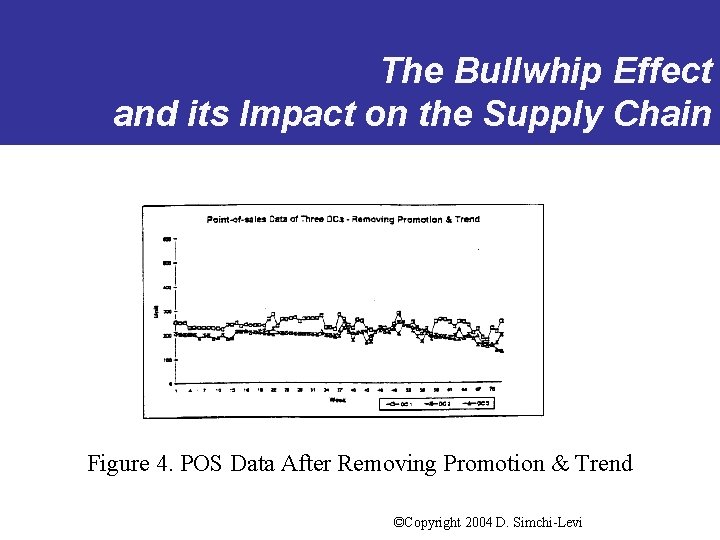
The Bullwhip Effect and its Impact on the Supply Chain Figure 4. POS Data After Removing Promotion & Trend ©Copyright 2004 D. Simchi-Levi
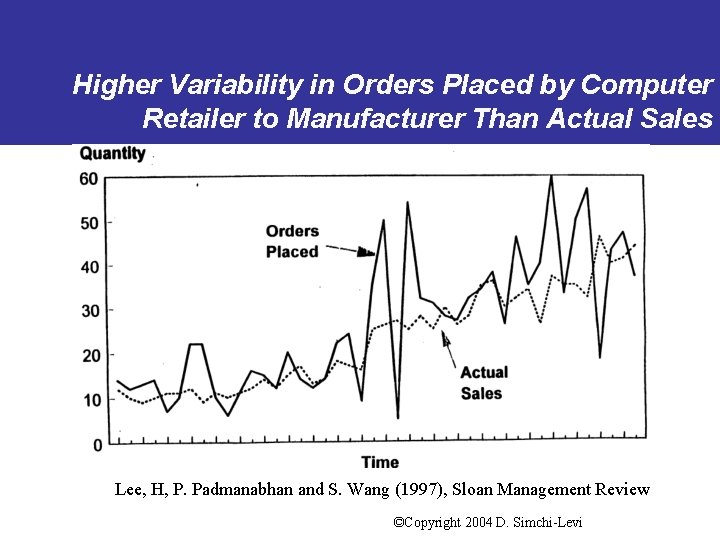
Higher Variability in Orders Placed by Computer Retailer to Manufacturer Than Actual Sales Lee, H, P. Padmanabhan and S. Wang (1997), Sloan Management Review ©Copyright 2004 D. Simchi-Levi
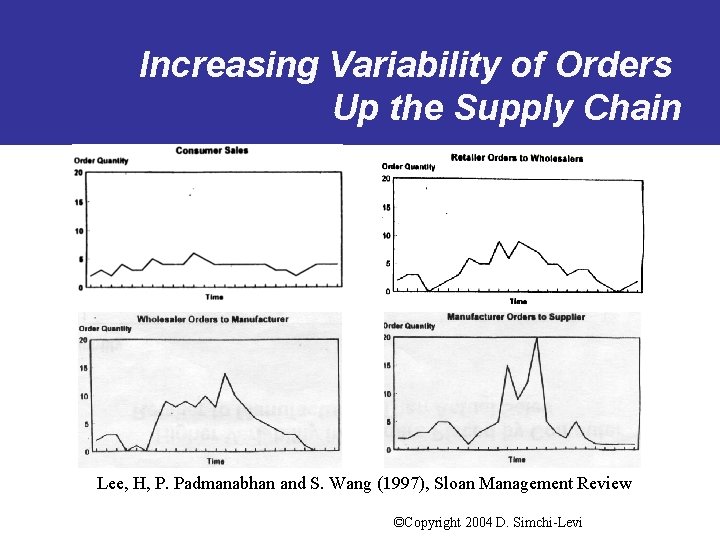
Increasing Variability of Orders Up the Supply Chain Lee, H, P. Padmanabhan and S. Wang (1997), Sloan Management Review ©Copyright 2004 D. Simchi-Levi
We Conclude …. • Order Variability is amplified up the supply chain; upstream echelons face higher variability. • What you see is not what they face. ©Copyright 2004 D. Simchi-Levi
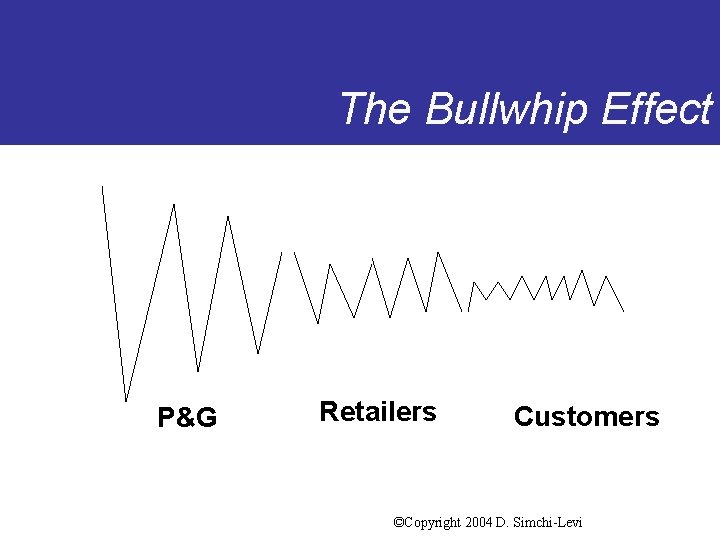
The Bullwhip Effect P&G Retailers Customers ©Copyright 2004 D. Simchi-Levi
What are the Causes…. • Promotional sales • Volume and Transportation Discounts • Inflated orders - IBM Aptiva orders increased by 2 -3 times when retailers thought that IBM would be out of stock over Christmas - Same with Motorola’s Cellular phones ©Copyright 2004 D. Simchi-Levi
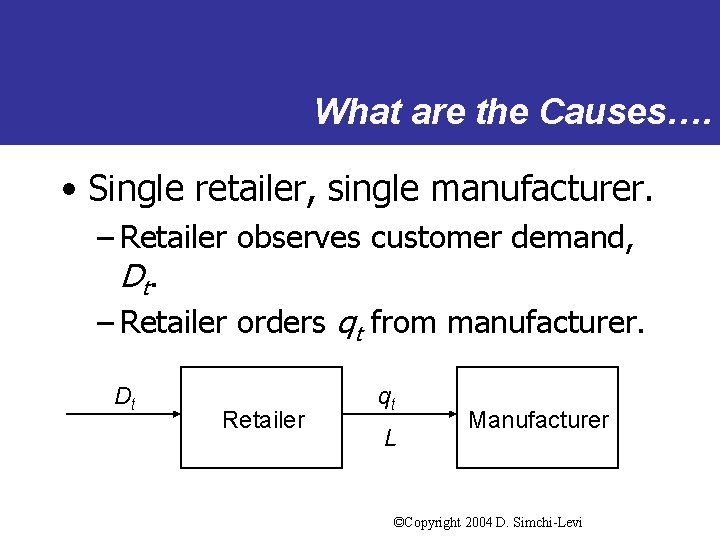
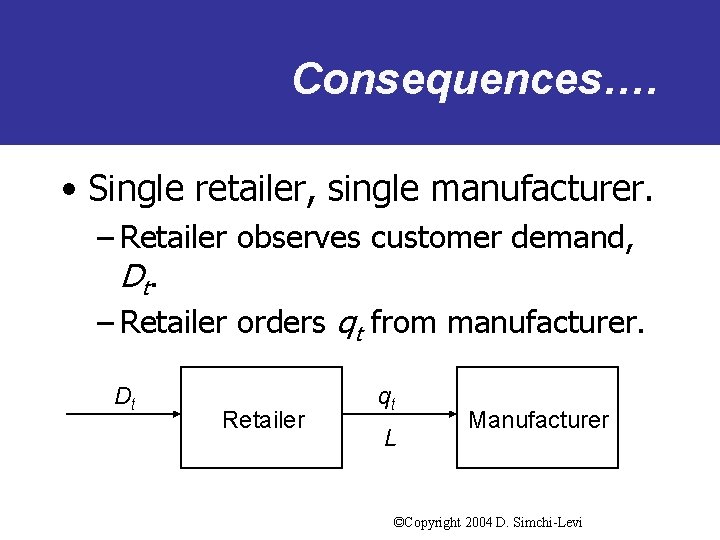
What are the Causes…. • Single retailer, single manufacturer. – Retailer observes customer demand, Dt. – Retailer orders qt from manufacturer. Dt Retailer qt L Manufacturer ©Copyright 2004 D. Simchi-Levi
What are the Causes…. • • • Promotional sales Volume and Transportation Discounts Inflated orders Demand Forecast Long cycle times ©Copyright 2004 D. Simchi-Levi
Consequences…. • Increased safety stock • Reduced service level ©Copyright 2004 D. Simchi-Levi
Consequences…. • Single retailer, single manufacturer. – Retailer observes customer demand, Dt. – Retailer orders qt from manufacturer. Dt Retailer qt L Manufacturer ©Copyright 2004 D. Simchi-Levi
Consequences…. • Increased safety stock • Reduced service level • Inefficient allocation of resources • Increased transportation costs ©Copyright 2004 D. Simchi-Levi
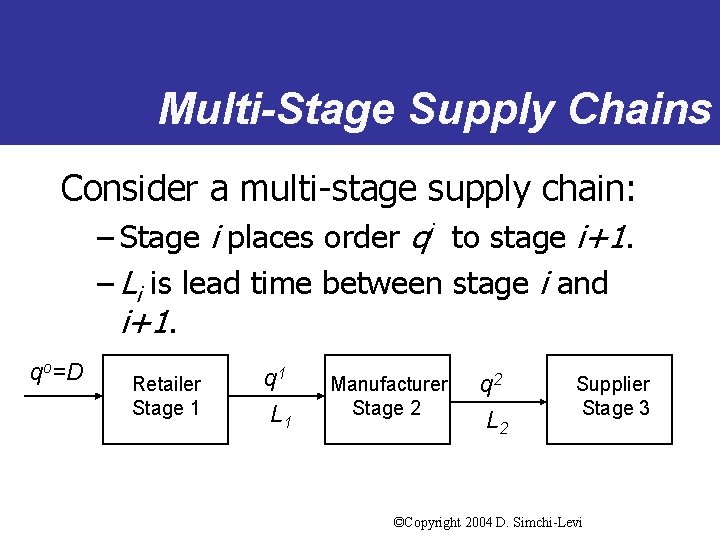
Multi-Stage Supply Chains Consider a multi-stage supply chain: – Stage i places order qi to stage i+1. – Li is lead time between stage i and i+1. qo=D Retailer Stage 1 q 1 L 1 Manufacturer Stage 2 q 2 L 2 Supplier Stage 3 ©Copyright 2004 D. Simchi-Levi
What are the Causes…. • • • Promotional sales Volume and Transportation Discounts Inflated orders Demand Forecast Long cycle times Luck of centralized demand information ©Copyright 2004 D. Simchi-Levi
Example: Automotive Supply Chain • Custom order takes 60 -70 days • Many different products – High level of demand uncertainty • Dealers’ inventory does not capture demand accurately – GM estimates: “Research shows we lose 10% to 11% of sales because the car is not available” ©Copyright 2004 D. Simchi-Levi
Supply Chain Strategies • Achieving Global Optimization • Managing Uncertainty – Risk Pooling – Risk Sharing ©Copyright 2004 D. Simchi-Levi
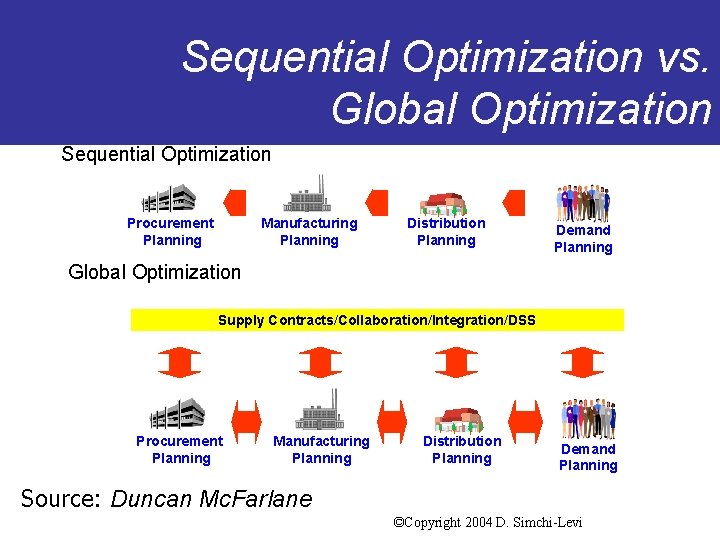
Sequential Optimization vs. Global Optimization Sequential Optimization Procurement Planning Manufacturing Planning Distribution Planning Demand Planning Global Optimization Supply Contracts/Collaboration/Integration/DSS Procurement Planning Manufacturing Planning Distribution Planning Demand Planning Source: Duncan Mc. Farlane ©Copyright 2004 D. Simchi-Levi
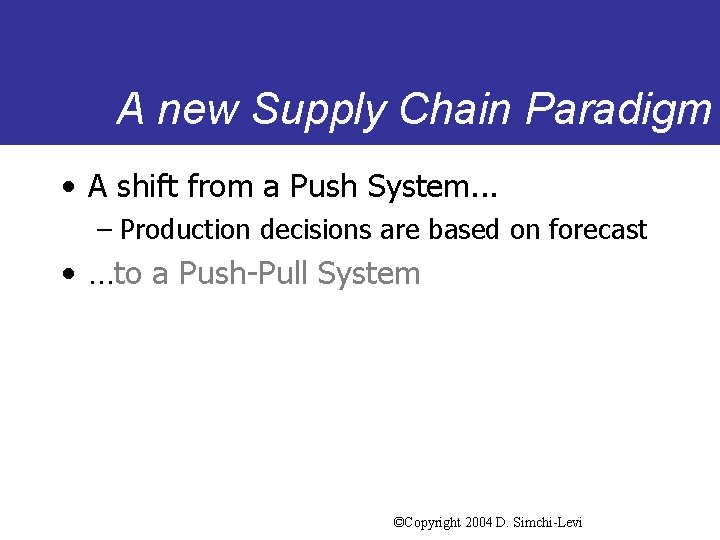
A new Supply Chain Paradigm • A shift from a Push System. . . – Production decisions are based on forecast • …to a Push-Pull System ©Copyright 2004 D. Simchi-Levi
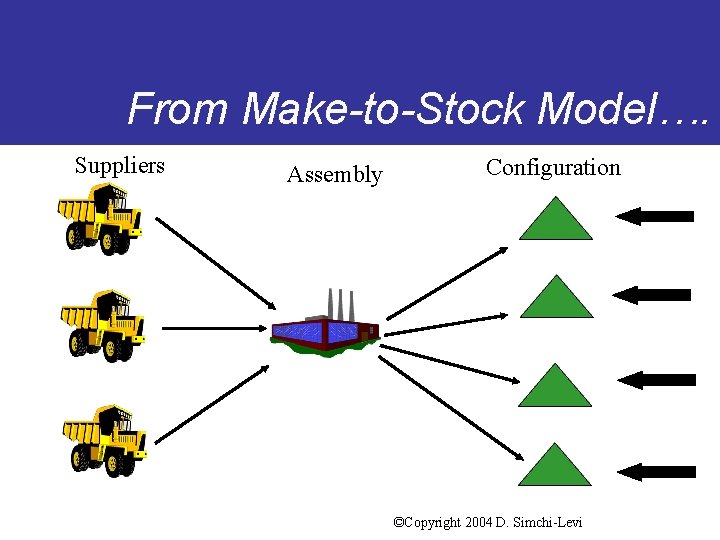
From Make-to-Stock Model…. Suppliers Assembly Configuration ©Copyright 2004 D. Simchi-Levi
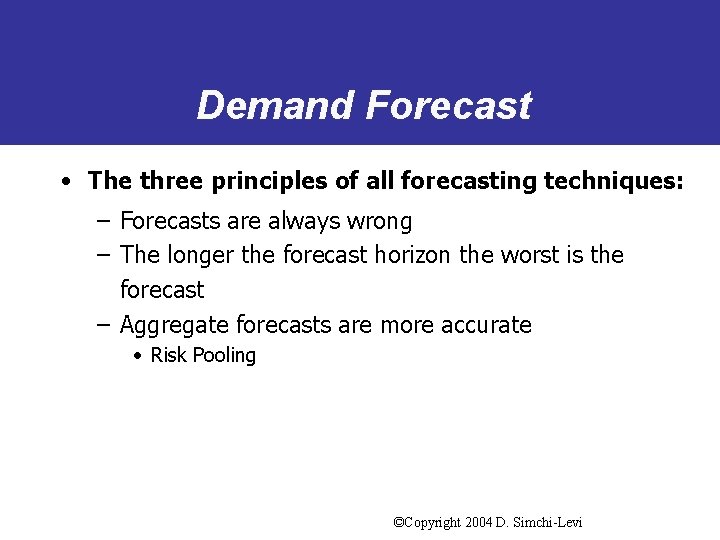
Demand Forecast • The three principles of all forecasting techniques: – Forecasts are always wrong – The longer the forecast horizon the worst is the forecast – Aggregate forecasts are more accurate • Risk Pooling ©Copyright 2004 D. Simchi-Levi
A new Supply Chain Paradigm • A shift from a Push System. . . – Production decisions are based on forecast • …to a Push-Pull System ©Copyright 2004 D. Simchi-Levi
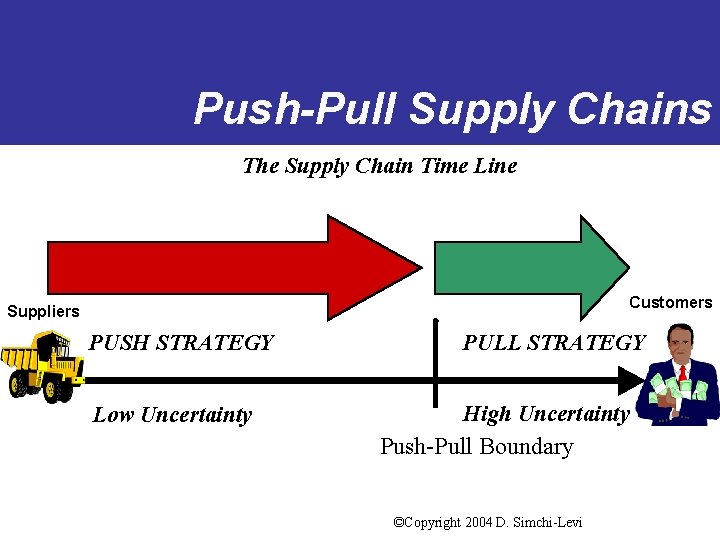
Push-Pull Supply Chains The Supply Chain Time Line Customers Suppliers PUSH STRATEGY Low Uncertainty PULL STRATEGY High Uncertainty Push-Pull Boundary ©Copyright 2004 D. Simchi-Levi
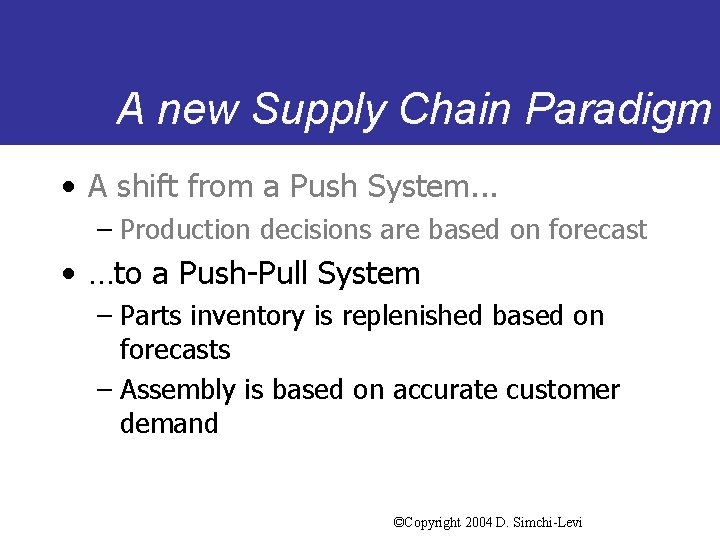
A new Supply Chain Paradigm • A shift from a Push System. . . – Production decisions are based on forecast • …to a Push-Pull System – Parts inventory is replenished based on forecasts – Assembly is based on accurate customer demand ©Copyright 2004 D. Simchi-Levi
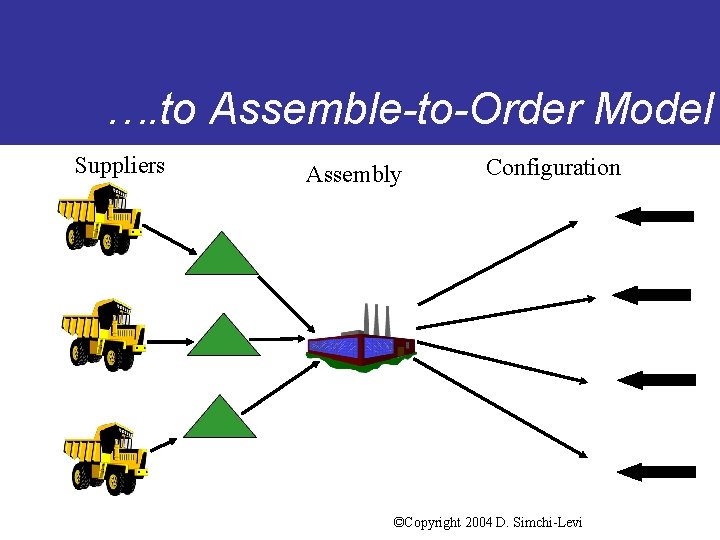
…. to Assemble-to-Order Model Suppliers Assembly Configuration ©Copyright 2004 D. Simchi-Levi
Demand Forecast • The three principles of all forecasting techniques: – Forecasts are always wrong – The longer the forecast horizon the worst is the forecast – Aggregate forecasts are more accurate • Risk Pooling ©Copyright 2004 D. Simchi-Levi
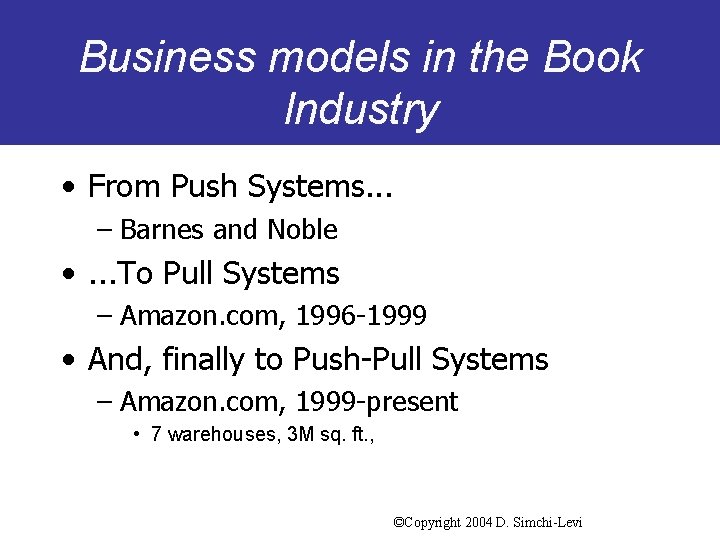
Business models in the Book Industry • From Push Systems. . . – Barnes and Noble • . . . To Pull Systems – Amazon. com, 1996 -1999 • And, finally to Push-Pull Systems – Amazon. com, 1999 -present • 7 warehouses, 3 M sq. ft. , ©Copyright 2004 D. Simchi-Levi
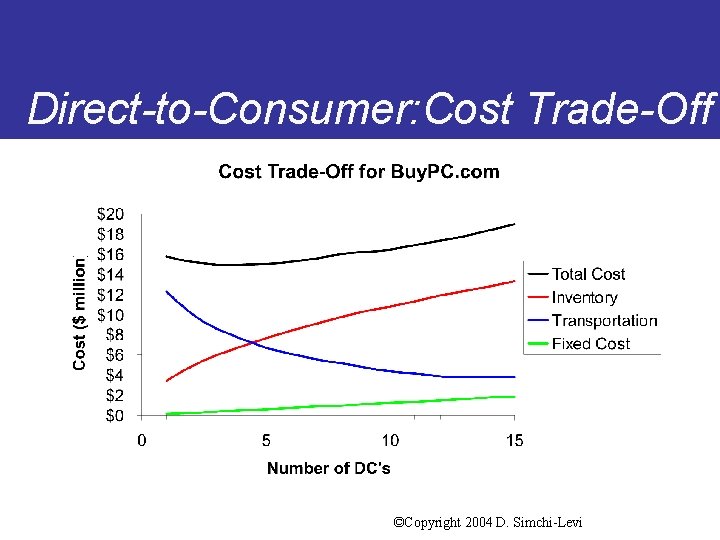
Direct-to-Consumer: Cost Trade-Off ©Copyright 2004 D. Simchi-Levi
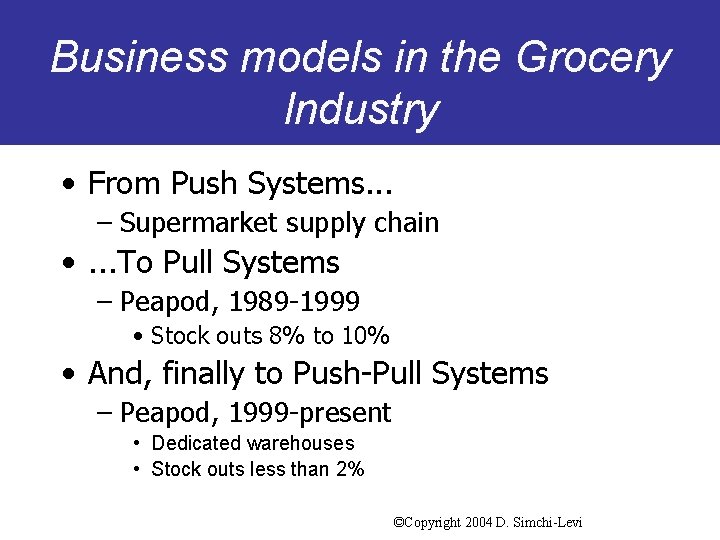
Business models in the Grocery Industry • From Push Systems. . . – Supermarket supply chain • . . . To Pull Systems – Peapod, 1989 -1999 • Stock outs 8% to 10% • And, finally to Push-Pull Systems – Peapod, 1999 -present • Dedicated warehouses • Stock outs less than 2% ©Copyright 2004 D. Simchi-Levi
Business models in the Grocery Industry • Key Challenges for e-grocer: – Transportation cost • Density of customers – Very short order cycle times • Less than 12 hours ©Copyright 2004 D. Simchi-Levi
e-Business in the Retail Industry • Brick-&-Mortar companies establish Virtual retail stores – Wal-Mart, K-Mart, Barnes and Noble • Use a hybrid approach in stocking – Fast moving/High volume products for local storage – Slow moving/Low volume products for on-line purchase • Channel Conflict Issues ©Copyright 2004 D. Simchi-Levi
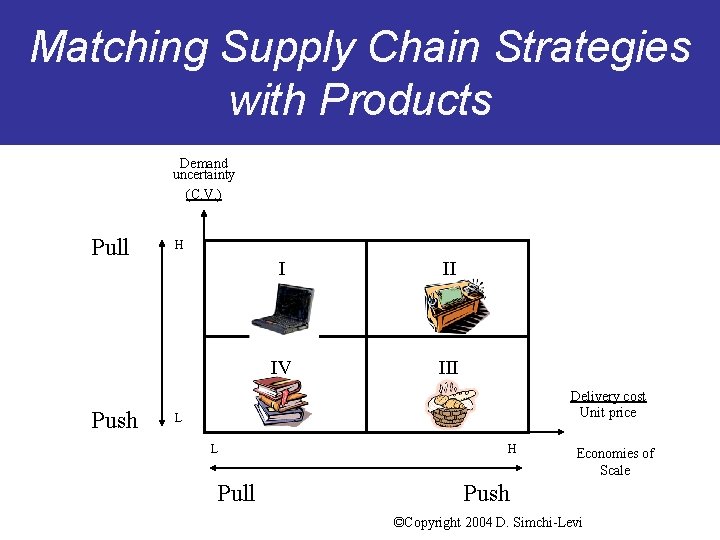
Matching Supply Chain Strategies with Products Demand uncertainty (C. V. ) Pull H I II Computer IV Push III Delivery cost Unit price L L Pull H Economies of Scale Push ©Copyright 2004 D. Simchi-Levi
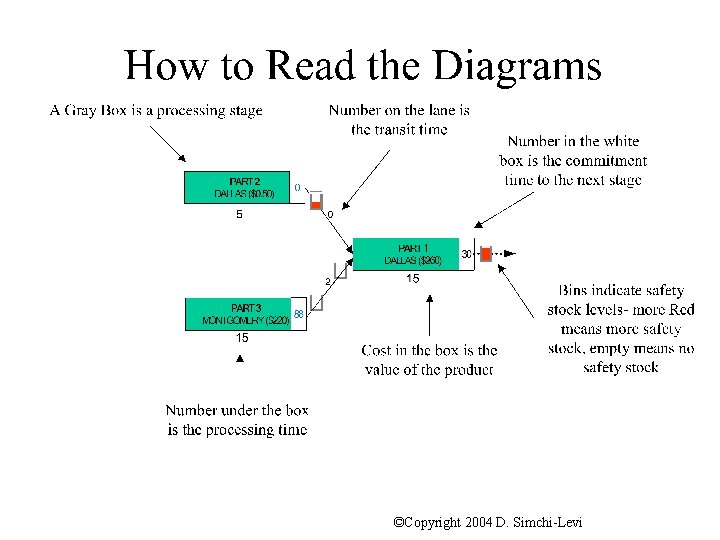
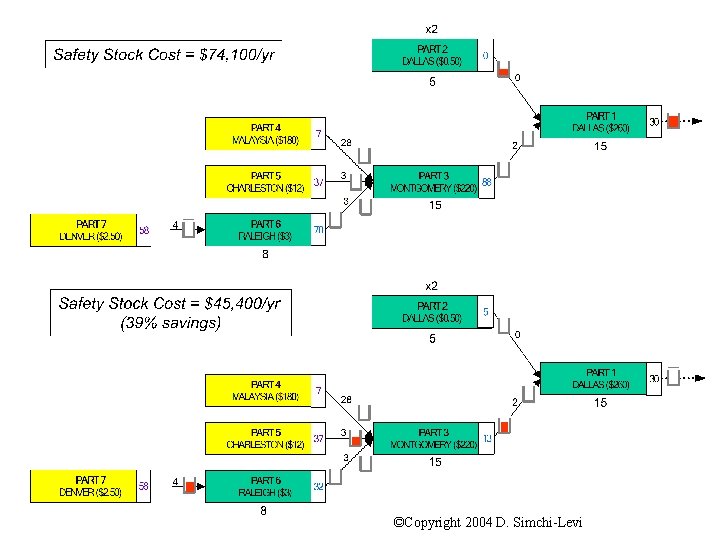
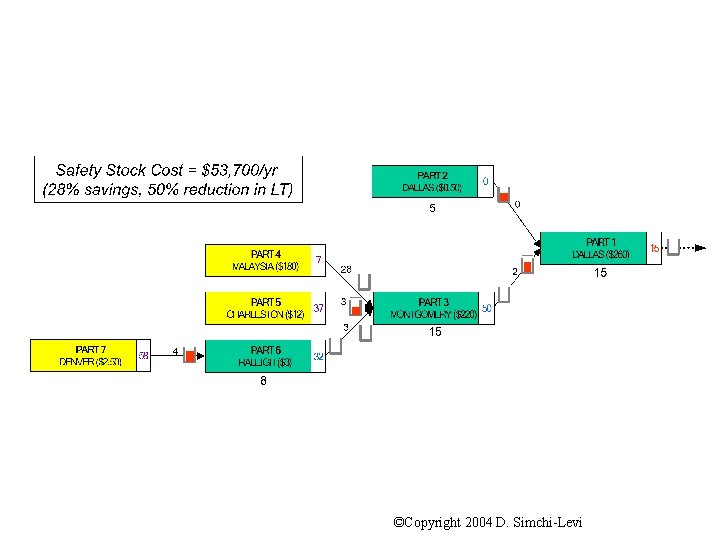
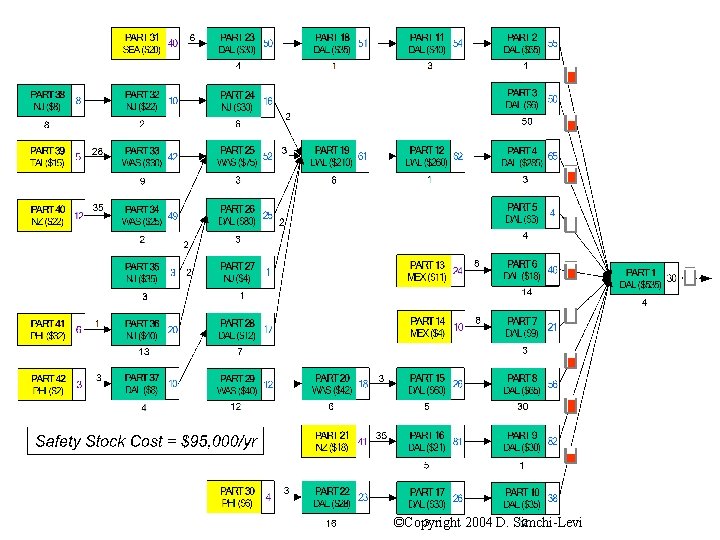
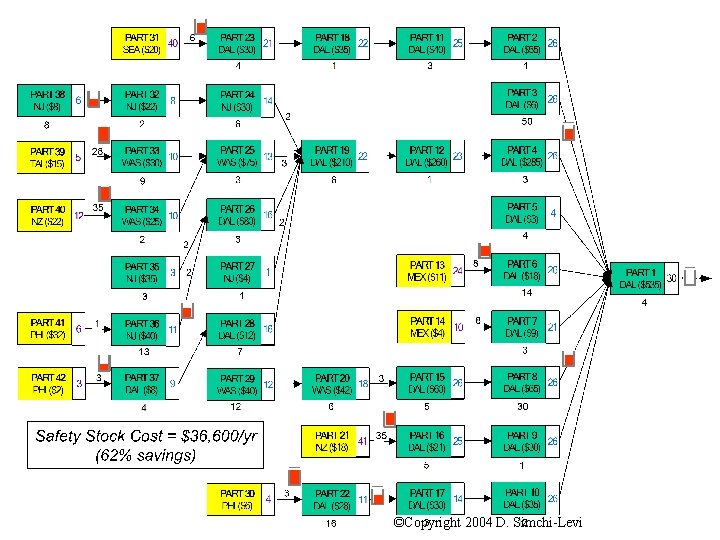
Shifting the Push-Pull Boundary: A Case Study • Manufacturer of circuit boards and other hightech products • Sells customized products with high value and short life cycles • Multi-stage BOM – e. g. , copper & fiberglass circuit board enclosure processor • Case study concerns one of 27, 000 SKUs ©Copyright 2004 D. Simchi-Levi
©Copyright 2004 D. Simchi-Levi
©Copyright 2004 D. Simchi-Levi
©Copyright 2004 D. Simchi-Levi
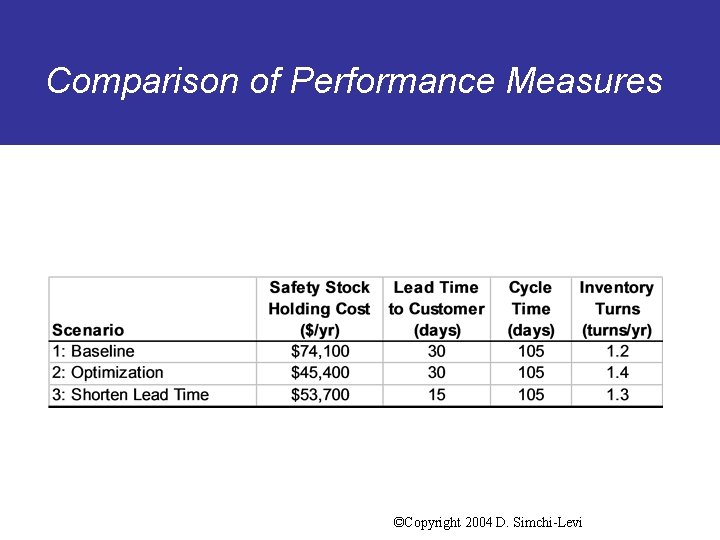
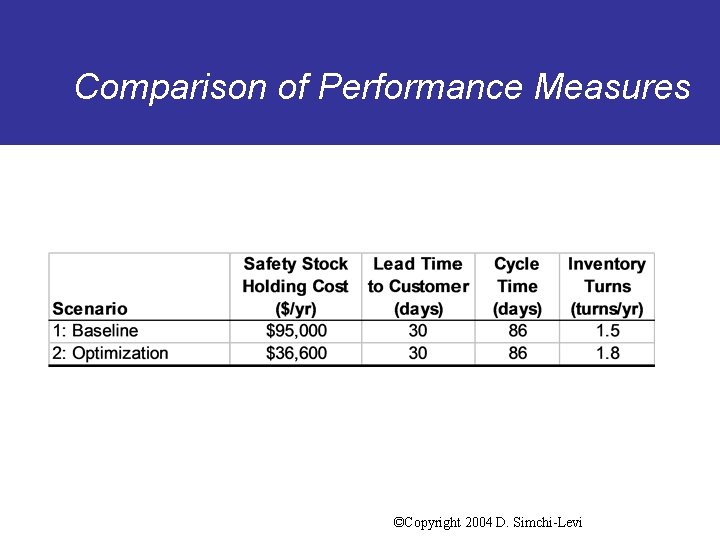
Comparison of Performance Measures ©Copyright 2004 D. Simchi-Levi
©Copyright 2004 D. Simchi-Levi
©Copyright 2004 D. Simchi-Levi
Comparison of Performance Measures ©Copyright 2004 D. Simchi-Levi
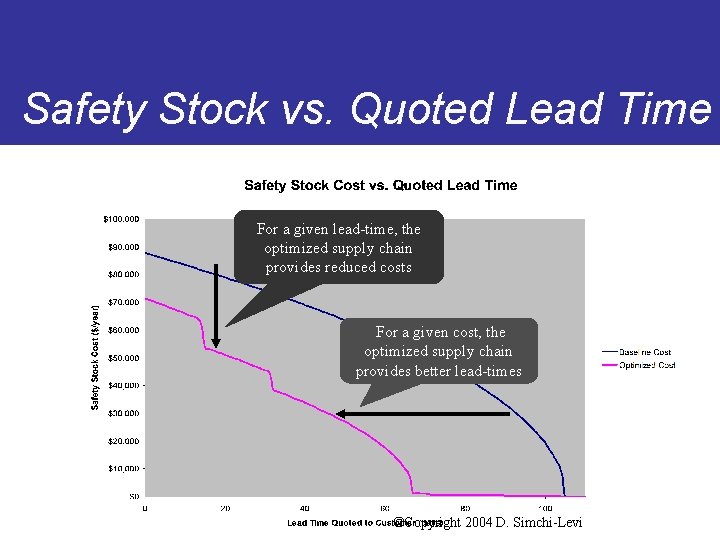
Safety Stock vs. Quoted Lead Time For a given lead-time, the optimized supply chain provides reduced costs For a given cost, the optimized supply chain provides better lead-times ©Copyright 2004 D. Simchi-Levi
Outline of the Presentation u Introduction u Push-Pull Systems u Supply Contracts ©Copyright 2004 D. Simchi-Levi
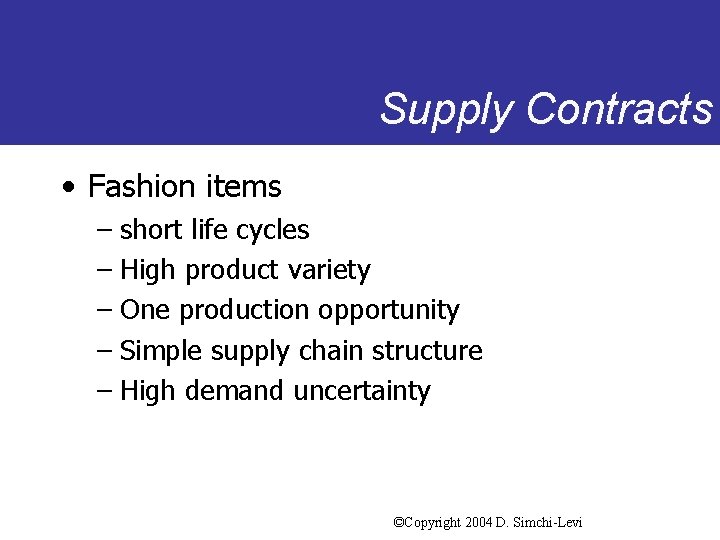
Supply Contracts • Fashion items – short life cycles – High product variety – One production opportunity – Simple supply chain structure – High demand uncertainty ©Copyright 2004 D. Simchi-Levi
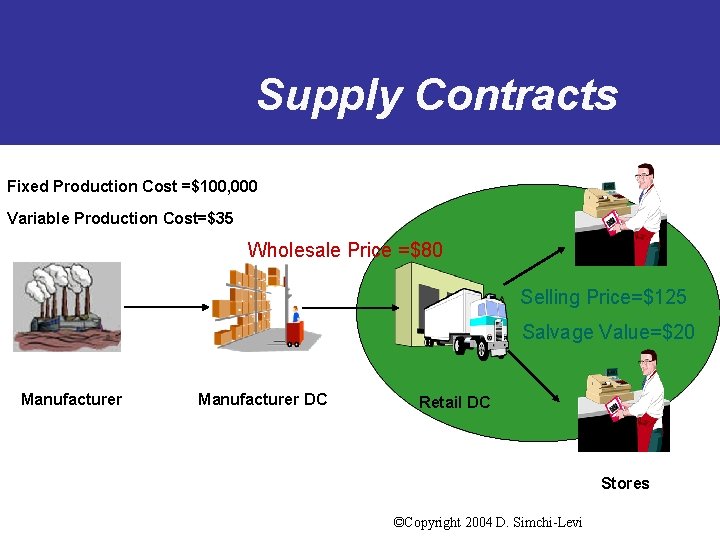
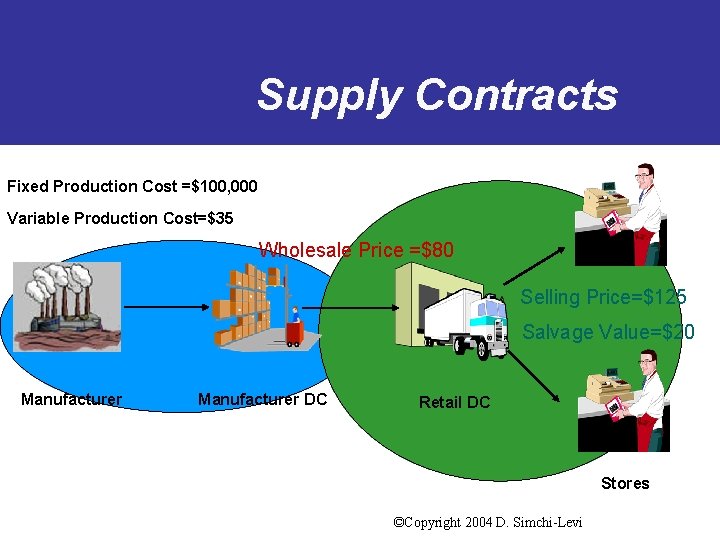
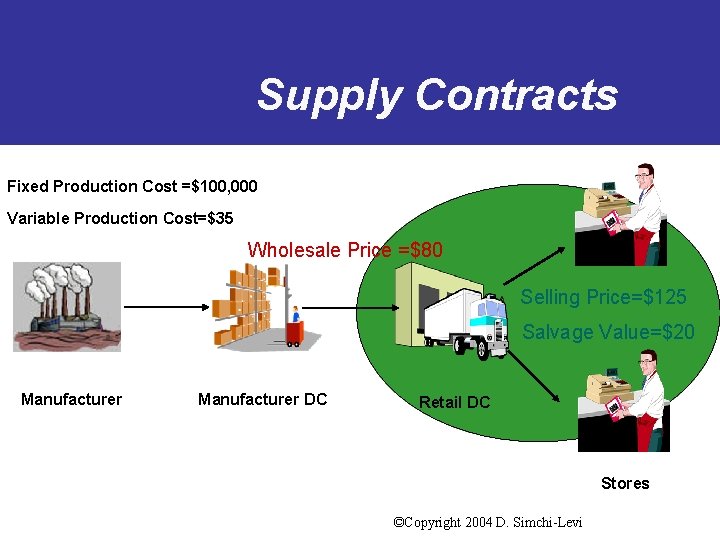
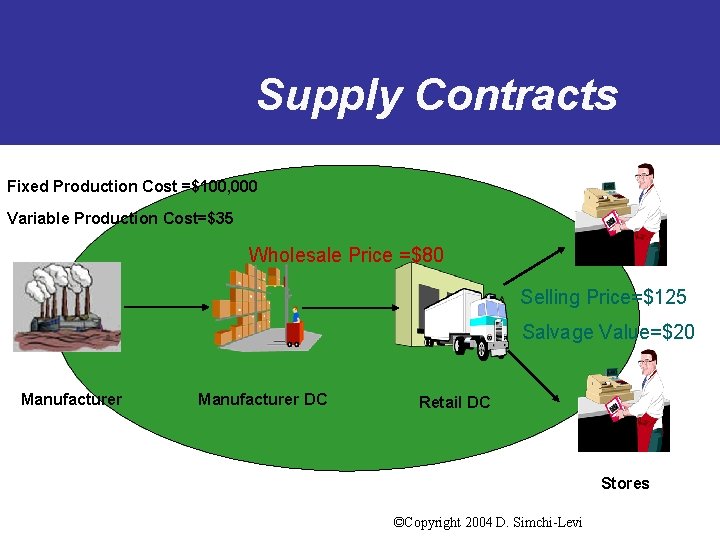
Supply Contracts Fixed Production Cost =$100, 000 Variable Production Cost=$35 Wholesale Price =$80 Selling Price=$125 Salvage Value=$20 Manufacturer DC Retail DC Stores ©Copyright 2004 D. Simchi-Levi
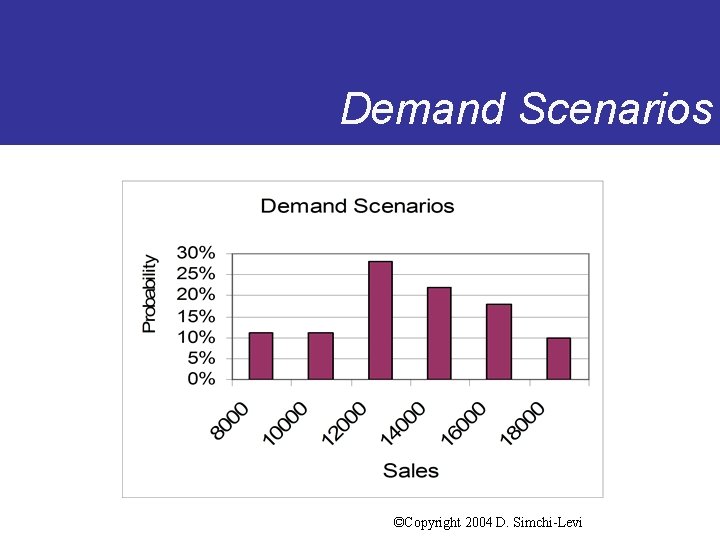
Demand Scenarios ©Copyright 2004 D. Simchi-Levi
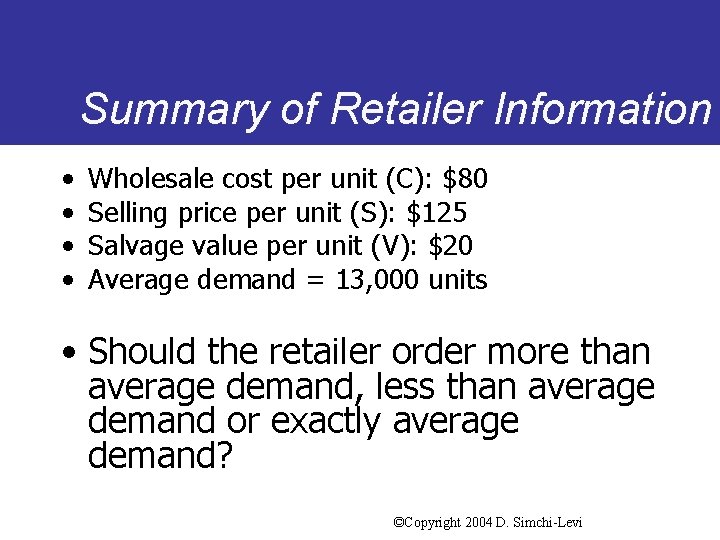
Summary of Retailer Information • • Wholesale cost per unit (C): $80 Selling price per unit (S): $125 Salvage value per unit (V): $20 Average demand = 13, 000 units • Should the retailer order more than average demand, less than average demand or exactly average demand? ©Copyright 2004 D. Simchi-Levi
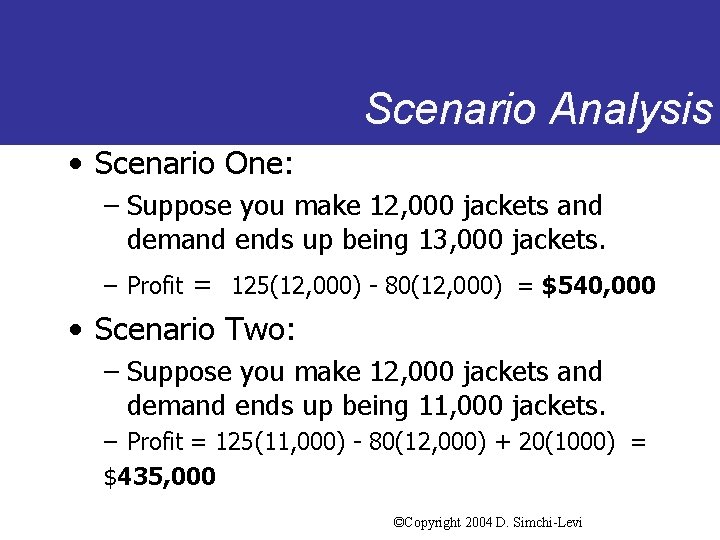
Scenario Analysis • Scenario One: – Suppose you make 12, 000 jackets and demand ends up being 13, 000 jackets. – Profit = 125(12, 000) - 80(12, 000) = $540, 000 • Scenario Two: – Suppose you make 12, 000 jackets and demand ends up being 11, 000 jackets. – Profit = 125(11, 000) - 80(12, 000) + 20(1000) = $435, 000 ©Copyright 2004 D. Simchi-Levi
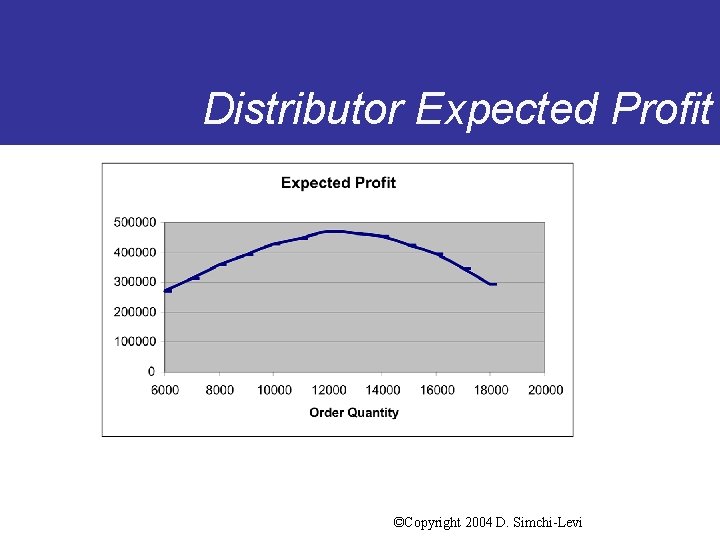
Distributor Expected Profit ©Copyright 2004 D. Simchi-Levi
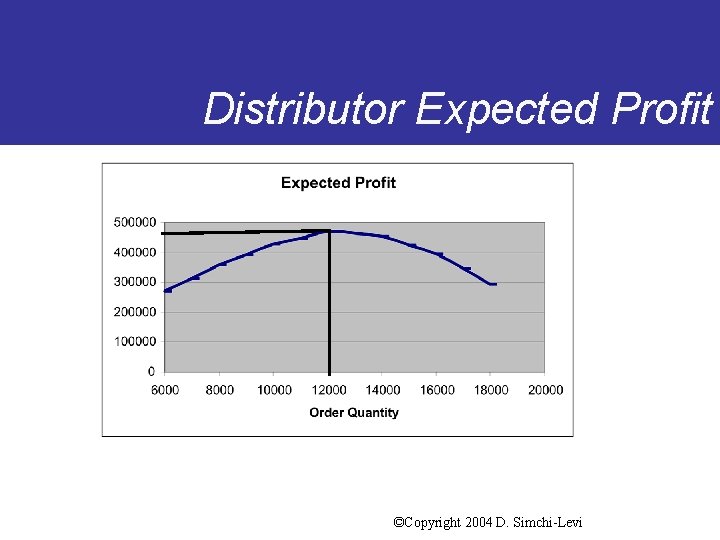
Distributor Expected Profit ©Copyright 2004 D. Simchi-Levi
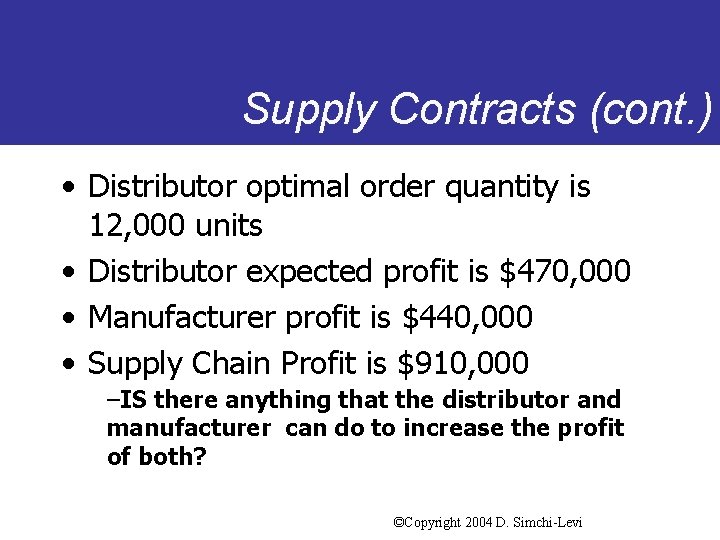
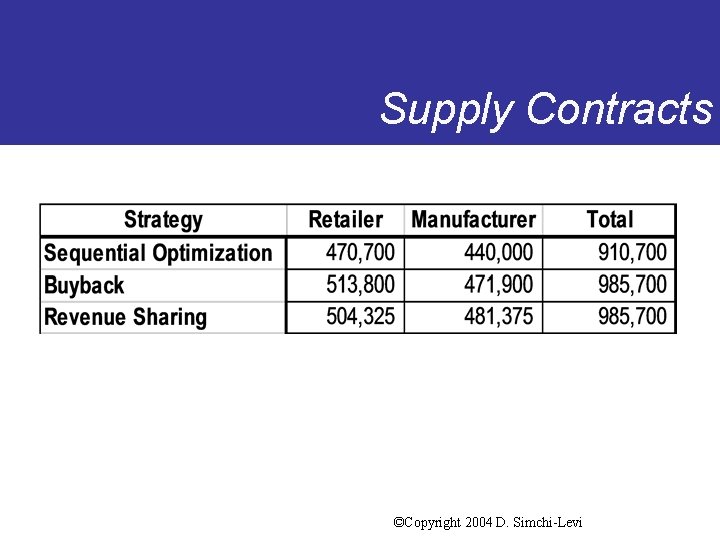
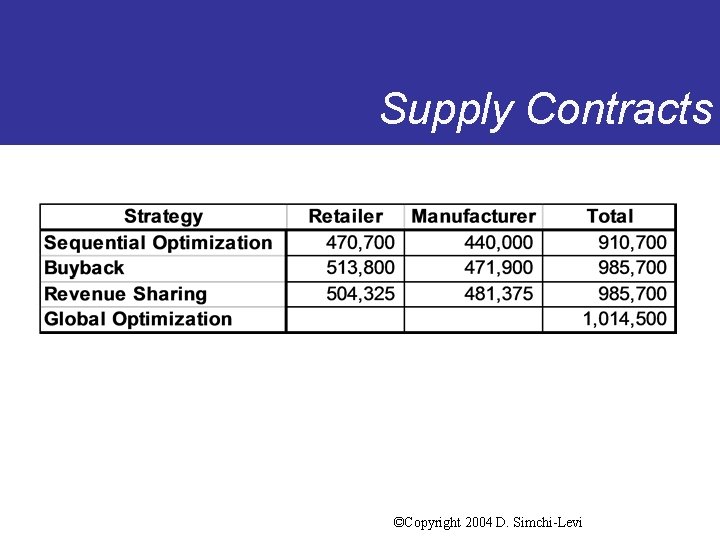
Supply Contracts (cont. ) • Distributor optimal order quantity is 12, 000 units • Distributor expected profit is $470, 000 • Manufacturer profit is $440, 000 • Supply Chain Profit is $910, 000 –IS there anything that the distributor and manufacturer can do to increase the profit of both? ©Copyright 2004 D. Simchi-Levi
Supply Contracts Fixed Production Cost =$100, 000 Variable Production Cost=$35 Wholesale Price =$80 Selling Price=$125 Salvage Value=$20 Manufacturer DC Retail DC Stores ©Copyright 2004 D. Simchi-Levi
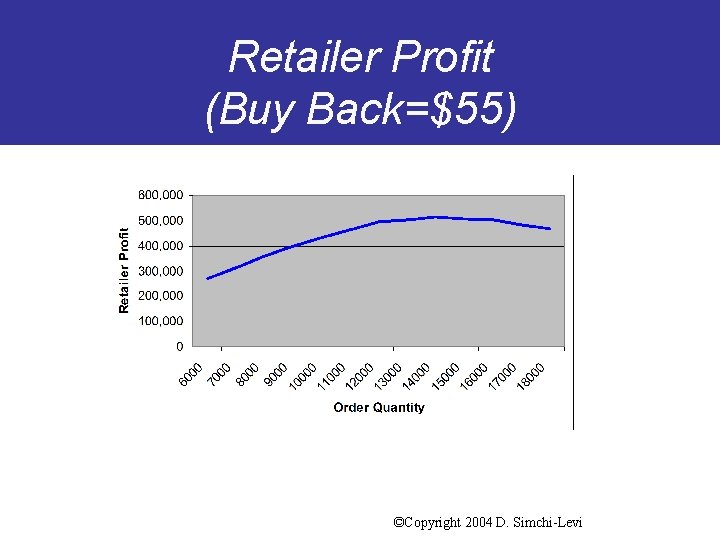
Retailer Profit (Buy Back=$55) ©Copyright 2004 D. Simchi-Levi
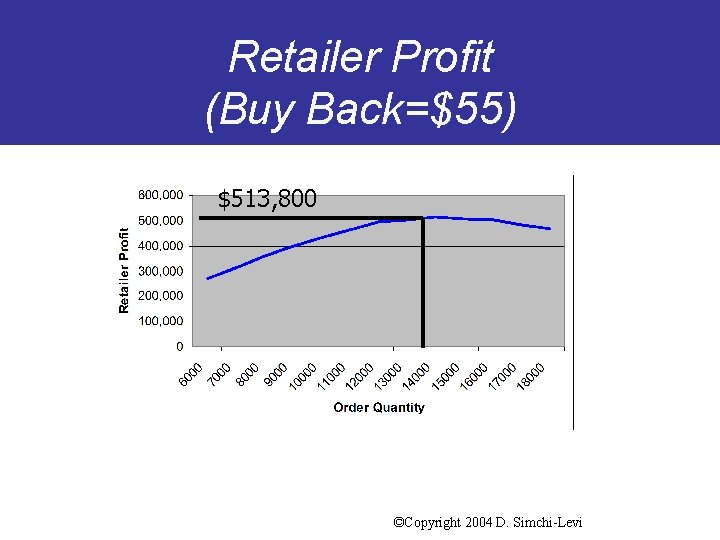
Retailer Profit (Buy Back=$55) $513, 800 ©Copyright 2004 D. Simchi-Levi
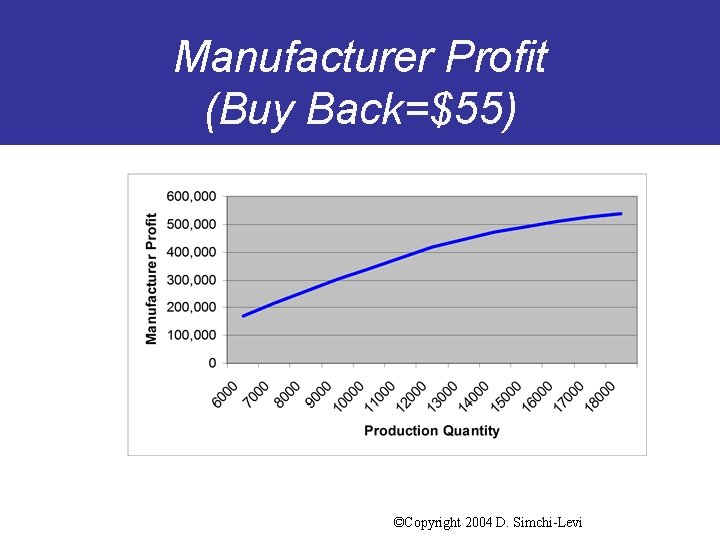
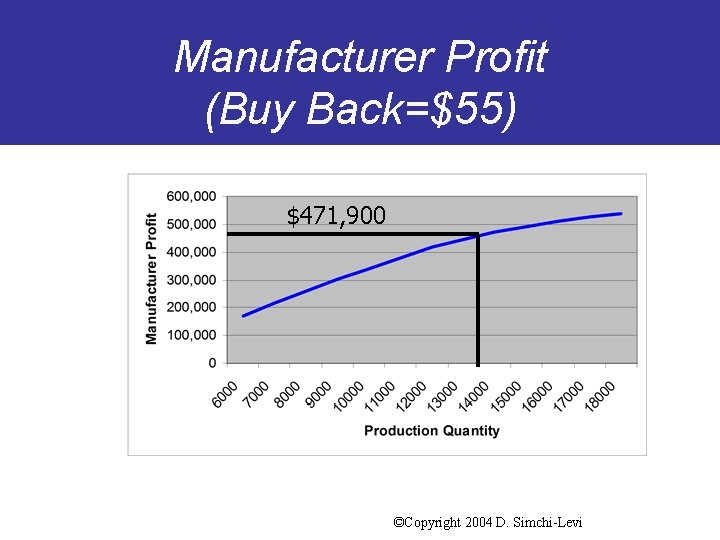
Manufacturer Profit (Buy Back=$55) ©Copyright 2004 D. Simchi-Levi
Manufacturer Profit (Buy Back=$55) $471, 900 ©Copyright 2004 D. Simchi-Levi
Supply Contracts Fixed Production Cost =$100, 000 Variable Production Cost=$35 Wholesale Price =$80 Selling Price=$125 Salvage Value=$20 Manufacturer DC Retail DC Stores ©Copyright 2004 D. Simchi-Levi
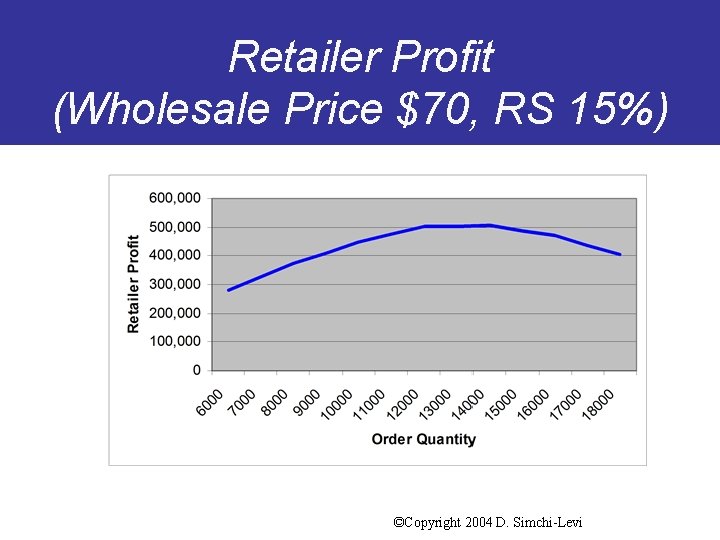
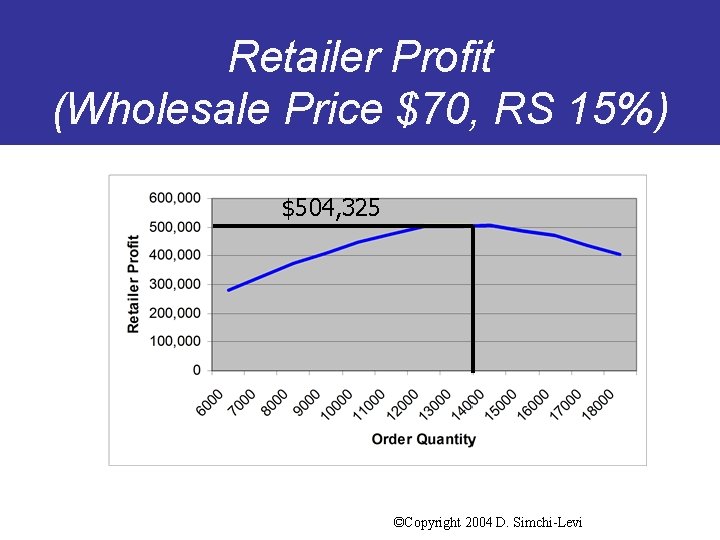
Retailer Profit (Wholesale Price $70, RS 15%) ©Copyright 2004 D. Simchi-Levi
Retailer Profit (Wholesale Price $70, RS 15%) $504, 325 ©Copyright 2004 D. Simchi-Levi
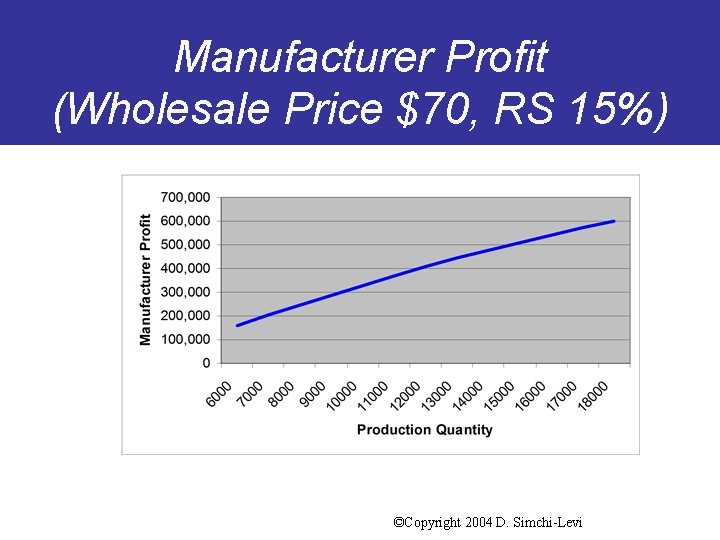
Manufacturer Profit (Wholesale Price $70, RS 15%) ©Copyright 2004 D. Simchi-Levi
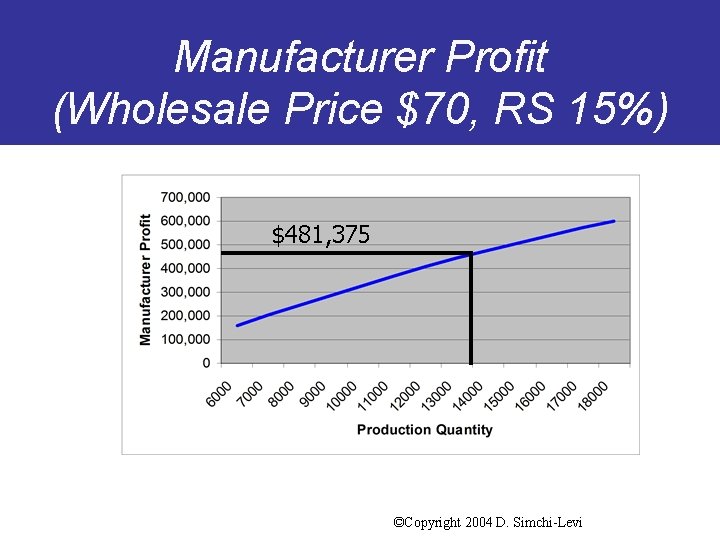
Manufacturer Profit (Wholesale Price $70, RS 15%) $481, 375 ©Copyright 2004 D. Simchi-Levi
Supply Contracts ©Copyright 2004 D. Simchi-Levi
Supply Contracts Fixed Production Cost =$100, 000 Variable Production Cost=$35 Wholesale Price =$80 Selling Price=$125 Salvage Value=$20 Manufacturer DC Retail DC Stores ©Copyright 2004 D. Simchi-Levi
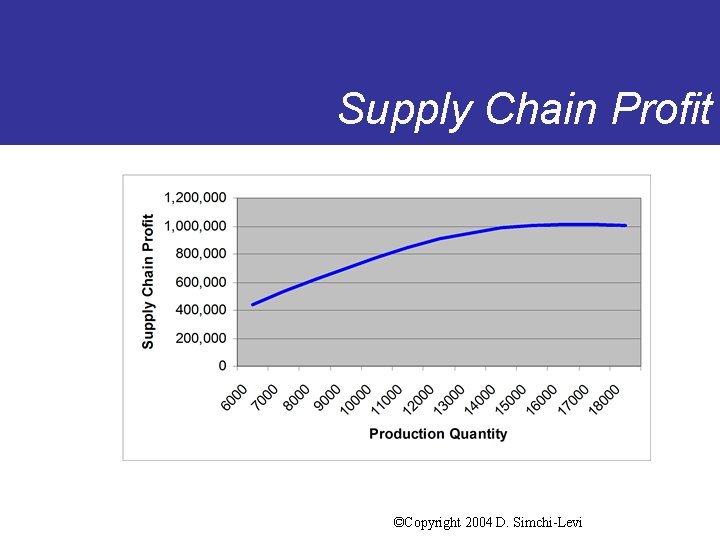
Supply Chain Profit ©Copyright 2004 D. Simchi-Levi
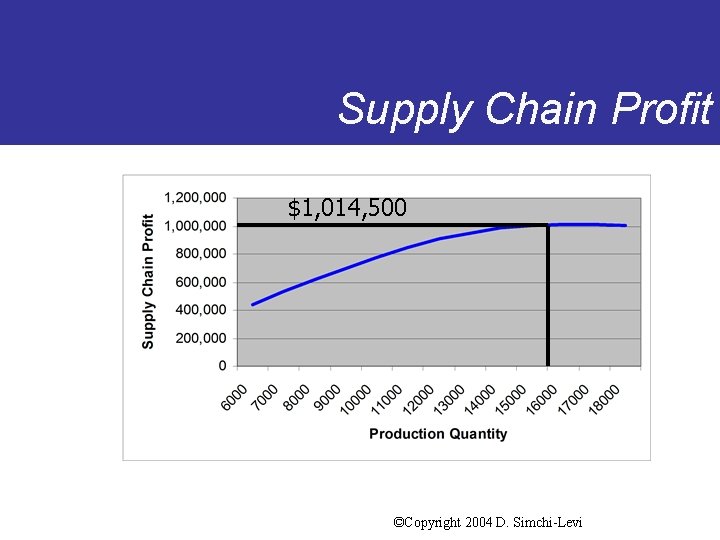
Supply Chain Profit $1, 014, 500 ©Copyright 2004 D. Simchi-Levi
Supply Contracts ©Copyright 2004 D. Simchi-Levi
Supply Contracts: Key Insights • Effective supply contracts allow supply chain partners to replace sequential optimization by global optimization • Buy Back and Revenue Sharing contracts achieve this objective through risk sharing ©Copyright 2004 D. Simchi-Levi
Supply Contracts: Case Study • Example: Demand for a movie newly released video cassette typically starts high and decreases rapidly – Peak demand last about 10 weeks • Blockbuster purchases a copy from a studio for $65 and rent for $3 – Hence, retailer must rent the tape at least 22 times before earning profit • Retailers cannot justify purchasing enough to cover the peak demand – In 1998, 20% of surveyed customers reported that they could not rent the movie they wanted ©Copyright 2004 D. Simchi-Levi
Supply Contracts: Case Study • Starting in 1998 Blockbuster entered a revenue sharing agreement with the major studios – Studio charges $8 per copy – Blockbuster pays 30 -45% of its rental income • Even if Blockbuster keeps only half of the rental income, the breakeven point is 6 rental per copy • The impact of revenue sharing on Blockbuster was dramatic – Rentals increased by 75% in test markets – Market share increased from 25% to 31% (The 2 nd largest retailer, Hollywood Entertainment Corp has 5% market share) ©Copyright 2004 D. Simchi-Levi
What are the drawbacks of RS? • Administrative Cost – Lawsuit brought by three independent video retailers who complained that they had been excluded from receiving the benefits of revenue sharing was dismissed (June 2002) – The Walt Disney Company has sued Blockbuster accusing them of cheating its video unit of approximately $120 million under a four year revenue sharing agreement (January 2003) • Impact on sales effort – Retailers have incentive to push products with higher profit margins – Automotive industry: automobile sales depends on retail effort ©Copyright 2004 D. Simchi-Levi
What are the drawbacks of RS? • Retailer may carry substitute or complementary products from other suppliers – One supplier offers revenue sharing while the other does not • Substitute products: retail will push the product with high margin • Complementary products: retailer may discount the product offered under revenue sharing to motivate sales of the other product ©Copyright 2004 D. Simchi-Levi
Other Contracts • Quantity Flexibility Contracts – Supplier provides full refund for returned items as long as the number of returns is no larger than a certain quantity • Sales Rebate Contracts – Supplier provides direct incentive for the retailer to increase sales by means of a rebate paid by the supplier for any item sold above a certain quantity ©Copyright 2004 D. Simchi-Levi
©Copyright 2004 D. Simchi-Levi