
Innovating for Engagement in an English for General
- Slides: 26
Innovating for Engagement in an English for General Academic Purposes (EGAP) course Meredith Mac. Aulay Tania Bencic
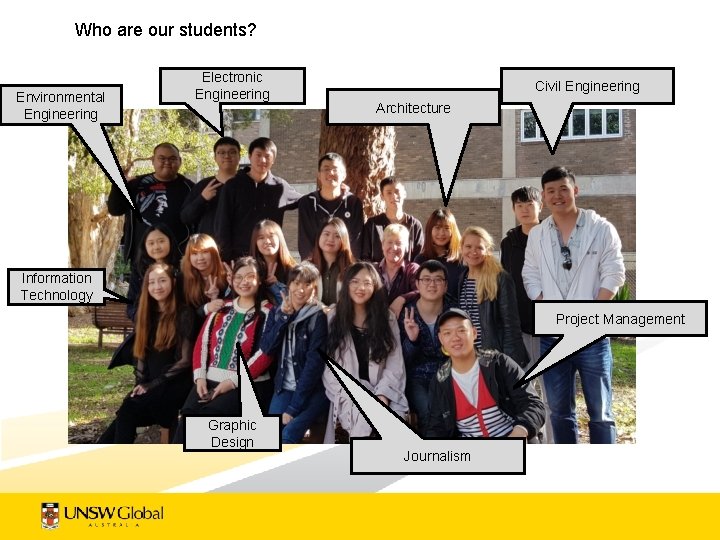
Who are our students? Environmental Engineering Electronic Engineering Civil Engineering Architecture Information Technology Project Management Graphic Design Journalism
Background UNSW Institute of Languages Direct Entry Program University English Entry Course (UEEC) English Australia Action Research Project 2018 ‘Making connections: student investigations of their future disciplines within a Direct entry EAP course’ Participants of our AR 36 students of various majors CEFR B 2
Issues and Rationale for our Research Issues with EGAP courses § Failure to transfer generic skills (Counsell, 2011; Ong 2014; Mac. Aulay, 2016) § Lack of discipline-specific language (Dooey, 2010) Issues in our course § Lack of basic content knowledge/language for their majors § Failure to see connections between UEEC and future course § Low motivation
Research Questions § How can UEEC students make greater connections with their future university disciplines? § What effects will these connections have on students?
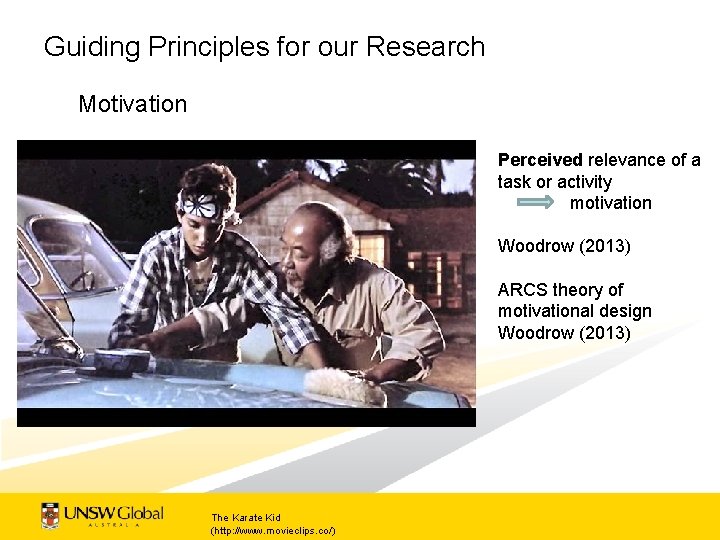
Guiding Principles for our Research Motivation Perceived relevance of a task or activity motivation Woodrow (2013) ARCS theory of motivational design Woodrow (2013) The Karate Kid (http: //www. movieclips. co/)
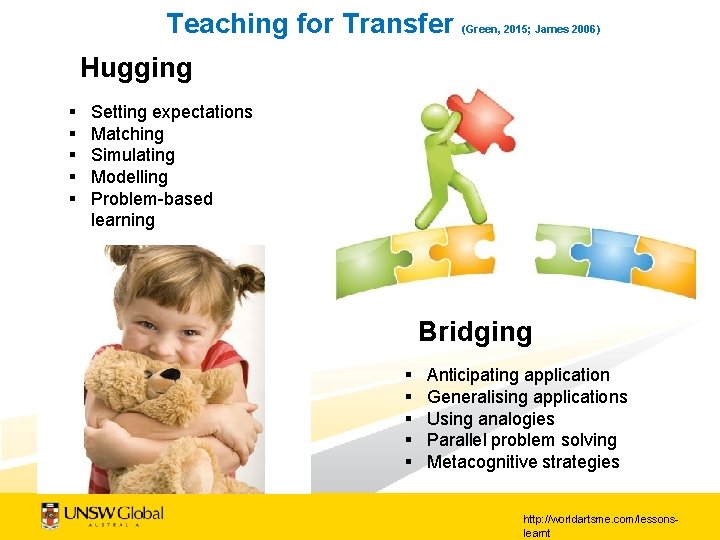
Teaching for Transfer (Green, 2015; James 2006) Hugging § § § Setting expectations Matching Simulating Modelling Problem-based learning Bridging § § § Anticipating application Generalising applications Using analogies Parallel problem solving Metacognitive strategies http: //worldartsme. com/lessonslearnt
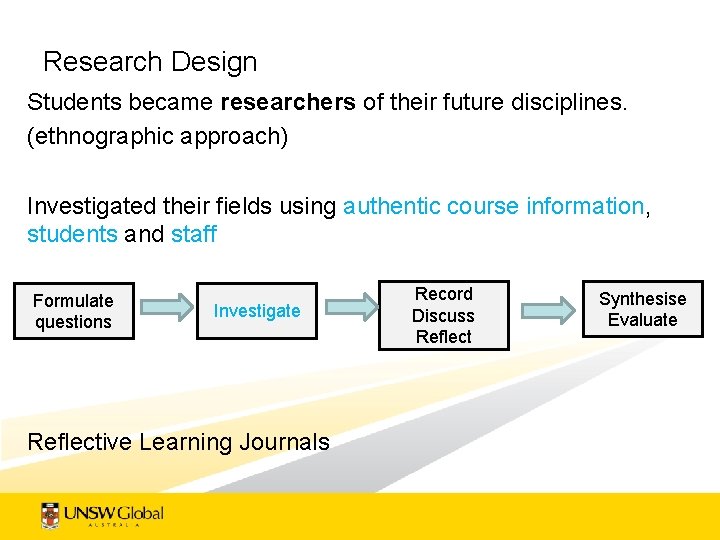
Research Design Students became researchers of their future disciplines. (ethnographic approach) Investigated their fields using authentic course information, students and staff Formulate questions Investigate Reflective Learning Journals Record Discuss Reflect Synthesise Evaluate
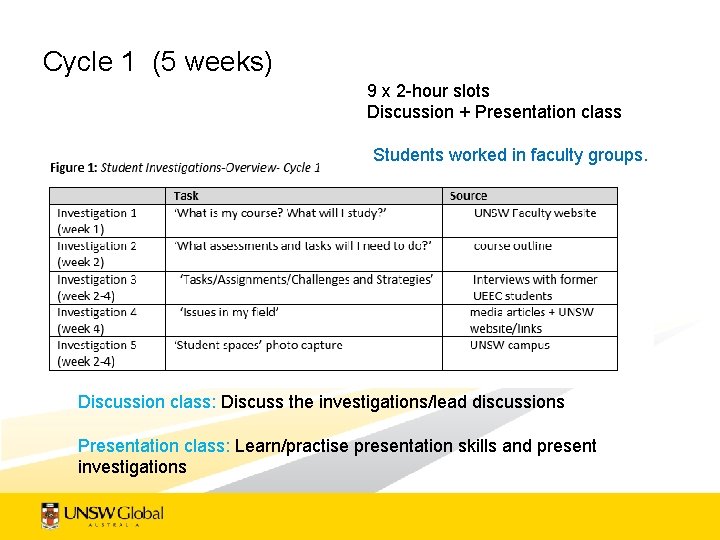
Cycle 1 (5 weeks) 9 x 2 -hour slots Discussion + Presentation class Students worked in faculty groups. Discussion class: Discuss the investigations/lead discussions Presentation class: Learn/practise presentation skills and present investigations
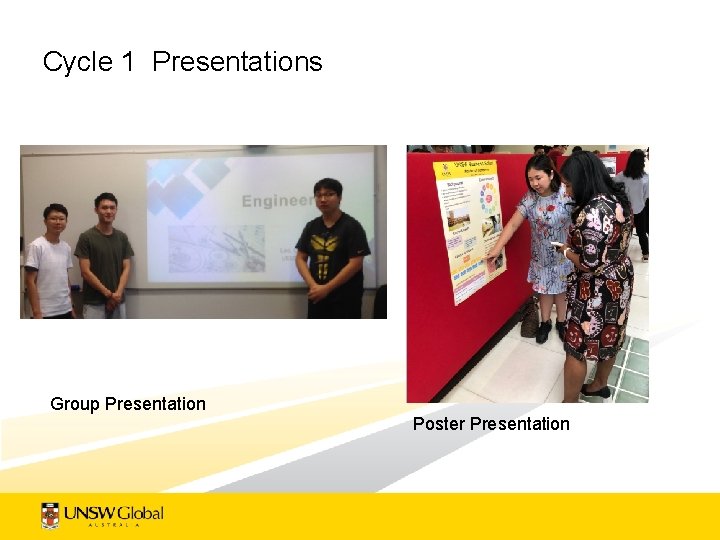
Cycle 1 Presentations Group Presentation Poster Presentation
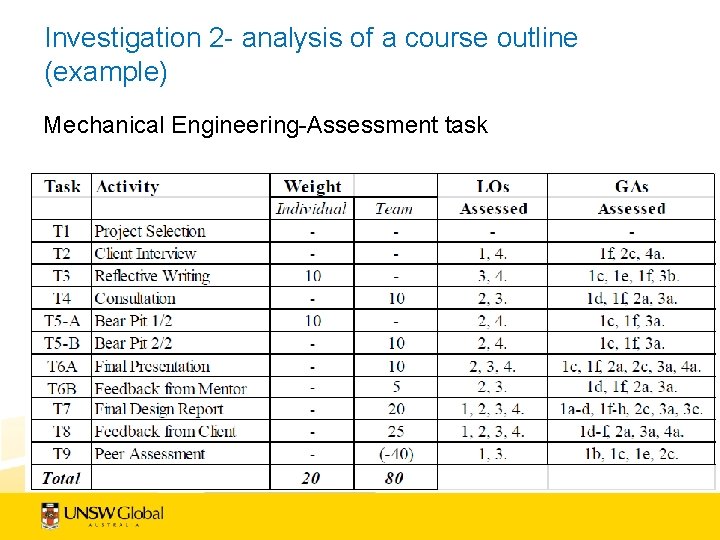
Investigation 2 - analysis of a course outline (example) Mechanical Engineering-Assessment task
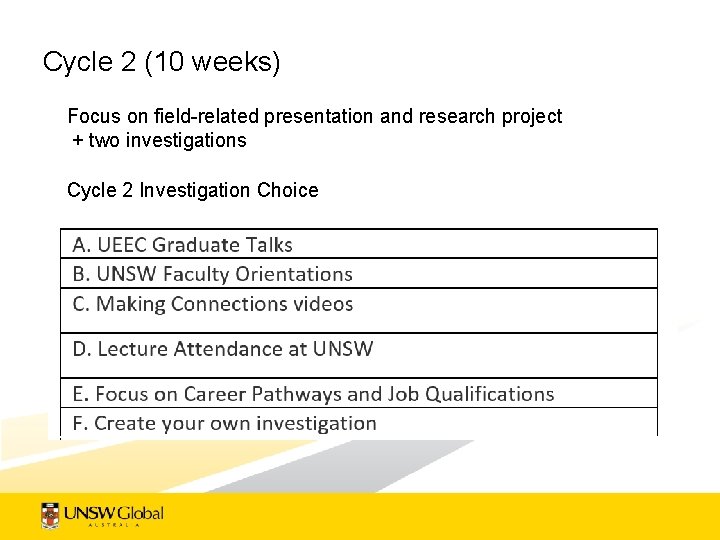
Cycle 2 (10 weeks) Focus on field-related presentation and research project + two investigations Cycle 2 Investigation Choice
Data Collection § § § Surveys Reflective Learning Journals Researcher reflective journals Focus groups Posters and presentations-analysed for content
Key Findings Cycle 1 and Cycle 2 • Increased knowledge • Increased motivation and overall confidence • Peer connections • Improved skills
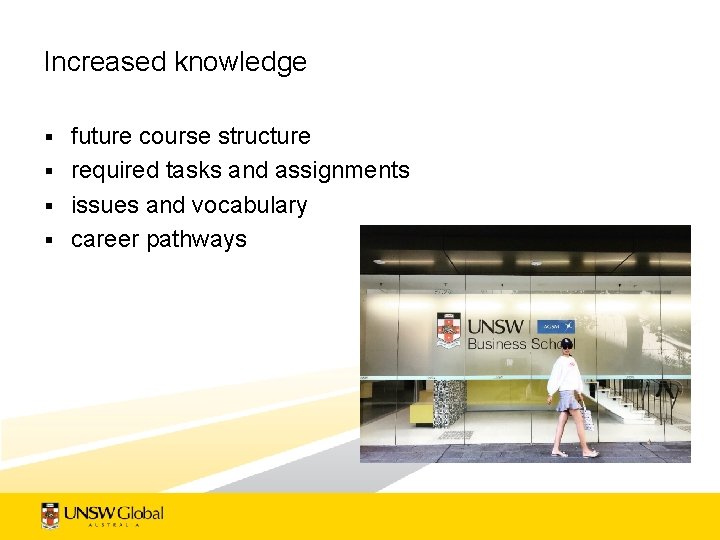
Increased knowledge future course structure § required tasks and assignments § issues and vocabulary § career pathways §
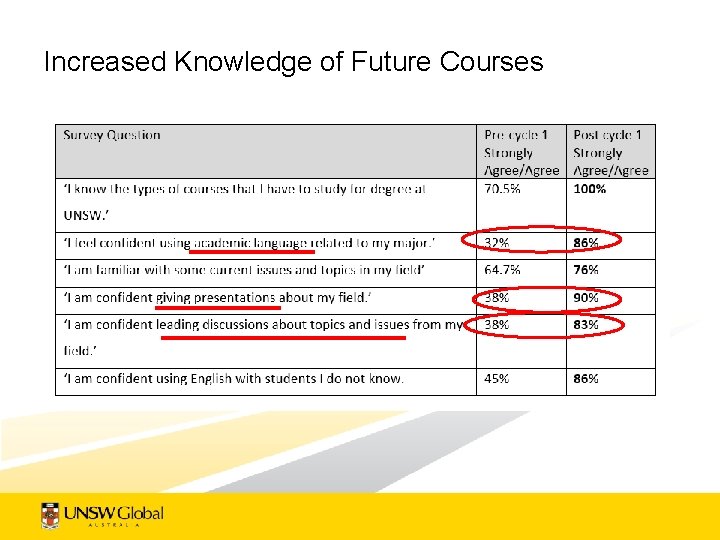
Increased Knowledge of Future Courses
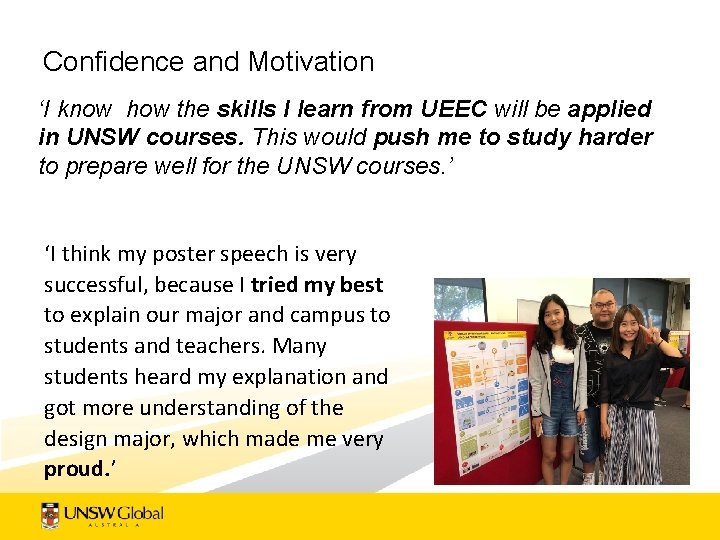
Confidence and Motivation ‘I know how the skills I learn from UEEC will be applied in UNSW courses. This would push me to study harder to prepare well for the UNSW courses. ’ ‘I think my poster speech is very successful, because I tried my best to explain our major and campus to students and teachers. Many students heard my explanation and got more understanding of the design major, which made me very proud. ’
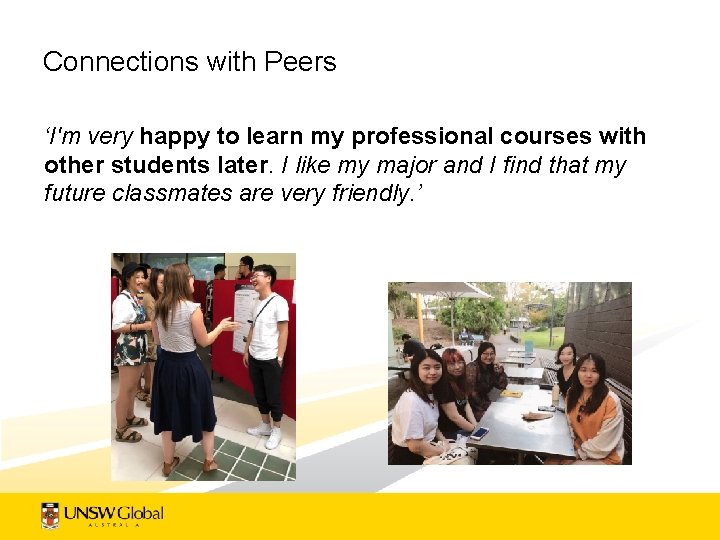
Connections with Peers ‘I'm very happy to learn my professional courses with other students later. I like my major and I find that my future classmates are very friendly. ’
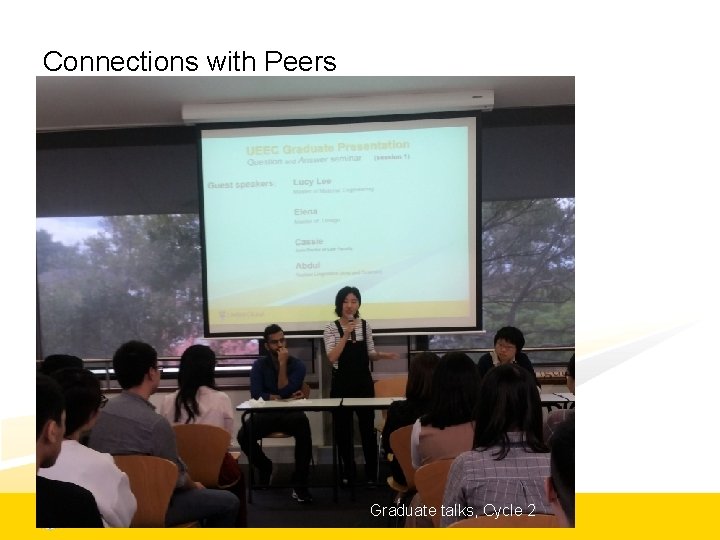
Connections with Peers Graduate talks, Cycle 2
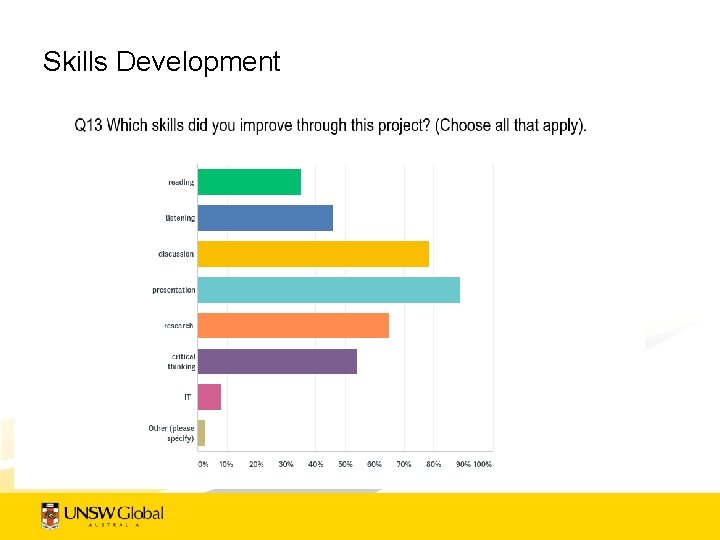
Skills Development
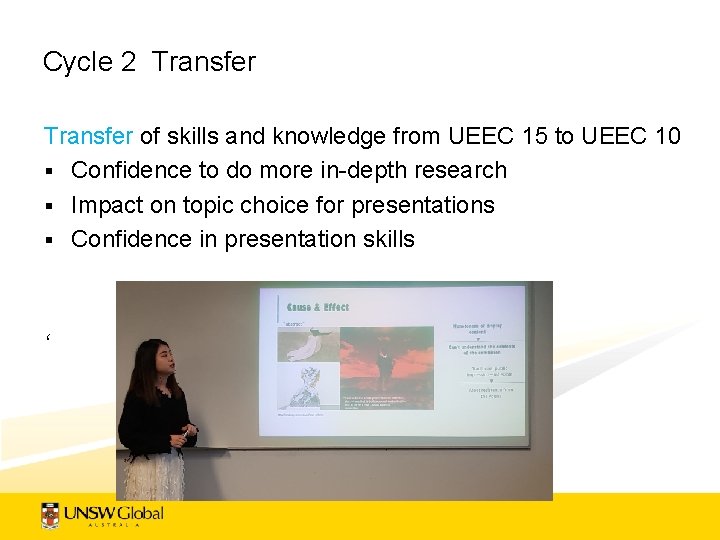
Cycle 2 Transfer of skills and knowledge from UEEC 15 to UEEC 10 § Confidence to do more in-depth research § Impact on topic choice for presentations § Confidence in presentation skills ‘
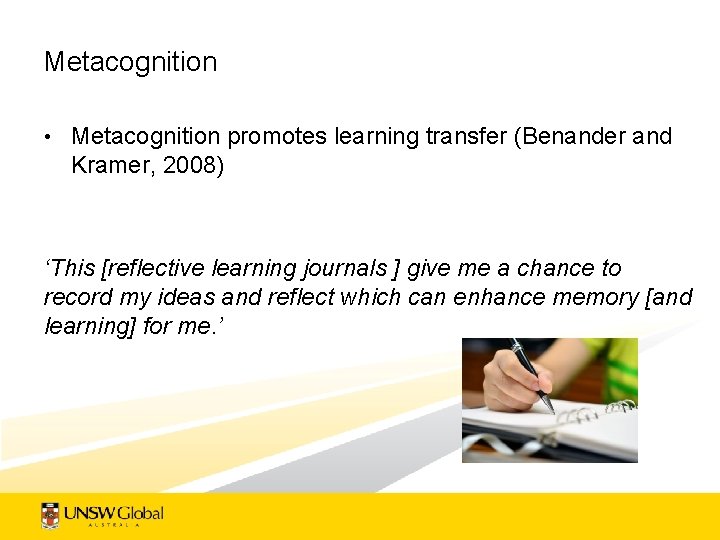
Metacognition • Metacognition promotes learning transfer (Benander and Kramer, 2008) ‘This [reflective learning journals ] give me a chance to record my ideas and reflect which can enhance memory [and learning] for me. ’
Conclusions § Various ways to make connections § Relevance of tasks linked to student motivation § Benefits of reflection § Recognition of student capabilities Implementation of the Cycle 1 activities into the UEEC 15 curriculum!
Discussion How can you innovate your course to engage EGAP students and help them to make connections with their future faculties?
Thank you for listening! Contact: m. macaulay@unswglobal. unsw. edu. au t. bencic@unswglobal. unsw. edu. au Future Publication: Mac. Aulay, M & Bencic, T (2019) Making Connections: Student investigations of their future disciplines within a Direct Entry EAP course’ Cambridge Assessment English Research Notes
References Counsell, J. (2011). How effectively and consistently do international postgraduate students apply the writing strategies they have been taught in a generic skills-based course to their subsequent discipline-based studies? Journal of Academic Language and Learning, 5 (1). A 1 -A 17. Dooey, P. (2010). Students’ perspectives of an EAP pathway program. Journal of English for Academic Purposes, 9(1), 184 -197. James, MA (2006) Teaching for transfer in ELT Journal, 60 (2), 151 -159. Keller, J. M. (2010). Motivational Design For Learning And Performance: The ARCS Model Approach. New York: Springer. Mac. Aulay, M (2016). Transition and transfer: Effects of an EAP direct entry course on students’ discussion skills at university. University of Sydney Papers in TESOL, vol 11, pp. 97 -130. http: //faculty. edfac. usyd. edu. au/projects/usp_in_tesol/currentissue. htm Mac. Aulay, M & Bencic, T (2019) Making Connections: Student investigations of their future disciplines within a Direct Entry EAP course’ Cambridge Assessment English Research Notes (publication to be released in 2019) Ong, V. (2014). An investigation of learning transfer from an EAP pathway program: An academic literacies perspective. (Doctoral thesis). University of New South Wales, Australia. Woodrow, L. (2013). Motivation and the transition to university. In E. Ushioda (ed. ), International perspectives on motivation: Language learning and professional challenges: Basingstoke: Palgrave Macmillan, 117 -132.