
Inner Planets Notes Mercury Venus Earth Mars Monday
- Slides: 9
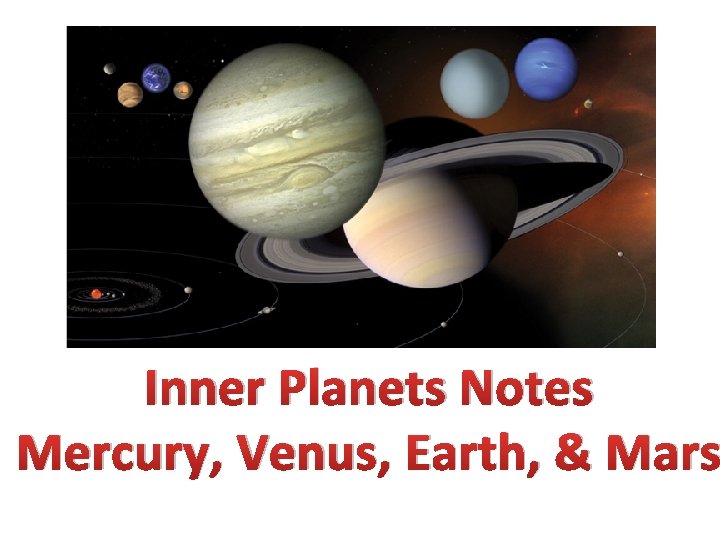
Inner Planets Notes Mercury, Venus, Earth, & Mars
Monday, April 15: FCAT Math Exam Wednesday, April 17: FCAT Reading Exam Thursday, April 18: FCAT Science Exam
Introduction to Inner Planets • Terrestrial planets means that the planet is made up of rock • Organized atmosphere that makes them different from the outer and dwarf planets • http: //www. youtube. com/watch? v=VHWs. Jgar Mt. A&list=SPD 89 B 8 D 14616 A 0 E 09
Mercury • Smallest inner planet and closest to the Sun • AU are used to measure the distance the planet is from the Sun • 0. 39 average from the Sun • No moons • Revolution period is 88 days
Venus • Second planet from the Sun • 97% carbon dioxide so the planet is very dense • Greenhouse effects occurs when a planet’s atmosphere traps solar energy and causes the surface temperature to increase • 0. 72 AU from the Sun • Revolution is 225 days / no moons
Earth • • • Third inner planet from the Sun Has 1 moon Greenhouse effects also occurs (Venus) 1. 00 AU from the Sun Revolution: 365 days Organized atmosphere that supports energy from the Sun, access to water, and food.
Mars • 4 th planet from the Sun • 2 moons that were originally part of Mars • Revolution period is 1. 88 years or roughly Earth years • 1. 52 AU is the distance from the Sun • Comparable in size to Mercury
Inner Planets Review Questions 1. Using the inner planets as an example, explain why the period of revolution and the astronomical units from the Sun increases in value. 2. What is meant by the term “terrestrial” planet? 3. What two planets are affected by the influence of greenhouses gases? Explain what occurs because of these gases. 4. Explain 2 similarities and 2 differences that planet Mercury and Mars have.
Home Learning Due Tuesday • Read Inner Planets Section starts on page 59 • Finish review questions on Inner Planets for next class