
Inner Attention based Recurrent Neural Networks for Answer
Inner Attention based Recurrent Neural Networks for Answer Selection Bingning Wang, Kang Liu, Jun Zhao National Laboratory of Pattern Recognition, Institute of Automation, Chinese Academy of Sciences 报告人:王炳宁 2016年 6月24日

Attention Bias Problem In recurrent neural networks, at each time step a word is added and the hidden states are updated recurrently. So these hidden states near the end of the sequence are bound to capture more information than previous states, so the resource is expected to pay more attention to these states. cosine rq ave|max Attention SUM ra RNN Question Answer 2
Attention Based Recurrent Neural Networks 3
Attention Based Recurrent Neural Networks 4
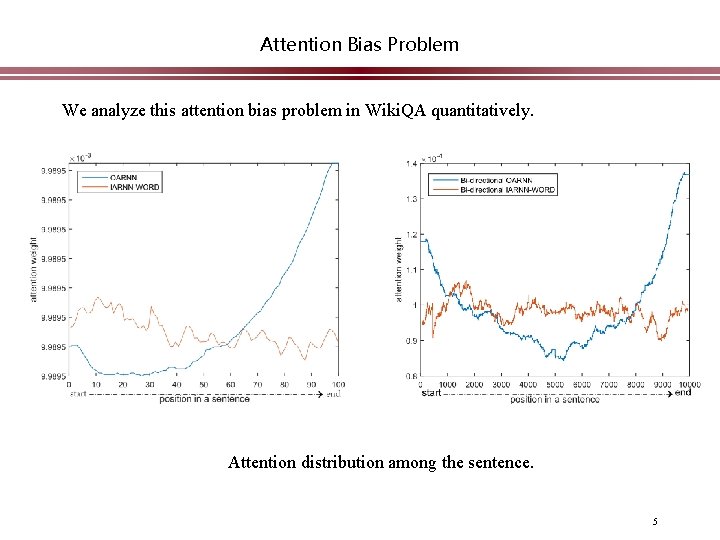
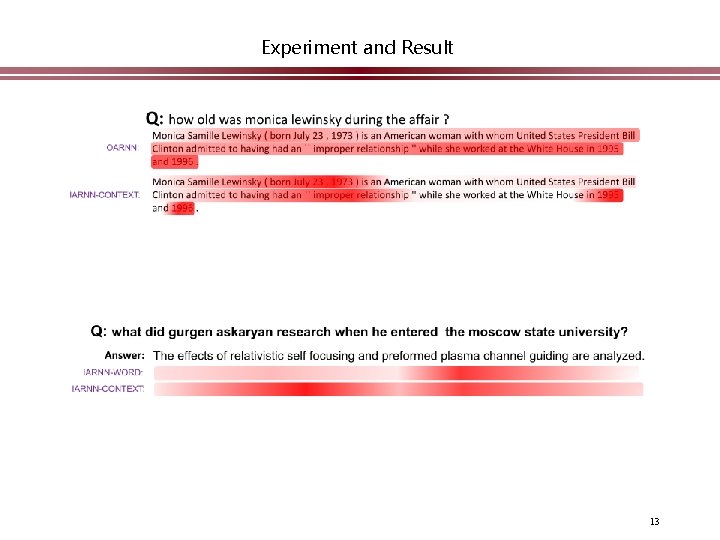
Attention Bias Problem We analyze this attention bias problem in Wiki. QA quantitatively. Attention distribution among the sentence. 5
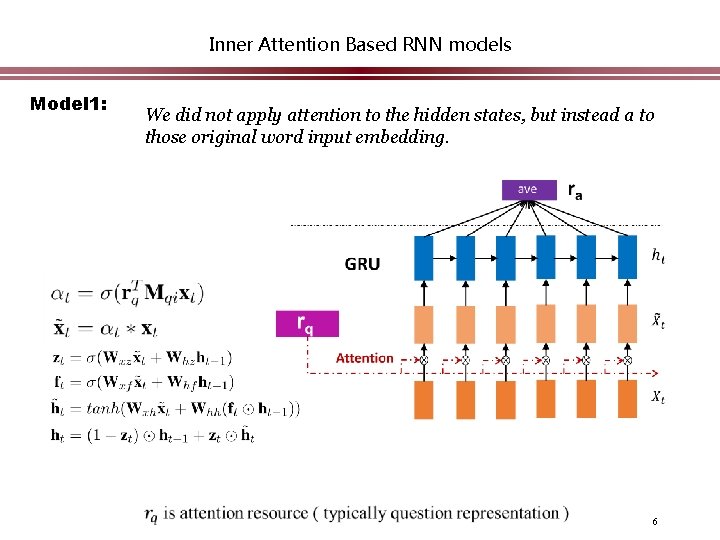
Inner Attention Based RNN models Model 1: We did not apply attention to the hidden states, but instead a to those original word input embedding. 6
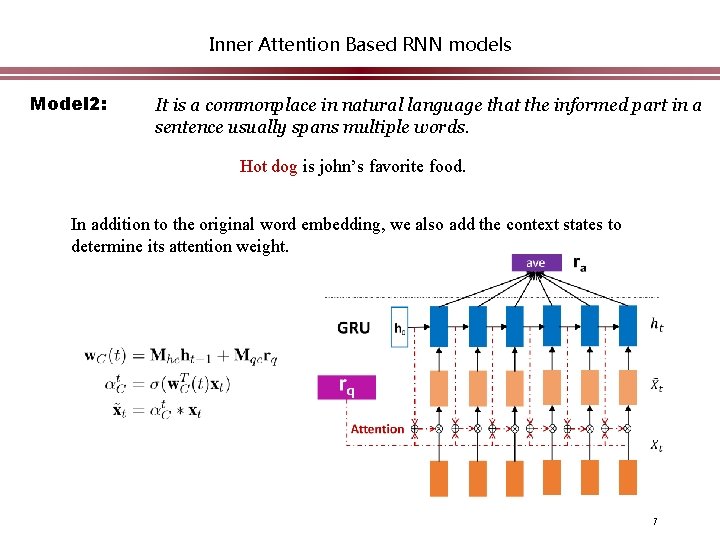
Inner Attention Based RNN models Model 2: It is a commonplace in natural language that the informed part in a sentence usually spans multiple words. Hot dog is john’s favorite food. In addition to the original word embedding, we also add the context states to determine its attention weight. 7
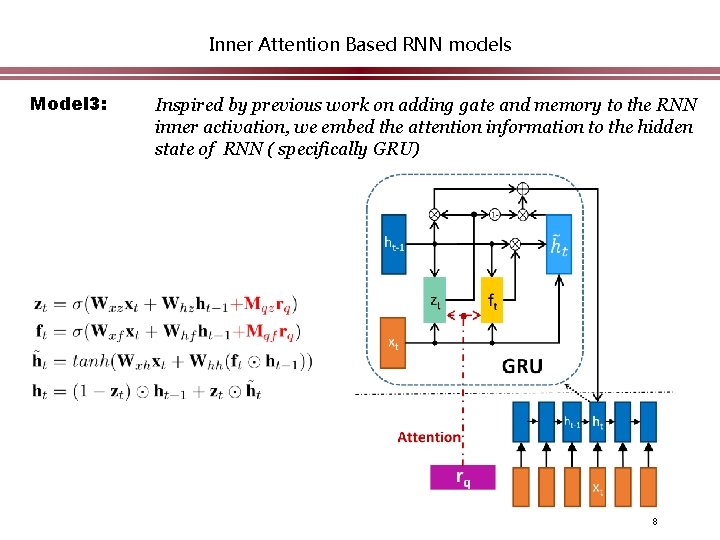
Inner Attention Based RNN models Model 3: Inspired by previous work on adding gate and memory to the RNN inner activation, we embed the attention information to the hidden state of RNN ( specifically GRU) 8
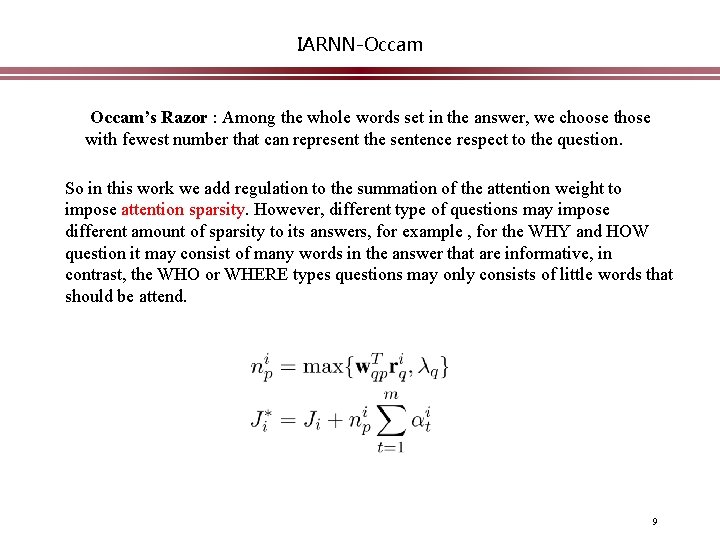
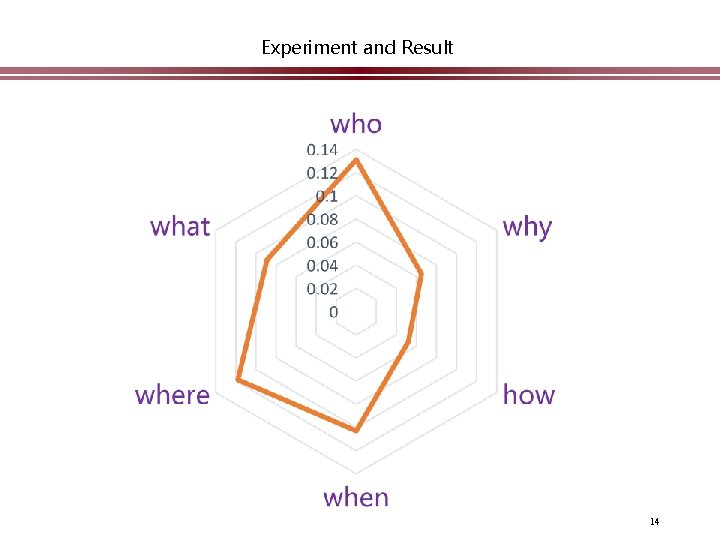
IARNN-Occam’s Razor : Among the whole words set in the answer, we choose those with fewest number that can represent the sentence respect to the question. So in this work we add regulation to the summation of the attention weight to impose attention sparsity. However, different type of questions may impose different amount of sparsity to its answers, for example , for the WHY and HOW question it may consist of many words in the answer that are informative, in contrast, the WHO or WHERE types questions may only consists of little words that should be attend. 9
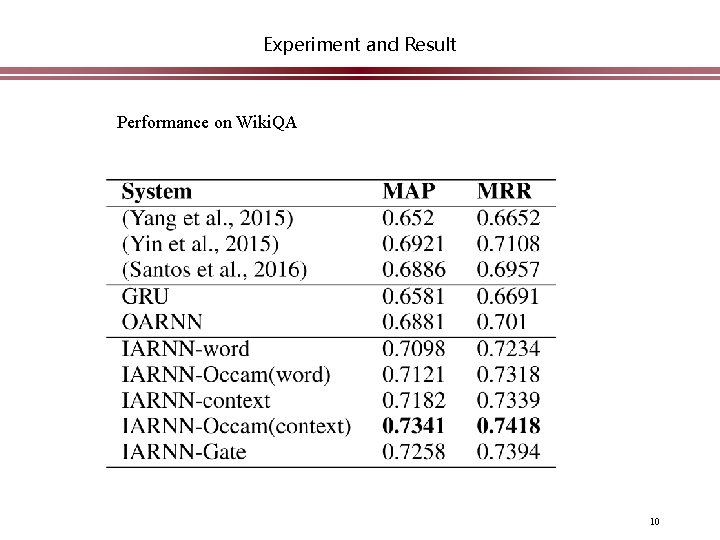
Experiment and Result Performance on Wiki. QA 10
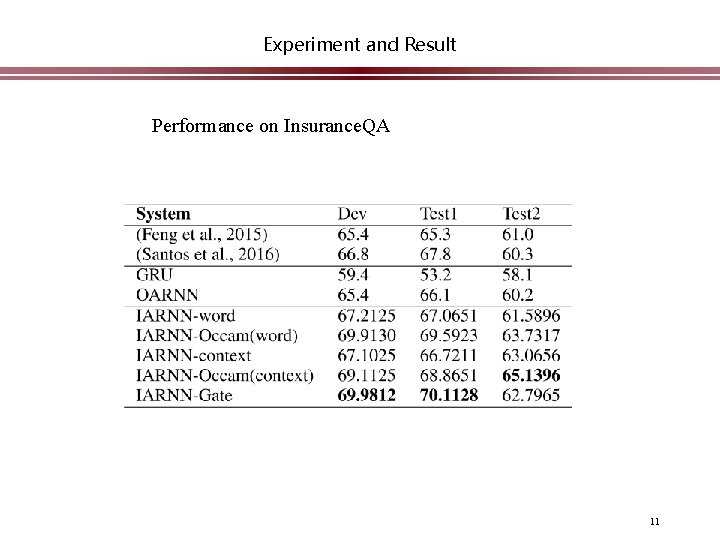
Experiment and Result Performance on Insurance. QA 11
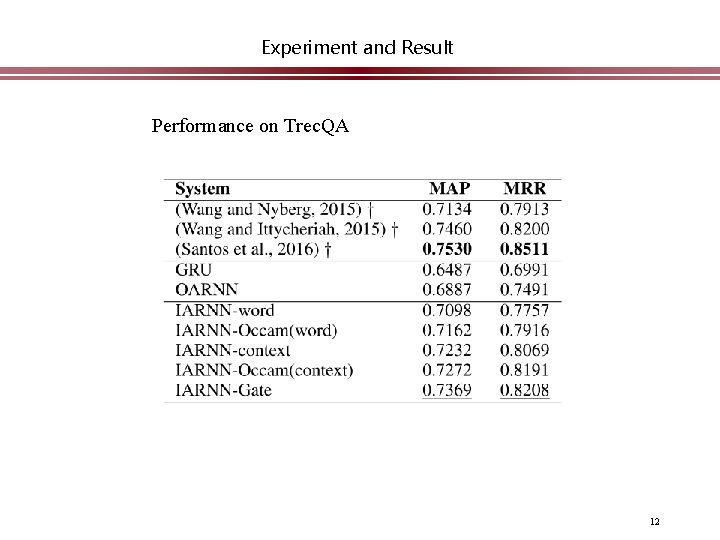
Experiment and Result Performance on Trec. QA 12
Experiment and Result 13
Experiment and Result 14

Thank you research@bingning. wang 15
- Slides: 15