
InkSpecific Handheld Readers and Security Variable Data Printing

Ink-Specific Handheld Readers and Security Variable Data Printing (SVDP) 20 September 2006 NIP 22 Steven Simske Principal Scientist, Security Printing, HP Labs John R. Hattersley (In. Data Systems), Galia Golodetz (HPIndigo), James Stasiak (Hewlett-Packard), Jason Aronoff (HP Labs) © 2006 Hewlett-Packard Development Company, L. P. The information contained herein is subject to change without notice

Outline: Security printing overview Overt and covert features Ink considerations Handheld reader considerations Linking the ink and reader Results © 2006 Hewlett-Packard Development Company, L. P. The information contained herein is subject to change without notice

Security Printing Overview © 2006 Hewlett-Packard Development Company, L. P. The information contained herein is subject to change without notice
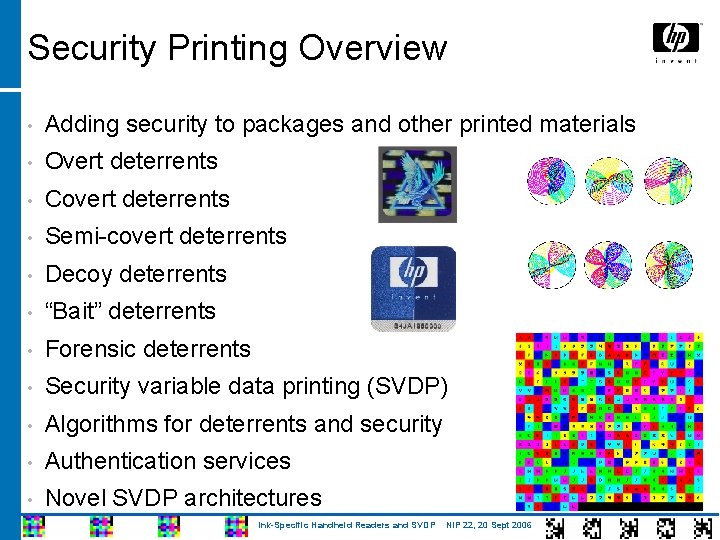
Security Printing Overview • Adding security to packages and other printed materials • Overt deterrents • Covert deterrents • Semi-covert deterrents • Decoy deterrents • “Bait” deterrents • Forensic deterrents • Security variable data printing (SVDP) • Algorithms for deterrents and security • Authentication services • Novel SVDP architectures Ink-Specific Handheld Readers and SVDP NIP 22, 20 Sept 2006
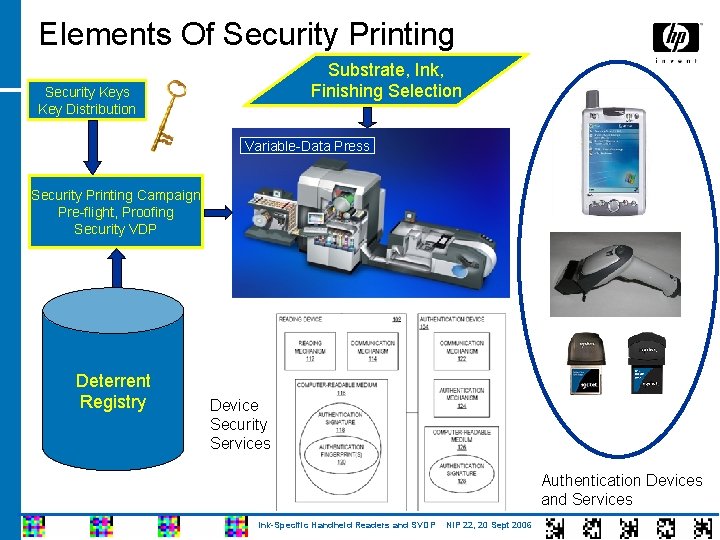
Elements Of Security Printing Substrate, Ink, Finishing Selection Security Keys Key Distribution Variable-Data Press Security Printing Campaign Pre-flight, Proofing Security VDP Deterrent Registry Device Security Services Authentication Devices and Services Ink-Specific Handheld Readers and SVDP NIP 22, 20 Sept 2006
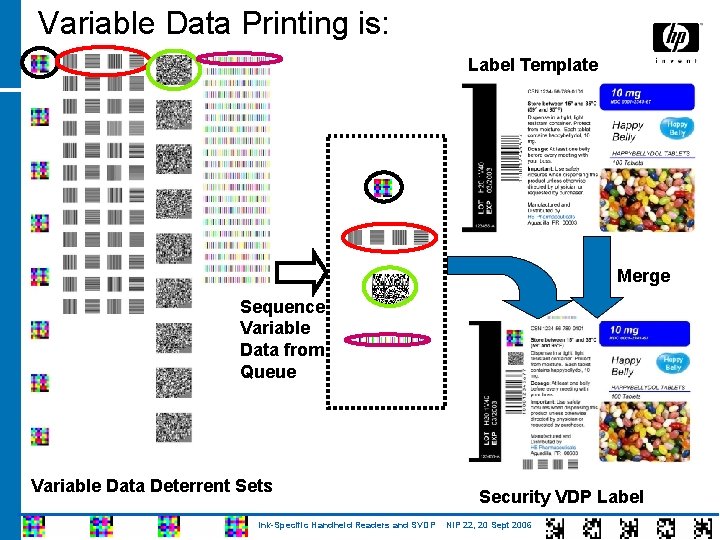
Variable Data Printing is: Label Template Merge Sequence Variable Data from Queue Variable Data Deterrent Sets Ink-Specific Handheld Readers and SVDP Security VDP Label NIP 22, 20 Sept 2006
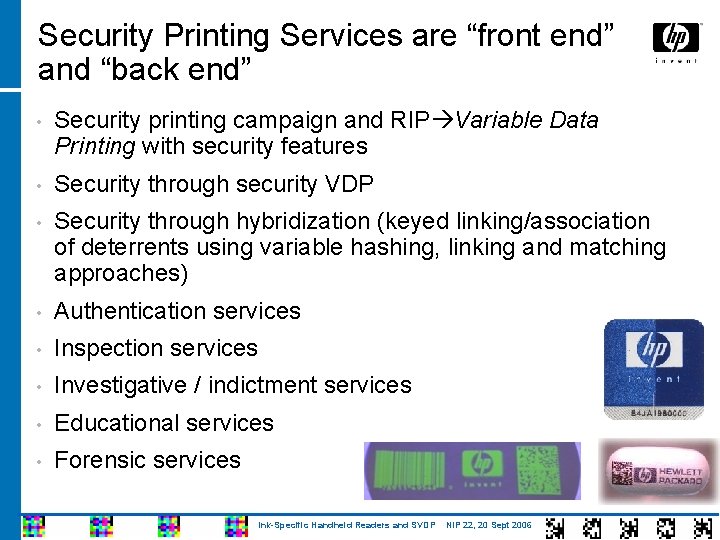
Security Printing Services are “front end” and “back end” • Security printing campaign and RIP Variable Data Printing with security features • Security through security VDP • Security through hybridization (keyed linking/association of deterrents using variable hashing, linking and matching approaches) • Authentication services • Inspection services • Investigative / indictment services • Educational services • Forensic services Ink-Specific Handheld Readers and SVDP NIP 22, 20 Sept 2006
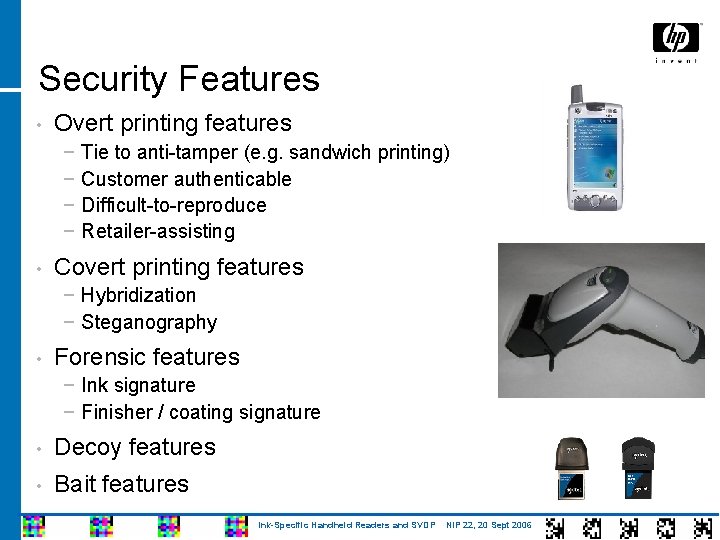
Security Features • Overt printing features − Tie to anti-tamper (e. g. sandwich printing) − Customer authenticable − Difficult-to-reproduce − Retailer-assisting • Covert printing features − Hybridization − Steganography • Forensic features − Ink signature − Finisher / coating signature • Decoy features • Bait features Ink-Specific Handheld Readers and SVDP NIP 22, 20 Sept 2006

Overt and Covert Features © 2006 Hewlett-Packard Development Company, L. P. The information contained herein is subject to change without notice
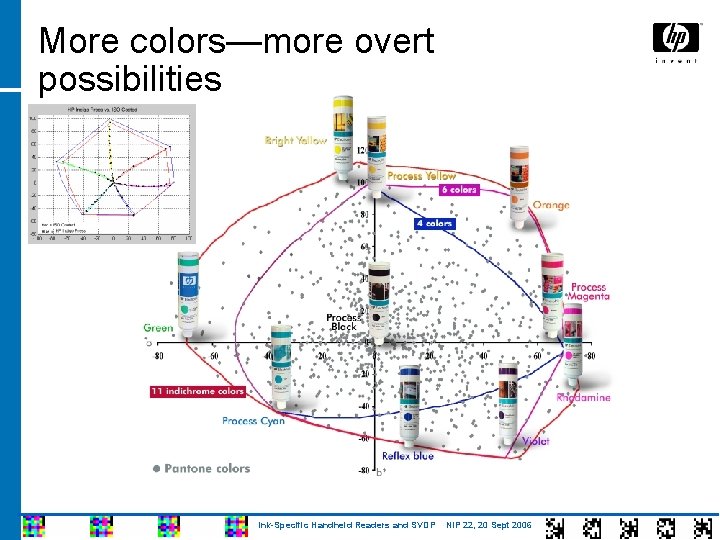
More colors—more overt possibilities Ink-Specific Handheld Readers and SVDP NIP 22, 20 Sept 2006
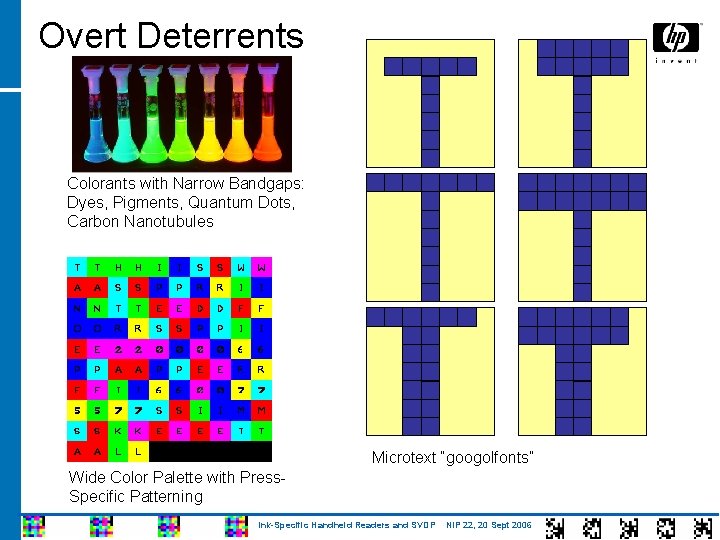
Overt Deterrents Colorants with Narrow Bandgaps: Dyes, Pigments, Quantum Dots, Carbon Nanotubules Microtext “googolfonts” Wide Color Palette with Press. Specific Patterning Ink-Specific Handheld Readers and SVDP NIP 22, 20 Sept 2006

Overt + Anti-Tamper: Substrate/ink Layering through Sandwich Printing (Below left). The use of sandwich printing on the HP Indigo Press for creating a peel-off label. A CMYK print can be seen through the transparent substrate (light layer, top), while three spot color layers (the minimum number of layers to create an opaque barrier) are used to hide the underlying message (in black spot color) until the substrate is peeled off. Ink-Specific Handheld Readers and SVDP NIP 22, 20 Sept 2006
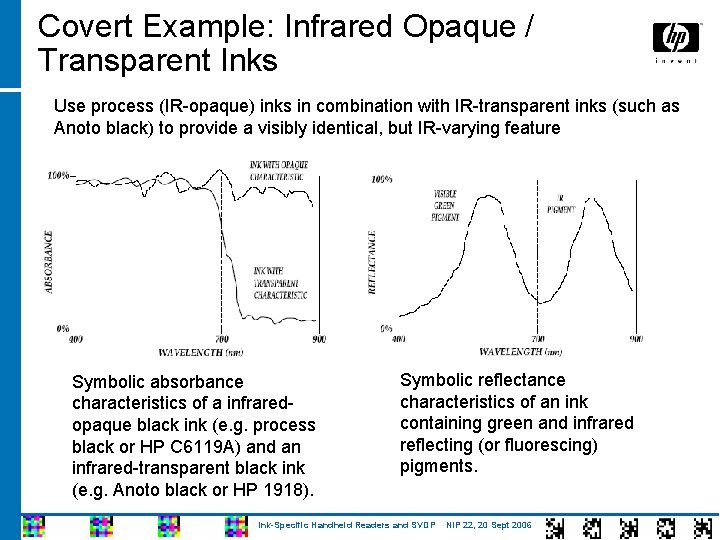
Covert Example: Infrared Opaque / Transparent Inks Use process (IR-opaque) inks in combination with IR-transparent inks (such as Anoto black) to provide a visibly identical, but IR-varying feature Symbolic absorbance characteristics of a infraredopaque black ink (e. g. process black or HP C 6119 A) and an infrared-transparent black ink (e. g. Anoto black or HP 1918). Symbolic reflectance characteristics of an ink containing green and infrared reflecting (or fluorescing) pigments. Ink-Specific Handheld Readers and SVDP NIP 22, 20 Sept 2006
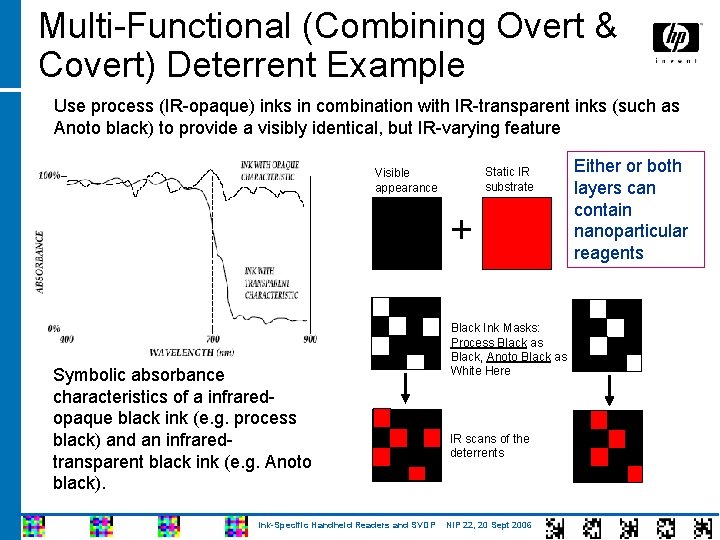
Multi-Functional (Combining Overt & Covert) Deterrent Example Use process (IR-opaque) inks in combination with IR-transparent inks (such as Anoto black) to provide a visibly identical, but IR-varying feature Static IR substrate Visible appearance + Symbolic absorbance characteristics of a infraredopaque black ink (e. g. process black) and an infraredtransparent black ink (e. g. Anoto black). Ink-Specific Handheld Readers and SVDP Black Ink Masks: Process Black as Black, Anoto Black as White Here IR scans of the deterrents NIP 22, 20 Sept 2006 Either or both layers can contain nanoparticular reagents

Ink Considerations © 2006 Hewlett-Packard Development Company, L. P. The information contained herein is subject to change without notice
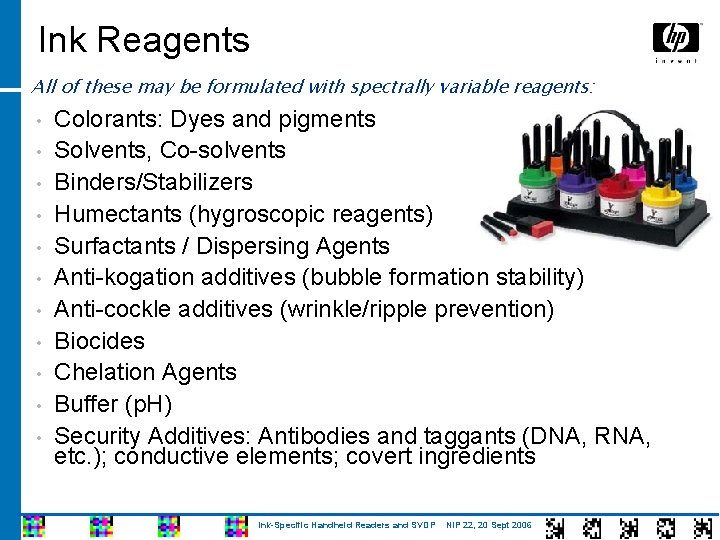
Ink Reagents All of these may be formulated with spectrally variable reagents: • • • Colorants: Dyes and pigments Solvents, Co-solvents Binders/Stabilizers Humectants (hygroscopic reagents) Surfactants / Dispersing Agents Anti-kogation additives (bubble formation stability) Anti-cockle additives (wrinkle/ripple prevention) Biocides Chelation Agents Buffer (p. H) Security Additives: Antibodies and taggants (DNA, RNA, etc. ); conductive elements; covert ingredients Ink-Specific Handheld Readers and SVDP NIP 22, 20 Sept 2006
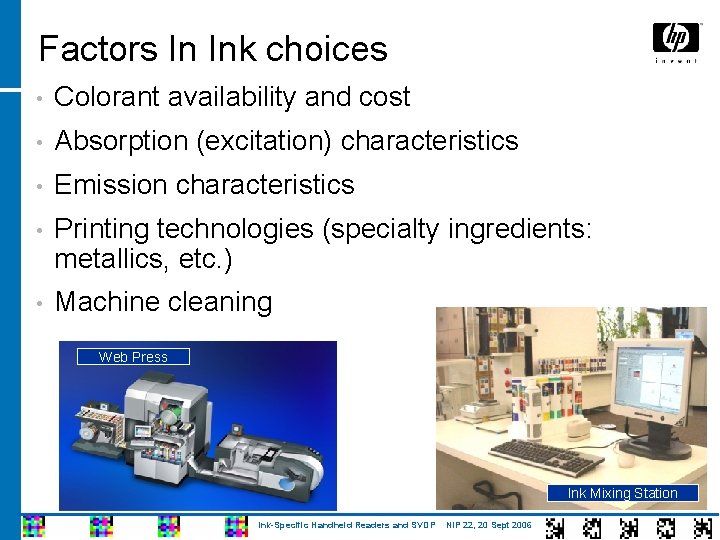
Factors In Ink choices • Colorant availability and cost • Absorption (excitation) characteristics • Emission characteristics • Printing technologies (specialty ingredients: metallics, etc. ) • Machine cleaning Web Press Ink Mixing Station Ink-Specific Handheld Readers and SVDP NIP 22, 20 Sept 2006
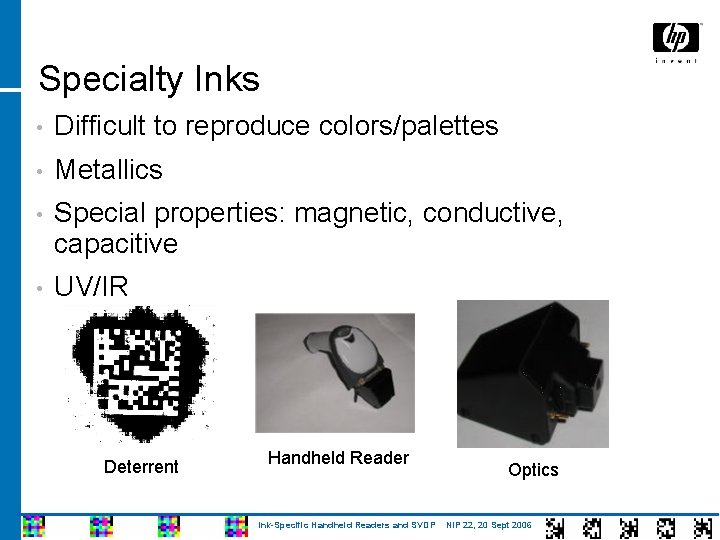
Specialty Inks • Difficult to reproduce colors/palettes • Metallics • Special properties: magnetic, conductive, capacitive • UV/IR Deterrent Handheld Reader Ink-Specific Handheld Readers and SVDP Optics NIP 22, 20 Sept 2006
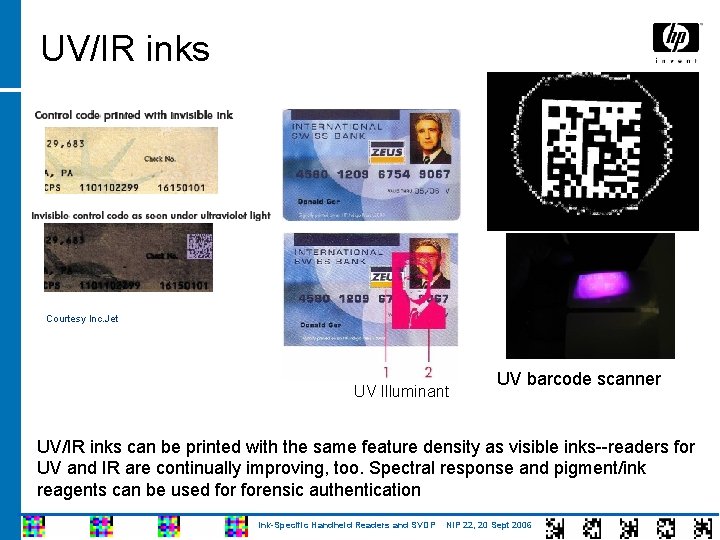
UV/IR inks Courtesy Inc. Jet UV Illuminant UV barcode scanner UV/IR inks can be printed with the same feature density as visible inks--readers for UV and IR are continually improving, too. Spectral response and pigment/ink reagents can be used forensic authentication Ink-Specific Handheld Readers and SVDP NIP 22, 20 Sept 2006
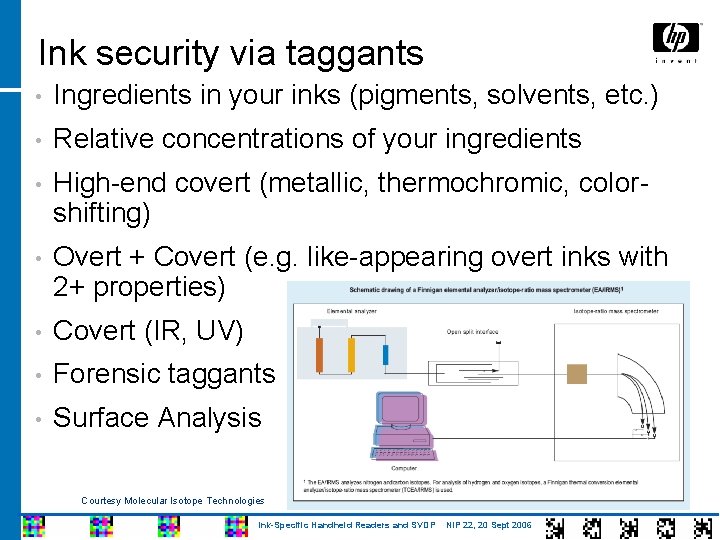
Ink security via taggants • Ingredients in your inks (pigments, solvents, etc. ) • Relative concentrations of your ingredients • High-end covert (metallic, thermochromic, colorshifting) • Overt + Covert (e. g. like-appearing overt inks with 2+ properties) • Covert (IR, UV) • Forensic taggants • Surface Analysis Courtesy Molecular Isotope Technologies Ink-Specific Handheld Readers and SVDP NIP 22, 20 Sept 2006

Handheld Reader Considerations © 2006 Hewlett-Packard Development Company, L. P. The information contained herein is subject to change without notice
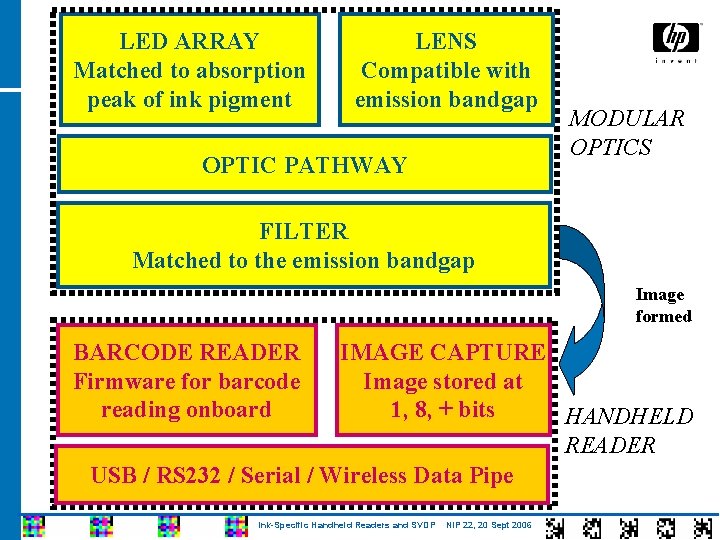
LED ARRAY Matched to absorption peak of ink pigment LENS Compatible with emission bandgap OPTIC PATHWAY MODULAR OPTICS FILTER Matched to the emission bandgap Image formed BARCODE READER Firmware for barcode reading onboard IMAGE CAPTURE Image stored at 1, 8, + bits HANDHELD READER USB / RS 232 / Serial / Wireless Data Pipe Ink-Specific Handheld Readers and SVDP NIP 22, 20 Sept 2006
Considerations and Approaches • LEDs (from 365 nm-800 nm) are readily available • Filters are readily available in the same range • Barcode readers are standardized and provide an excellent comparative metric for any ink/ISHR combination • LEDs are not FDA regulated, and ready to ship at 365 nm • The optics are modular to allow a single reader to support multiple inks • The LEDs are matched with the ink peak absorption wavelength • The filters are matched to the ink emission bandgap Ink-Specific Handheld Readers and SVDP NIP 22, 20 Sept 2006

Linking the Ink and Reader © 2006 Hewlett-Packard Development Company, L. P. The information contained herein is subject to change without notice
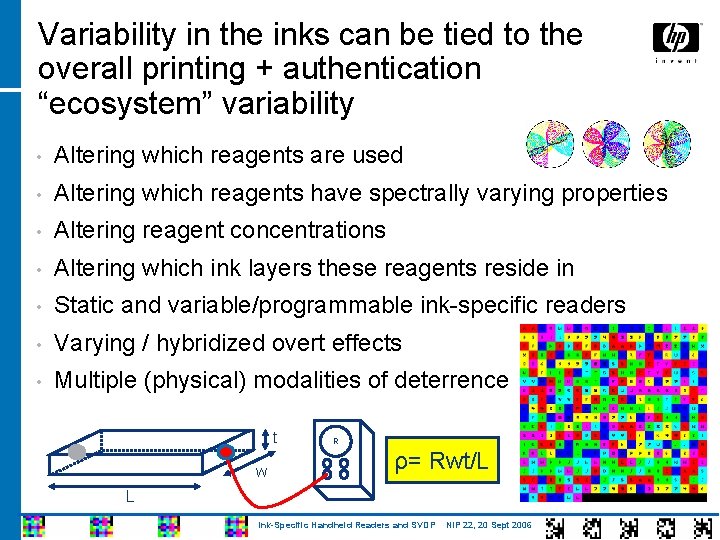
Variability in the inks can be tied to the overall printing + authentication “ecosystem” variability • Altering which reagents are used • Altering which reagents have spectrally varying properties • Altering reagent concentrations • Altering which ink layers these reagents reside in • Static and variable/programmable ink-specific readers • Varying / hybridized overt effects • Multiple (physical) modalities of deterrence t w R ρ= Rwt/L L Ink-Specific Handheld Readers and SVDP NIP 22, 20 Sept 2006

Case Study: Development of Near-Nano Ink Product Description: 6105 Silver Conductor is a flexible, low electrical resistance, screen printable composition. Processing Substrates: Polyester, paper, polyimide, other plastics, FR 4 Screen Mesh and Type: 200 to 325 mesh stainless steel, 230 to 305 mesh polyester, ½ mil. emulsion Squeeze: 70 durometer Typical Cure Cycle: 30 to 60 minutes at 130°C in a box oven or IR equivalent. Resistance can be lowered at higher cure temperatures. Typical Cured Print Thickness: 8 to 10 microns Typical Properties: Viscosity 20 K to 40 K cps, HBT #3 spindle, 10 rpm; Percent Solids 76 to 82; Coverage 100 to 200 sq cm/gm depending on screen; Sheet Resistivity Less than 3 milliohms per square per mil on higher temp substrates; Less than 5 milliohms per square per mil on lower temp substrates; Adhesion Passes cross hatch tape test (3 M Scotch Tape #810); Clean Up Isopropyl Alcohol or Acetone t R w ρ= Rwt/L L Ink-Specific Handheld Readers and SVDP NIP 22, 20 Sept 2006
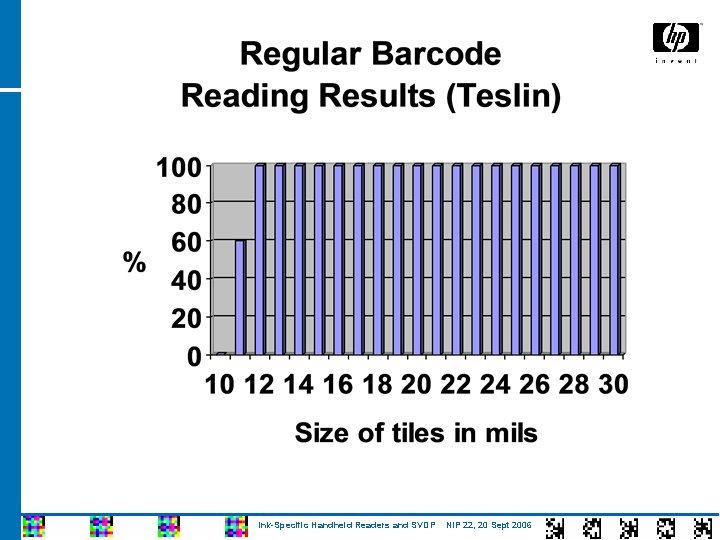
Qualification of Conductive Inks • Reflective inks can be read if contrast with the substrate is high • Reflection can be filtered • Default handheld scanner, 400 nm LEDs, can read 20 mil (0. 5 mm) module 2 D Data Matrix barcodes • With filtering this can be extended to the low end of the spec. range (10 mil, 0. 25 mm) Ink-Specific Handheld Readers and SVDP NIP 22, 20 Sept 2006
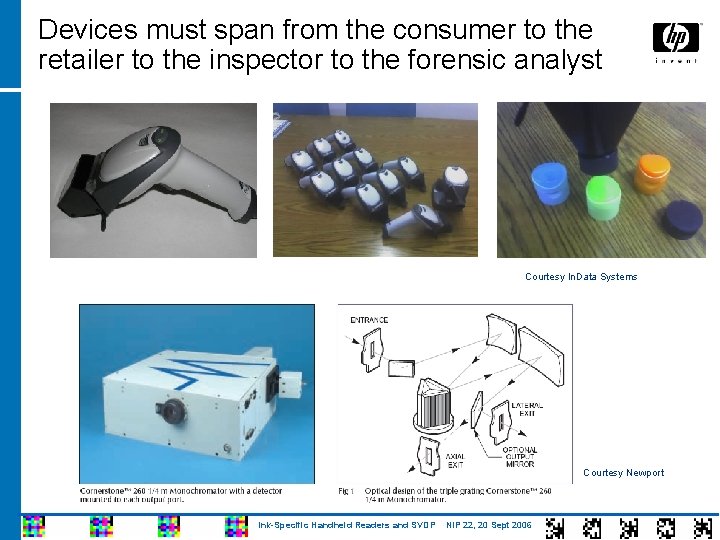
Devices must span from the consumer to the retailer to the inspector to the forensic analyst Courtesy In. Data Systems Courtesy Newport Ink-Specific Handheld Readers and SVDP NIP 22, 20 Sept 2006
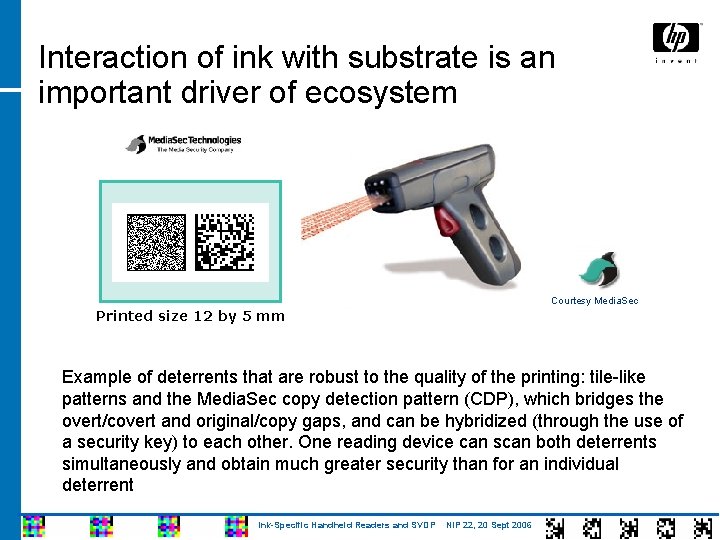
Interaction of ink with substrate is an important driver of ecosystem Courtesy Media. Sec Printed size 12 by 5 mm Example of deterrents that are robust to the quality of the printing: tile-like patterns and the Media. Sec copy detection pattern (CDP), which bridges the overt/covert and original/copy gaps, and can be hybridized (through the use of a security key) to each other. One reading device can scan both deterrents simultaneously and obtain much greater security than for an individual deterrent Ink-Specific Handheld Readers and SVDP NIP 22, 20 Sept 2006
Results © 2006 Hewlett-Packard Development Company, L. P. The information contained herein is subject to change without notice
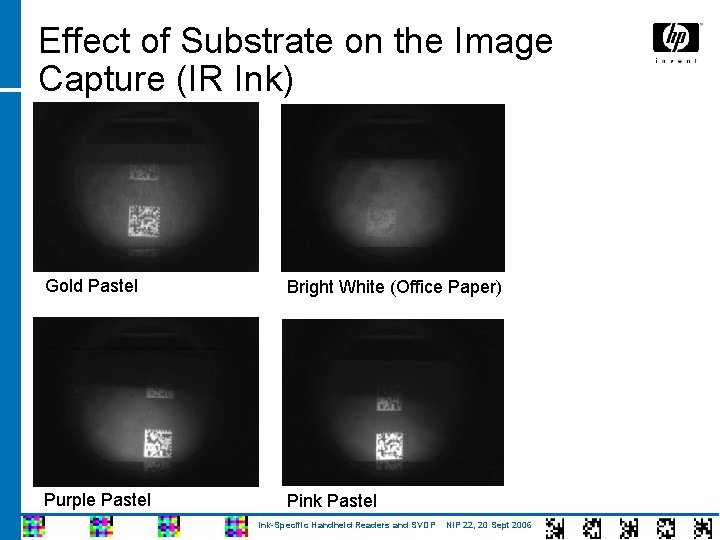
Effect of Substrate on the Image Capture (IR Ink) Gold Pastel Bright White (Office Paper) Purple Pastel Pink Pastel Ink-Specific Handheld Readers and SVDP NIP 22, 20 Sept 2006
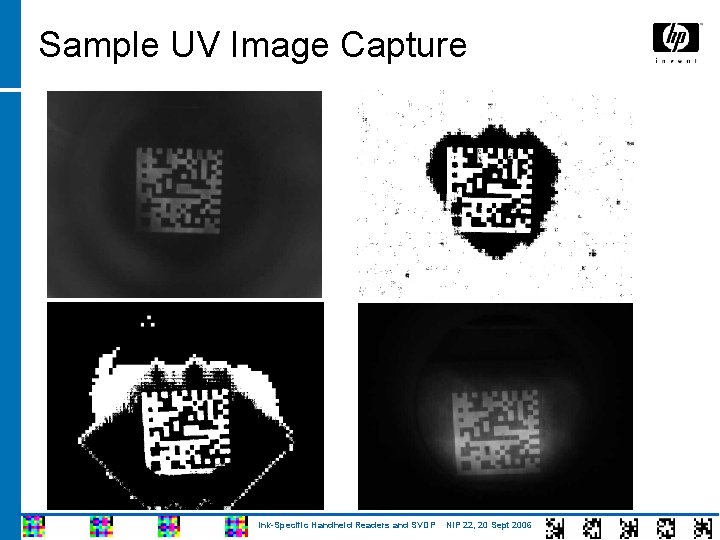
Sample UV Image Capture Ink-Specific Handheld Readers and SVDP NIP 22, 20 Sept 2006
Ink-Specific Handheld Readers and SVDP NIP 22, 20 Sept 2006
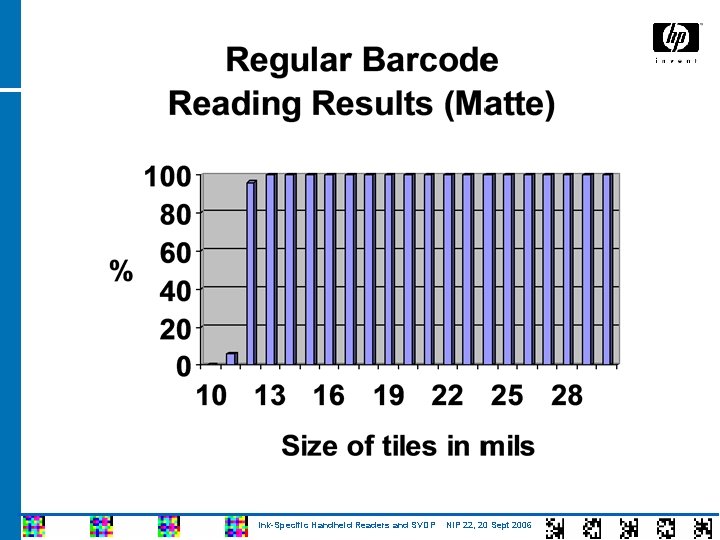
Ink-Specific Handheld Readers and SVDP NIP 22, 20 Sept 2006
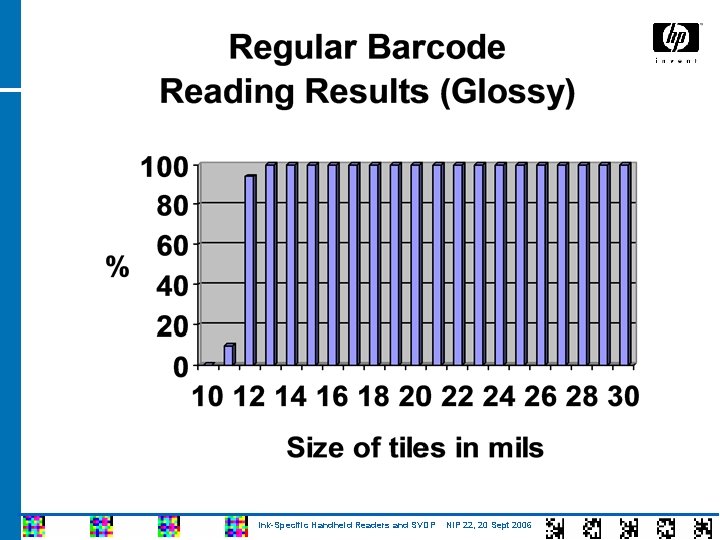
Ink-Specific Handheld Readers and SVDP NIP 22, 20 Sept 2006
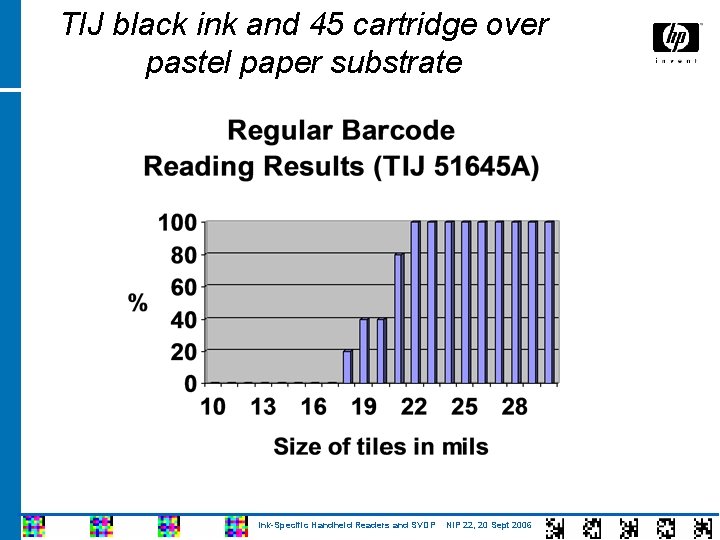
TIJ black ink and 45 cartridge over pastel paper substrate Ink-Specific Handheld Readers and SVDP NIP 22, 20 Sept 2006

Acknowledgments: Maureen Brock, Phil Keenan, Dave Kellar and Henry Sang In. Data Systems, Media. Sec, Methode © 2006 Hewlett-Packard Development Company, L. P. The information contained herein is subject to change without notice
- Slides: 37