
Injuries Part 2 Fractures Dislocations of the Hand


- Slides: 15
Injuries, Part 2 Fractures & Dislocations of the Hand & Wrist
“Before & After” BELLWORK On a piece of notebook paper, draw two columns. Label the first column ‘Before’ and the second column ‘After. ’ Then answer the following questions under the ‘Before’ column. Put the paper aside until the end of class. 1. How does a finger fracture occur? 2. How does a finger dislocation occur? 3. What are the signs of a finger fracture? 4. What are the signs of a finger dislocation?
Objectives Differentiate between common injuries and their mechanisms, signs, symptoms and treatments.
Terminology Anatomical snuffbox: a depression over the wrist that can be seen when the fingers are extended Avascular necrosis: tissue death due to lack of blood supply Boxer’s fracture: injury of the 5 th metacarpal Colles’ fracture: fracture of the distal radius
Idea Wave List 3 ideas about the injuries that we discussed yesterday. Be ready to share with the class. After the “Idea Wave, ” rank your top three ideas from the class. PROPERTY OF PIMA COUNTY JTED, 2010 5
Fractures/Dislocations • • • Radial / ulnar fracture Carpal dislocation Metacarpal fracture Phalynx dislocation
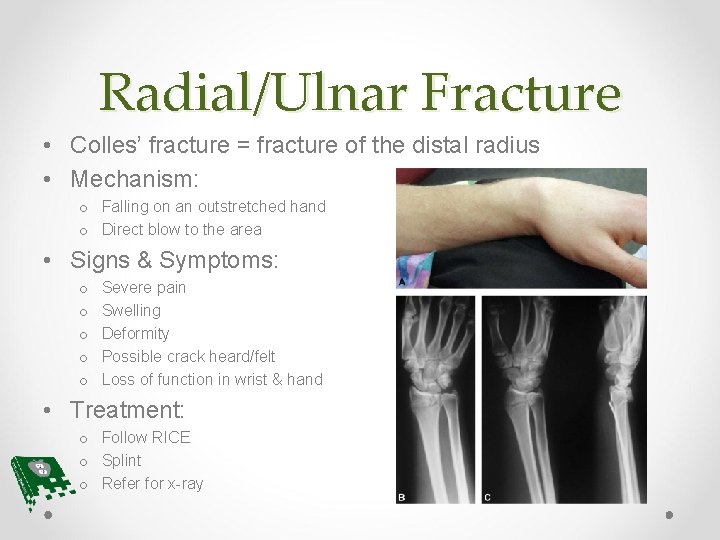
Radial/Ulnar Fracture • Colles’ fracture = fracture of the distal radius • Mechanism: o Falling on an outstretched hand o Direct blow to the area • Signs & Symptoms: o o o Severe pain Swelling Deformity Possible crack heard/felt Loss of function in wrist & hand • Treatment: o Follow RICE o Splint o Refer for x-ray
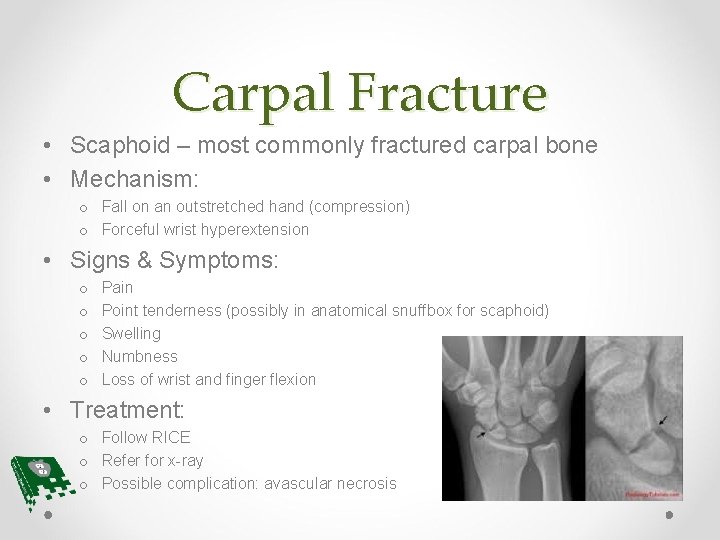
Carpal Fracture • Scaphoid – most commonly fractured carpal bone • Mechanism: o Fall on an outstretched hand (compression) o Forceful wrist hyperextension • Signs & Symptoms: o o o Pain Point tenderness (possibly in anatomical snuffbox for scaphoid) Swelling Numbness Loss of wrist and finger flexion • Treatment: o Follow RICE o Refer for x-ray o Possible complication: avascular necrosis
Carpal Dislocation • Lunate – most commonly dislocated carpal bone • Mechanism: o Falling on an extended hand o Hyperextension • Signs & Symptoms: o o Pain Swelling Numbness Loss of ROM • Treatment: o Follow RICE o Refer for x-ray / reduction
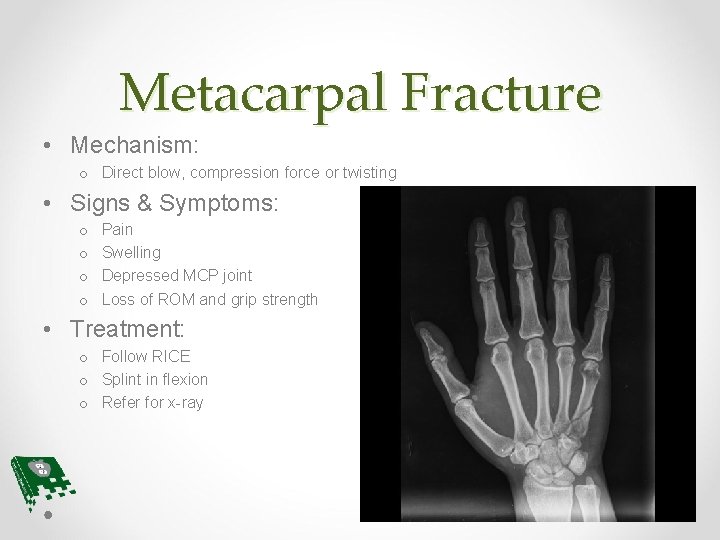
Metacarpal Fracture • Mechanism: o Direct blow, compression force or twisting • Signs & Symptoms: o o Pain Swelling Depressed MCP joint Loss of ROM and grip strength • Treatment: o Follow RICE o Splint in flexion o Refer for x-ray
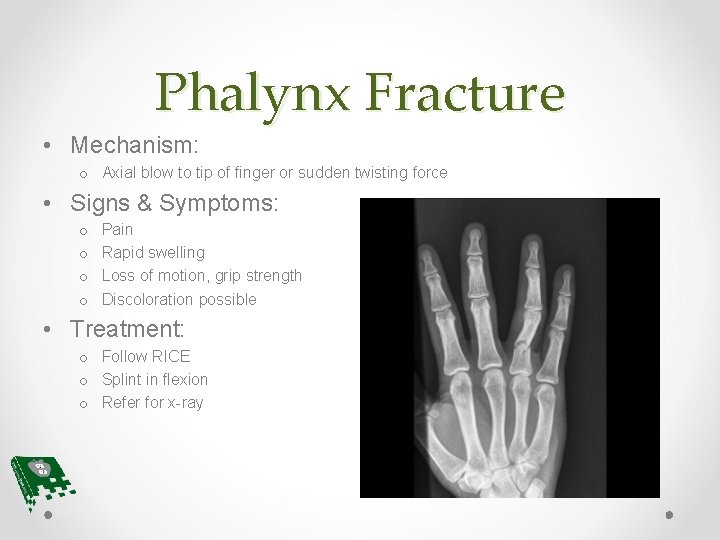
Phalynx Fracture • Mechanism: o Axial blow to tip of finger or sudden twisting force • Signs & Symptoms: o o Pain Rapid swelling Loss of motion, grip strength Discoloration possible • Treatment: o Follow RICE o Splint in flexion o Refer for x-ray
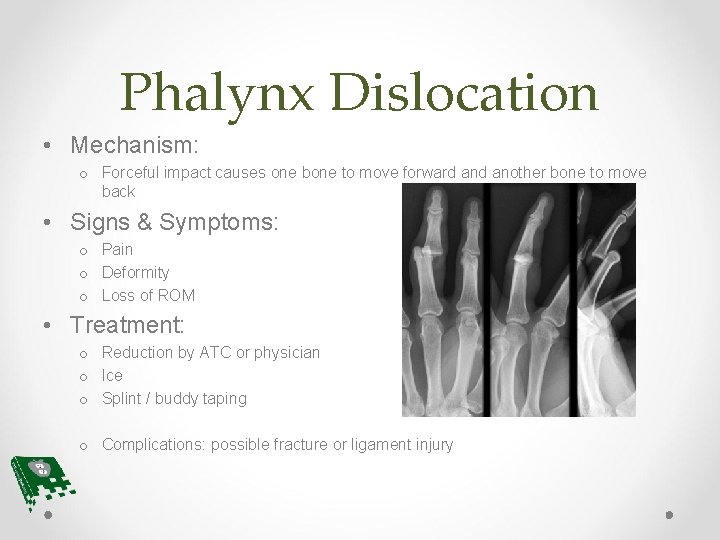
Phalynx Dislocation • Mechanism: o Forceful impact causes one bone to move forward another bone to move back • Signs & Symptoms: o Pain o Deformity o Loss of ROM • Treatment: o Reduction by ATC or physician o Ice o Splint / buddy taping o Complications: possible fracture or ligament injury
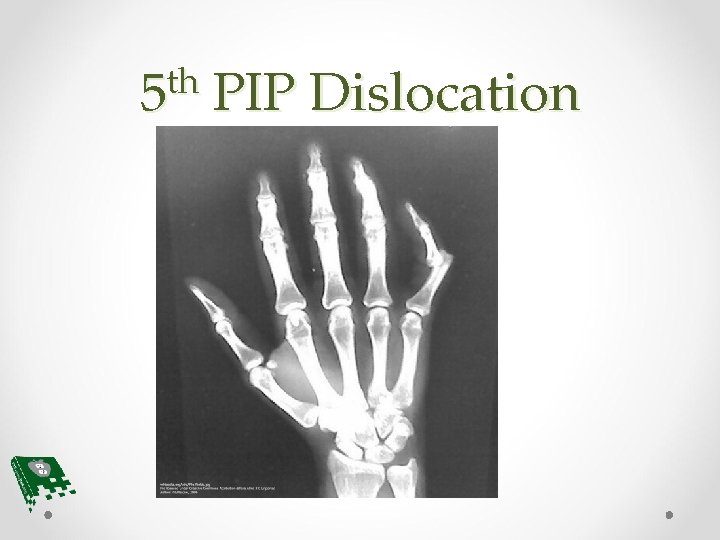
th 5 PIP Dislocation
“What’s My Injury? ” • With a partner, choose an injury from today’s lesson. • Create a scenario for that injury including the mechanism, signs & symptoms, and treatment. Write the scenario down. • Be prepared to share your injury with the class.
“Before & After” CLOSURE On your bellwork sheet, answer the following questions in the ‘after’ column. This will assess your new learning for the day! 1. 2. 3. 4. How does a carpal fracture happen? How does a carpal dislocation happen? What are the signs of a carpal fracture? What are the signs of a carpal dislocation?