
Injuries Part 1 Sprains Strains of the Wrist
- Slides: 11
Injuries, Part 1 Sprains & Strains of the Wrist, Hand, & Fingers 9/19/2021 1
“Before & After” BELLWORK On a piece of notebook paper, draw two columns. Label the first column ‘before’ and the second column ‘after. ’ Then answer the following questions under the ‘before’ column. Put the paper aside until the end of class. 1. How does a wrist strain happen? 2. How does a wrist sprain happen? 3. What are the signs of a wrist strain? 4. What are the signs of a wrist sprain? 9/19/2021 2
Objective Differentiate between common injuries of the hand & wrist, and their mechanisms, signs & symptoms, and treatments. Property of CTE Joint Venture 9/19/2021 3
INTERVIEW • Each student will find a partner. One person assumes the role of the interviewer and one is the interviewee. • The interviewer asks the assigned questions and writes the answers down. • The partners switch roles and repeat the process. • When time is called, groups should be prepared to share the results of • their interviews with the class. 9/19/2021 4
Interview Questions. . . 1. Think of a wrist or hand injury that either you or someone you know sustained. What was the injury? 2. What was the injury mechanism? 3. What were the signs & symptoms? 4. What treatment was given? 9/19/2021 5
Wrist Strain (Injury to the wrist Tendons) • Mechanism: o Wrist hyperflexion/hyperextension o Repetitive stress • Signs & Symptoms: o o Pain over area Swelling Limited/painful ROM Decreased grip strength • Treatment: o RICE (rest, ice, compression, elevation) o Rehabilitation to restore normal ROM and strength o Tape for return to activity/Brace Property of CTE Joint Venture 9/19/2021 6
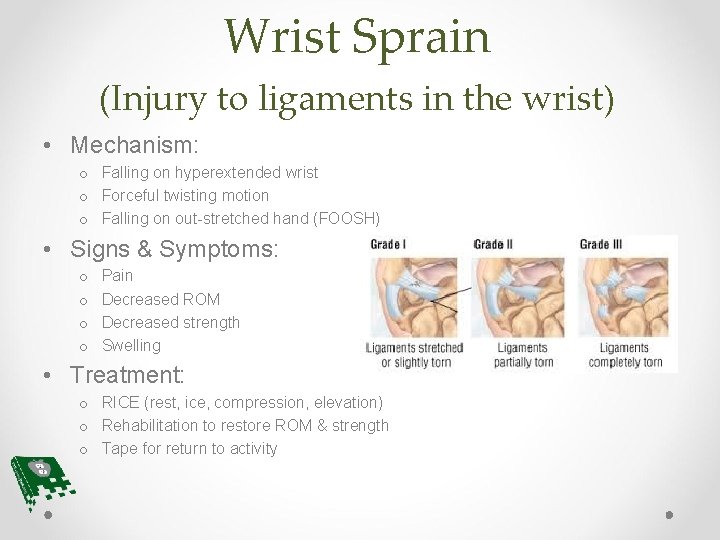
Wrist Sprain (Injury to ligaments in the wrist) • Mechanism: o Falling on hyperextended wrist o Forceful twisting motion o Falling on out-stretched hand (FOOSH) • Signs & Symptoms: o o Pain Decreased ROM Decreased strength Swelling • Treatment: o RICE (rest, ice, compression, elevation) o Rehabilitation to restore ROM & strength o Tape for return to activity
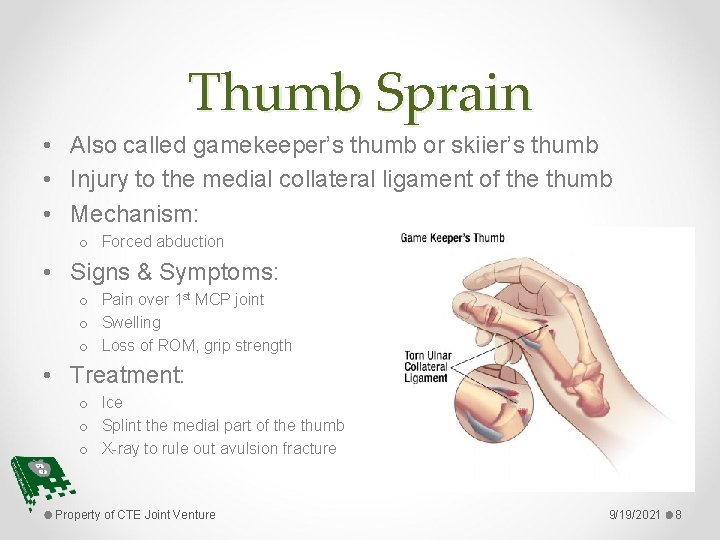
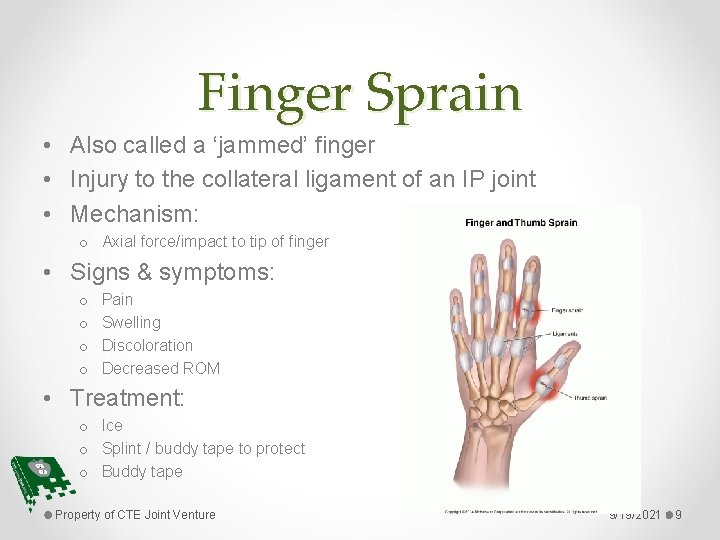
Thumb Sprain • Also called gamekeeper’s thumb or skiier’s thumb • Injury to the medial collateral ligament of the thumb • Mechanism: o Forced abduction • Signs & Symptoms: o Pain over 1 st MCP joint o Swelling o Loss of ROM, grip strength • Treatment: o Ice o Splint the medial part of the thumb o X-ray to rule out avulsion fracture Property of CTE Joint Venture 9/19/2021 8
Finger Sprain • Also called a ‘jammed’ finger • Injury to the collateral ligament of an IP joint • Mechanism: o Axial force/impact to tip of finger • Signs & symptoms: o o Pain Swelling Discoloration Decreased ROM • Treatment: o Ice o Splint / buddy tape to protect o Buddy tape Property of CTE Joint Venture 9/19/2021 9
“What’s My Injury? ” • With a partner, choose an injury from today’s lesson • Create a scenario for that injury including the mechanism, signs & symptoms, and treatment for the injury • Be prepared to share your injury with the class Property of CTE Joint Venture 9/19/2021 10
“Before & After” CLOSURE On your bellwork sheet, answer the following questions in the ‘After’ column. This will assess your new learning for the day! 1. How does a wrist strain happen? 2. How does a wrist sprain happen? 3. What are the signs of a wrist strain? 4. What are the signs of a wrist sprain? 9/19/2021 11