
Injuries of the Thigh Hip Groin Pelvis Chapter
- Slides: 40
Injuries of the Thigh, Hip, Groin & Pelvis Chapter 17
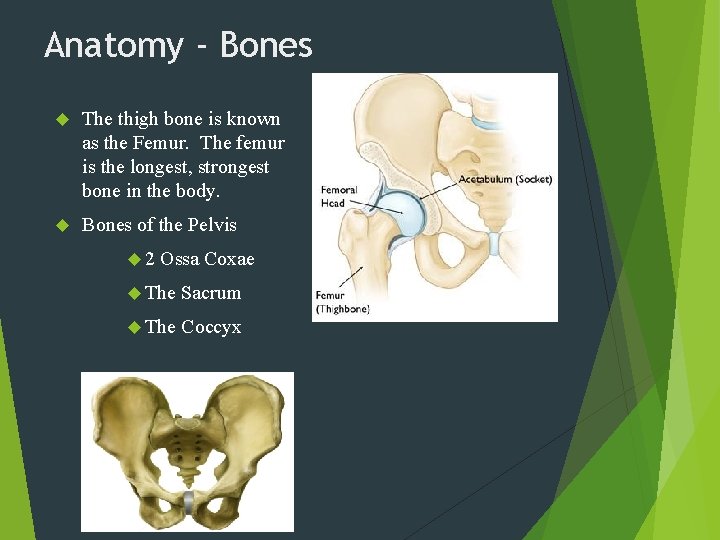
Anatomy - Bones The thigh bone is known as the Femur. The femur is the longest, strongest bone in the body. Bones of the Pelvis 2 Ossa Coxae The Sacrum The Coccyx
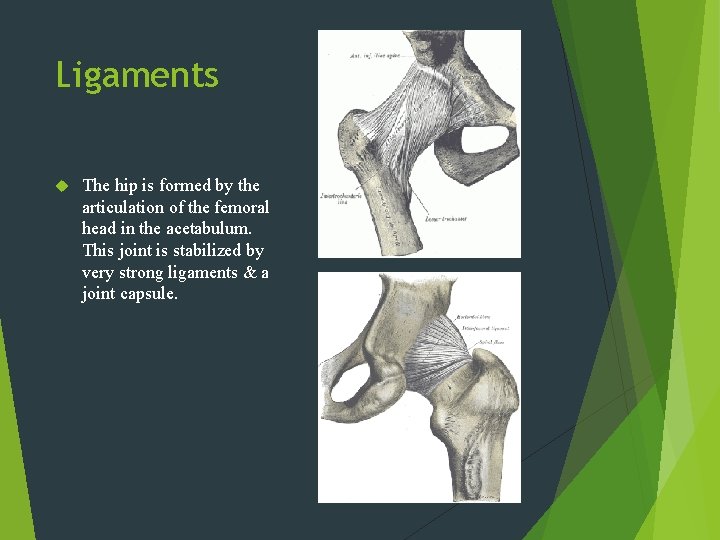
Ligaments The hip is formed by the articulation of the femoral head in the acetabulum. This joint is stabilized by very strong ligaments & a joint capsule.
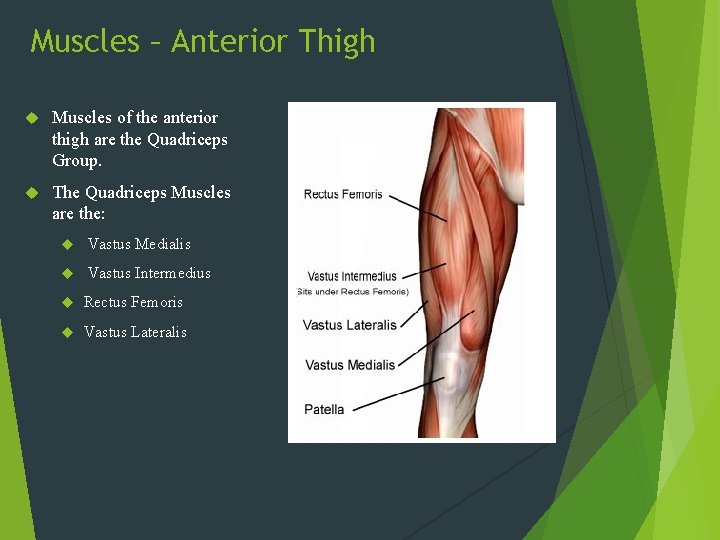
Muscles – Anterior Thigh Muscles of the anterior thigh are the Quadriceps Group. The Quadriceps Muscles are the: Vastus Medialis Vastus Intermedius Rectus Femoris Vastus Lateralis
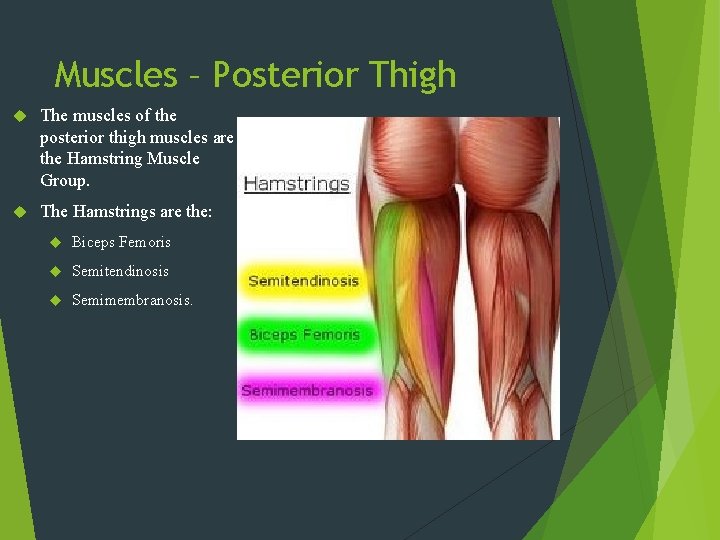
Muscles – Posterior Thigh The muscles of the posterior thigh muscles are the Hamstring Muscle Group. The Hamstrings are the: Biceps Femoris Semitendinosis Semimembranosis.
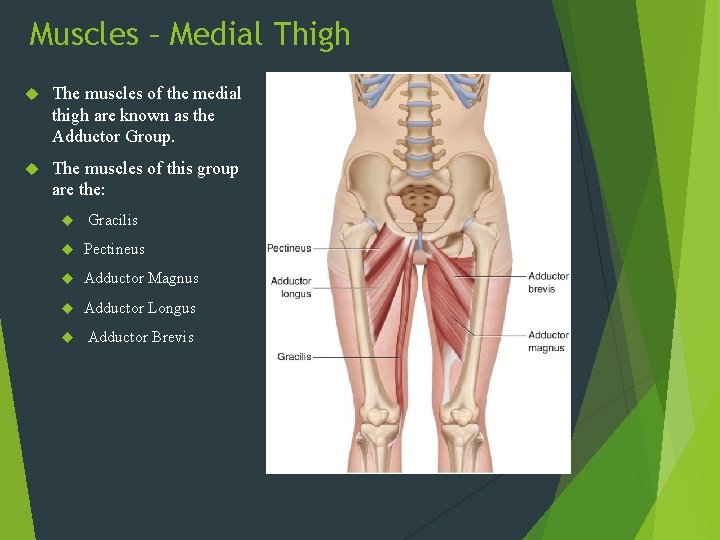
Muscles – Medial Thigh The muscles of the medial thigh are known as the Adductor Group. The muscles of this group are the: Gracilis Pectineus Adductor Magnus Adductor Longus Adductor Brevis
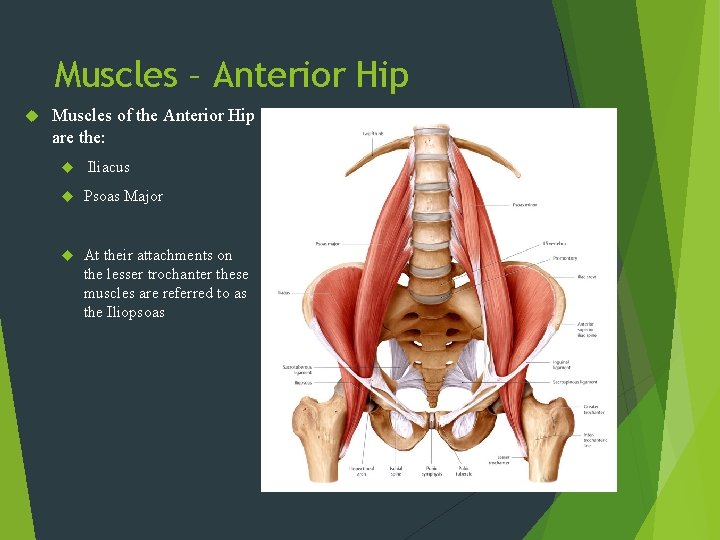
Muscles – Anterior Hip Muscles of the Anterior Hip are the: Iliacus Psoas Major At their attachments on the lesser trochanter these muscles are referred to as the Iliopsoas
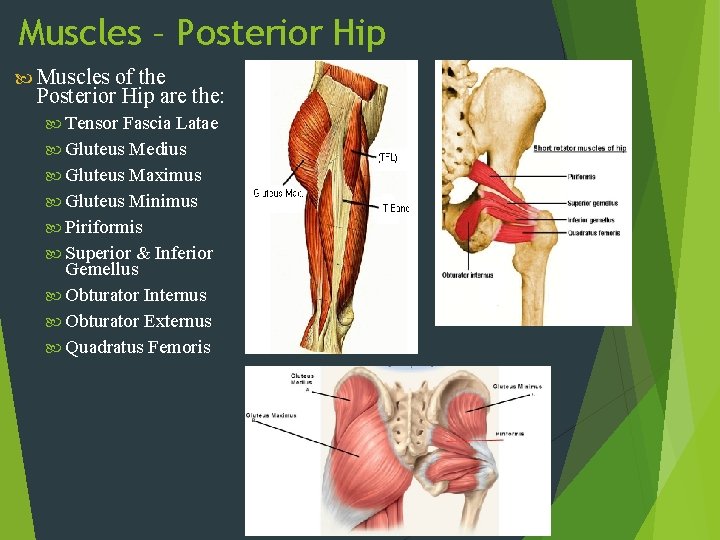
Muscles – Posterior Hip Muscles of the Posterior Hip are the: Tensor Fascia Latae Gluteus Medius Gluteus Maximus Gluteus Minimus Piriformis Superior & Inferior Gemellus Obturator Internus Obturator Externus Quadratus Femoris
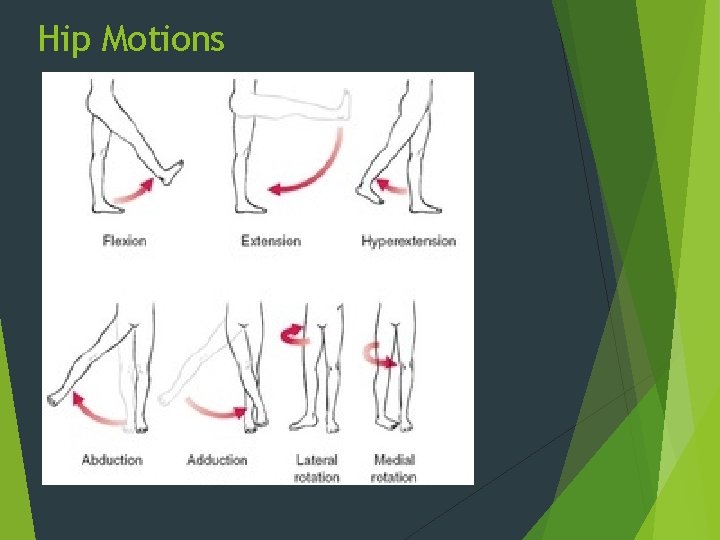
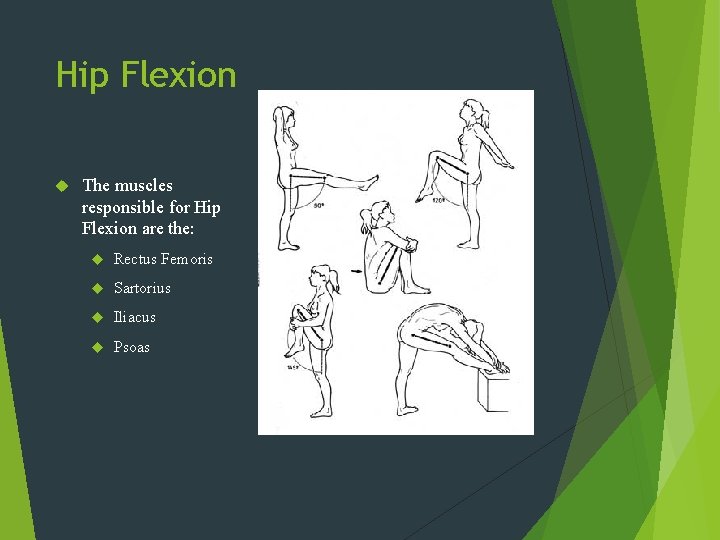
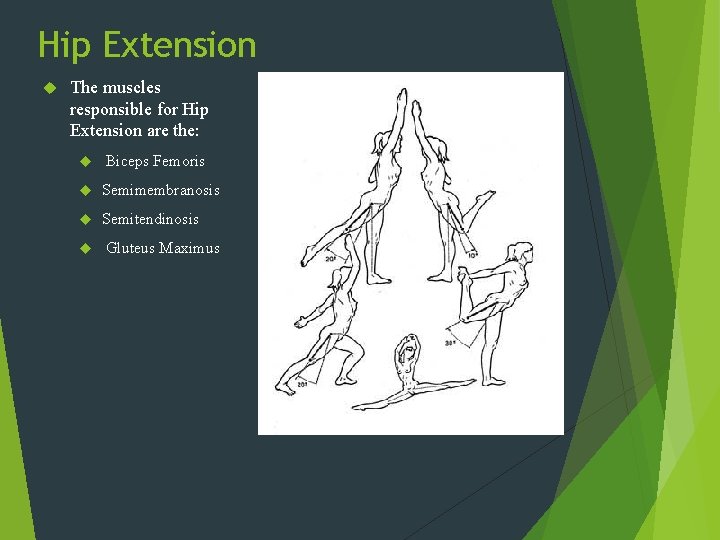
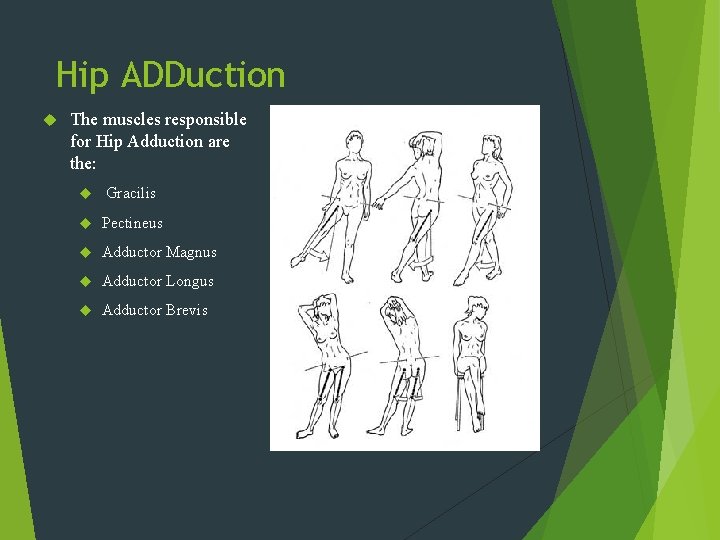
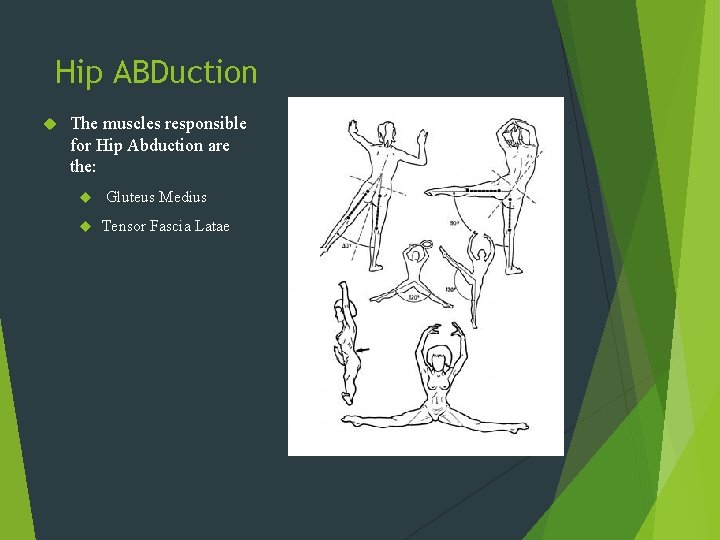
Hip Motions There are 6 hip motions Internal Rotation: Gluteus Minimus External Rotation: Piriformis, Superior Gemellus, Inferior Gemellus, Obturator Internus, externus & femoris Flexion: Rectus Femoris, Sartorius, Illiacus, Psoas Extension: Hamstring group, Gluteus Maximus Adduction: Gracilis, Pectineus, Adductor Magnus, Adductor Longus & Brevis Abduction: Gluteus Medius, Tensor Fascia Latae
Hip Motions
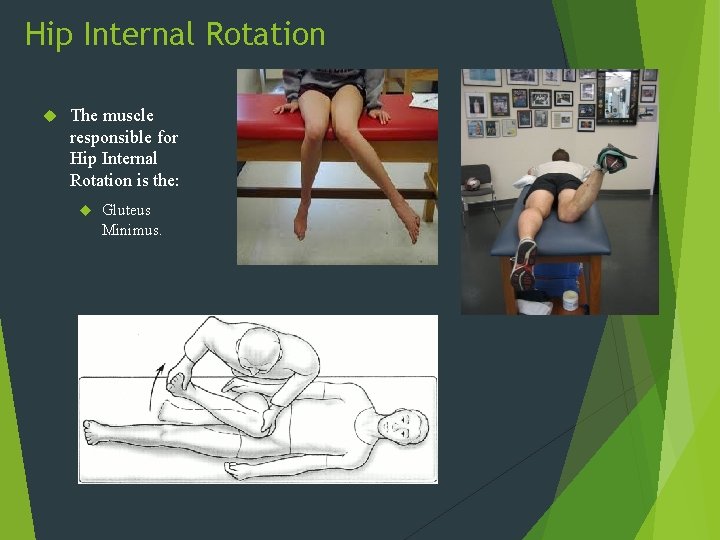
Hip Internal Rotation The muscle responsible for Hip Internal Rotation is the: Gluteus Minimus.
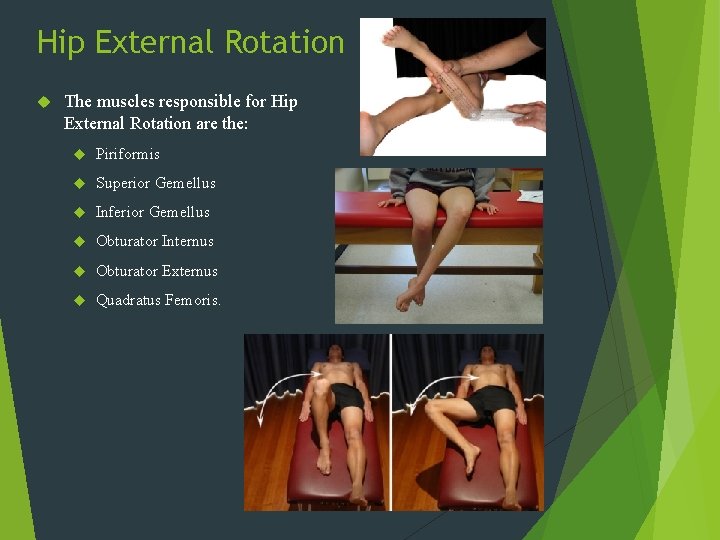
Hip External Rotation The muscles responsible for Hip External Rotation are the: Piriformis Superior Gemellus Inferior Gemellus Obturator Internus Obturator Externus Quadratus Femoris.
Hip Flexion The muscles responsible for Hip Flexion are the: Rectus Femoris Sartorius Iliacus Psoas
Hip Extension The muscles responsible for Hip Extension are the: Biceps Femoris Semimembranosis Semitendinosis Gluteus Maximus
Hip ADDuction The muscles responsible for Hip Adduction are the: Gracilis Pectineus Adductor Magnus Adductor Longus Adductor Brevis
Hip ABDuction The muscles responsible for Hip Abduction are the: Gluteus Medius Tensor Fascia Latae
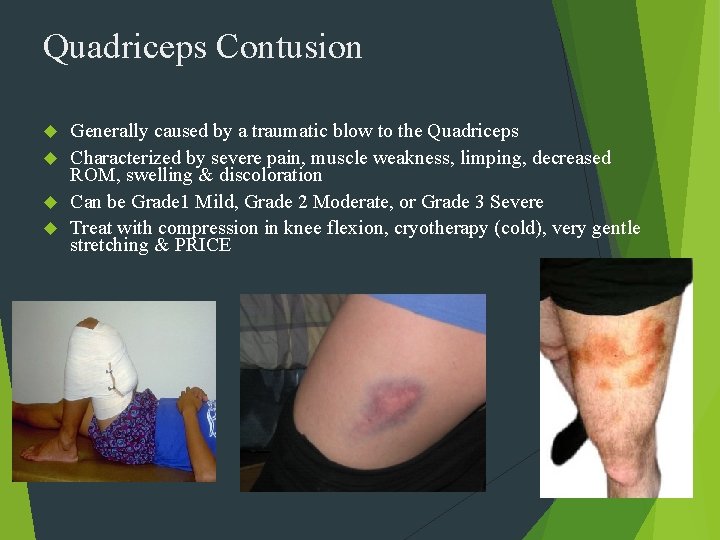
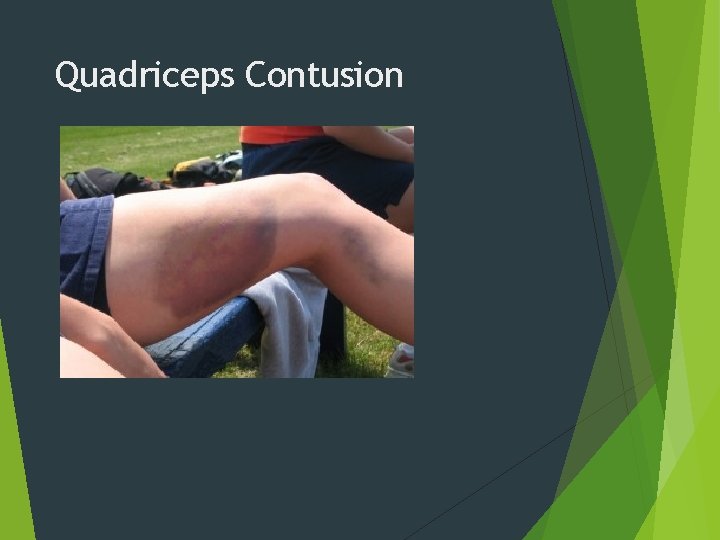
Quadriceps Contusion Generally caused by a traumatic blow to the Quadriceps Characterized by severe pain, muscle weakness, limping, decreased ROM, swelling & discoloration Can be Grade 1 Mild, Grade 2 Moderate, or Grade 3 Severe Treat with compression in knee flexion, cryotherapy (cold), very gentle stretching & PRICE
Quadriceps Contusion
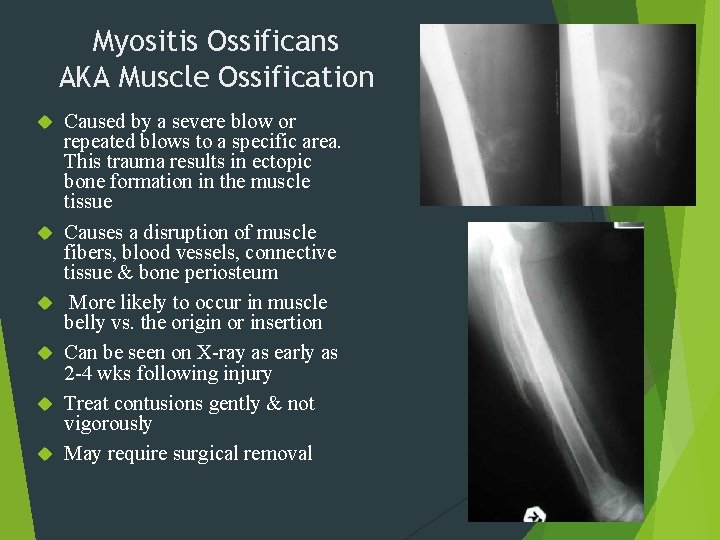
Myositis Ossificans AKA Muscle Ossification Caused by a severe blow or repeated blows to a specific area. This trauma results in ectopic bone formation in the muscle tissue Causes a disruption of muscle fibers, blood vessels, connective tissue & bone periosteum More likely to occur in muscle belly vs. the origin or insertion Can be seen on X-ray as early as 2 -4 wks following injury Treat contusions gently & not vigorously May require surgical removal
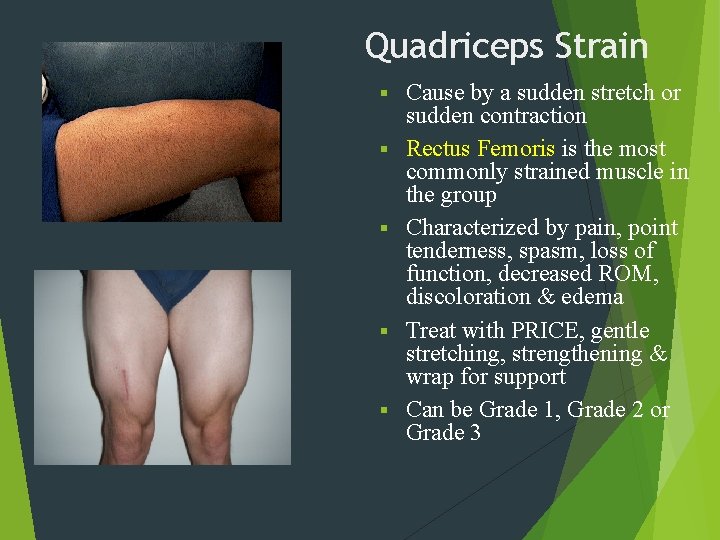
Quadriceps Strain Cause by a sudden stretch or sudden contraction Rectus Femoris is the most commonly strained muscle in the group Characterized by pain, point tenderness, spasm, loss of function, decreased ROM, discoloration & edema Treat with PRICE, gentle stretching, strengthening & wrap for support Can be Grade 1, Grade 2 or Grade 3
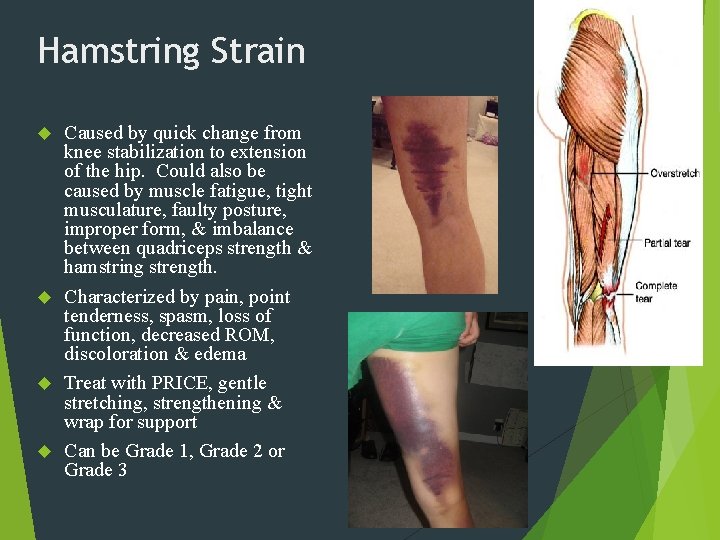
Hamstring Strain Caused by quick change from knee stabilization to extension of the hip. Could also be caused by muscle fatigue, tight musculature, faulty posture, improper form, & imbalance between quadriceps strength & hamstring strength. Characterized by pain, point tenderness, spasm, loss of function, decreased ROM, discoloration & edema Treat with PRICE, gentle stretching, strengthening & wrap for support Can be Grade 1, Grade 2 or Grade 3
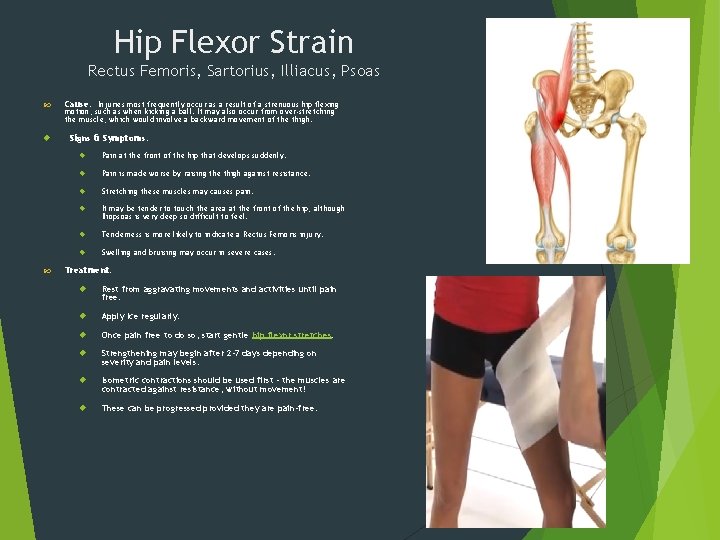
Hip Flexor Strain Rectus Femoris, Sartorius, Illiacus, Psoas Cause: Injuries most frequently occur as a result of a strenuous hip flexing motion, such as when kicking a ball. It may also occur from over-stretching the muscle, which would involve a backward movement of the thigh. Signs & Symptoms: Pain at the front of the hip that develops suddenly. Pain is made worse by raising the thigh against resistance. Stretching these muscles may causes pain. It may be tender to touch the area at the front of the hip, although Iliopsoas is very deep so difficult to feel. Tenderness is more likely to indicate a Rectus Femoris injury. Swelling and bruising may occur in severe cases. Treatment: Rest from aggravating movements and activities until pain free. Apply Ice regularly. Once pain free to do so, start gentle hip flexor stretches. Strengthening may begin after 2 -7 days depending on severity and pain levels. Isometric contractions should be used first - the muscles are contracted against resistance, without movement! These can be progressed provided they are pain-free.
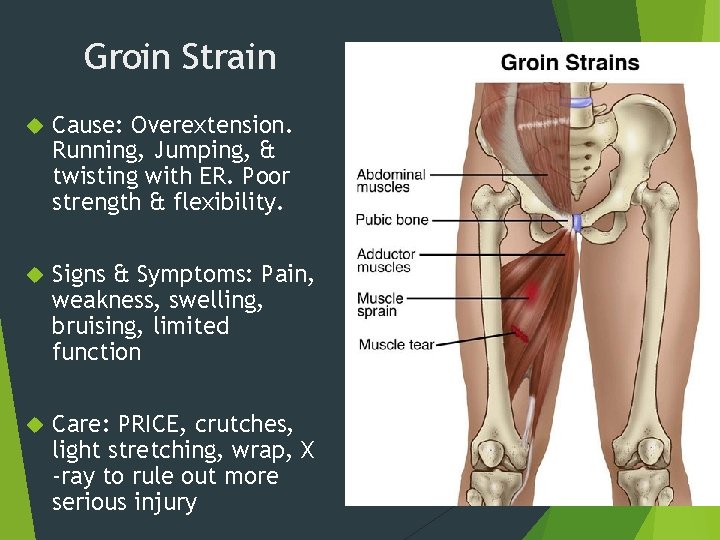
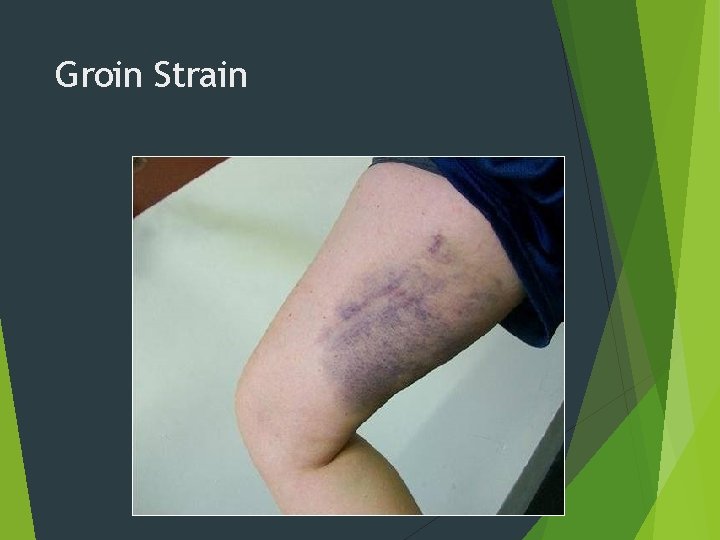
Groin Strain Cause: Overextension. Running, Jumping, & twisting with ER. Poor strength & flexibility. Signs & Symptoms: Pain, weakness, swelling, bruising, limited function Care: PRICE, crutches, light stretching, wrap, X -ray to rule out more serious injury
Groin Strain
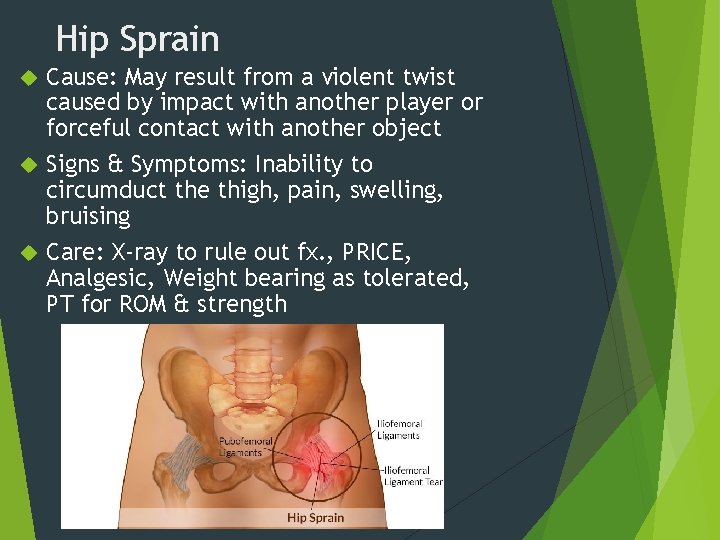
Hip Sprain Cause: May result from a violent twist caused by impact with another player or forceful contact with another object Signs & Symptoms: Inability to circumduct the thigh, pain, swelling, bruising Care: X-ray to rule out fx. , PRICE, Analgesic, Weight bearing as tolerated, PT for ROM & strength
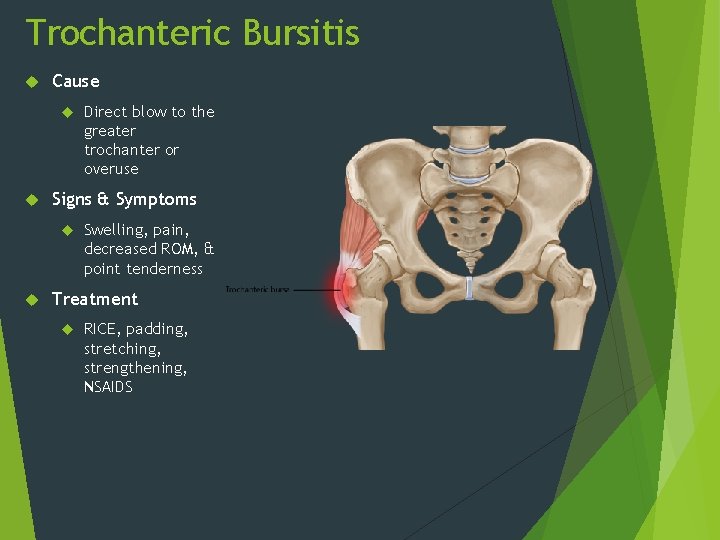
Trochanteric Bursitis Cause Signs & Symptoms Direct blow to the greater trochanter or overuse Swelling, pain, decreased ROM, & point tenderness Treatment RICE, padding, stretching, strengthening, NSAIDS
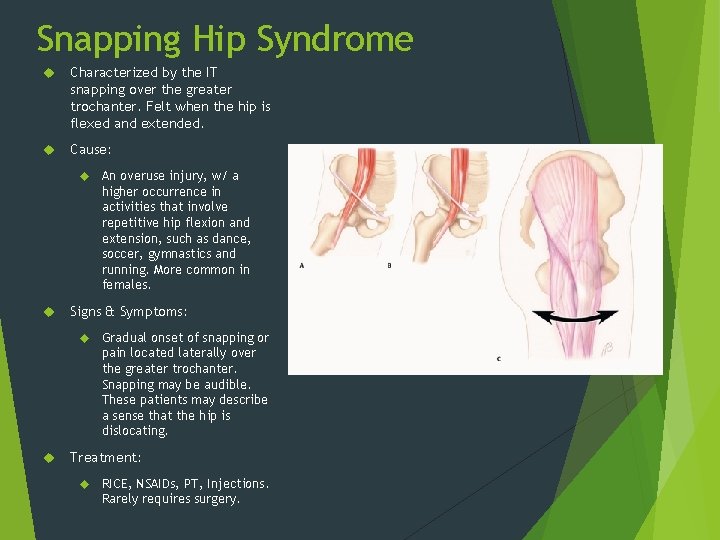
Snapping Hip Syndrome Characterized by the IT snapping over the greater trochanter. Felt when the hip is flexed and extended. Cause: Signs & Symptoms: An overuse injury, w/ a higher occurrence in activities that involve repetitive hip flexion and extension, such as dance, soccer, gymnastics and running. More common in females. Gradual onset of snapping or pain located laterally over the greater trochanter. Snapping may be audible. These patients may describe a sense that the hip is dislocating. Treatment: RICE, NSAIDs, PT, Injections. Rarely requires surgery.
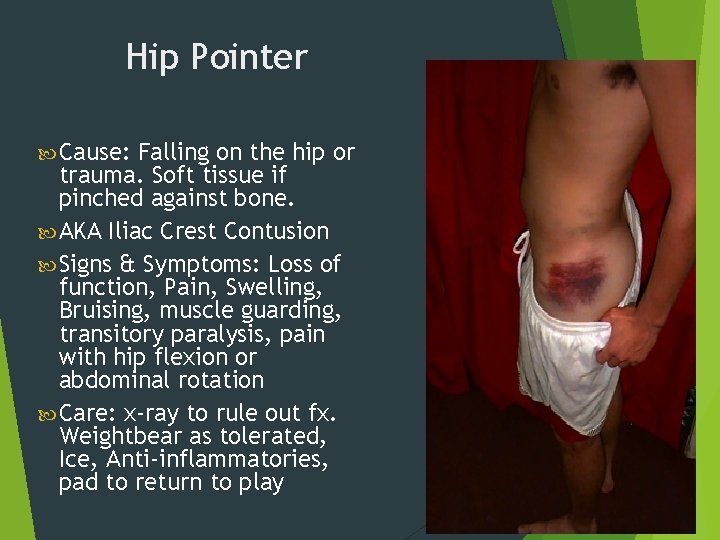
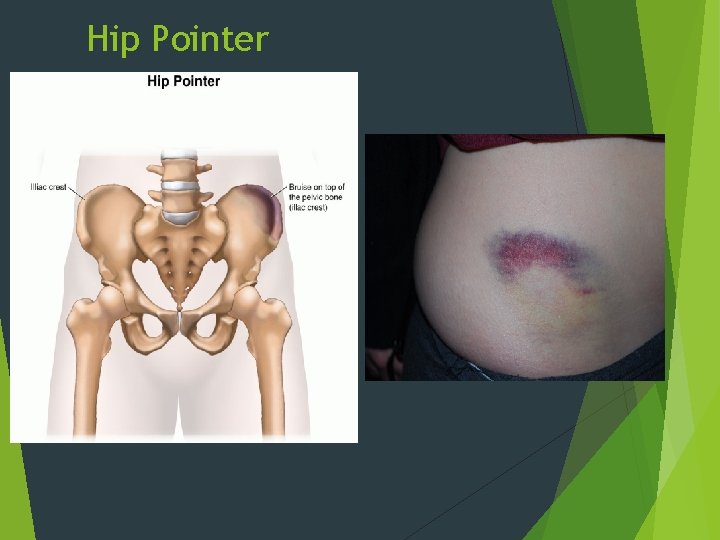
Hip Pointer Cause: Falling on the hip or trauma. Soft tissue if pinched against bone. AKA Iliac Crest Contusion Signs & Symptoms: Loss of function, Pain, Swelling, Bruising, muscle guarding, transitory paralysis, pain with hip flexion or abdominal rotation Care: x-ray to rule out fx. Weightbear as tolerated, Ice, Anti-inflammatories, pad to return to play
Hip Pointer
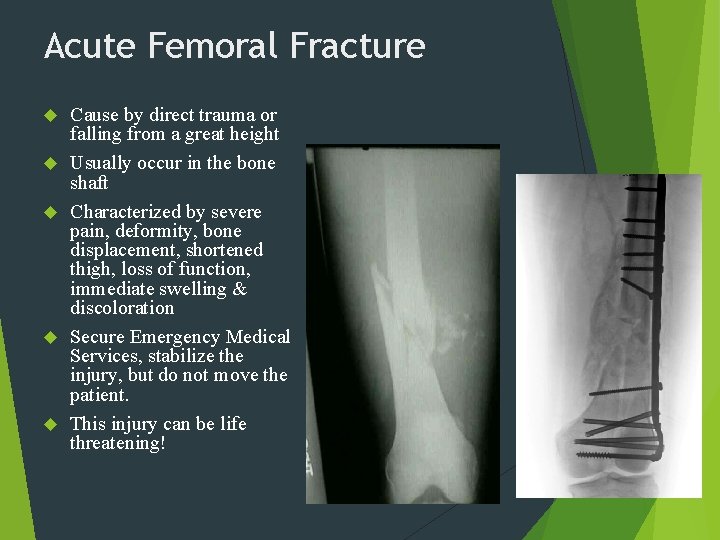
Acute Femoral Fracture Cause by direct trauma or falling from a great height Usually occur in the bone shaft Characterized by severe pain, deformity, bone displacement, shortened thigh, loss of function, immediate swelling & discoloration Secure Emergency Medical Services, stabilize the injury, but do not move the patient. This injury can be life threatening!
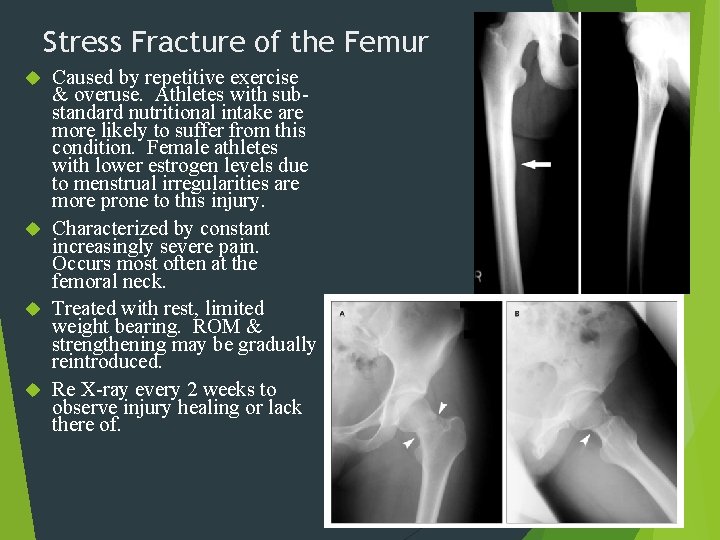
Stress Fracture of the Femur Caused by repetitive exercise & overuse. Athletes with substandard nutritional intake are more likely to suffer from this condition. Female athletes with lower estrogen levels due to menstrual irregularities are more prone to this injury. Characterized by constant increasingly severe pain. Occurs most often at the femoral neck. Treated with rest, limited weight bearing. ROM & strengthening may be gradually reintroduced. Re X-ray every 2 weeks to observe injury healing or lack there of.
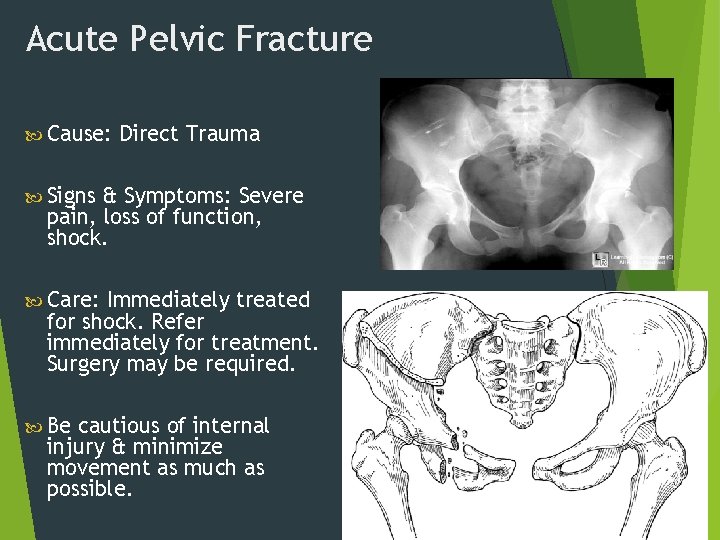
Acute Pelvic Fracture Cause: Direct Trauma Signs & Symptoms: Severe pain, loss of function, shock. Care: Immediately treated for shock. Refer immediately for treatment. Surgery may be required. Be cautious of internal injury & minimize movement as much as possible.
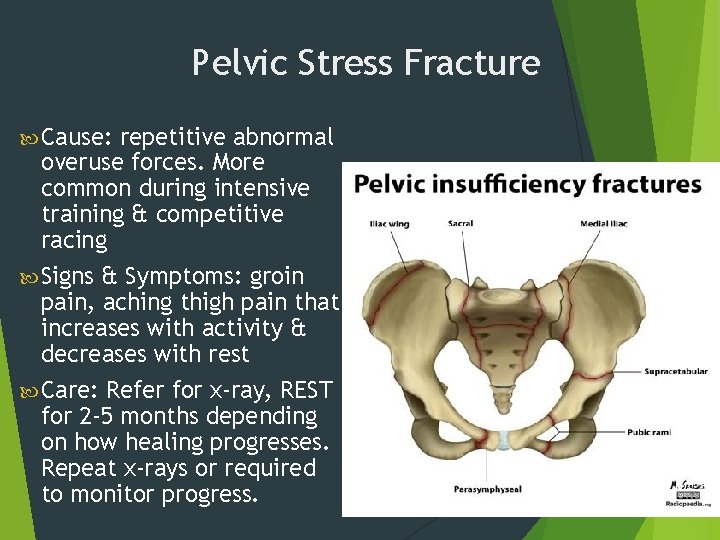
Pelvic Stress Fracture Cause: repetitive abnormal overuse forces. More common during intensive training & competitive racing Signs & Symptoms: groin pain, aching thigh pain that increases with activity & decreases with rest Care: Refer for x-ray, REST for 2 -5 months depending on how healing progresses. Repeat x-rays or required to monitor progress.
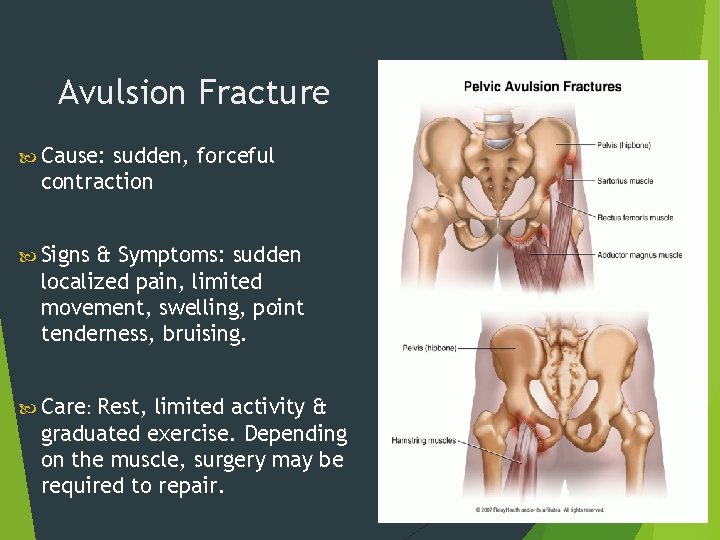
Avulsion Fracture Cause: sudden, forceful contraction Signs & Symptoms: sudden localized pain, limited movement, swelling, point tenderness, bruising. Care: Rest, limited activity & graduated exercise. Depending on the muscle, surgery may be required to repair.
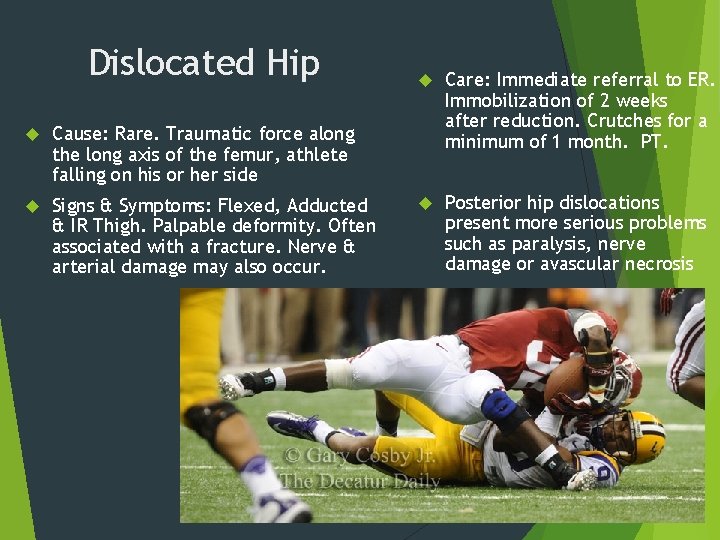
Dislocated Hip Cause: Rare. Traumatic force along the long axis of the femur, athlete falling on his or her side Signs & Symptoms: Flexed, Adducted & IR Thigh. Palpable deformity. Often associated with a fracture. Nerve & arterial damage may also occur. Care: Immediate referral to ER. Immobilization of 2 weeks after reduction. Crutches for a minimum of 1 month. PT. Posterior hip dislocations present more serious problems such as paralysis, nerve damage or avascular necrosis
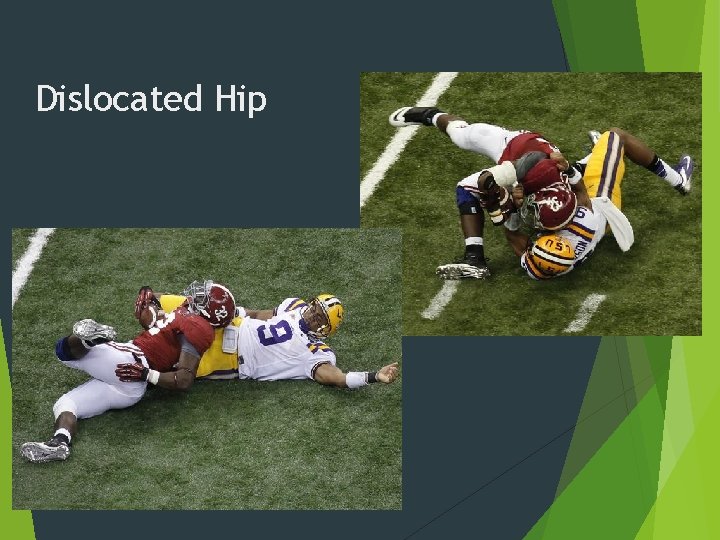
Dislocated Hip
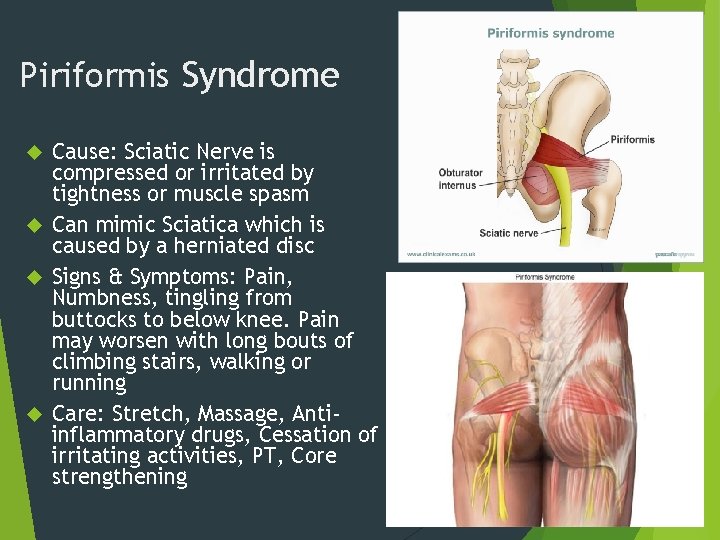
Piriformis Syndrome Cause: Sciatic Nerve is compressed or irritated by tightness or muscle spasm Can mimic Sciatica which is caused by a herniated disc Signs & Symptoms: Pain, Numbness, tingling from buttocks to below knee. Pain may worsen with long bouts of climbing stairs, walking or running Care: Stretch, Massage, Antiinflammatory drugs, Cessation of irritating activities, PT, Core strengthening
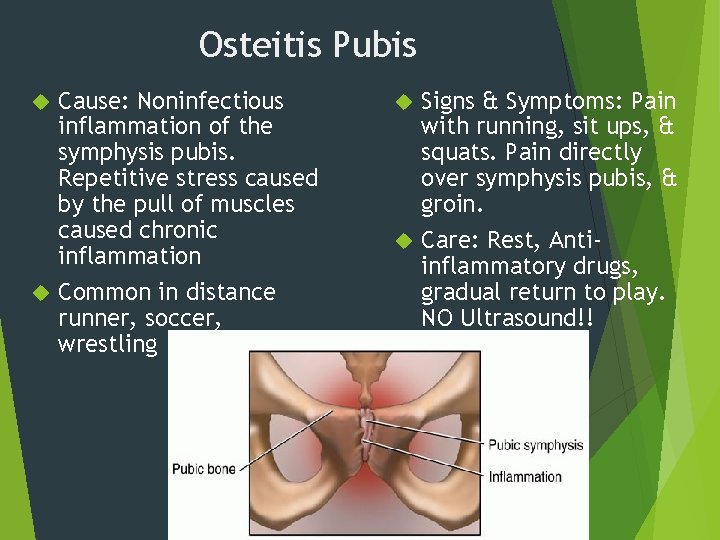
Osteitis Pubis Cause: Noninfectious inflammation of the symphysis pubis. Repetitive stress caused by the pull of muscles caused chronic inflammation Common in distance runner, soccer, wrestling Signs & Symptoms: Pain with running, sit ups, & squats. Pain directly over symphysis pubis, & groin. Care: Rest, Antiinflammatory drugs, gradual return to play. NO Ultrasound!!
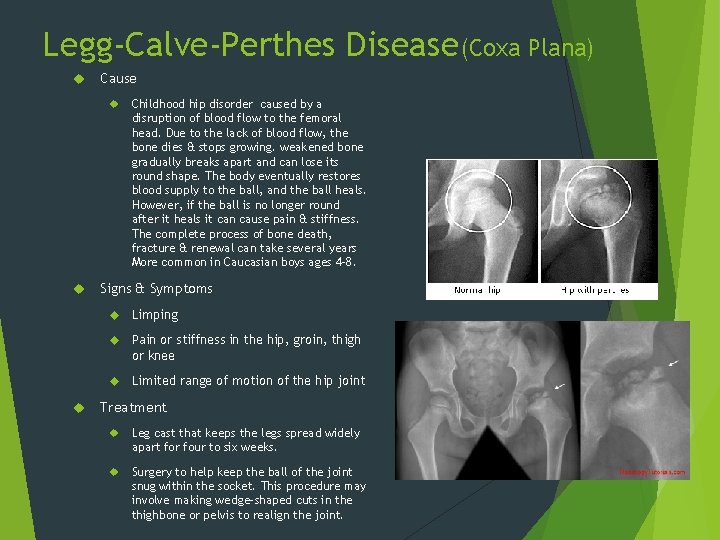
Legg-Calve-Perthes Disease(Coxa Plana) Cause Childhood hip disorder caused by a disruption of blood flow to the femoral head. Due to the lack of blood flow, the bone dies & stops growing. weakened bone gradually breaks apart and can lose its round shape. The body eventually restores blood supply to the ball, and the ball heals. However, if the ball is no longer round after it heals it can cause pain & stiffness. The complete process of bone death, fracture & renewal can take several years More common in Caucasian boys ages 4 -8. Signs & Symptoms Limping Pain or stiffness in the hip, groin, thigh or knee Limited range of motion of the hip joint Treatment Leg cast that keeps the legs spread widely apart for four to six weeks. Surgery to help keep the ball of the joint snug within the socket. This procedure may involve making wedge-shaped cuts in the thighbone or pelvis to realign the joint.
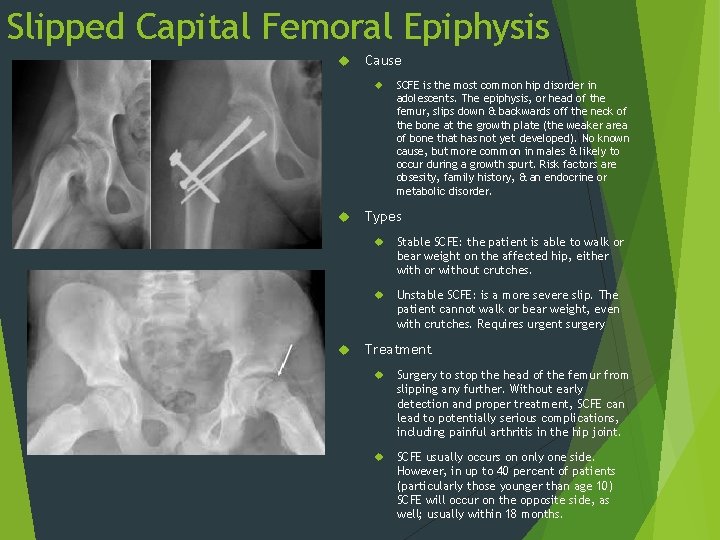
Slipped Capital Femoral Epiphysis Cause SCFE is the most common hip disorder in adolescents. The epiphysis, or head of the femur, slips down & backwards off the neck of the bone at the growth plate (the weaker area of bone that has not yet developed). No known cause, but more common in males & likely to occur during a growth spurt. Risk factors are obsesity, family history, & an endocrine or metabolic disorder. Types Stable SCFE: the patient is able to walk or bear weight on the affected hip, either with or without crutches. Unstable SCFE: is a more severe slip. The patient cannot walk or bear weight, even with crutches. Requires urgent surgery Treatment Surgery to stop the head of the femur from slipping any further. Without early detection and proper treatment, SCFE can lead to potentially serious complications, including painful arthritis in the hip joint. SCFE usually occurs on only one side. However, in up to 40 percent of patients (particularly those younger than age 10) SCFE will occur on the opposite side, as well; usually within 18 months.