
Injectionmoulding glass into any shape Read the full
- Slides: 2
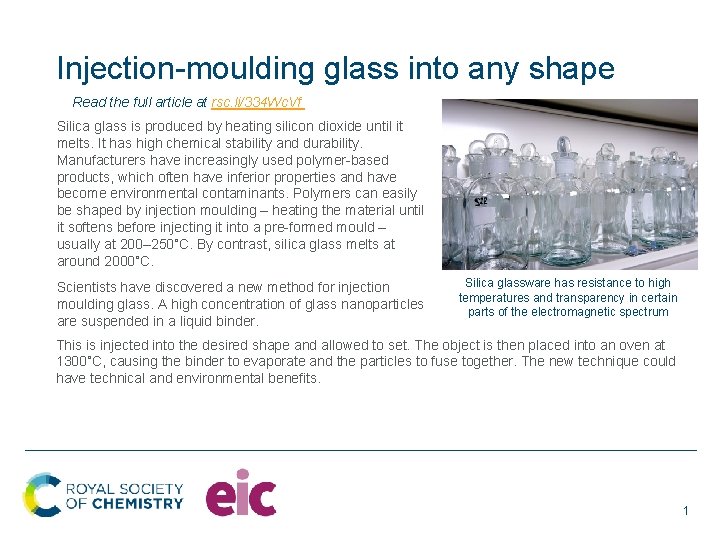
Injection-moulding glass into any shape Read the full article at rsc. li/334 Wc. Vf Silica glass is produced by heating silicon dioxide until it melts. It has high chemical stability and durability. Manufacturers have increasingly used polymer-based products, which often have inferior properties and have become environmental contaminants. Polymers can easily be shaped by injection moulding – heating the material until it softens before injecting it into a pre-formed mould – usually at 200– 250˚C. By contrast, silica glass melts at around 2000˚C. Scientists have discovered a new method for injection moulding glass. A high concentration of glass nanoparticles are suspended in a liquid binder. Silica glassware has resistance to high temperatures and transparency in certain parts of the electromagnetic spectrum This is injected into the desired shape and allowed to set. The object is then placed into an oven at 1300˚C, causing the binder to evaporate and the particles to fuse together. The new technique could have technical and environmental benefits. 1
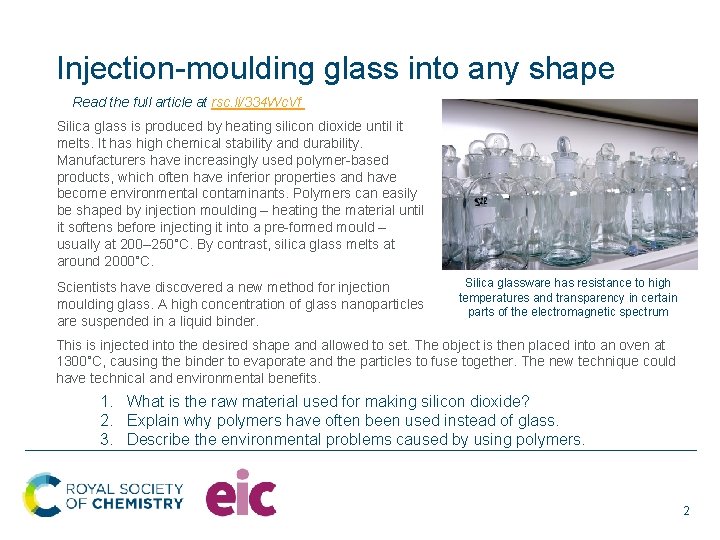
Injection-moulding glass into any shape Read the full article at rsc. li/334 Wc. Vf Silica glass is produced by heating silicon dioxide until it melts. It has high chemical stability and durability. Manufacturers have increasingly used polymer-based products, which often have inferior properties and have become environmental contaminants. Polymers can easily be shaped by injection moulding – heating the material until it softens before injecting it into a pre-formed mould – usually at 200– 250˚C. By contrast, silica glass melts at around 2000˚C. Scientists have discovered a new method for injection moulding glass. A high concentration of glass nanoparticles are suspended in a liquid binder. Silica glassware has resistance to high temperatures and transparency in certain parts of the electromagnetic spectrum This is injected into the desired shape and allowed to set. The object is then placed into an oven at 1300˚C, causing the binder to evaporate and the particles to fuse together. The new technique could have technical and environmental benefits. 1. What is the raw material used for making silicon dioxide? 2. Explain why polymers have often been used instead of glass. 3. Describe the environmental problems caused by using polymers. 2