
INJECTION SAFETY PRACTICE BELLO C B DEFINITION A
INJECTION SAFETY PRACTICE BELLO C. B
DEFINITION • A safe injection is one that does not harm the recipient, does not expose the provider to any avoidable risk and does not result in any waste that is dangerous for other people/ community. • It is the one given when there are no suitable alternatives. • Its assured when the right drug is given to the right patient in the right dose using the right injection equipment at the right site via the right route. • Its given by a skilled health worker
RISK ASSOCIATED WITH UNSAFE INJECTION PRACTICE • Transmission of infections: inoculation of an infectious agent into the patients body. • Paralysis: injection of a drug into a nerve, which can lead to damage of the nerve, resulting in weakness of the limb supplied by the nerve. • Drug reactions: abnormal response of the body to a drug. The most life threatening is Anaphylaxis, which is sudden collapse of the circulatory system due to immunological response to the injected drug.
DISEASES/ CONDITIONS TRANSMITTED / CAUSED BY UNSAFE INJECTION PRACTICE • • HEPATITIS B HEPATITIS C HIV/AIDS ABSCESSES HEMORRHAGIC FEVERS MALARIA TETANUS
RISK GROUPS • Patients/ Clients, especially immunocompromised individuals • Healthcare workers • Healthcare waste management personnel • Communities • Drug users
RELATED AREAS OF INJECTION SAFETY PRACTICE • Injection safety is an integral aspect of infection prevention and control. • It is an element of standard precaution • It is key element of patient and healthcare worker safety.
CONDITIONS CAUSING RISKS PROVIDERS v. Inadequate supply of safety boxes v. Unsafe practices that lead to needle stick injuries when: • Recapping needles • Manipulating used sharp (bending, breaking or cutting) • Passing on sharps from one healthcare worker to another • Sharps are found in unexpected places like linen, patient/client suddenly moves during administration of injection
CONDITIONS CAUSING RISKS Patients/Clients • Self medication • Re-use injection equipment • Receive injections when there are other treatment alternatives • Sharps are found in unexpected places like linen • When contaminated drug is administered • When aseptic technique is not observed by healthcare worker • Administration of the drug at incorrect anatomical site • Expired drugs • Package is damaged or compromised.
CONDITIONS CAUSING RISKS Community v. Unsafe waste disposal practices such as : • Non secured waste site (not fenced) • Improperly placed disposal site (too close to people) • Reused syringes and needles • Sharing syringes and needles • Improperly disposed waste (pit too shallow, Incinerator overflowing, open dumping
UNSAFE INJECTION PRACTICES • Unsafe injection that harm v. Recipient ü Contaminated drug is administered • Partially opened vials are mixed • Multi dose vials are used • Needles are left in rubber cap of vial ü Expired drug is given ü Syringes loaded with different medication ü Drugs & vaccine stored in the same refrigerator ü Applying pressure to bleeding sites with dirty material or finger
UNSAFE INJECTION PRACTICES ü Drug administered at incorrect anatomical sites • Infants vaccinated in the buttocks rather than antero-lateral • Giving large boluses of intramuscular quinine ü Un-sterile needles and syringes used Re-use of syringes and needles ü Loading syringes with multiple doses ü Healthcare worker not observing aseptic technique ü Storing used open multi-dose vials beyond recommended period
HEALTHCARE WORKERS ü Carrying around used syringes & needles before disposal ü Placing syringes and needles on a surface prior to disposal ü Recapping needles (two-handed). ü Reaching into a container of used syringes & needles ü Manually detaching needles from syringes ü Manipulating used sharps (cleaning, changing, bending, breaking or cutting) ü Passing sharps from one healthcare worker to another ü Overfilling safety boxes ü Using a syringe & needle on an agitated pt without assistance
COMMUNITY • Leaving syringes & Needles in areas accessible to the public, especially children • Sharing syringes and needles • Re-using syringes and needles • Receiving injections from informal health sector.
KEY STEPS OF A SAFE INJECTION • Use a syringe and needle from a new, sealed undamaged packet for every injection. • Without re-capping, immediately after place syringe and needle in a safety box immediately after use. • Manage injection waste safely and appropriately.
KEY STEPS OF A SAFE INJECTION • Maintain the RIGHT’ WAYS TO GIVE A SAFE INJECTION
üRight patient üRight drug üRight formulation üRight injection equipment üRight dosage üRight time üRight route üRight storage üRight method of disposal üRight anatomical site üRight trained personnel
KEY STEPS TO SAFE INJECTION • Select safe medicine • Use sterile injection equipment • Avoid contamination of equipment and medication (observe aseptic technique) • Dispose of injection wastes and sharps appropriately • Disseminate public health education and information
KEY STEPS TO SAFE INJECTION • Wash hands or use alcohol based handrub • Prepare on clean surface • Do not touch part of needle that will come in contact with patient’s tissue. • Do not leave the needle in the rubber cap of the vial
KEY STEPS TO SAFE INJECTION • RECONSTITUTE DRUGS OR VACCINES SAFELY üUse new sterile syringe and needle for each reconstitution. üUse the correct diluent/water for injection üReconstitute according to the manufacturers specifications.
KEY STEPS TO SAFE INJECTION • DISPOSE OFF INJECTION WASTES AND SHARPS APPROPRIATELY • Immediate disposal of and needle in puncture and leak-proof safety box • Prevent needle stick injury
TYPES OF INJECTION DEVICES • 1. Auto-disable syringes: cannot be re-used, eliminate pt-to-pt transmission of disease. More expensive & has no needle stick prevention features. • 2. Manually retractable: cannot be re-used, needle retract inside barrel hence prevent needle stick injuries. Not automatic, expensive • 3. Automatically retractable: Has automatic safety feature, needle retracts inside barrel. Cannot be used. • 4. Standard disposable: Less expensive, available in local market and can be re-used. • 5. Re-usable syringes: least expensive, can be re-used
NEEDLE REMOVERS • These are manually operated to remove the needle from the syringe by cutting the hub of the syringe and/or the needle. • It reduces occupational risks to waste handlers & scavengers • Prevents re-use of syringes • Reduce the volume of sharp waste.
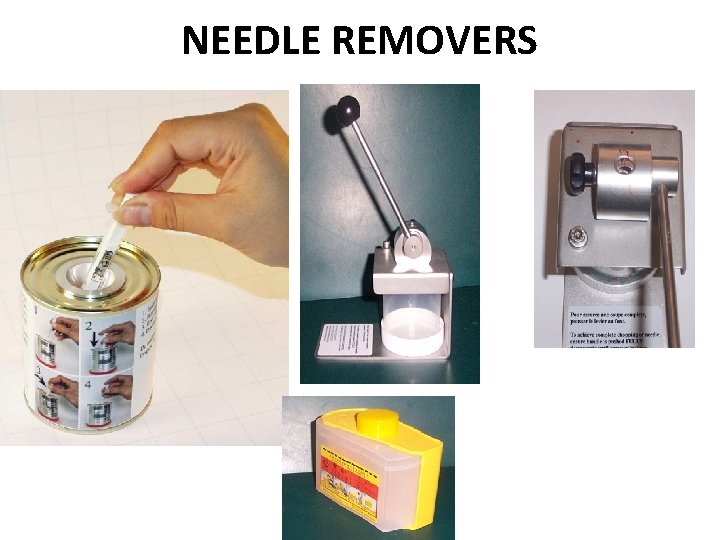
NEEDLE REMOVERS
SAFETY BOXES • These are made of puncture resistant and liquid-proof cardboard. They are used for collecting used syringes and needles immediately after use. • 5 litres safety boxes hold up to 100 used syringes and needles • It should be made available at the point of use • It require on-going supply • Filled boxes require final treatment.
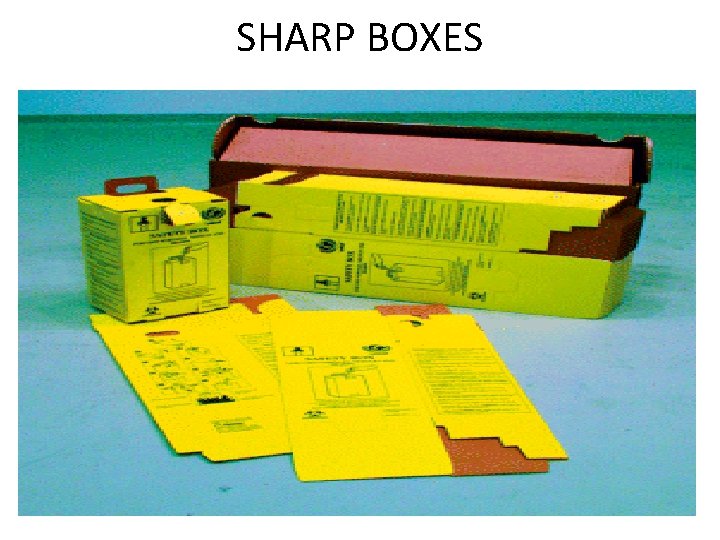
SHARP BOXES
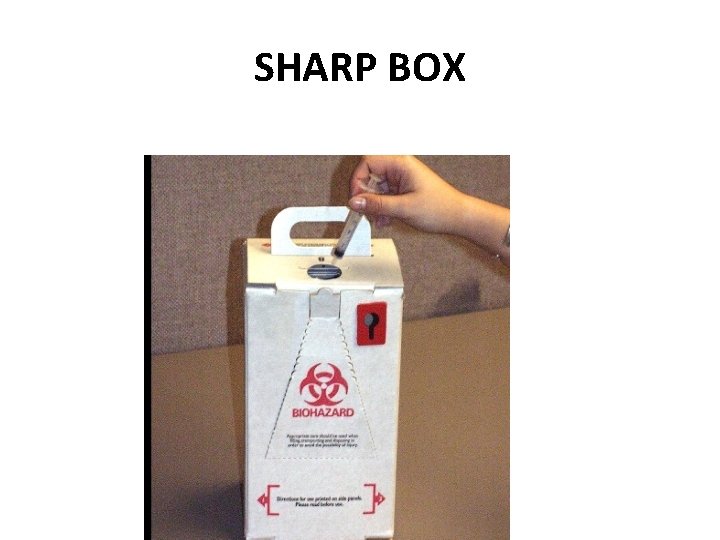
SHARP BOX
ADVERSE EVENTS THAT FOLLOW INJECTIONS • This is an incident which harms a person receiving care caused by poor injection practices rather than the underlying condition. • Clinical manifestation of an unwanted effect arising from an injection.
COMMON AEFI • Transmission of blood borne infections. (Hepatitis B, Hepatitis C, HIV). • Injection abscess • Paralysis • Trauma • Shock • Allergic reactions
PREVENTION OF AEFI • Take medical history including drug history • Proper reconstitution • Observe the ‘eleven rights’ of injection safety • Adequate staff training and re-training. • Communication, public education of IS (injection safety).
MANAGEMENT OF AEFI • • Emergency preparedness Correct treatment Logistics – supplies Supervision, monitoring and feedback
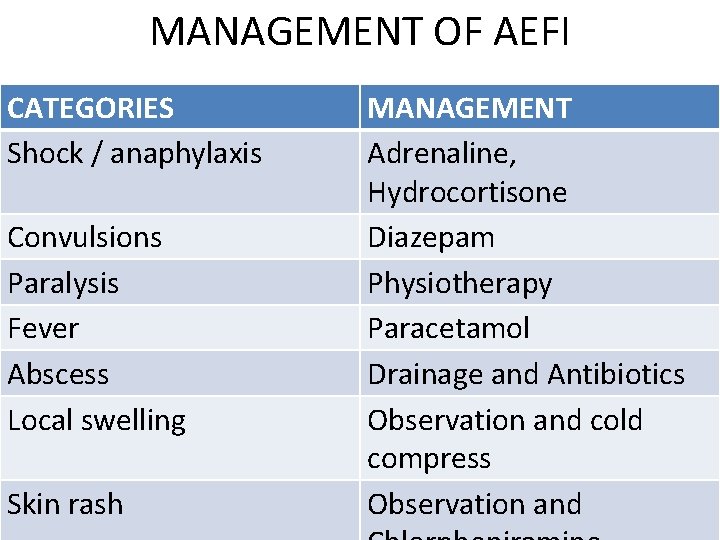
MANAGEMENT OF AEFI CATEGORIES Shock / anaphylaxis Convulsions Paralysis Fever Abscess Local swelling Skin rash MANAGEMENT Adrenaline, Hydrocortisone Diazepam Physiotherapy Paracetamol Drainage and Antibiotics Observation and cold compress Observation and

QUOTE THE GOLDEN LADDER • “if we can see further it is because we stand on the rungs of a ladder built by those who came before us. TOMDILLION.
• Thank you for listening
- Slides: 33