
Injection Protection Failures and Dump Failures V Kain
- Slides: 24
Injection Protection Failures and Dump Failures V. Kain AB/OP Input from: B. Goddard, T. Kramer, J. Wenninger • Description of Injection and Extraction • Possible Failure Scenarios during Injection and Extraction • Protection against these Failure Scenarios June 12, 2007 V. Kain AB/OP 1
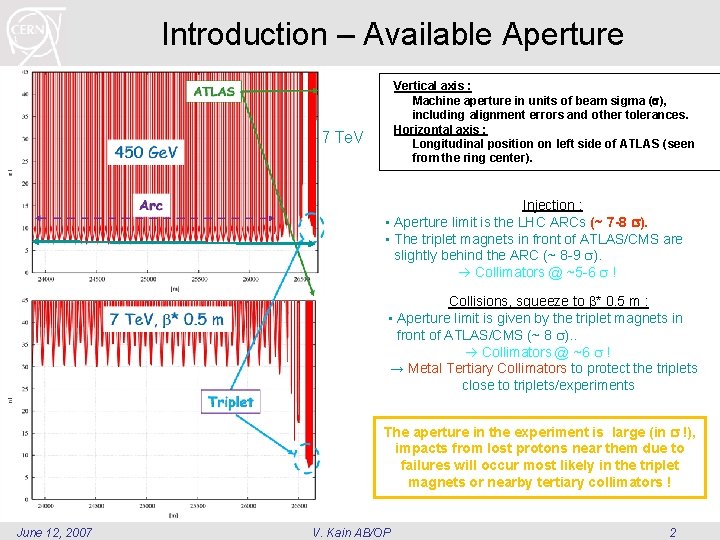
Introduction – Available Aperture Vertical axis : Machine aperture in units of beam sigma (s), including alignment errors and other tolerances. Horizontal axis : Longitudinal position on left side of ATLAS (seen from the ring center). 7 Te. V Injection : • Aperture limit is the LHC ARCs (~ 7 -8 s). • The triplet magnets in front of ATLAS/CMS are slightly behind the ARC (~ 8 -9 s). Collimators @ ~5 -6 s ! Collisions, squeeze to b* 0. 5 m : • Aperture limit is given by the triplet magnets in front of ATLAS/CMS (~ 8 s). . Collimators @ ~6 s ! → Metal Tertiary Collimators to protect the triplets close to triplets/experiments The aperture in the experiment is large (in s !), impacts from lost protons near them due to failures will occur most likely in the triplet magnets or nearby tertiary collimators ! June 12, 2007 V. Kain AB/OP 2
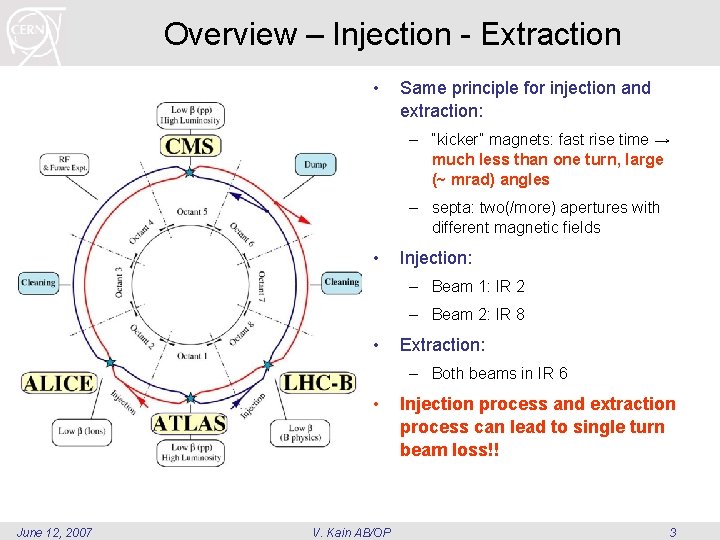
Overview – Injection - Extraction • Same principle for injection and extraction: – “kicker” magnets: fast rise time → much less than one turn, large (~ mrad) angles – septa: two(/more) apertures with different magnetic fields • Injection: – Beam 1: IR 2 – Beam 2: IR 8 • Extraction: – Both beams in IR 6 • June 12, 2007 V. Kain AB/OP Injection process and extraction process can lead to single turn beam loss!! 3
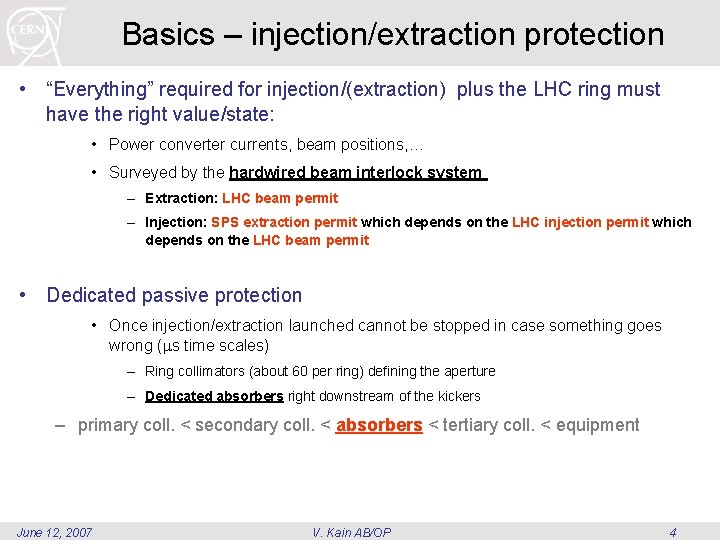
Basics – injection/extraction protection • “Everything” required for injection/(extraction) plus the LHC ring must have the right value/state: • Power converter currents, beam positions, … • Surveyed by the hardwired beam interlock system – Extraction: LHC beam permit – Injection: SPS extraction permit which depends on the LHC injection permit which depends on the LHC beam permit • Dedicated passive protection • Once injection/extraction launched cannot be stopped in case something goes wrong (ms time scales) – Ring collimators (about 60 per ring) defining the aperture – Dedicated absorbers right downstream of the kickers – primary coll. < secondary coll. < absorbers < tertiary coll. < equipment June 12, 2007 V. Kain AB/OP 4
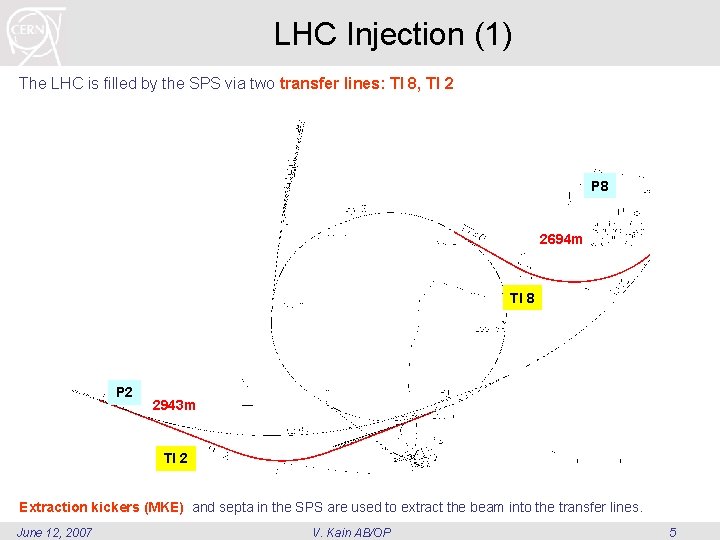
LHC Injection (1) The LHC is filled by the SPS via two transfer lines: TI 8, TI 2 P 8 2694 m TI 8 P 2 2943 m TI 2 Extraction kickers (MKE) and septa in the SPS are used to extract the beam into the transfer lines. June 12, 2007 V. Kain AB/OP 5
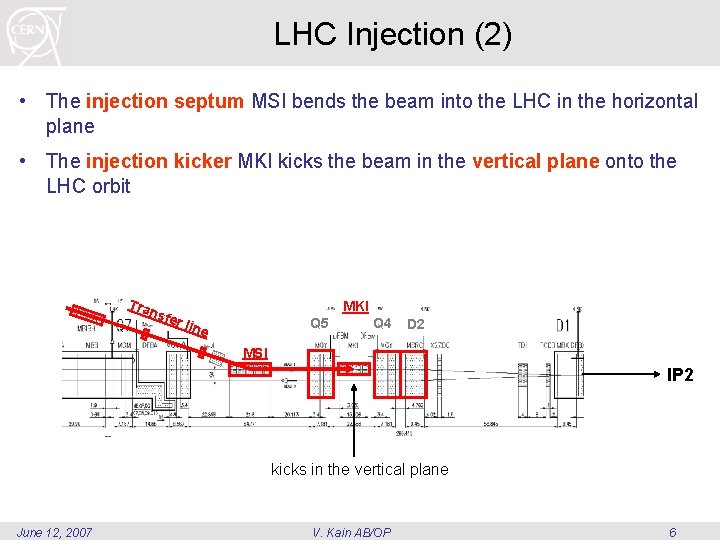
LHC Injection (2) • The injection septum MSI bends the beam into the LHC in the horizontal plane • The injection kicker MKI kicks the beam in the vertical plane onto the LHC orbit Tra nsf MKI er l Q 5 ine Q 4 D 2 MSI IP 2 kicks in the vertical plane June 12, 2007 V. Kain AB/OP 6
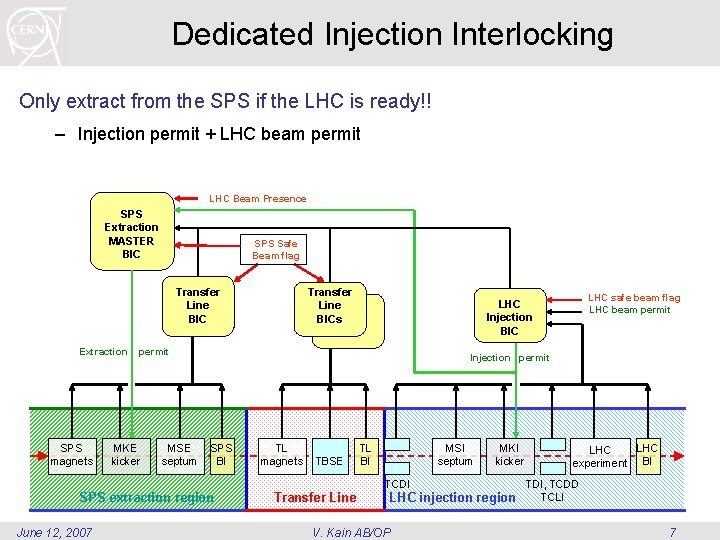
Dedicated Injection Interlocking Only extract from the SPS if the LHC is ready!! – Injection permit + LHC beam permit LHC Beam Presence SPS Extraction MASTER BIC SPS Safe Beam flag Transfer Line BIC Extraction SPS magnets MKE kicker MSE septum LHC safe beam flag LHC beam permit LHC Injection BIC permit Injection permit SPS BI SPS extraction region June 12, 2007 Transfer Line BICs TL magnets TBSE Transfer Line TL BI MSI septum TCDI MKI kicker LHC injection region V. Kain AB/OP LHC experiment BI TDI, TCDD TCLI 7
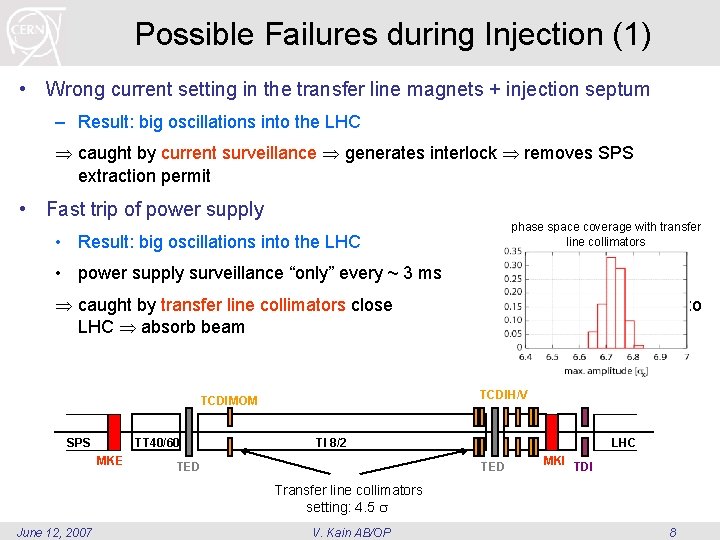
Possible Failures during Injection (1) • Wrong current setting in the transfer line magnets + injection septum – Result: big oscillations into the LHC caught by current surveillance generates interlock removes SPS extraction permit • Fast trip of power supply phase space coverage with transfer line collimators • Result: big oscillations into the LHC • power supply surveillance “only” every ~ 3 ms caught by transfer line collimators close LHC absorb beam TCDIH/V TCDIMOM SPS TT 40/60 MKE to TI 8/2 TED LHC TED MKI TDI Transfer line collimators setting: 4. 5 s June 12, 2007 V. Kain AB/OP 8
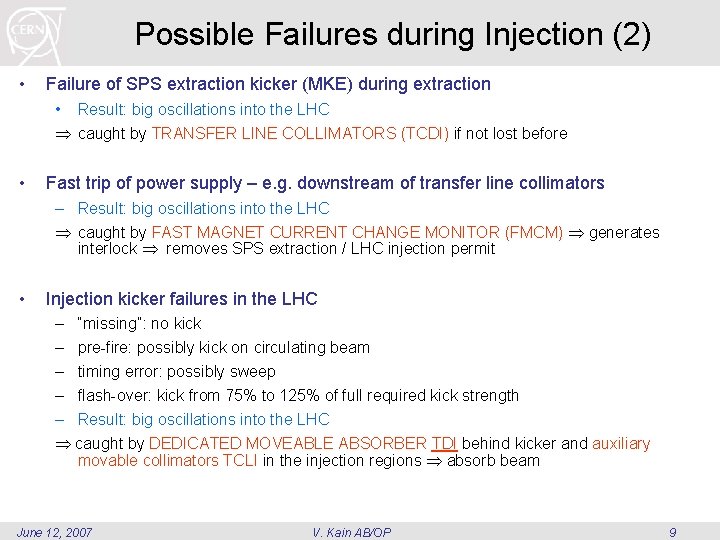
Possible Failures during Injection (2) • Failure of SPS extraction kicker (MKE) during extraction • Result: big oscillations into the LHC caught by TRANSFER LINE COLLIMATORS (TCDI) if not lost before • Fast trip of power supply – e. g. downstream of transfer line collimators – Result: big oscillations into the LHC caught by FAST MAGNET CURRENT CHANGE MONITOR (FMCM) generates interlock removes SPS extraction / LHC injection permit • Injection kicker failures in the LHC – “missing”: no kick – pre-fire: possibly kick on circulating beam – timing error: possibly sweep – flash-over: kick from 75% to 125% of full required kick strength – Result: big oscillations into the LHC caught by DEDICATED MOVEABLE ABSORBER TDI behind kicker and auxiliary movable collimators TCLI in the injection regions absorb beam June 12, 2007 V. Kain AB/OP 9
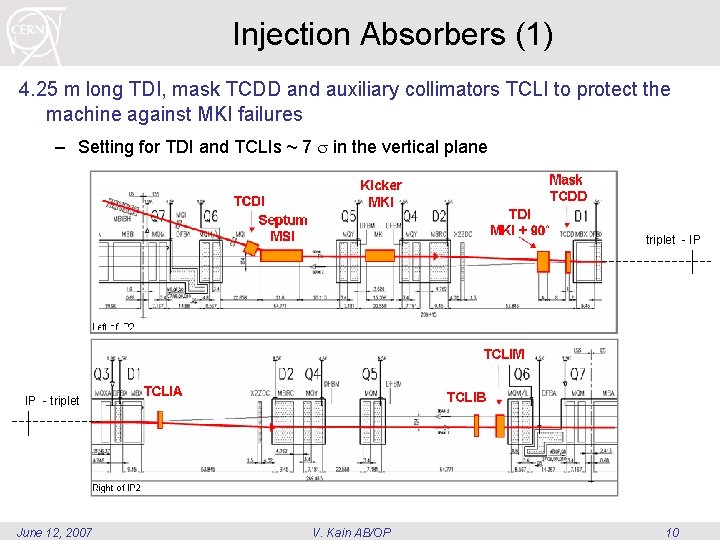
Injection Absorbers (1) 4. 25 m long TDI, mask TCDD and auxiliary collimators TCLI to protect the machine against MKI failures – Setting for TDI and TCLIs ~ 7 s in the vertical plane triplet - IP IP - triplet June 12, 2007 V. Kain AB/OP 10
Injection Absorbers (2) • The required setting of the injection absorbers depend on beam parameters. • The reference settings have to be established. – afterwards reference settings are interlocked. • Settings can only be established with Safe Beam – maskable settings • With Safe Beam injection absorbers could be out or have the wrong setting June 12, 2007 V. Kain AB/OP 11
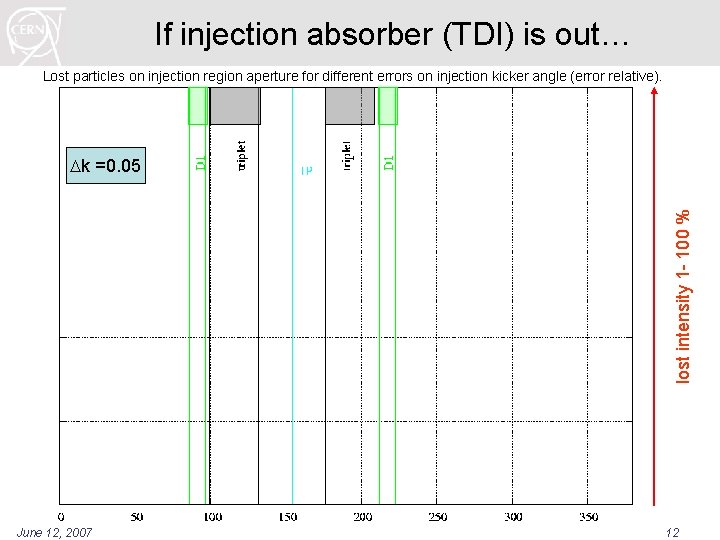
If injection absorber (TDI) is out… Lost particles on injection region aperture for different errors on injection kicker angle (error relative). lost intensity 1 - 100 % Dk Dk==0. 05 =0. 85 =0. 75 =0. 65 =0. 55 =0. 45 =0. 35 =0. 25 =0. 15 ==0. 2 0. 95 0. 9 0. 8 0. 7 0. 6 0. 5 0. 4 0. 3 0. 1 June 12, 2007 V. Kain AB/OP 12
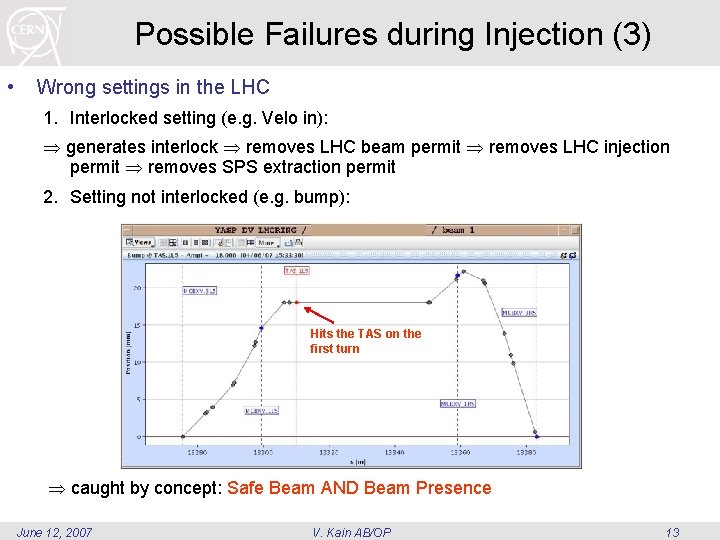
Possible Failures during Injection (3) • Wrong settings in the LHC 1. Interlocked setting (e. g. Velo in): generates interlock removes LHC beam permit removes LHC injection permit removes SPS extraction permit 2. Setting not interlocked (e. g. bump): Hits the TAS on the first turn caught by concept: Safe Beam AND Beam Presence June 12, 2007 V. Kain AB/OP 13
Concepts: Safe Beam & Beam Presence • Injection of high intensity beam into the LHC is only possible if beam is already circulating – Otherwise: only Safe Beam possible (SPS/LHC safe beam flag) • Entry to injection BIC: LHC safe beam flag • Entry to SPS master BIC: combination of LHC beam presence plus SPS safe beam flag – Generated with fast BCT up to 1 ms before injection • Safe beam intensity at injection: ~ 1012 protons • In principle can inject 1012 protons into empty machine – Can experiments take our safe beam limit 450 Ge. V being lost in the experimental area (e. g. TAS) without damage? – Can easily construct bumps etc. to lose safe beam ANYWHERE. – The protection system can be less comprehensive with safe beam (MASKING). June 12, 2007 V. Kain AB/OP 14
Proposed Nominal Injection Sequence 1. Inject a single bunch into the empty machine (Intensity 5 x 10⁹ p+ - ~ 1011 p+) – Check parameters etc… and ensure that beam circulates with reasonable lifetime. 2. Inject an intermediate beam of ~ 12 nominal intensity bunches – Fine tune parameters, adjust/check collimators and protection devices etc. 3. Once the machine is in good shape, switch to high intensity injections. June 12, 2007 V. Kain AB/OP 15
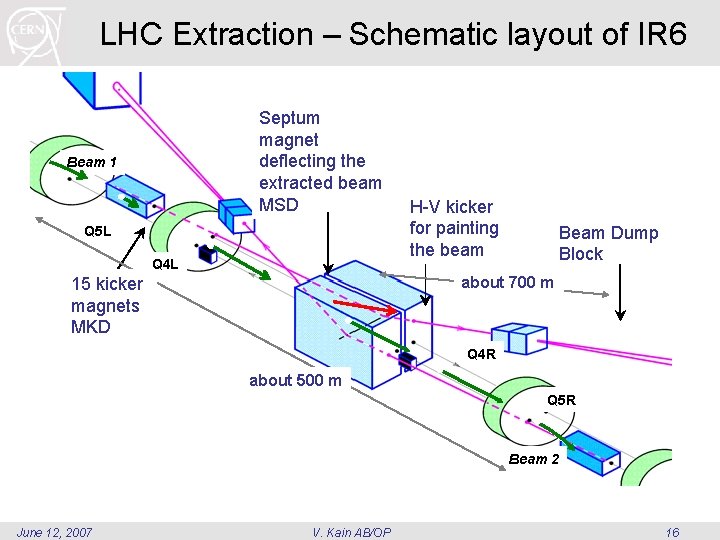
LHC Extraction – Schematic layout of IR 6 Septum magnet deflecting the extracted beam MSD Beam 1 Q 5 L Q 4 L H-V kicker for painting the beam Beam Dump Block about 700 m 15 kicker magnets MKD Q 4 R about 500 m Q 5 R Beam 2 June 12, 2007 V. Kain AB/OP 16
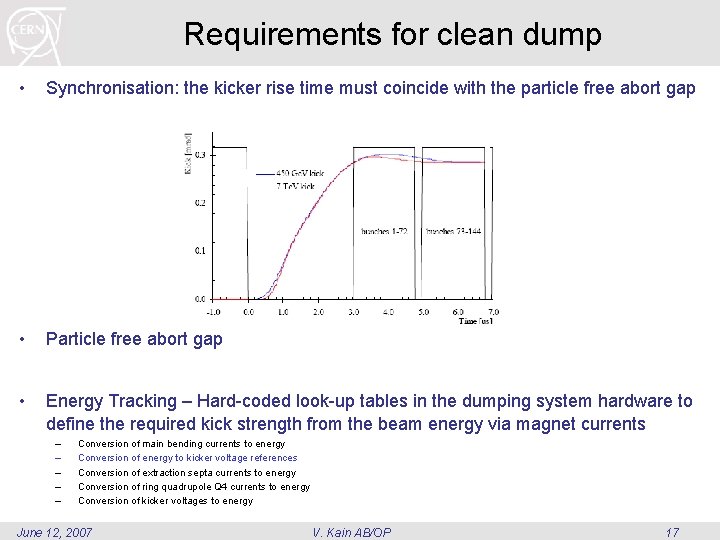
Requirements for clean dump • Synchronisation: the kicker rise time must coincide with the particle free abort gap • Particle free abort gap • Energy Tracking – Hard-coded look-up tables in the dumping system hardware to define the required kick strength from the beam energy via magnet currents – – – Conversion of main bending currents to energy Conversion of energy to kicker voltage references Conversion of extraction septa currents to energy Conversion of ring quadrupole Q 4 currents to energy Conversion of kicker voltages to energy June 12, 2007 V. Kain AB/OP 17
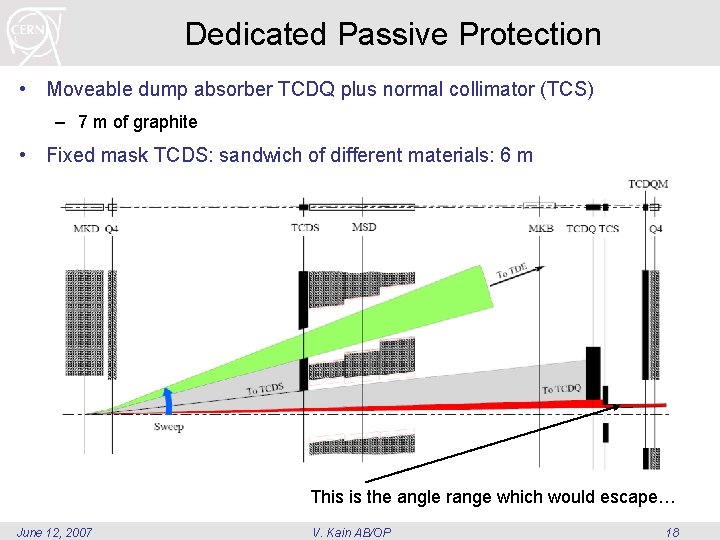
Dedicated Passive Protection • Moveable dump absorber TCDQ plus normal collimator (TCS) – 7 m of graphite • Fixed mask TCDS: sandwich of different materials: 6 m This is the angle range which would escape… June 12, 2007 V. Kain AB/OP 18
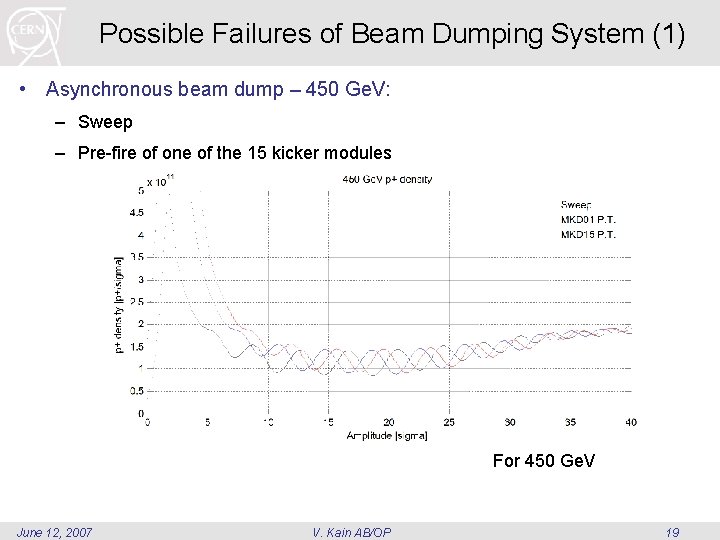
Possible Failures of Beam Dumping System (1) • Asynchronous beam dump – 450 Ge. V: – Sweep – Pre-fire of one of the 15 kicker modules For 450 Ge. V June 12, 2007 V. Kain AB/OP 19
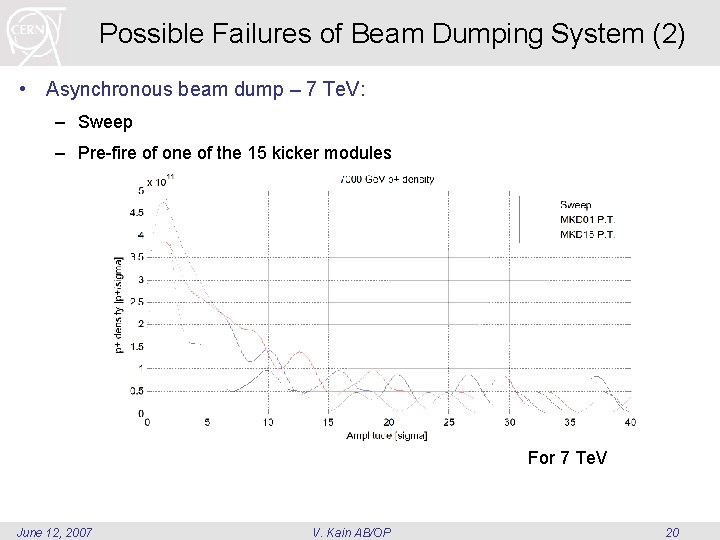
Possible Failures of Beam Dumping System (2) • Asynchronous beam dump – 7 Te. V: – Sweep – Pre-fire of one of the 15 kicker modules For 7 Te. V June 12, 2007 V. Kain AB/OP 20
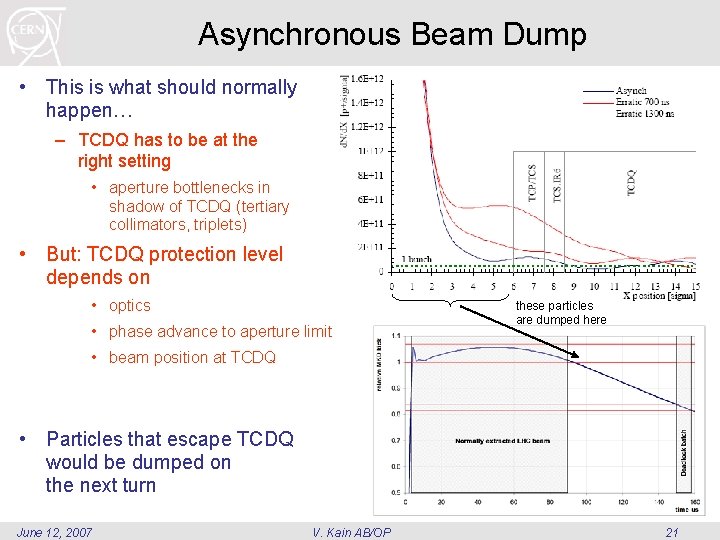
Asynchronous Beam Dump • This is what should normally happen… – TCDQ has to be at the right setting • aperture bottlenecks in shadow of TCDQ (tertiary collimators, triplets) • But: TCDQ protection level depends on • optics • phase advance to aperture limit these particles are dumped here • beam position at TCDQ • Particles that escape TCDQ would be dumped on the next turn June 12, 2007 V. Kain AB/OP 21
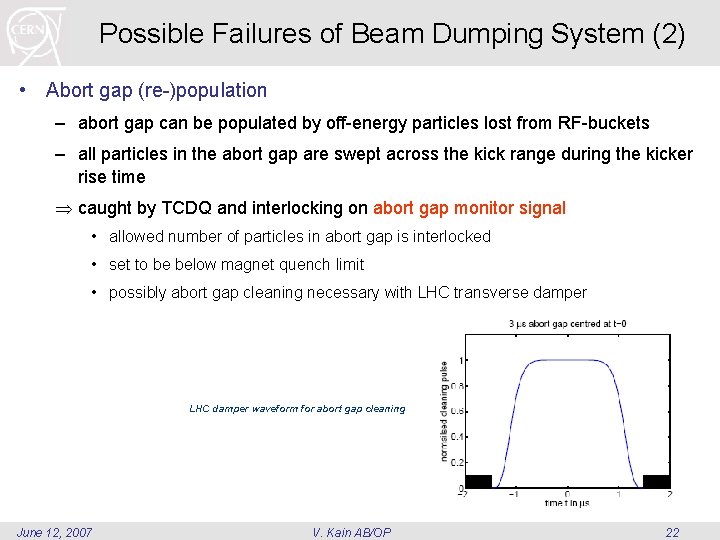
Possible Failures of Beam Dumping System (2) • Abort gap (re-)population – abort gap can be populated by off-energy particles lost from RF-buckets – all particles in the abort gap are swept across the kick range during the kicker rise time caught by TCDQ and interlocking on abort gap monitor signal • allowed number of particles in abort gap is interlocked • set to be below magnet quench limit • possibly abort gap cleaning necessary with LHC transverse damper LHC damper waveform for abort gap cleaning June 12, 2007 V. Kain AB/OP 22
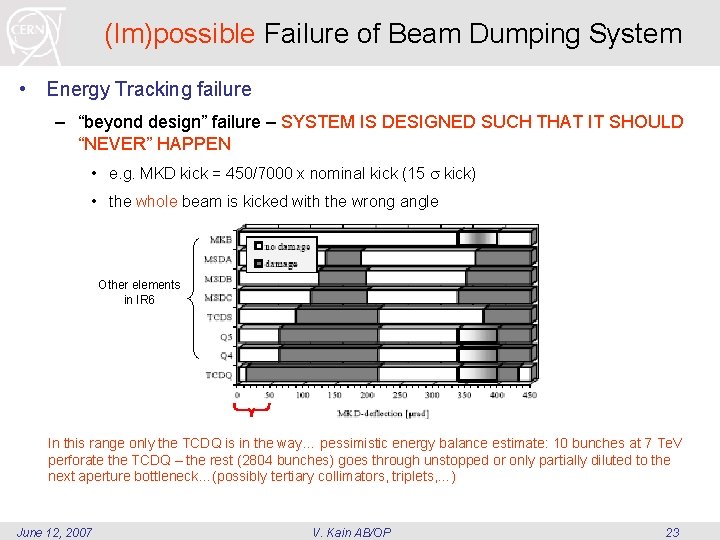
(Im)possible Failure of Beam Dumping System • Energy Tracking failure – “beyond design” failure – SYSTEM IS DESIGNED SUCH THAT IT SHOULD “NEVER” HAPPEN • e. g. MKD kick = 450/7000 x nominal kick (15 s kick) • the whole beam is kicked with the wrong angle Other elements in IR 6 In this range only the TCDQ is in the way… pessimistic energy balance estimate: 10 bunches at 7 Te. V perforate the TCDQ – the rest (2804 bunches) goes through unstopped or only partially diluted to the next aperture bottleneck…(possibly tertiary collimators, triplets, …) June 12, 2007 V. Kain AB/OP 23
Summary • Injection: – With the current machine protection philosophy up to ~ 1012 protons could be lost close or in the experimental area. • However, unlikely because “nominally” inject pilot into empty machine first…. – Is the machine safe beam limit compatible with the experiments? • Also, showers generated by beam loss very close to experiment: triplet, TAS, … • Beam dumping: – At 7 Te. V, squeezed optics, the LHC aperture bottleneck is close to the experiments (triplets). – Additional protection for the triplets is foreseen with the tertiary collimators. – In case of problems during extraction coupled with TCDQ settings, orbit or optics errors, “some” beam loss at the tertiary collimators/triplets may occur. – Difficult to quantify - detailed analysis ongoing. Ph. D thesis of Thomas Kramer, AB/BT. June 12, 2007 V. Kain AB/OP 24