
Initiatives to Improve Data Accuracy Completeness and Timeliness




- Slides: 75
Initiatives to Improve Data Accuracy, Completeness and Timeliness Across the HIV Care Continuum 2016 NATIONAL RYAN WHITE CONFERENCE ON HIV CARE & TREATMENT
Introduction to the Session 2016 NATIONAL RYAN WHITE CONFERENCE ON HIV CARE & TREATMENT
Acknowledgement/Disclosure This presentation is supported by grants from the Health Resources and Services Administration (HRSA) Special Projects of National Significance (SPNS) Program. Specific grant numbers are listed on the slides introducing each speaker. The presentation’s contents are solely the responsibility of the authors and do not necessarily represent the official view of HRSA or the SPNS Program. 2016 NATIONAL RYAN WHITE CONFERENCE ON HIV CARE & TREATMENT
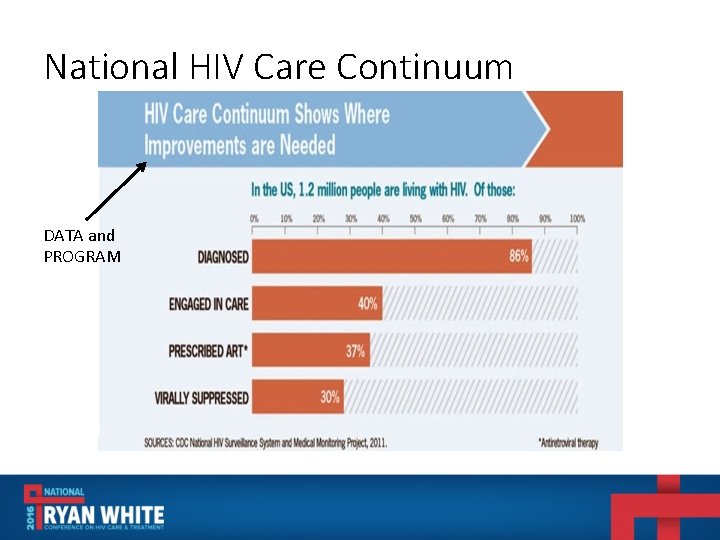
National HIV Care Continuum DATA and PROGRAM
Data Quality: What, Why, How? • Surveillance, Ryan White, and other HIV data are not just utilized for funding formulas and static reports • Real-time tracking of diagnosis, linkage, care engagement, medication adherence and viral suppression are needed • Current data systems – set up artificially with barriers based on funding streams, jurisdictions, disease status, etc.
Accuracy How do people get included in/excluded from Continuum of Care analyses? • Death • Proof of out of jurisdiction address • No care in xx period of time? • Modeling methods? • Only care in xx period of time? 24% of current living cases in VA e. HARS – no lab in last 5 years (n=6, 005)
Completeness • Markers for care cannot all be tracked in e. HARS • Systems outside of health department purview often have data on care status for PLWH • Electronic medical records/health information exchanges/all payer claims databases often available in jurisdictions •
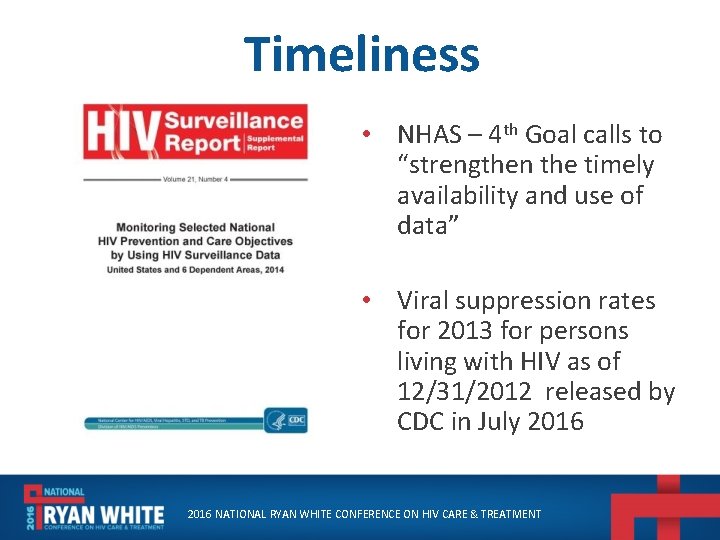
Timeliness • NHAS – 4 th Goal calls to “strengthen the timely availability and use of data” • Viral suppression rates for 2013 for persons living with HIV as of 12/31/2012 released by CDC in July 2016 NATIONAL RYAN WHITE CONFERENCE ON HIV CARE & TREATMENT
This session… • Features presentations from • Virginia: Health Information technology initiatives to improve HIV Surveillance data • Louisiana: Electronic HIV Data to Care System • North Carolina: System for Data to Care using CAREWare data • HRSA: Building Bridges in Electronic Medical Record Systems 2016 NATIONAL RYAN WHITE CONFERENCE ON HIV CARE & TREATMENT
Virginia's Health Information Technology Initiatives: Improvements in Care Continuum Measurement Anne Giuranna Rhodes, Ph. D Virginia Department of Health Division of Disease Prevention Grant H 97 HA 27534 2016 NATIONAL RYAN WHITE CONFERENCE ON HIV CARE & TREATMENT
Background Division of Disease Prevention • Integrated division comprised of several programs focused on HIV prevention, identification, care, and data management. • HIV Surveillance, HIV Prevention, HIV Care Services, STD Surveillance, Data Operations and Administration (SODA), TB program and services for recent immigrants. Mission Statement: • “To maximize public health and safety through the elimination, prevention, and control of disease, disability, and death caused by HIV/AIDS, viral hepatitis, other sexually transmitted infections and tuberculosis. ”
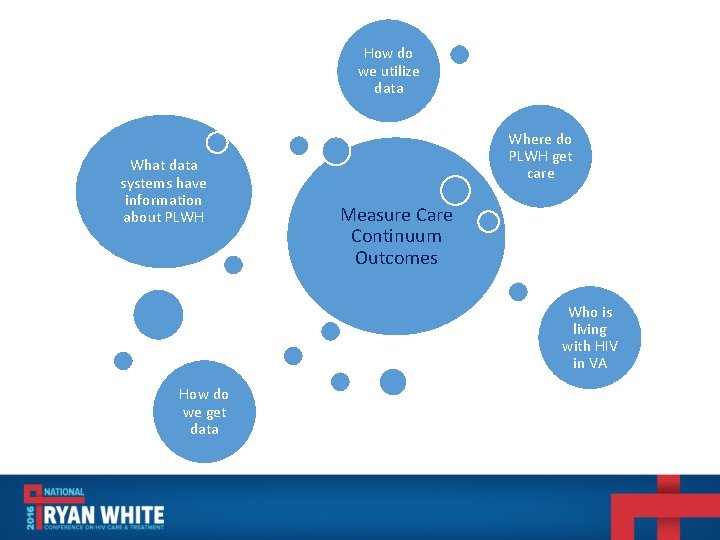
How do we utilize data What data systems have information about PLWH Where do PLWH get care Measure Care Continuum Outcomes Who is living with HIV in VA How do we get data
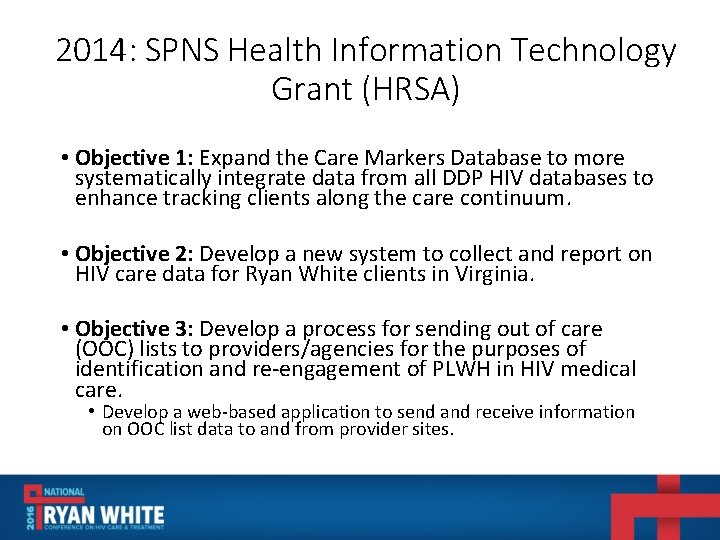
2014: SPNS Health Information Technology Grant (HRSA) • Objective 1: Expand the Care Markers Database to more systematically integrate data from all DDP HIV databases to enhance tracking clients along the care continuum. • Objective 2: Develop a new system to collect and report on HIV care data for Ryan White clients in Virginia. • Objective 3: Develop a process for sending out of care (OOC) lists to providers/agencies for the purposes of identification and re-engagement of PLWH in HIV medical care. • Develop a web-based application to send and receive information on OOC list data to and from provider sites.
Defining Virginia’s HIV Continuum of Care What’s considered a care marker? CD 4 test Linkage Evidence of a care marker within 30 days of initial HIV diagnosis Viral load test HIV medical care visit Retention 2 or more care markers in 12 months at least 3 months apart ART prescription Viral Suppression Last viral load <200 copies/m. L in the time period being measured
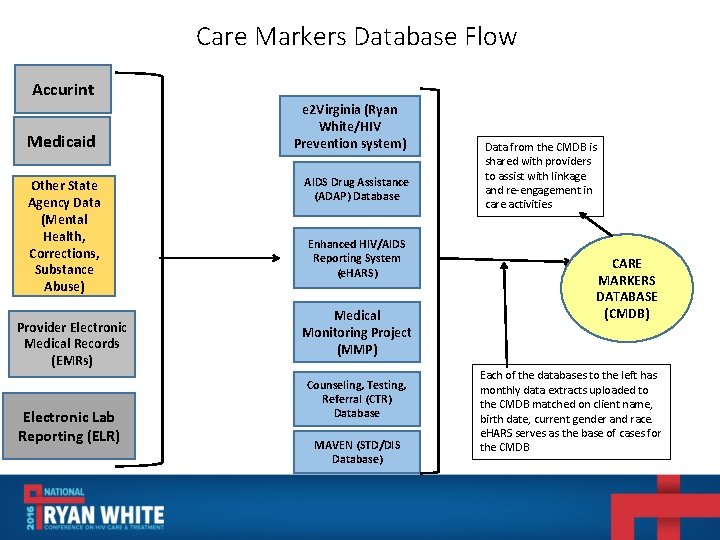
Care Markers Database Flow Accurint Medicaid Other State Agency Data (Mental Health, Corrections, Substance Abuse) Provider Electronic Medical Records (EMRs) Electronic Lab Reporting (ELR) e 2 Virginia (Ryan White/HIV Prevention system) AIDS Drug Assistance (ADAP) Database Enhanced HIV/AIDS Reporting System (e. HARS) Medical Monitoring Project (MMP) Counseling, Testing, Referral (CTR) Database MAVEN (STD/DIS Database) Data from the CMDB is shared with providers to assist with linkage and re-engagement in care activities CARE MARKERS DATABASE (CMDB) Each of the databases to the left has monthly data extracts uploaded to the CMDB matched on client name, birth date, current gender and race. e. HARS serves as the base of cases for the CMDB
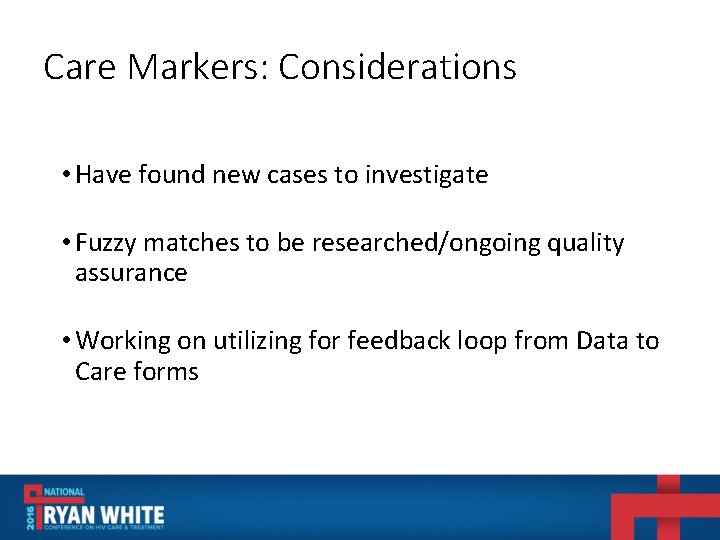
Care Markers: Considerations • Have found new cases to investigate • Fuzzy matches to be researched/ongoing quality assurance • Working on utilizing for feedback loop from Data to Care forms
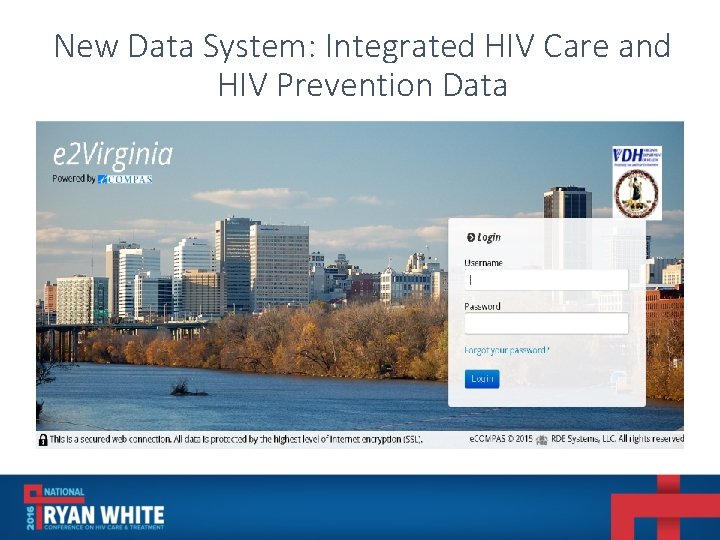
New Data System: Integrated HIV Care and HIV Prevention Data
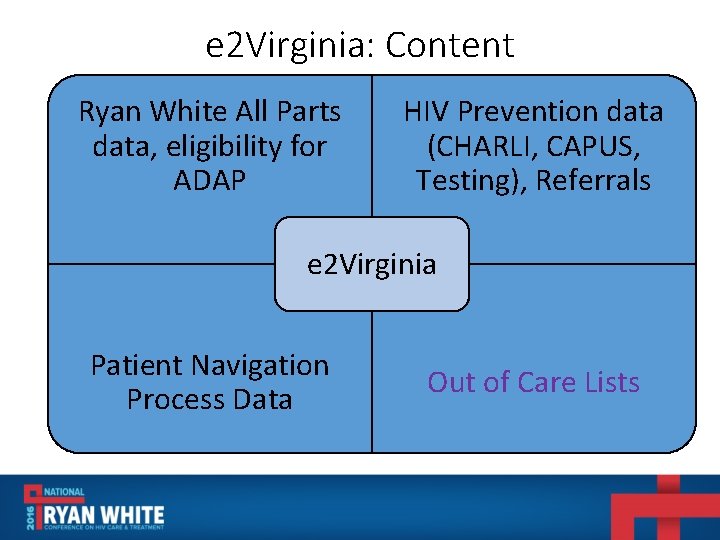
e 2 Virginia: Content Ryan White All Parts data, eligibility for ADAP HIV Prevention data (CHARLI, CAPUS, Testing), Referrals e 2 Virginia Patient Navigation Process Data Out of Care Lists
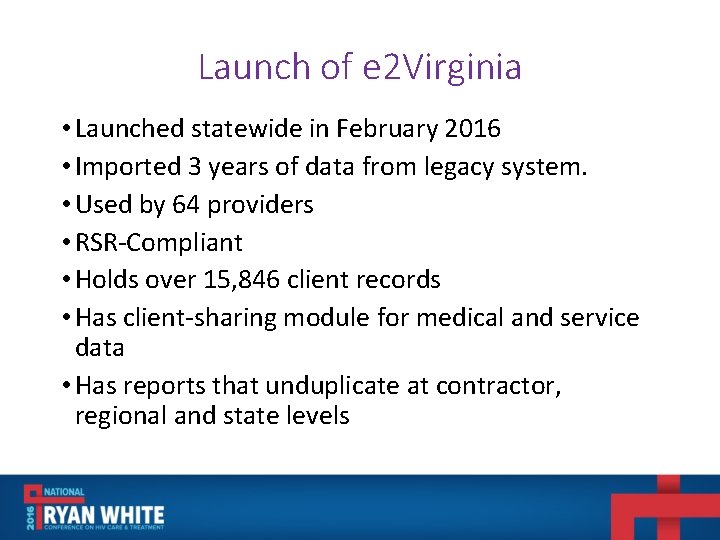
Launch of e 2 Virginia • Launched statewide in February 2016 • Imported 3 years of data from legacy system. • Used by 64 providers • RSR-Compliant • Holds over 15, 846 client records • Has client-sharing module for medical and service data • Has reports that unduplicate at contractor, regional and state levels
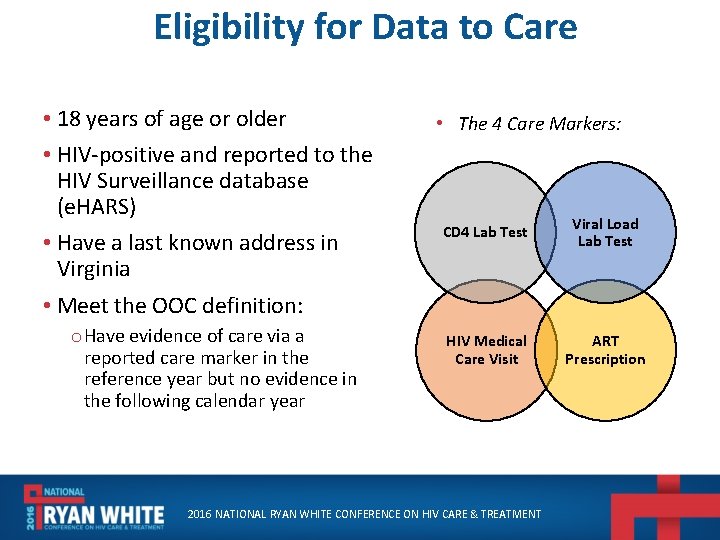
Eligibility for Data to Care • 18 years of age or older • HIV-positive and reported to the HIV Surveillance database (e. HARS) • Have a last known address in Virginia • Meet the OOC definition: o Have evidence of care via a reported care marker in the reference year but no evidence in the following calendar year • The 4 Care Markers: CD 4 Lab Test Viral Load Lab Test HIV Medical Care Visit ART Prescription 2016 NATIONAL RYAN WHITE CONFERENCE ON HIV CARE & TREATMENT
Overall Dt. C Outcomes Deceased 4% Discharged 2% N=192 Unable to be Located 17% Relocated OOS 11% Other 3% Not in Care 5% Incarcerated 2% Data reported to the Virginia Department of Health as of 06/09/2016 In Care 56%
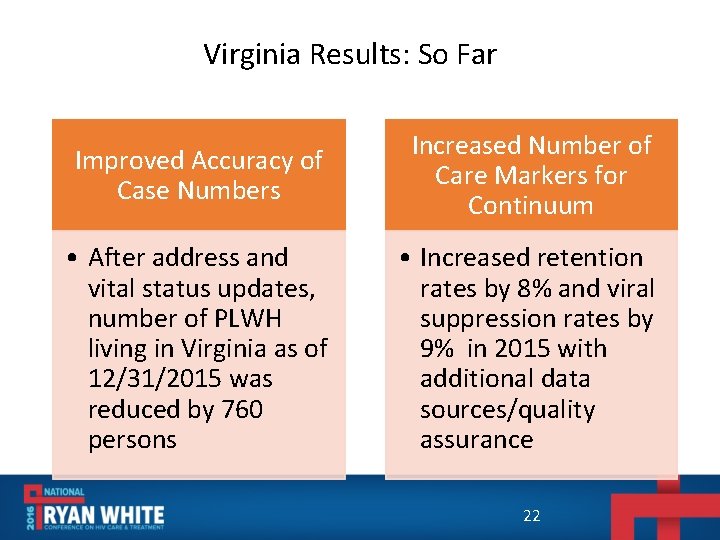
Virginia Results: So Far Improved Accuracy of Case Numbers Increased Number of Care Markers for Continuum • After address and vital status updates, number of PLWH living in Virginia as of 12/31/2015 was reduced by 760 persons • Increased retention rates by 8% and viral suppression rates by 9% in 2015 with additional data sources/quality assurance 22
For More Information… • Anne Rhodes, Ph. D HIV Surveillance Director Anne. Rhodes@vdh. virginia. gov • Lauren Yerkes, MPH HIV Epidemiologist Lauren. Yerkes@vdh. virginia. gov • Kate Gilmore, MPH Data Manager Kathryn. Gilmore@vdh. virginia. gov • Jesse Thomas, RDE jesse@rdesystems. com
LA Links: a Data to Care Intervention Using an Automated Real-time Surveillance Data System Debbie Wendell, Ph. D, MPH Data Management/Analysis Unit Manager Louisiana Department of Health, STD/HIV Program 2016 NATIONAL RYAN WHITE CONFERENCE ON HIV CARE & TREATMENT
Disclosures Presenter(Debbie Wendell) has no financial interest to disclose. This continuing education activity is managed and accredited by Professional Education Services Group in cooperation with HSRA and LRG. PESG, HSRA, LRG and all accrediting organization do not support or endorse any product or service mentioned in this activity. PESG, HRSA, and LRG staff has no financial interest to disclose. 2016 NATIONAL RYAN WHITE CONFERENCE ON HIV CARE & TREATMENT
Learning Objectives At the conclusion of this activity, the participant will be able to: 1. Describe how real-time surveillance data can be used for “Data to Care” interventions 2. Demonstrate the benefit of automatically updating electronic out of care line lists 3. Describe ways to improve line lists and HIV surveillance data 2016 NATIONAL RYAN WHITE CONFERENCE ON HIV CARE & TREATMENT
Obtaining CME/CE Credit If you would like to receive continuing education credit for this activity, please visit: http: //ryanwhite. cds. pesgce. com 2016 NATIONAL RYAN WHITE CONFERENCE ON HIV CARE & TREATMENT
Louisiana Links § CAPUS-funded, “Data to Care” intervention § October 2013 -September 2015 – demonstration project in 3 metro areas with highest prevalence § Expanded statewide in 2016 § Utilizes surveillance data to identify PLWH who are: § Newly diagnosed and not linked to care § Previously diagnosed who need re-engagement § Persons not virally suppressed § Automated electronic line lists with weekly automated update process 2016 NATIONAL RYAN WHITE CONFERENCE ON HIV CARE & TREATMENT
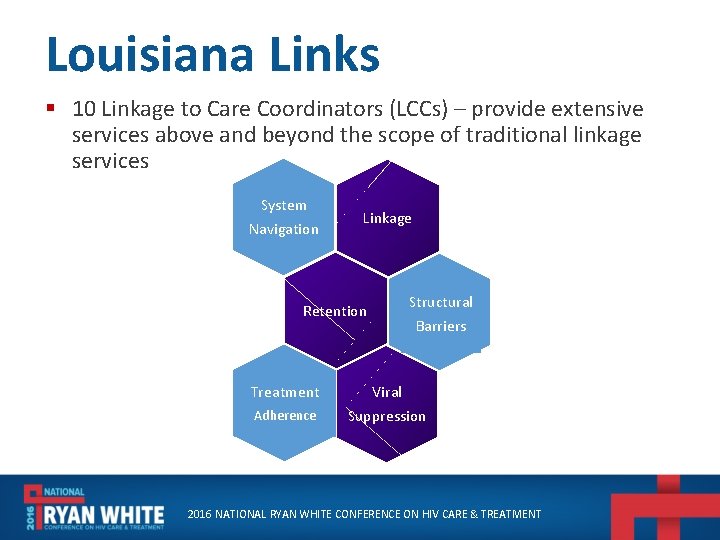
Louisiana Links § 10 Linkage to Care Coordinators (LCCs) – provide extensive services above and beyond the scope of traditional linkage services System Navigation Linkage Retention Treatment Adherence Structural Barriers Viral Suppression 2016 NATIONAL RYAN WHITE CONFERENCE ON HIV CARE & TREATMENT
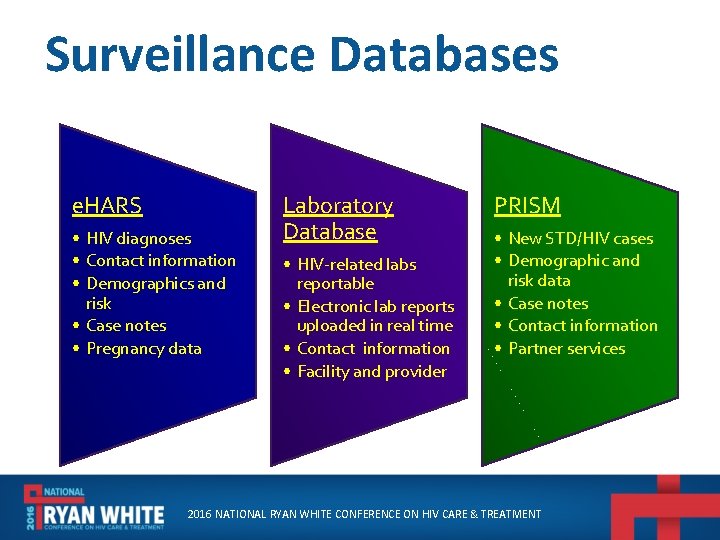
Surveillance Databases e. HARS • HIV diagnoses • Contact information • Demographics and risk • Case notes • Pregnancy data Laboratory Database • HIV-related labs reportable • Electronic lab reports uploaded in real time • Contact information • Facility and provider PRISM • New STD/HIV cases • Demographic and risk data • Case notes • Contact information • Partner services 2016 NATIONAL RYAN WHITE CONFERENCE ON HIV CARE & TREATMENT
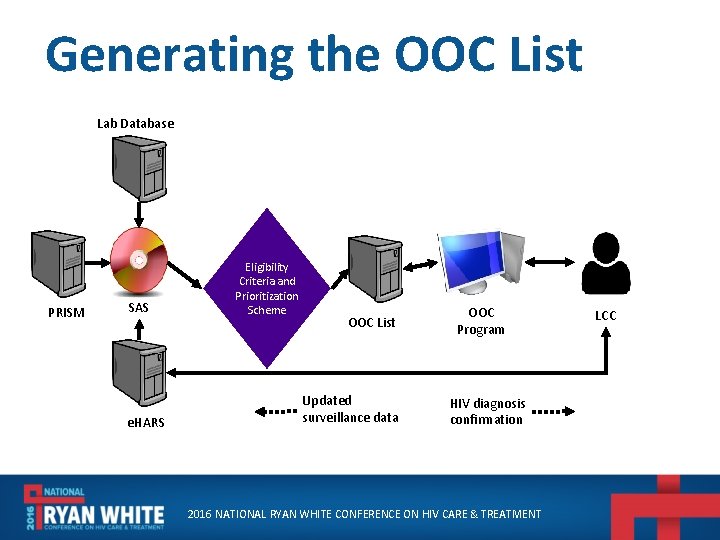
Generating the OOC List Lab Database PRISM SAS e. HARS Eligibility Criteria and Prioritization Scheme OOC List Updated surveillance data OOC Program HIV diagnosis confirmation 2016 NATIONAL RYAN WHITE CONFERENCE ON HIV CARE & TREATMENT LCC
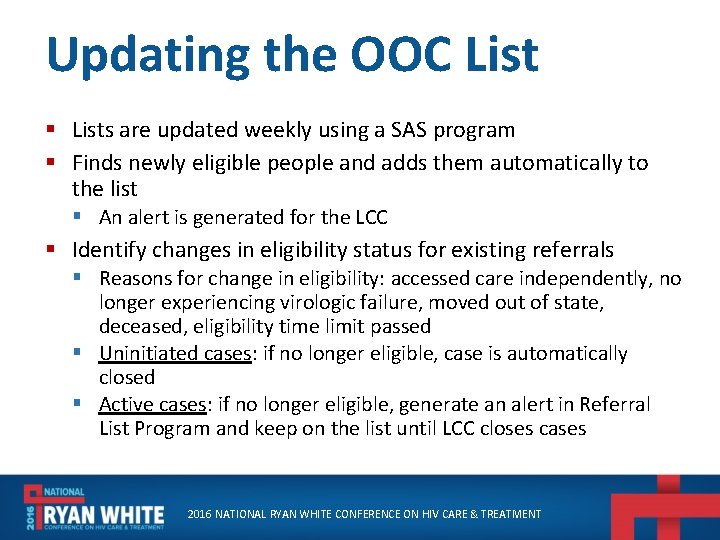
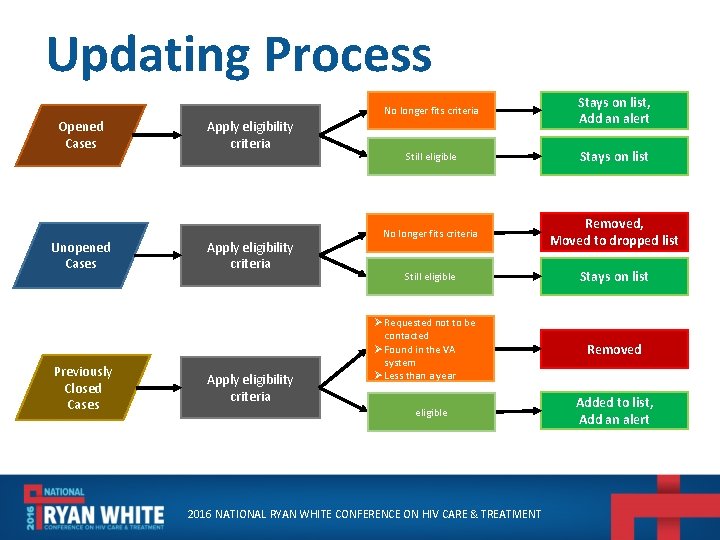
Updating the OOC List § Lists are updated weekly using a SAS program § Finds newly eligible people and adds them automatically to the list § An alert is generated for the LCC § Identify changes in eligibility status for existing referrals § Reasons for change in eligibility: accessed care independently, no longer experiencing virologic failure, moved out of state, deceased, eligibility time limit passed § Uninitiated cases: if no longer eligible, case is automatically closed § Active cases: if no longer eligible, generate an alert in Referral List Program and keep on the list until LCC closes cases 2016 NATIONAL RYAN WHITE CONFERENCE ON HIV CARE & TREATMENT
Updating Process Opened Cases Unopened Cases Previously Closed Cases Apply eligibility criteria No longer fits criteria Stays on list, Add an alert Still eligible Stays on list No longer fits criteria Removed, Moved to dropped list Still eligible Stays on list Ø Requested not to be contacted Ø Found in the VA system Ø Less than a year eligible 2016 NATIONAL RYAN WHITE CONFERENCE ON HIV CARE & TREATMENT Removed Added to list, Add an alert
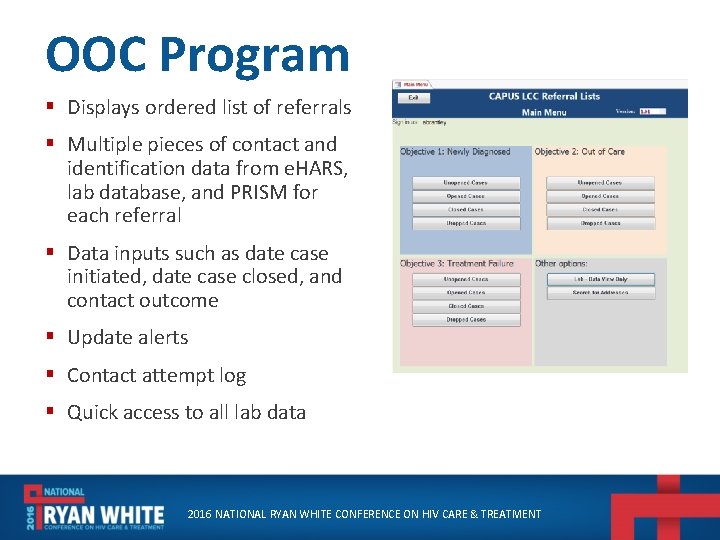
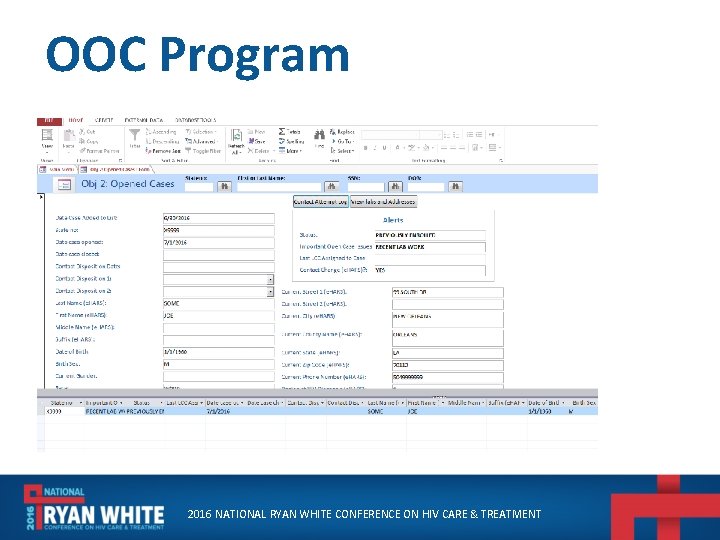
OOC Program § Displays ordered list of referrals § Multiple pieces of contact and identification data from e. HARS, lab database, and PRISM for each referral § Data inputs such as date case initiated, date case closed, and contact outcome § Update alerts § Contact attempt log § Quick access to all lab data 2016 NATIONAL RYAN WHITE CONFERENCE ON HIV CARE & TREATMENT
OOC Program 2016 NATIONAL RYAN WHITE CONFERENCE ON HIV CARE & TREATMENT
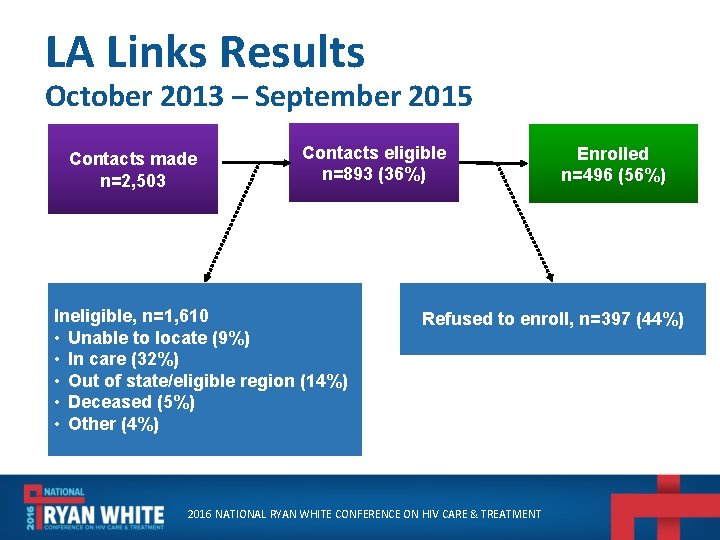
LA Links Results October 2013 – September 2015 Contacts made n=2, 503 Contacts eligible n=893 (36%) Ineligible, n=1, 610 • Unable to locate (9%) • In care (32%) • Out of state/eligible region (14%) • Deceased (5%) • Other (4%) Enrolled n=496 (56%) Refused to enroll, n=397 (44%) 2016 NATIONAL RYAN WHITE CONFERENCE ON HIV CARE & TREATMENT
Improving Surveillance Data § LCCs fill out case report forms to update Louisiana surveillance database (e. HARS) § New addresses, risk information, deaths, earlier diagnoses § Identify labs that may not be reporting completely § Other ways to improve surveillance: § Persons newly enrolled in Ryan White services are looked up immediately in e. HARS and unreported cases are investigated § Newly reported HIV cases are automatically transferred to the Partner Services database daily and info obtained during DIS interviews provided back to e. HARS § Routinely link e. HARS data to Vital Records, Medicaid data, CAREWare, National Death Index, and SSDMF 2016 NATIONAL RYAN WHITE CONFERENCE ON HIV CARE & TREATMENT
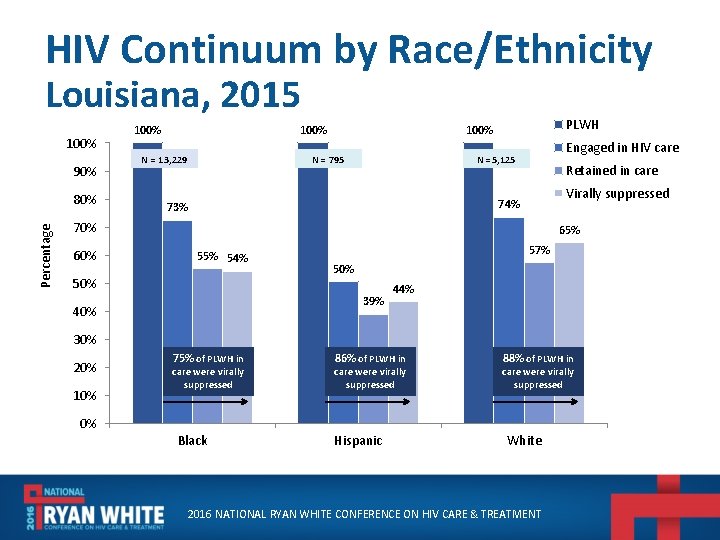
Lessons Learned § Automatic update process saved time and resources § 30% of referrals were closed automatically during update process before LCC had to do an work on them § Alerts helped LCCs close 942 ineligible cases § Linkages to external data systems and data to care interventions have improved HIV continuum data § Still have PLWH in the first bar who are likely not living in Louisiana, so the percentages in the subsequent bars are underestimated § Louisiana focuses on viral suppression on persons in care; best able to show inequities 2016 NATIONAL RYAN WHITE CONFERENCE ON HIV CARE & TREATMENT
HIV Continuum by Race/Ethnicity Louisiana, 2015 100% 90% Percentage 80% 100% N = 13, 229 PLWH 100% N = 795 Engaged in HIV care N =5, 125 Retained in care Virally suppressed 74% 73% 70% 65% 54% 50% 57% 50% 39% 40% 44% 30% 20% 10% 75% of PLWH in care were virally suppressed 86% of PLWH in care were virally suppressed 88% of PLWH in care were virally suppressed 0% Black Hispanic White 2016 NATIONAL RYAN WHITE CONFERENCE ON HIV CARE & TREATMENT
Questions? Debbie Wendell debbie. wendell@la. gov (504) 568 -7474 2016 NATIONAL RYAN WHITE CONFERENCE ON HIV CARE & TREATMENT
NC-ECHO A North Carolina model data warehouse for Engagement in Care and HIV Outreach Evelyn Byrd Quinlivan, MD Jenna Donovan, MPH 2016 NATIONAL RYAN WHITE CONFERENCE ON HIV CARE & TREATMENT
Disclosures No authors have no financial interest to disclose. Grant Support: This project is supported by the Health Resources and Services Administration (HRSA) of the US Department of Health and Human Services (HHS) under Systems Linkages for Access to Care Initiative (H 97 HA 22695) and support did not include non-governmental sources. This information, content and conclusions are those of the authors and should not be construed as the official position or policy of, nor should any endorsements be inferred by HRSA, HHS, the US Government, or the NCDHHS. This continuing education activity is managed and accredited by Professional Education Services Group in cooperation with HSRA and LRG. PESG, HSRA, LRG and all accrediting organization do not support or endorse any product or service mentioned in this activity. PESG, HRSA, and LRG staff has no financial interest to disclose. 2016 NATIONAL RYAN WHITE CONFERENCE ON HIV CARE & TREATMENT
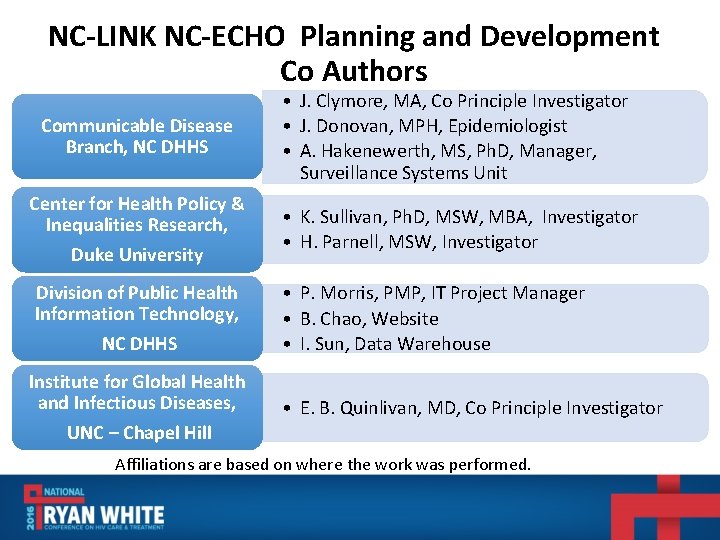
NC-LINK NC-ECHO Planning and Development Co Authors Communicable Disease Branch, NC DHHS • J. Clymore, MA, Co Principle Investigator • J. Donovan, MPH, Epidemiologist • A. Hakenewerth, MS, Ph. D, Manager, Surveillance Systems Unit Center for Health Policy & Inequalities Research, Duke University • K. Sullivan, Ph. D, MSW, MBA, Investigator • H. Parnell, MSW, Investigator Division of Public Health Information Technology, NC DHHS • P. Morris, PMP, IT Project Manager • B. Chao, Website • I. Sun, Data Warehouse Institute for Global Health and Infectious Diseases, UNC – Chapel Hill • E. B. Quinlivan, MD, Co Principle Investigator Affiliations are based on where the work was performed.
Learning Objectives The audience will be able to: Describe the development process for creation of a data warehouse for HIV outreach. Describe the key functions and the purpose of each function within the model data warehouse. Describe the staffing needs for data warehouse construction and use. 2016 NATIONAL RYAN WHITE CONFERENCE ON HIV CARE & TREATMENT
Obtaining CME/CE Credit If you would like to receive continuing education credit for this activity, please visit: http: //ryanwhite. cds. pesgce. com 2016 NATIONAL RYAN WHITE CONFERENCE ON HIV CARE & TREATMENT
Setting: HIV in North Carolina 2016 NATIONAL RYAN WHITE CONFERENCE ON HIV CARE & TREATMENT
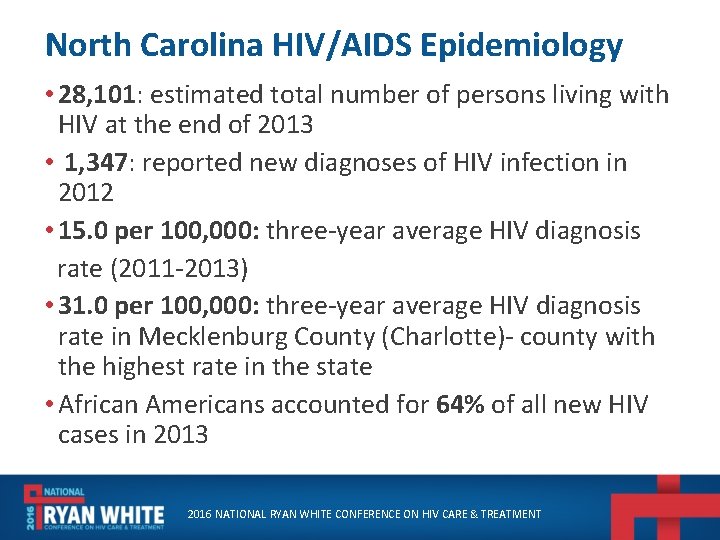
North Carolina HIV/AIDS Epidemiology • 28, 101: estimated total number of persons living with HIV at the end of 2013 • 1, 347: reported new diagnoses of HIV infection in 2012 • 15. 0 per 100, 000: three-year average HIV diagnosis rate (2011 -2013) • 31. 0 per 100, 000: three-year average HIV diagnosis rate in Mecklenburg County (Charlotte)- county with the highest rate in the state • African Americans accounted for 64% of all new HIV cases in 2013 2016 NATIONAL RYAN WHITE CONFERENCE ON HIV CARE & TREATMENT
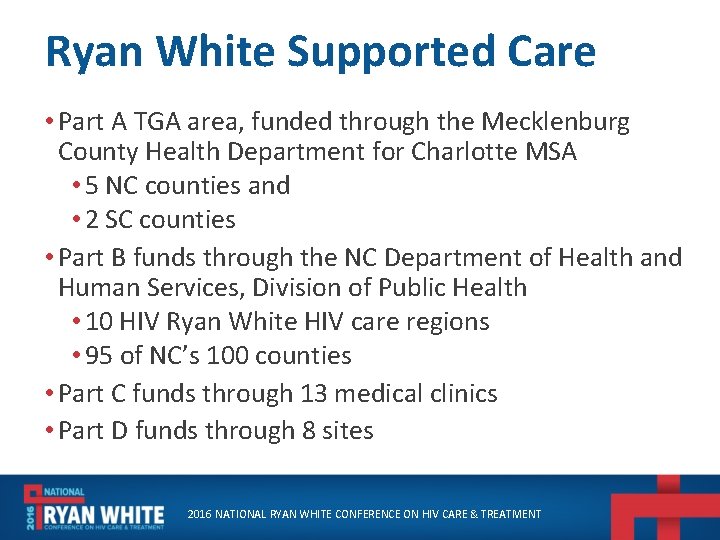
Ryan White Supported Care • Part A TGA area, funded through the Mecklenburg County Health Department for Charlotte MSA • 5 NC counties and • 2 SC counties • Part B funds through the NC Department of Health and Human Services, Division of Public Health • 10 HIV Ryan White HIV care regions • 95 of NC’s 100 counties • Part C funds through 13 medical clinics • Part D funds through 8 sites 2016 NATIONAL RYAN WHITE CONFERENCE ON HIV CARE & TREATMENT
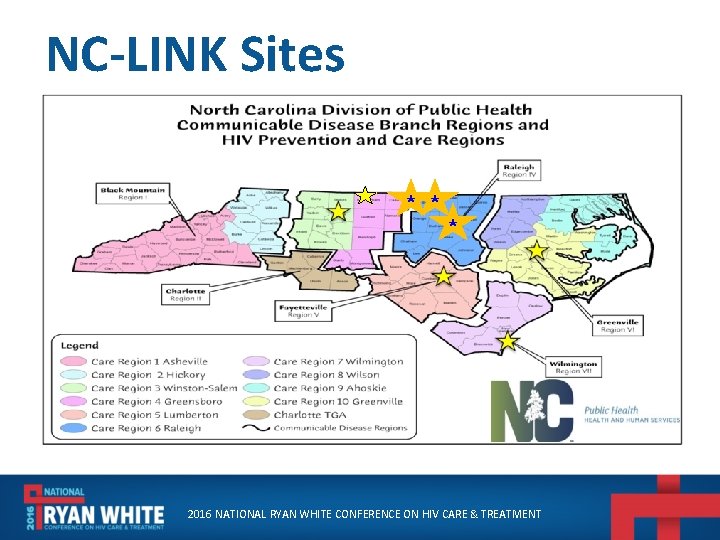
NC-LINK Sites 2016 NATIONAL RYAN WHITE CONFERENCE ON HIV CARE & TREATMENT
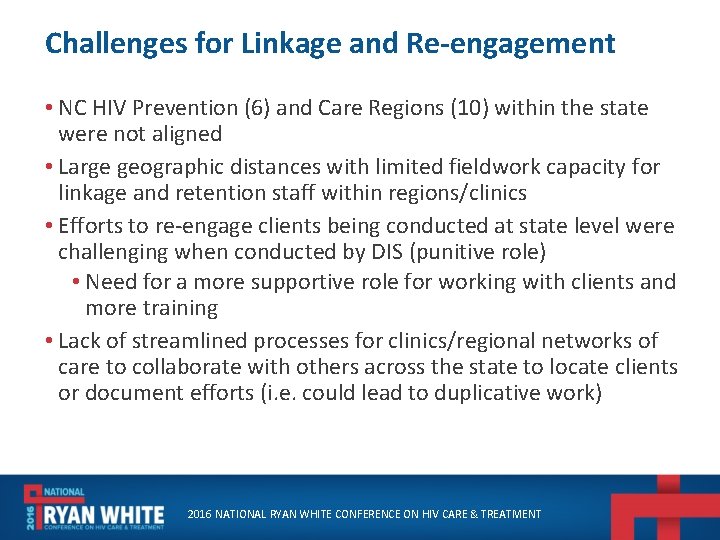
Challenges for Linkage and Re-engagement • NC HIV Prevention (6) and Care Regions (10) within the state were not aligned • Large geographic distances with limited fieldwork capacity for linkage and retention staff within regions/clinics • Efforts to re-engage clients being conducted at state level were challenging when conducted by DIS (punitive role) • Need for a more supportive role for working with clients and more training • Lack of streamlined processes for clinics/regional networks of care to collaborate with others across the state to locate clients or document efforts (i. e. could lead to duplicative work) 2016 NATIONAL RYAN WHITE CONFERENCE ON HIV CARE & TREATMENT
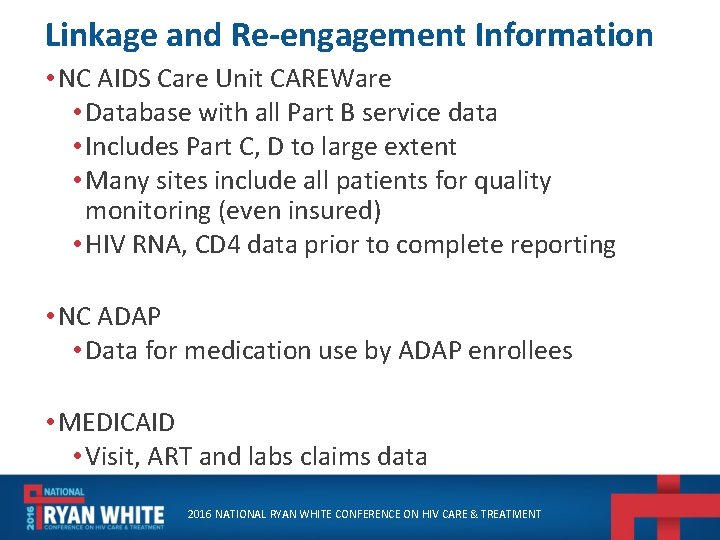
Linkage and Re-engagement Information • NC EDSS Surveillance of HIV RNA & CD 4 • New database designed to have individual as base record that than specific events. • Addresses, staff contacts and other notes are updated with each event. • e. HARS – Surveillance of HIV RNA & CD 4 • Official CDC surveillance reporting tool with built-in hierarchy for race, exposure, matching. 2016 NATIONAL RYAN WHITE CONFERENCE ON HIV CARE & TREATMENT
Linkage and Re-engagement Information • NC AIDS Care Unit CAREWare • Database with all Part B service data • Includes Part C, D to large extent • Many sites include all patients for quality monitoring (even insured) • HIV RNA, CD 4 data prior to complete reporting • NC ADAP • Data for medication use by ADAP enrollees • MEDICAID • Visit, ART and labs claims data 2016 NATIONAL RYAN WHITE CONFERENCE ON HIV CARE & TREATMENT
NC LINK Overview 2016 NATIONAL RYAN WHITE CONFERENCE ON HIV CARE & TREATMENT
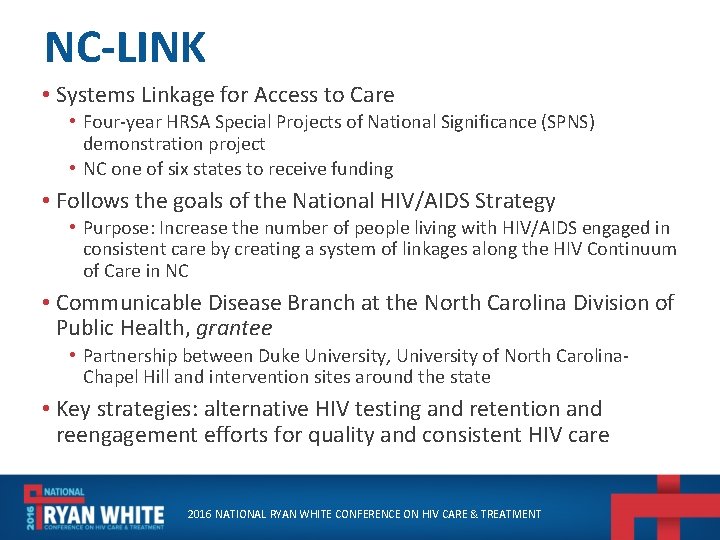
NC-LINK • Systems Linkage for Access to Care • Four-year HRSA Special Projects of National Significance (SPNS) demonstration project • NC one of six states to receive funding • Follows the goals of the National HIV/AIDS Strategy • Purpose: Increase the number of people living with HIV/AIDS engaged in consistent care by creating a system of linkages along the HIV Continuum of Care in NC • Communicable Disease Branch at the North Carolina Division of Public Health, grantee • Partnership between Duke University, University of North Carolina- Chapel Hill and intervention sites around the state • Key strategies: alternative HIV testing and retention and reengagement efforts for quality and consistent HIV care 2016 NATIONAL RYAN WHITE CONFERENCE ON HIV CARE & TREATMENT
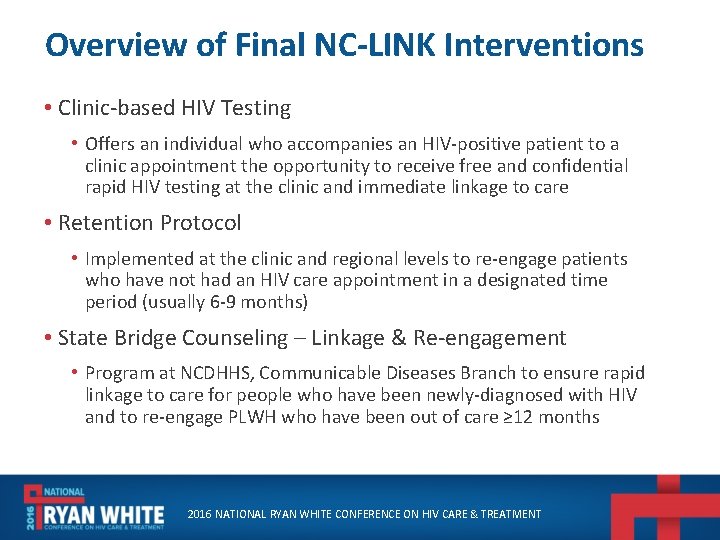
Overview of Final NC-LINK Interventions • Clinic-based HIV Testing • Offers an individual who accompanies an HIV-positive patient to a clinic appointment the opportunity to receive free and confidential rapid HIV testing at the clinic and immediate linkage to care • Retention Protocol • Implemented at the clinic and regional levels to re-engage patients who have not had an HIV care appointment in a designated time period (usually 6 -9 months) • State Bridge Counseling – Linkage & Re-engagement • Program at NCDHHS, Communicable Diseases Branch to ensure rapid linkage to care for people who have been newly-diagnosed with HIV and to re-engage PLWH who have been out of care ≥ 12 months 2016 NATIONAL RYAN WHITE CONFERENCE ON HIV CARE & TREATMENT
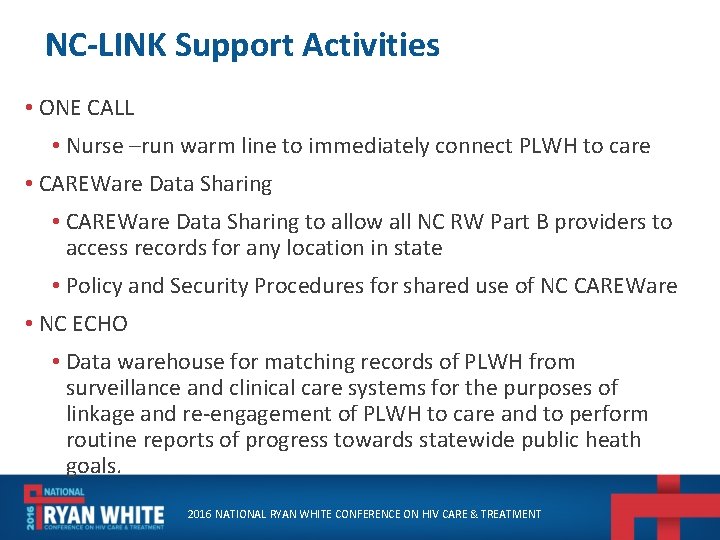
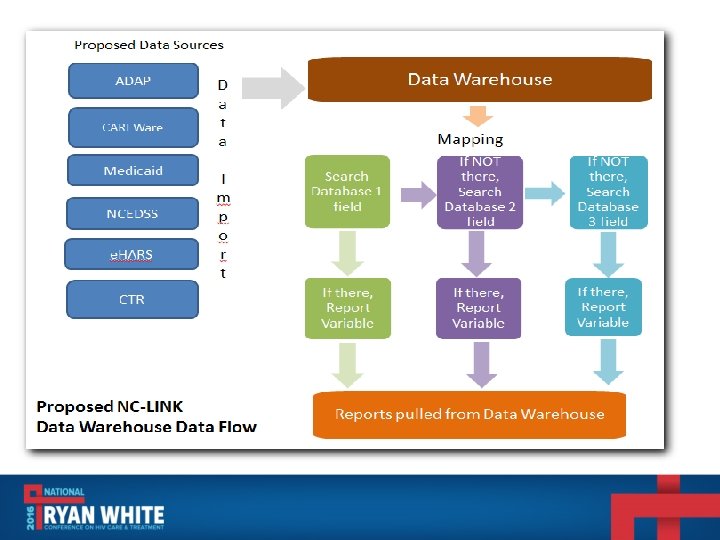
NC-LINK Support Activities • ONE CALL • Nurse –run warm line to immediately connect PLWH to care • CAREWare Data Sharing to allow all NC RW Part B providers to access records for any location in state • Policy and Security Procedures for shared use of NC CAREWare • NC ECHO • Data warehouse for matching records of PLWH from surveillance and clinical care systems for the purposes of linkage and re-engagement of PLWH to care and to perform routine reports of progress towards statewide public heath goals. 2016 NATIONAL RYAN WHITE CONFERENCE ON HIV CARE & TREATMENT
NC ECHO 2016 NATIONAL RYAN WHITE CONFERENCE ON HIV CARE & TREATMENT
Development process for creation of a data warehouse for HIV outreach. 2016 NATIONAL RYAN WHITE CONFERENCE ON HIV CARE & TREATMENT
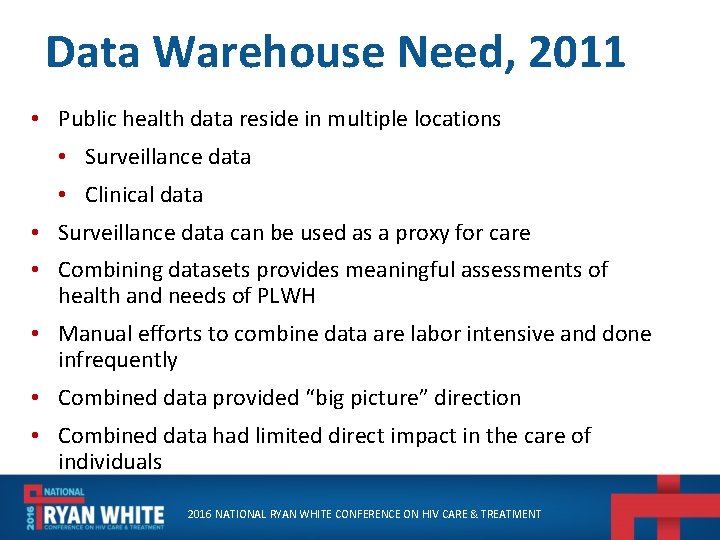
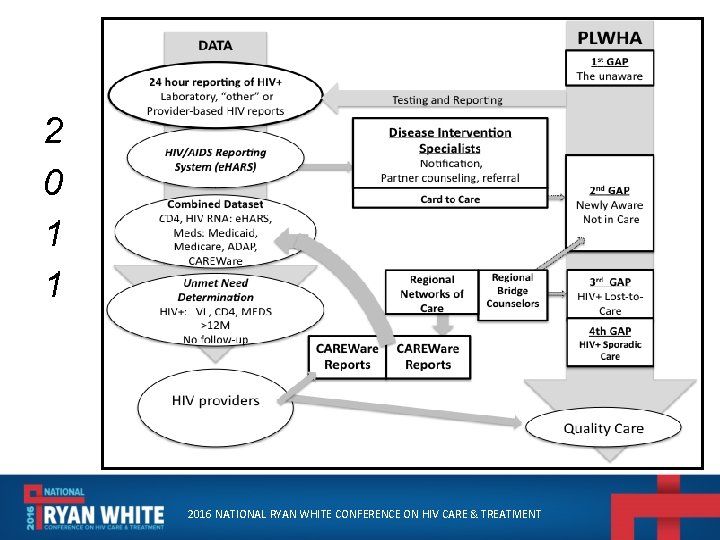
Data Warehouse Need, 2011 • Public health data reside in multiple locations • Surveillance data • Clinical data • Surveillance data can be used as a proxy for care • Combining datasets provides meaningful assessments of health and needs of PLWH • Manual efforts to combine data are labor intensive and done infrequently • Combined data provided “big picture” direction • Combined data had limited direct impact in the care of individuals 2016 NATIONAL RYAN WHITE CONFERENCE ON HIV CARE & TREATMENT
2 0 1 1 2016 NATIONAL RYAN WHITE CONFERENCE ON HIV CARE & TREATMENT
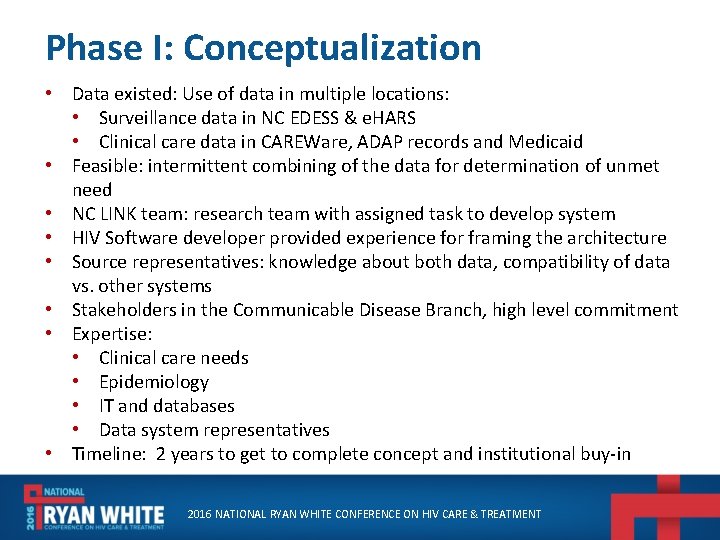
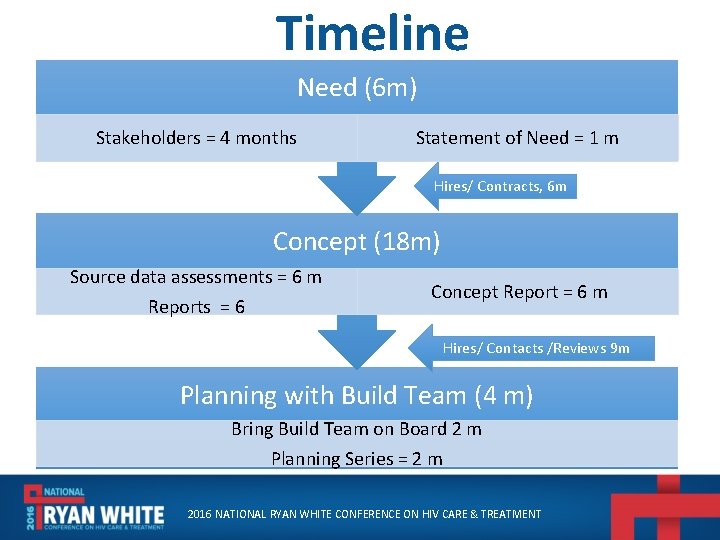
Phase I: Conceptualization • Data existed: Use of data in multiple locations: • Surveillance data in NC EDESS & e. HARS • Clinical care data in CAREWare, ADAP records and Medicaid • Feasible: intermittent combining of the data for determination of unmet need • NC LINK team: research team with assigned task to develop system • HIV Software developer provided experience for framing the architecture • Source representatives: knowledge about both data, compatibility of data vs. other systems • Stakeholders in the Communicable Disease Branch, high level commitment • Expertise: • Clinical care needs • Epidemiology • IT and databases • Data system representatives • Timeline: 2 years to get to complete concept and institutional buy-in 2016 NATIONAL RYAN WHITE CONFERENCE ON HIV CARE & TREATMENT
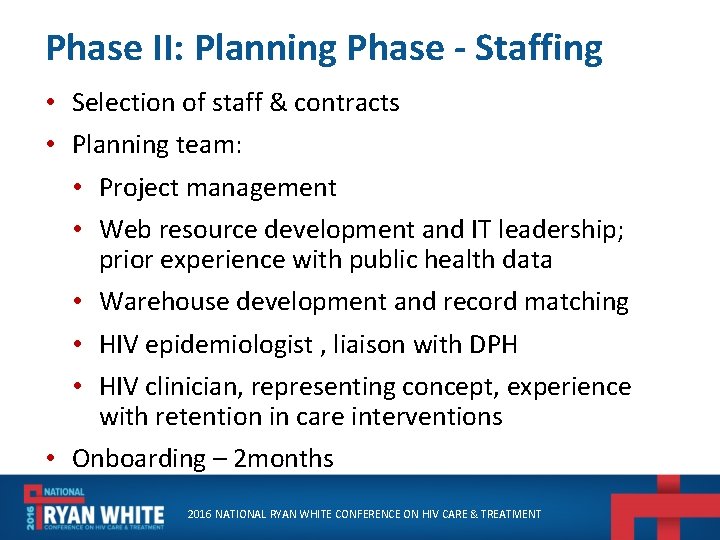
Phase II: Planning Phase - Staffing • Selection of staff & contracts • Planning team: • Project management • Web resource development and IT leadership; prior experience with public health data • Warehouse development and record matching • HIV epidemiologist , liaison with DPH • HIV clinician, representing concept, experience with retention in care interventions • Onboarding – 2 months 2016 NATIONAL RYAN WHITE CONFERENCE ON HIV CARE & TREATMENT
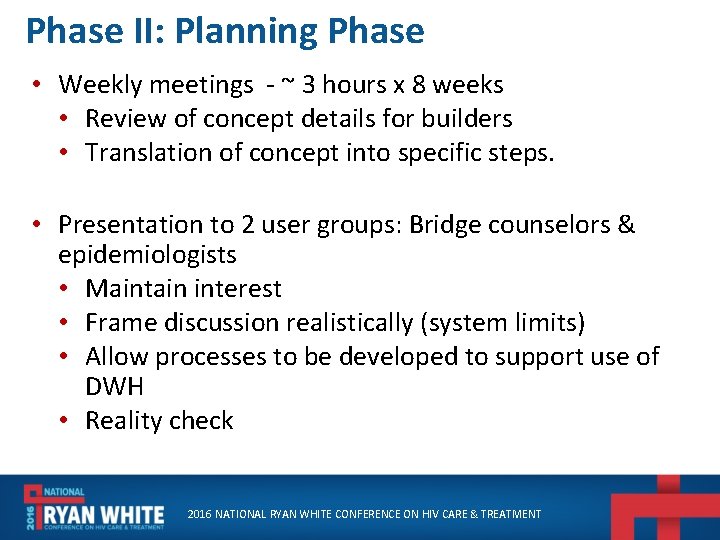
Phase II: Planning Phase • Weekly meetings - ~ 3 hours x 8 weeks • Review of concept details for builders • Translation of concept into specific steps. • Presentation to 2 user groups: Bridge counselors & epidemiologists • Maintain interest • Frame discussion realistically (system limits) • Allow processes to be developed to support use of DWH • Reality check 2016 NATIONAL RYAN WHITE CONFERENCE ON HIV CARE & TREATMENT
Key functions and the aim of each function within the model data warehouse. 2016 NATIONAL RYAN WHITE CONFERENCE ON HIV CARE & TREATMENT
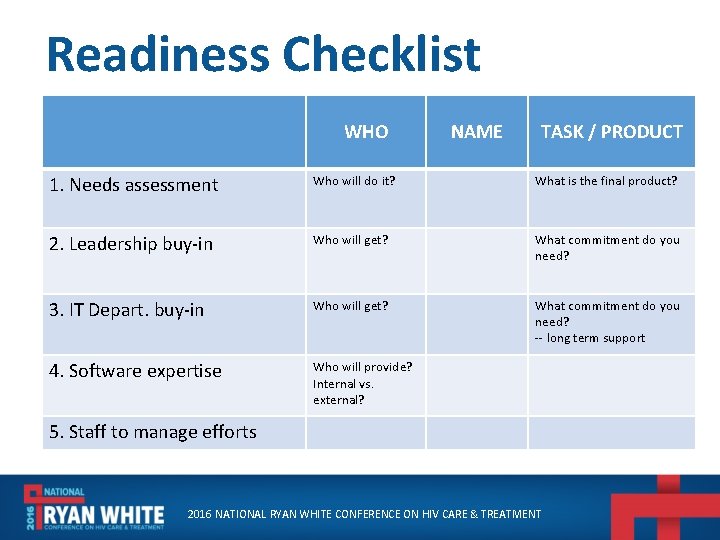
Readiness Checklist WHO NAME TASK / PRODUCT 1. Needs assessment Who will do it? What is the final product? 2. Leadership buy-in Who will get? What commitment do you need? 3. IT Depart. buy-in Who will get? What commitment do you need? -- long term support 4. Software expertise Who will provide? Internal vs. external? 5. Staff to manage efforts 2016 NATIONAL RYAN WHITE CONFERENCE ON HIV CARE & TREATMENT
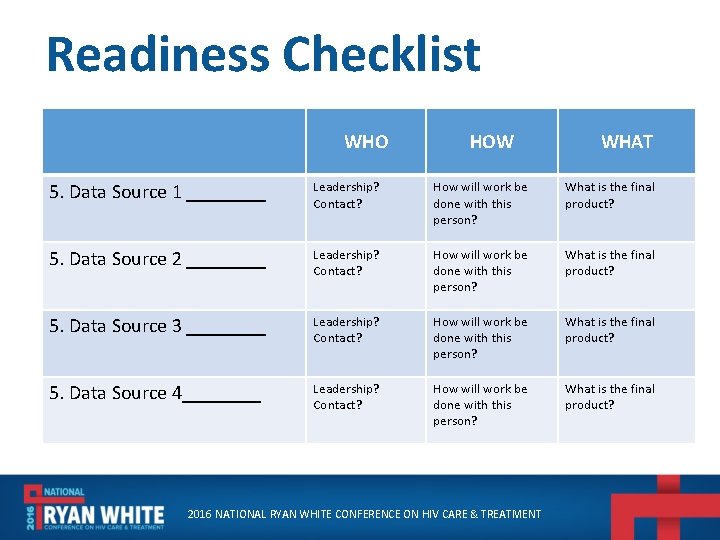
Readiness Checklist WHO HOW WHAT 5. Data Source 1 ____ Leadership? Contact? How will work be done with this person? What is the final product? 5. Data Source 2 ____ Leadership? Contact? How will work be done with this person? What is the final product? 5. Data Source 3 ____ Leadership? Contact? How will work be done with this person? What is the final product? 5. Data Source 4____ Leadership? Contact? How will work be done with this person? What is the final product? 2016 NATIONAL RYAN WHITE CONFERENCE ON HIV CARE & TREATMENT
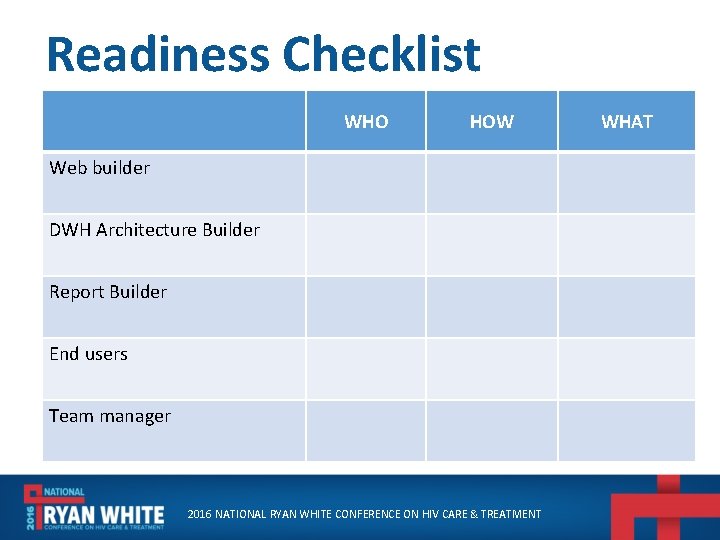
Readiness Checklist WHO HOW Web builder DWH Architecture Builder Report Builder End users Team manager 2016 NATIONAL RYAN WHITE CONFERENCE ON HIV CARE & TREATMENT WHAT
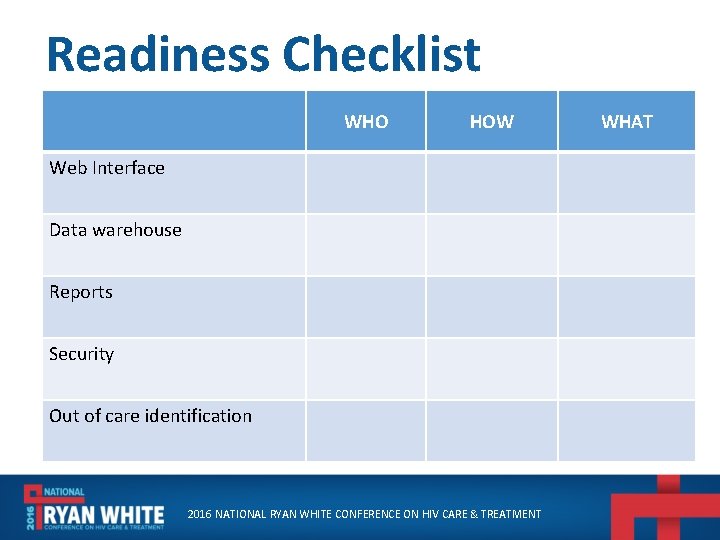
Readiness Checklist WHO HOW Web Interface Data warehouse Reports Security Out of care identification 2016 NATIONAL RYAN WHITE CONFERENCE ON HIV CARE & TREATMENT WHAT
Timeline Need (6 m) Stakeholders = 4 months Statement of Need = 1 m Hires/ Contracts, 6 m Concept (18 m) Source data assessments = 6 m Reports = 6 Concept Report = 6 m Hires/ Contacts /Reviews 9 m Planning with Build Team (4 m) Bring Build Team on Board 2 m Planning Series = 2 m 2016 NATIONAL RYAN WHITE CONFERENCE ON HIV CARE & TREATMENT
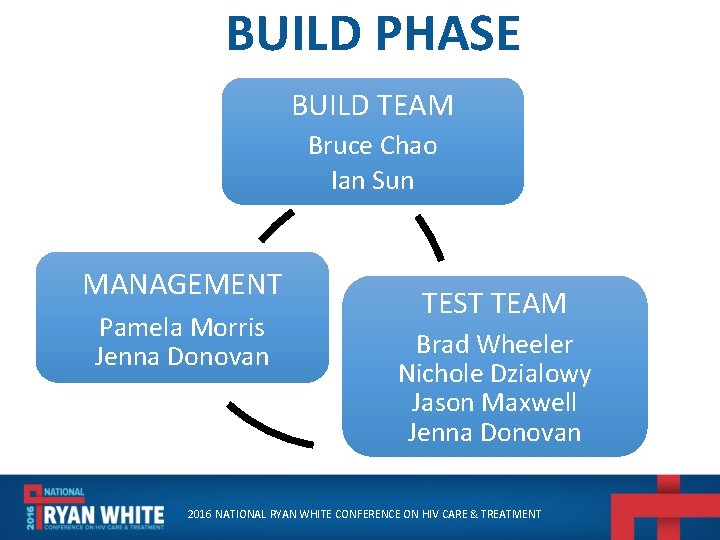
BUILD PHASE BUILD TEAM Bruce Chao Ian Sun MANAGEMENT Pamela Morris Jenna Donovan TEST TEAM Brad Wheeler Nichole Dzialowy Jason Maxwell Jenna Donovan 2016 NATIONAL RYAN WHITE CONFERENCE ON HIV CARE & TREATMENT
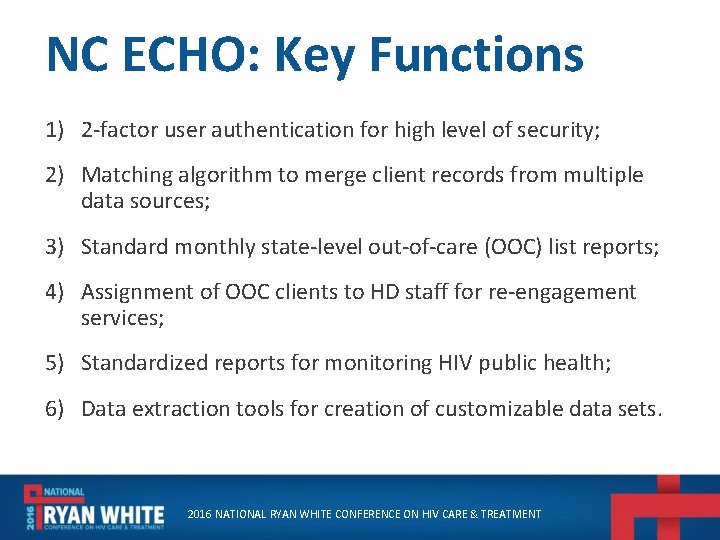
NC ECHO: Key Functions 1) 2 -factor user authentication for high level of security; 2) Matching algorithm to merge client records from multiple data sources; 3) Standard monthly state-level out-of-care (OOC) list reports; 4) Assignment of OOC clients to HD staff for re-engagement services; 5) Standardized reports for monitoring HIV public health; 6) Data extraction tools for creation of customizable data sets. 2016 NATIONAL RYAN WHITE CONFERENCE ON HIV CARE & TREATMENT
NC- ECHO Display 2016 NATIONAL RYAN WHITE CONFERENCE ON HIV CARE & TREATMENT
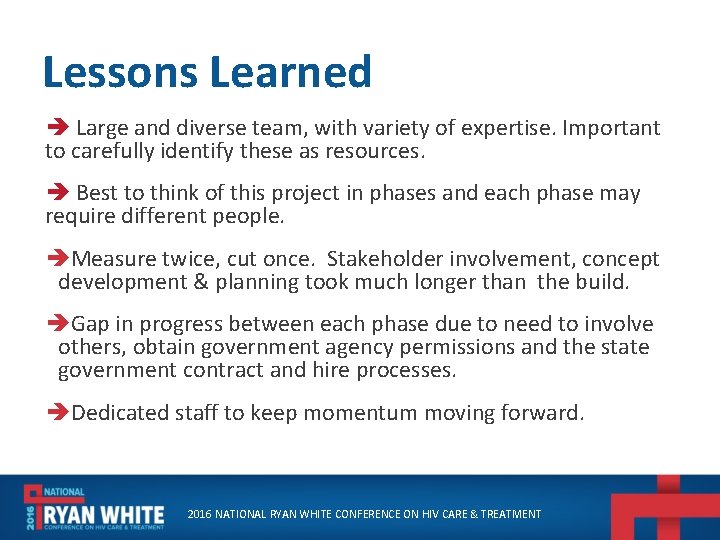
Lessons Learned Large and diverse team, with variety of expertise. Important to carefully identify these as resources. Best to think of this project in phases and each phase may require different people. Measure twice, cut once. Stakeholder involvement, concept development & planning took much longer than the build. Gap in progress between each phase due to need to involve others, obtain government agency permissions and the state government contract and hire processes. Dedicated staff to keep momentum moving forward. 2016 NATIONAL RYAN WHITE CONFERENCE ON HIV CARE & TREATMENT
Questions? 2016 NATIONAL RYAN WHITE CONFERENCE ON HIV CARE & TREATMENT