
Initiation and Propagation of MJO in a high
- Slides: 10
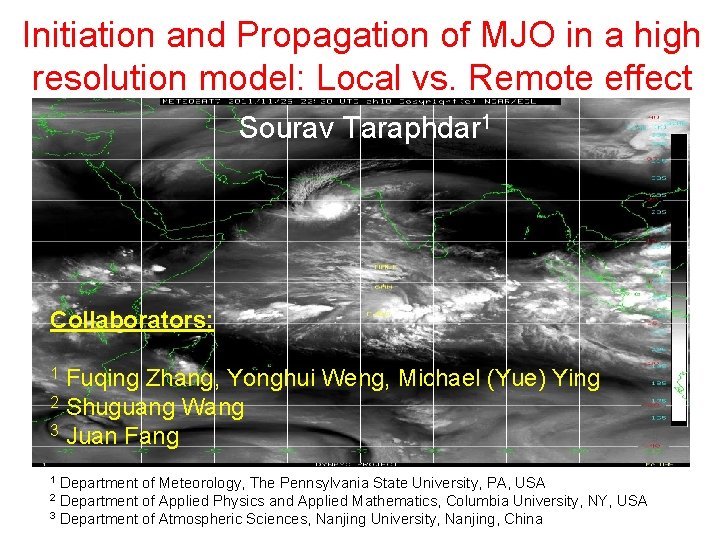
Initiation and Propagation of MJO in a high resolution model: Local vs. Remote effect Sourav Taraphdar 1 Collaborators: Fuqing Zhang, Yonghui Weng, Michael (Yue) Ying 2 Shuguang Wang 3 Juan Fang 1 Department of Meteorology, The Pennsylvania State University, PA, USA 2 Department of Applied Physics and Applied Mathematics, Columbia University, NY, USA 3 Department of Atmospheric Sciences, Nanjing University, Nanjing, China 1
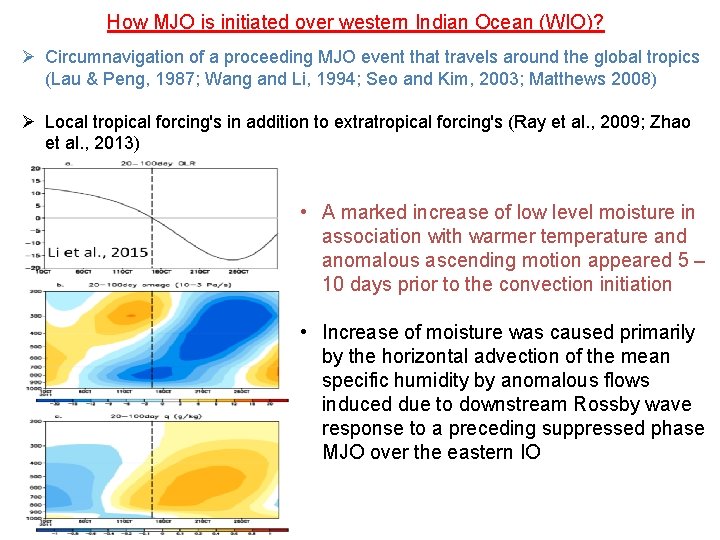
How MJO is initiated over western Indian Ocean (WIO)? Ø Circumnavigation of a proceeding MJO event that travels around the global tropics (Lau & Peng, 1987; Wang and Li, 1994; Seo and Kim, 2003; Matthews 2008) Ø Local tropical forcing's in addition to extratropical forcing's (Ray et al. , 2009; Zhao et al. , 2013) • A marked increase of low level moisture in association with warmer temperature and anomalous ascending motion appeared 5 – 10 days prior to the convection initiation • Increase of moisture was caused primarily by the horizontal advection of the mean specific humidity by anomalous flows induced due to downstream Rossby wave response to a preceding suppressed phase MJO over the eastern IO
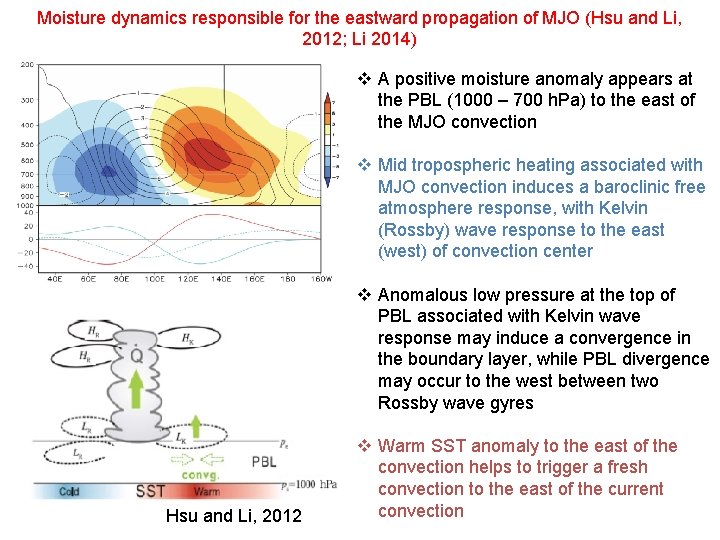
Moisture dynamics responsible for the eastward propagation of MJO (Hsu and Li, 2012; Li 2014) v A positive moisture anomaly appears at the PBL (1000 – 700 h. Pa) to the east of the MJO convection v Mid tropospheric heating associated with MJO convection induces a baroclinic free atmosphere response, with Kelvin (Rossby) wave response to the east (west) of convection center v Anomalous low pressure at the top of PBL associated with Kelvin wave response may induce a convergence in the boundary layer, while PBL divergence may occur to the west between two Rossby wave gyres Hsu and Li, 2012 v Warm SST anomaly to the east of the convection helps to trigger a fresh convection to the east of the current convection
q What primarily causes MJO initiation ? is it causes by local effects and/or circumnavigating signals (remote effects)? q What are the role of equatorial Rossby waves and Kelvin waves in preconditioning the IO for MJO propagation using high resolution model with waves separation techniques? v Control Simulation: WRF model at 9 km horizontal resolution following the experimental design of Wang et al. , (2015) v Experimental design: Identify the MJO signals into the forcing's data sets v Experiment 1: Removes MJO related signals only from initial condition v Experiment 2: Similar to “ 1” but removes MJO from boundary conditions v Experiment 3: Removes both from initial and boundary conditions Ø Events: Oct 2013 during DYNAMO/CINDY 2013 field campaign Ø ERA-Interim is adopted to construct initial, bottom and lateral boundary conditions for regional simulations Ø Model simulations start from 1 Oct 2013, with spectral nudging of horizontal winds for the first 3 days
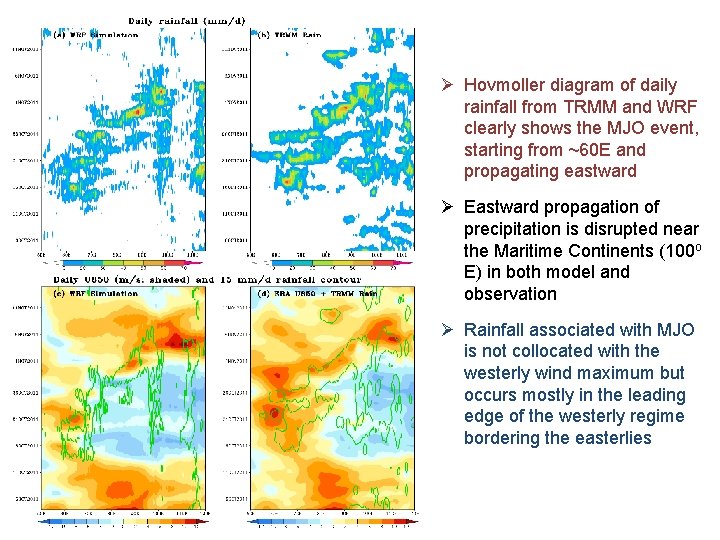
Ø Hovmoller diagram of daily rainfall from TRMM and WRF clearly shows the MJO event, starting from ~60 E and propagating eastward Ø Eastward propagation of precipitation is disrupted near the Maritime Continents (100 o E) in both model and observation Ø Rainfall associated with MJO is not collocated with the westerly wind maximum but occurs mostly in the leading edge of the westerly regime bordering the easterlies
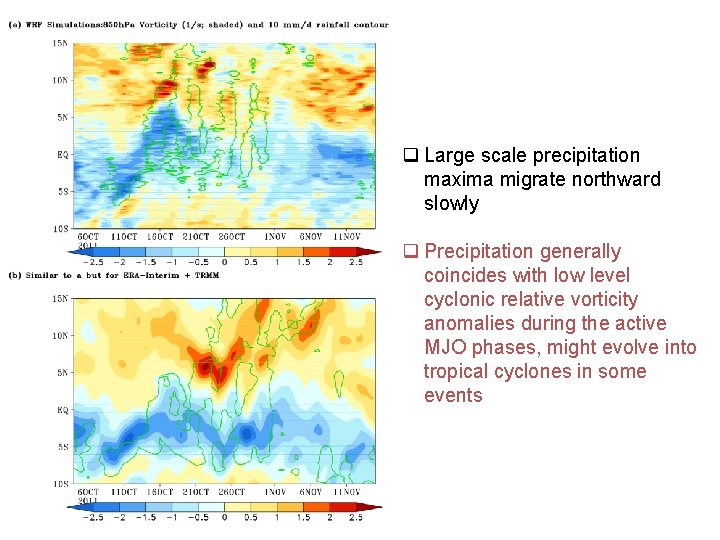
q Large scale precipitation maxima migrate northward slowly q Precipitation generally coincides with low level cyclonic relative vorticity anomalies during the active MJO phases, might evolve into tropical cyclones in some events
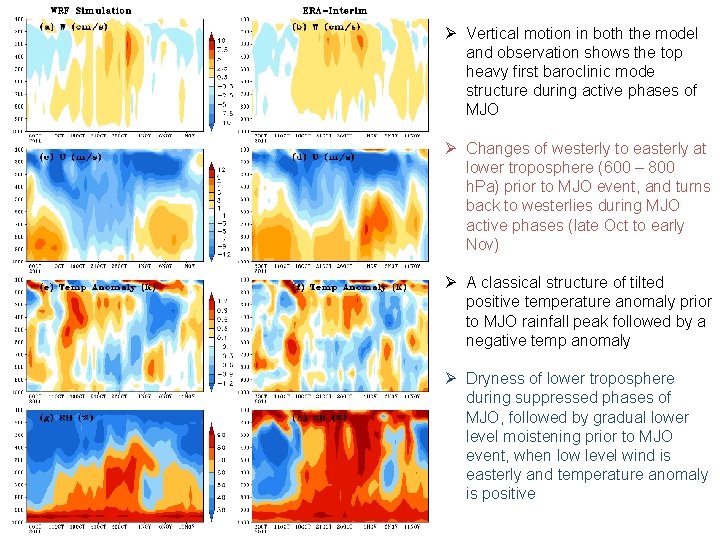
Ø Vertical motion in both the model and observation shows the top heavy first baroclinic mode structure during active phases of MJO Ø Changes of westerly to easterly at lower troposphere (600 – 800 h. Pa) prior to MJO event, and turns back to westerlies during MJO active phases (late Oct to early Nov) Ø A classical structure of tilted positive temperature anomaly prior to MJO rainfall peak followed by a negative temp anomaly Ø Dryness of lower troposphere during suppressed phases of MJO, followed by gradual lower level moistening prior to MJO event, when low level wind is easterly and temperature anomaly is positive
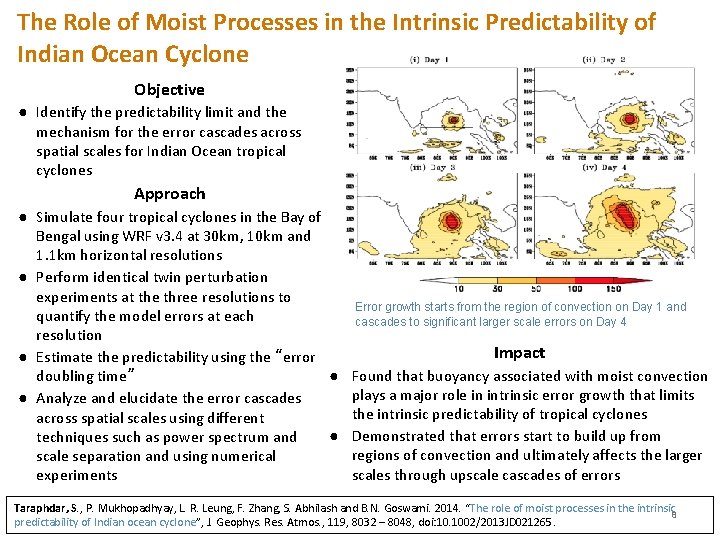
The Role of Moist Processes in the Intrinsic Predictability of Indian Ocean Cyclone Objective ● Identify the predictability limit and the mechanism for the error cascades across spatial scales for Indian Ocean tropical cyclones Approach ● Simulate four tropical cyclones in the Bay of Bengal using WRF v 3. 4 at 30 km, 10 km and 1. 1 km horizontal resolutions ● Perform identical twin perturbation experiments at the three resolutions to Error growth starts from the region of convection on Day 1 and quantify the model errors at each cascades to significant larger scale errors on Day 4 resolution Impact ● Estimate the predictability using the “error ● Found that buoyancy associated with moist convection doubling time” plays a major role in intrinsic error growth that limits ● Analyze and elucidate the error cascades the intrinsic predictability of tropical cyclones across spatial scales using different ● Demonstrated that errors start to build up from techniques such as power spectrum and regions of convection and ultimately affects the larger scale separation and using numerical scales through upscale cascades of errors experiments Taraphdar, S. , P. Mukhopadhyay, L. R. Leung, F. Zhang, S. Abhilash and B. N. Goswami. 2014. “The role of moist processes in the intrinsic 8 predictability of Indian ocean cyclone”, J. Geophys. Res. Atmos. , 119, 8032 – 8048, doi: 10. 1002/2013 JD 021265.
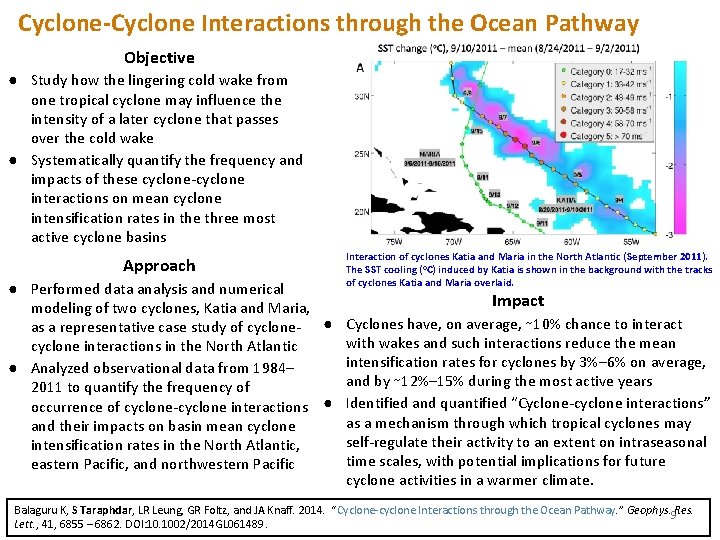
Cyclone-Cyclone Interactions through the Ocean Pathway Objective ● Study how the lingering cold wake from one tropical cyclone may influence the intensity of a later cyclone that passes over the cold wake ● Systematically quantify the frequency and impacts of these cyclone-cyclone interactions on mean cyclone intensification rates in the three most active cyclone basins Approach Interaction of cyclones Katia and Maria in the North Atlantic (September 2011). The SST cooling (o. C) induced by Katia is shown in the background with the tracks of cyclones Katia and Maria overlaid. ● Performed data analysis and numerical Impact modeling of two cyclones, Katia and Maria, as a representative case study of cyclone- ● Cyclones have, on average, ∼ 10% chance to interact with wakes and such interactions reduce the mean cyclone interactions in the North Atlantic intensification rates for cyclones by 3%– 6% on average, ● Analyzed observational data from 1984– and by ∼ 12%– 15% during the most active years 2011 to quantify the frequency of occurrence of cyclone-cyclone interactions ● Identified and quantified “Cyclone-cyclone interactions” as a mechanism through which tropical cyclones may and their impacts on basin mean cyclone self-regulate their activity to an extent on intraseasonal intensification rates in the North Atlantic, time scales, with potential implications for future eastern Pacific, and northwestern Pacific cyclone activities in a warmer climate. Balaguru K, S Taraphdar, LR Leung, GR Foltz, and JA Knaff. 2014. “Cyclone-cyclone Interactions through the Ocean Pathway. ” Geophys. 9 Res. Lett. , 41, 6855 – 6862. DOI: 10. 1002/2014 GL 061489.
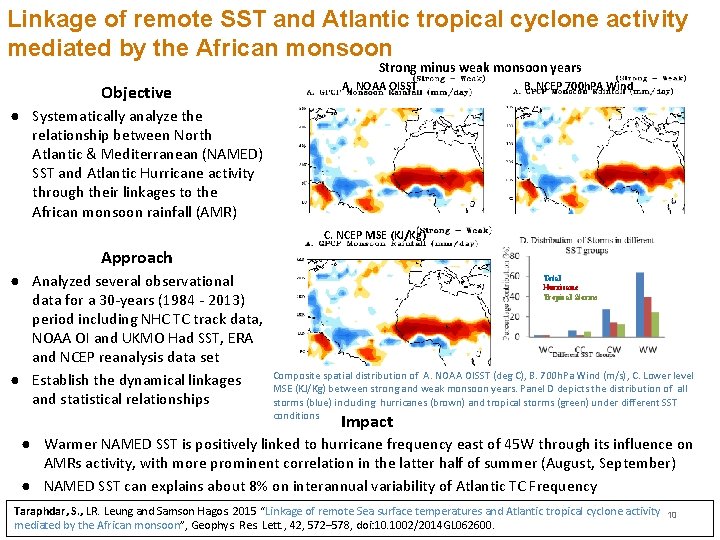
Linkage of remote SST and Atlantic tropical cyclone activity mediated by the African monsoon Strong minus weak monsoon years Objective A. NOAA OISST B. NCEP 700 h. PA Wind ● Systematically analyze the relationship between North Atlantic & Mediterranean (NAMED) SST and Atlantic Hurricane activity through their linkages to the African monsoon rainfall (AMR) C. NCEP MSE (KJ/Kg) Approach ● Analyzed several observational data for a 30 -years (1984 - 2013) period including NHC TC track data, NOAA OI and UKMO Had SST, ERA and NCEP reanalysis data set ● Establish the dynamical linkages and statistical relationships Total Hurricane Tropical Storms Composite spatial distribution of A. NOAA OISST (deg C), B. 700 h. Pa Wind (m/s), C. Lower level MSE (KJ/Kg) between strong and weak monsoon years. Panel D depicts the distribution of all storms (blue) including hurricanes (brown) and tropical storms (green) under different SST conditions Impact ● Warmer NAMED SST is positively linked to hurricane frequency east of 45 W through its influence on AMRs activity, with more prominent correlation in the latter half of summer (August, September) ● NAMED SST can explains about 8% on interannual variability of Atlantic TC Frequency Taraphdar, S. , LR. Leung and Samson Hagos. 2015 “Linkage of remote Sea surface temperatures and Atlantic tropical cyclone activity mediated by the African monsoon”, Geophys. Res. Lett. , 42, 572– 578, doi: 10. 1002/2014 GL 062600. 10