
Initial Network Monitoring for LHCONE Shawn Mc KeeUniversity
- Slides: 12
Initial Network Monitoring for LHCONE Shawn Mc. Kee/University of Michigan LHCOPN/LHCONE Meeting - Berkeley January 31 st, 2012
Monitoring LHCONE: Goals/Purpose T We need to understand how a transition to LHCONE will impact our infrastructure. T First step: get monitoring in place to create a baseline of the current situation T Second step: as sites transition to using LHCONE, characterize the impact based upon measurements T To gather the before/after measurements for LHCONE we chose the perf. SONAR-PS toolkit: already demonstrated in USATLAS and the capabilities of the modular dashboard. T perf. SONAR’s main purpose is to aid in network diagnosis by quickly allowing users to isolate the location of problems. In addition it can provide a standard measurement of various network performance related metrics over time as well as “on-demand” tests. LHCOPN/LHCONE 2/11/2022 2
Summary for LHCONE T As noted, our specific goal in setting up perf. SONAR-PS for LHCONE is to acquire before and after network measurements for the selected early adopter sites. This is not the long-term network monitoring setup for LHCONE…that is TBD (being discussed at this meeting) T Details of which sites and how sites should setup the perf. SONAR-PS installations is documented on the Twiki at: https: //twiki. cern. ch/twiki/bin/view/LHCONE/Site. List T Sites should carefully review the info on the Twiki! T In the next few slides I will highlight some of the relevant details LHCOPN/LHCONE 2/11/2022 3
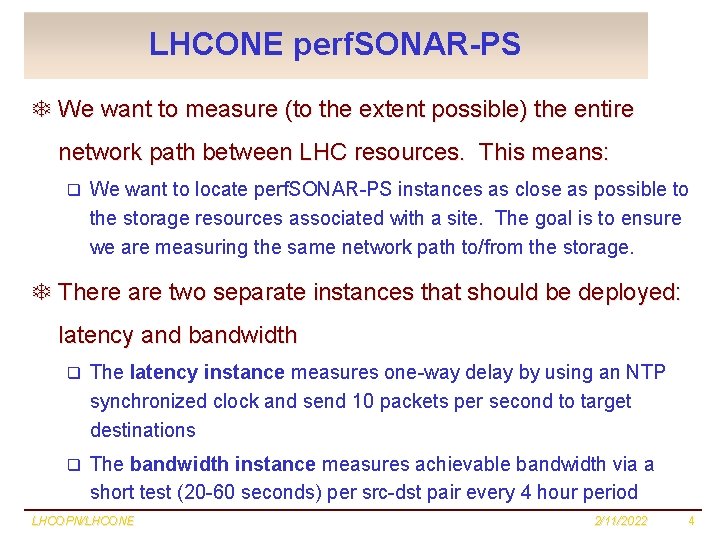
LHCONE perf. SONAR-PS T We want to measure (to the extent possible) the entire network path between LHC resources. This means: q We want to locate perf. SONAR-PS instances as close as possible to the storage resources associated with a site. The goal is to ensure we are measuring the same network path to/from the storage. T There are two separate instances that should be deployed: latency and bandwidth q The latency instance measures one-way delay by using an NTP synchronized clock and send 10 packets per second to target destinations q The bandwidth instance measures achievable bandwidth via a short test (20 -60 seconds) per src-dst pair every 4 hour period LHCOPN/LHCONE 2/11/2022 4
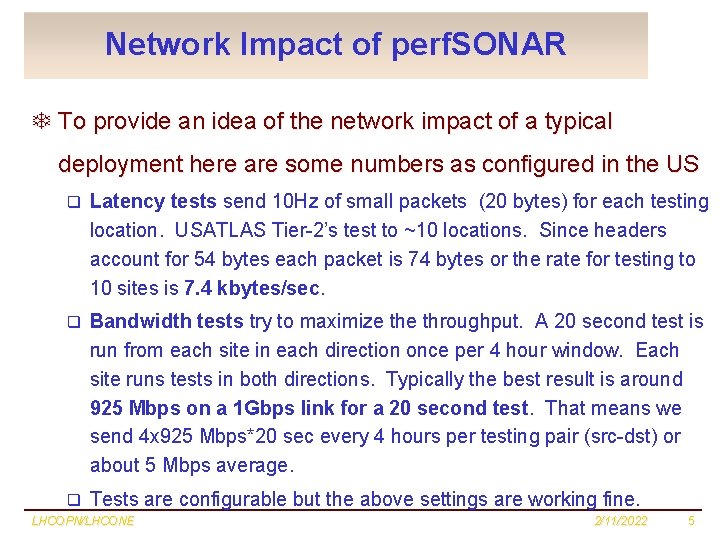
Network Impact of perf. SONAR T To provide an idea of the network impact of a typical deployment here are some numbers as configured in the US q Latency tests send 10 Hz of small packets (20 bytes) for each testing location. USATLAS Tier-2’s test to ~10 locations. Since headers account for 54 bytes each packet is 74 bytes or the rate for testing to 10 sites is 7. 4 kbytes/sec. q Bandwidth tests try to maximize throughput. A 20 second test is run from each site in each direction once per 4 hour window. Each site runs tests in both directions. Typically the best result is around 925 Mbps on a 1 Gbps link for a 20 second test. That means we send 4 x 925 Mbps*20 sec every 4 hours per testing pair (src-dst) or about 5 Mbps average. q Tests are configurable but the above settings are working fine. LHCOPN/LHCONE 2/11/2022 5
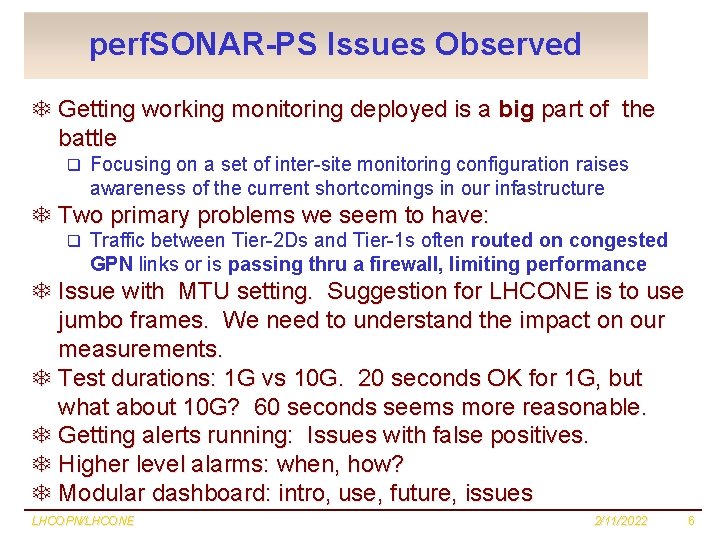
perf. SONAR-PS Issues Observed T Getting working monitoring deployed is a big part of the battle q Focusing on a set of inter-site monitoring configuration raises awareness of the current shortcomings in our infastructure T Two primary problems we seem to have: q Traffic between Tier-2 Ds and Tier-1 s often routed on congested GPN links or is passing thru a firewall, limiting performance T Issue with MTU setting. Suggestion for LHCONE is to use jumbo frames. We need to understand the impact on our measurements. T Test durations: 1 G vs 10 G. 20 seconds OK for 1 G, but what about 10 G? 60 seconds seems more reasonable. T Getting alerts running: Issues with false positives. T Higher level alarms: when, how? T Modular dashboard: intro, use, future, issues LHCOPN/LHCONE 2/11/2022 6
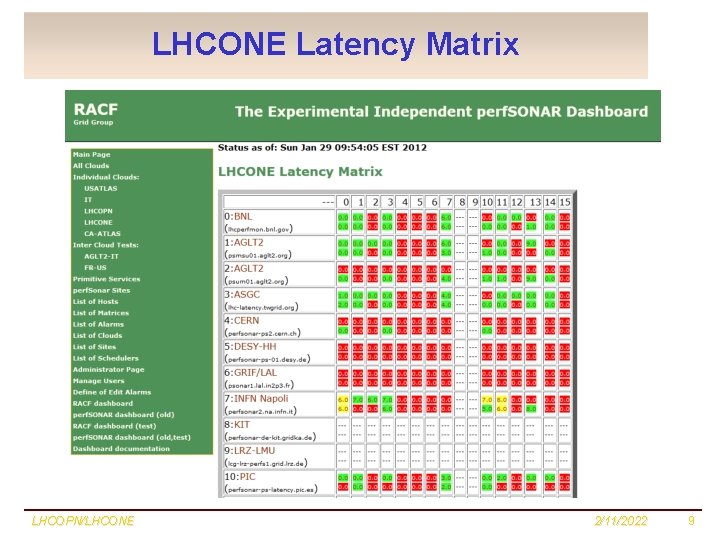
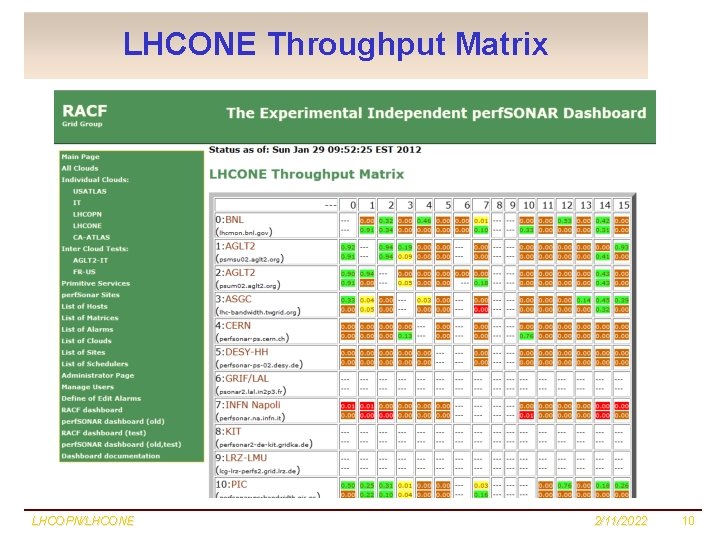
Modular Dashboard T Thanks to Tom Wlodek’s work on developing a “modular dashboard” we have a very nice way to summarize the extensive information being collected for the near-term LHCONE network characterization. T The dashboard provides a highly configurable interface to monitor a set of perf. SONAR-PS instances via simple plugin test modules. Users can be authorized based upon their grid credentials. Sites, clouds, services, tests, alarms and hosts can be quickly added and controlled. LHCOPN/LHCONE 2/11/2022 7
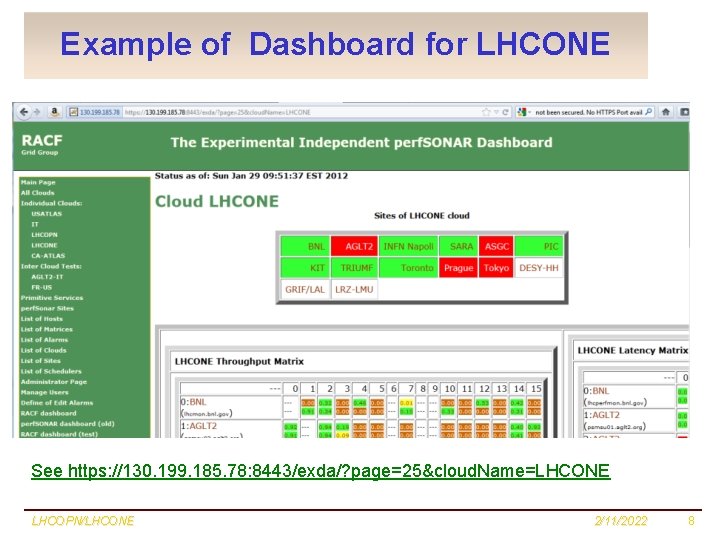
Example of Dashboard for LHCONE See https: //130. 199. 185. 78: 8443/exda/? page=25&cloud. Name=LHCONE LHCOPN/LHCONE 2/11/2022 8
LHCONE Latency Matrix LHCOPN/LHCONE 2/11/2022 9
LHCONE Throughput Matrix LHCOPN/LHCONE 2/11/2022 10
Using the Dashboard T The dashboard is very useful for all of us to use to get a quick picture of the status for a particular grouping (cloud) T It is also very useful for sites to debug their configurations! T Note that you can quickly drill down and get error details as well as history plots or tables. T I strongly wish to encourage all the early adopter sites targeted for LHCONE to use the dashboard to check status https: //130. 199. 185. 78: 8443/exda/? page=25&cloud. Name=LHCONE (quick demo of what you can do) LHCOPN/LHCONE 2/11/2022 11
Discussion/Questions T Any questions about this presentation? T Next up: some slides from Jason, John and me, intended to seed discussion on monitoring. On to the next set of slides… LHCOPN/LHCONE 2/11/2022 12