
INITIAL EMERGENCY RESPONSE KEY QUESTIONS n What do
- Slides: 5
INITIAL EMERGENCY RESPONSE KEY QUESTIONS n What do I do? n What do I look out for? n Who do I save? n What about me?
TRIAGE What is it? n n The process of prioritising injured people according to need and likely benefit from medical care. If many people are injured at an accident scene…who do I treat first? ? ? n n Treat the victim that has the most life threatening situation first. How do I work out whose life is most at threat? n n Look for the quiet person – eg. those that don’t have signs of life or aren’t breathing. Followed by injuries involving blood loss, burns, poisons and breaks.
AGRESSION or DISTRESS ( The uncooperative injured person) n n Some injured people are uncooperative, upset and angry To reduce these feelings, it is important to stay calm, tell the truth and talk through what is going on. Do you have any other ideas? If someone refuses help and clearly says ‘NO’…. do not touch them but find other methods of helping them.
INFECTION CONTROL It is vital that you protect yourself from body fluid contact…( body fluid includes blood, saliva, vomit etc ) n There are diseases that can be caught from body fluid contact. n
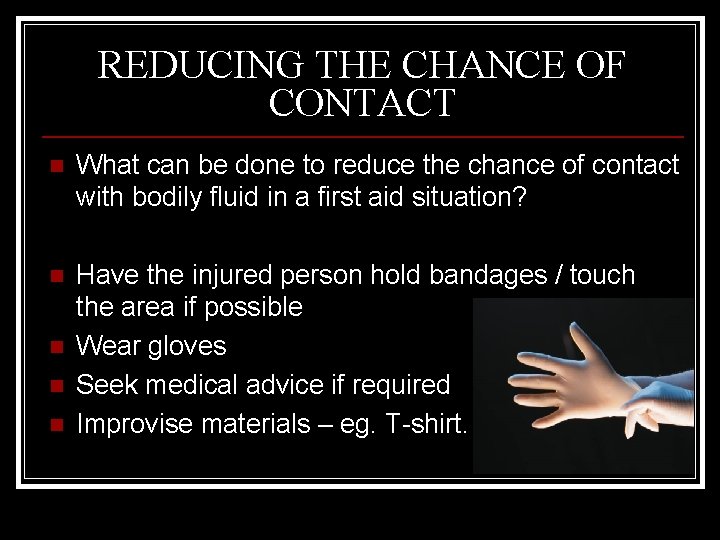
REDUCING THE CHANCE OF CONTACT n What can be done to reduce the chance of contact with bodily fluid in a first aid situation? n Have the injured person hold bandages / touch the area if possible Wear gloves Seek medical advice if required Improvise materials – eg. T-shirt. n n n