
Initial Design of Entity Types EMPLOYEE DEPARTMENT PROJECT
- Slides: 20
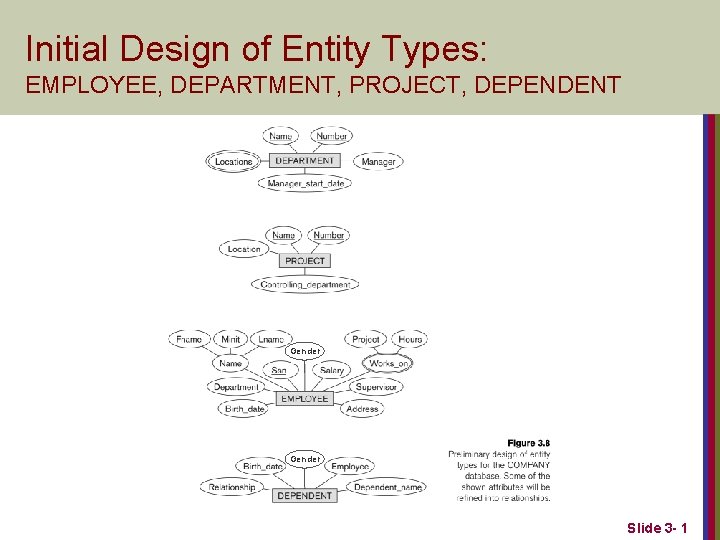
Initial Design of Entity Types: EMPLOYEE, DEPARTMENT, PROJECT, DEPENDENT Gender Slide 3 - 1
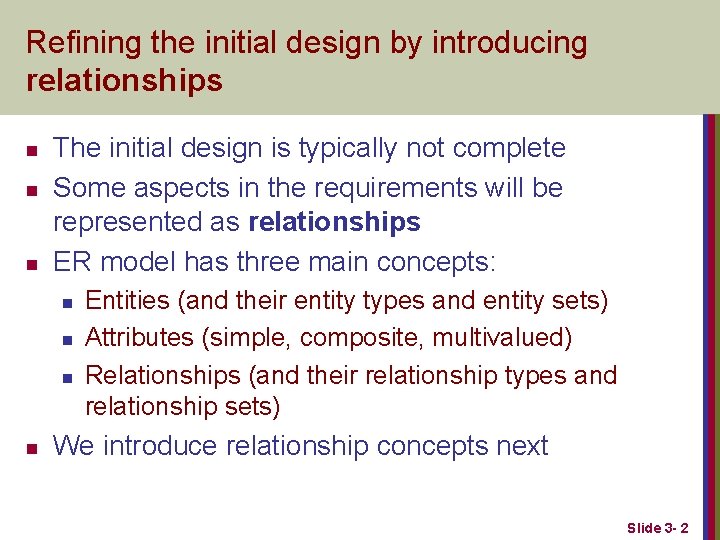
Refining the initial design by introducing relationships n n n The initial design is typically not complete Some aspects in the requirements will be represented as relationships ER model has three main concepts: n n Entities (and their entity types and entity sets) Attributes (simple, composite, multivalued) Relationships (and their relationship types and relationship sets) We introduce relationship concepts next Slide 3 - 2
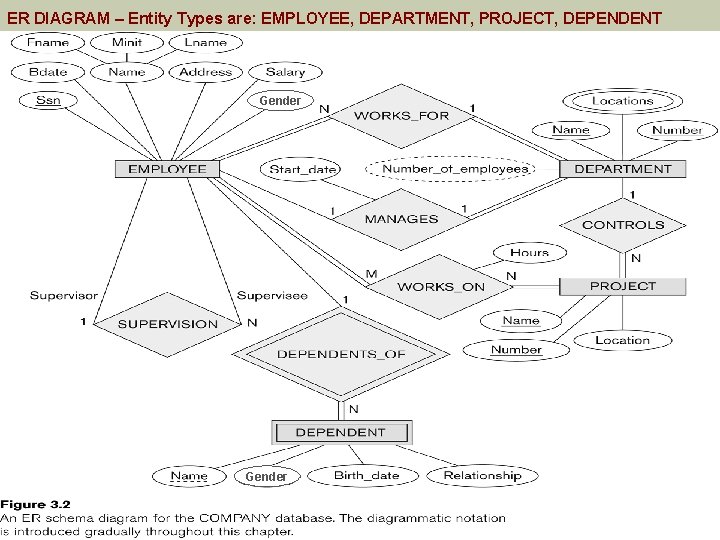
ER DIAGRAM – Entity Types are: EMPLOYEE, DEPARTMENT, PROJECT, DEPENDENT Gender Slide 3 - 3
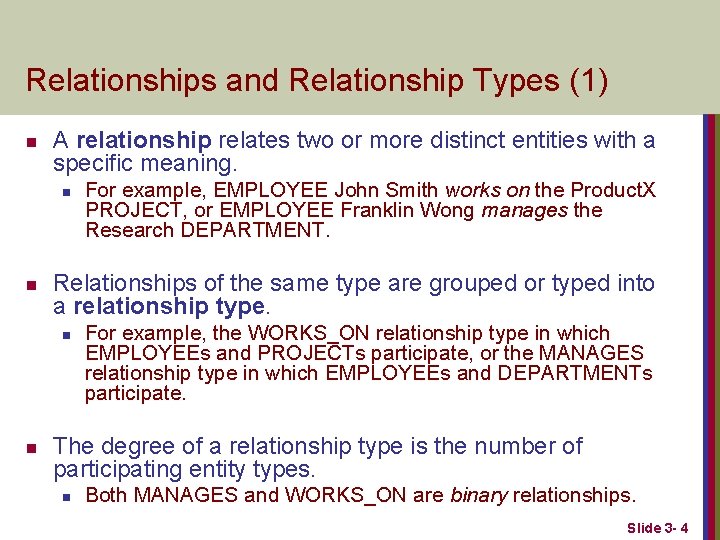
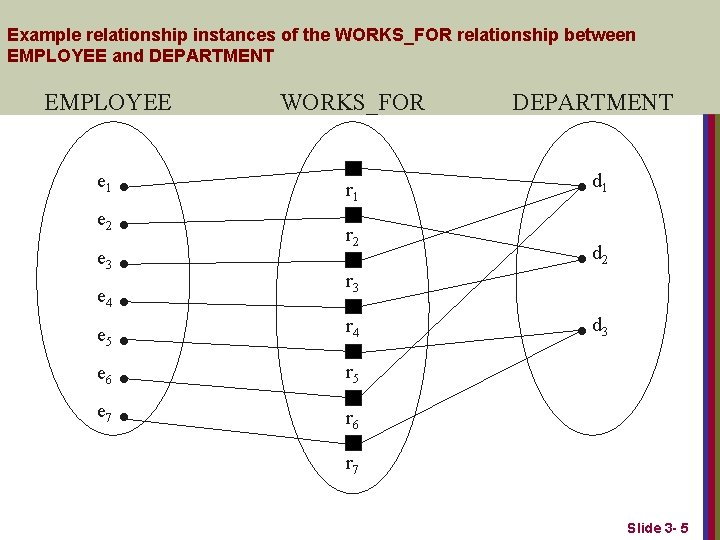
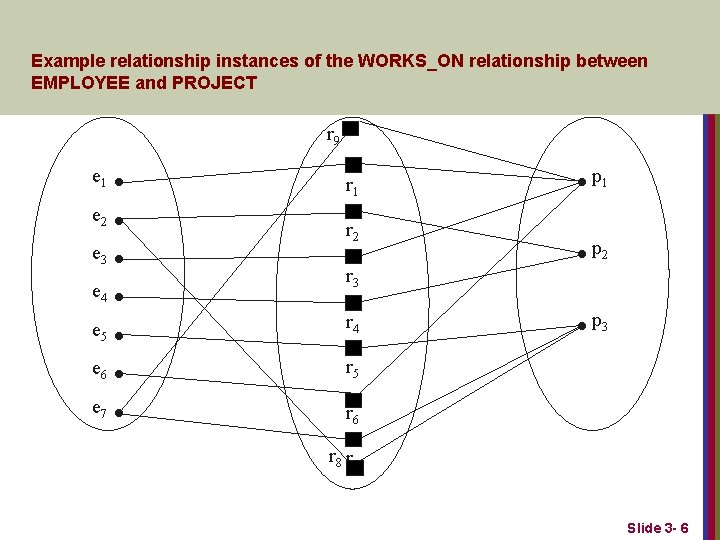
Relationships and Relationship Types (1) n A relationship relates two or more distinct entities with a specific meaning. n n Relationships of the same type are grouped or typed into a relationship type. n n For example, EMPLOYEE John Smith works on the Product. X PROJECT, or EMPLOYEE Franklin Wong manages the Research DEPARTMENT. For example, the WORKS_ON relationship type in which EMPLOYEEs and PROJECTs participate, or the MANAGES relationship type in which EMPLOYEEs and DEPARTMENTs participate. The degree of a relationship type is the number of participating entity types. n Both MANAGES and WORKS_ON are binary relationships. Slide 3 - 4
Example relationship instances of the WORKS_FOR relationship between EMPLOYEE and DEPARTMENT EMPLOYEE WORKS_FOR e 1 r 1 e 2 e 3 r 2 e 4 DEPARTMENT d 1 d 2 d 3 r 4 e 5 e 6 r 5 e 7 r 6 r 7 Slide 3 - 5
Example relationship instances of the WORKS_ON relationship between EMPLOYEE and PROJECT r 9 e 1 r 1 e 2 e 3 r 2 e 4 p 1 p 2 p 3 r 4 e 5 e 6 r 5 e 7 r 6 r 8 r 7 Slide 3 - 6
Relationships and Relationship Types (2) n More than one relationship type can exist with the same participating entity types. n For example, MANAGES and WORKS_FOR are distinct relationships between EMPLOYEE and DEPARTMENT, but with different meanings and different relationship instances. Slide 3 - 7
Weak Entity Types n n An entity that does not have a key attribute A weak entity must participate in an identifying relationship type with an owner or identifying entity type Entities are identified by the combination of: n A partial key of the weak entity type n The particular entity they are related to in the identifying entity type Example: n A DEPENDENT entity is identified by the dependent’s first name, and the specific EMPLOYEE with whom the dependent is related n Name of DEPENDENT is the partial key n DEPENDENT is a weak entity type n EMPLOYEE is its identifying entity type via the identifying relationship type DEPENDENT_OF Slide 3 - 8
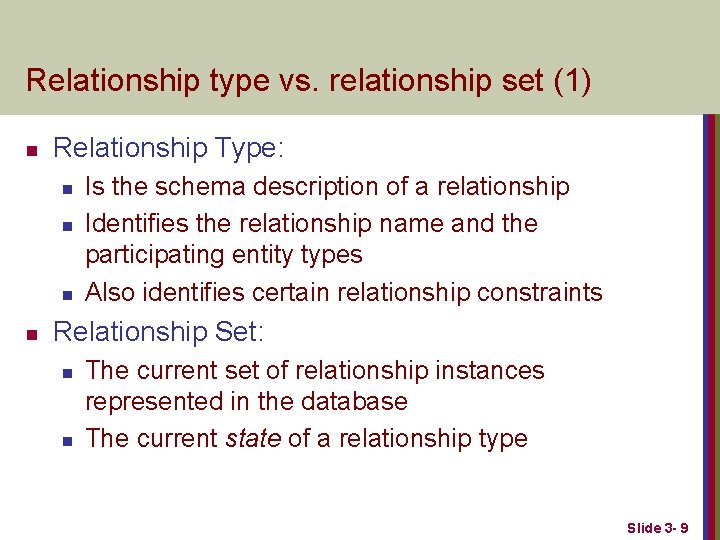
Relationship type vs. relationship set (1) n Relationship Type: n n Is the schema description of a relationship Identifies the relationship name and the participating entity types Also identifies certain relationship constraints Relationship Set: n n The current set of relationship instances represented in the database The current state of a relationship type Slide 3 - 9
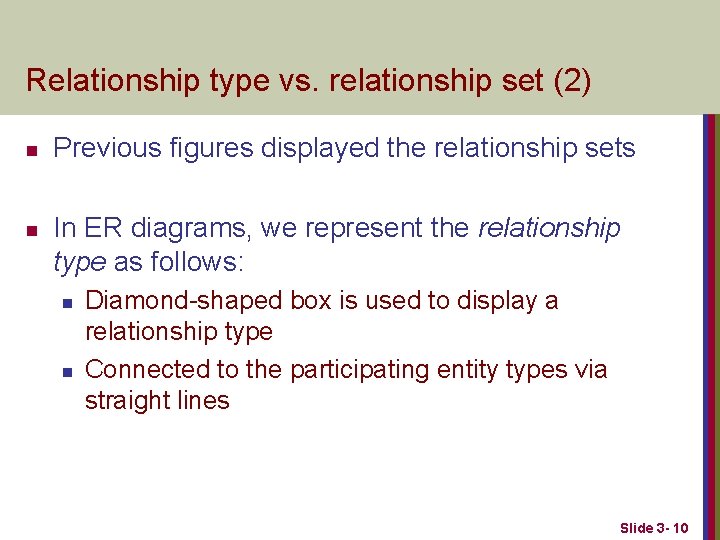
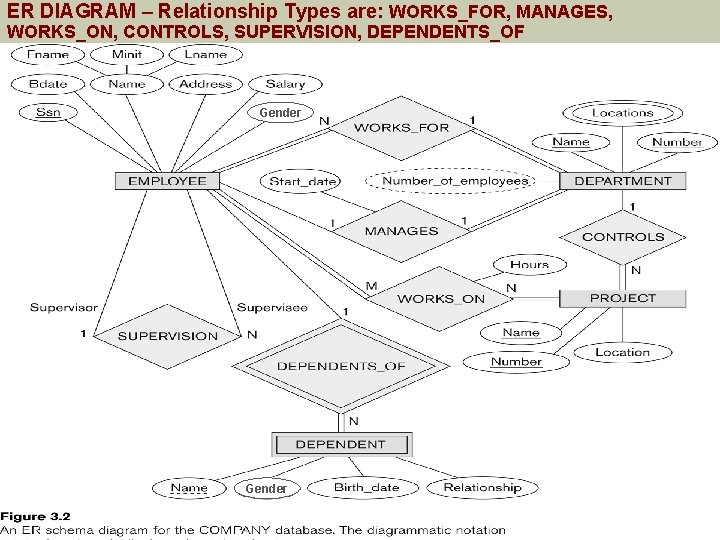
Relationship type vs. relationship set (2) n n Previous figures displayed the relationship sets In ER diagrams, we represent the relationship type as follows: n n Diamond-shaped box is used to display a relationship type Connected to the participating entity types via straight lines Slide 3 - 10
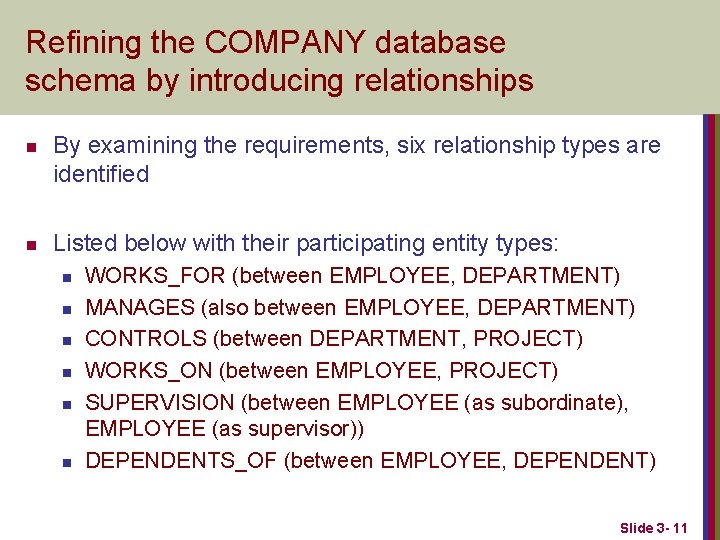
Refining the COMPANY database schema by introducing relationships n n By examining the requirements, six relationship types are identified Listed below with their participating entity types: n n n WORKS_FOR (between EMPLOYEE, DEPARTMENT) MANAGES (also between EMPLOYEE, DEPARTMENT) CONTROLS (between DEPARTMENT, PROJECT) WORKS_ON (between EMPLOYEE, PROJECT) SUPERVISION (between EMPLOYEE (as subordinate), EMPLOYEE (as supervisor)) DEPENDENTS_OF (between EMPLOYEE, DEPENDENT) Slide 3 - 11
ER DIAGRAM – Relationship Types are: WORKS_FOR, MANAGES, WORKS_ON, CONTROLS, SUPERVISION, DEPENDENTS_OF Gender Slide 3 - 12
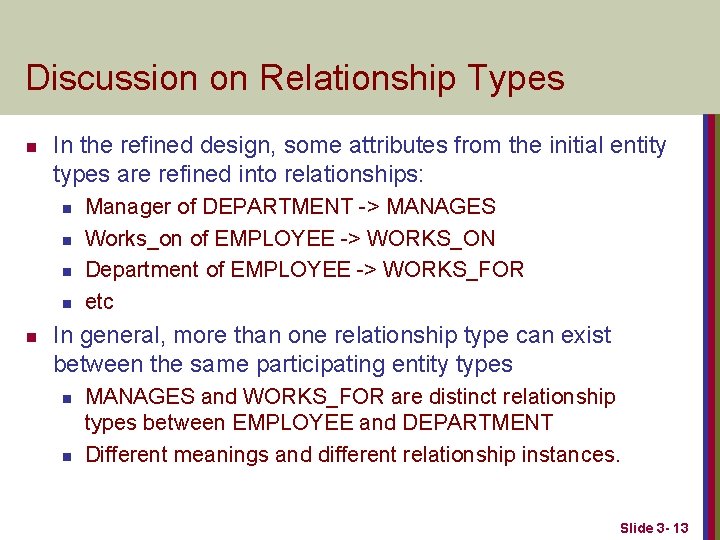
Discussion on Relationship Types n In the refined design, some attributes from the initial entity types are refined into relationships: n n n Manager of DEPARTMENT -> MANAGES Works_on of EMPLOYEE -> WORKS_ON Department of EMPLOYEE -> WORKS_FOR etc In general, more than one relationship type can exist between the same participating entity types n n MANAGES and WORKS_FOR are distinct relationship types between EMPLOYEE and DEPARTMENT Different meanings and different relationship instances. Slide 3 - 13
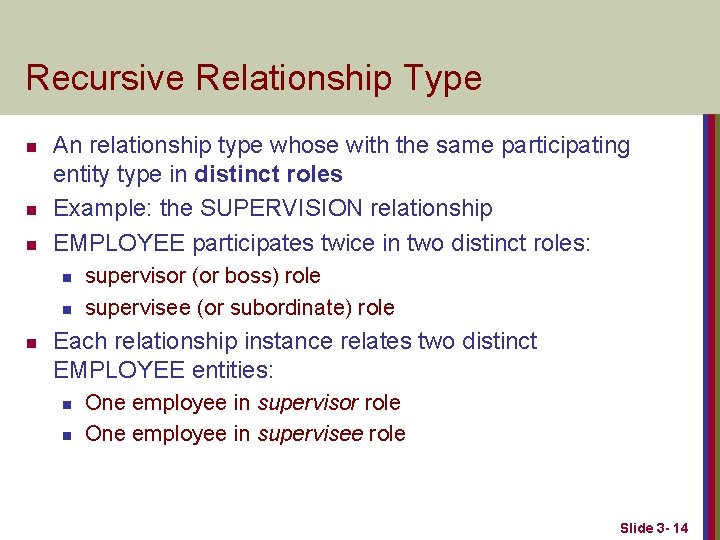
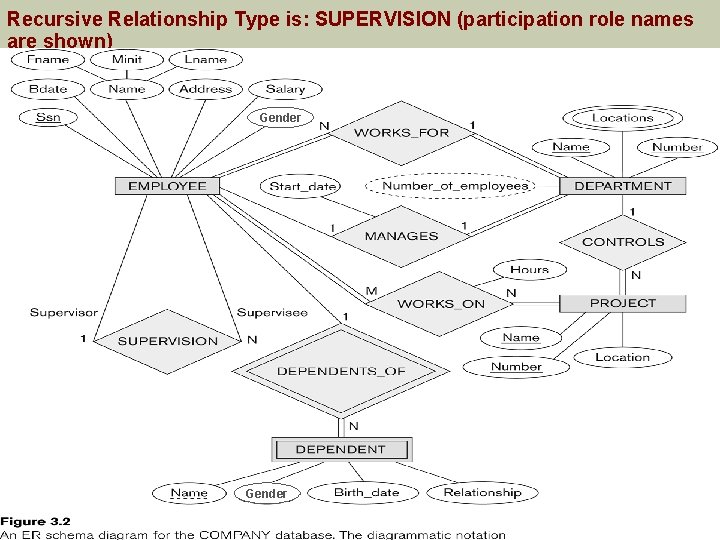
Recursive Relationship Type n n n An relationship type whose with the same participating entity type in distinct roles Example: the SUPERVISION relationship EMPLOYEE participates twice in two distinct roles: n n n supervisor (or boss) role supervisee (or subordinate) role Each relationship instance relates two distinct EMPLOYEE entities: n n One employee in supervisor role One employee in supervisee role Slide 3 - 14
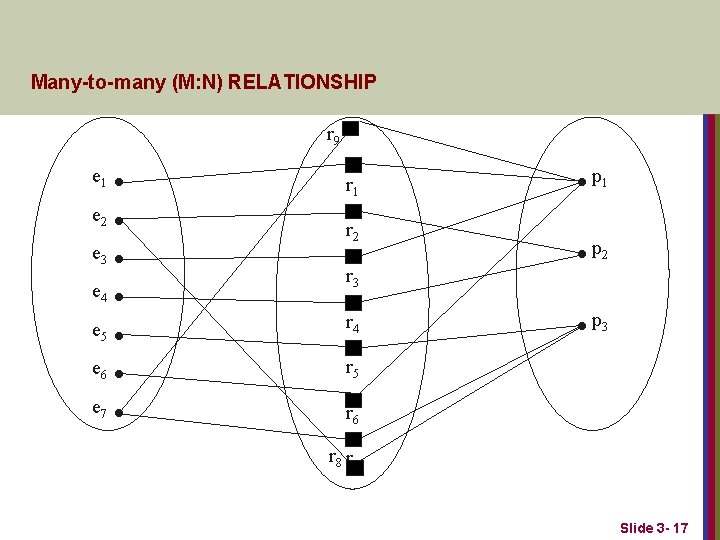
Constraints on Relationships n Constraints on Relationship Types n n (Also known as ratio constraints) Cardinality Ratio (specifies maximum participation) n n n One-to-one (1: 1) One-to-many (1: N) or Many-to-one (N: 1) Many-to-many (M: N) Slide 3 - 15
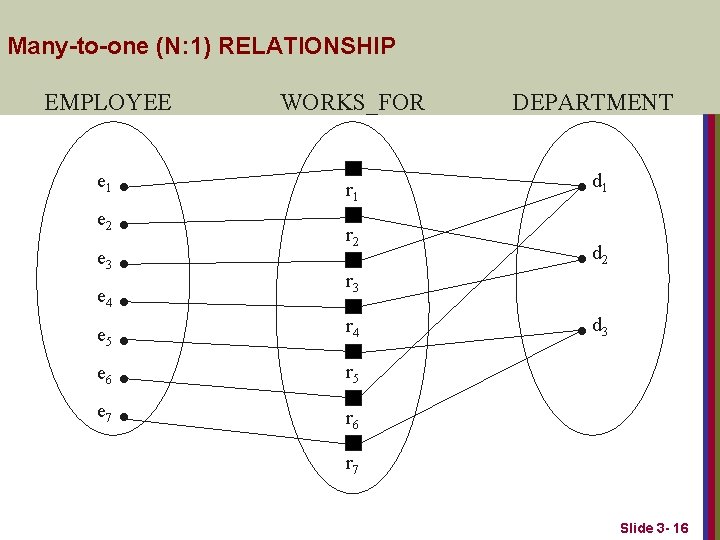
Many-to-one (N: 1) RELATIONSHIP EMPLOYEE WORKS_FOR e 1 r 1 e 2 e 3 r 2 e 4 DEPARTMENT d 1 d 2 d 3 r 4 e 5 e 6 r 5 e 7 r 6 r 7 Slide 3 - 16
Many-to-many (M: N) RELATIONSHIP r 9 e 1 r 1 e 2 e 3 r 2 e 4 p 1 p 2 p 3 r 4 e 5 e 6 r 5 e 7 r 6 r 8 r 7 Slide 3 - 17
Recursive Relationship Type is: SUPERVISION (participation role names are shown) Gender Slide 3 - 18
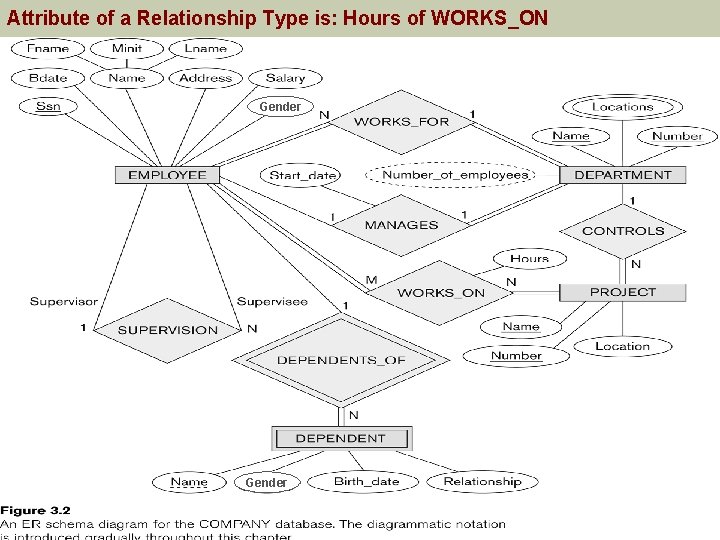
Attributes of Relationship types n A relationship type can have attributes: n n For example, Hours. Per. Week of WORKS_ON Its value for each relationship instance describes the number of hours per week that an EMPLOYEE works on a PROJECT. n n A value of Hours. Per. Week depends on a particular (employee, project) combination Most relationship attributes are used with M: N relationships n In 1: N relationships, they can be transferred to the entity type on the N-side of the relationship Slide 3 - 19
Attribute of a Relationship Type is: Hours of WORKS_ON Gender Slide 3 - 20