
Initial Con Ex Deployment Examples draftbriscoeconexinitialdeploy02 txt Bob
Initial Con. Ex Deployment Examples draft-briscoe-conex-initial-deploy-02. txt Bob Briscoe, BT Dirk Kutscher, NEC IETF-83 Con. Ex Mar 2012
draft status • individual draft • draft-briscoe-conex-initial-deploy-02. txt • work in progress • intended status: informational • new co-author, Dirk Kutscher • immediate intent: • WG feedback on scenarios • adopt as WG item?
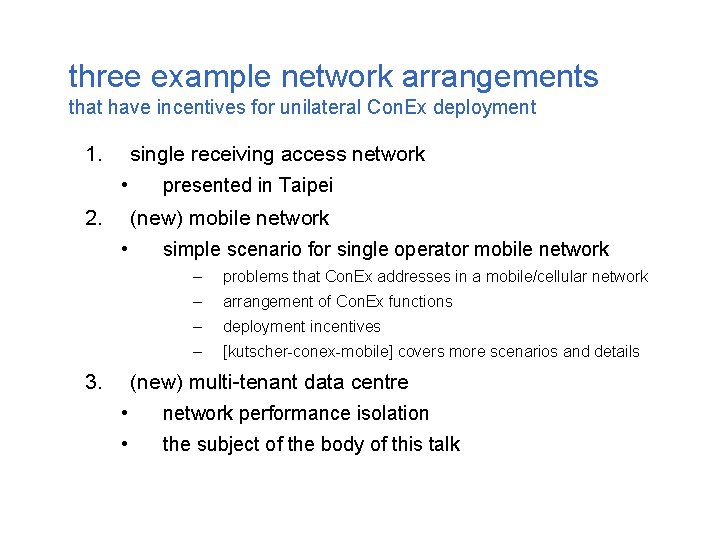
three example network arrangements that have incentives for unilateral Con. Ex deployment 1. single receiving access network • presented in Taipei 2. (new) mobile network • simple scenario for single operator mobile network 3. – problems that Con. Ex addresses in a mobile/cellular network – arrangement of Con. Ex functions – deployment incentives – [kutscher-conex-mobile] covers more scenarios and details (new) multi-tenant data centre • network performance isolation • the subject of the body of this talk
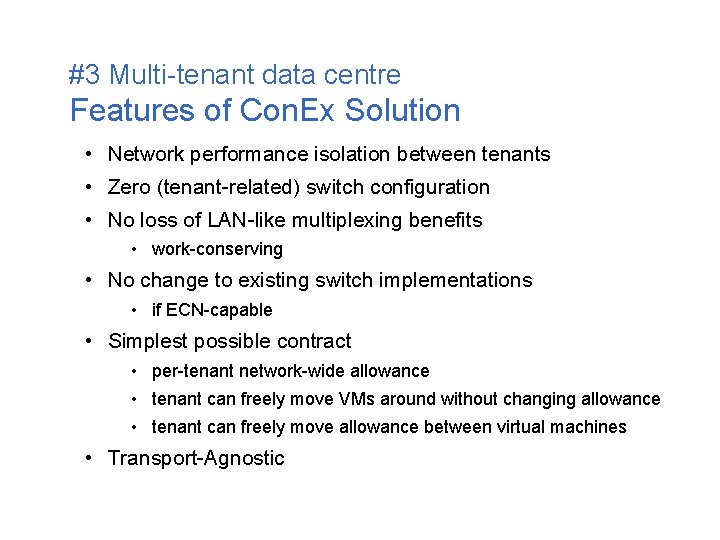
#3 Multi-tenant data centre Features of Con. Ex Solution • Network performance isolation between tenants • Zero (tenant-related) switch configuration • No loss of LAN-like multiplexing benefits • work-conserving • No change to existing switch implementations • if ECN-capable • Simplest possible contract • per-tenant network-wide allowance • tenant can freely move VMs around without changing allowance • tenant can freely move allowance between virtual machines • Transport-Agnostic
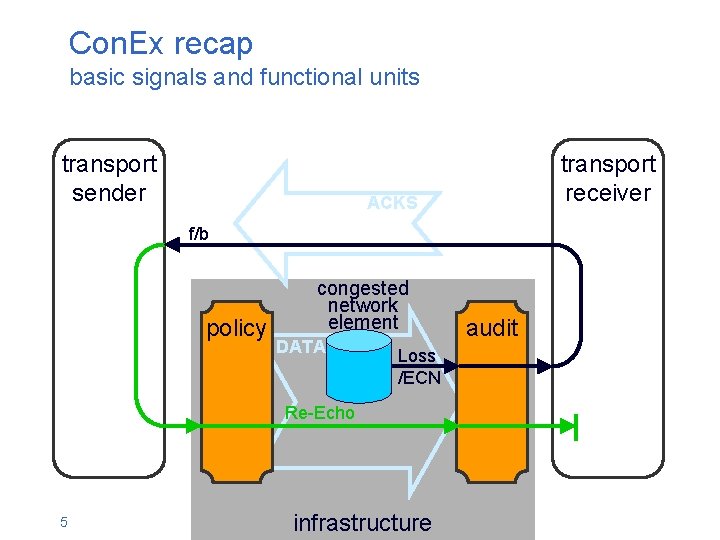
Con. Ex recap basic signals and functional units transport sender transport receiver ACKS f/b policy congested network element DATA Loss /ECN Re-Echo 5 infrastructure audit
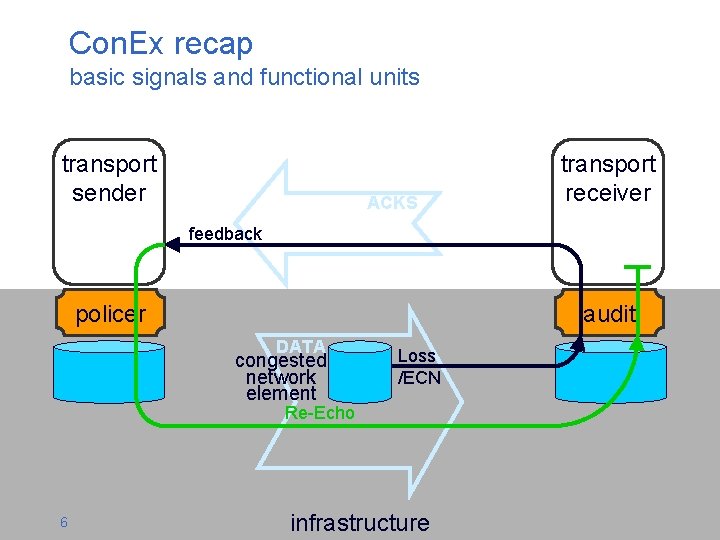
Con. Ex recap basic signals and functional units transport sender ACKS transport receiver feedback policer audit DATA congested network element Loss /ECN Re-Echo 6 infrastructure
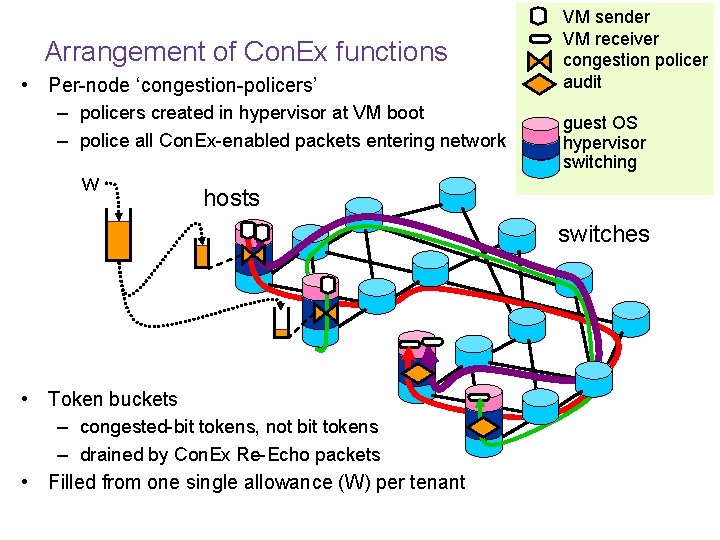
Arrangement of Con. Ex functions • Per-node ‘congestion-policers’ – policers created in hypervisor at VM boot – police all Con. Ex-enabled packets entering network w VM sender VM receiver congestion policer audit guest OS hypervisor switching hosts switches • Token buckets – congested-bit tokens, not bit tokens – drained by Con. Ex Re-Echo packets • Filled from one single allowance (W) per tenant
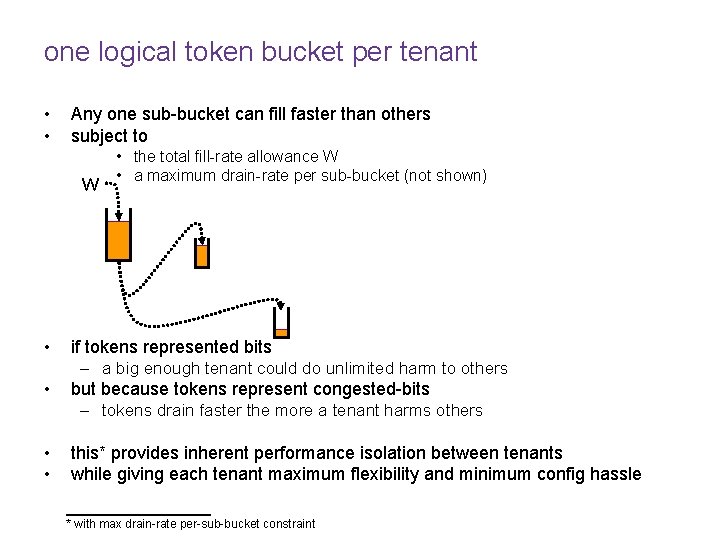
one logical token bucket per tenant • • Any one sub-bucket can fill faster than others subject to w • • • the total fill-rate allowance W • a maximum drain-rate per sub-bucket (not shown) if tokens represented bits – a big enough tenant could do unlimited harm to others but because tokens represent congested-bits – tokens drain faster the more a tenant harms others this* provides inherent performance isolation between tenants while giving each tenant maximum flexibility and minimum config hassle * with max drain-rate per-sub-bucket constraint
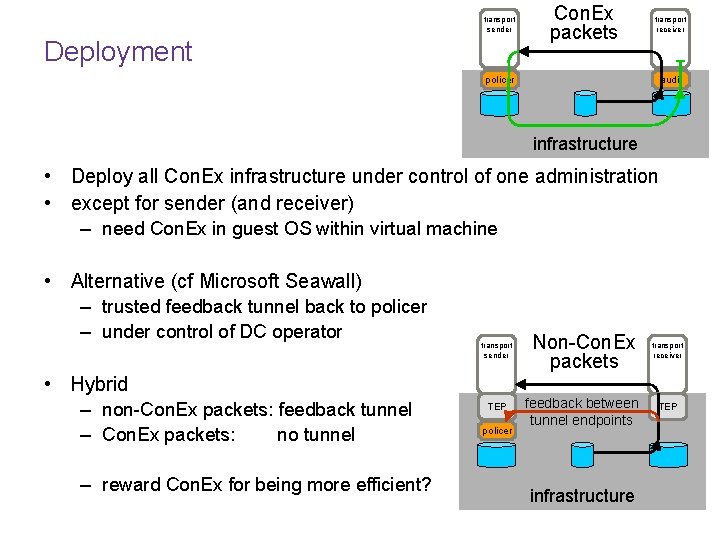
transport sender Deployment Con. Ex packets transport receiver policer audit infrastructure • Deploy all Con. Ex infrastructure under control of one administration • except for sender (and receiver) – need Con. Ex in guest OS within virtual machine • Alternative (cf Microsoft Seawall) – trusted feedback tunnel back to policer – under control of DC operator • Hybrid – non-Con. Ex packets: feedback tunnel – Con. Ex packets: no tunnel – reward Con. Ex for being more efficient? transport sender TEP policer Non-Con. Ex packets feedback between tunnel endpoints infrastructure transport receiver TEP
status & plans • relationship to conex-mobile • mobile section in initial-deploy is for general Con. Ex audience • conex-mobile is Con. Ex entry-point for mobile audience • both hoped to become WG items • plan – finish the document • re-organise to describe incentives up front • complete empty sections (e. g. tail pieces) working group input • more reviews please • WG feedback on choice of scenarios? • ready to be adopted as WG item of work?
Initial Con. Ex Deployment Examples draft-briscoe-conex-initial-deploy-02. txt Q&A
- Slides: 11