
Initial Assessment of the Impact of Jet Flame
- Slides: 22
Initial Assessment of the Impact of Jet Flame Hazard From Hydrogen Cars In Road Tunnels And the Implication On Hydrogen Car Design Dr. Yajue Wu Department of Chemical and Process Engineering Sheffield University Wu. Y. , International Conference on Hydrogen Safety, 11 - 13 September 2007 0
Hydrogen Economy and Hydrogen Fuelled Vehicles When hydrogen economy takes off, hydrogen cars would be regular users of urban transportation systems. The use of underground space became more and more important all over the world. The volume of tunnelling construction is expected to be around 2, 100 km in Europe and 2, 350 km in Asian in next 10 to 15 years. The sustainability of tunnelling activities requires consideration of impacts of hydrogen cars as the future users of the existing tunnels and new tunnels to be constructed Wu. Y. , International Conference on Hydrogen Safety, 11 - 13 September 2007 1
Hazard Posed by Hydrogen Release from High Pressure Source Subsonic and supersonic jet release. Ignitibility: Very low ignition energy Minimum Ignition Energy hydrogen (0. 017 m. J) methane (0. 29 m. J) gasoline (0. 24 m. J) Stability: Once ignited, hydrogen jets produce very stable diffusion jet flames. Jet flame is a dominating feature companying hydrogen fuel release Wu. Y. , International Conference on Hydrogen Safety, 11 - 13 September 2007 2
Objectives Carry out initial assessment of the fire hazards and fire scenarios associated with allowing hydrogen cars to use the existing tunnel. CFD simulations to assess the implication hydrogen fire on the tunnel ventilation systems. Wu. Y. , International Conference on Hydrogen Safety, 11 - 13 September 2007 3
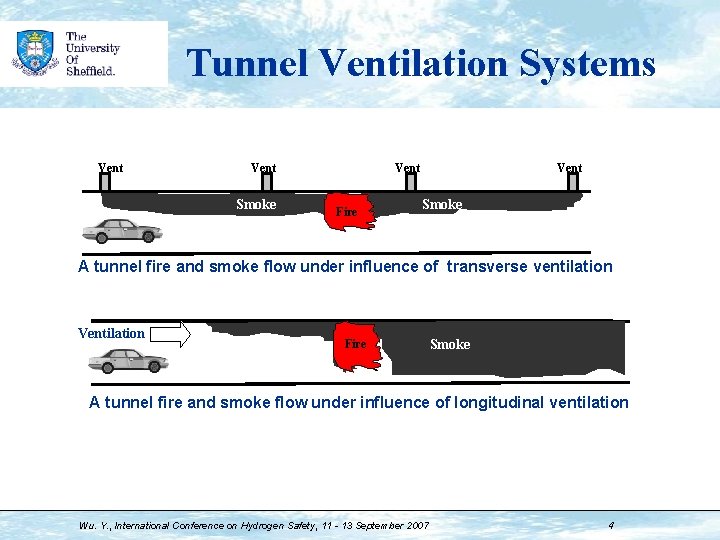
Tunnel Ventilation Systems Vent Smoke Vent Fire Vent Smoke A tunnel fire and smoke flow under influence of transverse ventilation Ventilation Fire Smoke A tunnel fire and smoke flow under influence of longitudinal ventilation Wu. Y. , International Conference on Hydrogen Safety, 11 - 13 September 2007 4
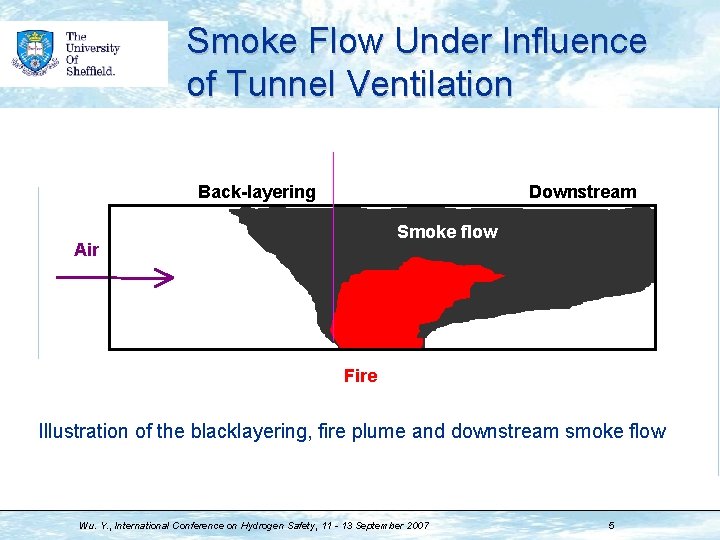
Smoke Flow Under Influence of Tunnel Ventilation Back-layering Downstream Smoke flow Air Fire Illustration of the blacklayering, fire plume and downstream smoke flow Wu. Y. , International Conference on Hydrogen Safety, 11 - 13 September 2007 5
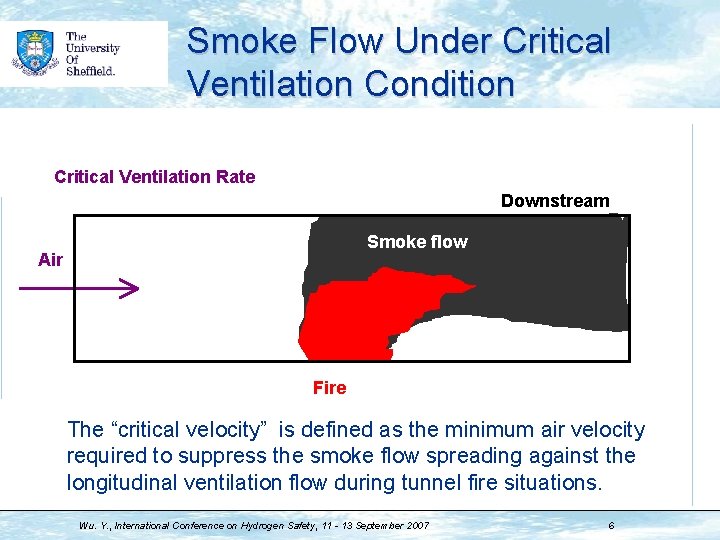
Smoke Flow Under Critical Ventilation Condition Critical Ventilation Rate Downstream Smoke flow Air Fire The “critical velocity” is defined as the minimum air velocity required to suppress the smoke flow spreading against the longitudinal ventilation flow during tunnel fire situations. Wu. Y. , International Conference on Hydrogen Safety, 11 - 13 September 2007 6
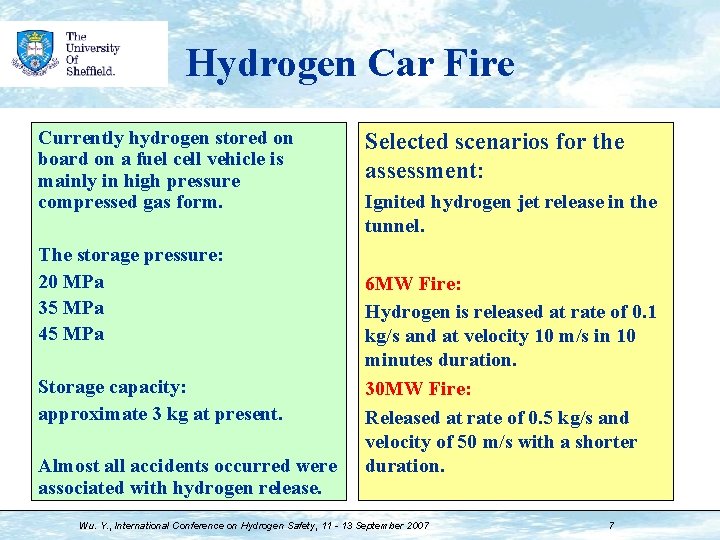
Hydrogen Car Fire Currently hydrogen stored on board on a fuel cell vehicle is mainly in high pressure compressed gas form. The storage pressure: 20 MPa 35 MPa 45 MPa Storage capacity: approximate 3 kg at present. Almost all accidents occurred were associated with hydrogen release. Selected scenarios for the assessment: Ignited hydrogen jet release in the tunnel. 6 MW Fire: Hydrogen is released at rate of 0. 1 kg/s and at velocity 10 m/s in 10 minutes duration. 30 MW Fire: Released at rate of 0. 5 kg/s and velocity of 50 m/s with a shorter duration. Wu. Y. , International Conference on Hydrogen Safety, 11 - 13 September 2007 7
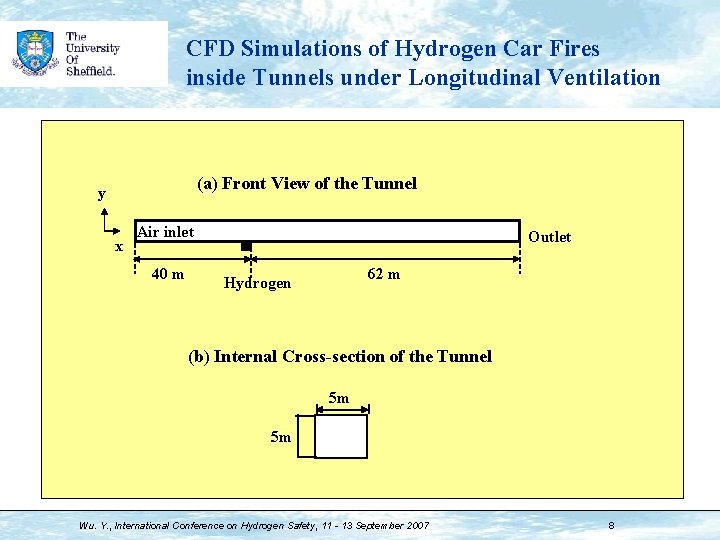
CFD Simulations of Hydrogen Car Fires inside Tunnels under Longitudinal Ventilation (a) Front View of the Tunnel y x Air inlet 40 m Outlet 62 m Hydrogen (b) Internal Cross-section of the Tunnel 5 m 5 m Wu. Y. , International Conference on Hydrogen Safety, 11 - 13 September 2007 8
Critical Velocity For the 5 m by 5 m square cross-section tunnel, our previous studies gave the value of super-critical ventilation velocity as 2. 5 m/s, which would eliminate the back layering and force the smoke moving downstream only regardless what the magnitude of the heat output from the fire is. The critical velocity is tested for the 6 MW and 30 MW hydrogen fires. Wu. Y. , International Conference on Hydrogen Safety, 11 - 13 September 2007 9
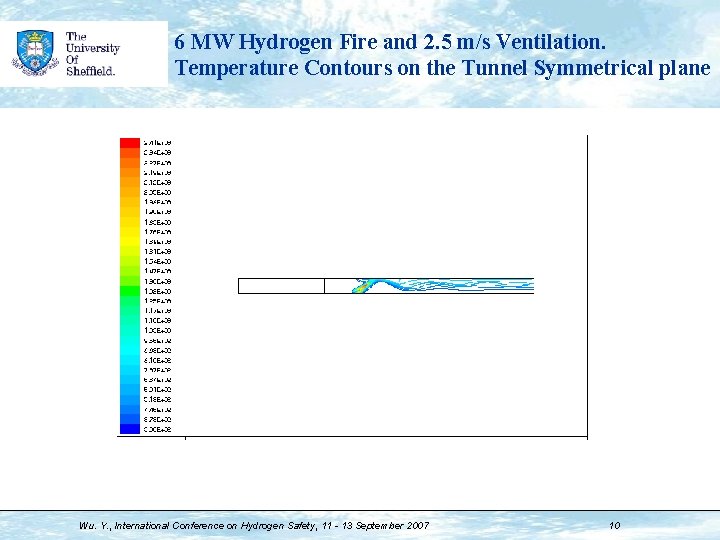
6 MW Hydrogen Fire and 2. 5 m/s Ventilation. Temperature Contours on the Tunnel Symmetrical plane Wu. Y. , International Conference on Hydrogen Safety, 11 - 13 September 2007 10
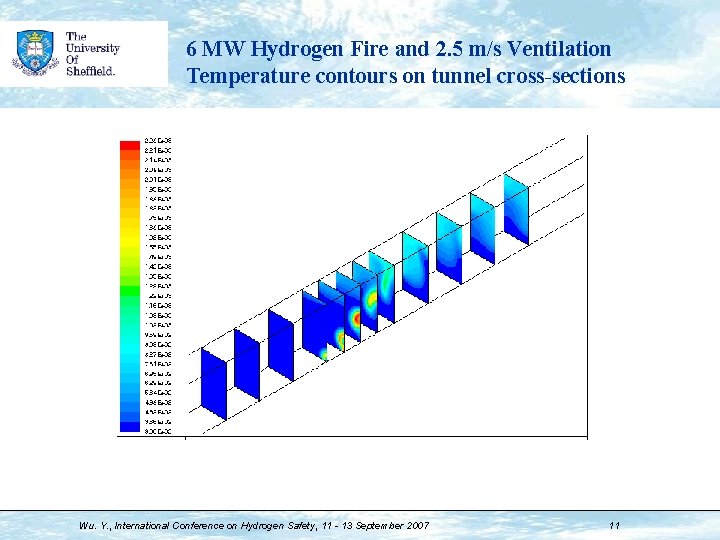
6 MW Hydrogen Fire and 2. 5 m/s Ventilation Temperature contours on tunnel cross-sections Wu. Y. , International Conference on Hydrogen Safety, 11 - 13 September 2007 11
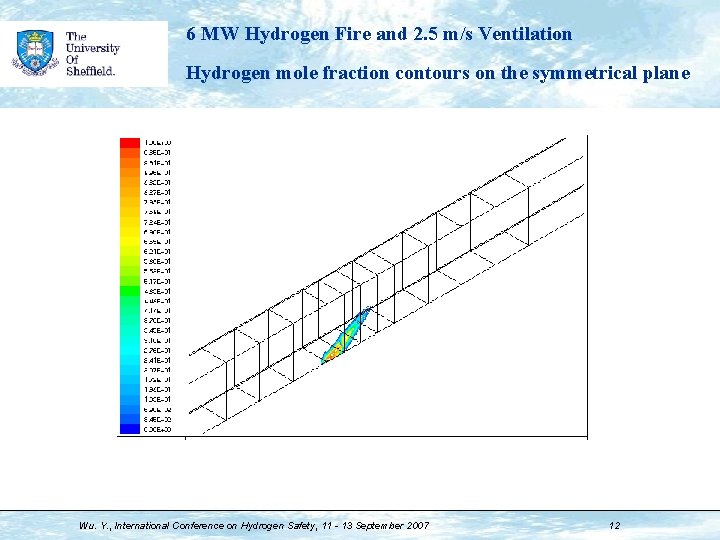
6 MW Hydrogen Fire and 2. 5 m/s Ventilation Hydrogen mole fraction contours on the symmetrical plane Wu. Y. , International Conference on Hydrogen Safety, 11 - 13 September 2007 12
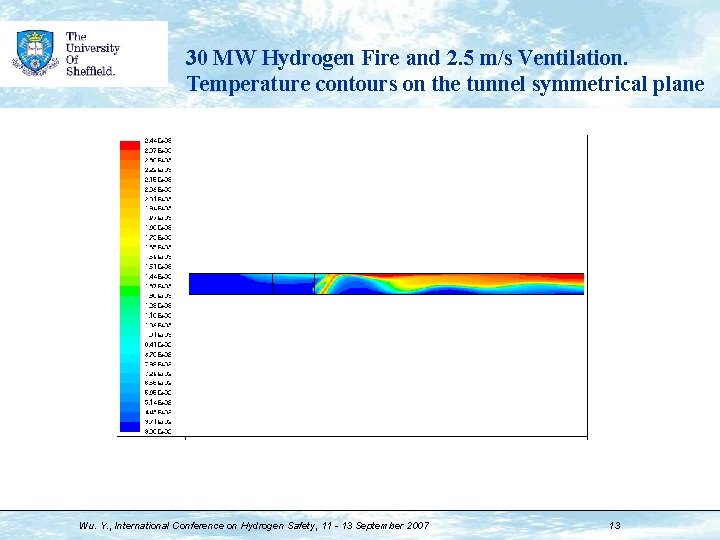
30 MW Hydrogen Fire and 2. 5 m/s Ventilation. Temperature contours on the tunnel symmetrical plane Wu. Y. , International Conference on Hydrogen Safety, 11 - 13 September 2007 13
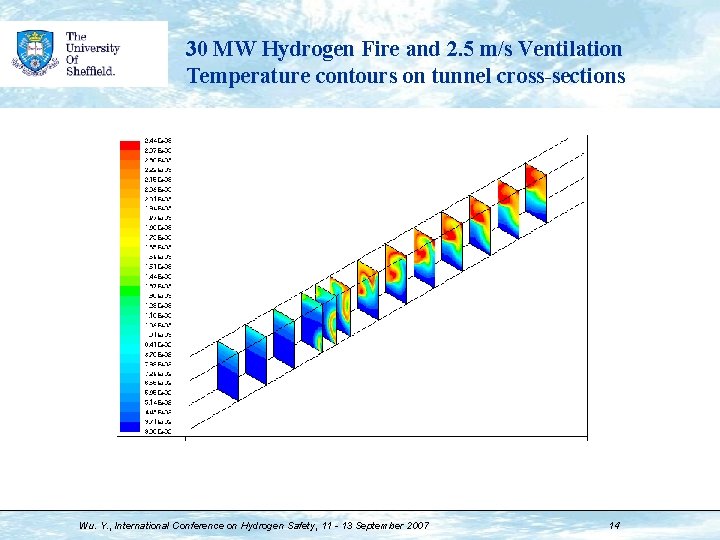
30 MW Hydrogen Fire and 2. 5 m/s Ventilation Temperature contours on tunnel cross-sections Wu. Y. , International Conference on Hydrogen Safety, 11 - 13 September 2007 14
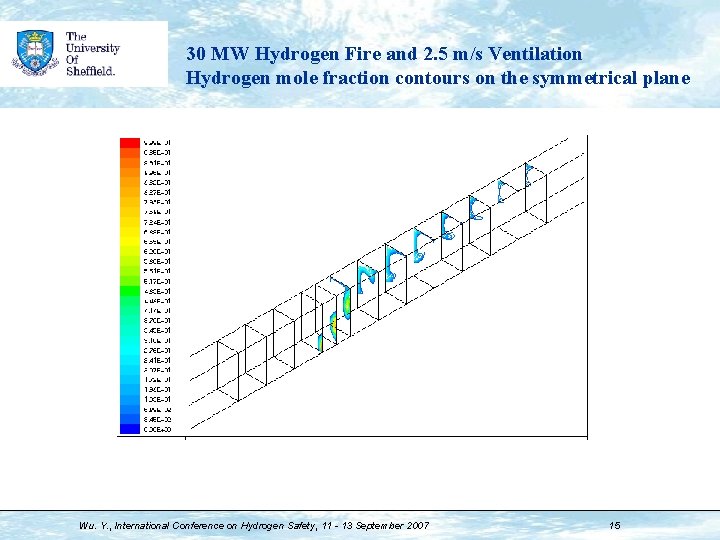
30 MW Hydrogen Fire and 2. 5 m/s Ventilation Hydrogen mole fraction contours on the symmetrical plane Wu. Y. , International Conference on Hydrogen Safety, 11 - 13 September 2007 15
Critical Velocity 6 MW Fire: 30 MW fire: The ventilation (2. 5 m/s) has fully eliminate the backlayering. The ventilation flow didn’t eliminate the backlayering, however the length of the backlayering was controlled within the length of three tunnel heights. Wu. Y. , International Conference on Hydrogen Safety, 11 - 13 September 2007 16
Jet Flame Hazards 6 MW fire: 30 MW fire: Flame length was short and located in lower part of tunnel. Flame reached the tunnel ceiling and spread under ceiling for a long distance (45 m) downstream. Wu. Y. , International Conference on Hydrogen Safety, 11 - 13 September 2007 17
Oxygen Deficiency 6 MW fire: 30 MW fire: There was no oxygen deficiency and the flame length was short and within two tunnel heights downstream. The oxygen deficiency caused the hydrogen spread downstream under the ceiling for a long distance and the reacting flow produced high temperature under the ceiling. Wu. Y. , International Conference on Hydrogen Safety, 11 - 13 September 2007 18
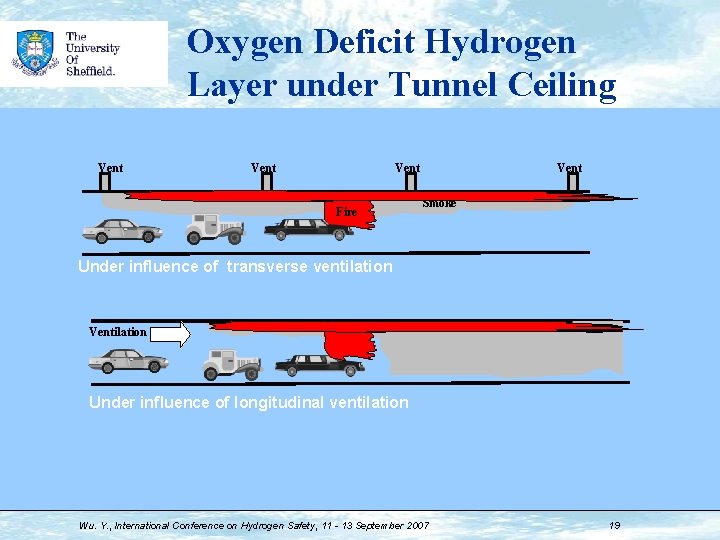
Oxygen Deficit Hydrogen Layer under Tunnel Ceiling Vent Fire Vent Smoke Under influence of transverse ventilation Ventilation Fire Under influence of longitudinal ventilation Wu. Y. , International Conference on Hydrogen Safety, 11 - 13 September 2007 19
Conclusions The super-critical ventilation velocity can completely eliminate the backlayering in normal hydrogen release rate or keep the backlayering under control in very high release rate. Jet flame hazard could be the dominant feature for hydrogen cars inside tunnel. For high release rate, the flame inside the tunnel might be in the status of oxygen deficit. This would result impingement of hydrogen jet flame on the tunnel ceiling and produce high temperature ceiling flow reaching substantial distance and damage tunnel infrastructures. The oxygen deficit hydrogen fire also pose flashover hazard inside tunnel and ventilation ducts. Wu. Y. , International Conference on Hydrogen Safety, 11 - 13 September 2007 20
Thank you ! Wu. Y. , International Conference on Hydrogen Safety, 11 - 13 September 2007 21