
Inhibitors A HowTo Guide to Stopping Chemical Reactions
Inhibitors A How-To Guide to Stopping Chemical Reactions Link for Video on VX: https: //www. youtube. com/watch? v=mkb. Bnvz 0 rw 0
What is an Inhibitor? An Inhibitor is a molecule that binds to an enzyme and decreases its activity. Inhibitors blocking an enzyme’s activity, can kill a pathogen or correct a metabolic imbalance. This is why many inhibitors are used in drugs or medicine. For example, antioxidants are added into food as inhibitors to prevent its exposure to air. This act will cause the food to not spoil as easily. The same thing is true with metals and rusting. N. K.
Inhibitors in the Body Enzyme inhibitors can be found with our bodies and within any organism’s body. These inhibitors attach themselves to a protein within a cell where an enzyme, a type of catalyst, would instead. Since enzymes, being catalysts and lowering activation energy, cannot attach, this disables any activation energy needed for the protein to function being lowered due to the enzyme. These often appear due to infections, either viral or bacterial (or otherwise), which make the protein unable to carry out its functions within a cell, because the protein may not have enough energy given to it to activate it without the use of an enzyme. In conclusion, enzymes lower activation energy, while enzyme inhibitors make proteins unable to lower their activation energy through the use of enzymes. A. S.

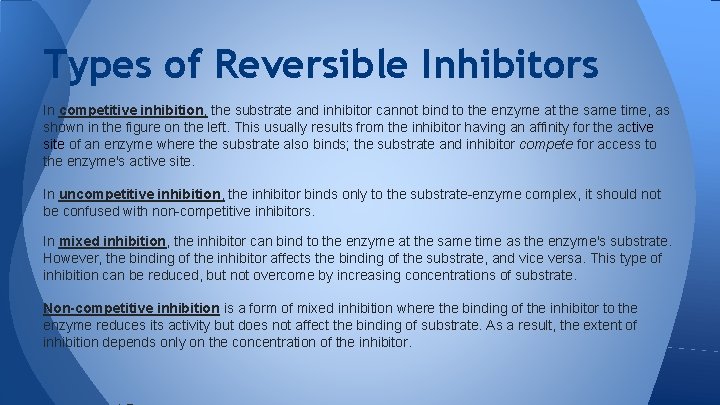
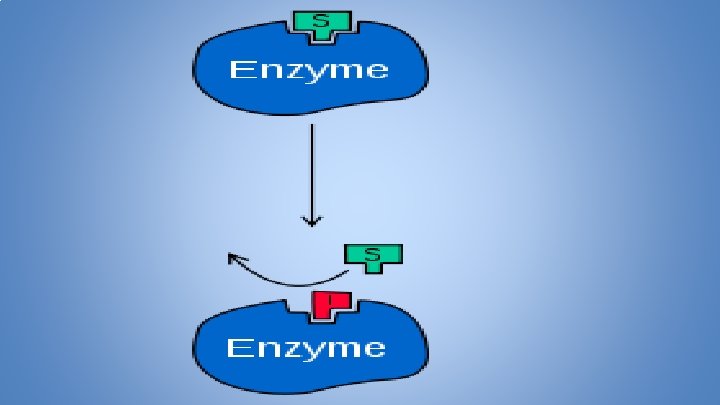
Types of Reversible Inhibitors In competitive inhibition, the substrate and inhibitor cannot bind to the enzyme at the same time, as shown in the figure on the left. This usually results from the inhibitor having an affinity for the active site of an enzyme where the substrate also binds; the substrate and inhibitor compete for access to the enzyme's active site. In uncompetitive inhibition, the inhibitor binds only to the substrate-enzyme complex, it should not be confused with non-competitive inhibitors. In mixed inhibition, the inhibitor can bind to the enzyme at the same time as the enzyme's substrate. However, the binding of the inhibitor affects the binding of the substrate, and vice versa. This type of inhibition can be reduced, but not overcome by increasing concentrations of substrate. Non-competitive inhibition is a form of mixed inhibition where the binding of the inhibitor to the enzyme reduces its activity but does not affect the binding of substrate. As a result, the extent of inhibition depends only on the concentration of the inhibitor.
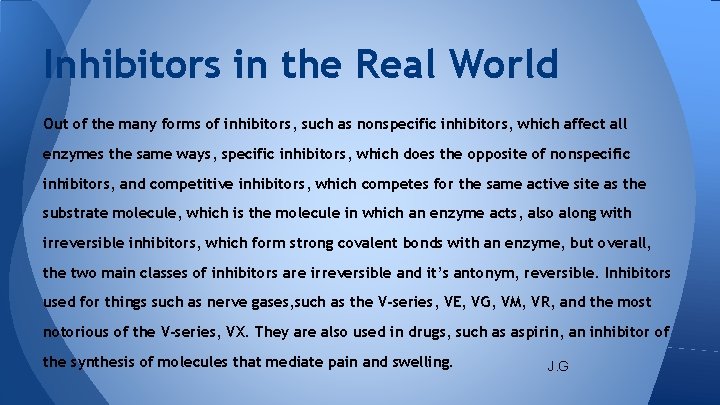
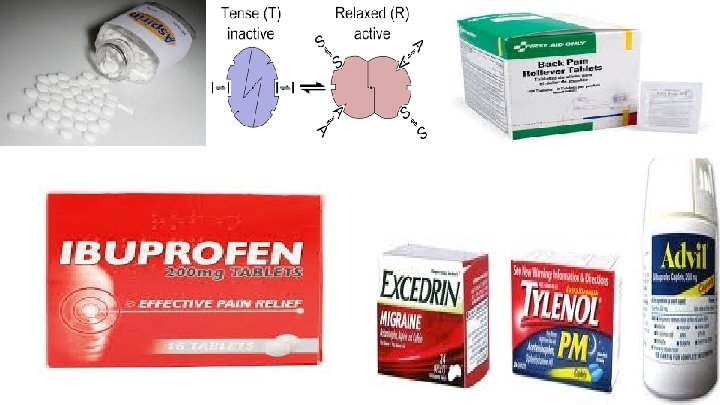
Inhibitors in the Real World Out of the many forms of inhibitors, such as nonspecific inhibitors, which affect all enzymes the same ways, specific inhibitors, which does the opposite of nonspecific inhibitors, and competitive inhibitors, which competes for the same active site as the substrate molecule, which is the molecule in which an enzyme acts, also along with irreversible inhibitors, which form strong covalent bonds with an enzyme, but overall, the two main classes of inhibitors are irreversible and it’s antonym, reversible. Inhibitors used for things such as nerve gases, such as the V-series, VE, VG, VM, VR, and the most notorious of the V-series, VX. They are also used in drugs, such as aspirin, an inhibitor of the synthesis of molecules that mediate pain and swelling. J. G
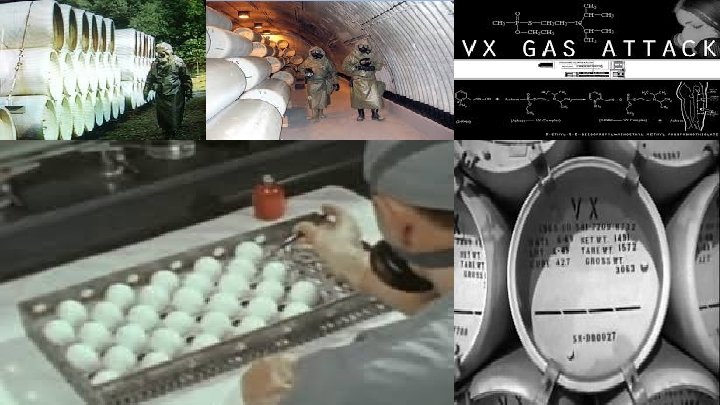
What is VX? VX is the most toxic nerve gas, or agent, ever to be synthesized for which it has been independently confirmed. Tasteless and odorless, it has no other known uses except in chemical warfare. As a chemical weapon, it is classified as a WMD by the UN in the Un Resolution 687, the production and stockpiling outlawed in 1993. The median lethal dose for humans is about 10 milligrams through skin contact and for inhalation is estimated to be about 30 -50 mg-min/m 3. It’s full molecular formula is C 11 H 26 NO 2 PS. Why are we even talking about this? VX is an acetylcholinesterase inhibitor, i. e. , it works by blocking the function of the enzyme acetylcholinesterase. Basically, what this means is that it has something to do with muscles. When you tense your muscles, or basically just move, your muscles create acetylcholine. VX prevent your muscles from producing acetylcholine. No acetylcholine, no movement, of any of your limbs, arms, legs, practically every single muscle in your body stops moving, including your lungs. If one lost muscle control in their lungs, well, you know the rest. J. G

The End Thank For Watching! Any Questions?
- Slides: 12