
Inheritance Patterns Related to Gender Determination A Mechanisms





- Slides: 19
Inheritance Patterns Related to Gender Determination A. Mechanisms of gender determination B. X-linkage C. Sex-limited and sex-influenced traits
A. Mechanisms of Gender Determination Chromosomal mechanisms – Gender determined by the presence or absence of certain chromosomes called sex chromosomes – Other “non-sex” chromosomes are called autosomes – Not all genes on a sex chromosome are necessarily related to gender or reproduction Genic mechanisms
A. Mechanisms of Gender Determination X-O mechanisms – In grasshoppers and related insects – A single sex chromosome (X) – Females are have two copies of the X chromosome (XX); each ovum produced will carry an X chromosome (females are homogametous) – Males have only one copy of X, and no other sex chromosome (XO); half the sperm carry an X, and the other half have no sex chromosome (males are
A. Mechanisms of Gender Determination X-Y mechanisms – Females are XX (homogametous gender) males are XY (heterogametous gender) – In mammals: • • The embryonic gonads develop into testes in response to the expression of a “testes determining factor” gene on the Y chromosome; Otherwise, the gonads develop into ovaries The Y chromosome also has a region that has sequence homology with the X chromosome, allowing pairing and segregation during
A. Mechanisms of Gender Determination X-Y mechanisms – In Drosophila and similar insects, gender is determined by the ratio of X chromosomes and autosomes – In both mammals and Drosophila, the X chromosome carries many genes not related to gender or reproduction – Genes located on the X chromosome are called X-linked genes
A. Mechanisms of Gender Determination Z-W mechanisms – In birds and some reptiles – Z chromosome is similar to the X; W similar to Y – Except. . . – Males are homogametous (ZZ) and females are heterogametous (ZW)
A. Mechanisms of Gender Determination Diploid-haploid mechanisms – In bees and wasps – Females (queen and worker bees) develop from fertilized eggs and have diploid cells – Males (drones) develop from unfertilized eggs and have haploid cells
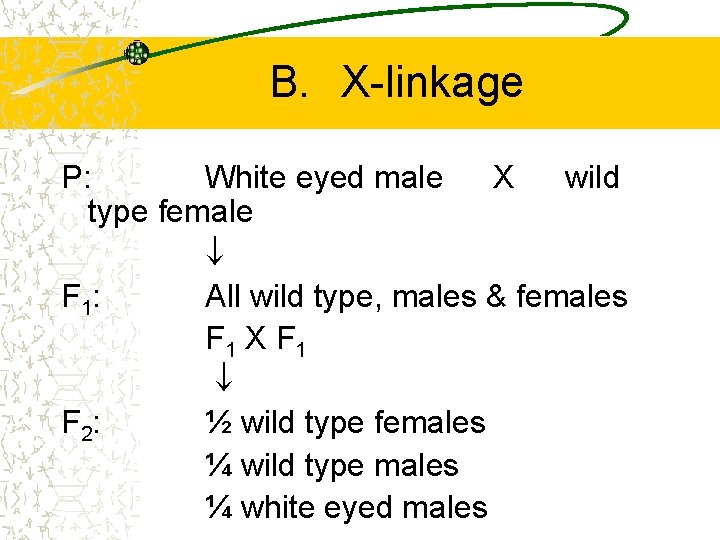
B. X-linkage Discovered by T. H. Morgan around 1910 First X-linked gene to be discovered: white eye gene in Drosophila Morgan’s students found a single rare, mutant white eyed male fly and, of course, wanted to characterize it by a monohybrid cross
B. X-linkage P: White eyed male X wild type female F 1: All wild type, males & females F 1 X F 1 F 2: ½ wild type females ¼ wild type males ¼ white eyed males
B. X-linkage Obviously, the gene for white eye is recessive to its allele for normal eye color What was unusual was that all of the F 2 recessive offspring were males – no females Morgan would have expected to find equal numbers of males and females in the F 2 phenotypes With autosomal genes, one expects an F 2 ratio of 3/8 dominant females: 1/8 recessive females:
B. X-linkage Morgan deduced that the white eye results could be explained if the gene for white eye color is located on the X chromosome This was the first direct evidence that genes are located on chromosomes
B. X-linkage Genotypic explanation of Drosophila white eye: – One gene, X-linked, with two alleles, w+ & w – Different genotypes in males and females: w+ w+ : Homozygous wild type females w+ w : Heterozygous wild type females w w : Homozygous white-eyed females w+ Y : Hemizygous wild type males w Y : Hemizygous white-eyed type males
B. X-linkage Note that, with respect to X-linked genes, males are neither homozygous nor heterozygous, but hemizygous Also note that the “Y” designates the Y chromosome in males During spermatogenesis, ½ the sperm get the X chromosome (that has the X-linked genes), and ½ the sperm get the Y
B. X-linkage So, for the white-eye monohybrid cross: P: w Y male X w+ w+ female F 1: w+ Y males & w+ w females F 1 X F 1 F 2: ¼ w+ w+ females ¼ w+ w females ¼ w+ Y males ¼ w Y males
B. X-linkage Morgan found that a testcross would produce white-eyed (w w) females: w Y male & w+ w females ¼ w+ w females ¼ w+ Y males ¼ w Y males
B. X-linkage There are many X-linked traits in humans – Example: Red-green color blindness Normal female (N N) X Colorblind male (n Y) ½ N n (Carrier females) & ½ N Y (Normal males) Carrier female (N n) X Normal male (N Y)
B. X-linkage Z-linked traits in birds exhibit similar inheritance patterns, except that it is the male bird that is homogametous – Example: barred feathers in chickens
C. Sex-limited & Sex-Influenced Traits Sex-limited trait: – A trait, produced by an autosomal gene, in which the expression of a specific genotype is limited to only one gender – Example: Hen-feather vs. rooster-feather patterns in chickens
C. Sex-limited & Sex-Influenced Traits Sex-influenced trait: – A trait, produced by an autosomal gene, in which an allele is dominant in one gender but is recessive in the other gender – Example: Pattern baldness in humans