
Inheritance n n Classes and Subclasses Or Extending
Inheritance n n Classes and Subclasses Or Extending a Class 1
Inheritance: Introduction n Reusability--building new components by utilising existing components- is yet another important aspect of OO paradigm. It is always good/“productive” if we are able to reuse something that is already exists rather than creating the same all over again. This is achieve by creating new classes, reusing the properties of existing classes. 2
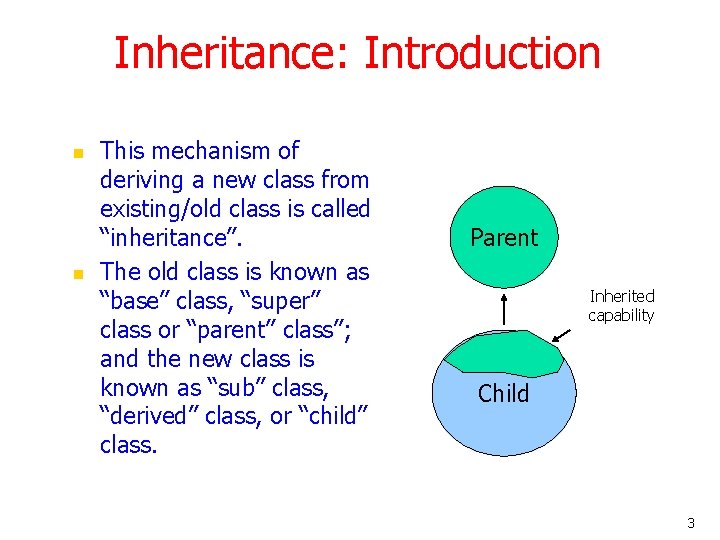
Inheritance: Introduction n n This mechanism of deriving a new class from existing/old class is called “inheritance”. The old class is known as “base” class, “super” class or “parent” class”; and the new class is known as “sub” class, “derived” class, or “child” class. Parent Inherited capability Child 3
Inheritance: Introduction n The inheritance allows subclasses to inherit all properties (variables and methods) of their parent classes. The different forms of inheritance are: n n n Single inheritance (only one super class) Multiple inheritance (several super classes) Hierarchical inheritance (one super class, many sub classes) Multi-Level inheritance (derived from a derived class) Hybrid inheritance (more than two types) Multi-path inheritance (inheritance of some properties from two sources). 4
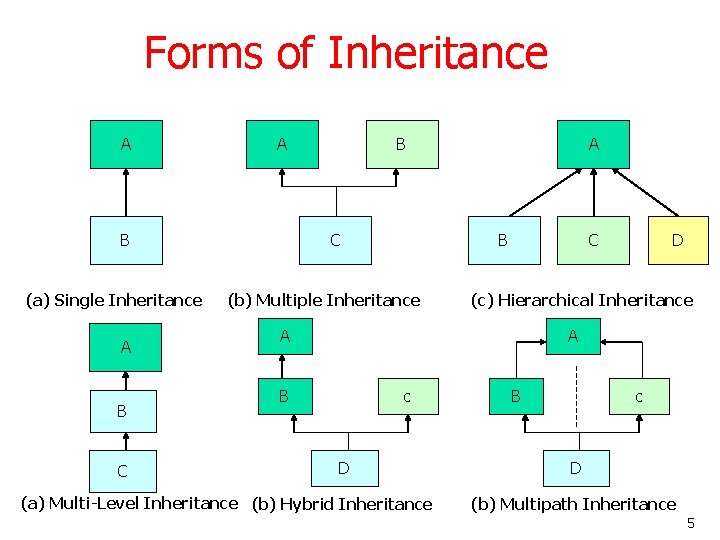
Forms of Inheritance A A B (a) Single Inheritance A B C A B (b) Multiple Inheritance C D (c) Hierarchical Inheritance A A B c D (a) Multi-Level Inheritance (b) Hybrid Inheritance B c D (b) Multipath Inheritance 5
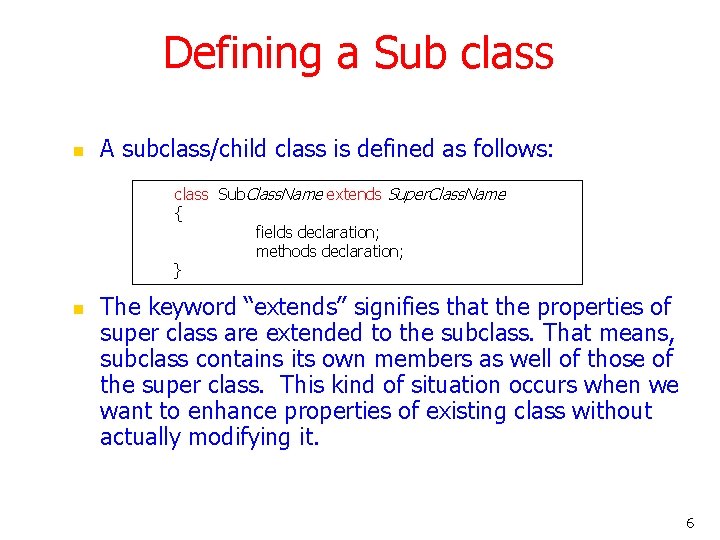
Defining a Sub class n A subclass/child class is defined as follows: class Sub. Class. Name extends Super. Class. Name { fields declaration; methods declaration; } n The keyword “extends” signifies that the properties of super class are extended to the subclass. That means, subclass contains its own members as well of those of the super class. This kind of situation occurs when we want to enhance properties of existing class without actually modifying it. 6
Subclasses and Inheritance n n n Circle class captures basic properties For drawing application, need a circle to draw itself on the screen, Graphic. Circle. . . This can be realised either by updating the circle class itself (which is not a good Software Engineering method) or creating a new class that builds on the existing class and additional properties. 7
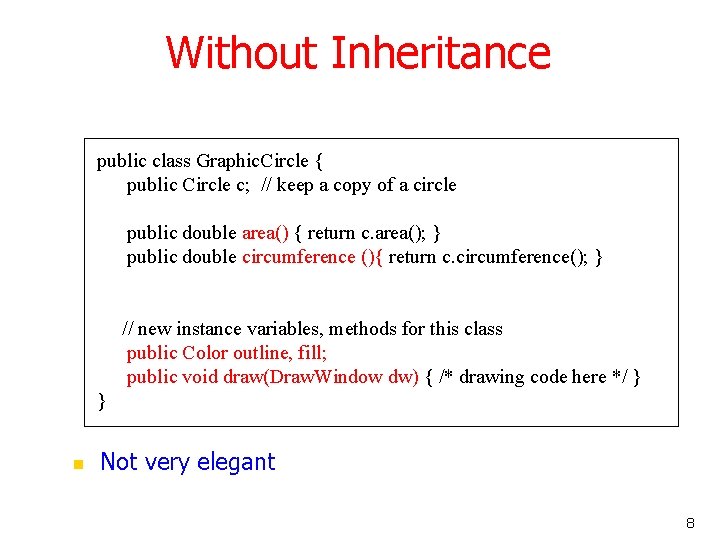
Without Inheritance public class Graphic. Circle { public Circle c; // keep a copy of a circle public double area() { return c. area(); } public double circumference (){ return c. circumference(); } // new instance variables, methods for this class public Color outline, fill; public void draw(Draw. Window dw) { /* drawing code here */ } } n Not very elegant 8
Subclasses and Inheritance n n Circle class captures basic properties For drawing application need a circle to draw itself on the screen, Graphic. Circle Java/OOP allows for Circle class code to be implicitly (re)used in defining a Graphic. Circle becomes a subclass of Circle, extending its capabilities 9
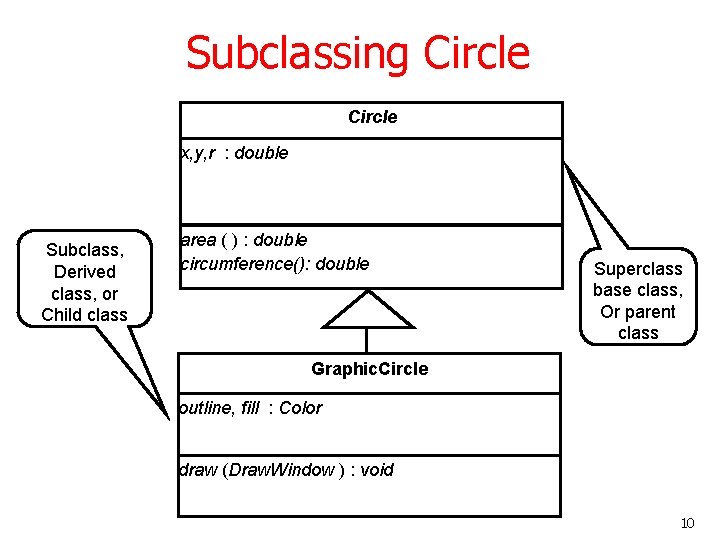
Subclassing Circle x, y, r : double Subclass, Derived class, or Child class area ( ) : double circumference(): double Superclass base class, Or parent class Graphic. Circle outline, fill : Color draw (Draw. Window ) : void 10
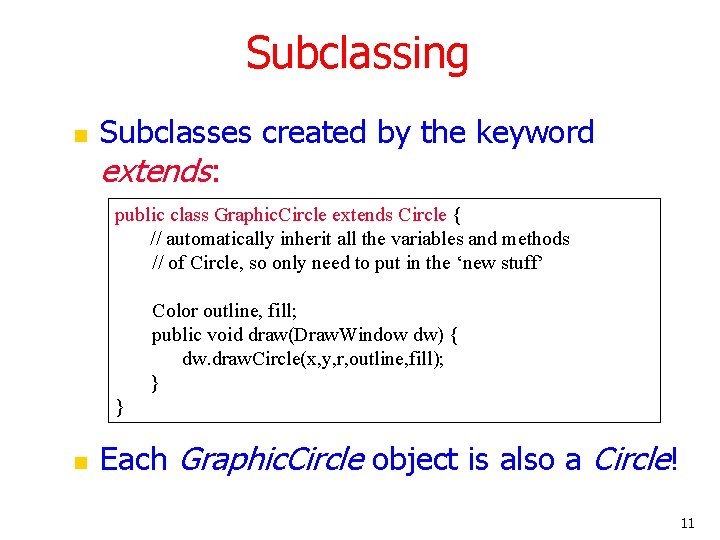
Subclassing n Subclasses created by the keyword extends: public class Graphic. Circle extends Circle { // automatically inherit all the variables and methods // of Circle, so only need to put in the ‘new stuff’ Color outline, fill; public void draw(Draw. Window dw) { dw. draw. Circle(x, y, r, outline, fill); } } n Each Graphic. Circle object is also a Circle! 11
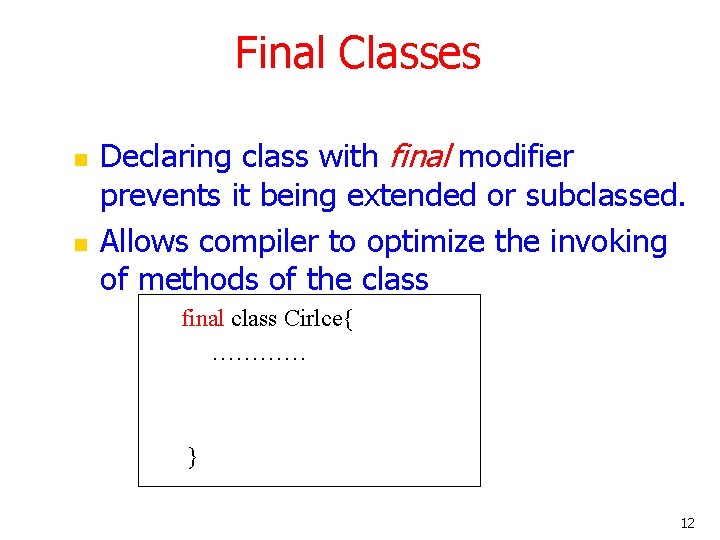
Final Classes n n Declaring class with final modifier prevents it being extended or subclassed. Allows compiler to optimize the invoking of methods of the class final class Cirlce{ ………… } 12
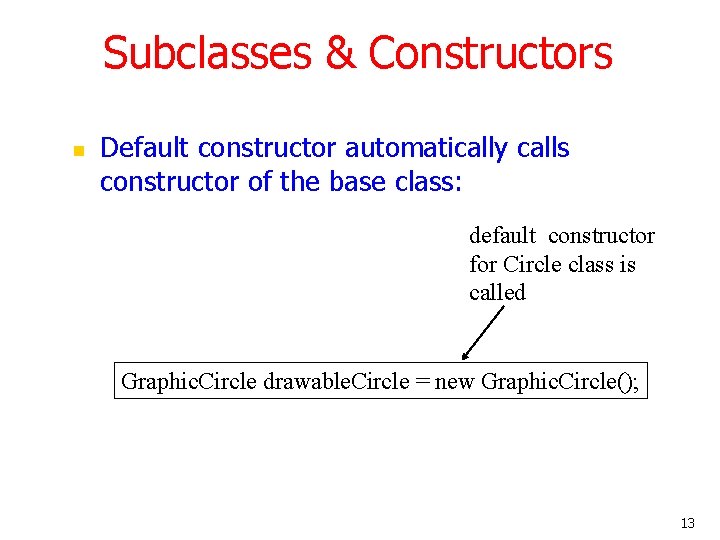
Subclasses & Constructors n Default constructor automatically calls constructor of the base class: default constructor for Circle class is called Graphic. Circle drawable. Circle = new Graphic. Circle(); 13
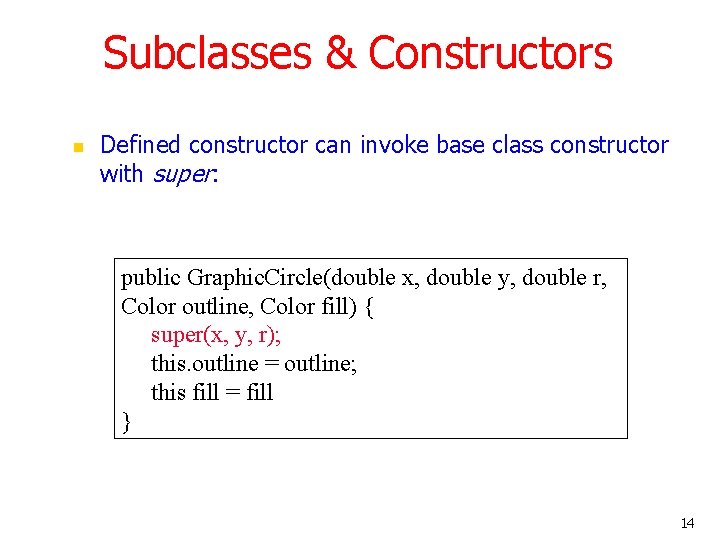
Subclasses & Constructors n Defined constructor can invoke base class constructor with super: public Graphic. Circle(double x, double y, double r, Color outline, Color fill) { super(x, y, r); this. outline = outline; this fill = fill } 14
Shadowed Variables n Subclasses defining variables with the same name as those in the superclass, shadow them: 15
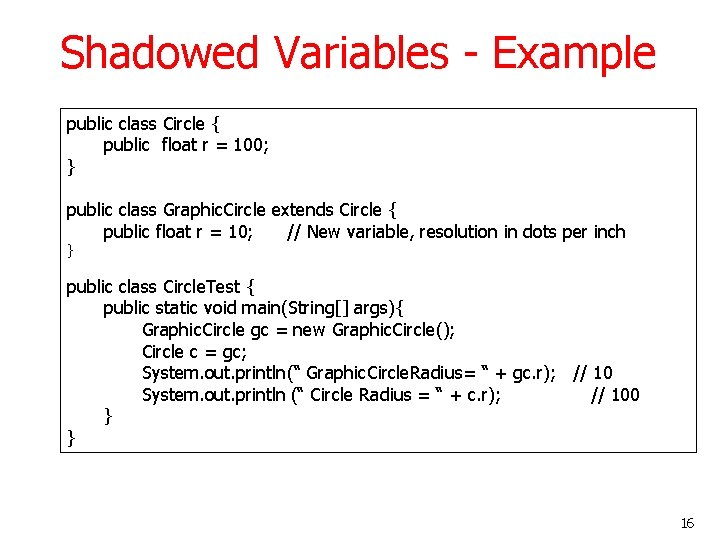
Shadowed Variables - Example public class Circle { public float r = 100; } public class Graphic. Circle extends Circle { public float r = 10; // New variable, resolution in dots per inch } public class Circle. Test { public static void main(String[] args){ Graphic. Circle gc = new Graphic. Circle(); Circle c = gc; System. out. println(“ Graphic. Circle. Radius= “ + gc. r); // 10 System. out. println (“ Circle Radius = “ + c. r); // 100 } } 16
Overriding Methods n Derived/sub classes defining methods with same name, return type and arguments as those in the parent/super class, override their parents methods: 17
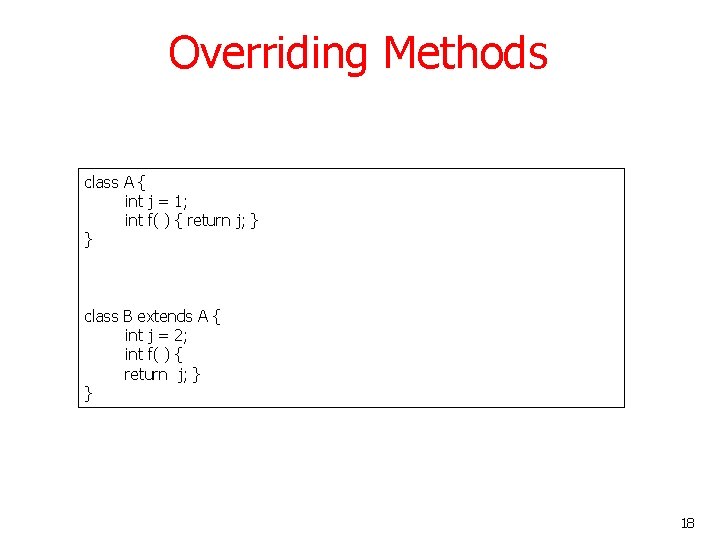
Overriding Methods class A { int j = 1; int f( ) { return j; } } class B extends A { int j = 2; int f( ) { return j; } } 18
![Overriding Methods class override_test { public static void main(String args[]) { B b =](http://slidetodoc.com/presentation_image_h/77aa87ad0e1effe54fe3bbb8782b06b2/image-19.jpg "Overriding Methods class override_test { public static void main(String args[]) { B b =")
Overriding Methods class override_test { public static void main(String args[]) { B b = new B(); System. out. println(b. j); // refers to B. j prints 2 System. out. println(b. f()); // refers to B. f prints 2 Object Type Casting A a = (A) b; System. out. println(a. j); // now refers to a. j prints 1 System. out. println(a. f()); // overridden method still refers to B. f() prints 2 ! } } [raj@mundroo] inheritance [1: 167] java override_test 2 2 19
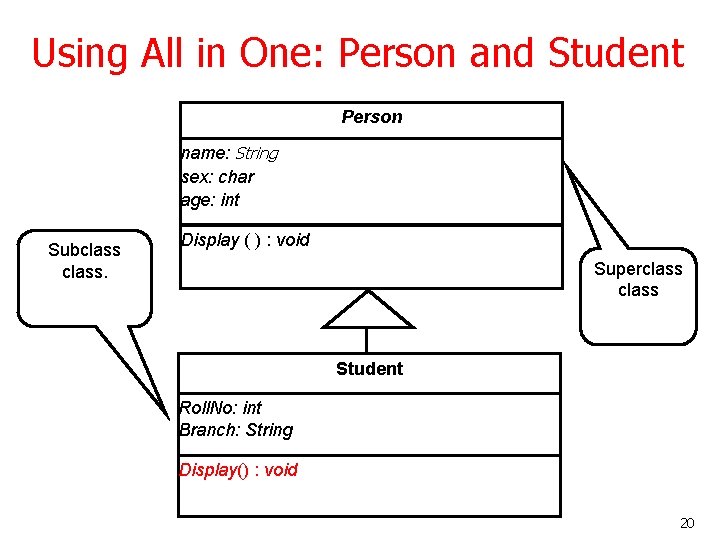
Using All in One: Person and Student Person name: String sex: char age: int Subclass. Display ( ) : void Superclass Student Roll. No: int Branch: String Display() : void 20
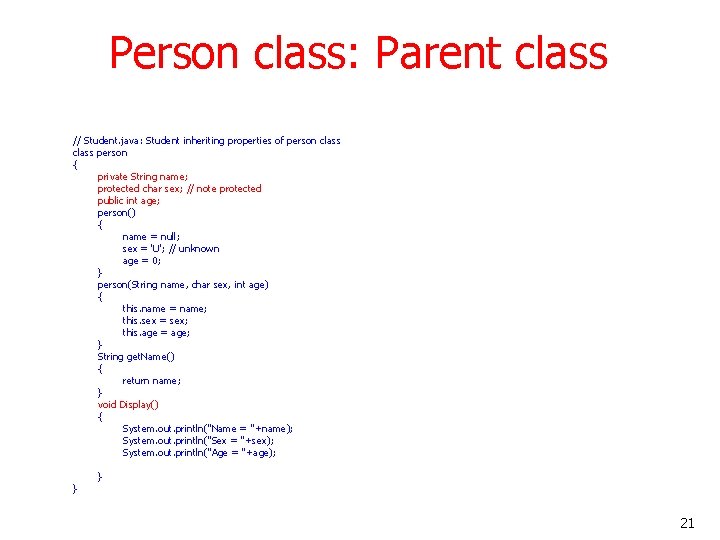
Person class: Parent class // Student. java: Student inheriting properties of person class person { private String name; protected char sex; // note protected public int age; person() { name = null; sex = 'U'; // unknown age = 0; } person(String name, char sex, int age) { this. name = name; this. sex = sex; this. age = age; } String get. Name() { return name; } void Display() { System. out. println("Name = "+name); System. out. println("Sex = "+sex); System. out. println("Age = "+age); } } 21
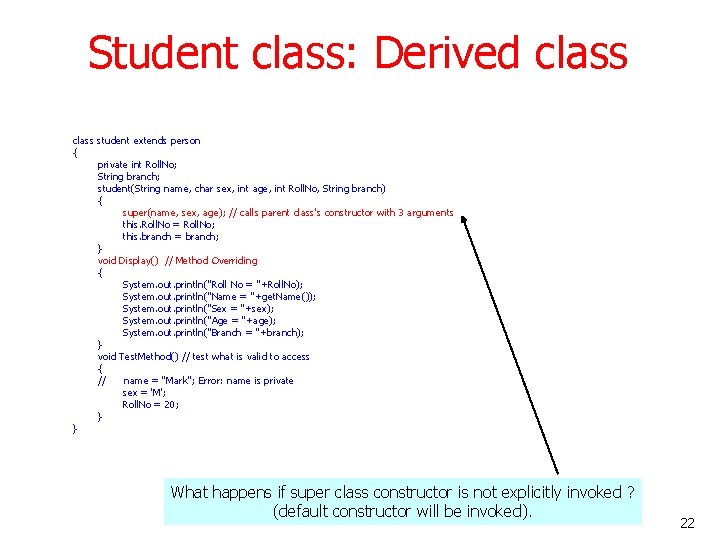
Student class: Derived class student extends person { private int Roll. No; String branch; student(String name, char sex, int age, int Roll. No, String branch) { super(name, sex, age); // calls parent class's constructor with 3 arguments this. Roll. No = Roll. No; this. branch = branch; } void Display() // Method Overriding { System. out. println("Roll No = "+Roll. No); System. out. println("Name = "+get. Name()); System. out. println("Sex = "+sex); System. out. println("Age = "+age); System. out. println("Branch = "+branch); } void Test. Method() // test what is valid to access { // name = "Mark"; Error: name is private sex = 'M'; Roll. No = 20; } } What happens if super class constructor is not explicitly invoked ? (default constructor will be invoked). 22
![Driver Class class My. Test { public static void main(String args[] ) { student](http://slidetodoc.com/presentation_image_h/77aa87ad0e1effe54fe3bbb8782b06b2/image-23.jpg "Driver Class class My. Test { public static void main(String args[] ) { student")
Driver Class class My. Test { public static void main(String args[] ) { student s 1 = new student("Rama", 'M', 21, 1, "Computer Science"); student s 2 = new student("Sita", 'F', 19, 2, "Software Engineering"); System. out. println("Student 1 Details. . . "); s 1. Display(); System. out. println("Student 2 Details. . . "); s 2. Display(); person p 1 = new person("Rao", 'M', 45); System. out. println("Person Details. . . "); p 1. Display(); } } Can we create Object of person class ? 23
![Output [raj@mundroo] inheritance [1: 154] java My. Test Student 1 Details. . . Roll](http://slidetodoc.com/presentation_image_h/77aa87ad0e1effe54fe3bbb8782b06b2/image-24.jpg "Output [raj@mundroo] inheritance [1: 154] java My. Test Student 1 Details. . . Roll")
Output [raj@mundroo] inheritance [1: 154] java My. Test Student 1 Details. . . Roll No = 1 Name = Rama Sex = M Age = 21 Branch = Computer Science Student 2 Details. . . Roll No = 2 Name = Sita Sex = F Age = 19 Branch = Software Engineering Person Details. . . Name = Rao Sex = M Age = 45 [raj@mundroo] inheritance [1: 155] 24
Summary n n n Inheritance promotes reusability by supporting the creation of new classes from existing classes. Various forms of inheritance can be realised in Java. Child class constructor can be directed to invoke selected constructor from parent using super keyword. Variables and Methods from parent classes can be overridden by redefining them in derived classes. New Keywords: extends, super, final 25
References n n Chapter 8: Sections 8. 11, 8. 12, 8. 13, and 8. 14 from Java book by Balagurusamy Optional: <for in depth> n Chapter 14: Inheritance from “Mastering C++” by Venugopal and Buyya! 26
- Slides: 26