
Inheritance Gregor Mendel Father of Genetics Austrian monk
- Slides: 13
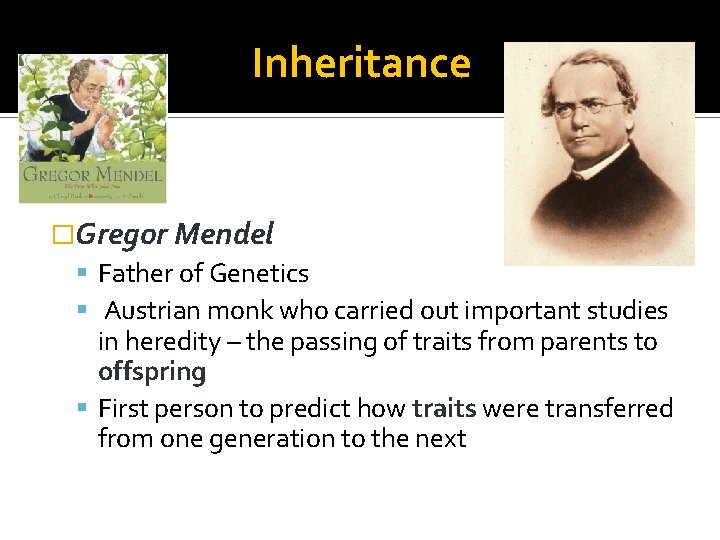
Inheritance �Gregor Mendel Father of Genetics Austrian monk who carried out important studies in heredity – the passing of traits from parents to offspring First person to predict how traits were transferred from one generation to the next
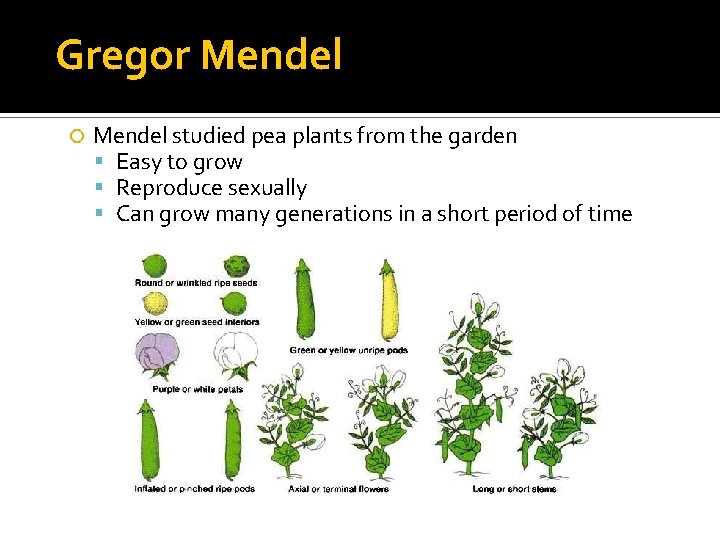
Gregor Mendel studied pea plants from the garden Easy to grow Reproduce sexually Can grow many generations in a short period of time
Gregor Mendel More on his pea plants � He observed that one group of seeds produced tall pea plants for many generations, and always produced tall offspring � He also observed another group of seeds produced short pea plants for many generations, and always produced short offspring These are called true-breeding or purebred
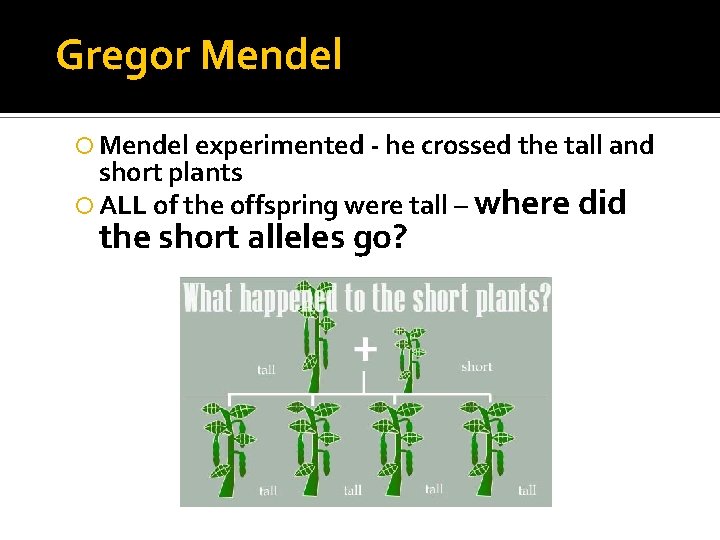
Gregor Mendel experimented - he crossed the tall and short plants ALL of the offspring were tall – where did the short alleles go?
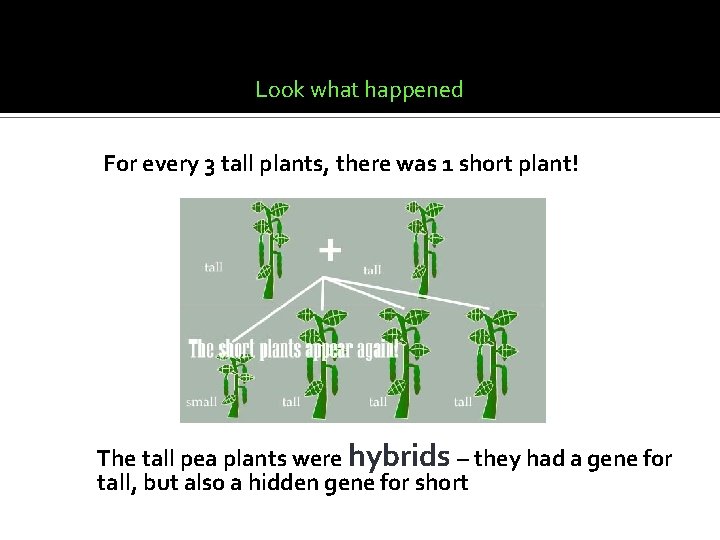
Mendel then took two of the tall plants from new generation and crossed them Look what happened For every 3 tall plants, there was 1 short plant! The tall pea plants were hybrids – they had a gene for tall, but also a hidden gene for short
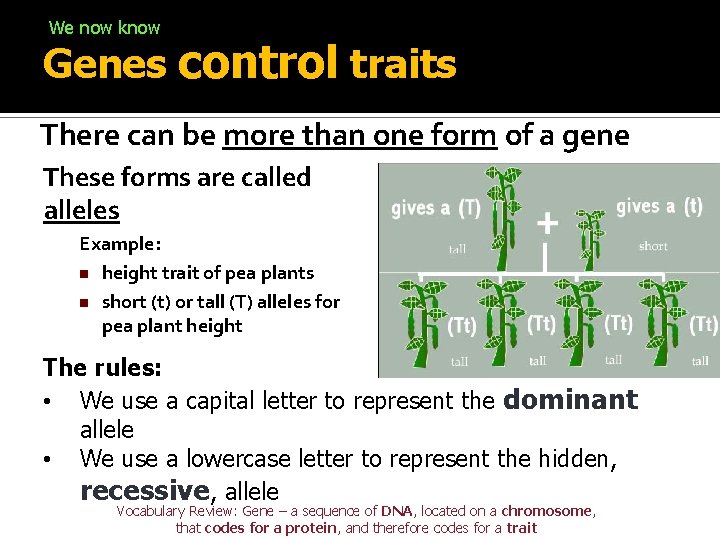
We now know Genes control traits There can be more than one form of a gene These forms are called alleles Example: n height trait of pea plants n short (t) or tall (T) alleles for pea plant height The rules: • We use a capital letter to represent the dominant allele • We use a lowercase letter to represent the hidden, recessive, allele Vocabulary Review: Gene – a sequence of DNA, located on a chromosome, that codes for a protein, and therefore codes for a trait
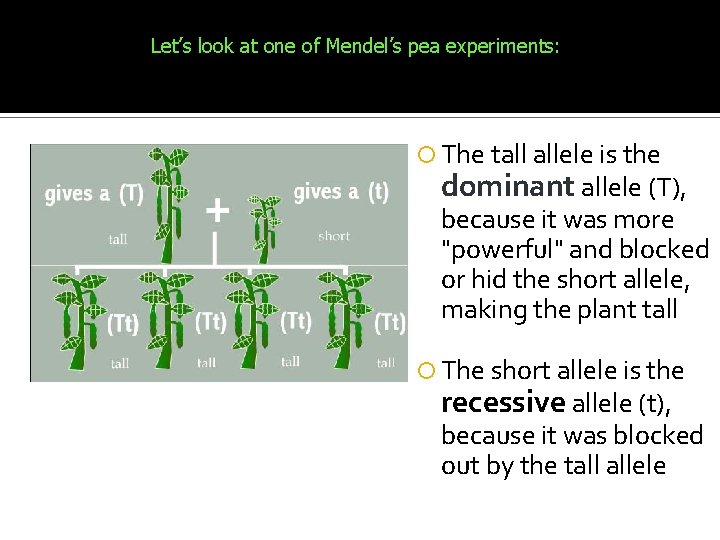
Let’s look at one of Mendel’s pea experiments: The tall allele is the dominant allele (T), because it was more "powerful" and blocked or hid the short allele, making the plant tall The short allele is the recessive allele (t), because it was blocked out by the tall allele
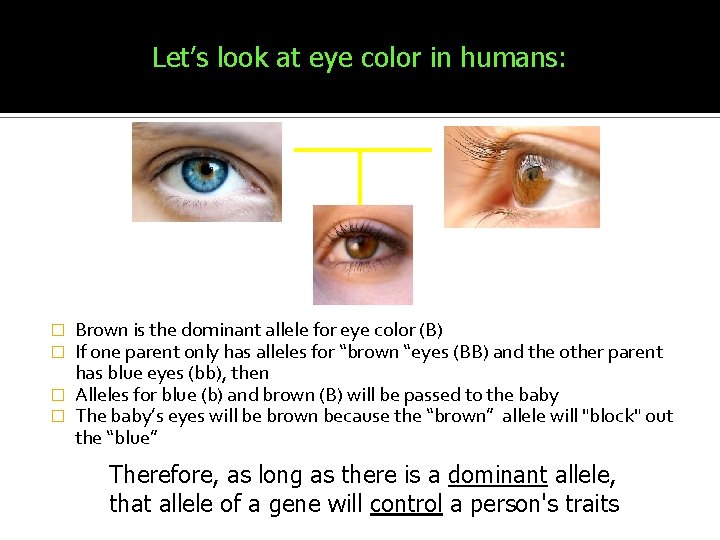
Let’s look at eye color in humans: Brown is the dominant allele for eye color (B) If one parent only has alleles for “brown “eyes (BB) and the other parent has blue eyes (bb), then � Alleles for blue (b) and brown (B) will be passed to the baby � The baby’s eyes will be brown because the “brown” allele will "block" out the “blue” � � Therefore, as long as there is a dominant allele, that allele of a gene will control a person's traits
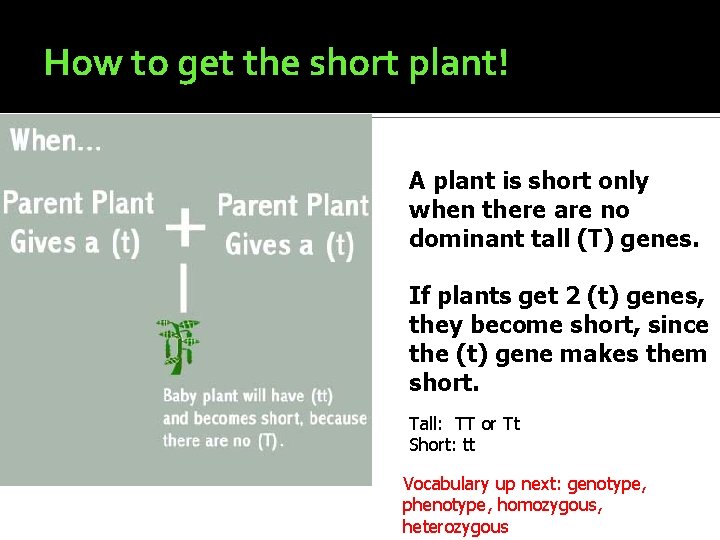
How to get the short plant! A plant is short only when there are no dominant tall (T) genes. If plants get 2 (t) genes, they become short, since the (t) gene makes them short. Tall: TT or Tt Short: tt Vocabulary up next: genotype, phenotype, homozygous, heterozygous
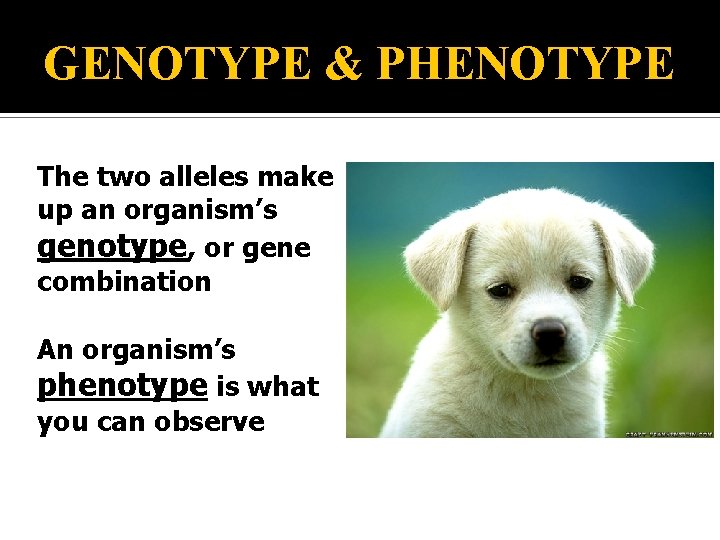
GENOTYPE & PHENOTYPE The two alleles make up an organism’s genotype, or gene combination An organism’s phenotype is what you can observe
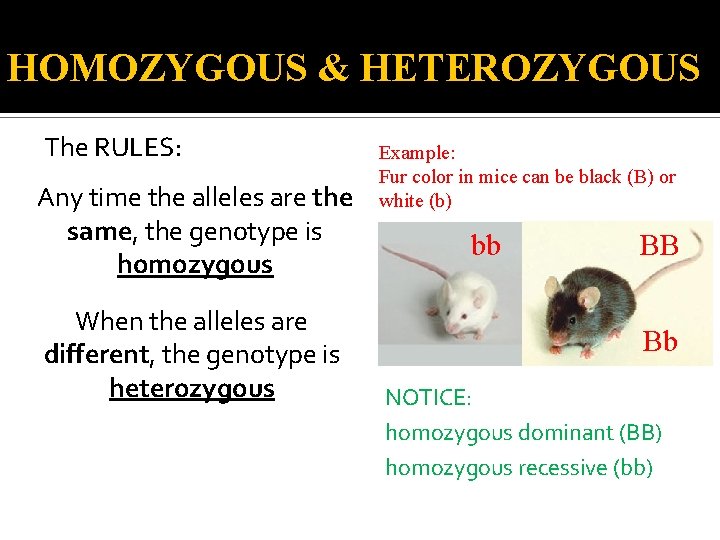
HOMOZYGOUS & HETEROZYGOUS The RULES: Any time the alleles are the same, the genotype is homozygous When the alleles are different, the genotype is heterozygous Example: Fur color in mice can be black (B) or white (b) bb BB Bb NOTICE: homozygous dominant (BB) homozygous recessive (bb)
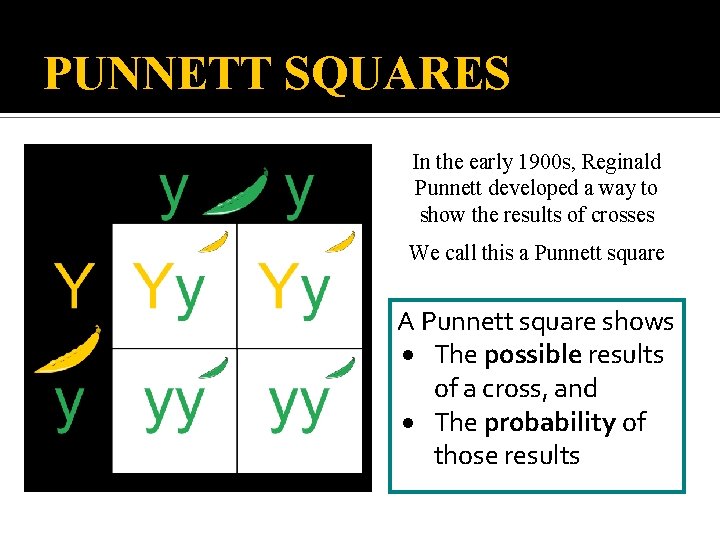
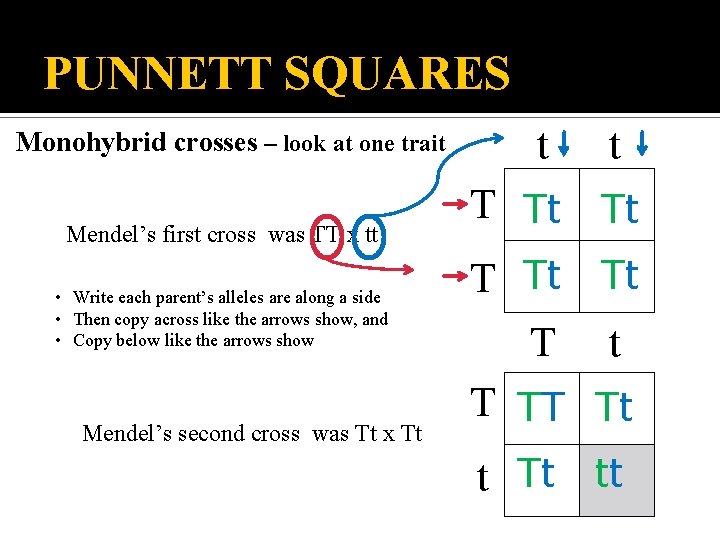
PUNNETT SQUARES In the early 1900 s, Reginald Punnett developed a way to show the results of crosses We call this a Punnett square A Punnett square shows · The possible results of a cross, and · The probability of those results
PUNNETT SQUARES Monohybrid crosses – look at one trait Mendel’s first cross was TT x tt • Write each parent’s alleles are along a side • Then copy across like the arrows show, and • Copy below like the arrows show Mendel’s second cross was Tt x Tt t t T Tt Tt T TT Tt tt