
Inheritance CSCI 201 Principles of Software Development Jeffrey


![Inheritance Example (cont. ) 1 public class Test { 2 public static void main(String[]](https://slidetodoc.com/presentation_image_h2/3f721c6b26ae4236d6416dab25728b69/image-17.jpg "Inheritance Example (cont. ) 1 public class Test { 2 public static void main(String[]")
- Slides: 17
Inheritance CSCI 201 Principles of Software Development Jeffrey Miller, Ph. D. jeffrey. miller@usc. edu
Outline • Inheritance USC CSCI 201 L
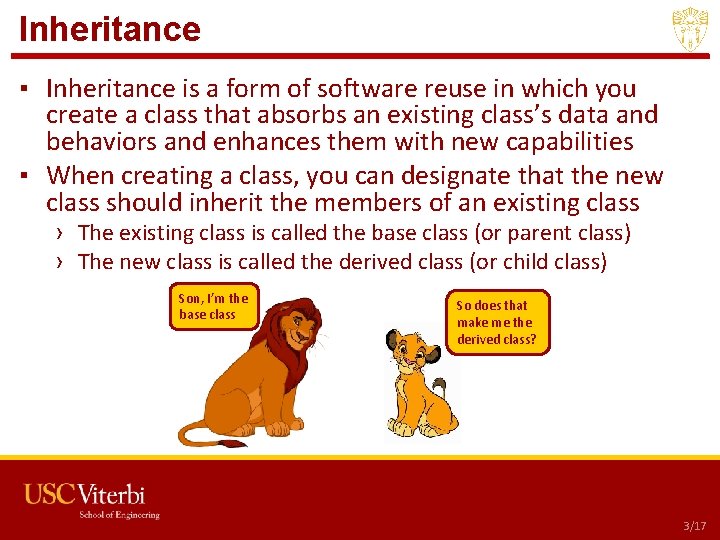
Inheritance ▪ Inheritance is a form of software reuse in which you create a class that absorbs an existing class’s data and behaviors and enhances them with new capabilities ▪ When creating a class, you can designate that the new class should inherit the members of an existing class › The existing class is called the base class (or parent class) › The new class is called the derived class (or child class) Son, I’m the base class So does that make me the derived class? USC CSCI 201 L 3/17
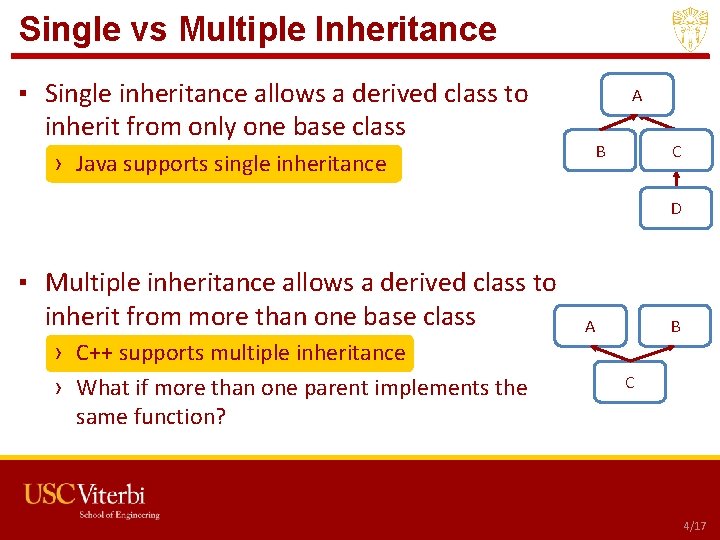
Single vs Multiple Inheritance ▪ Single inheritance allows a derived class to inherit from only one base class A B › Java supports single inheritance C D ▪ Multiple inheritance allows a derived class to inherit from more than one base class › C++ supports multiple inheritance › What if more than one parent implements the same function? A B C USC CSCI 201 L 4/17
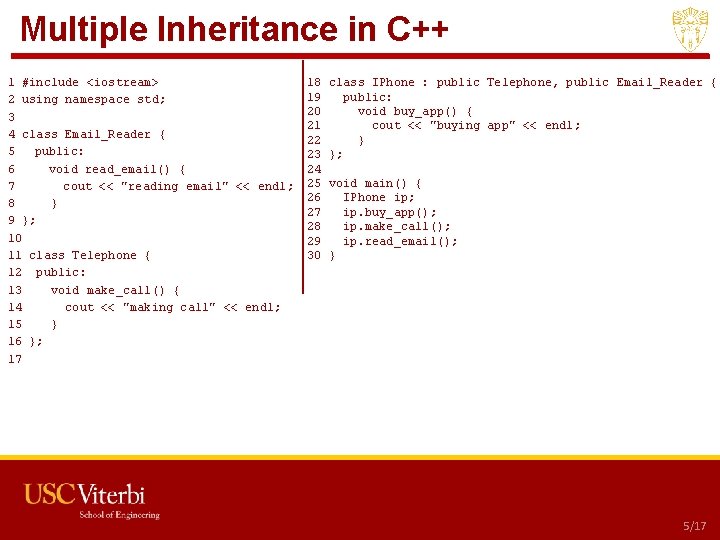
Multiple Inheritance in C++ 1 #include <iostream> 2 using namespace std; 3 4 class Email_Reader { 5 public: 6 void read_email() { 7 cout << "reading email" << endl; 8 } 9 }; 10 11 class Telephone { 12 public: 13 void make_call() { 14 cout << "making call" << endl; 15 } 16 }; 17 • Inheritance 18 19 20 21 22 23 24 25 26 27 28 29 30 class IPhone : public Telephone, public Email_Reader { public: void buy_app() { cout << "buying app" << endl; } }; void main() { IPhone ip; ip. buy_app(); ip. make_call(); ip. read_email(); } USC CSCI 201 L 5/17
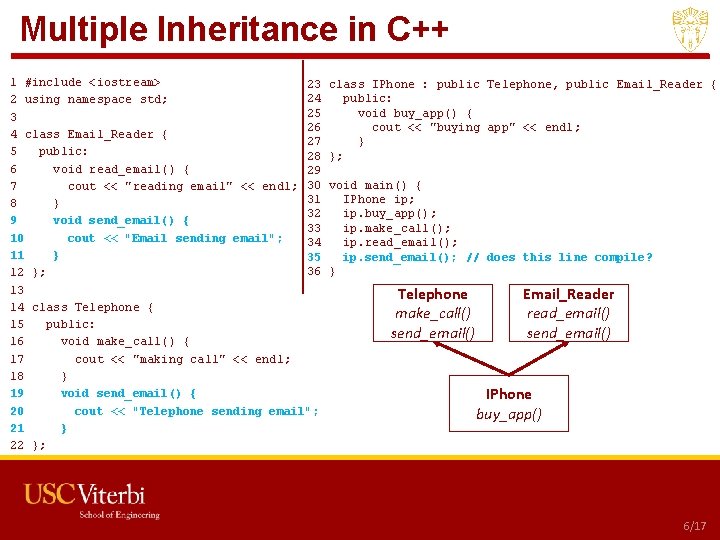
Multiple Inheritance in C++ 1 #include <iostream> 23 24 2 using namespace std; 25 3 26 4 class Email_Reader { 27 5 public: 28 6 void read_email() { 29 7 cout << "reading email" << endl; 30 31 8 } 32 9 void send_email() { 33 10 cout << "Email sending email"; 34 11 } 35 36 12 }; 13 14 class Telephone { 15 public: 16 void make_call() { 17 cout << "making call" << endl; 18 } 19 void send_email() { 20 cout << "Telephone sending email"; 21 } 22 }; • Inheritance class IPhone : public Telephone, public Email_Reader { public: void buy_app() { cout << "buying app" << endl; } }; void main() { IPhone ip; ip. buy_app(); ip. make_call(); ip. read_email(); ip. send_email(); // does this line compile? } Telephone make_call() send_email() Email_Reader read_email() send_email() IPhone buy_app() USC CSCI 201 L 6/17
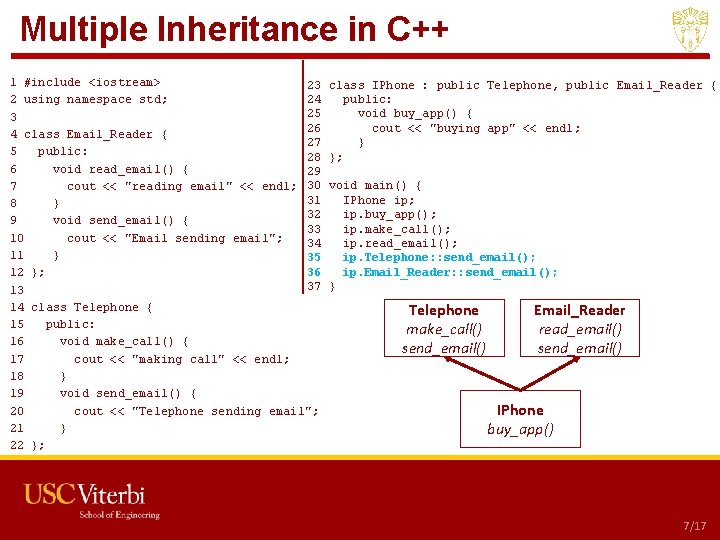
Multiple Inheritance in C++ 1 #include <iostream> 23 24 2 using namespace std; 25 3 26 4 class Email_Reader { 27 5 public: 28 6 void read_email() { 29 7 cout << "reading email" << endl; 30 31 8 } 32 9 void send_email() { 33 10 cout << "Email sending email"; 34 11 } 35 36 12 }; 37 13 14 class Telephone { 15 public: 16 void make_call() { 17 cout << "making call" << endl; 18 } 19 void send_email() { 20 cout << "Telephone sending email"; 21 } 22 }; • Inheritance class IPhone : public Telephone, public Email_Reader { public: void buy_app() { cout << "buying app" << endl; } }; void main() { IPhone ip; ip. buy_app(); ip. make_call(); ip. read_email(); ip. Telephone: : send_email(); ip. Email_Reader: : send_email(); } Telephone make_call() send_email() Email_Reader read_email() send_email() IPhone buy_app() USC CSCI 201 L 7/17
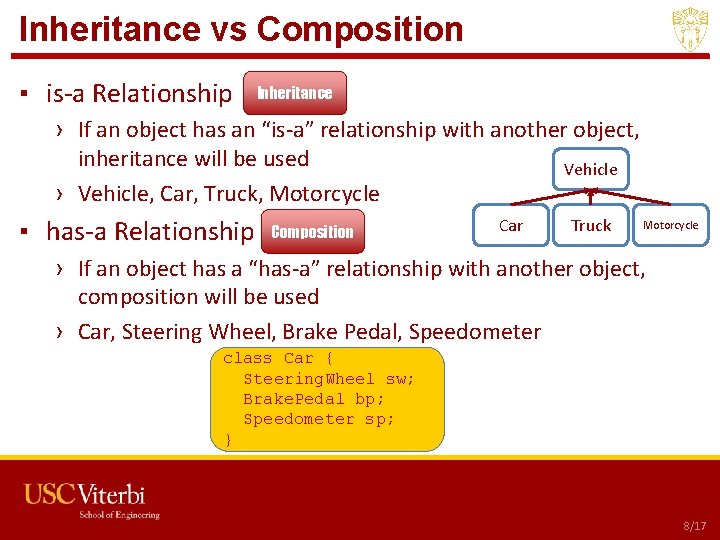
Inheritance vs Composition ▪ is-a Relationship Inheritance › If an object has an “is-a” relationship with another object, inheritance will be used Vehicle › Vehicle, Car, Truck, Motorcycle ▪ has-a Relationship Composition Car Truck Motorcycle › If an object has a “has-a” relationship with another object, composition will be used › Car, Steering Wheel, Brake Pedal, Speedometer class Car { Steering. Wheel sw; Brake. Pedal bp; Speedometer sp; } • Inheritance USC CSCI 201 L 8/17
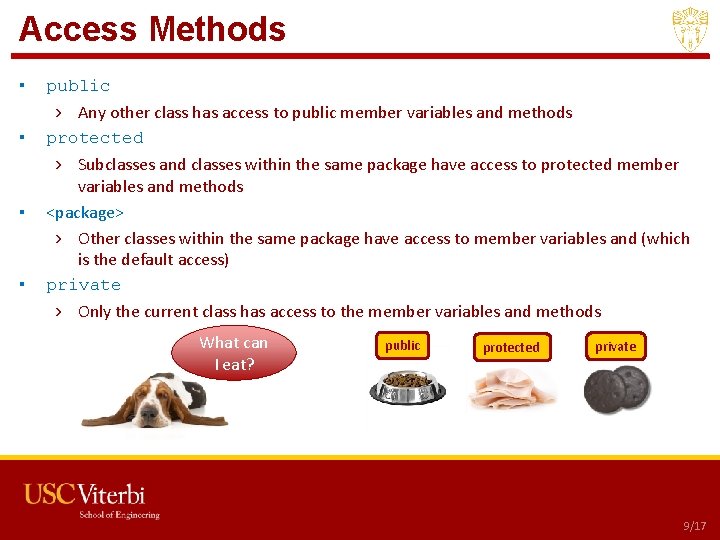
Access Methods ▪ ▪ public › Any other class has access to public member variables and methods protected › Subclasses and classes within the same package have access to protected member variables and methods <package> › Other classes within the same package have access to member variables and (which is the default access) private › Only the current class has access to the member variables and methods What can I eat? • Inheritance public protected private USC CSCI 201 L 9/17
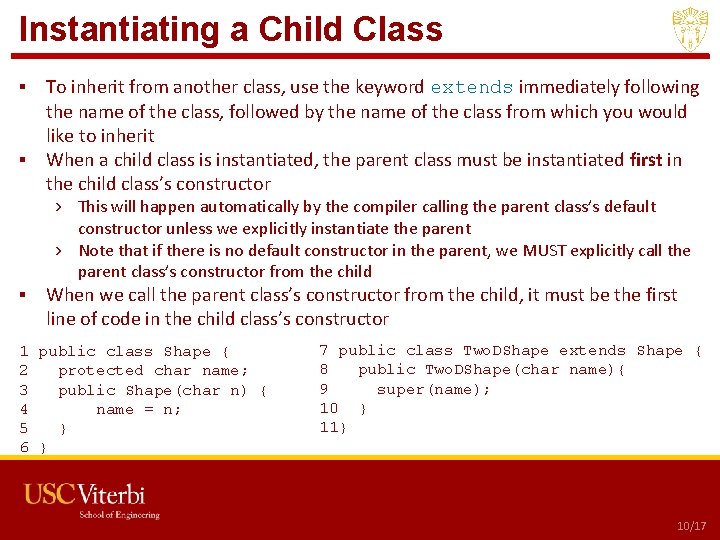
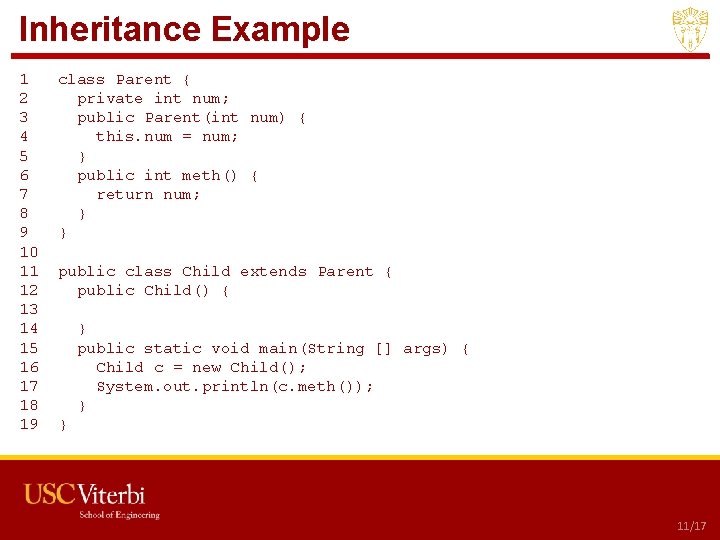
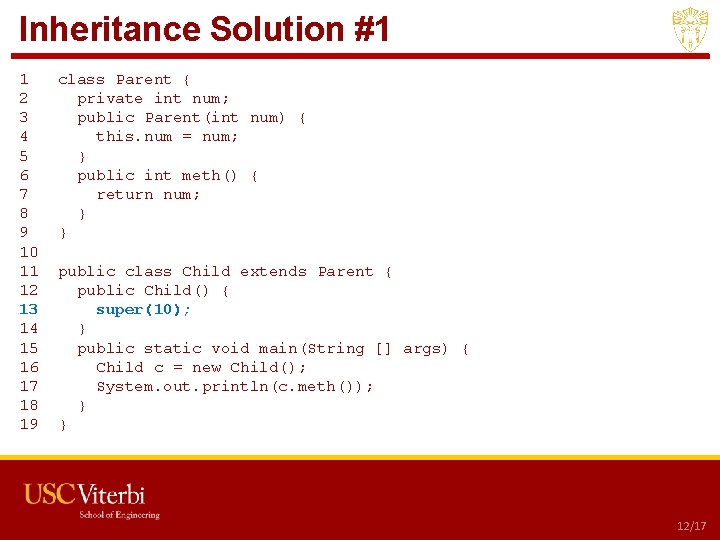
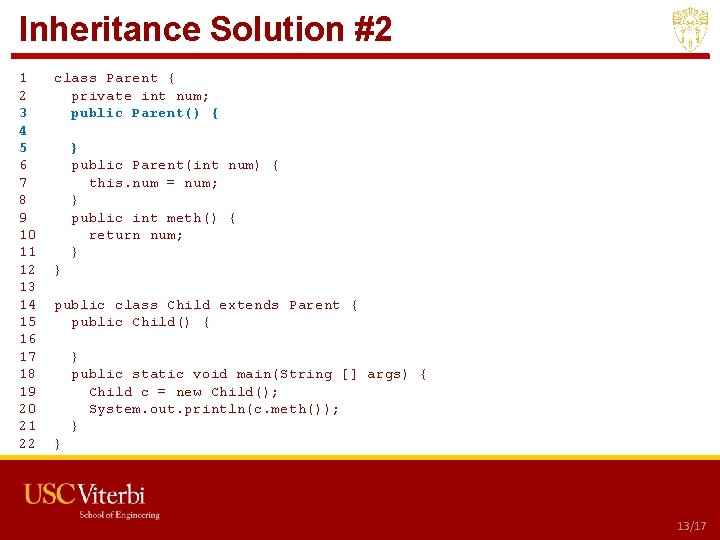
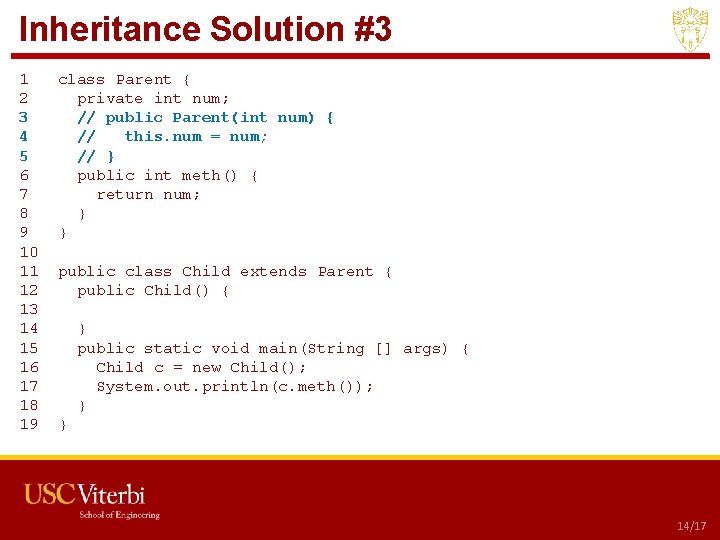
Instantiating a Child Class ▪ To inherit from another class, use the keyword extends immediately following the name of the class, followed by the name of the class from which you would like to inherit ▪ When a child class is instantiated, the parent class must be instantiated first in the child class’s constructor › This will happen automatically by the compiler calling the parent class’s default constructor unless we explicitly instantiate the parent › Note that if there is no default constructor in the parent, we MUST explicitly call the parent class’s constructor from the child ▪ When we call the parent class’s constructor from the child, it must be the first line of code in the child class’s constructor 1 public class Shape { 2 protected char name; 3 public Shape(char n) { 4 name = n; 5 } 6 } • Inheritance 7 public class Two. DShape extends Shape { 8 public Two. DShape(char name){ 9 super(name); 10 } 11} USC CSCI 201 L 10/17
Inheritance Example 1 2 3 4 5 6 7 8 9 10 11 12 13 14 15 16 17 18 19 • class Parent { private int num; public Parent(int num) { this. num = num; } public int meth() { return num; } } public class Child extends Parent { public Child() { } public static void main(String [] args) { Child c = new Child(); System. out. println(c. meth()); } } Inheritance USC CSCI 201 L 11/17
Inheritance Solution #1 1 2 3 4 5 6 7 8 9 10 11 12 13 14 15 16 17 18 19 • class Parent { private int num; public Parent(int num) { this. num = num; } public int meth() { return num; } } public class Child extends Parent { public Child() { super(10); } public static void main(String [] args) { Child c = new Child(); System. out. println(c. meth()); } } Inheritance USC CSCI 201 L 12/17
Inheritance Solution #2 1 2 3 4 5 6 7 8 9 10 11 12 13 14 15 16 17 18 19 20 21 22 • class Parent { private int num; public Parent() { } public Parent(int num) { this. num = num; } public int meth() { return num; } } public class Child extends Parent { public Child() { } public static void main(String [] args) { Child c = new Child(); System. out. println(c. meth()); } } Inheritance USC CSCI 201 L 13/17
Inheritance Solution #3 1 2 3 4 5 6 7 8 9 10 11 12 13 14 15 16 17 18 19 • class Parent { private int num; // public Parent(int num) { // this. num = num; // } public int meth() { return num; } } public class Child extends Parent { public Child() { } public static void main(String [] args) { Child c = new Child(); System. out. println(c. meth()); } } Inheritance USC CSCI 201 L 14/17
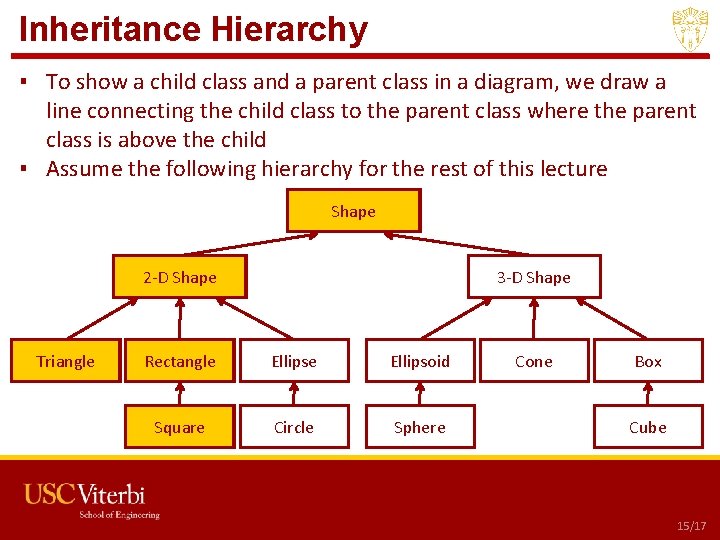
Inheritance Hierarchy ▪ To show a child class and a parent class in a diagram, we draw a line connecting the child class to the parent class where the parent class is above the child ▪ Assume the following hierarchy for the rest of this lecture Shape 2 -D Shape Triangle • Inheritance 3 -D Shape Rectangle Ellipsoid Square Circle Sphere Cone Box Cube USC CSCI 201 L 15/17
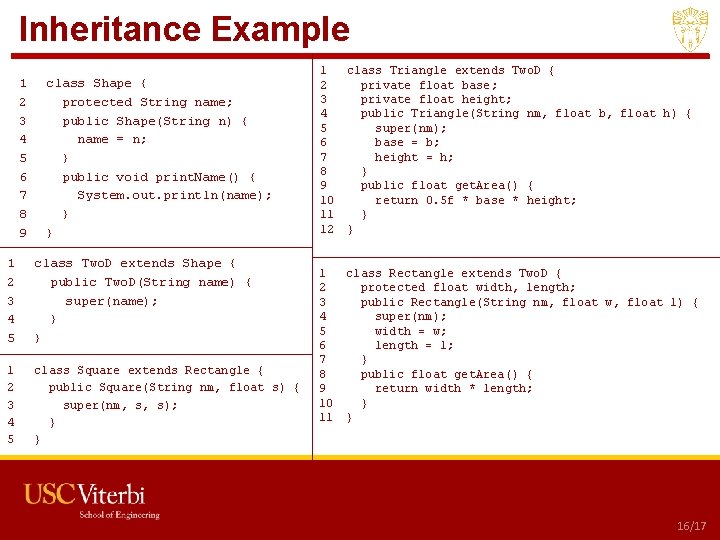
Inheritance Example 1 2 3 4 5 6 7 8 9 class Shape { protected String name; public Shape(String n) { name = n; } public void print. Name() { System. out. println(name); } } 1 2 3 4 5 class Two. D extends Shape { public Two. D(String name) { super(name); } } 1 2 3 4 5 class Square extends Rectangle { public Square(String nm, float s) { super(nm, s, s); } } • Inheritance 1 2 3 4 5 6 7 8 9 10 11 12 class Triangle extends Two. D { private float base; private float height; public Triangle(String nm, float b, float h) { super(nm); base = b; height = h; } public float get. Area() { return 0. 5 f * base * height; } } 1 2 3 4 5 6 7 8 9 10 11 class Rectangle extends Two. D { protected float width, length; public Rectangle(String nm, float w, float l) { super(nm); width = w; length = l; } public float get. Area() { return width * length; } } USC CSCI 201 L 16/17
Inheritance Example (cont. ) 1 public class Test { 2 public static void main(String[] args) { 3 Triangle t = new Triangle(“triangle”, 3. 0 f, 4. 0 f); 4 t. print. Name(); 5 System. out. println(t. get. Area()); 6 Rectangle r = new Rectangle(“rect”, 5. 0 f, 6. 0 f); 7 r. print. Name(); 8 System. out. println(r. get. Area()); 9 Square sq = new Square(“square”, 3); 10 sq. print. Name(); 11 System. out. println(sq. get. Area()); 12 } 13 } • Inheritance USC CSCI 201 L 17/17