
Inheritance Chapter 29 Gregor Mendal 1822 1884 Father
- Slides: 35
Inheritance Chapter 29
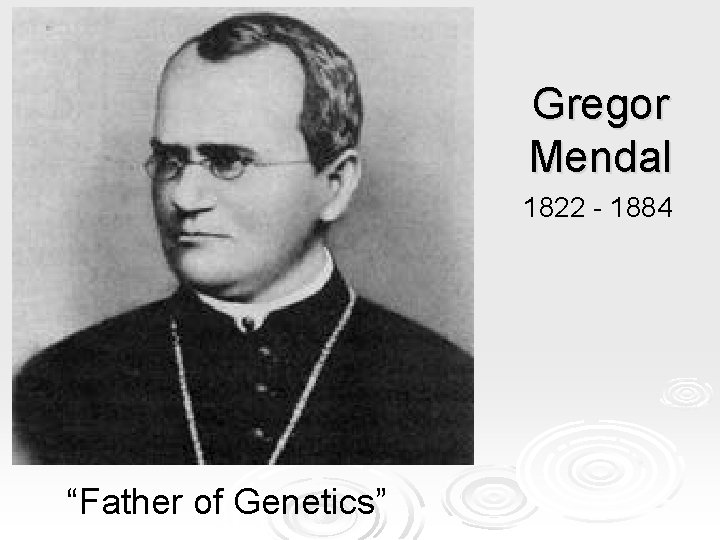
Gregor Mendal 1822 - 1884 “Father of Genetics”
What Mendal did Ø He bred peas in the monastery garden at Brno, Czech Republic (then part of the Austro. Hungarian Empire). Ø Observed occasional variations in the appearance of these plants. Ø Selectively bred plants to consistently produce “characteristics” that were unusual. Ø Saw a pattern in the way that the unusual characteristics showed up. Ø Was the first to propose that these characteristics were passed from one generation to another by the gametes.
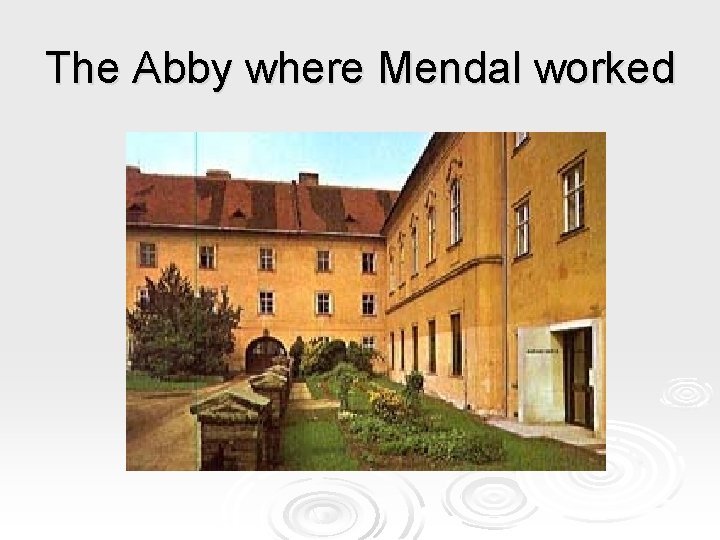
The Abby where Mendal worked
What Mendal did not do Ø He didn’t use the word “gene” to refer to subject of his work. Ø He didn’t see chromosomes. Ø He never used a Punnett square. Ø He never achieved fame in his lifetime for his work.
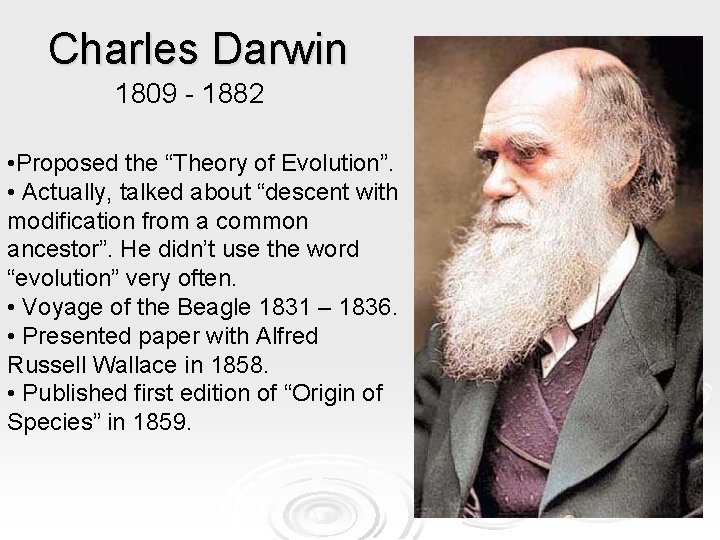
Charles Darwin 1809 - 1882 • Proposed the “Theory of Evolution”. • Actually, talked about “descent with modification from a common ancestor”. He didn’t use the word “evolution” very often. • Voyage of the Beagle 1831 – 1836. • Presented paper with Alfred Russell Wallace in 1858. • Published first edition of “Origin of Species” in 1859.
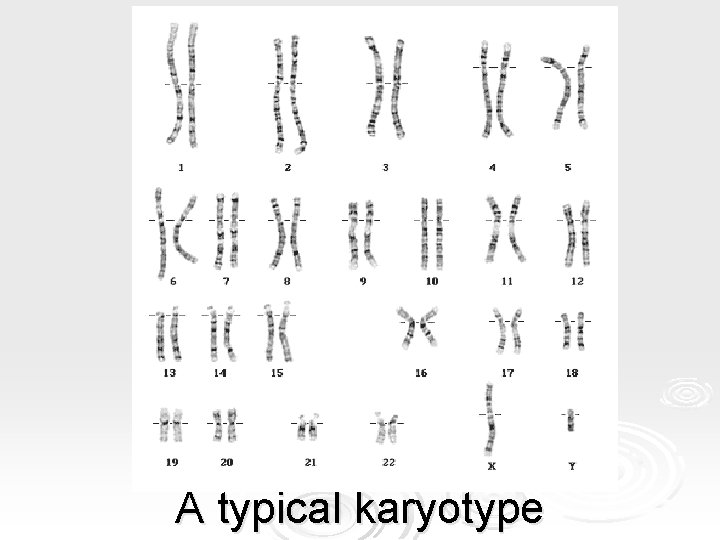
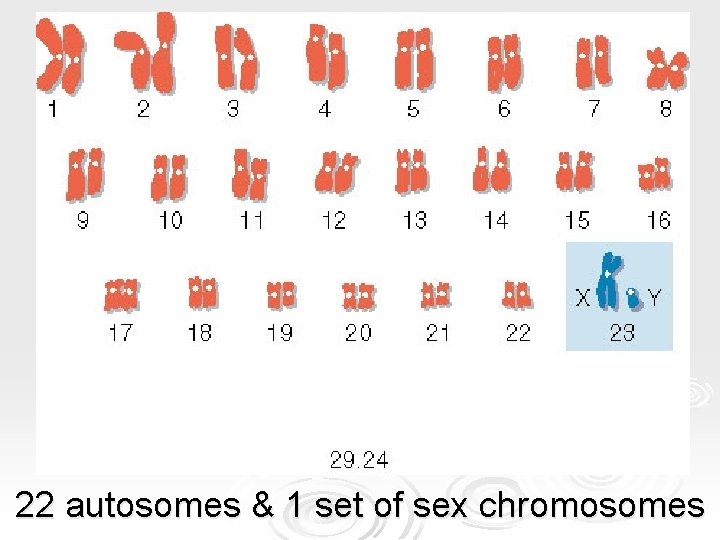
Some Vocabulary Ø Genetics – study of inheritance. Ø Autosomes – the 22 pairs of chromosomes that do not determine genetic sex. Ø Sex chromosomes – the 23 rd pair, the X and the Y. Ø Karyotype – the diploid chromosomes displayed in their condensed form and paired as homologs
A typical karyotype
More Vocabulary Ø Alleles - a matched pair of two genes, coding for the same or alternative forms of a particular trait. Found at the same location (locus) on homologous chromosomes. Ø Homozygous – having the same alleles for a trait Ø Heterozygous – having different alleles for the same trait.
More words Ø Dominant – an allele that expresses itself and masks its partner. Example: brown hair is dominant over blond. Ø Recessive – the reverse of the above. The allele that is masked Ø Allele pairs are expressed as a pair of letters representing the trait. Example: Mendal’s peas came in tall and short. Tall is the dominant allele for height in peas. Therefore it is written as a capital “T”. Ø A heterozyote for height would be Tt, with the lowercase t representing the recessive.
Genotype vs. Phenotype Ø Genotype – the actual alleles an organism has is it’s genotype. In our heterozygote pea plant that would be Tt. Ø Phenotype – that which is expressed. Our pea plant maybe genotypically heterozygotic but phenotypically it is tall. Ø Homozygote dominant = TT phenotype = tall Ø Homozygote recessive = tt Ø Heterozygote phenotype = short = Tt phenotype = tall
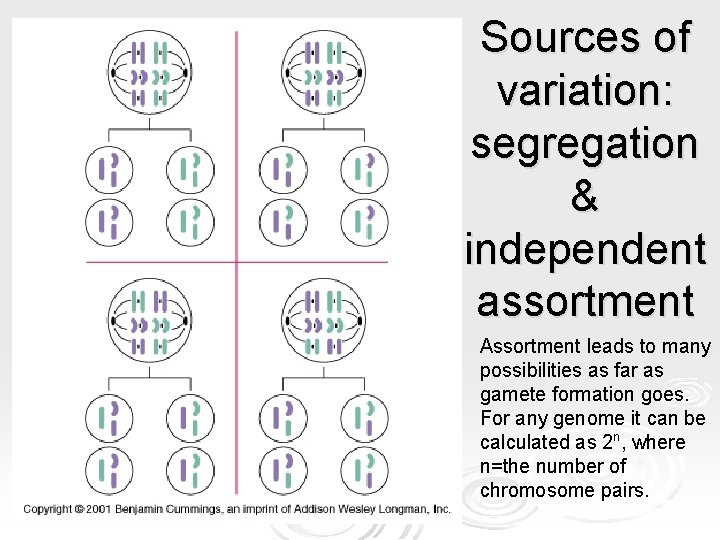
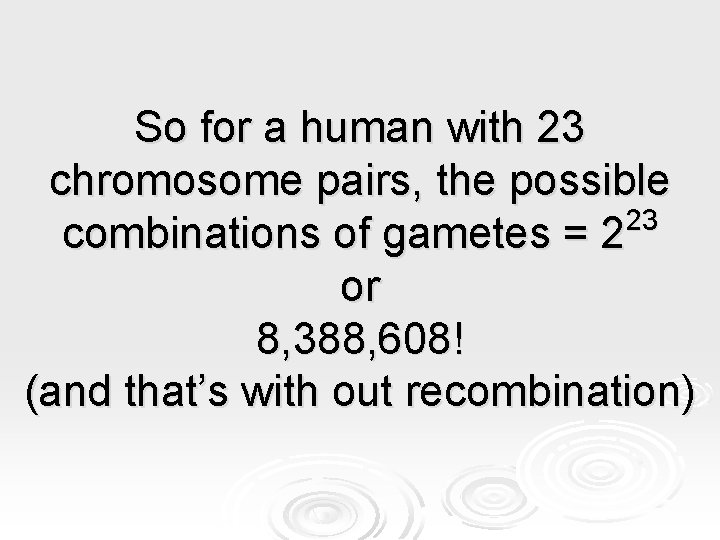
Sources of variation: segregation & independent assortment Assortment leads to many possibilities as far as gamete formation goes. For any genome it can be calculated as 2 n, where n=the number of chromosome pairs.
So for a human with 23 chromosome pairs, the possible 23 combinations of gametes = 2 or 8, 388, 608! (and that’s with out recombination)
Mendal’s Laws Ø Mendal discovered that if you bred plants that had two alleles for each trait that you would get the same ratios of phenotypes & genotypes whenever you crossed heterozygotes. It was like clockwork! Ø This was because of independent assortment and segregation, which became known as “Mendal’s Laws”
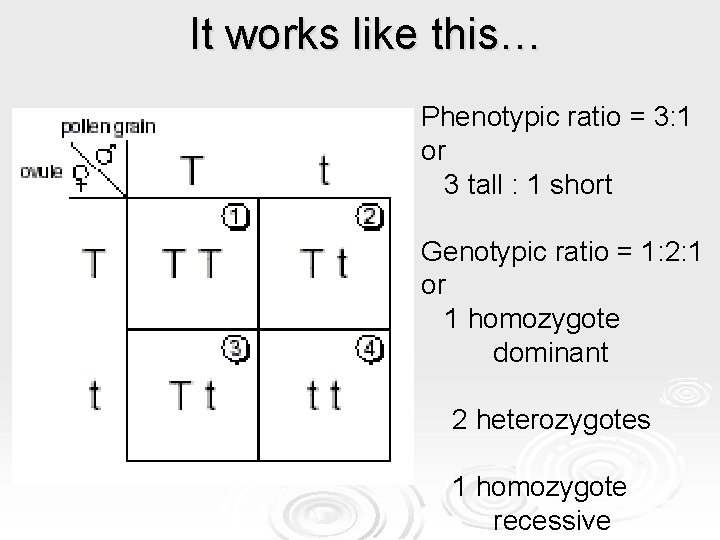
It works like this… Phenotypic ratio = 3: 1 or 3 tall : 1 short Genotypic ratio = 1: 2: 1 or 1 homozygote dominant 2 heterozygotes 1 homozygote recessive
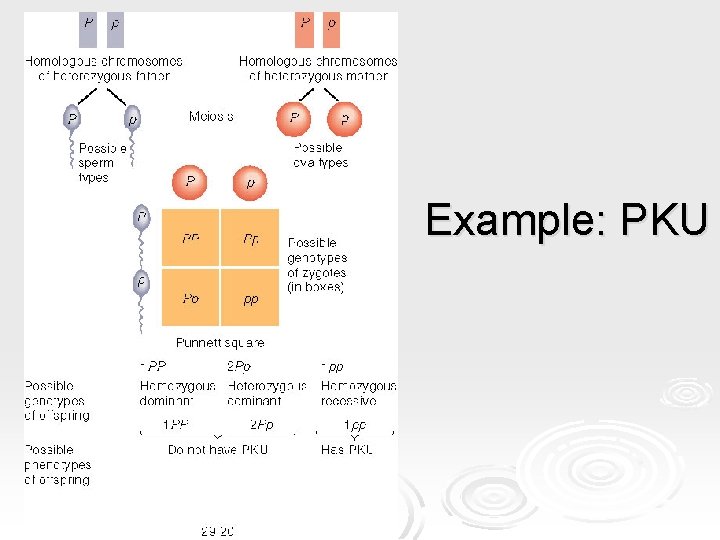
Example: PKU
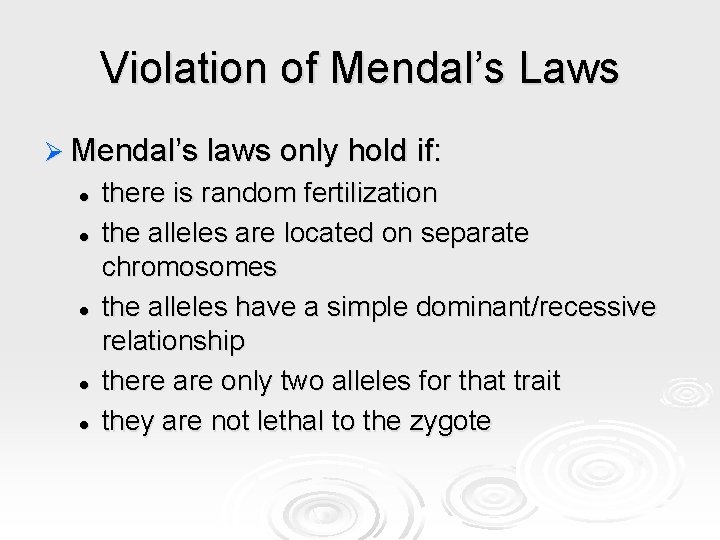
Violation of Mendal’s Laws Ø Mendal’s laws only hold if: l l l there is random fertilization the alleles are located on separate chromosomes the alleles have a simple dominant/recessive relationship there are only two alleles for that trait they are not lethal to the zygote
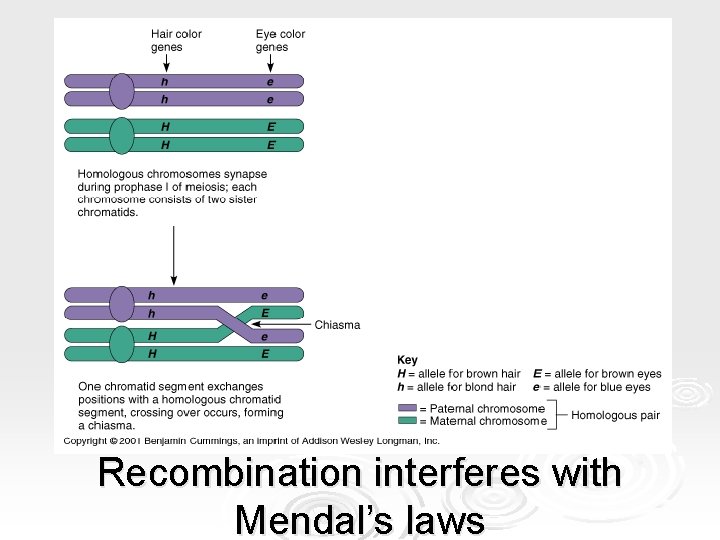
Recombination interferes with Mendal’s laws
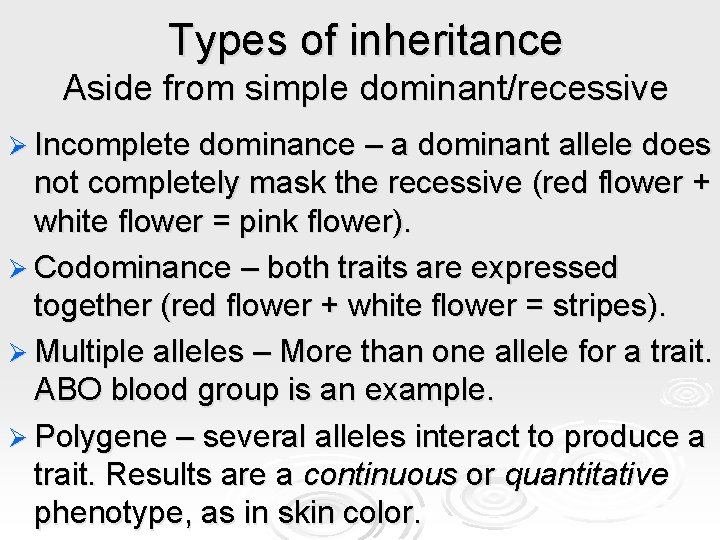
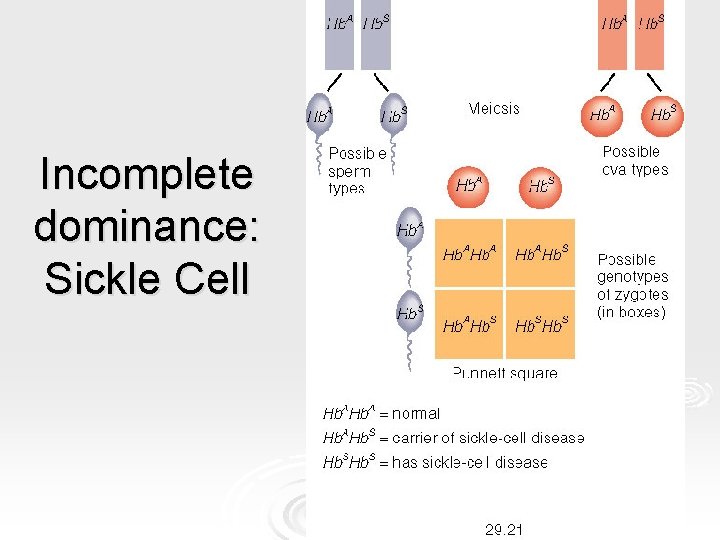
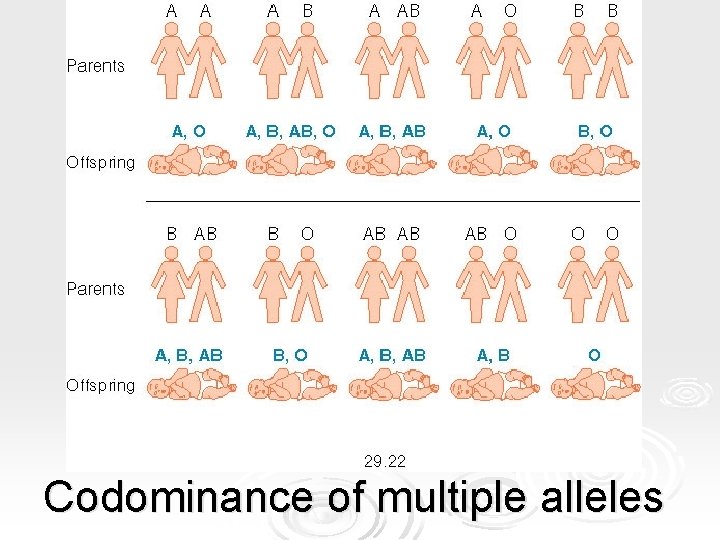
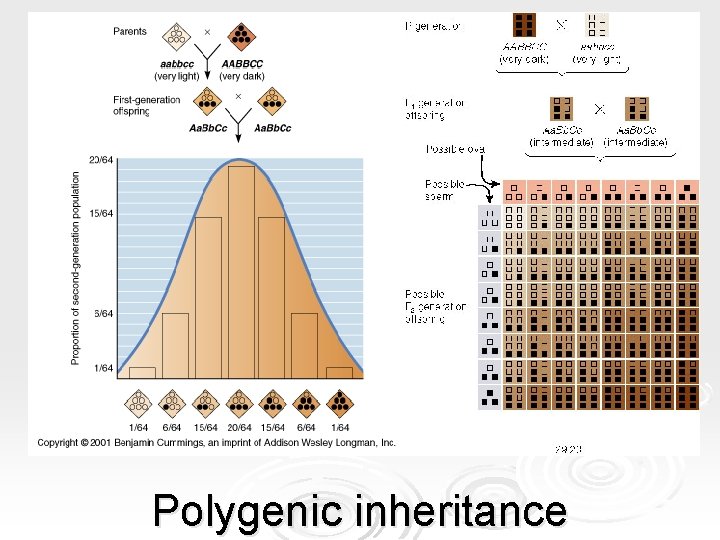
Types of inheritance Aside from simple dominant/recessive Ø Incomplete dominance – a dominant allele does not completely mask the recessive (red flower + white flower = pink flower). Ø Codominance – both traits are expressed together (red flower + white flower = stripes). Ø Multiple alleles – More than one allele for a trait. ABO blood group is an example. Ø Polygene – several alleles interact to produce a trait. Results are a continuous or quantitative phenotype, as in skin color.
Incomplete dominance: Sickle Cell
Codominance of multiple alleles
Polygenic inheritance
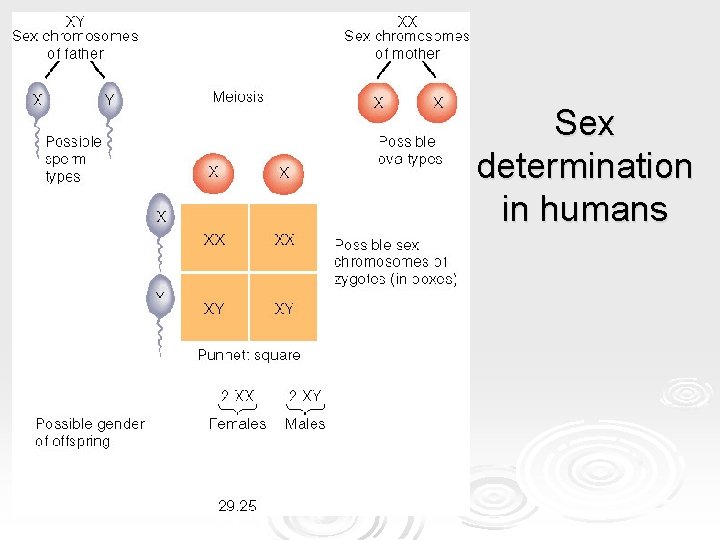
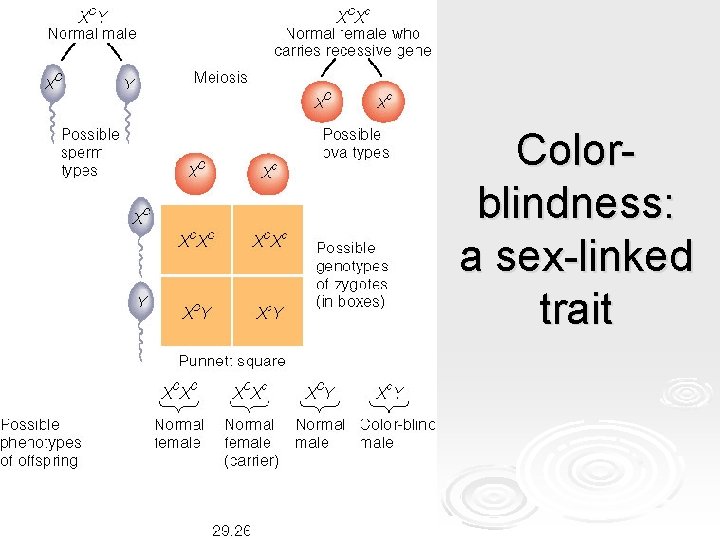
Sex-linked inheritance Ø Males only have one X chromosome. Therefore, if a trait is found only on the X it will be expressed in a male regardless of whether it is dominant or recessive. Ø X – inactivation occurs in females. Every normal woman has two Xs but they only need one. Therefore, one X chromosome turns off, forming a Barr body. Ø Because X – inactivation is random in most cases, it leads to a fine mosaic of cells in females.
22 autosomes & 1 set of sex chromosomes
Sex determination in humans
Colorblindness: a sex-linked trait
Environmental influences Ø Phenocopy – Developmental influences impact genetic expression in ways that appear to be genetic but are not inheritable. Ø Temperature, nutrition, non-genetic pathologies can have impacts that are expressed in ways that appear genetic.
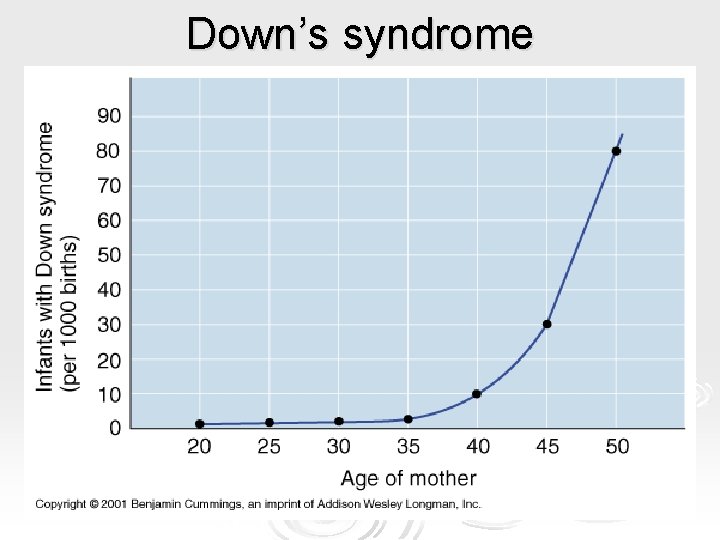
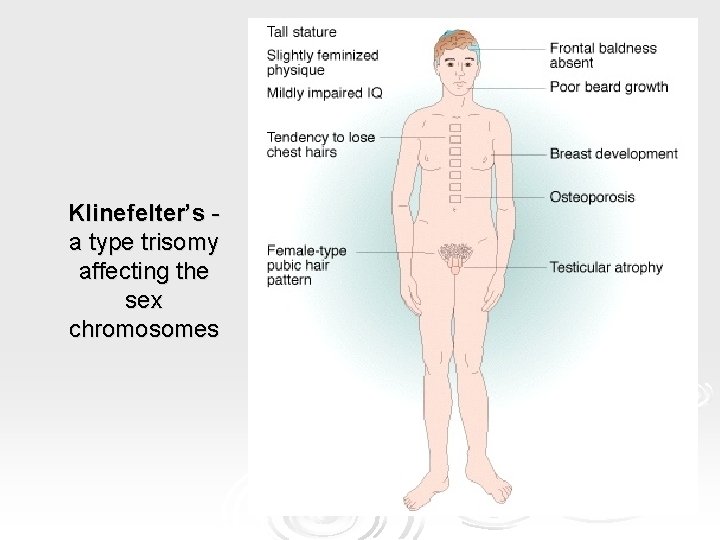
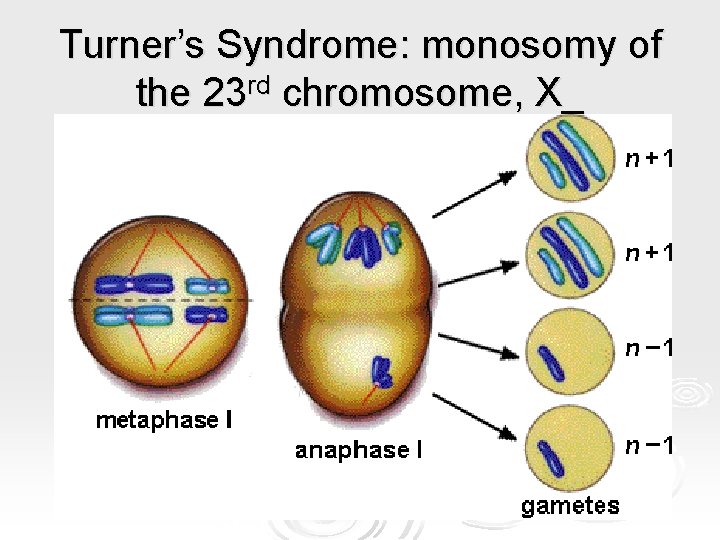
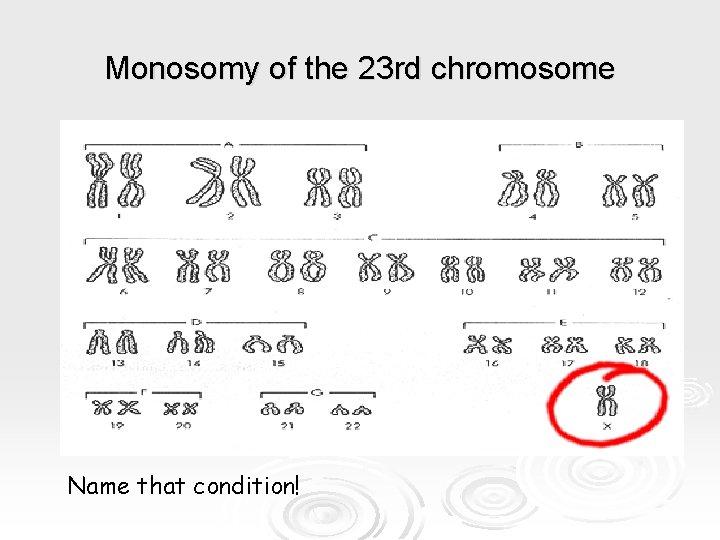
Genetic defects Ø Aneuploidy – a defective set of genes. Ø Triploidy – an extra set of chromosomes Ø Trisomy – an extra single chromosome Ø Monosomy – a missing homolog Ø Trisomy of the 23 rd chromosome – XXX = “super female” XXY = Klinefelter’s syndrome Ø Trisomy of the 21 st chromosome leads to Down’s Syndrome.
Down’s syndrome
Klinefelter’s a type trisomy affecting the sex chromosomes
Turner’s Syndrome: monosomy of the 23 rd chromosome, X_
Monosomy of the 23 rd chromosome Name that condition!
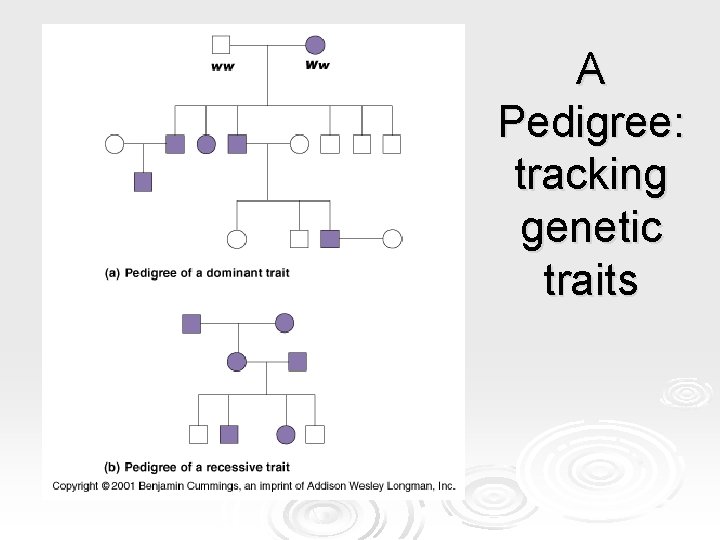
A Pedigree: tracking genetic traits
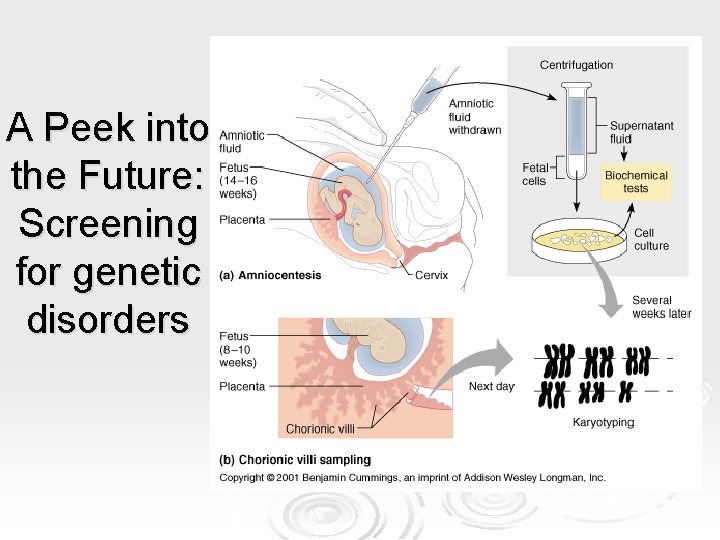
A Peek into the Future: Screening for genetic disorders
That’s all folks!